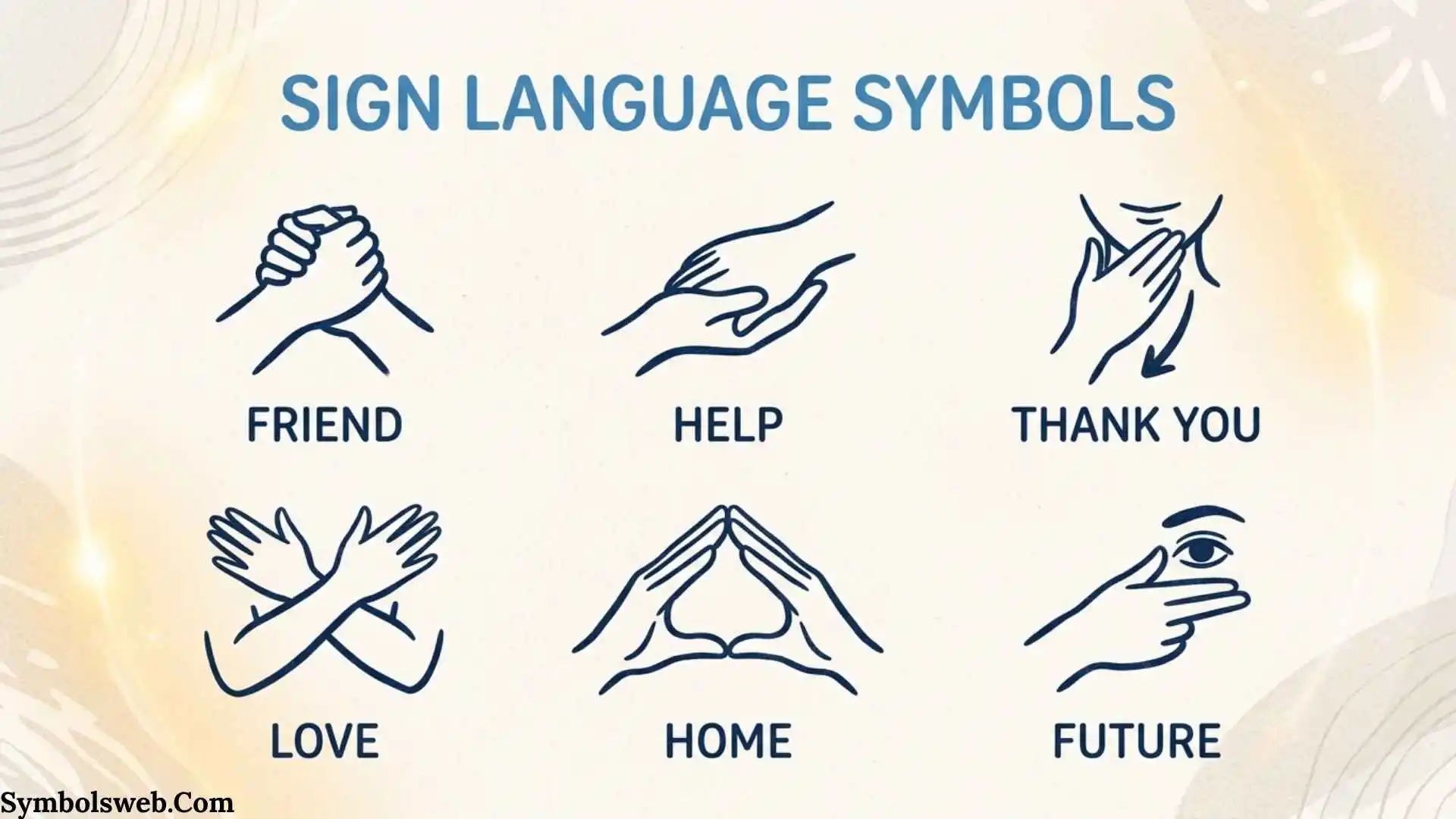
Sign language symbols are far more than simple hand shapes or gestures. They represent one of humanity’s most remarkable systems of communication, allowing people to express thoughts, emotions, stories, and identities without spoken words.
Across history, these symbols have connected communities, preserved culture, and empowered millions of deaf and hearing individuals. Understanding sign language symbols reveals not only how language works but also how humans create meaning through movement, expression, and shared understanding.
Sign Language Symbols: (Quick Answer)
Sign language symbols are visual signs, handshapes, gestures, facial expressions, and body movements used within sign languages to communicate words, ideas, emotions, and concepts. They function as the building blocks of complete languages, carrying linguistic, cultural, social, and symbolic meaning across deaf communities worldwide.
Also Check This Post: 63+ Alchemy Symbols and Meanings: The Hidden Language of Transformation, Wisdom, and Spiritual Power
Quick Facts About Sign Language Symbols
| Aspect | Information |
| Origin | Developed naturally within Deaf communities across different cultures |
| Historical Significance | Enabled communication, education, and cultural identity among Deaf people |
| Main Meaning | Visual representation of language, concepts, emotions, and ideas |
| Spiritual Meaning | Symbolizes connection, understanding, expression, and inclusion |
| Cultural Importance | Central to Deaf culture and community identity |
| Modern Usage | Education, communication, media, technology, accessibility, and advocacy |
What Are Sign Language Symbols?
A common misconception is that sign language is universal. In reality, there are hundreds of sign languages worldwide, each with its own symbols, grammar, and vocabulary.
Examples include:
- American Sign Language (ASL)
- British Sign Language (BSL)
- Pakistani Sign Language (PSL)
- French Sign Language (LSF)
- Japanese Sign Language (JSL)
Historically, sign languages emerged naturally wherever Deaf communities formed. Records of structured signing exist from ancient civilizations, but modern recognition of sign language accelerated during the eighteenth and nineteenth centuries through Deaf education.
Over time, sign language symbols evolved from practical communication tools into powerful cultural markers representing identity, resilience, and community belonging.
Deep Symbolic Meaning of Sign Language Symbols
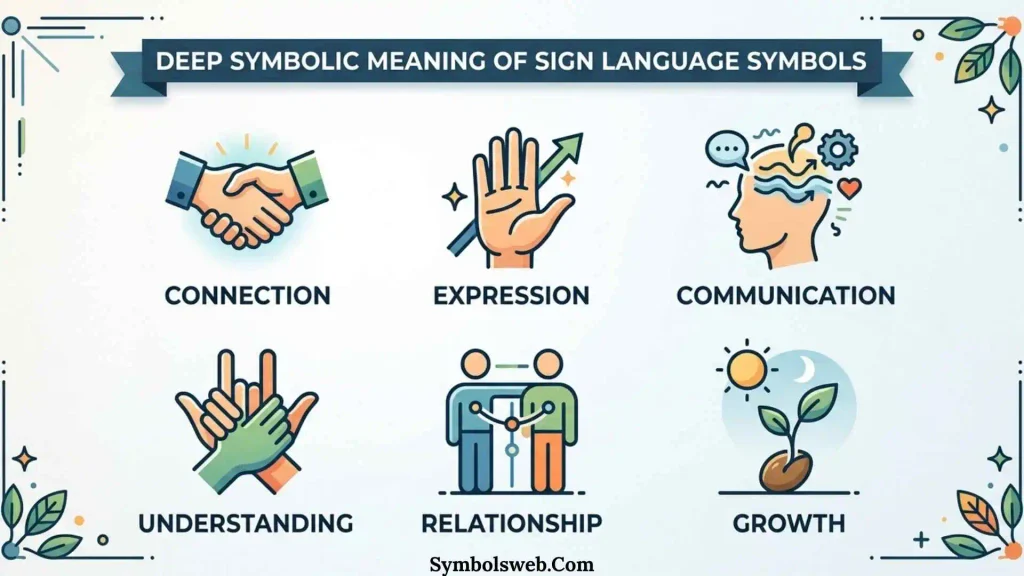
Spiritual Level
On a spiritual level, sign language symbols represent connection beyond spoken language.
Many spiritual traditions teach that true understanding goes beyond words. Sign language beautifully reflects this idea. A simple gesture can communicate compassion, love, gratitude, or hope without a single spoken sound.
Spiritually, sign language symbols often symbolize:
- Unity between people
- Silent understanding
- Human connection
- Presence and mindfulness
- Inner expression
The act of communicating visually encourages attentiveness and awareness, qualities often associated with spiritual growth.
Inner Transformation
Learning sign language can transform how people listen. Instead of hearing words, individuals learn to observe emotions, movements, and subtle expressions.
This shift creates deeper empathy and awareness.
Soul and Consciousness Connections
Many people describe signing as a highly expressive experience because it involves the entire body. The combination of movement and meaning creates a communication style that feels deeply personal and authentic.
Psychological Level
Psychologically, sign language symbols reveal fascinating aspects of human cognition.
Human Emotions
Research shows that facial expressions and gestures communicate emotions more directly than words alone. Sign language integrates both elements naturally.
This makes many sign language symbols emotionally powerful.
Archetypes and Jungian Symbolism
Psychologist Carl Jung proposed that humans share universal symbols called archetypes.
Many sign language concepts mirror these archetypes:
- Heart gestures representing love
- Open hands representing trust
- Upward movements representing growth
- Circular motions symbolizing cycles and continuity
These patterns resonate because humans instinctively associate certain movements with particular meanings.
Emotional Attraction
People are often fascinated by sign language because it transforms abstract ideas into visible forms. Watching someone sign creates an emotional connection that spoken language sometimes cannot achieve.
Cultural Level
Sign language symbols carry profound cultural significance.
For Deaf communities, they are not merely communication tools. They are expressions of identity, history, and belonging.
Imagine attending a gathering where everyone communicates effortlessly through signs. The symbols become shared cultural experiences that strengthen community bonds.
These symbols preserve stories, traditions, humor, and collective memories across generations.
Types and Variations of Sign Language Symbols
Alphabet Symbols
Visual Description
Handshapes representing individual letters.
Meaning
Spell names, places, and specific words.
Symbolism
Knowledge, literacy, and communication.
Cultural Connection
Used in many sign languages worldwide.
Where It Appears
- Education
- Everyday conversation
- Public interpretation
Number Symbols
Visual Description
Specific finger configurations indicating numerical values.
Meaning
Represent counting and mathematics.
Symbolism
Order, measurement, and logic.
Cultural Connection
Universal communication of quantity.
Where It Appears
- Schools
- Businesses
- Daily communication
Conceptual Symbols
Visual Description
Gestures representing complete ideas.
Meaning
Express actions, emotions, or objects.
Symbolism
Efficiency and understanding.
Cultural Connection
Core vocabulary of sign languages.
Where It Appears
- Conversations
- Storytelling
- Public speaking
Facial Expression Symbols
Visual Description
Eyebrow movements, mouth shapes, and facial cues.
Meaning
Provide grammar and emotional context.
Symbolism
Authenticity and emotional truth.
Cultural Connection
Essential element of sign language fluency.
Where It Appears
- Communication
- Theatre
- Performance art
Directional and Spatial Symbols
Visual Description
Movements occurring in specific locations around the body.
Meaning
Show relationships, locations, and actions.
Symbolism
Connection and perspective.
Cultural Connection
Unique linguistic features of sign languages.
Where It Appears
- Narrative storytelling
- Education
- Interpretation
Sign Language Symbols Across Different Cultures
Ancient Egypt
Although no formal sign language survives from ancient Egypt, artistic depictions show ritual gestures and symbolic hand positions.
These movements often conveyed authority, devotion, and spiritual meaning.
Ancient Greece
Greek philosophers discussed communication through gestures. Historical writings suggest that hand signs were recognized as meaningful forms of expression.
Gestures frequently symbolized wisdom, persuasion, and social status.
Roman Culture
Romans used structured gestures in public speaking, military commands, and theatre.
Many symbolic hand movements represented power, agreement, warning, or respect.
Eastern Traditions
In many Asian cultures, hand gestures carry deep symbolic meanings.
Religious practices in Buddhism and Hinduism use sacred hand positions called mudras. These visual symbols communicate spiritual concepts such as peace, enlightenment, and compassion.
Indigenous Traditions
Several Indigenous communities developed sophisticated gesture systems for communication across language barriers.
These symbols facilitated trade, storytelling, diplomacy, and cultural exchange.
Modern Interpretations
Today, sign language symbols represent:
- Accessibility
- Equality
- Diversity
- Inclusion
- Human rights
They are increasingly recognized as symbols of empowerment and social progress.
Also Check This Post: 55+ Food Symbols: Hidden Meanings Cultural Traditions and Powerful Symbolism
Similar Symbols and Their Meanings
| Symbol Type | Similarity to Sign Language Symbols | Key Difference |
| Gestures | Uses body movement | Not always linguistic |
| Mudras | Symbolic hand positions | Primarily spiritual |
| Body Language | Nonverbal communication | Often unconscious |
| Pictograms | Visual communication | Static rather than dynamic |
| Written Symbols | Convey meaning visually | Lack movement and expression |
Common Misconceptions
Many people confuse sign language with simple gestures.
However, true sign languages have:
- Grammar
- Syntax
- Vocabulary
- Regional variations
- Cultural identity
They are complete languages rather than collections of signs.
Sign Language Symbols in Mythology and Folklore
Throughout folklore, silent communication often appears as a source of wisdom and mystery.
Many legends feature characters who communicate through symbolic gestures when words are impossible or forbidden.
In various traditions:
- Silent monks communicate through signs.
- Sacred gestures convey divine messages.
- Heroes use symbolic hand signals during quests.
- Mystical figures communicate hidden truths through movement.
These stories reinforce the idea that meaning can exist beyond spoken language.
Over centuries, such narratives helped shape society’s understanding of symbolic communication.
Sign Language Symbols in Art, Literature, Movies and Pop Culture
Paintings
Artists often depict expressive hands to symbolize communication, emotion, and connection.
Hands can tell stories even when mouths remain silent.
Literature
Writers frequently use gestures and signs as metaphors for understanding and human connection.
Silent communication often symbolizes trust and intimacy.
Poetry
Poets describe hands as instruments of expression, emphasizing movement as language.
Movies
Films increasingly feature sign language to portray authentic Deaf experiences.
Notable examples include:
- Children of a Lesser God
- CODA
- A Quiet Place
These works helped introduce wider audiences to the richness of sign language.
Television
Modern television includes Deaf characters and sign language interpreters more frequently than ever before.
Tattoos
Sign language symbols are popular tattoo designs representing:
- Love
- Family
- Hope
- Identity
- Inclusion
Fashion
Designers increasingly incorporate sign language symbols into clothing and accessories to promote awareness and accessibility.
Modern Design
Brands and organizations use sign-inspired imagery to communicate diversity and inclusivity.
Spiritual and Dream Meaning of Sign Language Symbols
Dreams involving sign language symbols often relate to communication and understanding.
Common Dream Interpretations
| Dream Scenario | Possible Meaning |
| Learning signs | Personal growth |
| Unable to understand signs | Miscommunication |
| Signing fluently | Confidence and self-expression |
| Watching others sign | Need to listen more carefully |
| Silent conversation | Deep emotional connection |
Positive Messages
- Greater understanding
- Improved relationships
- Self-expression
- Emotional clarity
- Personal growth
Cautionary Messages
- Miscommunication
- Isolation
- Unspoken feelings
- Hidden emotions
Dream interpretation depends on personal circumstances and cultural beliefs.
Positive and Negative Meanings of Sign Language Symbols
| Positive Meaning | Negative Meaning |
| Connection | Misunderstanding |
| Inclusion | Exclusion when inaccessible |
| Expression | Communication barriers |
| Identity | Social prejudice |
| Community | Isolation from wider society |
| Empowerment | Marginalization |
| Understanding | Misinterpretation |
Like many symbols, sign language can represent both opportunity and challenge depending on context.
Why Humans Are Attracted to Sign Language Symbols
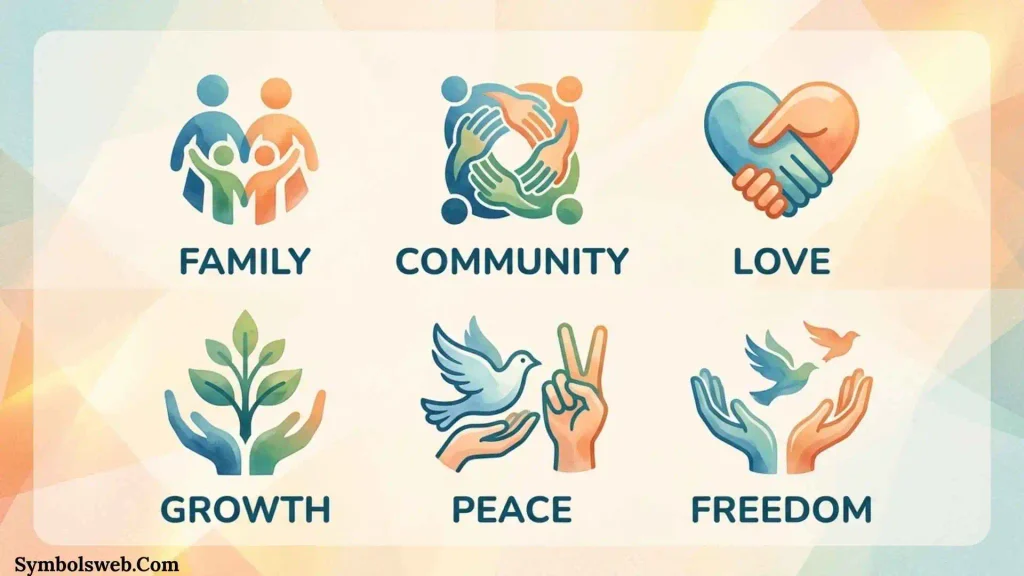
Humans naturally seek meaning in movement.
Long before written language existed, our ancestors relied heavily on gestures.
This evolutionary history helps explain why sign language feels intuitive and emotionally engaging.
Several psychological factors contribute to this attraction:
Pattern Recognition
The brain excels at recognizing visual patterns and movements.
Emotional Communication
Facial expressions combined with gestures create rich emotional information.
Collective Symbolism
Many hand movements trigger shared cultural associations.
Storytelling
Sign language transforms language into a visual performance, making stories memorable.
Personal Meaning
For many individuals, sign language symbolizes perseverance, inclusion, family, and identity.
Modern Uses of Sign Language Symbols
Today, sign language symbols appear in many aspects of daily life.
Tattoos
People choose signs representing meaningful words and names.
Jewelry
Necklaces and bracelets often feature symbolic hand signs.
Fashion
Clothing designs incorporate sign language alphabets and messages.
Branding
Organizations use sign-inspired imagery to emphasize accessibility.
Social Media
Sign language content reaches millions through educational and awareness campaigns.
Contemporary Spirituality
Some people view signing as a mindful and expressive practice.
Home Decor
Decorative art featuring sign language symbols celebrates communication and inclusion.
Personal Expression
Individuals use signs to represent identity, relationships, and values.
Interesting Facts About Sign Language Symbols
- Sign languages have their own grammar systems.
- There are hundreds of sign languages worldwide.
- Sign language is processed in many of the same brain regions as spoken language.
- Facial expressions are essential grammatical elements in sign languages.
- Sign languages evolve naturally over time.
- Some signs are iconic and visually resemble what they represent.
- Different countries often have completely different sign languages.
- Sign poetry is a recognized artistic form.
- Sign language interpreters play vital roles in accessibility.
- Many hearing people learn sign language to communicate with family and friends.
Frequently Asked Questions
What are sign language symbols?
Sign language symbols are visual signs made through handshapes, movements, facial expressions, and body language that communicate words, concepts, and emotions within sign languages.
Are sign language symbols universal?
No. Different countries and communities have their own sign languages, each with unique symbols, grammar, and vocabulary.
Why are facial expressions important in sign language?
Facial expressions provide emotional information and grammatical meaning, making them essential parts of communication.
What do sign language symbols represent spiritually?
They often symbolize connection, understanding, empathy, mindfulness, and communication beyond spoken words.
Can sign language symbols be used in tattoos?
Yes. Many people choose sign language symbols to represent love, family, hope, identity, and meaningful personal messages.
Is sign language considered a real language?
Absolutely. Linguists recognize sign languages as complete natural languages with their own grammar, syntax, and cultural traditions.
Conclusion
Sign language symbols represent far more than gestures. They embody language, culture, identity, history, and human connection. From ancient symbolic movements to modern Deaf communities, these visual expressions have helped people communicate across barriers and generations.
Their deeper meaning reminds us that understanding is not limited to words. Sometimes the most powerful messages are seen rather than heard, revealing the extraordinary ways humans connect with one another.
Also Check This Post: 59+ Maori Symbols: Ancient Meanings Spiritual Wisdom and the Powerful Stories Behind Them

Jordan Hayes is a writer with a passion for exploring the history, meanings, and cultural significance behind symbols from around the world. He enjoys turning complex topics into clear, engaging content that anyone can understand. Jordan is also the fictional author of The Silent Language of Ancient Marks and Hidden Symbols Beyond the Surface, two original book concepts created for his author profile. When he’s not writing, he spends time researching myths, traditions, and forgotten stories that inspire his work. His goal is to help readers discover the deeper meanings behind the symbols they encounter every day.
 Ethan Holloway
 Eliana Foster
[…] Law Symbols: Hidden Meanings, History, and Powerful Representations of Justice 61+ Sign Language Symbols: Meanings, History, Cultural Significance, and Hidden Communication Powe… 63+ Alchemy Symbols and Meanings: The Hidden Language of Transformation, Wisdom, and Spiritual […]
[…] Explained 73+ Law Symbols: Hidden Meanings, History, and Powerful Representations of Justice 61+ Sign Language Symbols: Meanings, History, Cultural Significance, and Hidden Communication Powe… 63+ Alchemy Symbols and Meanings: The Hidden Language of Transformation, Wisdom, and Spiritual […]
[…] Explained 73+ Law Symbols: Hidden Meanings, History, and Powerful Representations of Justice 61+ Sign Language Symbols: Meanings, History, Cultural Significance, and Hidden Communication Powe… 63+ Alchemy Symbols and Meanings: The Hidden Language of Transformation, Wisdom, and Spiritual […]