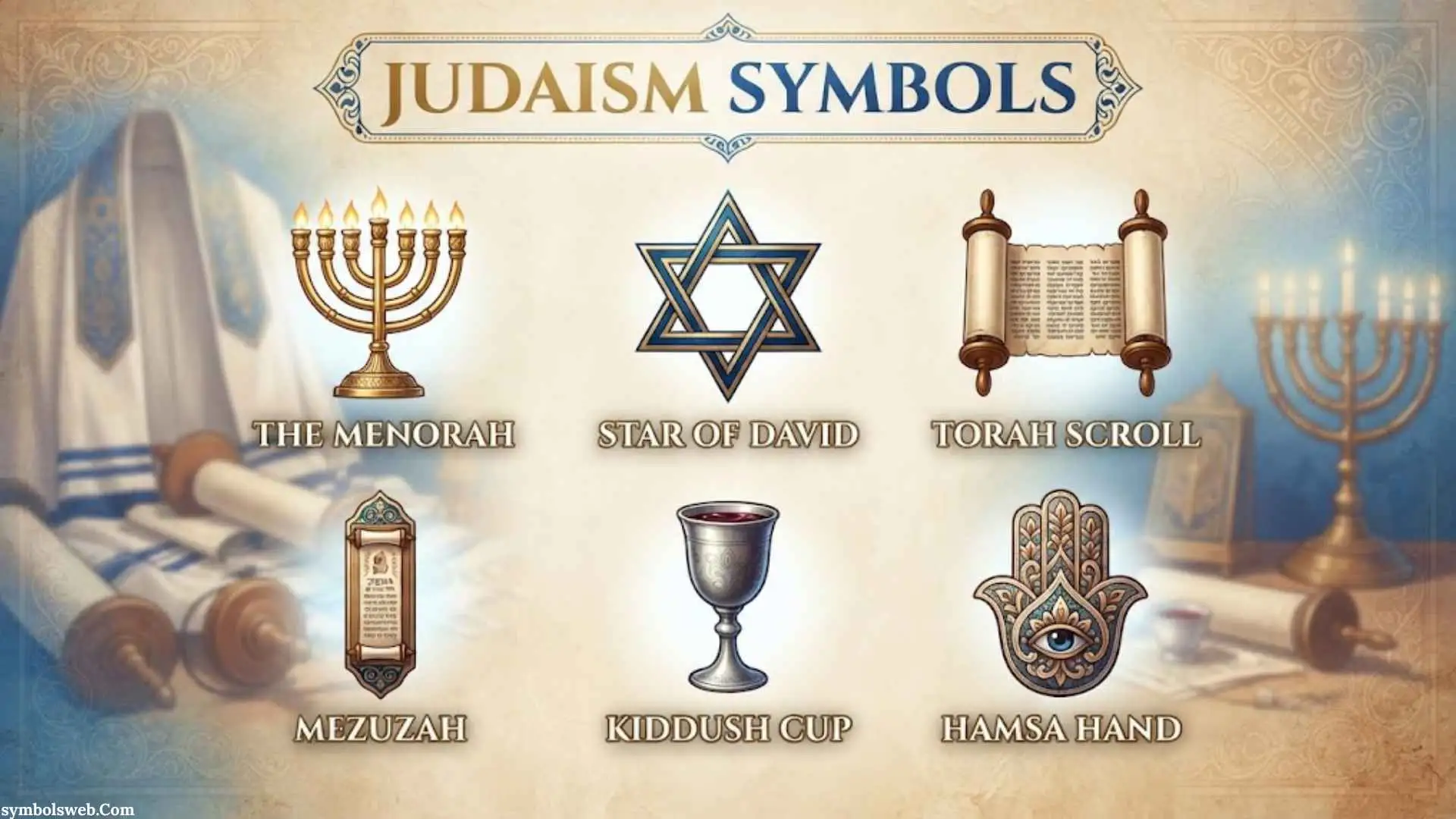
When I explore Judaism symbols, I discover that each symbol carries a unique meaning connected to Jewish faith, history, traditions, and identity. These symbols help me understand important beliefs and values that have been passed down through generations.
If you are learning about Judaism symbols for the first time, you may notice familiar images such as the Star of David, menorah, and Chai. When you understand what these symbols represent, you can better appreciate their importance in Jewish culture and religious traditions.
In this guide, I will help you explore the most important Judaism symbols, their meanings, origins, and uses. You will learn what each symbol represents and why it remains meaningful to Jewish people today.
Judaism Symbols: (Quick Answer)
Judaism symbols are important signs that represent Jewish faith, history, beliefs, and traditions. You may recognize symbols like the Star of David, menorah, Chai, and Torah, each with its own meaning. When you learn these symbols, you can better understand Jewish culture and religious traditions.
Quick Facts About Judaism Symbols
| Aspect | Information |
| Origin | Ancient Israel and Jewish religious traditions |
| Historical Significance | Represent faith, covenant, survival, and Jewish identity |
| Main Meaning | Connection between God, people, and spiritual life |
| Spiritual Meaning | Divine presence, wisdom, protection, and holiness |
| Cultural Importance | Central to Jewish heritage, rituals, and community identity |
| Modern Usage | Jewelry, synagogues, art, education, fashion, and cultural expression |
What Are Judaism Symbols?
Judaism symbols are visual representations connected to Jewish beliefs, practices, history, and identity. They help communicate religious teachings, preserve traditions, and strengthen communal bonds.
Many symbols emerged from biblical narratives, temple worship, sacred texts, and centuries of Jewish cultural development.
Unlike some religions that heavily rely on sacred imagery, Judaism traditionally places greater emphasis on scripture, law, and ethical living. However, certain symbols became powerful reminders of faith and collective memory.
Throughout history, Jewish communities faced exile, persecution, migration, and renewal. Symbols helped preserve identity across continents and generations.
Today, these symbols appear in synagogues, prayer books, jewelry, national emblems, artwork, and family traditions.
Deep Symbolic Meaning of Judaism Symbols
Spiritual Level
On a spiritual level, Judaism symbols point toward a relationship with God.
Many symbolize:
- Divine guidance
- Sacred wisdom
- Protection
- Holiness
- Faithfulness
- Spiritual growth
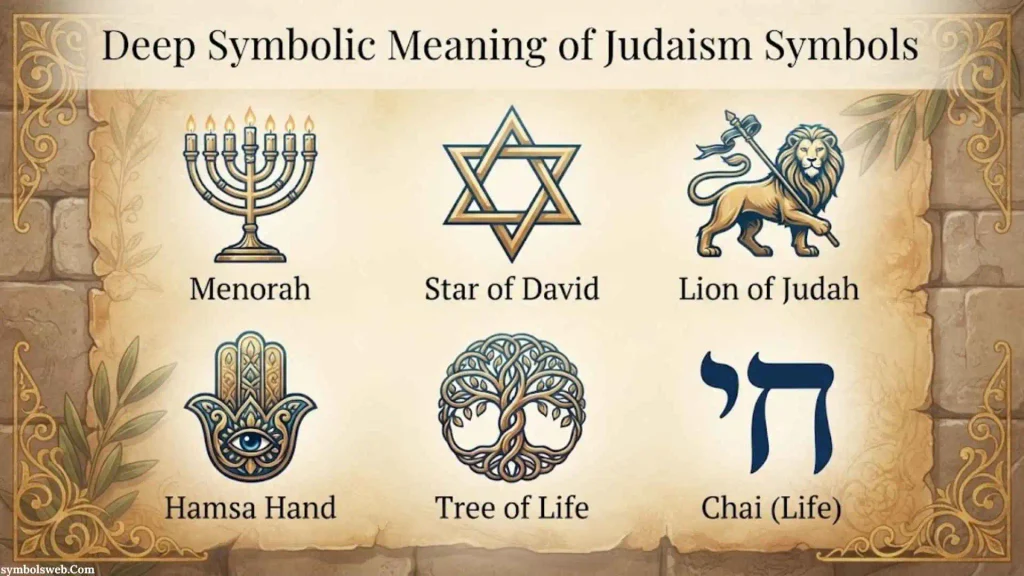
For example, the Menorah’s light represents divine illumination. The Torah symbolizes God’s teachings. The Star of David is often viewed as a reminder of spiritual balance and connection.
These symbols encourage reflection, prayer, and moral living.
Psychological Level
Psychologically, symbols provide meaning and emotional security.
According to theories developed by psychologist Carl Jung, symbols often connect to universal archetypes found in the human mind.
Judaism symbols evoke:
- Belonging
- Identity
- Hope
- Resilience
- Continuity
For many Jews, seeing familiar symbols can create a powerful sense of connection to family history and ancestral traditions.
Cultural Level
Culturally, Judaism symbols unite communities across different countries and backgrounds.
Imagine walking into a synagogue anywhere in the world and recognizing the Menorah or Star of David. These symbols immediately communicate shared heritage and values.
They serve as visual bridges between past and present.
Types and Variations of Judaism Symbols
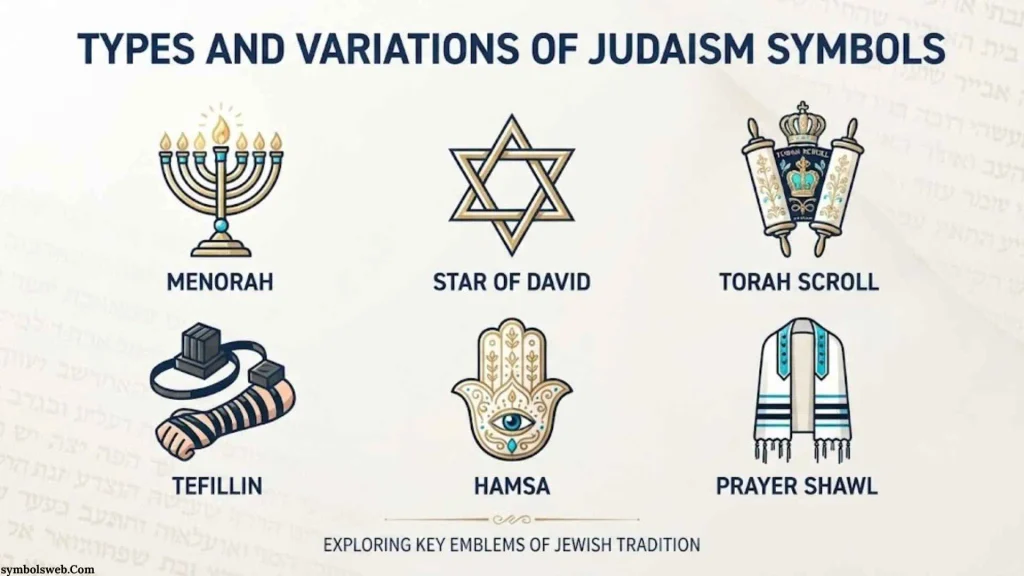
Star of David (Magen David)
Visual Description
A six-pointed star formed by two overlapping triangles.
Meaning
Represents Jewish identity and divine-human connection.
Symbolism
- Protection
- Unity
- Spiritual balance
- Faith
Cultural Connection
Appears on synagogues, Jewish artwork, and the national flag of Israel.
Where It Appears
- Religious buildings
- Jewelry
- Flags
- Literature
- Memorials
Menorah
Visual Description
A seven-branched ancient lampstand.
Meaning
Represents divine wisdom and God’s presence.
Symbolism
- Light
- Knowledge
- Spiritual enlightenment
- Creation
Cultural Connection
One of Judaism’s oldest symbols.
Where It Appears
- Synagogues
- Religious texts
- National emblems
- Ceremonies
Hanukkiah
Visual Description
A nine-branched candelabrum used during Hanukkah.
Meaning
Commemorates the miracle of the temple oil.
Symbolism
- Faith
- Miracles
- Perseverance
Cultural Connection
Central to Hanukkah celebrations.
Chai
Visual Description
Hebrew letters spelling “life.”
Meaning
The Hebrew word for life.
Symbolism
- Vitality
- Blessing
- Prosperity
Cultural Connection
Popular in jewelry and gifts.
Hamsa
Visual Description
An open hand-shaped symbol.
Meaning
Protection against negativity.
Symbolism
- Safety
- Blessing
- Good fortune
Cultural Connection
Found throughout Jewish communities, especially in Middle Eastern traditions.
Torah Scroll
Visual Description
Handwritten Hebrew scripture scroll.
Meaning
Represents divine teaching.
Symbolism
- Wisdom
- Covenant
- Sacred knowledge
Cultural Connection
The heart of Jewish worship and learning.
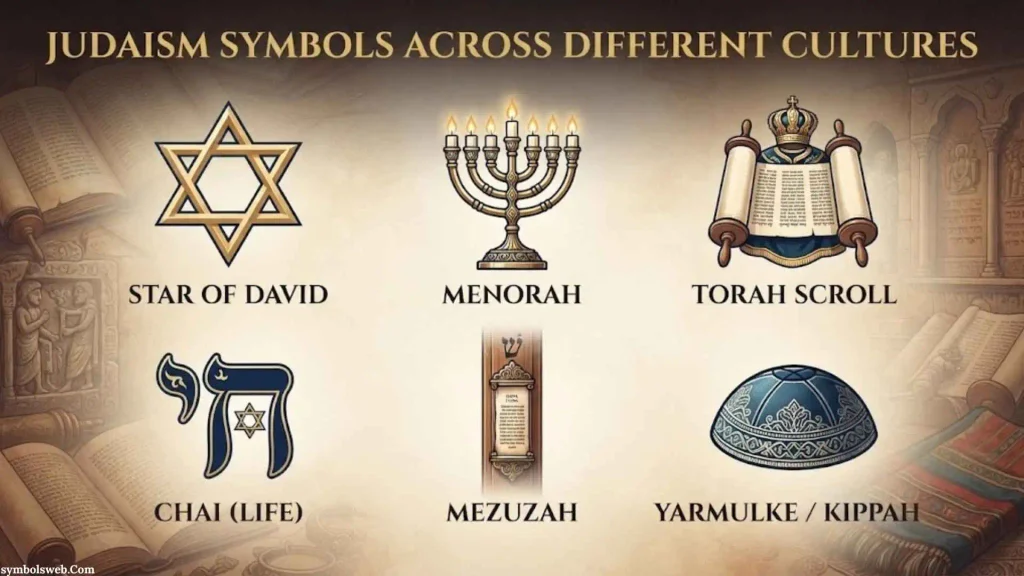
Judaism Symbols Across Different Cultures
Ancient Egypt
Jewish history intersects with Egypt through the Exodus narrative.
Symbols connected to liberation and divine protection gained significance through memories of slavery and freedom.
Ancient Greece
Greek influence shaped Jewish artistic expression during the Hellenistic period.
Some symbolic forms adopted artistic styles while maintaining distinct Jewish meanings.
Roman Culture
Roman rule profoundly impacted Jewish identity.
After the destruction of the Second Temple, symbols like the Menorah became powerful reminders of resilience and faith.
Eastern Traditions
Jewish communities across Persia, India, and Central Asia incorporated regional artistic styles into symbolic designs.
The Hamsa became especially prominent in many Eastern Jewish communities.
Indigenous Traditions
Diaspora communities often interacted with indigenous cultures while preserving their own sacred symbols.
This cultural exchange influenced artistic representations without altering core religious meanings.
Modern Interpretations
Today, Judaism symbols appear globally.
They are used in:
- Education
- Art
- Social activism
- Cultural heritage projects
- Digital media
Their meanings continue evolving while remaining rooted in tradition.
Similar Symbols and Their Meanings
| Symbol | Similarity | Difference |
| Star of David | Sacred geometric symbol | Specifically associated with Judaism |
| Pentagram | Geometric religious symbol | Different religious history and meaning |
| Cross | Religious identity symbol | Primarily associated with Christianity |
| Crescent Moon | Faith symbol | Associated with Islam |
| Lotus | Spiritual growth symbol | Rooted in Eastern religions |
Common Misconceptions
One common misconception is that the Star of David has always been Judaism’s primary symbol.
Historically, the Menorah predates it by many centuries and was once the more dominant symbol of Jewish identity.
Judaism Symbols in Mythology and Folklore
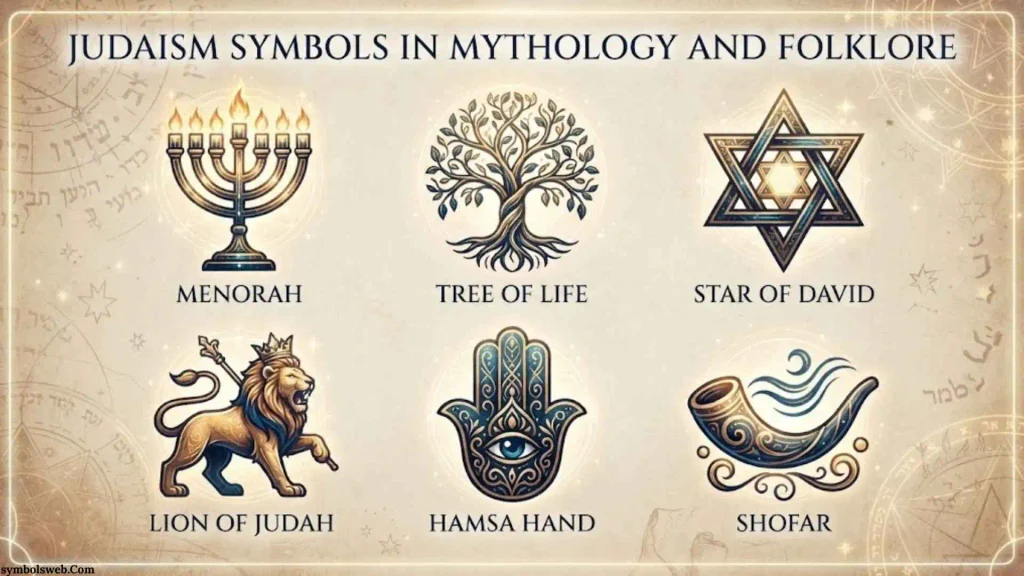
Jewish folklore contains many stories involving sacred symbols.
The Menorah is linked to narratives about divine light and temple worship.
The Hamsa appears in traditions concerning protection from harmful intentions and misfortune.
Mystical Jewish traditions, especially within Kabbalah, often interpret symbols as gateways to deeper spiritual truths.
Ancient stories transformed these symbols into powerful carriers of collective memory.
Generations passed down their meanings through storytelling, prayer, and ritual.
Judaism Symbols in Art, Literature, Movies, and Pop Culture
Art
Jewish artists frequently use sacred symbols to explore identity, memory, and spirituality.
The Menorah and Star of David appear in paintings, sculptures, and contemporary installations.
Literature
Jewish symbols often appear in poetry and novels as representations of survival, faith, and belonging.
Many Holocaust memoirs reference these symbols as reminders of cultural identity.
Movies and Television
Films depicting Jewish history frequently feature:
- Menorahs
- Torah scrolls
- Synagogues
- Stars of David
These visual elements instantly communicate cultural context.
Tattoos
Although traditional Jewish law generally discourages tattooing, some individuals choose symbolic designs such as:
- Chai
- Hamsa
- Star of David
to express identity and remembrance.
Fashion
Jewish symbols appear in:
- Necklaces
- Bracelets
- Clothing
- Artistic accessories
Modern Design
Contemporary designers use Jewish symbolism in architecture, logos, educational materials, and digital art.
Spiritual and Dream Meaning of Judaism Symbols
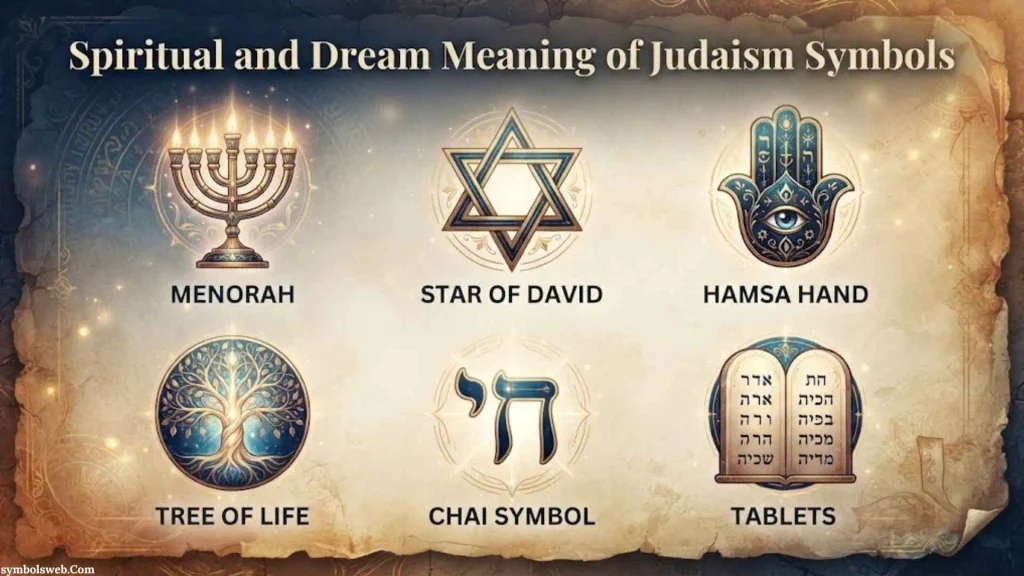
Dreams involving Jewish symbols often carry symbolic interpretations rather than literal predictions.
Star of David in Dreams
May represent:
- Balance
- Protection
- Spiritual awakening
- Personal alignment
Menorah in Dreams
Often symbolizes:
- Wisdom
- Guidance
- Clarity
- Hope
Torah in Dreams
May suggest:
- Learning
- Moral reflection
- Seeking truth
Positive Messages
- Spiritual growth
- New understanding
- Inner peace
- Divine guidance
Cautionary Messages
- Ignoring wisdom
- Losing direction
- Disconnecting from values
Dream interpretation remains highly personal and depends on individual circumstances.
Positive and Negative Meanings of Judaism Symbols
| Positive Meaning | Negative Meaning |
| Faith | Misuse for political agendas |
| Wisdom | Dogmatic interpretation |
| Protection | False sense of invulnerability |
| Identity | Social division when misunderstood |
| Unity | Exclusion if used improperly |
| Tradition | Resistance to healthy change |
Symbols themselves are neutral. Their impact depends on how people interpret and use them.
Why Humans Are Attracted to Judaism Symbols
Humans naturally seek meaning through visual symbols.
Judaism symbols satisfy several deep psychological needs:
Identity
People want to know where they belong.
Symbols provide visible markers of community and heritage.
Storytelling
Every symbol carries centuries of stories.
Humans connect emotionally to narratives.
Pattern Recognition
The brain naturally responds to recognizable shapes and meaningful imagery.
Collective Memory
Symbols preserve cultural experiences across generations.
Personal Meaning
A Star of David necklace may represent family history.
A Menorah may remind someone of childhood celebrations.
These personal connections make symbols emotionally powerful.
Modern Uses of Judaism Symbols
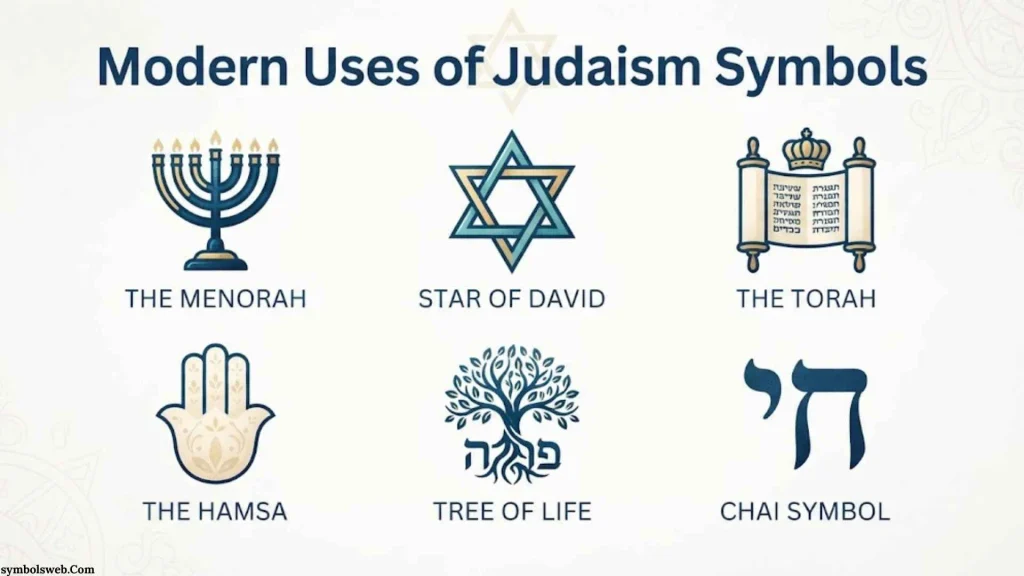
Jewelry
Necklaces featuring Chai and the Star of David remain popular expressions of faith and identity.
Home Decor
Many families display Menorahs, Hamsa designs, and Hebrew artwork.
Fashion
Designers incorporate Jewish symbols into contemporary styles.
Branding
Jewish organizations use traditional symbols to communicate heritage and values.
Social Media
Symbols help users express cultural identity online.
Contemporary Spirituality
People exploring spirituality often study Jewish symbolism for its rich historical and mystical meanings.
Education
Schools, museums, and cultural centers use symbols to teach Jewish history and tradition.
Interesting Facts About Judaism Symbols
- The Menorah is one of the oldest surviving symbols of Judaism.
- The Star of David became widely associated with Judaism relatively late in Jewish history.
- The Hebrew word “Chai” means “life.”
- The numerical value of Chai in Hebrew is 18, making the number 18 especially meaningful in Jewish culture.
- The Menorah appears on the official emblem of Israel.
- Torah scrolls are traditionally handwritten by specially trained scribes.
- The Hamsa is shared across multiple Middle Eastern cultures and religions.
- Some ancient synagogue mosaics contain intricate symbolic artwork dating back nearly two thousand years.
- Jewish mystical traditions often interpret symbols on multiple spiritual levels.
- Many Jewish symbols continue to evolve while preserving their ancient roots.
Frequently Asked Questions
What is the most important symbol in Judaism?
The Menorah and Star of David are among the most recognized Judaism symbols. Historically, the Menorah is older, while the Star of David became the most widely recognized symbol of Jewish identity.
What does the Star of David symbolize?
The Star of David symbolizes protection, unity, faith, and the connection between the divine and humanity.
Why is the Menorah important in Judaism?
The Menorah represents divine light, wisdom, and God’s presence. It was an important feature of the ancient Temple in Jerusalem.
What does Chai mean in Judaism?
Chai is a Hebrew word meaning “life.” It symbolizes vitality, blessing, and the value of living a meaningful life.
Is the Hamsa a Jewish symbol?
The Hamsa is widely used in many Jewish communities as a symbol of protection and blessing, although it also appears in other Middle Eastern cultures.
Are Judaism symbols used today?
Yes. Judaism symbols remain important in worship, education, jewelry, art, community life, and cultural identity around the world.
Conclusion
Judaism symbols are far more than decorative images. They are living connections to faith, history, memory, and identity. From the radiant light of the Menorah to the enduring presence of the Star of David, these symbols carry centuries of meaning and human experience.
Their power comes not only from religion but also from the stories, hopes, and values they preserve. As long as people seek wisdom, belonging, and spiritual connection, Judaism symbols will continue to inspire future generations.

Eliana Foster is a writer with a passion for exploring the meanings behind symbols, traditions, and cultural history. She enjoys breaking down complex topics into simple, engaging articles that are easy for everyone to understand. Eliana is also the fictional author of The Hidden Language of Silent Marks and Beyond the Circle of Ancient Signs, two original book concepts created for her author profile. When she’s not writing, she loves visiting museums, reading about mythology, and researching the stories behind symbols from around the world. Her goal is to help readers discover the fascinating meanings hidden in everyday signs and ancient emblems.
 Jordan Hayes
 Ethan Holloway