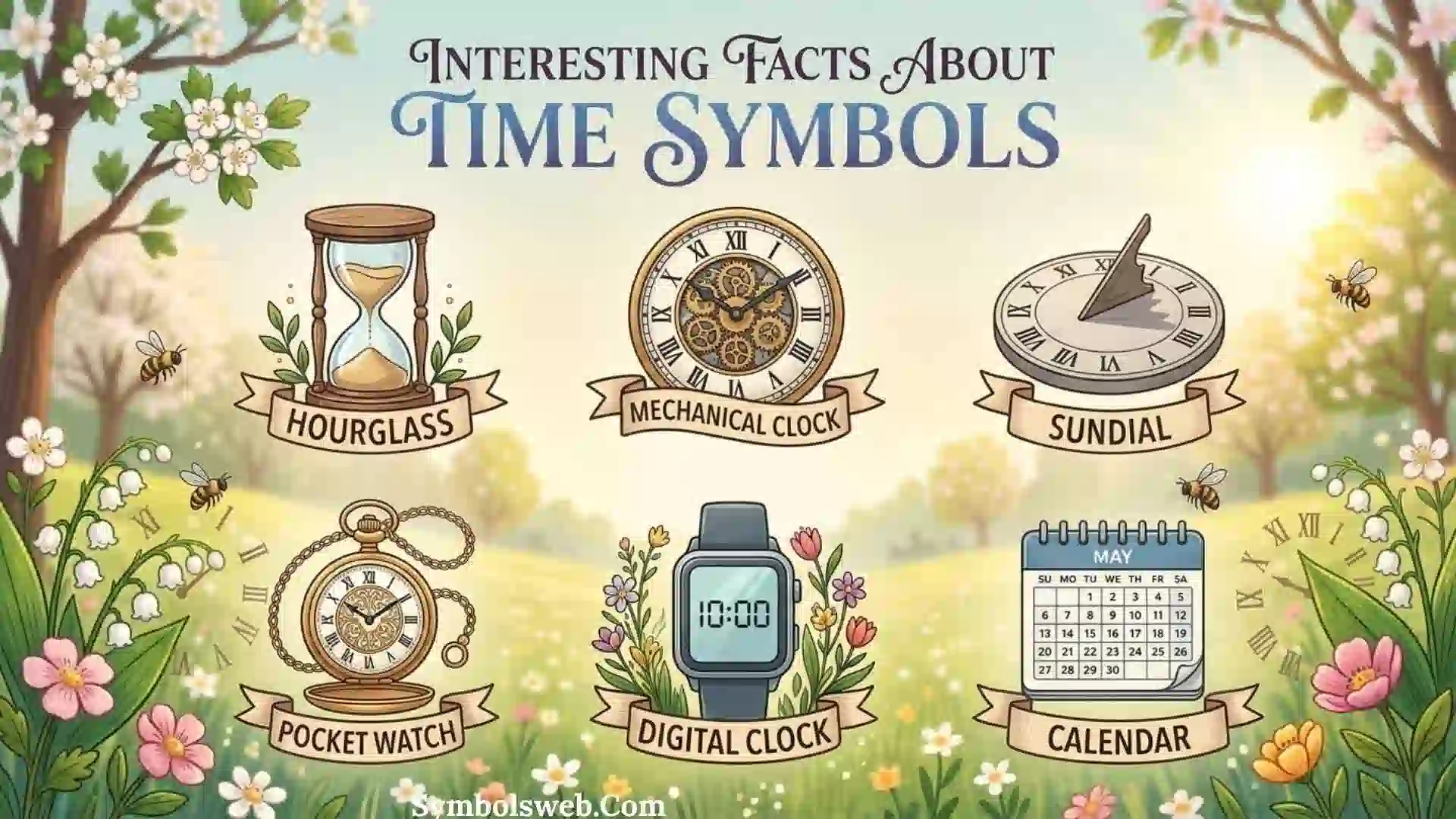
Time symbols have fascinated humanity for thousands of years because they represent one of life’s greatest mysteries: the passage of existence itself. Every culture has created symbols to understand time, measure change, and make sense of birth, growth, aging, and renewal.
These powerful symbols appear in ancient temples, sacred texts, artwork, dreams, and modern designs. By exploring their meanings, we uncover deeper insights into human history, spirituality, psychology, and our relationship with the universe.
Time Symbols: (Quick Answer)
Time symbols are visual representations that express the passage of time, eternity, cycles, change, mortality, and renewal. Common time symbols include clocks, hourglasses, sundials, circles, spirals, and celestial bodies. Across cultures, these symbols help people understand life’s temporary nature while also connecting to ideas of destiny, growth, and eternal existence.
Quick Facts About Time Symbols
| Aspect | Information |
| Origin | Prehistoric observations of natural cycles, sun, moon, and seasons |
| Historical Significance | Used to track seasons, religious events, agriculture, and human life stages |
| Main Meaning | Passage of time, change, cycles, mortality, and continuity |
| Spiritual Meaning | Eternity, destiny, cosmic order, and soul evolution |
| Cultural Importance | Appears in mythology, religion, art, literature, and daily life |
| Modern Usage | Watches, tattoos, logos, jewelry, digital icons, and home decor |
What Are Time Symbols?
Time symbols are visual images, objects, patterns, or signs that represent time and its effects. Humans have always sought ways to understand the movement of days, seasons, years, and generations. As a result, symbolic representations of time emerged in nearly every civilization.
Before mechanical clocks existed, people relied on natural indicators such as sunrise, sunset, moon phases, and seasonal changes. These recurring events inspired symbols that communicated deeper truths about existence.
The earliest time symbols often came from nature. The sun represented daily cycles. The moon reflected monthly rhythms. Circles symbolized endless repetition and continuity. As societies advanced, more sophisticated symbols such as sundials, calendars, and hourglasses emerged.
Over time, these symbols became more than practical tools. They evolved into powerful metaphors for life, death, destiny, memory, and eternity.
Deep Symbolic Meaning of Time Symbols
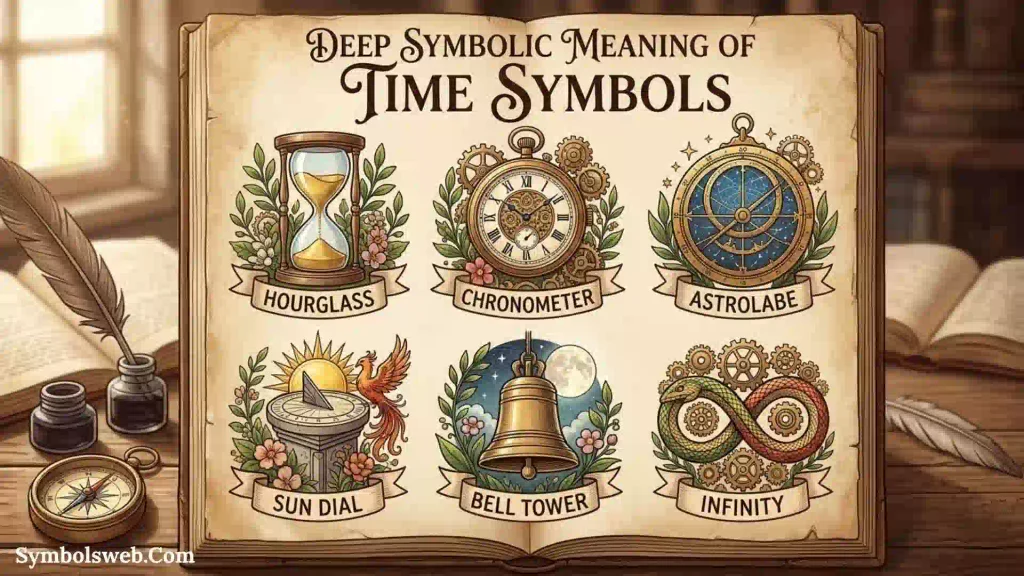
Spiritual Level
Spiritually, time symbols often represent the connection between the physical and eternal worlds.
Many traditions view earthly time as temporary while the soul exists beyond ordinary time. Symbols such as circles, spirals, and celestial movements suggest that life is part of a greater cosmic journey.
A spiral, for example, symbolizes spiritual evolution. Rather than moving in a straight line, the soul grows through repeated lessons and experiences.
The hourglass often reminds people that life is precious and limited. In spiritual teachings, this encourages mindfulness and appreciation of the present moment.
Time symbols also reflect divine order. The predictable movement of stars, planets, and seasons suggests that the universe operates according to a greater purpose.
Psychological Level
Psychologically, time symbols speak directly to human emotions.
People naturally worry about aging, change, and the future. Time symbols help transform these abstract fears into understandable images.
According to the theories of psychologist Carl Jung, many time-related symbols function as archetypes. They appear repeatedly across cultures because they reflect universal human experiences.
For example:
- Clocks often symbolize awareness and responsibility.
- Circles represent wholeness and completion.
- Spirals reflect growth and transformation.
- Cycles symbolize life’s recurring patterns.
These symbols attract us because they help organize our understanding of existence.
Cultural Level
Culturally, time symbols connect communities through shared beliefs and traditions.
Many festivals follow seasonal cycles. Calendars structure social life. Religious ceremonies often commemorate sacred moments in time.
Imagine a harvest festival. While it celebrates food and abundance, it also symbolizes the annual cycle of growth, maturity, and renewal. Through such traditions, time becomes meaningful rather than merely measurable.
Types and Variations of Time Symbols
Clock
Visual Description: Circular face with moving hands.
Meaning: Passage of measurable time.
Symbolism: Awareness, urgency, mortality.
Cultural Connection: Common worldwide.
Where It Appears: Art, literature, films, dreams, tattoos.
Hourglass
Visual Description: Two glass chambers connected by a narrow center.
Meaning: Finite time.
Symbolism: Life’s temporary nature.
Cultural Connection: Medieval Europe and beyond.
Where It Appears: Philosophy, fantasy stories, memorial art.
Sundial
Visual Description: Shadow-casting pointer on a marked surface.
Meaning: Natural timekeeping.
Symbolism: Harmony with nature.
Cultural Connection: Ancient civilizations.
Where It Appears: Gardens, historical monuments.
Circle
Visual Description: Endless closed loop.
Meaning: Eternity.
Symbolism: Infinite cycles and continuity.
Cultural Connection: Universal.
Where It Appears: Sacred geometry, religion, meditation.
Spiral
Visual Description: Curving line expanding outward.
Meaning: Evolution and growth.
Symbolism: Spiritual development.
Cultural Connection: Ancient Celtic and Indigenous traditions.
Where It Appears: Art, carvings, dreams.
Sun
Visual Description: Radiant celestial body.
Meaning: Daily cycles.
Symbolism: Life, energy, rebirth.
Cultural Connection: Nearly every civilization.
Where It Appears: Mythology, religion, national symbols.
Moon
Visual Description: Crescent or full lunar form.
Meaning: Monthly cycles.
Symbolism: Change, intuition, rhythm.
Cultural Connection: Global.
Where It Appears: Spiritual traditions, literature, dreams.
Time Symbols Across Different Cultures
Ancient Egypt
Ancient Egyptians viewed time as both cyclical and eternal.
The daily journey of the sun god Ra across the sky symbolized recurring renewal. The scarab beetle also represented rebirth and the continuous movement of existence.
Ancient Greece
Greek culture introduced profound philosophical ideas about time.
Chronos represented chronological time, while Kairos symbolized the perfect moment for action. These concepts still influence modern thinking.
Roman Culture
Romans linked time to order, governance, and destiny.
Calendars became essential tools for organizing society, agriculture, and religious ceremonies.
Eastern Traditions
Many Eastern philosophies view time as cyclical rather than linear.
In Hinduism and Buddhism, existence moves through repeating cycles of creation, destruction, and rebirth. The wheel often symbolizes this endless process.
Indigenous Traditions
Many Indigenous cultures understand time through natural cycles.
Seasonal changes, animal migrations, and celestial movements guide daily life and spiritual practice.
Modern Interpretations
Today, time symbols often express personal meaning.
People use clocks, hourglasses, and celestial imagery in tattoos, jewelry, and artwork to represent memories, growth, and life’s fleeting nature.
Similar Symbols and Their Meanings
| Symbol | Similarity to Time Symbols | Key Difference |
| Circle | Represents continuity | Focuses on eternity |
| Spiral | Represents progression | Emphasizes growth |
| Wheel | Represents cycles | Often linked to destiny |
| Clock | Measures time | More practical than spiritual |
| Infinity Symbol | Suggests endless existence | Less focused on change |
| Sun | Marks daily cycles | Connected to life energy |
| Moon | Marks recurring phases | Associated with emotions |
Common Misconceptions
One common misconception is that all time symbols represent mortality. While some emphasize life’s limits, many celebrate renewal, growth, and eternal continuity.
Time Symbols in Mythology and Folklore
Throughout mythology, time is often portrayed as a powerful force beyond human control.
Greek mythology features Chronos, associated with the relentless movement of time.
Norse mythology describes cosmic cycles leading to destruction and renewal through Ragnarok.
In Hindu mythology, vast cosmic ages known as Yugas illustrate immense cycles of creation and transformation.
Folklore frequently includes magical clocks, enchanted calendars, and prophetic visions involving time. These stories reflect humanity’s fascination with destiny and the unknown future.
Many modern interpretations of time symbols can be traced directly back to these ancient narratives.
Time Symbols in Art, Literature, Movies and Pop Culture
Paintings
Artists frequently use clocks, shadows, and celestial imagery to explore mortality and memory.
One of the most famous examples is Salvador Dalí’s melting clocks, which challenge conventional ideas about time and reality.
Literature
Writers use time symbols to represent growth, regret, fate, and transformation.
From ancient epics to modern novels, clocks and seasons often mirror a character’s emotional journey.
Poetry
Poets have long connected time with beauty, love, aging, and memory.
Seasonal imagery frequently symbolizes life’s stages.
Movies
Films often use clocks and countdowns to create suspense.
Time travel stories rely heavily on symbolic representations of timelines, destiny, and alternate realities.
Television
Many television dramas use recurring clocks or calendar references to symbolize urgency and change.
Tattoos
Time symbol tattoos are extremely popular.
Common designs include:
- Hourglasses
- Pocket watches
- Clock faces
- Infinity symbols
- Sun and moon combinations
These tattoos often represent meaningful life experiences.
Fashion and Design
Luxury watches, celestial jewelry, and minimalist clock motifs continue to symbolize sophistication, legacy, and personal identity.
Spiritual and Dream Meaning of Time Symbols
Dreams involving time symbols often carry powerful messages.
Common Dream Interpretations
Clock Running Fast
May suggest stress, pressure, or fear of missing opportunities.
Broken Clock
Can symbolize feeling stuck or disconnected from progress.
Hourglass
Often represents awareness of life’s precious moments.
Spiral
Suggests personal growth and spiritual evolution.
Sunrise
Represents new beginnings and hope.
Positive Messages
- Personal transformation
- Spiritual awakening
- Renewal
- Wisdom
- Growth
Cautionary Messages
- Wasted opportunities
- Fear of aging
- Anxiety about change
- Resistance to personal growth
Positive and Negative Meanings of Time Symbols
| Positive Meaning | Negative Meaning |
| Growth | Aging |
| Wisdom | Regret |
| Renewal | Loss |
| Opportunity | Pressure |
| Evolution | Fear of change |
| Continuity | Mortality awareness |
| Spiritual development | Anxiety about the future |
| Hope | Impermanence |
Time symbols contain both light and shadow. Their meaning depends on personal perspective and context.
Why Humans Are Attracted to Time Symbols
Humans are naturally aware of time’s influence.
We celebrate birthdays, remember anniversaries, and mark historical milestones because time helps create meaning.
Psychologists suggest that people are drawn to time symbols because they help organize life experiences into understandable patterns.
Stories, memories, and traditions all depend on time.
Time symbols also provide comfort. They remind us that difficult periods eventually pass and that growth often emerges from change.
On a deeper level, these symbols connect us to collective human experience. Across thousands of years, people have shared the same hopes, fears, and questions about existence.
Modern Uses of Time Symbols
Tattoos
Represent memories, life lessons, and personal milestones.
Jewelry
Hourglass pendants and watch-inspired designs symbolize life’s value.
Fashion
Time imagery adds sophistication and symbolic depth.
Branding
Many companies use clocks, circles, and infinity-inspired designs to communicate reliability and continuity.
Social Media
Time symbols frequently appear in motivational content about growth and mindfulness.
Contemporary Spirituality
Used in meditation practices focused on presence and awareness.
Home Decor
Clocks and celestial artwork remain among the most popular symbolic decorations worldwide.
Interesting Facts About Time Symbols
- The oldest known sundials are over 3,500 years old.
- The circle is one of humanity’s oldest symbolic representations of eternity.
- Ancient civilizations often tracked time using stars rather than clocks.
- Hourglasses became widely used during medieval times.
- Many cultures independently developed circular calendars.
- The infinity symbol became popular in mathematics during the 17th century.
- Spiral patterns appear in prehistoric cave art.
- Lunar calendars existed long before modern calendars.
- Many sacred sites align with solar events such as solstices.
- Time symbols appear in nearly every major religion.
Frequently Asked Questions
What is the most common symbol for time?
The clock is the most widely recognized symbol for time because it directly measures the passage of hours and minutes.
What does an hourglass symbolize?
An hourglass symbolizes limited time, mortality, mindfulness, and the importance of appreciating the present moment.
Are time symbols spiritual?
Yes. Many time symbols carry spiritual meanings related to eternity, soul growth, cosmic order, and life’s cyclical nature.
What does a spiral mean in relation to time?
A spiral often represents growth, evolution, and the idea that life progresses through repeating yet advancing experiences.
Why do people get time symbol tattoos?
People choose time symbol tattoos to honor memories, mark life-changing events, symbolize personal growth, or express awareness of life’s temporary nature.
What is the difference between a clock and an infinity symbol?
A clock represents measurable time, while an infinity symbol represents timelessness and eternal existence.
Conclusion
Time symbols are far more than simple images or tools for measuring hours. They carry profound messages about life, change, growth, mortality, and eternity. Across civilizations, they have helped people understand their place in the universe and find meaning in life’s unfolding journey.
If appearing in dreams, myths, art, or personal expression, these symbols remind us that every moment matters. In understanding time symbols, we gain a deeper appreciation for both the fleeting beauty and enduring mystery of existence.

Hi, I’m Ethan Holloway, and I’ve always believed that a few meaningful words can change the way we think, feel, and live. I enjoy collecting timeless quotes, studying their deeper meanings, and sharing inspiring messages that help people stay motivated through every stage of life.
Over the years, I’ve explored thousands of famous sayings from writers, leaders, philosophers, and everyday people. My goal is to make wisdom easy to understand and useful for everyone.
Books by Ethan Holloway
- The Power of Everyday Quotes
- Words That Inspire Greatness
 Jordan Hayes
 Eliana Foster