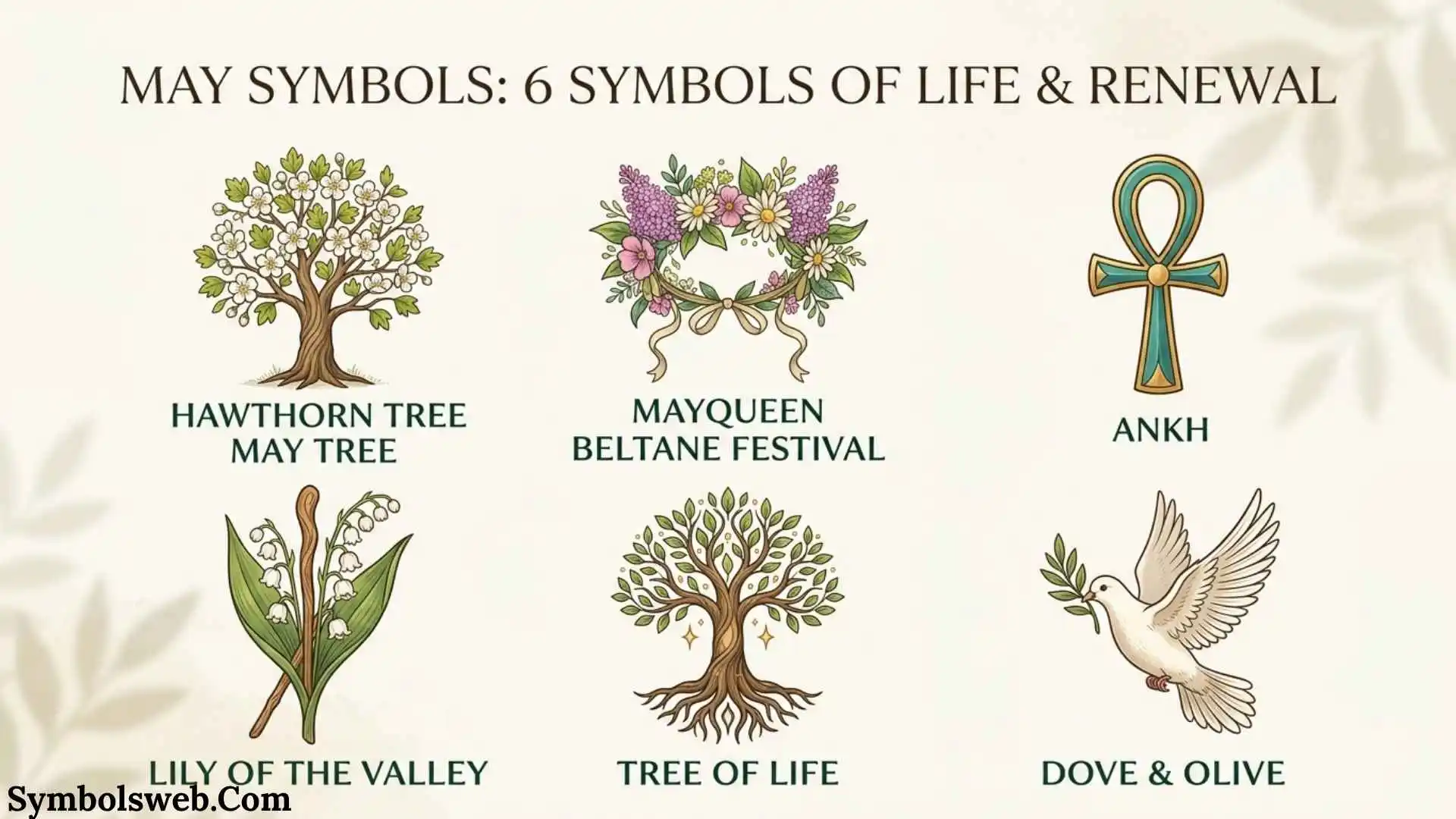
Many symbols are a beautiful collection of flowers, gemstones, colors, seasonal traditions, zodiac signs, and cultural images that represent growth, renewal, hope, beauty, and new beginnings. As spring reaches its fullest expression in the Northern Hemisphere, May has long been connected with life returning to the land.
From the emerald’s deep green glow to the delicate lily of the valley, each May symbol tells a different story. Together, they reveal why this month has held such a powerful place in human culture, history, spirituality, and imagination.
May Symbols: (Quick Answer)
May symbols are traditional objects, natural elements, and cultural signs associated with the month of May. The best-known include the emerald birthstone, lily of the valley and hawthorn flowers, the color green, Taurus and Gemini, the Flower Moon, and May Day traditions such as flowers and the maypole. Collectively, these symbols represent renewal, hope, fertility, happiness, growth, love, and the arrival of warmer seasons.
Quick Facts About May Symbols
| Aspect | Information |
| Origin | May’s symbolism developed through Roman traditions, European seasonal customs, birthstone and flower traditions, astrology, and Indigenous lunar traditions |
| Historical Significance | May has been linked with spring festivals, flowers, fertility, agriculture, and community celebrations for centuries |
| Main Meaning | Growth, renewal, hope, happiness, fertility, beauty, and transition |
| Birthstone | Emerald |
| Birth Flowers | Lily of the valley and hawthorn |
| Main Color | Green |
| Spiritual Meaning | Renewal, inner growth, healing, hope, and transformation |
| Zodiac Signs | Taurus and Gemini |
| Lunar Symbol | Flower Moon |
| Cultural Importance | May Day, maypoles, floral traditions, spring celebrations, and labor movements |
| Modern Usage | Birthdays, jewelry, tattoos, wedding flowers, fashion, home décor, branding, and personal symbolism |
What Are May Symbols?
May symbols are the images, natural objects, traditions, and ideas that people have connected with the month of May.
Unlike a single religious symbol, May has many symbolic layers. Some come from nature. Others come from ancient mythology, seasonal celebrations, astrology, folklore, or modern birth-month traditions.
The strongest theme connecting them is renewal.
May arrives during a period when nature appears to wake up completely in much of the Northern Hemisphere. Trees become greener, flowers open, birds become active, and agricultural life becomes increasingly important. This natural transformation helped make May a powerful symbol of life returning after winter.
Why Is May Called May?
The English name “May” comes through older forms of the name from the Latin Maius. The exact origin of Maius has been debated, but ancient tradition connected it with Maia, a Roman goddess associated with growth and abundance. Another ancient explanation connected the name with maiores, meaning ancestors or elders.
This uncertainty is important because it shows that even the name of May carries layers of meaning.
The Romans also had major spring celebrations around this time. The Floralia, a festival dedicated to Flora, goddess of flowers and vegetation, was celebrated from late April into early May. These traditions helped strengthen the association between this period and flowers, fertility, abundance, and seasonal change.
How May Became a Symbol of Renewal
For agricultural societies, spring was not simply beautiful. It was essential.
New growth meant food could eventually be harvested. Flowering plants signaled seasonal change. Animals reproduced. Communities prepared for the warmer months.
As a result, May naturally became associated with:
- New beginnings
- Fertility
- Growth
- Hope
- Love
- Abundance
- Beauty
- Youth
- Happiness
- Transformation
These meanings still appear in modern May birthdays, wedding traditions, jewelry, tattoos, poetry, and spiritual practices.
Deep Symbolic Meaning of May Symbols
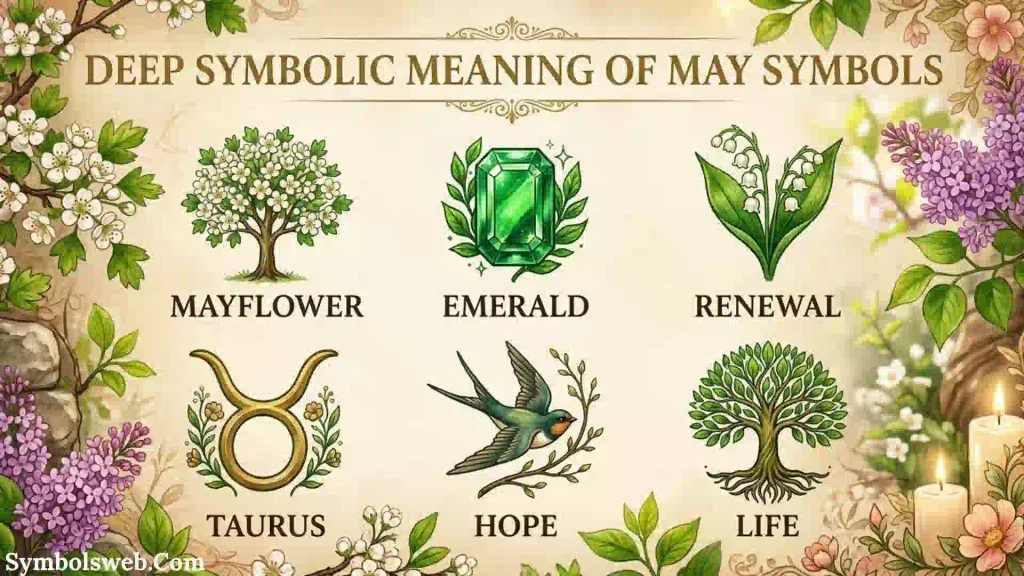
May symbols become especially interesting when viewed beyond their surface appearance.
A green emerald is not simply a gemstone. A white flower is not simply a flower. A maypole is not simply a decorated wooden pole.
Each can carry an idea about how humans understand life.
Spiritual Meaning
Spiritually, May often represents awakening.
The season’s movement from colder months into abundant growth can be understood as a metaphor for inner transformation. Something that appeared dormant begins to live again.
For this reason, May symbolism is often associated with:
- Spiritual renewal
- Hope after difficult periods
- Personal growth
- Healing
- Rebirth
- Emotional openness
- Connection with nature
- New beginnings
These interpretations are symbolic rather than universal religious doctrines. Different spiritual traditions understand seasonal imagery in different ways.
The emerald is particularly strong in this context because its green color naturally connects it with vegetation and spring. The Gemological Institute of America describes emerald as a gemstone associated with rebirth and renewal and notes its long history in Egyptian and Incan cultures.
Psychological Meaning
From a psychological perspective, May symbolism can be understood through the human tendency to connect environmental change with emotional experience.
When landscapes become green and flowers begin to appear, people may naturally associate these visual signals with safety, life, possibility, and movement.
This does not mean that every person experiences May in the same way. Personal memories and cultural background matter greatly.
Jungian psychology also offers a useful interpretive framework. In Jung’s concept of archetypal imagery, natural cycles can become powerful symbols of psychological transformation. Spring can therefore be read as an image of emergence, renewal, and the return of energy.
That is an interpretation, not a scientific claim that May itself causes particular emotions.
Cultural Meaning
Culturally, May often represents a community welcoming a new season.
May Day celebrations historically included flowers, dancing, processions, maypoles, greenery, and other public rituals. In Britain, the tradition of “bringing in the May” involved gathering flowers and branches and returning with them to communities.
The result is an important cultural idea:
May is not only about individual renewal. It is also about shared renewal.
Types and Variations of May Symbols
May has no single official symbol. Instead, several major symbols work together to create the month’s identity.
Emerald
Visual description: A transparent green gemstone ranging from bluish green to rich green.
Meaning: Renewal, vitality, wisdom, love, abundance, and growth.
Symbolism: Emerald’s green color makes it an obvious representation of spring and new life.
Cultural connection: Emeralds have been valued by ancient Egyptians, Incan societies, European royalty, and modern jewelry cultures. Cleopatra was famously associated with emeralds.
Where it appears: Jewelry, crowns, religious objects, family heirlooms, engagement rings, birthday gifts, art, and fashion.
Lily of the Valley
Visual description: Small, usually white, bell-shaped flowers hanging from slender stems.
Meaning: Purity, sweetness, humility, happiness, and renewal.
Symbolism: Its delicate appearance and spring flowering have made it a natural symbol of gentle happiness and returning life.
Cultural connection: It has a long history in European folklore and Christian traditions. In France, lily of the valley is traditionally associated with May 1 and good luck.
Where it appears: Wedding bouquets, perfumes, gardens, paintings, poetry, birthday gifts, and May Day traditions.
Hawthorn
Visual description: A thorny shrub or small tree with clusters of white or pink flowers.
Meaning: Hope, protection, fertility, love, and seasonal change.
Symbolism: Its flowers appear around the transition from spring toward summer in many parts of Europe.
Cultural connection: Hawthorn has strong connections with European folklore, May Day customs, and Celtic traditions. It was also used historically in hedges because its thorns provided natural protection.
Where it appears: Folklore, hedgerows, May Day decorations, gardens, poetry, and traditional celebrations.
Green
Green is perhaps the most recognizable color associated with May.
It represents:
- Life
- Nature
- Growth
- Freshness
- Balance
- Renewal
- Prosperity
The connection is straightforward. May is a time when vegetation becomes increasingly visible and abundant in many Northern Hemisphere regions.
Flower Moon
The May full moon is commonly called the Flower Moon.
The name reflects the abundance of flowers that appear during this season. The Old Farmer’s Almanac attributes the Flower Moon name to Algonquin traditions and also records other May lunar names from Indigenous peoples, including names connected with budding plants and planting.
This is a useful reminder that lunar names were not one universal system. Different communities used different names based on their local environment, climate, animals, plants, and seasonal activities.
Maypole
The maypole is one of the most recognizable visual symbols of May Day.
It is traditionally decorated with flowers, greenery, and ribbons. Dancers may move around the pole while weaving the ribbons into patterns.
Historically, maypole customs became established in England and were later restricted during the seventeenth century before being revived.
Symbolically, the maypole can represent:
- Community
- Fertility
- Celebration
- Seasonal renewal
- Connection between people and nature
May Queen
The May Queen is another traditional May Day figure.
She represents youth, beauty, spring, and the ceremonial celebration of the season. In different communities, May Queen traditions have taken different forms.
Today, the tradition is often viewed as a piece of European folk culture rather than a universal religious practice.
Taurus and Gemini
May belongs partly to two Western zodiac signs:
- Taurus, generally covering the first part of May
- Gemini, generally covering the later part of May
Taurus is symbolically connected with stability, nature, sensuality, patience, and material life.
Gemini is associated with communication, curiosity, flexibility, and duality.
These are astrological interpretations rather than scientifically established personality traits.
May Symbols Across Different Cultures
May symbolism change significantly from one culture to another. There is no single worldwide interpretation.
Ancient Egypt
Ancient Egypt did not use the modern Gregorian month of May, so it would be misleading to claim that May itself had one specific Egyptian symbol.
However, one of May’s most important symbols, the emerald, has a genuine ancient Egyptian connection.
Emerald mining in Egypt dates back to at least the Ptolemaic period, with known mining activity continuing for centuries. Cleopatra was famously associated with the gemstone.
The Egyptian connection therefore belongs primarily to the emerald, rather than to May as a calendar month.
Ancient Greece
Greek culture influenced the later history of emerald symbolism. The word emerald ultimately traces back to the ancient Greek term smaragdos, associated with a green gem.
Greek mythology also contains strong traditions around flowers, fertility, spring, and vegetation.
The hawthorn was associated in later accounts with marriage and fertility, reinforcing the broader European connection between spring flowers and new beginnings.
Roman Culture
Roman culture has one of the strongest historical connections to the month itself.
The Latin name for May was Maius. Ancient Roman traditions associated the month with Maia, while the Roman calendar also included important festivals connected with vegetation and flowers.
Floralia honored Flora, the goddess of flowers and vegetation. This festival included public celebrations and helped make the season a time of flowers, color, and abundance.
Eastern Traditions
There is no single “Eastern meaning of May” because Asian cultures have historically used different calendars, seasons, festivals, and symbolic systems.
In many East and South Asian traditions, spring and early summer are connected with renewal, fertility, agricultural cycles, flowers, and natural abundance.
The key lesson is that seasonal symbolism often follows the environment. Where May corresponds with a different climatic season, its symbolism can naturally differ from European and North American traditions.
Indigenous Traditions
The Flower Moon is one of the clearest examples of Indigenous seasonal symbolism associated with May.
The Old Farmer’s Almanac records Flower Moon as a name attributed to Algonquin peoples and notes other Indigenous names that describe budding plants, planting, frogs, and other seasonal observations.
It is important not to treat all Indigenous peoples as one cultural group. Different nations and communities have their own languages, calendars, traditions, and interpretations.
European and Celtic Traditions
May has deep roots in European spring customs.
In Britain, people traditionally gathered flowers and greenery on May Day. Hawthorn became especially important because it often flowered around this time.
In Irish and Scottish traditions connected with Beltane, flowers and decorated branches were used around homes and livestock. Hawthorn was among the plants associated with these customs.
This helped give hawthorn a dual symbolic character: it could represent celebration and fertility while also carrying associations with protection and the supernatural.
Similar Symbols and Their Meanings
Many symbols associated with May overlap with symbols from other seasons.
| Symbol | Main Meaning | Connection With May |
| Emerald | Renewal, vitality, abundance | May birthstone and spring green |
| Lily of the valley | Purity, sweetness, return to happiness | Traditional May birth flower |
| Hawthorn | Hope, protection, fertility | Traditional May flower and May Day plant |
| Green | Growth and life | Dominant visual color of spring |
| Flower Moon | Blooming and seasonal abundance | Traditional May lunar name |
| Maypole | Community and seasonal celebration | May Day tradition |
| Butterfly | Transformation | Modern spring symbolism |
| Sun | Energy and life | Longer, brighter days in the Northern Hemisphere |
| Rose | Love and beauty | Sometimes associated with spring, although not May’s principal birth flower |
May Symbols vs. Spring Symbols
May symbols are not exactly the same as spring symbols.
Spring is a whole season.
May is one month within that season in the Northern Hemisphere.
Therefore, symbols such as green leaves, flowers, butterflies, sunshine, and renewal may belong to both categories. May adds more specific traditions such as the maypole, May Day, May Queen, hawthorn, lily of the valley, emerald, and Flower Moon.
May Symbols in Mythology and Folklore
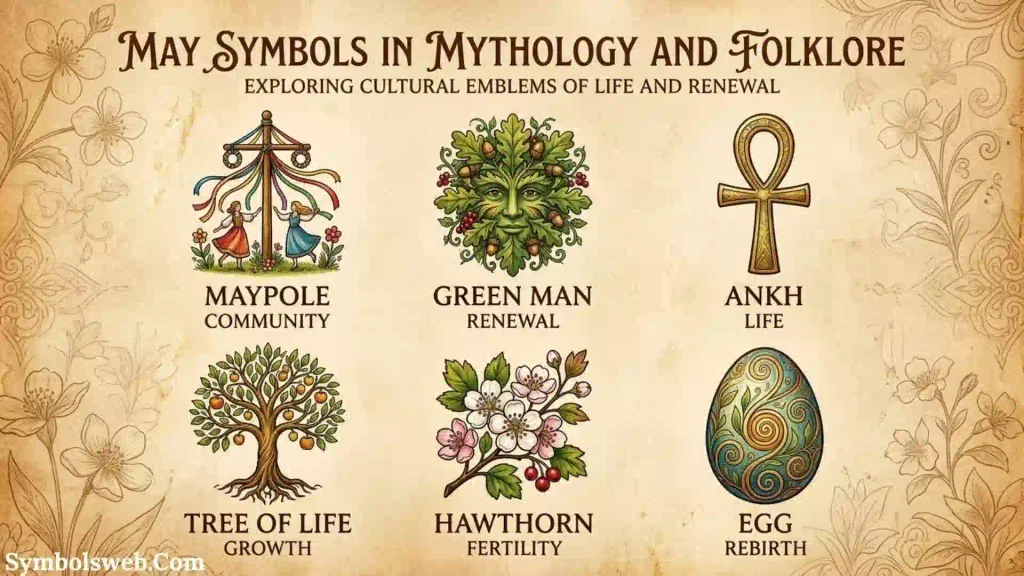
Mythology helped transform natural objects into meaningful symbols.
Maia and the Meaning of May
The traditional connection between May and Maia is one reason the month has long carried associations with growth and abundance.
The exact historical etymology of Maius remains debated, so it is better to describe Maia as a traditional explanation rather than an unquestionable fact.
The Folklore of Lily of the Valley
Lily of the valley has accumulated several legends.
Christian folklore has connected the flower with tears, including stories involving Mary. Other European traditions connected the flower with happiness, purity, and good fortune.
In France, lily of the valley is traditionally exchanged on May 1 as a token of good luck. The popular historical story connects this practice with King Charles IX receiving a sprig in 1561, although modern historical discussions caution that the details of this origin story are not equally well documented.
Hawthorn and the Otherworld
Hawthorn has an unusually strong place in European folklore.
In Irish traditions, solitary hawthorn trees have often been treated with special respect and associated with the fairy realm. This created a fascinating symbolic tension.
The tree could represent beauty and fertility, yet it could also represent a boundary between ordinary human life and the mysterious world beyond it.
Emerald Legends
Emerald has perhaps an even richer collection of legends.
Ancient and medieval traditions credited the gemstone with extraordinary powers, including revealing truth, protecting against evil, improving speech, and even providing healing. These are historical beliefs, not established medical properties.
May Symbols in Art, Literature, Movies and Pop Culture
May symbolism has survived because it is visually powerful.
May Symbols in Art
Artists have long used spring flowers, green landscapes, young leaves, and bright skies to represent renewal.
An emerald can communicate wealth and luxury, while a white flower can suggest innocence or fragility.
A May Day scene filled with dancers, ribbons, flowers, and greenery can communicate community and celebration without needing words.
May Symbols in Literature
Writers often use spring as a metaphor for:
- Youth
- Love
- Hope
- New beginnings
- Emotional awakening
- The passage of time
May is especially useful because it represents a moment when renewal is no longer merely beginning. It is visible.
May Symbols in Poetry
Poetry frequently turns flowers into emotional language.
A blooming hawthorn can represent hope.
A lily of the valley can represent delicate happiness.
An emerald can represent something precious, enduring, or alive.
The symbolism changes according to the writer’s intention.
May Symbols in Movies and Television
Film and television often use May Day imagery when a story needs to communicate celebration, fertility, tradition, community, or a connection to older beliefs.
Maypole dances and May Day ceremonies can appear innocent and joyful in one story, while folklore-based productions may use the same imagery to create mystery or tension.
This dual use demonstrates an important feature of symbolism: the meaning of an object depends heavily on context.
May Symbols in Tattoos
May-inspired tattoos commonly feature:
- Emeralds
- Lily of the valley
- Hawthorn branches
- Green leaves
- May flowers
- Butterflies
- Botanical designs
- Zodiac symbols
- Moon imagery
A person may choose a May symbol simply because they were born in May, while another person may choose it to represent recovery, hope, growth, or a new chapter.
Spiritual and Dream Meaning of May Symbols
Dream and spiritual symbolism should be treated as personal interpretation rather than a fixed code.
There is no scientific system proving that a particular May symbol always has one universal dream meaning.
Still, certain interpretations are common.
Dreaming of an Emerald
An emerald in a dream may personally represent:
- Something valuable
- Growth
- Self-worth
- Desire
- Renewal
- Wealth
- Emotional healing
The meaning depends on what happens to the emerald in the dream.
Finding one may feel different from losing one.
Dreaming of Lily of the Valley
Lily of the valley may evoke:
- Innocence
- Peace
- Memory
- Love
- A return to happiness
- Emotional recovery
If the flower appears after a difficult period in the dreamer’s life, its symbolism may feel especially connected with renewal.
Dreaming of Hawthorn
Hawthorn can carry a more complex symbolic message.
Its flowers suggest beauty and hope, while its thorns suggest protection and boundaries.
A hawthorn dream may therefore be interpreted as a tension between openness and self-protection.
Seeing May Symbols During Meditation
People who use seasonal imagery during meditation may choose May symbols to focus on:
- Personal growth
- Letting go of the past
- New beginnings
- Gratitude
- Connection with nature
- Hope
- Emotional renewal
These are reflective practices, not guaranteed supernatural messages.
Positive and Negative Meanings of May Symbols
Symbols rarely have only one side.
A flower can represent beauty but also remind us that beauty is temporary.
A thorn can represent protection but also pain.
An emerald can represent abundance but also attachment to wealth.
| Positive Meaning | Negative or Shadow Meaning |
| Growth | Fear of change |
| Renewal | Repeating old patterns |
| Hope | False hope |
| Love | Attachment |
| Fertility | Obsession with control |
| Beauty | Vanity |
| Protection | Isolation |
| Wealth | Materialism |
| Transformation | Uncertainty |
| Happiness | Fear of losing happiness |
Why One Symbol Can Have Opposite Meanings
This is one of the most important ideas in symbolic interpretation.
Humans do not experience symbols in isolation.
A thorn can protect a flower.
A green forest can represent life, but a dark forest can represent fear.
An emerald can symbolize prosperity, but it can also represent greed.
The symbol remains the same. The emotional and cultural context changes.
Why Humans Are Attracted to May Symbols
Humans have always looked for meaning in patterns.
The return of green after winter is a powerful pattern.
A seed becomes a plant.
A flower opens.
A dark landscape becomes colorful.
A cold season gives way to warmth.
These visible changes create an easy metaphor for human life.
Pattern Recognition
The human brain naturally notices recurring patterns.
Seasonal cycles are among the oldest patterns people have experienced.
When the same natural changes happen every year, they become more than biological events. They can become cultural stories.
Emotional Connection
People also attach personal memories to symbols.
Someone born in May may associate lily of the valley with childhood birthdays.
Another person may associate emerald jewelry with a parent or grandparent.
Someone else may see hawthorn and remember a countryside home.
The symbol becomes personal.
Cultural Memory
Symbols survive because societies pass them from one generation to another.
A child learns about May Day.
A family gives an emerald necklace for a birthday.
A community celebrates spring.
A poem describes flowers.
Over time, the symbol becomes part of cultural memory.
Modern Uses of May Symbols
May symbols remain surprisingly popular in modern life.
Tattoos
Birth flowers and emerald-inspired designs allow people to turn a birth month into a permanent personal symbol.
Jewelry
Emerald jewelry is one of the most traditional ways to celebrate a May birthday.
Emerald is also traditionally associated with the 20th and 35th wedding anniversaries.
Fashion
Green clothing, botanical prints, floral jewelry, and nature-inspired patterns often echo May’s seasonal symbolism.
Branding
Brands may use green, flowers, leaves, or botanical imagery to communicate:
- Freshness
- Natural products
- Growth
- Sustainability
- Health
- Renewal
Social Media
May symbols are common in birthday posts, seasonal captions, wedding content, astrology posts, floral photography, and nature-based content.
Contemporary Spirituality
Modern spiritual communities may use flowers, crystals, moon imagery, green colors, and seasonal rituals to represent personal transformation.
The meaning is usually individual rather than tied to one universal religious tradition.
Home Décor
May-inspired décor can include fresh flowers, botanical artwork, green textiles, natural wood, plants, and gemstone accents.
The goal is often to bring the feeling of spring indoors.
Interesting Facts About May Symbols
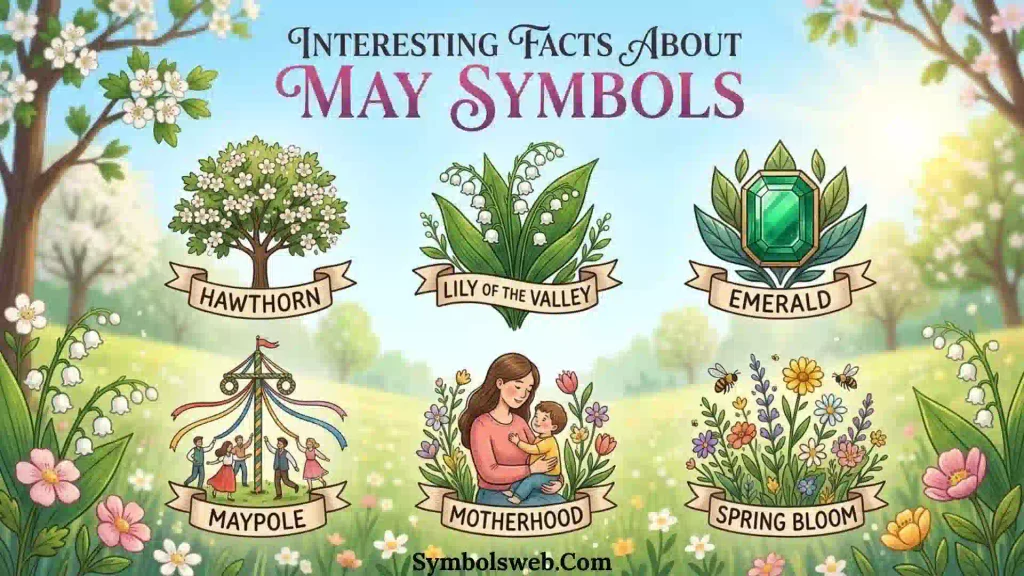
- Emerald is the official birthstone of May. The Gemological Institute of America identifies emerald as May’s birthstone.
- Emerald belongs to the beryl mineral family. It is the green to bluish-green variety of beryl.
- Ancient Egyptians mined emeralds. GIA notes that the earliest known Egyptian emerald mines date back to at least 330 BC.
- Cleopatra was famous for her love of emeralds. Emerald jewelry was part of her royal image.
- Lily of the valley is not actually a true lily. It belongs to the asparagus family, Asparagaceae.
- The May full moon is commonly called the Flower Moon. The name reflects the abundance of flowers during this period and has been attributed to Algonquin traditions.
- May has two widely recognized birth flowers. They are lily of the valley and hawthorn.
- May Day has more than one historical meaning. It includes older spring traditions as well as the later international association with workers’ movements and labor rights.
- Emerald has a long history of magical folklore. Historical traditions claimed it could reveal truth, provide foresight, or protect against harmful forces. These were beliefs, not scientifically established powers.
- The maypole has a complicated history. Maypole traditions flourished in medieval England, were banned in 1644, returned after 1660, and were later revived in new forms.
Frequently Asked Questions
What is the main symbol of May?
There is no single universal symbol of May. The emerald is its recognized birthstone, while lily of the valley and hawthorn are widely recognized birth flowers. Green, the Flower Moon, May Day flowers, and the maypole are also strongly associated with the month.
What does May symbolize?
May commonly symbolizes growth, renewal, hope, fertility, love, happiness, beauty, and new beginnings. These meanings come from seasonal changes, spring traditions, flowers, mythology, folklore, astrology, and modern birth-month symbolism.
What is May’s birthstone?
May’s birthstone is emerald. It is a green to bluish-green variety of beryl and has been valued for thousands of years. Emerald is strongly associated with renewal, spring, vitality, and abundance.
What are May’s birth flowers?
The two widely recognized May birth flowers are lily of the valley and hawthorn. Lily of the valley is commonly associated with purity, sweetness, humility, and a return to happiness, while hawthorn is associated with hope, love, protection, and fertility.
What does the Flower Moon symbolize?
The Flower Moon is the traditional name commonly given to the May full moon. Its symbolism centers on flowering plants, seasonal abundance, growth, and the awakening of nature. Different Indigenous communities have used different names and meanings for this time of year.
What does May symbolize spiritually?
Spiritually, May can represent renewal, inner growth, healing, hope, transformation, and the beginning of a new chapter. These meanings are interpretive rather than universal religious rules, so the personal meaning of May symbolism can vary from one person to another.
Conclusion
Many symbols tell a story much larger than a calendar month. The emerald represents the richness of renewal, lily of the valley suggests gentle happiness, and hawthorn combines hope with protection.
The Flower Moon, maypole, green landscapes, and May Day traditions all point toward the same deeper idea: life changes, returns, and grows. Perhaps that is why May feels so meaningful.

Hi, I’m Ethan Holloway, and I’ve always believed that a few meaningful words can change the way we think, feel, and live. I enjoy collecting timeless quotes, studying their deeper meanings, and sharing inspiring messages that help people stay motivated through every stage of life.
Over the years, I’ve explored thousands of famous sayings from writers, leaders, philosophers, and everyday people. My goal is to make wisdom easy to understand and useful for everyone.
Books by Ethan Holloway
- The Power of Everyday Quotes
- Words That Inspire Greatness
 Jordan Hayes
 Eliana Foster