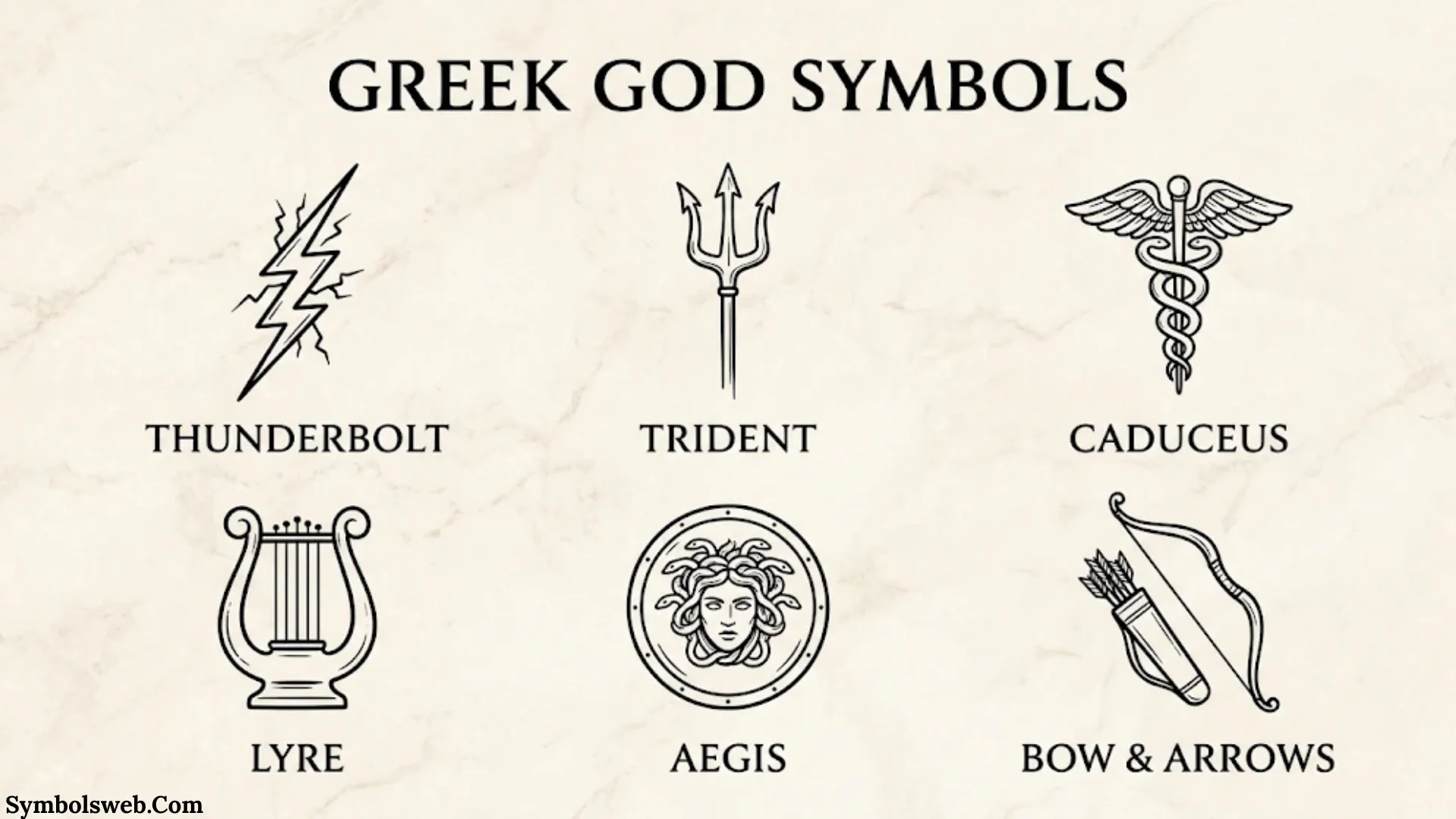
Greek god symbols reveal the stories, powers, and personalities of ancient Greek deities. A thunderbolt represents Zeus’s authority. Athena’s owl stands for wisdom while Poseidon’s trident reflects his control over the sea. These familiar objects and animals helped people recognize the gods in ancient art, temples, pottery, and sculptures.
However, Greek mythology symbols mean much more than simple identification. Many connect to important myths, religious beliefs, natural forces, and everyday life in ancient Greece. A pomegranate recalls the story of Persephone. A laurel wreath connects Apollo with poetry, music, and the famous myth of Daphne. A serpent can represent healing, renewal, or divine protection.
Whether you’re researching Greek god symbols and meanings, exploring ancient mythology, or looking for Greek mythology tattoo ideas, this guide explains the most important symbols and their stories. You’ll also discover the symbols of the Twelve Olympians, lesser-known Greek deities, sacred animals, and the differences between symbols that people often confuse.
What Are Greek God Symbols?
Greek god symbols are objects, animals, plants, weapons, and other attributes associated with particular gods and goddesses. They represent a deity’s powers, responsibilities, personality, or role in Greek mythology.
Ancient Greek artists used these attributes to help viewers identify divine figures. For example, a man holding a thunderbolt usually represents Zeus. A woman wearing a helmet and carrying a shield may represent Athena.
These symbols appeared throughout ancient Greek culture, including:
- Sculptures: Artists used recognizable objects and clothing to identify gods.
- Pottery: Painted scenes showed gods carrying their traditional attributes.
- Coins: Cities sometimes placed their patron deities and sacred animals on coins.
- Temples: Religious art and decorations represented the gods honored at each sanctuary.
- Religious offerings: Worshippers dedicated objects to deities as acts of devotion.
- Mythological stories: Animals, plants, and objects helped explain divine powers and events.
The Metropolitan Museum of Art explains that Greek gods had distinct personalities and domains. Ancient Greek artwork used their symbolic attributes to identify them.
The Metropolitan Museum of Art+1
Why Did Greek Gods Have Symbols?
Greek mythology included many gods with different responsibilities. Their symbols made their identities easier to recognize.
A trident immediately connected Poseidon with the sea. A sheaf of wheat linked Demeter with agriculture and harvests. Hermes’s winged sandals reflected his speed and role as a messenger.
Some symbols also carried religious meaning. An object could represent divine protection, fertility, victory, healing, or prosperity.
It’s also important to understand that not every symbol belonged to only one god. The aegis, for example, was associated with both Zeus and Athena. Its meaning depended on the story or artwork.
17 Greek God Symbols and Their Meanings
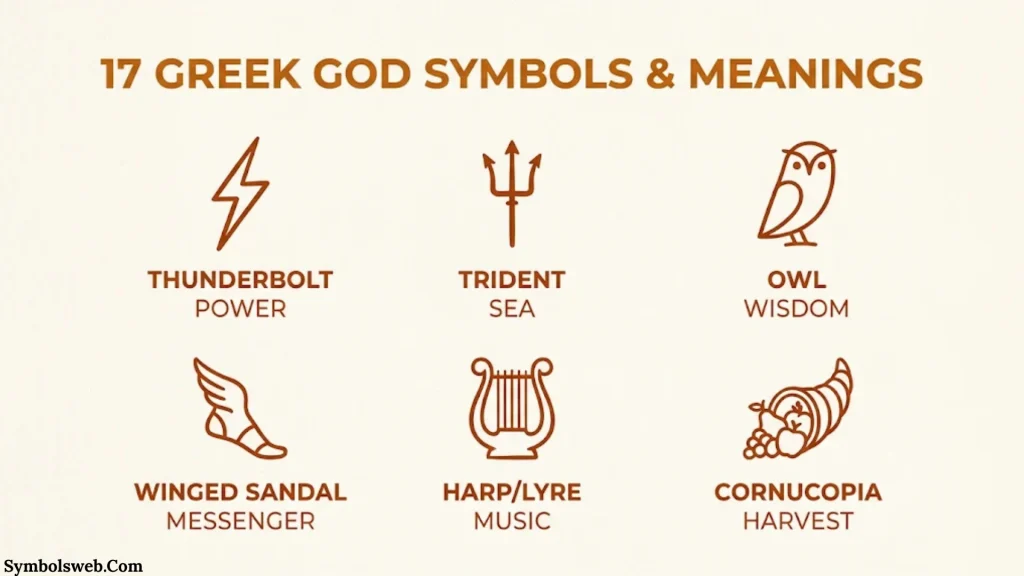
The following Greek mythology symbols are among the most recognizable attributes associated with ancient deities. Each one has a story or cultural connection that helps explain its meaning.
Thunderbolt: Symbol of Zeus
The thunderbolt is one of the most recognizable symbols in Greek mythology. It represents Zeus, the king of the gods and ruler of the sky.
Zeus controlled thunder, lightning, rain, and storms. His thunderbolt represented his extraordinary power and authority over gods and mortals.
According to Greek mythology, the Cyclopes forged Zeus’s thunderbolt after he freed them from imprisonment. They gave him this powerful weapon during the conflict against the Titans.
The thunderbolt helped establish Zeus as the supreme ruler of Mount Olympus.
Meanings of Zeus’s thunderbolt:
- Divine power and authority
- Strength and leadership
- Justice and punishment
- Control over storms and lightning
- Protection of divine order
The eagle, oak tree, and royal scepter are also associated with Zeus.
Owl: Symbol of Athena
The owl represents Athena, the Greek goddess of wisdom, strategic warfare, and crafts. It is one of the most famous symbols of wisdom in Western culture.
Athena was the patron goddess of Athens. Ancient Greeks connected her owl with intelligence, observation, and clear judgment.
Owls can see in low light and remain alert while much of the world sleeps. These qualities made the bird a fitting symbol for a goddess associated with knowledge and careful thinking.
The owl also appeared on ancient Athenian coins. The famous Athenian silver tetradrachm featured Athena on one side and an owl on the other.
Meanings of Athena’s owl:
- Wisdom and knowledge
- Intelligence and strategy
- Observation and awareness
- Clear judgment
- Protection and guidance
Athena’s other important symbols include the olive tree, helmet, spear, shield, and aegis.
Trident: Symbol of Poseidon
The trident is the three-pronged spear associated with Poseidon, the Greek god of the sea, earthquakes, and horses.
Poseidon used this powerful weapon to control the waters and stir up storms. Mythological stories also connect his trident with earthquakes and the creation of springs.
The three points make the trident easy to recognize in ancient artwork. Artists frequently depicted Poseidon holding it while standing beside sea creatures or riding a chariot.
Meanings of Poseidon’s trident:
- Power over the sea
- Strength and authority
- Natural forces
- Storms and earthquakes
- Control over water
The horse, dolphin, and bull are also associated with Poseidon.
Laurel Wreath: Symbol of Apollo
The laurel wreath is closely connected with Apollo, the Greek god of music, prophecy, poetry, healing, and archery.
Its association comes from the myth of Apollo and Daphne. According to the story, Daphne was a nymph who tried to escape Apollo’s pursuit. Her father, the river god Peneus, transformed her into a laurel tree.
Apollo then made the laurel sacred to himself.
The wreath later became a symbol of achievement and victory. Ancient Greeks used laurel wreaths to honor winners at the Pythian Games held near Apollo’s sanctuary at Delphi.
Meanings of Apollo’s laurel wreath:
- Victory and achievement
- Artistic excellence
- Prophecy and inspiration
- Honor and recognition
- Immortality and remembrance
Apollo is also associated with the lyre, bow, and tripod.
Cornucopia: Symbol of Abundance
The cornucopia, also called the horn of plenty, represents abundance, nourishment, fertility, and prosperity.
It usually appears as a curved horn filled with fruits, vegetables, flowers, or grain. In Greek mythology, one tradition connects it with Amalthea, the figure who cared for the infant Zeus.
The cornucopia later became associated with agricultural prosperity and several deities. Demeter, the goddess of agriculture, is particularly connected with harvest imagery and abundance.
Meanings of the cornucopia:
- Wealth and prosperity
- Fertility and growth
- Food and nourishment
- Agricultural abundance
- Good fortune
The cornucopia is not an exclusive symbol of one Greek god. Its meaning depends on the deity and artistic context.
Caduceus: Symbol of Hermes
The caduceus is the staff carried by Hermes, the messenger of the Greek gods. It usually appears as a central rod with two snakes wrapped around it and wings near the top.
Hermes protected travelers, merchants, shepherds, and messengers. He also guided the souls of the dead toward the Underworld.
The caduceus therefore became associated with communication, travel, commerce, and negotiation.
One common misunderstanding concerns its use as a medical symbol. The caduceus belongs to Hermes. The traditional medical symbol is the Rod of Asclepius, which has one snake wrapped around a staff.
Meanings of the caduceus:
- Communication and messages
- Trade and commerce
- Travel and movement
- Negotiation and exchange
- Mediation and diplomacy
Hermes also carries winged sandals and a traveler’s hat.
Aegis: Symbol of Divine Protection
The aegis is a protective object associated with Zeus and Athena. Ancient artwork often shows it as a shield or protective covering decorated with the head of Medusa.
The aegis represents divine protection and the power to repel danger. Athena frequently wears it over her chest while carrying a spear and shield.
Its connection with Medusa adds another layer of meaning. The Gorgon’s frightening face could serve as a protective image against harmful forces.
Meanings of the aegis:
- Divine protection
- Strength and authority
- Defense against enemies
- Courage and security
- Power over danger
The aegis is especially important in representations of Athena because it combines her protective and warrior roles.
Labrys: The Double Headed Axe
The labrys is a double-headed axe associated with ancient Aegean cultures, particularly Minoan Crete.
Archaeologists have found double-headed axe imagery in Minoan religious and artistic contexts. These objects appear in religious spaces and on artifacts from the Bronze Age.
The labrys is sometimes connected with female divinity and the Minoan religious world. However, it should not be presented as the exclusive personal symbol of a specific Olympian god.
Meanings commonly associated with the labrys include:
- Religious authority
- Strength and power
- Ritual practice
- Minoan culture
- Ancient Aegean traditions
Its historical significance makes it an important symbol when studying Greek and pre-Greek religious imagery.
Serpent: Symbol of Healing and Renewal
The serpent appears in several areas of Greek mythology. It can represent healing, renewal, protection, wisdom, and connections with the earth.
One of its most important associations is with Asclepius, the Greek god of medicine and healing. His traditional symbol is a staff with a single snake winding around it.
Snakes shed their skin, which made them meaningful symbols of renewal and transformation. Their presence in ancient healing sanctuaries also contributed to their religious significance.
Serpents were not limited to Asclepius. They also appeared in the imagery of Athena, Hecate, and other divine figures.
Meanings of the Greek serpent symbol:
- Healing and medicine
- Renewal and transformation
- Protection
- Wisdom and knowledge
- Connection with the earth
Evil Eye: Symbol of Protection
The evil eye, commonly known as mati in modern Greek, is a protective symbol used against harmful envy or hostile attention.
It usually appears as a blue eye-shaped design. People wear it as jewelry or display it in homes and other spaces.
Although the evil eye is familiar in Greek culture, it is not a personal attribute of one Olympian god. Beliefs about harmful looks and protective amulets have a much wider Mediterranean and Near Eastern history.
The evil eye should also be distinguished from the Gorgoneion, the image of Medusa’s face used in ancient Greek protective art.
Meanings of the evil eye:
- Protection against envy
- Defense against harmful attention
- Good fortune
- Spiritual protection
- Safety and well-being
Olive Tree: Symbol of Athena
The olive tree is one of the most important symbols associated with Athena. It represents wisdom, peace, prosperity, and the value of practical knowledge.
According to the myth of Athena and Poseidon, the two gods competed to become the patron deity of Athens.
Poseidon offered a source of water or a horse in different versions of the story. Athena gave the city an olive tree, which provided food, oil, and useful wood.
The people chose Athena’s gift. The city became known as Athens in her honor.
Meanings of the olive tree:
- Wisdom and intelligence
- Peace and harmony
- Prosperity and nourishment
- Practical skill
- Protection of the city
The olive branch also became a wider symbol of peace and victory.
Helmet and Spear: Symbols of Athena and Ares
The helmet and spear are common symbols of Greek warfare. They are especially associated with Athena and Ares, although the two gods represent different aspects of battle.
Athena represents strategy, discipline, military planning, and the protection of cities. Ares represents the violent and destructive side of war.
Athena’s helmet often appears alongside her aegis, shield, and spear. Ares is commonly shown as an armed warrior carrying a spear, sword, or shield.
Meanings of the helmet and spear:
- Courage and strength
- Military strategy
- Defense and protection
- Conflict and battle
- Leadership and discipline
These weapons help distinguish Athena’s strategic warfare from Ares’s association with the violence of battle.
Gorgoneion: Symbol of Medusa’s Protective Power
The Gorgoneion is an image of a Gorgon’s face, most famously Medusa’s. It appeared on shields, armor, pottery, buildings, and other objects in ancient Greek art.
Medusa was one of the three Gorgons. Her face could turn those who looked at her into stone.
The image became a protective device in Greek visual culture. Its frightening appearance was believed to repel danger and protect the person or place displaying it.
Athena’s aegis frequently includes the Gorgoneion.
Meanings of the Gorgoneion:
- Protection against evil
- Defense against enemies
- Power and intimidation
- Divine authority
- The ability to repel danger
Unlike the modern evil eye, the Gorgoneion comes directly from Greek mythological imagery.
Lyre: Symbol of Apollo
The lyre is a stringed musical instrument associated with Apollo, the Greek god of music, poetry, prophecy, and artistic inspiration.
Apollo’s lyre represents harmony, creativity, and the beauty of music. Ancient Greek artists frequently showed him holding the instrument.
The lyre also has an important connection with Hermes. According to mythology, Hermes created the first lyre using a tortoise shell and later gave it to Apollo.
Meanings of Apollo’s lyre:
- Music and harmony
- Poetry and creativity
- Artistic inspiration
- Balance and order
- Cultural achievement
Apollo’s association with music also connects him with the Muses, the divine figures who inspired artistic and intellectual work.
Torch: Symbol of Hecate and Demeter
The torch is associated with several Greek deities, especially Hecate and Demeter.
Hecate is connected with magic, crossroads, night, and transitions. Artists often depict her carrying torches that illuminate dark places.
Demeter’s torch has a different mythological connection. After Hades took Persephone to the Underworld, Demeter searched for her daughter. The torch represents this search and the goddess’s grief.
Meanings of the torch:
- Guidance and illumination
- Knowledge and awareness
- Protection in darkness
- Search and discovery
- Transition and transformation
The torch also connects with the religious traditions surrounding the Eleusinian Mysteries.
Chariot: Symbol of Helios and Apollo
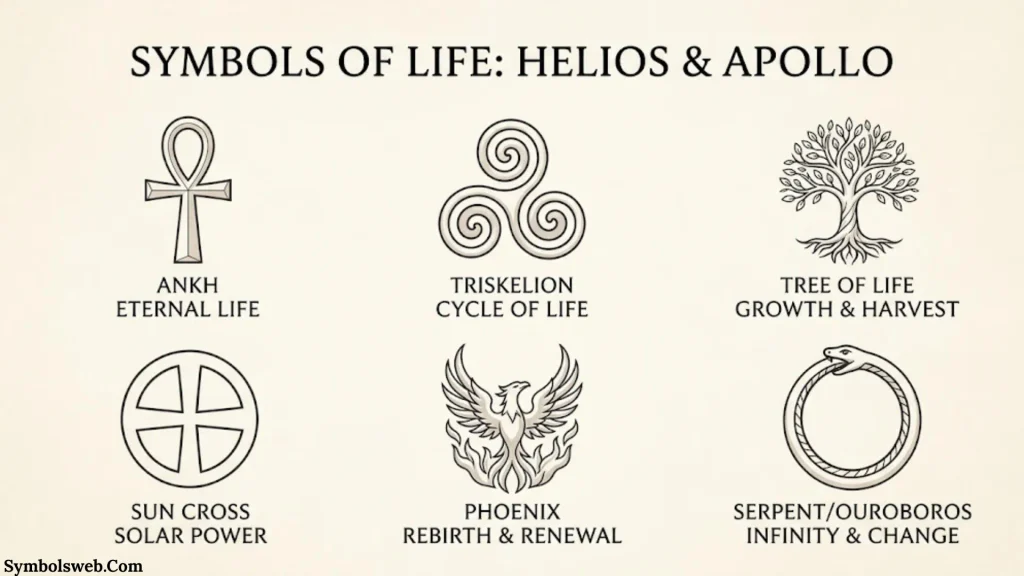
The chariot is closely associated with Helios, the Greek personification of the Sun. Mythological stories describe him driving a radiant chariot across the sky.
His journey explained the movement of the Sun from sunrise to sunset in ancient Greek storytelling.
Apollo later developed strong solar associations in Greek and Roman traditions. However, Helios and Apollo were distinct figures in much early Greek mythology.
This distinction matters when interpreting ancient artwork. A solar chariot does not automatically identify Apollo.
Meanings of the solar chariot:
- Light and illumination
- The passage of time
- Daily cycles
- Cosmic order
- Movement across the heavens
Helios is commonly shown with a radiant crown or solar imagery.
Pomegranate: Symbol of Persephone
Trilogia delle Madri /12: Sulla via di Eleusi
The pomegranate is an important symbol associated with Persephone, the goddess of spring growth and queen of the Underworld.
Its meaning comes from the myth of Persephone’s abduction by Hades. During her time in the Underworld, she ate pomegranate seeds. This act connected her to the realm of the dead.
In one widely known version of the story, Persephone must spend part of each year with Hades and the rest with Demeter.
Her annual return brings joy to Demeter and allows the earth to produce new growth. Her departure explains the seasonal loss of vegetation.
Meanings of the pomegranate:
- Fertility and abundance
- Life and death
- Rebirth and renewal
- Marriage and commitment
- Seasonal change
The pomegranate also appears in wider Greek religious and artistic traditions. Its meaning is not limited to Persephone.
Symbols of the Twelve Olympian Gods
The Twelve Olympians were the principal gods and goddesses associated with Mount Olympus. Ancient traditions did not always agree on the exact membership of this group. Hestia and Dionysus, for example, appear in different versions of the twelve.
Their symbols reflected their responsibilities, powers, and stories.
| Greek God or Goddess | Main Role | Important Symbols |
| Zeus | Sky, thunder, kingship, justice | Thunderbolt, eagle, oak, scepter |
| Hera | Marriage, women, childbirth | Peacock, cow, crown, scepter |
| Poseidon | Sea, earthquakes, horses | Trident, horse, dolphin, bull |
| Demeter | Agriculture, harvest, fertility | Wheat, torch, cornucopia, poppy |
| Athena | Wisdom, strategy, crafts | Owl, olive tree, aegis, helmet |
| Apollo | Music, prophecy, healing | Lyre, laurel, bow, tripod |
| Artemis | Hunting, wilderness, childbirth | Bow, arrows, deer, bear |
| Ares | War and battle | Spear, helmet, shield, sword |
| Aphrodite | Love, beauty, desire | Dove, rose, myrtle, apple |
| Hephaestus | Fire, metalworking, craftsmanship | Hammer, anvil, tongs, forge |
| Hermes | Travel, trade, communication | Caduceus, winged sandals, petasos |
| Dionysus | Wine, theater, celebration | Thyrsus, grapevine, ivy, drinking cup |
Zeus: Thunderbolt, Eagle, and Oak
Zeus ruled the sky and held authority over the gods. His thunderbolt represented his power to punish wrongdoing and maintain divine order.
His eagle symbolized strength and kingship. The oak tree was also sacred to him, especially at his ancient sanctuary of Dodona.
Hera: Peacock, Cow, and Crown
Hera was the queen of the gods and the goddess of marriage and women. Her symbols included the peacock, cow, scepter, and crown.
The peacock became particularly recognizable in later Greek and Roman artistic traditions. The crown represented her royal position.
Poseidon: Trident, Horse, and Dolphin
Poseidon ruled the sea and was also associated with earthquakes and horses.
His trident represented his control over water and storms. Horses reflected his connection with powerful animals and his role in equestrian traditions.
Demeter: Wheat, Torch, and Cornucopia
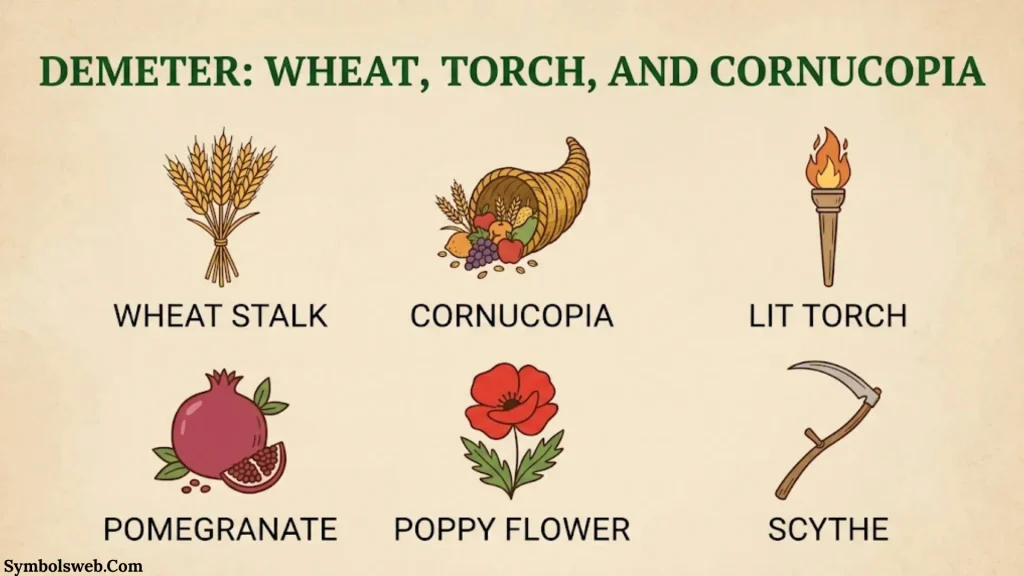
Demeter governed agriculture, grain, and the fertility of the earth.
Her wheat sheaf represented the harvest and the food that sustained human communities. The torch recalled her search for Persephone.
Athena: Owl, Olive Tree, and Aegis
Athena represented wisdom, strategic warfare, and skilled craftsmanship.
Her owl symbolized intelligence. The olive tree represented prosperity and the founding myth of Athens. Her aegis represented divine protection.
Apollo: Lyre, Laurel, and Bow
Apollo was associated with music, poetry, prophecy, healing, and archery.
His lyre represented artistic skill and harmony. The laurel recalled the story of Daphne while the bow reflected his role as an archer.
Artemis: Bow, Deer, and Bear
Artemis was the goddess of hunting and wilderness. She was also associated with childbirth and the protection of young people.
Her bow and arrows represented her hunting skills. The deer and bear reflected her connection with wild animals and nature.
Ares: Spear, Helmet, and Shield
Ares represented the violence and aggression of war.
His spear, helmet, shield, and sword identified him as a warrior. These symbols reflected the physical dangers of battle rather than Athena’s strategic approach to warfare.
Aphrodite: Dove, Rose, and Myrtle
Aphrodite was the goddess of love, beauty, and desire.
Her dove represented love and affection. The rose and myrtle became important floral symbols associated with beauty and romance.
Hephaestus: Hammer, Anvil, and Tongs
Hephaestus was the divine blacksmith and craftsman of the gods.
His tools represented metalworking, engineering, fire, and skilled labor. The hammer and anvil remain familiar symbols of craftsmanship.
Hermes: Caduceus, Winged Sandals, and Petasos
Hermes served as the messenger of the gods. He also protected travelers, merchants, and shepherds.
His winged sandals represented speed and movement. The caduceus identified him as a divine messenger while the petasos was his distinctive traveler’s hat.
Dionysus: Thyrsus, Grapevine, and Ivy
Dionysus was the god of wine, theater, celebration, and ecstatic religious experiences.
His thyrsus was a staff decorated with a pine cone and often wrapped in ivy or grapevine. These plants represented his connection with nature, wine, and ritual celebration.
Greek God Symbols Beyond the Twelve Olympians
Greek mythology includes many important deities who were not always counted among the Twelve Olympians. Their symbols help explain their roles in myths and ancient religious traditions.
| Greek Deity | Role | Main Symbols |
| Hades | Underworld and the dead | Helm of darkness, bident, Cerberus |
| Hecate | Magic, crossroads, night | Torches, keys, serpents, dogs |
| Helios | Personification of the Sun | Solar crown, chariot, horses |
| Asclepius | Medicine and healing | Rod of Asclepius, serpent |
| Eros | Love and desire | Bow, arrows, wings |
| Hestia | Hearth and home | Hearth fire, kettle |
| Nike | Victory | Wings, palm branch, laurel |
| Persephone | Spring growth and Underworld | Pomegranate, flowers, torch, grain |
Hades: Helm of Darkness and Cerberus
Hades ruled the Underworld, the realm of the dead. His helm of darkness allowed him to become invisible.
Cerberus, the three-headed dog, guarded the entrance to the Underworld. The bident, a two-pronged weapon, also appears in artistic representations of Hades.
His symbols connect him with death, the afterlife, hidden wealth, and the mysteries of the earth.
Hecate: Torches, Keys, and Crossroads
Hecate was associated with magic, night, spirits, and crossroads.
Her torches represented light in darkness. Keys symbolized access to hidden places and transitions between worlds.
Dogs and serpents also appeared in her religious and mythological imagery.
Helios: Sun and Chariot
Helios personified the Sun and drove his chariot across the heavens.
His symbols included a radiant crown, horses, and the solar chariot. He should not be confused with Apollo, whose association with the Sun became stronger in later traditions.
Asclepius: Rod of Asclepius
Asclepius was the Greek god of medicine and healing.
His most important symbol is a staff with one serpent wrapped around it. This image remains widely recognized as a symbol of medicine.
The Rod of Asclepius is different from Hermes’s caduceus, which usually has two snakes and wings.
Eros: Bow, Arrows, and Wings
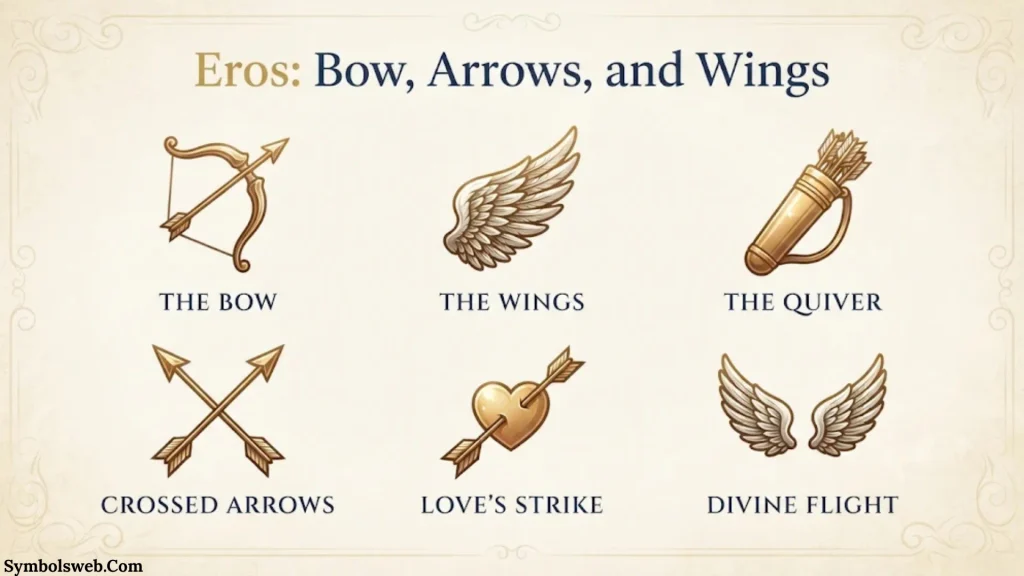
Eros represented love and desire. His bow and arrows symbolized the power of attraction.
In mythology and later art, Eros could appear as a youthful winged figure. Roman tradition identified him with Cupid.
Hestia: Hearth Fire
Hestia was the goddess of the hearth and domestic life.
Her sacred fire represented the warmth, stability, and unity of the household. The public hearth also held an important place in ancient Greek communities.
Nike: Wings and Laurel
Nike was the goddess of victory. Artists often represented her as a winged woman arriving to honor a successful athlete or warrior.
Her wings represented swift victory while the palm branch and laurel connected her with triumph and achievement.
Persephone: Pomegranate and Flowers
Persephone was both the goddess associated with spring growth and the queen of the Underworld.
The pomegranate represented her connection with Hades. Flowers and grain reflected her relationship with Demeter and the return of seasonal growth.
Greek Mythological Animals and Their Meanings
Animals played an important role in Greek mythology. Gods often had sacred animals that reflected their personalities, powers, or responsibilities.
These creatures appeared in religious art, stories, sculptures, and temple decorations.
| Animal | Associated Deity | Symbolic Meaning |
| Eagle | Zeus | Kingship, strength, divine authority |
| Owl | Athena | Wisdom, knowledge, awareness |
| Peacock | Hera | Royal status, beauty, majesty |
| Dolphin | Poseidon | Sea, guidance, protection |
| Horse | Poseidon | Strength, speed, power |
| Dove | Aphrodite | Love, affection, beauty |
| Deer | Artemis | Wilderness, gentleness, nature |
| Serpent | Asclepius | Healing, renewal, protection |
| Panther | Dionysus | Wild nature, power, ecstasy |
| Dog | Hecate | Protection, night, crossroads |
| Swan | Aphrodite and Apollo | Beauty, music, grace |
| Bull | Zeus and Poseidon | Strength, fertility, power |
Why Were Animals Sacred to Greek Gods?
Animals provided a way to understand divine qualities through familiar features of nature.
The eagle represented Zeus’s authority because of its strength and ability to soar high above the ground. Athena’s owl reflected observation and wisdom.
Poseidon’s dolphin connected him with the sea. Artemis’s deer reflected her relationship with wild animals and the natural world.
However, an animal did not always belong to one deity. The same creature could appear in different myths and religious traditions.
Greek Symbols by Meaning
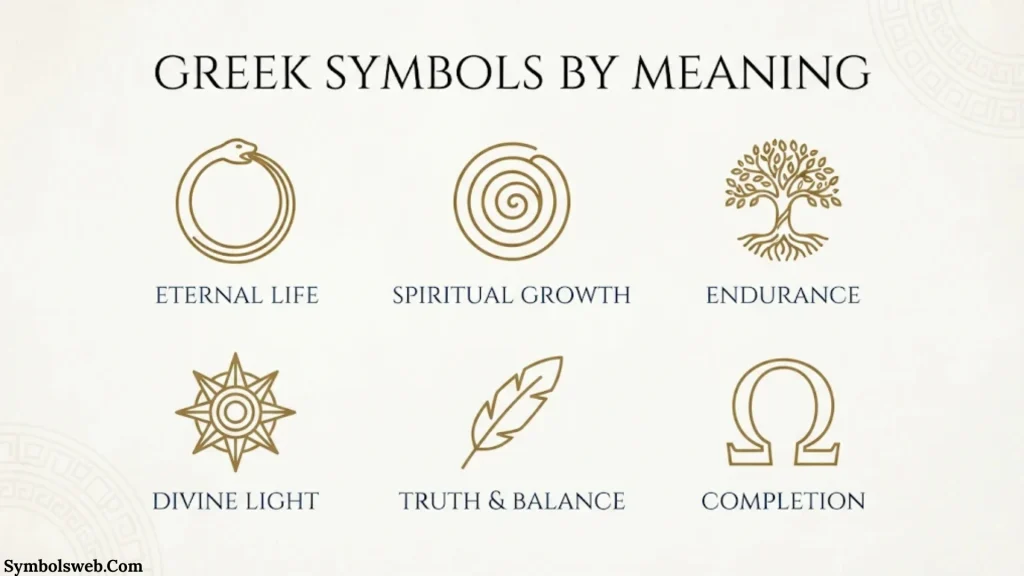
Greek mythology symbols can also be grouped by the ideas they represent. This approach helps when researching symbols for artwork, jewelry, tattoos, or personal study.
Greek Symbols of Power and Strength
Several Greek symbols represent authority, physical strength, and divine control.
- Zeus’s thunderbolt: Supreme authority and divine power.
- Poseidon’s trident: Control over the sea and natural forces.
- Ares’s spear: Military strength and aggression.
- Heracles’s club: Courage, physical strength, and heroic achievement.
- Zeus’s eagle: Kingship and divine authority.
Greek Symbols of Wisdom and Knowledge
Athena is the most important Greek goddess associated with wisdom.
Her owl represents intelligence and observation. The olive tree connects knowledge with practical skill and prosperity.
Apollo’s association with prophecy also connects him with knowledge of the future and divine inspiration.
Greek Symbols of Protection
Greek mythology contains several protective symbols.
- Aegis: Divine protection associated with Zeus and Athena.
- Gorgoneion: Medusa’s face used to repel danger.
- Owl: Wisdom and protective awareness associated with Athena.
- Hecate’s torch: Guidance through darkness.
- Serpent: Protection and renewal in several religious contexts.
Greek Symbols of Love
Aphrodite and Eros are the two most recognizable figures associated with love and desire.
Their symbols include:
- Dove: Affection and devotion.
- Rose: Love and beauty.
- Myrtle: Love and marriage.
- Apple: Desire and beauty in several mythological stories.
- Eros’s bow and arrows: Attraction and romantic desire.
- Swan: Beauty and grace.
Greek Symbols of War and Courage
Greek mythology presents different sides of warfare through Athena and Ares.
Athena represents strategy and disciplined defense. Ares represents the violence and intensity of battle.
Their symbols include helmets, shields, spears, swords, and armor.
Greek Symbols of Healing and Renewal
The serpent and Rod of Asclepius are the strongest Greek symbols connected with healing.
They represent medicine, renewal, and recovery. Apollo also had healing powers and was associated with protection against disease.
Greek Symbols of Fertility and Abundance
Agriculture and fertility were essential to ancient Greek life. Several deities represented the earth’s ability to produce food and sustain communities.
Important symbols include:
- Wheat: Demeter and agricultural fertility.
- Cornucopia: Abundance and prosperity.
- Pomegranate: Fertility and renewal.
- Olive tree: Nourishment and prosperity.
- Grapevine: Dionysus, wine, and celebration.
Greek Symbols of Victory and Success
Victory was an important theme in Greek religious, athletic, and military life.
Nike’s wings represented victory. Apollo’s laurel wreath became associated with achievement through the Pythian Games.
The olive wreath also honored winners at the ancient Olympic Games.
Historical Origins of Greek God Symbols
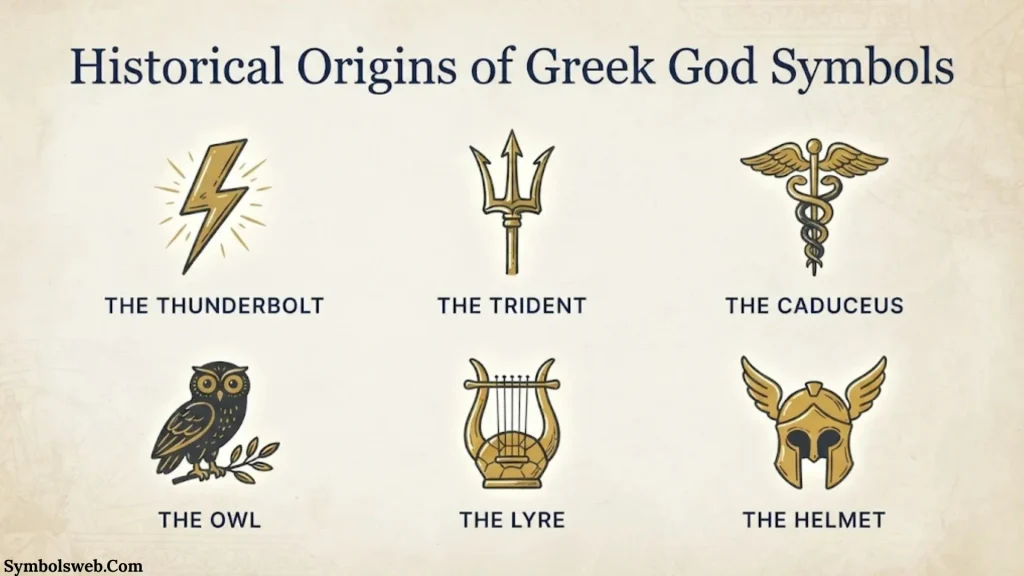
Greek god symbols developed over many centuries. Their meanings came from religious practices, local traditions, myths, and artistic conventions.
They were not all created at the same time. Some have roots in Bronze Age Aegean cultures while others became prominent in later Greek art.
Minoan Civilization and the Labrys
The Minoan civilization flourished on Crete during the Bronze Age. Its art and religious imagery included double-headed axes, often called labrys.
Archaeological discoveries show that these objects held significance in Minoan religious and ceremonial settings.
The labrys is therefore an important part of Aegean religious history. However, its exact meaning and relationship with particular deities remain subjects of historical interpretation.
Ancient Greek Religion and Sacred Attributes
Ancient Greek religion was polytheistic. People worshipped many gods and goddesses who had different responsibilities and areas of influence.
Communities honored their deities through sacrifices, festivals, prayers, and gifts. Sanctuaries contained objects and artwork connected with the gods worshipped there.
The Ashmolean Museum notes that ancient Greek religious objects included votive offerings, inscribed plaques, and vessels used for offerings.
Ashmolean Museum
Greek Art and the Development of Divine Symbols
Greek artists used familiar attributes to identify gods in sculptures, pottery, coins, and reliefs.
For example:
- Zeus appeared with a thunderbolt.
- Poseidon carried a trident.
- Athena wore a helmet and aegis.
- Apollo held a lyre.
- Hermes carried a herald’s staff.
These attributes helped people recognize divine figures even when inscriptions were absent.
However, artists did not always follow fixed rules. Some objects appeared in the imagery of several gods. A figure’s identity may depend on the entire scene rather than one isolated object.
Greek and Roman Interpretations
Roman culture adopted many Greek gods and adapted their names and traditions.
| Greek God | Roman Name |
| Zeus | Jupiter |
| Hera | Juno |
| Poseidon | Neptune |
| Demeter | Ceres |
| Athena | Minerva |
| Apollo | Apollo |
| Artemis | Diana |
| Ares | Mars |
| Aphrodite | Venus |
| Hephaestus | Vulcan |
| Hermes | Mercury |
| Dionysus | Bacchus |
| Hestia | Vesta |
| Hades | Pluto |
Roman artists continued using many familiar Greek attributes. However, Greek and Roman religious traditions were not identical. Their gods developed through different cultural practices and interpretations.
Greek God Symbols and Their Famous Myths
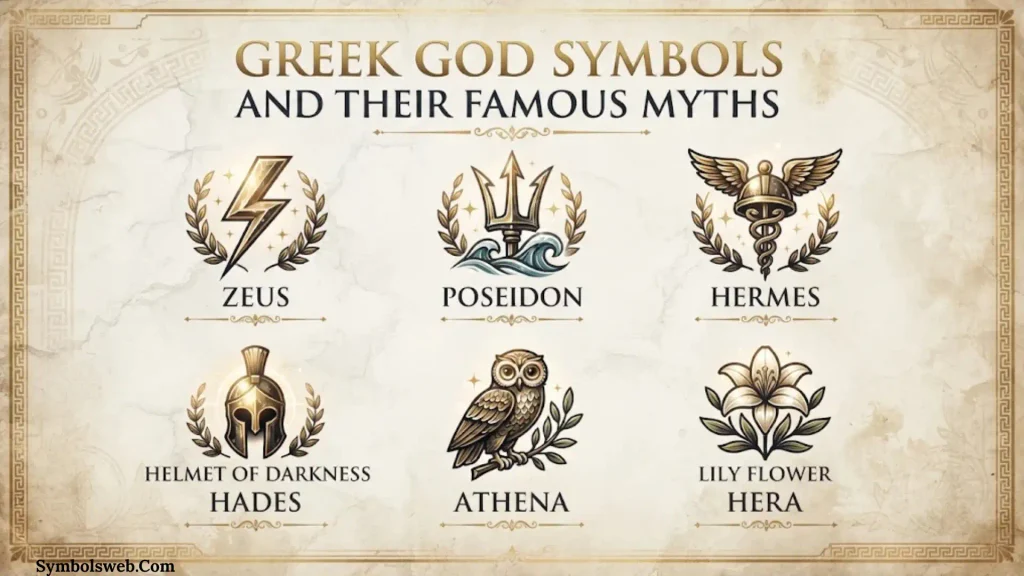
Many Greek symbols become easier to understand when you know the myths behind them.
Zeus and the Creation of the Thunderbolt
Zeus’s thunderbolt came from the Cyclopes, who forged it as a weapon for him.
The gift helped Zeus fight the Titans and establish his rule. It became a visual representation of his authority over the heavens.
Athena and the Olive Tree
Athena competed with Poseidon for the patronage of Athens.
Poseidon demonstrated his power while Athena offered an olive tree. The tree provided food, oil, and wood, making it a valuable gift for the city’s people.
Athena won the competition and became the city’s patron goddess.
Apollo and the Story of Daphne
Apollo pursued the nymph Daphne after becoming affected by Eros’s arrow.
Daphne tried to escape and was transformed into a laurel tree. Apollo then made the laurel sacred to himself.
This myth explains the connection between Apollo and the laurel wreath.
Persephone and the Pomegranate
Hades took Persephone to the Underworld, leaving her mother Demeter heartbroken.
During her time there, Persephone ate pomegranate seeds. This connected her to the Underworld and led to the tradition that she would spend part of each year with Hades.
Her return brought joy to Demeter and symbolized the earth’s renewal.
Hermes and the Creation of the Lyre
Hermes created the first lyre from a tortoise shell, according to Greek mythology.
He later gave the instrument to Apollo. The story connects Hermes with clever invention and Apollo with music.
Medusa and the Gorgoneion
Medusa was a Gorgon whose gaze could turn people to stone.
Perseus eventually killed her with divine assistance. Her head later became a protective image on Athena’s aegis.
This explains why Medusa’s face appeared on shields, armor, pottery, and other objects in ancient Greek art.
Greek God Symbols for Tattoos and Jewelry
Greek mythology symbols remain popular in tattoos, pendants, bracelets, and decorative designs. Their recognizable shapes and stories make them meaningful choices for people interested in ancient mythology.
Before choosing a design, understand its original context. A symbol may have several meanings or connections with different gods.
| Tattoo or Jewelry Symbol | Traditional Association | Common Meaning |
| Zeus’s thunderbolt | Zeus | Power, strength, authority |
| Athena’s owl | Athena | Wisdom, intelligence |
| Poseidon’s trident | Poseidon | Strength, sea, independence |
| Apollo’s laurel | Apollo | Victory, achievement |
| Aphrodite’s rose | Aphrodite | Love, beauty |
| Hermes’s caduceus | Hermes | Communication, travel, trade |
| Rod of Asclepius | Asclepius | Healing, medicine |
| Persephone’s pomegranate | Persephone | Renewal, fertility, transformation |
| Medusa’s head | Medusa and Athena | Protection, strength |
| Hecate’s torch | Hecate | Guidance, transition |
Greek Symbols for Strength Tattoos
If you want a design connected with strength, consider Zeus’s thunderbolt, Poseidon’s trident, or Heracles’s club.
Each symbol expresses a different kind of strength. Zeus represents authority, Poseidon represents control over natural forces, and Heracles represents physical courage and heroic endurance.
Greek Symbols for Wisdom Tattoos
Athena’s owl is a natural choice for a wisdom tattoo.
You could also consider Athena’s olive tree or an image of the goddess wearing her helmet. These designs connect intelligence with knowledge, strategy, and practical skill.
Greek Symbols for Love Tattoos
Aphrodite’s rose, dove, and myrtle are traditional choices for love-themed designs.
Eros’s bow and arrows can represent attraction and romantic desire. A pomegranate may offer a more complex design connected with Persephone, fertility, and transformation.
Greek Symbols for Protection Tattoos
The Aegis and Gorgoneion have strong historical connections with protection.
A Medusa-inspired design can represent the protective power of her image in ancient Greek art. Hecate’s torch can symbolize guidance through difficult periods.
Remember that modern tattoo meanings are personal interpretations. They may differ from the original religious meaning of a symbol.
Greek God Symbols That People Often Confuse
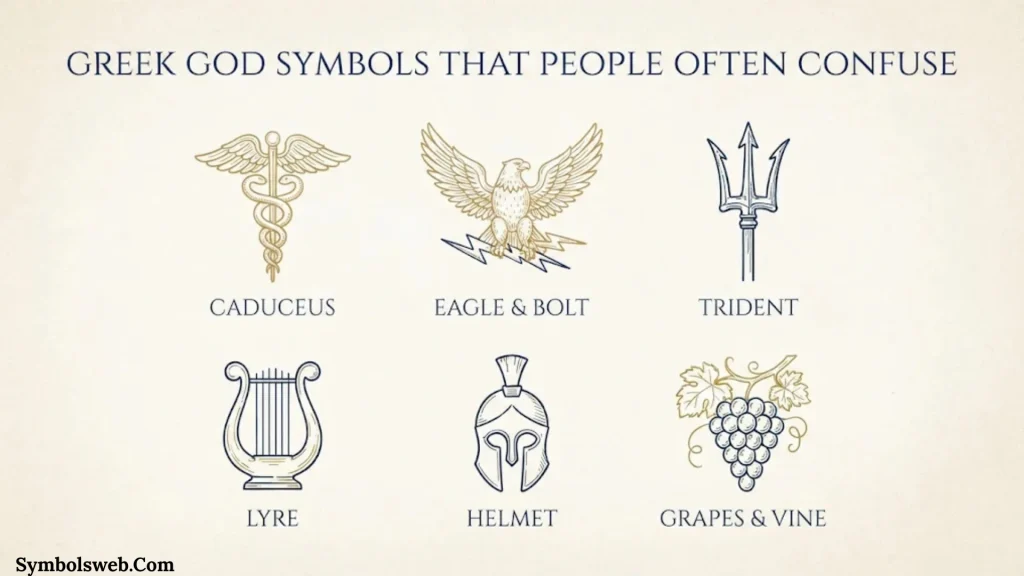
Some Greek mythology symbols look similar or have overlapping meanings. Understanding their differences helps prevent common mistakes.
Caduceus vs. Rod of Asclepius
The Serpent on the Pole. Photo from… | by John Gu | UWCCF | Medium
Both symbols feature snakes wrapped around a staff. However, they belong to different Greek deities.
| Feature | Caduceus | Rod of Asclepius |
| Associated deity | Hermes | Asclepius |
| Snakes | Usually two | One |
| Wings | Often present | Usually absent |
| Original association | Trade, messages, travel | Medicine and healing |
| Common modern confusion | Used by some medical organizations | Traditional medical emblem |
The Science Museum Group explains that the caduceus is Hermes’s herald’s wand. The Rod of Asclepius has the strongest historical connection with medicine.
Science Museum Group Blog
Helios vs. Apollo
Helios and Apollo are sometimes treated as the same figure in modern retellings.
However, early Greek mythology presents them as distinct deities. Helios personified the Sun while Apollo had a wider role involving prophecy, music, healing, and archery.
Apollo’s solar associations became stronger in later traditions.
Gorgoneion vs. Evil Eye
Both symbols have protective associations, but their origins differ.
The Gorgoneion represents the frightening face of Medusa and appears in ancient Greek art. The evil eye is a broader protective belief found across Mediterranean and Near Eastern cultures.
They should not be treated as identical symbols.
Aegis vs. Ordinary Shield
The aegis is a special protective attribute associated with Zeus and Athena. It is not simply another name for an ordinary shield.
Its decoration often includes the Gorgoneion. This gives it a distinct connection with divine protection.
Greek Symbols vs. Modern Interpretations
A symbol’s modern meaning may differ from its ancient meaning.
For example, people commonly use the owl to represent education and academic achievement today. Its ancient connection with Athena is much more specific.
Similarly, the laurel wreath has become a general symbol of success. Its Greek mythological connection includes Apollo, Daphne, and religious competitions.
Understanding these differences makes your interpretation more accurate.
Frequently Asked Questions About Greek God Symbols
What Are the Most Important Greek God Symbols?
Some of the most recognizable Greek god symbols include Zeus’s thunderbolt, Athena’s owl, Poseidon’s trident, Apollo’s lyre, Hermes’s caduceus, and Aphrodite’s dove.
These attributes help identify the gods in ancient Greek art and mythology.
What Are the Symbols of the Twelve Olympian Gods?
The Twelve Olympians had different attributes:
- Zeus: Thunderbolt and eagle
- Hera: Peacock and crown
- Poseidon: Trident and horse
- Demeter: Wheat and torch
- Athena: Owl and olive tree
- Apollo: Lyre and laurel
- Artemis: Bow and deer
- Ares: Spear and helmet
- Aphrodite: Dove and rose
- Hephaestus: Hammer and anvil
- Hermes: Caduceus and winged sandals
- Dionysus: Thyrsus and grapevine
Some ancient traditions included Hestia instead of Dionysus among the twelve.
What Is the Most Powerful Symbol in Greek Mythology?
Zeus’s thunderbolt is one of the strongest symbols of divine power in Greek mythology.
It represents his control over thunder and lightning as well as his position as king of the gods. However, the meaning of power depends on the deity and the context.
What Is the Greek Symbol for Wisdom?
The owl is the best-known Greek symbol of wisdom because of its connection with Athena.
The goddess also carries an olive branch and wears a helmet and aegis. Together, these attributes reflect wisdom, strategy, and protection.
What Greek Symbols Represent Protection?
The aegis, Gorgoneion, and serpent are important symbols associated with protection.
Athena’s aegis represents divine defense. Medusa’s image was used to repel danger in ancient Greek art. Serpents also appear in several protective and healing traditions.
What Are the Greek Symbols of Love?
The dove, rose, myrtle, and apple are associated with Aphrodite and Greek traditions of love and beauty.
Eros’s bow and arrows represent attraction and desire. These symbols remain popular in modern jewelry and tattoo designs.
Is the Caduceus a Greek Medical Symbol?
The caduceus belongs to Hermes and traditionally represents messages, trade, and travel.
The Rod of Asclepius is the traditional Greek symbol associated with medicine and healing. It features one serpent wrapped around a staff.
What Does the Greek Evil Eye Symbol Mean?
The Greek evil eye, often called mati, is a protective symbol intended to guard against envy and harmful attention.
It usually appears as a blue eye-shaped amulet. It belongs to a wider Mediterranean tradition rather than being the personal symbol of one Greek god.
What Does Medusa’s Head Symbolize?
Medusa’s head, known as the Gorgoneion, represented protection and the power to repel danger in ancient Greek art.
It appeared on shields, armor, and buildings. Athena’s aegis also frequently displayed Medusa’s face.
Which Greek God Symbols Are Best for Tattoos?
Popular Greek mythology tattoo symbols include Athena’s owl, Zeus’s thunderbolt, Poseidon’s trident, Apollo’s laurel wreath, and Aphrodite’s rose.
The best choice depends on the meaning you want to express. Research the symbol’s original mythology before choosing a permanent design.
Conclusion
Greek god symbols offer a fascinating way to understand ancient Greek mythology. Each attribute tells a story about a deity’s powers, personality, and responsibilities. Zeus’s thunderbolt represents divine authority while Athena’s owl reflects wisdom.
Poseidon’s trident connects him with the sea while Apollo’s lyre celebrates music and artistic inspiration.These symbols also reveal how deeply mythology shaped ancient Greek culture. They appeared in religious ceremonies, sculptures, pottery, coins, and everyday traditions.
Their meanings have continued to influence art, literature, jewelry, and popular culture. When you understand the stories behind them, Greek mythology becomes much more than a collection of gods and legends. It becomes a rich visual language of power, love, protection, wisdom, and transformation.

Eliana Foster is a writer with a passion for exploring the meanings behind symbols, traditions, and cultural history. She enjoys breaking down complex topics into simple, engaging articles that are easy for everyone to understand. Eliana is also the fictional author of The Hidden Language of Silent Marks and Beyond the Circle of Ancient Signs, two original book concepts created for her author profile. When she’s not writing, she loves visiting museums, reading about mythology, and researching the stories behind symbols from around the world. Her goal is to help readers discover the fascinating meanings hidden in everyday signs and ancient emblems.
 Ethan Holloway
 Jordan Hayes