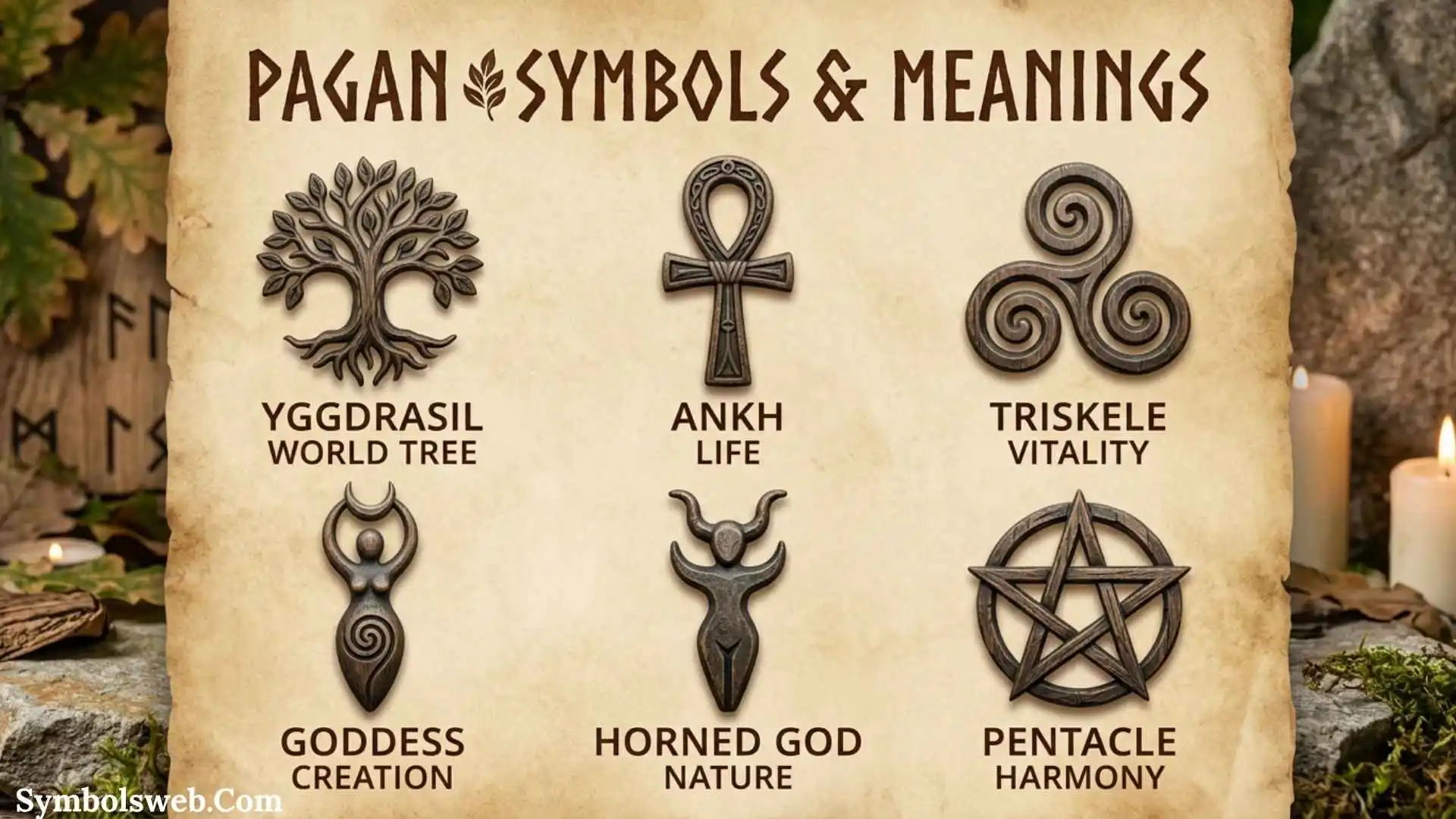
Pagan symbols and meanings reach far beyond the mysterious images often seen in jewelry, tattoos, books, and modern spiritual spaces. For thousands of years, people have used signs such as stars, spirals, moons, trees, animals, and sacred knots to express ideas about nature, protection, fertility, death, rebirth, and the unseen world.
What makes these symbols fascinating is that their meanings have never been completely fixed. A symbol can change as it moves from one culture to another, or from an ancient religion into a modern spiritual movement.
Some symbols commonly called “pagan” are genuinely ancient, while others were created or popularized much later by Wicca, Neopaganism, occult movements, or modern popular culture.
Pagan Symbols and Meanings: (Quick Answer)
Pagan symbols are visual signs associated with pre-Christian religions, folk traditions, modern Paganism, Wicca, and related spiritual movements. Common examples include the pentagram, Triple Moon, triskelion, triquetra, Thor’s hammer, spirals, solar symbols, and the ankh. Their meanings can include protection, nature, balance, transformation, fertility, cycles, spiritual power, and connection with the divine.
Also Check This Post: 63+ Yule Symbols: The Complete Guide to Their Meaning and Origins
Quick Facts About Pagan Symbols and Meanings
| Aspect | Information |
| Origin | Ancient European, Mediterranean, Egyptian, Near Eastern, and other traditional cultures, plus modern Pagan movements |
| Historical Significance | Symbols expressed religious beliefs, natural cycles, mythology, protection, fertility, death, and rebirth |
| Main Meaning | Depends on the individual symbol, culture, historical period, and context |
| Spiritual Meaning | Often connected with nature, cycles of life, divine forces, transformation, protection, and personal spirituality |
| Cultural Importance | Symbols helped communities express identity, mythology, religious ideas, and relationships with nature |
| Modern Usage | Found in Wicca, Neopaganism, jewelry, tattoos, artwork, literature, fashion, meditation, and personal spiritual practice |
What Are Pagan Symbols?
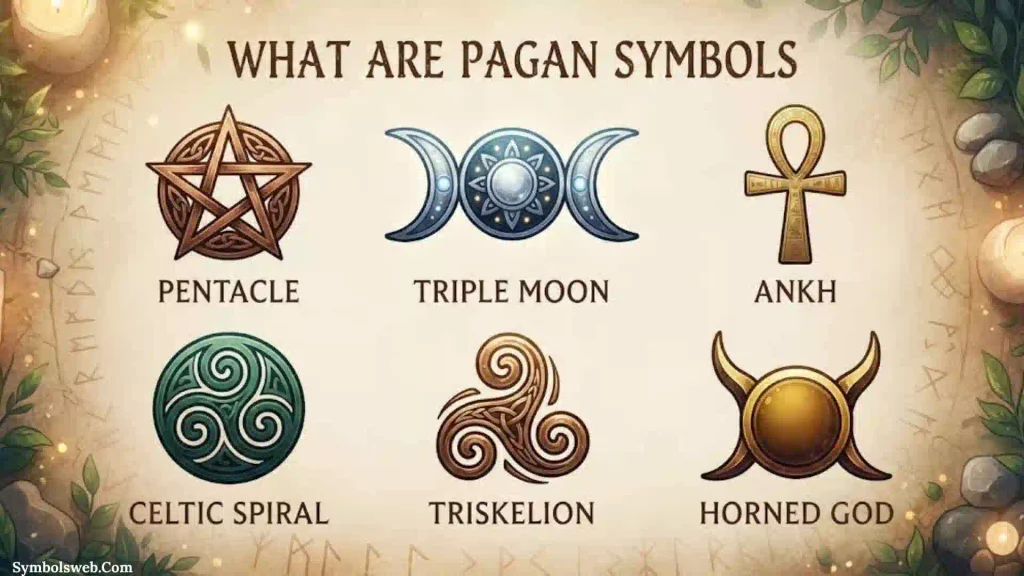
Pagan symbols are visual signs that have been associated with religious or spiritual traditions outside the major Abrahamic religions, particularly the pre-Christian religions of Europe and the Mediterranean.
However, the word “pagan” needs some care.
The Latin word paganus originally had meanings connected with a rural person or civilian, and later became a Christian term for people who followed non-Christian religions. It does not describe one ancient religion with one shared belief system.
Ancient Greek religion was not the same as Norse religion. Egyptian religion was not the same as Celtic religion. Roman religion was not the same as the many Indigenous traditions found around the world.
Therefore, there is no single ancient “Pagan symbol system.”
Instead, there are many different traditions, each with its own symbols, stories, gods, rituals, and meanings.
Ancient Symbols and Modern Pagan Symbols Are Not Always the Same
This is one of the most important points to understand.
A symbol may be ancient while its modern meaning is new.
The triskelion, for example, has very old examples in European and Mediterranean archaeology. A triskele motif appears in Celtic-period objects, while the ancient Greek world also used three-legged forms. Yet archaeologists cannot automatically tell us that every ancient example represented the same spiritual idea that modern Pagans associate with it.
The same caution applies to the triquetra. It is often described online as an ancient Celtic Pagan symbol with a specific meaning, but surviving evidence does not establish one universal pre-Christian meaning for it. It also became prominent in Christian art and later gained new meanings in modern Paganism.
This distinction between historical evidence and modern interpretation is essential when exploring Pagan symbolism.
Why Symbols Became So Important
Before modern books, websites, and mass communication, images were powerful ways to communicate.
A hammer could represent the protection of a god.
A spiral could evoke movement, growth, or the turning of time.
A moon could represent changing phases.
A tree could connect the earth below with the heavens above.
A symbol could therefore act like a small story.
It could carry an entire worldview without using a single written sentence.
Celtic Pagan Symbols and Meanings
Celtic pagan symbols are associated with the ancient cultures and traditions of Celtic-speaking peoples. Commonly discussed examples include spirals, triskeles, Celtic knots, and nature-inspired motifs. These designs are often connected in modern interpretations with ideas such as cycles, continuity, nature, transformation, and interconnectedness.
It is important to remember that not every symbol now called “Celtic” had a confirmed religious meaning in ancient times. Some interpretations come from later folklore, medieval artwork, or modern Celtic-inspired spirituality. Understanding the historical background of each symbol helps separate documented evidence from modern symbolism.
Norse Pagan Symbols and Meanings
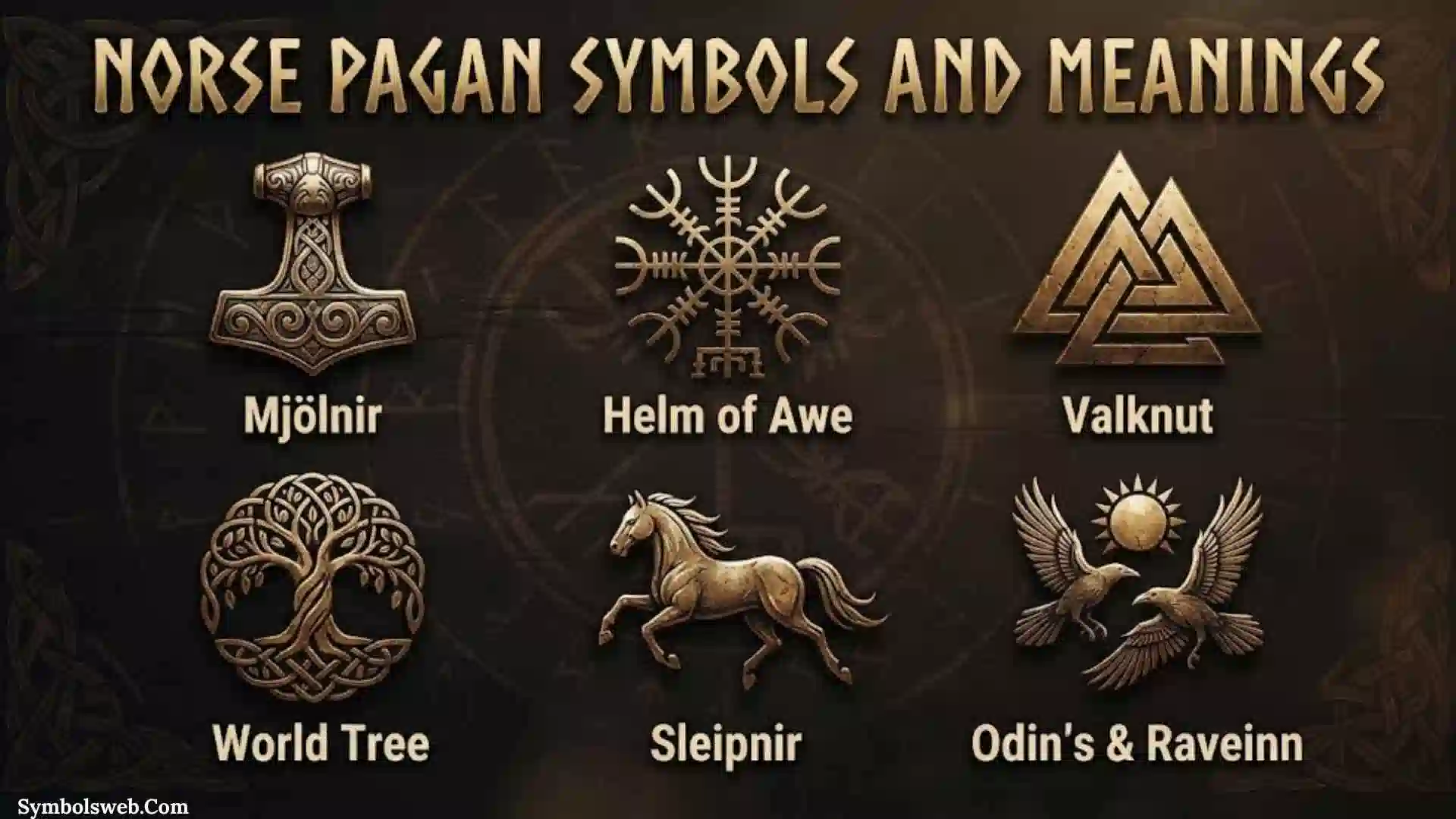
Norse pagan symbols come from the pre-Christian religious and mythological traditions of Scandinavia. Well-known examples include Mjölnir, the hammer associated with Thor, the Valknut, and various runic designs. These symbols can be connected with mythology, protection, death, strength, or the spiritual world depending on their historical context.
Norse symbolism is closely connected with stories about gods, warriors, nature, fate, and different realms of existence. However, the meaning of some symbols remains uncertain because archaeological evidence does not always provide a direct explanation of what a particular design represented.
Witch Symbols and Meanings
Witch symbols are used across different forms of historical and modern witchcraft, so their meanings are not identical everywhere. The pentagram, pentacle, triple moon, cauldron, wand, broom, and lunar imagery are among the symbols commonly associated with modern witchcraft.
The pentagram can represent the five elements in some modern magical traditions, while the triple moon is often associated with lunar cycles and transformation. The meaning of a witch symbol ultimately depends on the specific tradition, practice, and beliefs in which it is used.
Pagan Symbols of Protection
Pagan symbols of protection are found in various historical and modern traditions. They may be associated with safeguarding a person, home, family, or spiritual space. Thor’s hammer, protective knots, pentacles, certain runes, and particular animal or natural motifs are sometimes used in this context.
Protection symbolism often reflects the belief that particular signs, objects, or representations can provide spiritual strength or ward off harmful influences. Because different cultures developed their own protective traditions, there is no single protection symbol that represents all forms of paganism.
Pagan Symbols of Death
Pagan symbols of death often represent mortality, the afterlife, ancestors, transformation, or the transition from one stage of existence to another. In some traditions, death is viewed as part of a larger natural cycle rather than simply an ending.
The Valknut is frequently discussed in relation to death and Odin within Norse symbolism, although its precise historical meaning is still debated. Ravens, bones, winter imagery, and underworld-related motifs can also appear in modern interpretations of pagan death symbolism.
Pagan Symbols of Rebirth
Pagan symbols of rebirth commonly draw inspiration from natural cycles. Spring, seeds, flowers, sunrise, spirals, and returning vegetation can all represent renewal, growth, transformation, and the beginning of a new cycle.
The spiral is particularly common in modern symbolic interpretations because its continuous movement can suggest growth and change. Rebirth symbolism can vary considerably between traditions, with some focusing on seasonal renewal and others on spiritual transformation or the continuation of life.
What Are Pagan Symbols
Pagan symbols are signs, designs, objects, or natural images associated with pagan religions, pre-Christian traditions, folklore, and modern nature-based spiritual practices. Since paganism includes many different cultures and belief systems, there is no single universal collection of pagan symbols.
Some symbols have documented historical connections to particular cultures, while others gained their current meanings through modern paganism, Wicca, witchcraft, or contemporary spiritual movements. Their interpretation is therefore best understood by considering the culture and tradition behind each symbol.
Slavic Pagan Symbols and Meanings
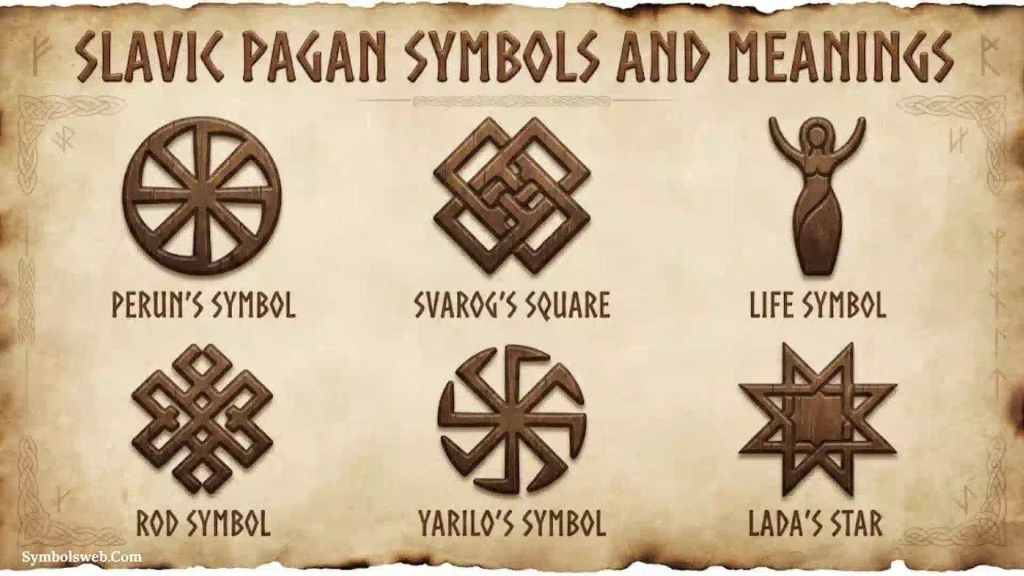
Slavic pagan symbols are associated with the pre-Christian beliefs and cultural traditions of various Slavic peoples. Symbols and motifs connected with the sun, fire, thunder, nature, and seasonal cycles are commonly discussed in relation to Slavic mythology.
Some modern sources associate particular geometric designs with deities such as Perun or with solar and protective ideas. However, evidence for the exact meaning of many symbols is limited, and some popular interpretations come from modern reconstruction rather than securely documented ancient practices.
Germanic Pagan Symbols and Meanings
Germanic pagan symbols are connected with the pre-Christian religious traditions of Germanic-speaking peoples. Runes, solar motifs, sacred animals, and symbols associated with gods such as Odin and Thor are frequently discussed within this subject.
Runes were historically a writing system, although later traditions gave some runes additional symbolic or magical associations. Likewise, solar and natural motifs can have different meanings depending on their archaeological and cultural context. Germanic pagan symbolism should therefore be studied according to the specific period and region.
Irish Pagan Symbols and Meanings
Irish pagan symbols are connected with Ireland’s pre-Christian mythology, folklore, natural landscapes, and artistic traditions. Spirals, triskeles, animals, sacred trees, and other nature-based motifs are often associated with Irish and wider Celtic symbolism.
The triskelion, featuring three connected spirals or arms, is commonly interpreted today as representing cycles, movement, balance, or transformation. However, the exact religious meaning of many ancient Irish designs is not always known, making it useful to distinguish historical evidence from modern interpretations.
Wiccan Pagan Symbols and Meanings
Wiccan pagan symbols are part of the modern Wiccan religious tradition, which developed primarily during the twentieth century. The pentacle, triple moon, elemental symbols, and representations of the Goddess and Horned God are commonly used in different Wiccan traditions.
The pentacle is often connected with earth, air, fire, water, and spirit, while the triple moon represents the waxing, full, and waning phases of the moon. Specific meanings can differ between Wiccan traditions and individual practitioners.
Baltic Pagan Symbols and Meanings
Baltic pagan symbols are associated with the traditional cultures of Baltic peoples, particularly Lithuanians and Latvians. Sun, star, fire, geometric, and nature-inspired motifs are prominent in Baltic folk art and modern discussions of pre-Christian symbolism.
Many Baltic designs are also connected with seasonal traditions and ideas of protection, nature, light, and continuity. Because Baltic symbolism has been preserved through folklore and traditional art as well as historical evidence, modern interpretations should be distinguished from meanings that can be directly established from ancient sources.
Lithuanian Pagan Symbols and Meanings
Lithuanian pagan symbolism is closely connected with nature, seasonal customs, folklore, fire, and traditional Baltic culture. Sun and star motifs are particularly prominent in Lithuanian folk designs and are often associated with light, life, warmth, and the natural cycle of the year.
Modern Lithuanian pagan traditions may also use reconstructed symbols based on folklore and historical research. As with other ancient traditions, the meaning of a particular design can change depending on whether it comes from historical religious practice, folk art, or modern spiritual use.
Ancient Pagan Symbols and Meanings
Ancient pagan symbols come from many different civilizations and cannot be understood as belonging to one unified religion. Solar symbols, serpents, trees, animals, stars, spirals, water, and fire appear in the religious and artistic traditions of numerous ancient cultures.
The meaning of these symbols could vary greatly. For example, a serpent might represent renewal in one tradition and danger or the underworld in another. For this reason, ancient pagan symbols should always be interpreted according to their specific culture, historical period, and available evidence rather than being assigned one universal meaning.
Deep Symbolic Meaning of Pagan Symbols
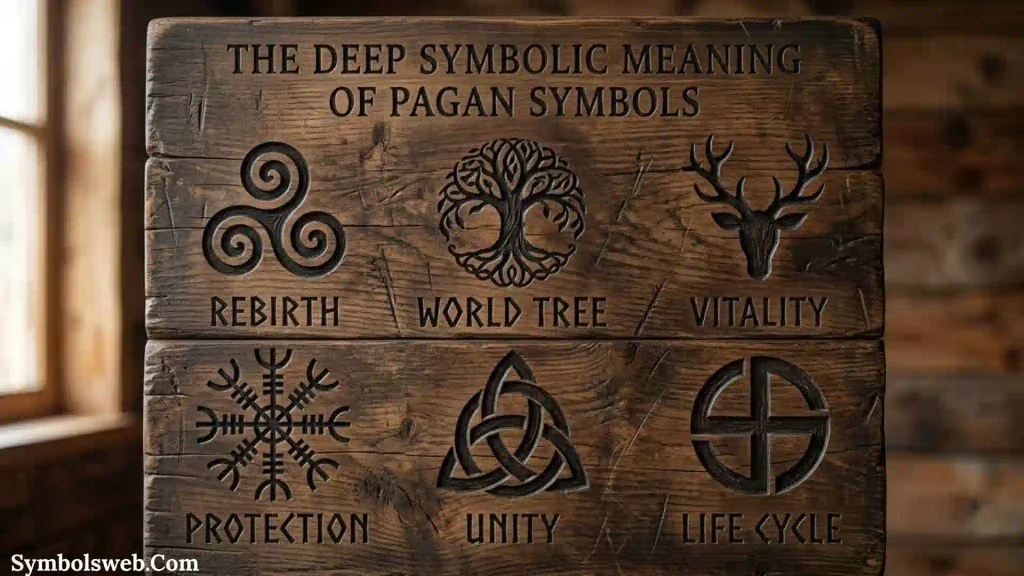
Although each symbol has its own history, many Pagan and Pagan-inspired symbols revolve around a few recurring themes.
Spiritual Meaning
Nature is one of the strongest themes.
Many Pagan traditions understand the natural world as spiritually significant rather than simply as a collection of physical objects. The changing seasons, sunrise, moon phases, fertility, storms, forests, rivers, and animals can all become expressions of sacred order.
This is why Pagan symbolism often feels circular rather than linear.
The seed becomes a plant.
The plant produces another seed.
The sun rises and sets.
The moon grows and disappears.
Winter gives way to spring.
Symbolically, endings can become beginnings.
Inner Transformation
Many modern practitioners also interpret Pagan symbols as maps of personal change.
A spiral may represent moving inward toward self-knowledge and then outward toward the world.
A moon may represent emotional change and different stages of life.
A serpent may represent transformation because it sheds its skin.
A circle may represent wholeness and continuity.
These interpretations are especially common in modern spiritual and psychological approaches to symbolism.
Psychological Meaning
Symbols can affect people because the human mind naturally searches for patterns and associations.
Carl Jung’s ideas about archetypes and the collective unconscious have also influenced modern interpretations of religious imagery. Jung argued that recurring symbolic patterns can appear across myths, dreams, religions, and cultures.
That does not mean every ancient symbol has one universal psychological meaning.
Instead, a symbol can become powerful because it connects an individual’s personal experience with a larger cultural story.
A person wearing a pentacle, for example, may see it as a religious identity, a reminder of balance, a connection to nature, or simply an important part of their personal history.
Cultural Meaning
Symbols also create community.
They can tell people:
“This is what I believe.”
“This is where I come from.”
“These are the stories I value.”
“This is the spiritual path I follow.”
For modern Pagans, a symbol can therefore serve both a spiritual and social purpose.
Types and Variations of Pagan Symbols
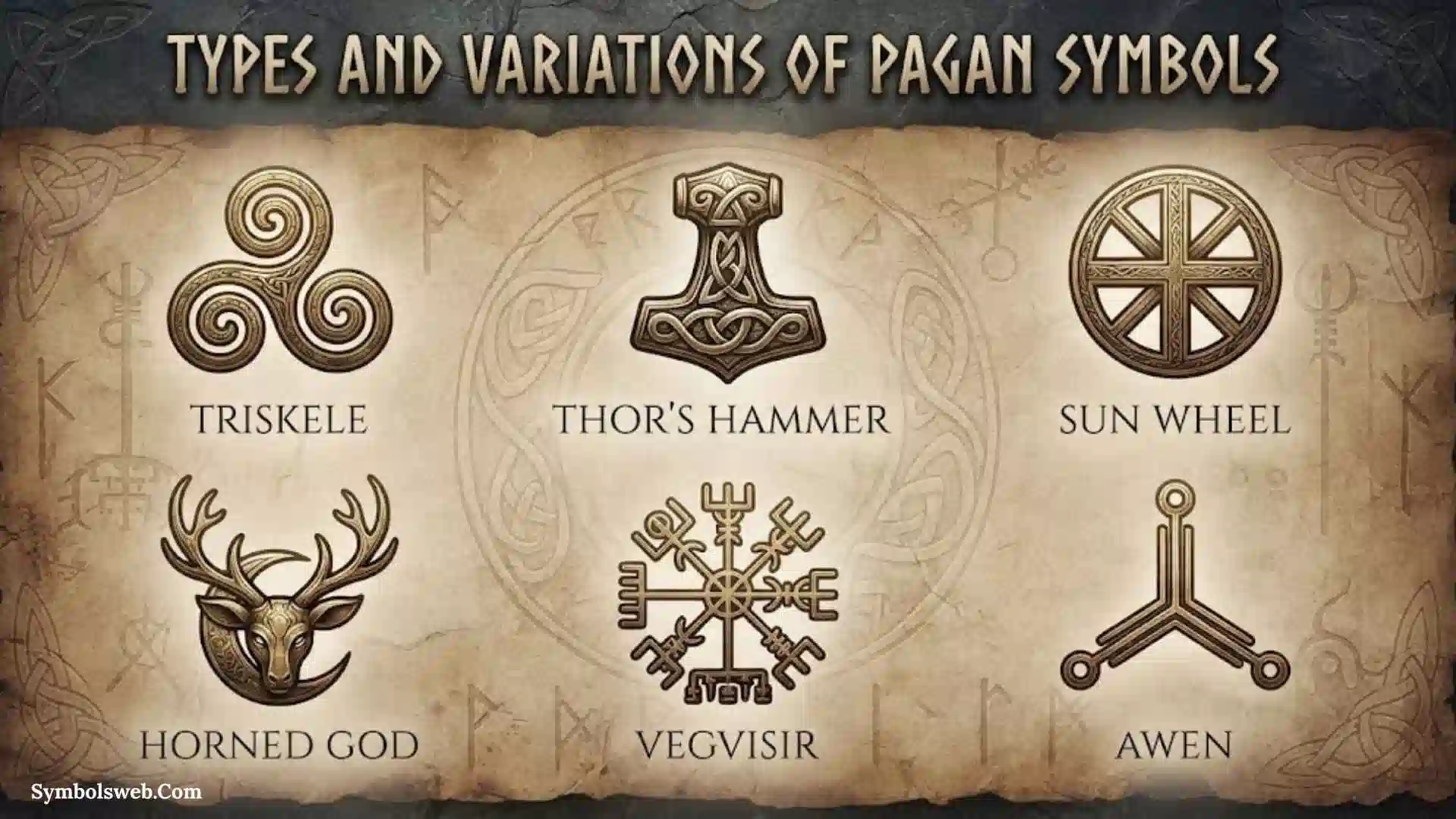
There are many symbols associated with Paganism and modern Pagan spirituality. The following are among the most recognizable.
1. Pentagram and Pentacle
The pentagram is a five-pointed star.
A pentacle commonly refers in modern Pagan and Wiccan usage to a pentagram enclosed within a circle, although historical terminology has been more complicated.
The five-pointed star is much older and more widespread than Wicca. It has appeared in different religious and cultural settings, including Pythagorean traditions, medieval Christianity, magic, and later occult movements.
In modern Wicca, the pentagram is often associated with the four classical elements, earth, air, fire, and water, together with spirit.
The circle can emphasize unity, wholeness, and the interconnectedness of those elements.
Common modern meanings include:
- Protection
- Balance
- Nature
- The four elements
- Spirit
- Wholeness
- Spiritual identity
It is important not to assume that every pentagram represents Satanism. The symbol has a long history that predates modern Satanic movements by centuries.
2. Triple Moon Symbol
The Triple Moon usually shows a waxing crescent, full moon, and waning crescent.
It is strongly associated with modern Wicca and Goddess-centered Pagan spirituality.
A common modern interpretation connects the three phases with:
- Maiden
- Mother
- Crone
These represent stages of life, feminine power, transformation, maturity, and renewal.
The idea of triple deities and lunar symbolism has ancient precedents, particularly in Greek religious traditions. However, the familiar Triple Moon graphic used today is best understood as a modern Pagan and Wiccan development rather than an unchanged ancient symbol.
3. Triskelion or Triskele
The triskelion, also called a triskele, is a three-part spiral or three-legged symbol.
It is particularly associated with Celtic and Mediterranean imagery, although its history is broader.
A famous example of three-spiral imagery appears at Newgrange in Ireland, a prehistoric monument dating to around 3200 BCE. The British Museum notes that Newgrange was designed so sunlight enters the chamber around the midwinter sunrise, creating powerful associations with cycles, light, and regeneration.
Ancient meanings of individual spiral designs are not always known.
Modern Pagan interpretations often connect the triskele with:
- Cycles
- Movement
- Growth
- Transformation
- Past, present, and future
- Land, sea, and sky
- Life, death, and rebirth
But these should be treated as interpretations rather than universal translations of ancient Celtic belief.
4. Triquetra
The triquetra consists of three interlocking arcs.
It is often called a Celtic knot and is strongly associated with Irish and Celtic-inspired design.
The symbol appears in medieval Christian manuscript art, including the Book of Kells tradition, and similar knotwork appears across European artistic traditions. Its original pre-Christian meaning is not securely documented.
Modern Pagans may interpret the three interconnected sections as:
- Three aspects of existence
- Land, sea, and sky
- Life, death, and rebirth
- Past, present, and future
- Threefold divine forces
- Spiritual unity
Its modern popularity also grew through fantasy media and popular culture.
5. Thor’s Hammer, Mjölnir
Thor’s hammer, known as Mjölnir, is one of the strongest examples of a symbol connected to a specific historical religious tradition.
Thor was a major god in Old Norse religion, associated with thunder, strength, protection, and the struggle against destructive forces.
Archaeologists have found numerous hammer-shaped pendants from the Viking Age. The Swedish History Museum explains that these objects occur in graves and settlements and were probably connected with Norse religious practice, although their precise purpose is not always certain.
Thor’s hammer has been associated with:
- Protection
- Strength
- Thunder
- Fertility
- Community
- Courage
- Defense against chaos
Interestingly, Thor was not simply a warrior figure. He was also connected with farmers and fertility. Rain was essential to agricultural life, making thunder and storms part of a much larger religious picture.
6. Spiral
The spiral is one of the most visually simple and widespread forms in human symbolic art.
It appears in prehistoric European monuments, rock art, decorative traditions, and modern spiritual imagery.
Because the spiral has no obvious beginning or end when viewed as a continuous movement, modern Pagans often associate it with:
- Growth
- Evolution
- Cycles
- Energy
- The journey inward
- The journey outward
- Life and rebirth
However, a spiral found on an ancient artifact should not automatically be given a modern Pagan meaning.
Archaeology can tell us where a design appears. It cannot always tell us exactly what the people who created it believed.
7. Solar Wheel and Sun Symbols
Circular solar imagery appears across many ancient cultures.
The sun naturally became a powerful symbol because it provides light, warmth, and the conditions necessary for life.
Modern Pagan interpretations may connect solar symbols with:
- Life
- Vitality
- Power
- Clarity
- Renewal
- Protection
- Seasonal cycles
Solar imagery was particularly important in ancient Mediterranean and European religious traditions.
8. Horned God Symbolism
The Horned God is especially important in modern Wicca and some forms of Neopaganism.
Modern representations may draw visual inspiration from ancient horned or antlered figures such as the Celtic Cernunnos and the Greek god Pan.
Yet it is historically inaccurate to claim that all these figures were simply one ancient Pagan “Horned God.”
Their cultures, stories, and religious roles were different.
In modern Wiccan theology, the Horned God may represent:
- Nature
- Masculine divine energy
- Fertility
- Animals
- Wilderness
- Life and death
- The balance of divine forces
The modern Wiccan framework developed largely in the twentieth century, particularly through the work associated with Gerald Gardner and later Wiccan writers.
9. Ankh
The ankh is the famous Egyptian symbol shaped somewhat like a cross with a loop at the top.
It is strongly connected with ancient Egyptian religion and is commonly translated or interpreted as representing life.
Ancient Egyptian gods and pharaohs are frequently shown holding or presenting the ankh.
The symbol is often associated with:
- Life
- Vitality
- Divine power
- Eternal existence
- Regeneration
Today, the ankh is sometimes used in modern Pagan, Kemetic, spiritual, fashion, and tattoo contexts.
Its ancient Egyptian history, however, is much older than modern Paganism.
10. Eye of Horus
The Eye of Horus is another major symbol from ancient Egyptian religion.
Horus was a powerful Egyptian deity associated with kingship and the sky.
The eye became associated with protection, healing, restoration, and well-being.
Modern interpretations often use it as a protective symbol.
Its popularity demonstrates how ancient religious symbols can survive long after the original religious system has changed.
11. Serpent
The serpent is one of the most complicated symbolic animals in human history.
It can represent:
- Transformation
- Healing
- Wisdom
- Fertility
- Danger
- Rebirth
- Hidden knowledge
- Life force
Its meaning depends heavily on the culture.
The serpent can be divine in one tradition and dangerous in another.
Its ability to shed its skin naturally encouraged associations with renewal and transformation.
12. Sacred Tree and World Tree
Trees are powerful symbols because they connect different worlds.
Their roots disappear underground.
Their trunks stand in the human world.
Their branches reach toward the sky.
The Norse tradition’s Yggdrasil is one of the best-known examples of a cosmic tree, while sacred trees and tree worship appear in many other cultures.
Modern Pagan spirituality often uses trees to symbolize:
- Connection
- Stability
- Growth
- Wisdom
- Family
- Earth and sky
- Spiritual grounding
Pagan Symbols Across Different Cultures
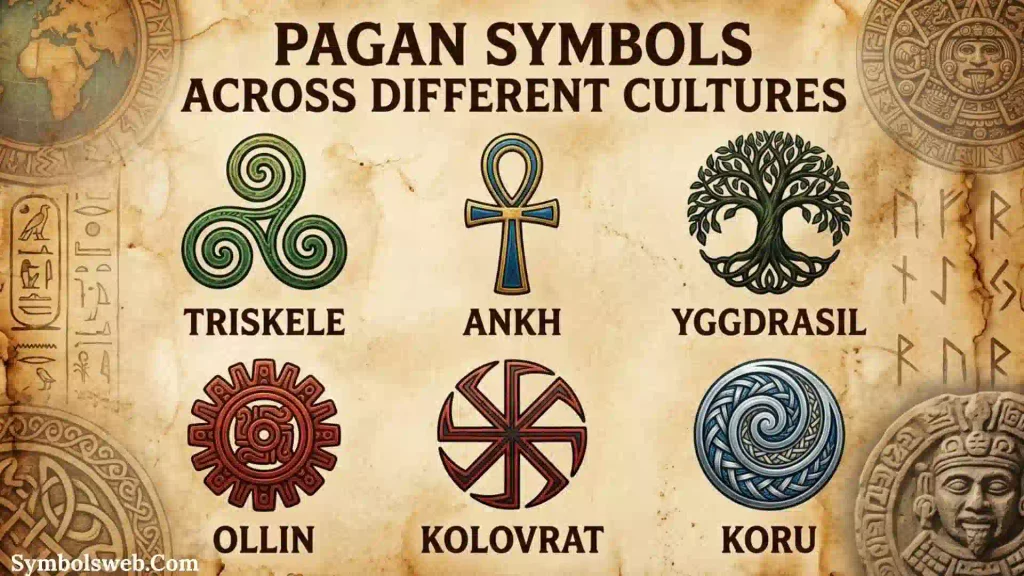
The biggest mistake when studying Pagan symbols is assuming that all ancient cultures shared one religion.
They did not.
The word “Pagan” is a broad modern category that covers many different historical traditions.
Ancient Egypt
Ancient Egyptian religion developed over thousands of years and included a large family of gods, temples, myths, rituals, and symbolic images.
Important symbols included the ankh, Eye of Horus, scarab, solar disk, lotus, and many sacred animal forms.
The Egyptian approach to symbolism was closely connected with ideas about life, death, divine kingship, order, protection, and regeneration.
For example, the scarab beetle became associated with Khepri and the rising sun, while the ankh represented life.
Modern Pagan and Kemetic practitioners sometimes draw inspiration from these symbols, but modern practice should not be confused with the ancient religion itself.
Ancient Greece
Ancient Greek religion produced many symbols connected with gods, animals, natural forces, and sacred objects.
The owl became strongly associated with Athena.
The laurel was connected with Apollo.
The serpent appeared in several religious and healing contexts.
The trident became associated with Poseidon.
The Greek world also provides important background for later Western occult symbolism.
The Pythagorean tradition, for example, gave special importance to mathematical relationships and sacred numbers. Pythagoras was an influential figure in the intellectual world of sixth-century BCE Greece.
Roman Culture
Roman religion shared many features with Greek religion but developed its own religious traditions and political meanings.
Symbols could connect gods with military power, agriculture, household protection, fertility, and the state.
The Romans also absorbed and adapted religious traditions from many peoples throughout the Mediterranean.
This cultural exchange is important because symbols rarely remain completely isolated.
A symbol can travel.
Its shape may survive while its meaning changes.
Eastern Traditions
The word “Pagan” should be used carefully when discussing Asian religions.
Hinduism, Buddhism, Jainism, Daoism, Shinto, and other traditions have their own identities and histories. They should not simply be labeled “Pagan.”
However, many of these traditions use symbolism involving cycles, nature, cosmic balance, sacred geometry, animals, deities, and elements.
The lotus, for example, carries major religious significance in Hindu and Buddhist traditions.
Its journey from muddy water to an open flower makes it a natural symbol of purity, awakening, and spiritual transformation.
This is a good example of why symbols should be studied within their own cultural context rather than placed into a single Western Pagan category.
Indigenous Traditions
Indigenous religions around the world also contain rich symbolic systems.
But there is no single “Indigenous Pagan symbolism.”
Native American, Aboriginal Australian, Arctic, African, Pacific, and other Indigenous traditions are enormously diverse.
Sacred animals, plants, landscapes, directions, ancestors, celestial bodies, and ceremonial objects can have specific meanings within particular communities.
These traditions should not be treated as a collection of interchangeable mystical symbols.
When a modern spiritual movement borrows an Indigenous symbol, questions of cultural ownership, context, and respect become important.
Modern Paganism
Modern Paganism is a diverse collection of religious and spiritual movements.
It can include Wicca, Druidry, Heathenry, Hellenism, modern Kemetic religion, Celtic Reconstructionism, Goddess spirituality, and many eclectic paths.
Some practitioners reconstruct historical religions from archaeological and textual evidence.
Others combine ideas from different traditions.
Still others focus mainly on nature, spirituality and personal ritual.
That diversity explains why modern Pagan symbols can have different meanings from one practitioner to another.
Also Check This Post: 111+ Engineering Drawing Symbols: Types Meanings & Uses Explained
Similar Pagan Symbols and Their Meanings
Symbols that look similar are not necessarily historically connected.
| Symbol | Common Modern Meaning | Important Historical Note |
| Pentagram | Balance, elements, spirit, protection | Has ancient and medieval uses predating modern Wicca |
| Pentacle | Balance, earth, protection, spiritual unity | Modern Wiccan usage is especially prominent |
| Triple Moon | Goddess, cycles, Maiden, Mother, Crone | The familiar graphic is a modern Pagan/Wiccan development |
| Triskelion | Cycles, movement, transformation | Ancient examples exist, but exact original meanings are often uncertain |
| Triquetra | Unity, threefold nature, protection | Appears prominently in medieval Christian art as well as modern Pagan use |
| Mjölnir | Strength, protection, Thor | Strong archaeological connection to Viking Age Norse religion |
| Ankh | Life, vitality, regeneration | Ancient Egyptian symbol |
| Spiral | Growth, cycles, transformation | Extremely widespread, with meanings varying by context |
| Solar wheel | Life, light, power, seasonal cycles | Solar imagery occurs in many cultures |
Pentagram vs. Pentacle
The terms are often used interchangeably today, but they are not always identical.
A pentagram is the five-pointed star.
A pentacle commonly means a pentagram enclosed within a circle in modern Pagan usage.
The history of the word “pentacle” is more complicated, and older magical literature used the term for a wider variety of talismanic designs.
Triskelion vs. Triquetra
Both are associated with the number three, but they look different.
The triskelion usually has three radiating legs or spirals.
The triquetra consists of three interlocking loops.
Modern Pagan traditions may assign related meanings to both, but they should not be treated as the same historical symbol.
Pagan Symbols in Mythology and Folklore
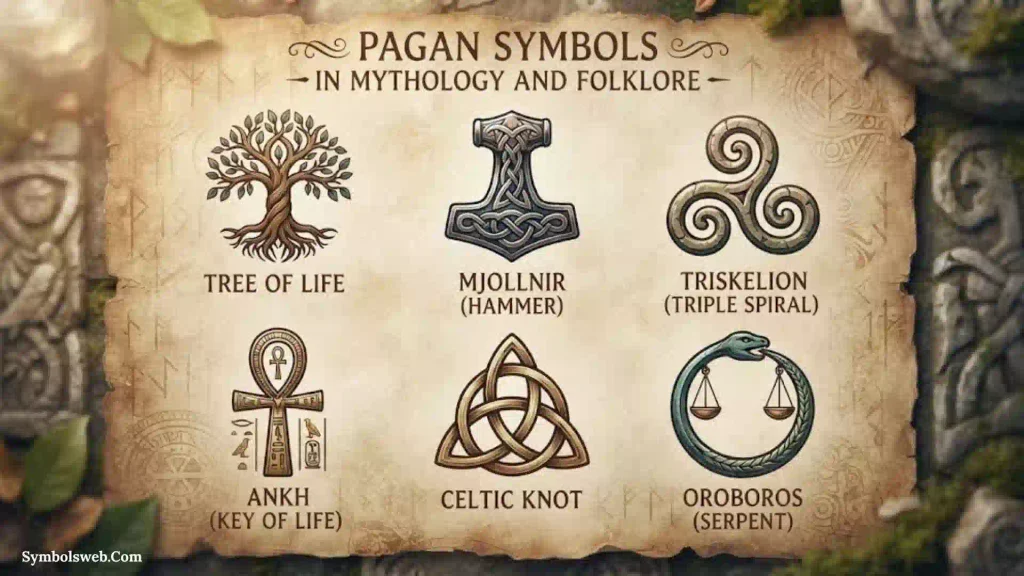
Mythology gives symbols emotional power.
A symbol becomes memorable when it is attached to a story.
Thor’s hammer is not merely a shape. It is connected to stories about Thor defending the gods and the world against giants.
In Norse tradition, Mjölnir helped preserve cosmic order. Archaeological finds show that miniature hammer pendants were worn and deposited during the Viking Age.
Greek mythology similarly transformed natural forces into stories.
The sun, sea, storms, forests, animals, and fertility could all be connected to divine personalities.
Egyptian mythology did the same through gods such as Horus, Isis, Osiris, Ra, Anubis, and Hathor.
These stories helped people understand forces that could otherwise seem mysterious or uncontrollable.
Symbols as Stories in Visual Form
A symbol often survives because the story behind it survives.
When someone sees a hammer pendant today, they may immediately think of Thor.
When someone sees a pentacle, they may think of Wicca.
When someone sees a Triple Moon, they may think of Goddess spirituality.
The symbol becomes a shortcut to an entire world of ideas.
Pagan Symbols in Art, Literature, Movies and Pop Culture
Pagan symbols have moved far beyond temples and archaeological sites.
They now appear in books, films, television, tattoos, fashion, games, music, and graphic design.
Paintings and Art
Artists have long borrowed mythological imagery.
Classical gods, magical creatures, sacred animals, solar imagery, and mysterious geometric forms have all appeared in Western art.
Modern artists often use these images to explore nature, sexuality, death, identity, rebellion, or spirituality.
Literature and Poetry
Pagan symbolism has played an important role in fantasy literature.
Writers use ancient-looking symbols because they create an immediate sense of mystery.
A circle can suggest an ancient order.
A rune can suggest forgotten knowledge.
A moon can suggest transformation.
A sacred tree can represent a world connecting different realms.
The symbol does not need to be historically accurate to work as literature.
It simply needs to evoke a feeling.
Movies and Television
Modern entertainment has also transformed Pagan symbols.
The triquetra, for example, became widely recognizable to a new audience through the television series Charmed, where it was connected with the show’s “Power of Three.”
Fantasy films and television often combine Celtic, Norse, Greek, Egyptian, and modern occult imagery.
This can create beautiful stories, but it can also blur historical distinctions.
Tattoos
Pagan-inspired tattoos are often chosen for deeply personal reasons.
Someone may choose a pentacle because it represents religious identity.
Another person may choose a spiral for personal transformation.
Someone else may choose Mjölnir because of an interest in Norse heritage, mythology, strength, or protection.
The tattoo therefore has two meanings:
The historical meaning of the symbol.
And the personal meaning given to it by the person wearing it.
Fashion and Jewelry
Pagan symbols are especially common in jewelry because small symbols can carry strong personal meaning.
Pendants, rings, bracelets, necklaces, and earrings may feature:
- Pentacles
- Moons
- Runes
- Mjölnir
- Spirals
- Celtic knots
- Solar symbols
- Ankh designs
For many people, wearing such an object is a form of identity and self-expression rather than a claim about ancient history.
Spiritual and Dream Meaning of Pagan Symbols
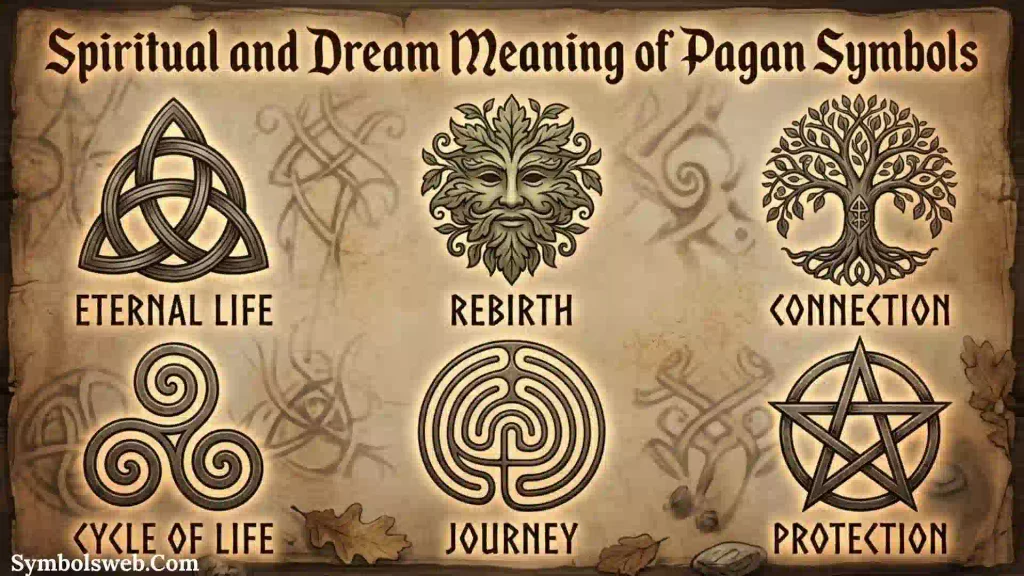
Dream interpretation is highly personal.
There is no scientific dictionary that says a particular Pagan symbol must mean one specific thing in every dream.
Still, symbolic patterns can be useful for reflection.
Dreaming of a Pentagram
A pentagram might personally represent balance, spirituality, protection, identity, or curiosity about the occult.
Its meaning depends on the dreamer’s own associations.
Dreaming of the Moon
The moon may evoke cycles, emotion, change, intuition, mystery, or the passage of time.
A changing moon can naturally become a metaphor for changing circumstances.
Dreaming of a Serpent
A serpent may represent transformation, fear, hidden knowledge, healing, sexuality, or renewal.
The emotional atmosphere of the dream matters as much as the symbol itself.
Dreaming of a Tree
A tree can symbolize roots, family, stability, growth, ancestry, or connection.
A healthy tree and a dying tree may create very different emotional impressions.
Meditation and Spiritual Practice
Modern practitioners sometimes use symbols during meditation as visual anchors.
Instead of treating the symbol as a supernatural object, someone may use it to focus attention on an idea.
A spiral can become a reminder of growth.
A circle can represent wholeness.
A moon can represent change.
A tree can represent grounding.
In this way, the symbol becomes a psychological and spiritual tool.
Positive and Negative Meanings of Pagan Symbols
Symbols rarely fit neatly into a positive or negative box.
The same image can represent opposing forces.
| Positive Meaning | Negative or Cautionary Meaning |
| Protection | Fear of danger |
| Transformation | Loss of the old self |
| Power | Abuse of power |
| Mystery | Confusion |
| Freedom | Rebellion without direction |
| Nature | Untamed forces |
| Death and rebirth | Grief and endings |
| Spiritual independence | Isolation |
| Strength | Aggression |
| Cycles | Repetition or stagnation |
Why Symbols Have Both Light and Shadow
Human life itself contains opposites.
Protection can become control.
Strength can become violence.
Mystery can become fear.
Transformation can be painful.
Death can mean an ending, but in symbolic language it can also mean the beginning of something new.
This is why mature symbolic interpretation looks at the entire context rather than assigning a simple label.
Why Humans Are Attracted to Pagan Symbols
There is something deeply human about finding meaning in images.
Imagine walking through a forest and seeing an enormous old tree.
You may understand scientifically that it is a living organism.
But emotionally, it can feel like much more.
It may remind you of childhood, family, age, memory, or the passage of time.
That emotional reaction is part of the power of symbolism.
Pattern Recognition
The human brain constantly looks for patterns.
Cycles are particularly easy to notice.
Day and night.
Summer and winter.
Birth and death.
Growing and fading.
The repeated nature of these experiences naturally lends itself to symbolic language.
Cultural Memory
Symbols can also preserve cultural memory.
A person who wears Mjölnir may feel connected to Norse mythology.
Someone wearing an ankh may feel drawn to ancient Egypt.
A person using a pentacle may feel connected to Wicca or modern Pagan spirituality.
The symbol becomes a bridge between the present and an imagined or remembered past.
Personal Meaning
Ultimately, people often choose symbols because those symbols tell a story about themselves.
A symbol may represent something they survived.
Something they believe.
Something they lost.
Something they hope to become.
That personal layer is often what makes a symbol emotionally powerful.
Modern Uses of Pagan Symbols
Pagan symbols are now used in many parts of everyday life.
Tattoos
Symbols can represent identity, transformation, heritage, spirituality, or personal beliefs.
Jewelry
Pendants and rings allow people to keep a meaningful symbol close to the body.
Fashion
Designers sometimes use moons, stars, runes, Celtic patterns, and ancient motifs simply for their visual appeal.
Branding
Brands may use natural or mystical symbolism to communicate ideas such as authenticity, freedom, nature, mystery, or tradition.
Social Media
Modern Pagan communities use symbols in profile images, usernames, artwork, posts, and educational content.
Contemporary Spirituality
Modern practitioners may use Pagan symbols during meditation, ritual, seasonal celebrations, altar work, or personal reflection.
Home Decor
Moon imagery, sacred geometry, botanical designs, crystals, sun symbols, and Pagan-inspired artwork have become common forms of spiritual interior decoration.
Personal Expression
Perhaps the most important modern use is identity.
A symbol can quietly say something about a person without requiring an explanation.
Interesting Facts About Pagan Symbols
- The pentagram is much older than modern Wicca. Its history includes ancient and medieval uses, so it cannot be reduced to one modern religion.
- Mjölnir pendants were genuinely used during the Viking Age. Archaeological discoveries include examples from graves, settlements, hoards, and other contexts.
- Thor’s hammer could have more than one association. Thor was connected not only with strength and thunder but also with fertility, rain, farmers, marriage, and protection.
- The Triple Moon is not an unchanged ancient symbol. Its familiar modern form belongs mainly to modern Pagan and Wiccan spirituality, even though lunar cycles and triple-goddess ideas have much older precedents.
- The triquetra does not have one securely proven ancient Pagan meaning. It appears in Celtic-influenced and Christian medieval art, among other contexts, and its modern Pagan meanings developed later.
- Newgrange is thousands of years older than Christianity. Its architecture aligns with the midwinter sunrise, creating powerful associations with light, seasonal cycles, and regeneration.
- The triskele is not exclusively Celtic. Three-part forms also appear in ancient Mediterranean contexts, including Sicily and the wider Greek world.
- A symbol can survive while its meaning changes. Religious symbols are often reused, reinterpreted, or given new meanings by later cultures.
- Not every ancient symbol called “Pagan” was actually a religious symbol. Some designs may have been decorative, political, artistic, or multifunctional.
- Modern Paganism is not one religion. It includes many different traditions with different beliefs, histories, gods, rituals, and interpretations.
Frequently Asked Questions
What is the most common Pagan symbol?
The pentagram or pentacle is probably the most recognizable symbol associated with modern Paganism and Wicca. However, it is not the only Pagan symbol, and the five-pointed star has a much older history across different cultures.
What does the Pagan pentagram mean?
In modern Wiccan and Pagan contexts, the pentagram can represent balance, the four classical elements, spirit, nature, protection, and the interconnectedness of existence. Its historical meanings have varied considerably across cultures and periods.
Is the pentagram a symbol of Satanism?
Not inherently. The pentagram existed in multiple religious, philosophical, magical, and cultural contexts long before modern Satanism. Its meaning depends on its orientation, surrounding imagery, cultural context, and the person or group using it.
What does the Triple Moon symbol mean?
The Triple Moon commonly represents the waxing moon, full moon, and waning moon. In modern Wiccan spirituality, these are often connected with the Maiden, Mother, and Crone and symbolize cycles, transformation, feminine divine power, life stages, and renewal.
What does Thor’s hammer symbolize?
Mjölnir is associated with Thor and commonly represents strength, protection, thunder, fertility, and the defense of cosmic order. Archaeological evidence confirms that hammer-shaped pendants were used in Viking Age Scandinavia.
Are all Celtic symbols Pagan?
No. This is a common misconception. Some symbols associated with Celtic art were used in Christian contexts, some were decorative, and others have uncertain original meanings. Modern Pagan interpretations should not automatically be presented as proven ancient Celtic beliefs.
Conclusion
Pagan symbols and meanings tell a much bigger story than a collection of mysterious shapes. They reveal how humans have used stars, moons, animals, trees, spirals, weapons, and geometric forms to understand life, nature, death, protection, and the unknown.
Some symbols carry genuine archaeological evidence from ancient religions, while others gained their familiar meanings through modern Paganism, Wicca, occultism, and popular culture.
And perhaps that is why these ancient looking signs still speak to people today: we are still searching for meaning in the same world beneath the changing symbols.
Also Check This Post: 119+ Symbols That Represent Love: and Their Hidden Meanings
Hi, I’m Ethan Holloway, and I’ve always believed that a few meaningful words can change the way we think, feel, and live. I enjoy collecting timeless quotes, studying their deeper meanings, and sharing inspiring messages that help people stay motivated through every stage of life.
Over the years, I’ve explored thousands of famous sayings from writers, leaders, philosophers, and everyday people. My goal is to make wisdom easy to understand and useful for everyone.
Books by Ethan Holloway
- The Power of Everyday Quotes
- Words That Inspire Greatness
 Jordan Hayes
 Eliana Foster
[…] Elden Ring Symbols: The Complete Guide for Beginners 133+ Pagan Symbols and Meanings: Complete Beginner’s Guide 119+ Symbols That Represent Love: and Their Hidden Meanings 111+ Engineering Drawing […]
[…] A Complete Guide for Beginners 135+ Elden Ring Symbols: The Complete Guide for Beginners 133+ Pagan Symbols and Meanings: Complete Beginner’s Guide 119+ Symbols That Represent Love: and Their Hidden Meanings 111+ Engineering Drawing […]
[…] A Complete Guide for Beginners 135+ Elden Ring Symbols: The Complete Guide for Beginners 133+ Pagan Symbols and Meanings: Complete Beginner’s Guide 119+ Symbols That Represent Love: and Their Hidden […]