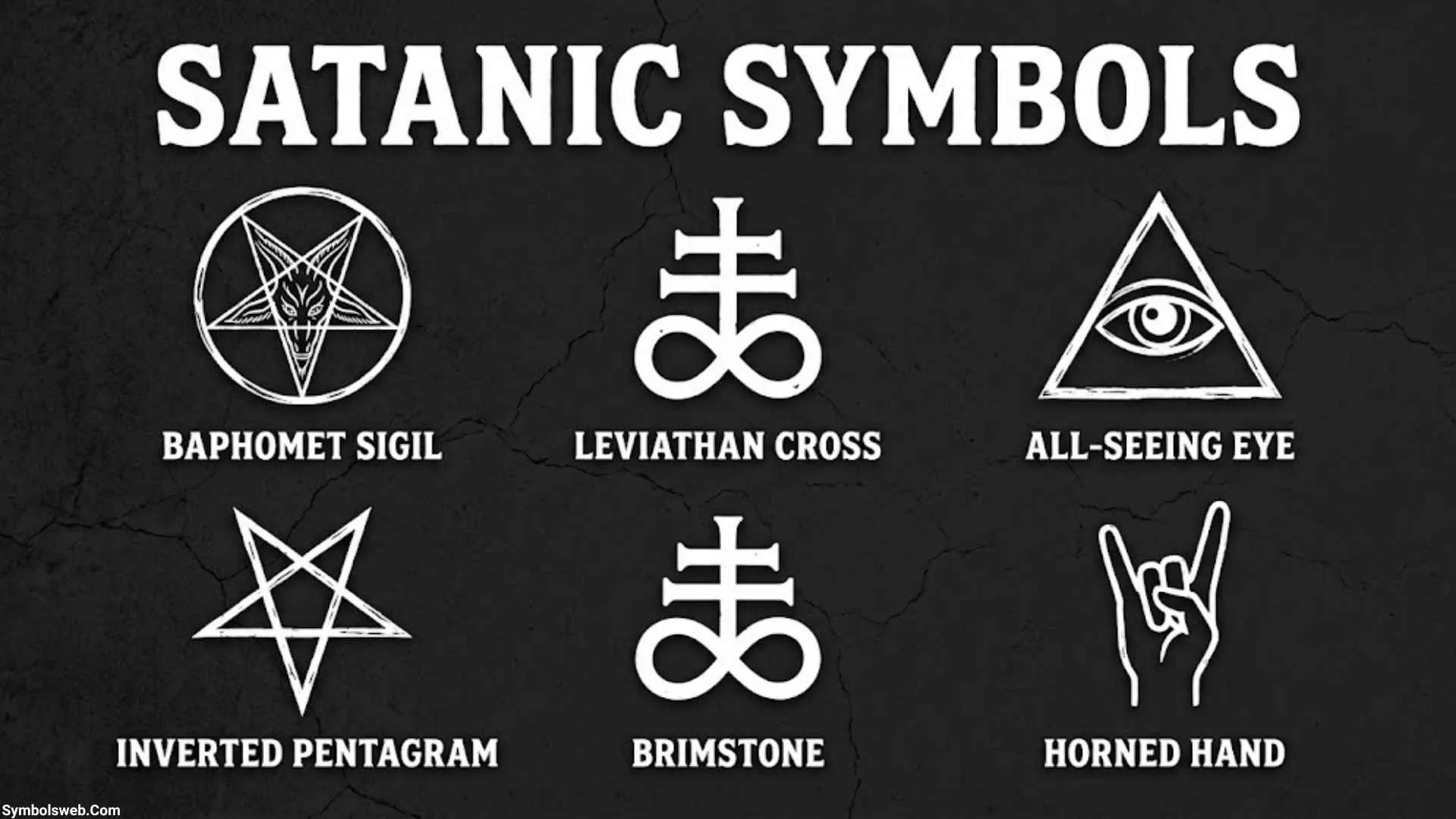
Satanic symbols have a long and complex history rooted in religion, occult traditions, philosophy, and modern culture. From the Sigil of Baphomet to the inverted pentagram, these designs carry different meanings depending on their origins and the people who use them. Some represent specific Satanic organizations, while others come from older religious or philosophical traditions.
Understanding Satanic symbols and their meanings requires looking beyond their appearance. A symbol associated with Satanism today may have originated in another tradition. Similarly, an inverted cross may represent Saint Peter in Christianity or express religious rebellion in modern art.
In this guide, you’ll discover the history, meanings, and cultural significance of major Satanic symbols. You’ll also learn how modern Satanic movements interpret these designs and why historical context matters when separating documented facts from popular misconceptions.
What Are Satanic Symbols?
Satanic symbols are signs, images, and emblems associated with Satanism, Satanic figures, or particular Satanic organizations. They can express religious identity, philosophical beliefs, individualism, or opposition to established religious authority.
Some symbols have direct connections to organized Satanism. The Sigil of Baphomet, for example, serves as the principal emblem of the Church of Satan. Other symbols, such as the inverted cross and pentagram, have broader histories across religious and occult traditions.
The term also overlaps with occult symbols, which appear in historical magical texts, alchemy, and esoteric philosophy. However, occult imagery isn’t automatically Satanic. Many occult traditions developed independently of modern Satanism.
What Satanic Symbols Represent
The meanings of Satanic symbols depend on their historical and cultural settings. In some modern Satanic traditions, these symbols communicate ideas such as:
- Individualism: Valuing personal identity and independent judgment.
- Personal responsibility: Accepting the consequences of your decisions.
- Intellectual freedom: Questioning claims and examining ideas critically.
- Religious dissent: Challenging established religious authority.
- Self-determination: Making independent choices about your beliefs and life.
- Group identity: Expressing an association with a particular organization or movement.
Not every Satanic group shares these values in the same way. Some interpret Satan symbolically, while others understand Satan through spiritual or theistic beliefs.
The Difference Between Satanic Symbols and Occult Symbols
Satanic symbols and occult symbols sometimes overlap, but they aren’t identical.
| Symbol | Common association | Important distinction |
| Sigil of Baphomet | Church of Satan | A recognizable modern Satanic emblem |
| Inverted pentagram | Occult imagery and Satanism | Its meaning depends on context |
| Sulfur symbol | Historical alchemy and modern occult imagery | Its alchemical history predates modern Satanic organizations |
| Caduceus | Hermes in Greek mythology | Not inherently Satanic |
| Inverted cross | Christian tradition and modern countercultural imagery | Can have different religious and cultural meanings |
| Sigil of Lucifer | Grimoire traditions and Luciferian practices | Not universally associated with Satanism |
Understanding these differences helps you interpret Satanic iconography without confusing unrelated traditions.
How Symbols Communicate Religious and Philosophical Ideas
Symbols communicate complex ideas through recognizable images. A cross, star, serpent, or animal figure may express religious identity, philosophical beliefs, or cultural traditions.
Satanic imagery often challenges familiar religious expectations. Some people use it to question authority, while others adopt it as part of a religious or philosophical identity.
To understand a symbol accurately, examine its historical origins, the people who use it, and its intended meaning.
The History and Origins of Satanic Symbols
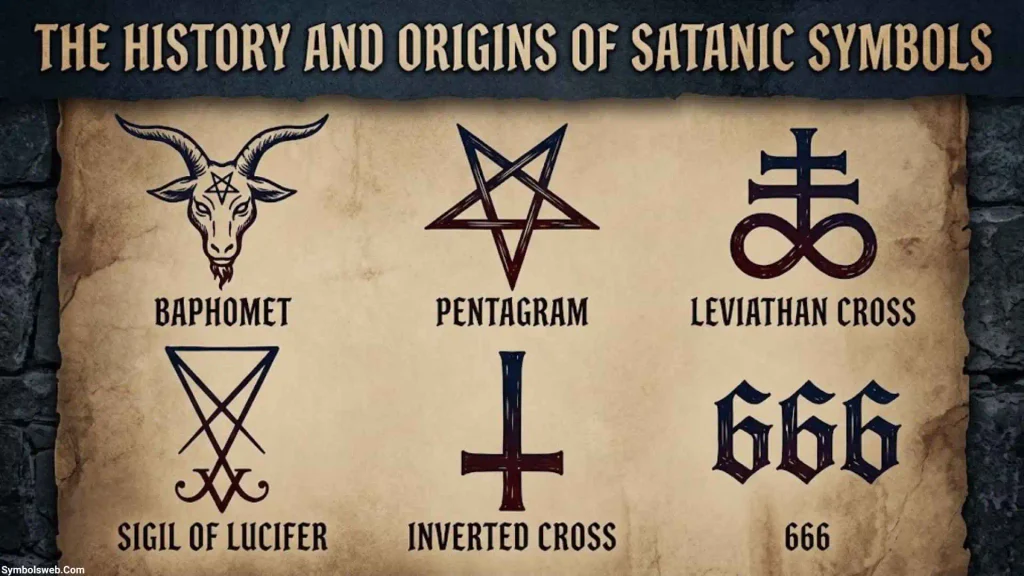
The history of Satanic symbolism includes Christian religious imagery, medieval controversies, Renaissance occult traditions, nineteenth-century illustrations, and modern religious movements. These influences developed at different times rather than forming one continuous tradition.
Many symbols associated with Satanism today originally served different purposes. Their meanings changed as writers, artists, and religious organizations adopted and reinterpreted them.
Satan in Christian Religious History
In Christianity, Satan is commonly understood as an adversarial figure associated with temptation, accusation, and opposition to God. Biblical passages and later theological interpretations shaped the familiar image of Satan as a spiritual opponent.
Over centuries, Christian artists developed visual representations of the devil using features such as horns, animal characteristics, and frightening expressions. These details came from different artistic and cultural influences rather than one single biblical description.
Modern Satanic movements later adopted or reinterpreted Satan as a symbol or spiritual figure. Some view Satan as a representation of independence and rebellion, while others understand Satan in religious or supernatural terms.
These interpretations differ from traditional Christian teachings and from one another.
Medieval and Renaissance Occult Traditions
Medieval and Renaissance Europe produced numerous occult symbols, including magical seals, planetary signs, alchemical diagrams, and images associated with supernatural beings.
Some magical texts, commonly called grimoires, contained symbols and instructions connected with ritual practices. These designs served different purposes, so they shouldn’t automatically be classified as Satanic.
The pentagram also appeared in various historical settings before becoming strongly associated with modern Satanic imagery. Its meanings changed across religious, magical, and philosophical traditions.
This history demonstrates why a symbol’s modern use doesn’t necessarily reveal its original purpose.
Éliphas Lévi and the Development of Modern Baphomet Imagery
Éliphas Lévi was a nineteenth-century French occult author whose depiction of Baphomet became influential in Western occult imagery.
His illustration appeared in Dogme et Rituel de la Haute Magie, published in two parts in 1854 and 1856. It showed a goat-headed figure with a torch, contrasting physical features, and symbolic hand gestures.
Lévi used the figure to explore relationships between opposing forces, including masculine and feminine qualities and spiritual and material existence. Later occultists and Satanic movements adapted aspects of this imagery.
However, Lévi’s original illustration is different from the modern Sigil of Baphomet used by the Church of Satan.
Anton LaVey and Modern Satanic Symbolism
Anton LaVey founded the Church of Satan in 1966 in the United States. His organization helped establish modern Satanism as an organized religious and philosophical movement.
The Church of Satan adopted the Sigil of Baphomet as its principal emblem. The design features a goat’s head inside an inverted pentagram, surrounded by Hebrew lettering spelling Leviathan.
LaVeyan Satanism generally takes a non-theistic approach. Satan serves primarily as a symbolic figure rather than a supernatural being that adherents must believe exists.
This distinction is important because the Church of Satan’s beliefs don’t represent every Satanic movement.
The Rise of Satanic Imagery in Popular Culture
Movies, music, novels, video games, and fashion have helped spread Satanic imagery worldwide.
Horror films frequently use inverted crosses, pentagrams, and goat-headed figures to suggest danger or supernatural power. These images help establish a mood, but they don’t always reflect the symbols’ historical meanings.
Musicians and fashion designers have also used Satanic imagery to challenge social expectations or create a rebellious identity. Some uses express sincere beliefs, while others serve artistic or commercial purposes.
Consequently, Satanic symbols in popular culture may communicate something different from the same designs in historical texts or religious organizations.
The Most Recognizable Satanic Symbols and Their Meanings
Several designs appear repeatedly in discussions of Satanism. Each has a distinct history, and their meanings can vary according to the group or tradition using them.
| Symbol | Main association | Historical context |
| Sigil of Baphomet | Church of Satan | Modern Satanic organizational emblem |
| Inverted pentagram | Occult traditions and Satanic imagery | Developed different meanings across historical periods |
| Sigil of Lucifer | Luciferian practices and occult texts | Associated with particular magical and modern spiritual traditions |
| Leviathan Cross | Modern Satanic imagery and sulfur symbolism | Connected with alchemical symbolism |
| Inverted cross | Christian tradition and countercultural imagery | Associated with Saint Peter in Christian tradition |
| Baphomet | Occult art and modern Satanism | Influenced by nineteenth-century imagery |
Sigil of Baphomet Meaning
The Sigil of Baphomet is one of the most recognizable Satanic symbols. Its familiar design combines a goat’s head, an inverted pentagram, and Hebrew letters spelling Leviathan.
The Church of Satan uses this emblem as its principal organizational symbol. Although earlier occult publications featured related goat-and-pentagram imagery, the familiar modern design became prominent through twentieth-century Satanic publications and organizational use.
The emblem represents a specific Satanic identity. Its meaning shouldn’t automatically be applied to every other Satanic group.
Key features include:
- A goat’s head positioned inside an inverted pentagram.
- Hebrew lettering spelling Leviathan.
- Two surrounding circles.
- A documented connection with the Church of Satan.
The Sigil of Baphomet illustrates how older occult imagery can become part of a modern religious movement.
Inverted Pentagram Meaning
An inverted pentagram is a five-pointed star positioned with one point facing downward and two points facing upward.
In modern Satanic imagery, the inverted pentagram is particularly recognizable when it contains a goat’s head. This association developed through Western occult literature and later Satanic publications.
However, pentagrams have appeared in many religious, cultural, and magical traditions. Their meanings depend on their orientation, accompanying imagery, and intended use.
An isolated inverted star doesn’t necessarily indicate Satanism. A goat’s head combined with an inverted pentagram provides a more specific connection to modern Satanic imagery.
Sigil of Lucifer Meaning
The Sigil of Lucifer appears in grimoire traditions and is associated with some modern Luciferian practices.
Contemporary interpretations may connect the design with knowledge, enlightenment, independent thought, or personal development. However, these meanings vary among practitioners and traditions.
Some Luciferians understand Lucifer as a spiritual being, while others interpret the figure symbolically. Although Luciferianism and Satanism can overlap, they aren’t identical belief systems.
The Sigil of Lucifer shouldn’t automatically be described as the official emblem of all Satanists.
Leviathan Cross Meaning
The Leviathan Cross, sometimes called the Brimstone Cross, features a double-barred cross above an infinity-like loop. It is associated with modern Satanic imagery, particularly through its connection with the Church of Satan and the Sigil of Baphomet.
The design is also linked to the alchemical symbol for sulfur. Historical alchemy used signs to represent substances and processes, while later movements adopted some of these designs for different purposes.
This distinction matters because the alchemical history of sulfur predates modern Satanic organizations.
Inverted Cross Meaning
The inverted cross has a longstanding connection with Christian tradition. According to a traditional Christian account, Saint Peter was crucified upside down because he considered himself unworthy of dying in the same manner as Jesus.
The inverted cross can therefore represent Saint Peter in Christian art and religious settings.
However, modern horror films, music, and countercultural movements have also used the design to express opposition to Christianity or create provocative imagery.
Its meaning depends on context. An inverted cross displayed in a church may communicate something very different from one used in an anti-Christian performance.
Baphomet Symbolism and the Goat’s Head
The goat’s head is closely associated with modern Baphomet imagery, especially when it appears inside an inverted pentagram.
However, goats aren’t inherently Satanic. They appear in mythology, religious traditions, agriculture, and ordinary artistic representations.
In the Sigil of Baphomet, the goat’s head forms part of a specific organizational emblem. Its meaning comes from the complete design rather than the animal alone.
When interpreting goat-headed imagery, examine the surrounding symbols and the context in which the design appears.
Baphomet Statue Meaning
The Satanic Temple’s Baphomet monument features a seated goat-headed figure with two children standing beside it. The organization has connected the monument with pluralism and debates about religious representation in public spaces.
The monument adapts familiar Baphomet imagery into a contemporary sculpture. It isn’t simply a reproduction of Éliphas Lévi’s nineteenth-century illustration.
Its public reception demonstrates how symbols can generate different interpretations. Supporters may view the monument as a statement about religious liberty, while critics may interpret it through their own religious beliefs.
Satanic Symbols Used by Modern Organizations
Modern Satanic organizations don’t necessarily share the same symbols or beliefs.
The Church of Satan uses the Sigil of Baphomet as its principal emblem. The Satanic Temple has used Baphomet imagery in campaigns involving religious liberty and equal treatment of religious viewpoints.
These organizations have different philosophies and activities. A symbol associated with one group shouldn’t automatically represent every Satanic movement.
The Sigil of Baphomet Explained
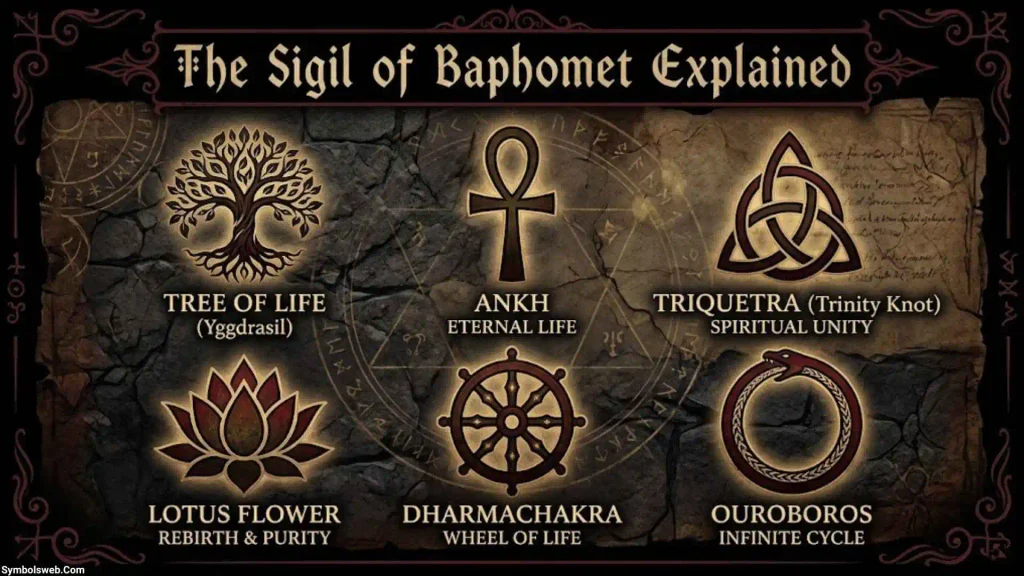
The Sigil of Baphomet combines several visual elements into one recognizable emblem. Its history demonstrates how older occult imagery became associated with a modern Satanic organization.
The Goat’s Head Inside the Inverted Pentagram
The goat’s head sits inside a five-pointed star whose upper points resemble horns. This arrangement gives the familiar emblem its distinctive appearance.
Earlier occult publications helped establish the connection between the inverted pentagram and goat imagery. Stanislas de Guaita’s 1897 work, La Clef de la Magie Noire, contains an important example of this visual tradition.
Later publications helped develop the modern emblem. The earlier designs and the Church of Satan’s symbol share visual elements, but their historical uses aren’t identical.
The Hebrew Letters and Their Role in the Design
The familiar Sigil of Baphomet includes Hebrew letters arranged between two circles. These letters spell Leviathan, a name associated with a sea creature in biblical literature and later religious and occult traditions.
Within the modern emblem, the inscription contributes to its recognizable design and association with the Church of Satan.
The use of Hebrew lettering doesn’t prove that the complete emblem originated in ancient Hebrew religion. The history of the specific design must be considered separately.
The Meaning of the Surrounding Circle
The surrounding circles frame the star and lettering, creating a unified design.
Circles often suggest continuity or unity in general symbolism. However, these associations shouldn’t be treated as definitive explanations of every element in the Sigil of Baphomet.
The most reliable interpretation begins with the emblem’s documented history and the explanation given by the organization that uses it.
The Symbol’s Association With Modern Satanism
The Church of Satan adopted the familiar emblem during its early development in the late 1960s. Its appearance in the organization’s publications helped establish it as a recognizable Satanic symbol.
Today, the design appears in entertainment, fashion, and online discussions. However, not everyone who displays a similar image belongs to the Church of Satan.
How the Sigil Differs From Older Pentagram Designs
The Sigil of Baphomet is a specific emblem combining a goat’s head, inverted pentagram, surrounding circles, and lettering.
A simple inverted pentagram lacks several of these identifying features. An upright pentagram has an even broader history across different religious and cultural traditions.
A pentagram is a geometric design. The Sigil of Baphomet is a particular emblem built around an inverted pentagram.
The Inverted Pentagram and Five-Pointed Star
The pentagram is one of the most misunderstood symbols in occult imagery. Its five points have carried different meanings across history, and its orientation can influence how people interpret it.
What Does an Inverted Pentagram Mean?
In modern Satanic imagery, an inverted pentagram often indicates an association with Satanism, particularly when paired with a goat’s head.
In other settings, it may belong to a different occult tradition or serve an artistic purpose. Its meaning depends on the historical period, accompanying imagery, and intended use.
Upright Pentagram vs. Inverted Pentagram
| Feature | Upright pentagram | Inverted pentagram |
| Orientation | One point faces upward | One point faces downward |
| Historical uses | Religious, cultural, magical, and philosophical settings | Occult traditions and modern Satanic imagery |
| Common modern associations | Protection and spiritual symbolism in some traditions | Satanic imagery, particularly with a goat’s head |
| Universal meaning | No | No |
These are common associations rather than universal rules. Both designs have meanings that vary across traditions.
Why the Inverted Pentagram Became Associated With Satanism
The association developed through Western occult literature, nineteenth-century illustrations, and later Satanic publications.
The goat’s head inside the inverted star became especially influential. The Church of Satan’s adoption of the Sigil of Baphomet helped make the design recognizable to a broad audience.
Movies, music, and popular media later reinforced this connection.
How Different Religious and Occult Traditions Interpret the Pentagram
Pentagrams appear in several religious and cultural traditions. Some practitioners use them in ritual settings, while others interpret them through ideas about protection, elements, or spiritual concepts.
The five-pointed star also appears in flags, decorative art, and organizational insignia. Its presence alone reveals little about someone’s beliefs.
The Sigil of Lucifer and Luciferian Symbolism
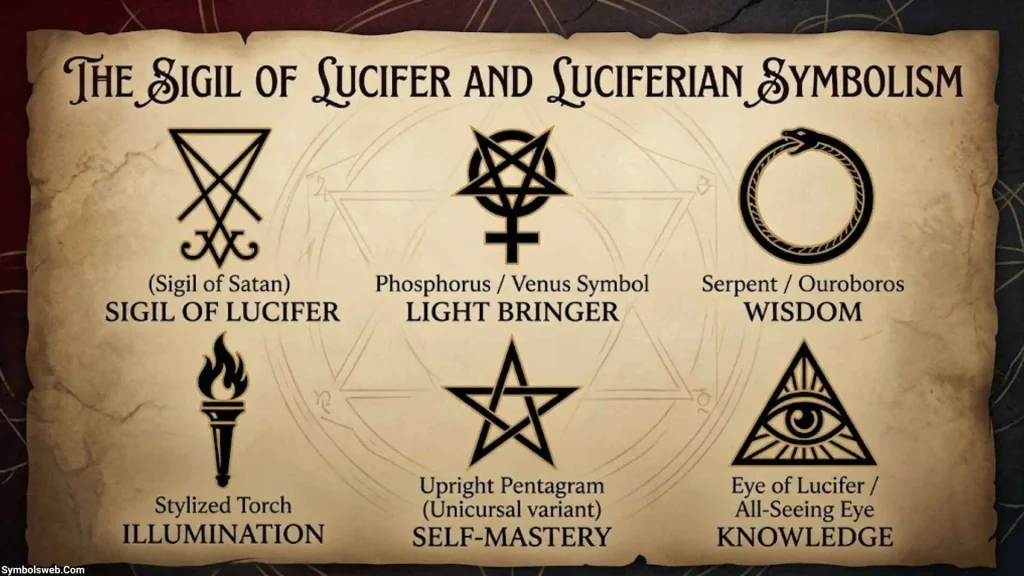
Luciferian symbolism requires separate consideration because Lucifer and Satan aren’t interchangeable in every religious or historical context.
What Does the Sigil of Lucifer Represent?
The Sigil of Lucifer is associated with Lucifer in certain grimoire traditions and modern Luciferian practices.
Contemporary interpretations may connect it with enlightenment, self-development, knowledge, or spiritual exploration. However, these meanings vary among practitioners.
Some understand Lucifer spiritually, while others interpret the figure symbolically or philosophically.
Lucifer as the Light-Bringer
The name Lucifer comes from Latin and is associated with the idea of a light-bringer or morning star.
Christian interpretations of Lucifer developed through historical readings of biblical language and later religious tradition. In some modern Luciferian interpretations, the light-bringer represents knowledge, questioning, and intellectual independence.
These interpretations differ from traditions that associate Lucifer with pride, rebellion, or spiritual downfall.
Knowledge, Enlightenment, and Independent Thought
Some modern Luciferian writers use Lucifer as a symbol of the pursuit of knowledge and the willingness to question inherited beliefs.
Within these frameworks, the figure may represent intellectual curiosity and personal growth. However, these meanings shouldn’t automatically be assigned to every historical reference to Lucifer.
Luciferian Symbolism vs. Satanic Symbolism
| Feature | Luciferian symbolism | Satanic symbolism |
| Central figure | Lucifer | Satan or other figures, depending on the tradition |
| Common interpretations | Knowledge and personal development in some modern traditions | Individualism, religious dissent, or spiritual beliefs |
| Beliefs about supernatural beings | Vary | Vary |
| Relationship between traditions | May overlap with Satanism | May overlap with Luciferianism |
Luciferianism and Satanism can share themes, but they aren’t universal synonyms.
The Leviathan Cross, Brimstone Cross, and Sulfur Symbol
The Leviathan Cross is often grouped with Satanic symbols because of its modern associations. Its history also connects with the alchemical symbol for sulfur.
What Is the Leviathan Cross?
The Leviathan Cross features a double-barred cross above an infinity-like loop. It is recognizable in modern Satanic imagery, although its history involves earlier symbolic traditions.
Its association with the Sigil of Baphomet and the Church of Satan has helped establish its modern identity.
The Alchemical Symbol for Sulfur
Sulfur, also spelled sulphur, is a chemical element that played a role in historical alchemy. Alchemists used symbols to identify substances and communicate ideas about materials and processes.
The alchemical sulfur symbol resembles a cross above a triangular form. Although it is visually related to the Leviathan Cross, similar designs shouldn’t automatically be treated as identical.
The historical use of sulfur notation doesn’t establish a Satanic purpose.
The Meaning of the Double-Barred Cross and Infinity Shape
Some modern interpretations associate the Leviathan Cross with autonomy, independence, or continuity. These meanings reflect particular symbolic readings rather than a universal historical definition.
The lower loop may suggest continuity because of its resemblance to the infinity sign. However, that visual similarity doesn’t prove that every use represents eternity or limitless potential.
How the Symbol Became Associated With Satanism
The Leviathan Cross became recognizable in modern Satanic contexts through its connection with the Sigil of Baphomet and related imagery.
Its appearance in music, fashion, and online content strengthened this association. Many people recognize the design without knowing its alchemical background.
Historical Alchemy vs. Modern Interpretations
Alchemical symbols shouldn’t be assigned modern religious meanings without evidence.
When interpreting the Leviathan Cross, consider whether the source is a historical alchemical text, a modern Satanic organization, or an artistic work. Each setting may use the design differently.
The Inverted Cross and the Cross of Saint Peter
The inverted cross illustrates how a symbol can carry contrasting meanings. Its Christian history predates its modern use as a provocative image in some countercultural settings.
What Is the Original Meaning of the Inverted Cross?
Christian tradition associates the inverted cross with Saint Peter. According to a longstanding account, Peter was crucified upside down because he considered himself unworthy of dying in the same manner as Jesus.
This account is part of Christian tradition rather than an explicit detail in the biblical narrative. Nevertheless, the inverted cross became an established representation of Saint Peter in Christian art.
The Christian Tradition Associated With Saint Peter
Saint Peter holds an important position in Christianity, particularly in Roman Catholic tradition. Christian artwork sometimes uses the inverted cross to represent his martyrdom.
This history challenges the assumption that every upside-down cross expresses hostility toward Christianity.
Why the Inverted Cross Is Sometimes Viewed as Satanic
Horror films, heavy metal artwork, and countercultural performances have used inverted crosses to suggest blasphemy or opposition to Christianity.
Some people deliberately use the symbol to communicate religious dissent. In those cases, the intended message comes from the user and the surrounding context.
Inverted Cross vs. Anti-Christian Symbolism
An inverted cross is a shape, while anti-Christian symbolism expresses a particular message or interpretation.
A religious symbol can be reinterpreted over time. To understand its meaning, examine the setting, accompanying imagery, and stated purpose rather than relying on orientation alone.
Baphomet Symbolism and Its Historical Meaning
Baphomet is a significant figure in occult history. Its modern imagery combines elements that invite interpretations about duality, nature, and opposing forces.
However, the historical record doesn’t support treating every appearance of Baphomet as an image of Satan.
Who Is Baphomet?
The name Baphomet appears in historical records connected with accusations against the Knights Templar during the early fourteenth century. The exact origin and original meaning of the name remain subjects of historical debate.
The familiar goat-headed image developed much later through nineteenth-century occult art, particularly Éliphas Lévi’s illustration.
Modern Satanic movements subsequently adopted Baphomet imagery for their own purposes. These later uses don’t establish that the medieval figure originally had the same meaning.
Éliphas Lévi’s Depiction of Baphomet
Lévi’s illustration combined a goat-headed figure with a torch, contrasting physical features, and symbolic hand gestures.
His depiction reflected nineteenth-century occult philosophy rather than a straightforward reproduction of an ancient religious image.
Later occultists and Satanic organizations adapted aspects of the design, demonstrating how occult iconography changes as different movements reinterpret familiar images.
Masculine and Feminine Symbolism
Lévi’s Baphomet includes both masculine and feminine features. These elements contribute to the illustration’s exploration of duality and contrasting principles.
Some interpretations connect the combination with the coexistence of different aspects of nature and human experience. However, these meanings belong to a specific symbolic framework and aren’t universal explanations of every Baphomet image.
The Torch Between Baphomet’s Horns
A torch rises between Baphomet’s horns in Lévi’s illustration. Within the nineteenth-century occult context, the flame forms part of the image’s broader philosophical symbolism.
Modern viewers may associate torches with knowledge, illumination, or discovery. These are familiar interpretations of torch imagery, but they shouldn’t replace the historical context of the original design.
The Hand Gesture and “As Above, So Below”
Lévi’s Baphomet raises one hand and lowers the other. The gesture is often connected with the phrase “As Above, So Below,” associated with Hermetic philosophy.
The phrase is commonly interpreted as expressing relationships between different levels of existence, such as the heavenly and earthly or the spiritual and material.
Although the gesture appears in modern Baphomet imagery, it isn’t exclusively Satanic. Its broader background belongs to Western esoteric thought.
The Caduceus and Entwined Serpents
The caduceus is a staff associated with Hermes in Greek mythology. Its familiar design features two serpents entwined around a central staff, often with wings near the top.
The symbol has historical associations with Hermes, communication, and exchange. It also appears in later artistic and professional imagery.
The caduceus isn’t inherently Satanic. When it appears in Baphomet imagery, its meaning comes from that particular composition rather than a universal connection to Satanism.
Balance, Duality, and the Union of Opposites
Baphomet’s combined features invite interpretations involving duality and the coexistence of contrasting forces. These may include masculine and feminine characteristics or spiritual and material existence.
In Lévi’s illustration, such contrasts form part of a broader occult framework. Modern organizations may reinterpret the figure according to their own beliefs and goals.
The Baphomet Statue and Its Modern Cultural Meaning
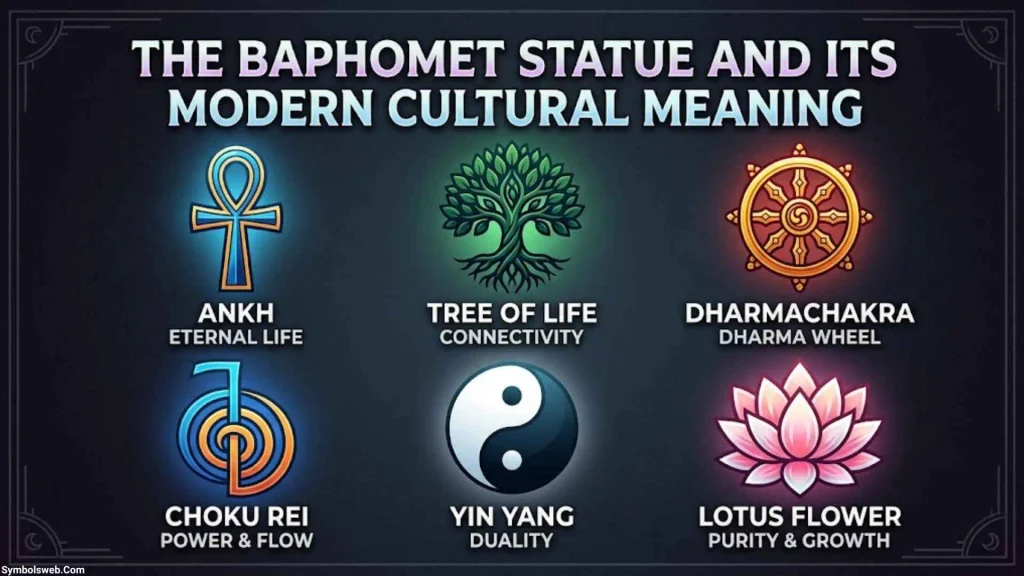
The modern Baphomet monument demonstrates how religious imagery can become part of public debates about freedom of belief and government neutrality.
The Satanic Temple’s Baphomet Monument
The Satanic Temple’s monument features a seated, goat-headed figure with two children standing beside it.
The organization connects the monument with pluralism and religious representation. It has also used Baphomet imagery in campaigns concerning the equal treatment of religious viewpoints in public spaces.
The Meaning of the Children Beside Baphomet
The children form part of the monument’s composition and contribute to its message about religious representation.
Their presence can be understood within the Temple’s stated emphasis on pluralism and the freedom to examine beliefs. However, claims about their symbolism should be tied to documented explanations rather than unsupported assumptions.
Religious Liberty and Freedom of Belief
The monument has featured in disputes over religious displays on public property. These debates often concern whether government institutions treat different religious viewpoints equally.
The Satanic Temple has argued for the inclusion of its religious expression in public forums where other religious displays are permitted.
Why the Monument Became a Subject of Public Debate
Baphomet’s appearance differs from familiar Christian imagery in many American communities. This contrast can provoke strong reactions, especially when the monument appears near another religious display.
Understanding the debate requires examining the competing views about religion, public institutions, and freedom of belief rather than assuming that one interpretation explains every response.
Other Symbols Commonly Linked to Satanism
Several additional symbols appear in discussions of Satanic imagery. Some have established connections to particular designs or organizations, while others are included because of visual similarities.
The Goat’s Head
The goat’s head is closely associated with modern Baphomet imagery, particularly when it appears inside an inverted pentagram.
However, goats appear in numerous religious, mythological, and artistic traditions. A goat’s head without additional context isn’t enough to establish a Satanic association.
The Sulfur Symbol in Occult Imagery
The sulfur symbol comes from alchemical notation and later appears in modern occult and Satanic contexts.
If you encounter it in a historical alchemical text, begin with the substance or process being discussed. If it appears in a modern organization’s emblem, examine that organization’s explanation.
The Double-Barred Cross
The double-barred cross appears in several symbolic and religious settings. Its resemblance to part of the Leviathan Cross doesn’t make every double-barred cross Satanic.
The accompanying design and documented use provide stronger clues to its meaning.
Flames and Torch Imagery
Flames and torches appear in mythology, religion, literature, and political imagery. They may suggest light, knowledge, warning, destruction, or renewal, depending on the context.
The torch in Lévi’s Baphomet illustration belongs to a specific occult composition. A flame used elsewhere may communicate something entirely different.
The Infinity Symbol
The infinity symbol represents an unending quantity in mathematics and may suggest continuity in broader visual contexts.
Some people use it in spiritual or occult artwork. However, it isn’t inherently Satanic, and its meaning depends on the surrounding imagery and intended use.
The Five-Pointed Star
The five-pointed star appears in religious traditions, national flags, decorative art, and organizational insignia.
Its orientation and accompanying elements can influence how people interpret it. A star alone doesn’t establish a connection to Satanism.
The Caduceus and Staff Motifs
The caduceus is associated with Hermes, while other staffs appear in mythology and religious art.
Although the caduceus appears in some interpretations of Baphomet, it isn’t a universal emblem of Satanism.
Symbols That Are Frequently Misidentified as Satanic
Several symbols are often misidentified because people focus on appearance rather than context.
- An isolated pentagram: It has multiple historical and modern uses.
- A crescent moon: It appears in numerous religious and cultural traditions.
- A serpent: Serpents appear in mythology, medicine, literature, and religious symbolism.
- An inverted cross: It can represent Saint Peter in Christian settings.
- A torch: It may symbolize light, knowledge, remembrance, or other ideas.
- A goat: It appears in ordinary art, mythology, and agricultural settings.
Visual resemblance alone isn’t enough to establish a symbol’s religious meaning.
What Satanic Symbols Mean in Modern Satanism
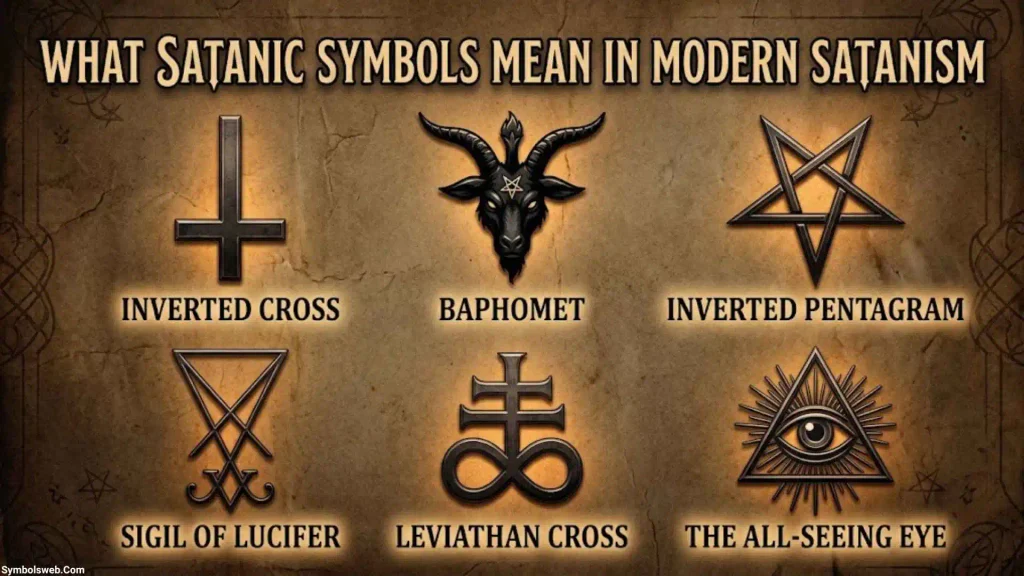
Modern Satanism includes different organizations, philosophical approaches, and religious beliefs. These differences explain why the same symbol can communicate different ideas to different people.
Symbolism in LaVeyan Satanism
LaVeyan Satanism developed around the Church of Satan, founded by Anton LaVey in 1966.
The tradition generally interprets Satan symbolically rather than requiring belief in a literal supernatural Satan. Its philosophy emphasizes individualism, personal responsibility, and resistance to conformity.
The Sigil of Baphomet reflects the Church of Satan’s organizational identity. Its meaning shouldn’t automatically be assigned to other Satanic movements.
Symbolism in The Satanic Temple
The Satanic Temple is a separate organization with its own principles and public activities.
It has used Satanic imagery in campaigns related to religious liberty, pluralism, bodily autonomy, and the relationship between religion and government.
Its Baphomet monument demonstrates how a religious symbol can also serve as a statement about public representation and equal treatment.
Atheistic Satanism vs. Theistic Satanism
Atheistic Satanism generally doesn’t require belief in a literal Satan. Instead, Satan may function as a literary, philosophical, or symbolic figure.
Theistic Satanism refers to approaches in which Satan is understood as a real spiritual or supernatural being. Beliefs vary among individuals and groups.
This distinction affects how people interpret Satanic symbols. One person may view an emblem as a statement of personal philosophy, while another may understand it through spiritual devotion.
Individualism, Personal Responsibility, and Autonomy
Some modern Satanic traditions emphasize individual choice, self-determination, and personal responsibility.
Their symbols can serve as reminders of these principles or as expressions of group identity. However, not every symbol represents all these values, and not every Satanist interprets a design in the same way.
Why Satanists Do Not All Interpret Symbols the Same Way
Satanic communities contain differences of opinion about supernatural beings, religious imagery, rituals, and philosophy.
Some Satanists use recognizable organizational emblems, while others prefer personal or artistic designs. Their beliefs and practices can differ significantly.
Consequently, Satanic beliefs can’t be accurately summarized through a single symbol or slogan.
Common Misconceptions About Satanic Symbols
Misunderstandings often arise when people interpret symbols without examining their origins. Popular culture can spread these mistakes by repeatedly using the same imagery to represent danger or evil.
Are All Satanic Symbols Connected to Evil?
No. The term Satanic refers to an association with Satan, Satanism, or a particular tradition. It doesn’t establish one universal moral meaning.
Some religious perspectives interpret Satan as an embodiment of evil. Certain modern Satanic groups use Satan as a symbol of individualism, dissent, or philosophical independence.
A balanced explanation should distinguish between different traditions.
Does Every Inverted Cross Represent Satanism?
No. The inverted cross has a longstanding association with Saint Peter in Christian tradition.
It also appears in anti-Christian artwork, horror films, and modern Satanic imagery. Its meaning depends on the person using it and the surrounding context.
Is Every Pentagram a Satanic Symbol?
No. Pentagrams have appeared in religious, cultural, and magical settings throughout history.
The inverted pentagram became associated with modern Satanism through particular occult designs and organizational uses. An isolated five-pointed star shouldn’t automatically be interpreted in the same way.
Are Baphomet and Satan the Same Figure?
Not in every historical or religious context. Baphomet’s name appears in medieval records, while the familiar goat-headed figure became influential through nineteenth-century occult art.
Modern Satanic movements later adopted Baphomet imagery. That later association doesn’t establish that Baphomet and Satan were always understood as identical figures.
Are Luciferian and Satanic Symbols Interchangeable?
No. Luciferianism and Satanism can overlap, but they include different interpretations of Lucifer, Satan, spirituality, and personal development.
A symbol associated with a Luciferian tradition shouldn’t automatically be described as an official Satanic emblem.
How Movies, Music, and Social Media Shape Public Perceptions
Entertainment often uses symbols to establish a mood quickly. An inverted cross or goat-headed figure can communicate danger to an audience familiar with horror conventions.
Social media can further simplify complex histories into dramatic images or short claims. When these claims spread without context, people may mistake modern artistic choices for ancient religious traditions.
Comparing popular explanations with historical sources helps prevent these errors.
How to Identify a Satanic Symbol Correctly
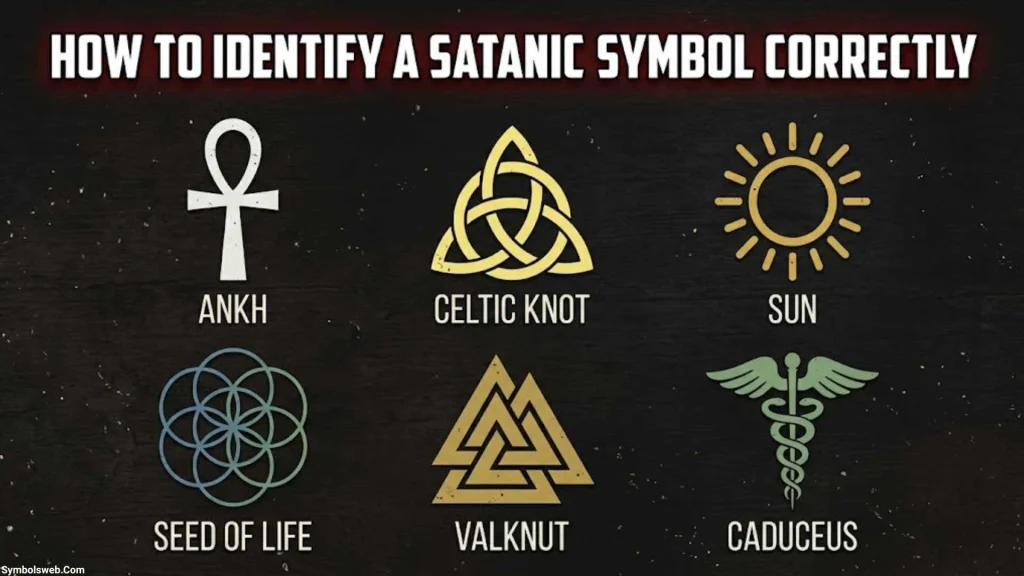
You don’t need to be an expert in religious history to investigate a symbol carefully. A few practical steps can help distinguish documented associations from speculation.
Examine the Symbol’s Historical Origin
Start by identifying the earliest documented appearance of the specific design. Look for historical texts, scholarly publications, museum collections, and credible organizational histories.
Be cautious when a source claims that a symbol is thousands of years old without providing evidence. An older visual element doesn’t prove that a modern design existed in the same form during ancient times.
Consider the Religious or Cultural Context
Ask where the symbol appears and who uses it. A design in a church, an alchemical manuscript, a modern Satanic publication, and a movie may carry different meanings.
Consider these details:
- The organization or tradition using the symbol.
- Other images or inscriptions in the design.
- The historical period in which it appeared.
- The creator’s explanation.
- The setting in which the symbol is displayed.
Distinguish Documented Uses From Online Claims
Online descriptions sometimes repeat interpretations without identifying their sources. A claim may sound convincing while lacking historical evidence.
Consult primary sources when possible. Organizational websites can explain how a group understands its emblem, while scholarly sources can help establish its broader history.
An organization’s explanation documents its own perspective, but it doesn’t necessarily settle every historical question.
Understand the Difference Between Association and Meaning
A symbol can be associated with a movement without having one universal meaning. Similarly, a design may appear in a Satanic context without every person using it intending the same message.
This distinction is especially useful when examining tattoos, clothing, jewelry, album covers, and online artwork.
The most reliable interpretation combines historical evidence, cultural context, and the stated purpose of the person or group using the symbol.
Frequently Asked Questions About Satanic Symbols
What Is the Most Recognizable Satanic Symbol?
The Sigil of Baphomet is one of the most recognizable modern Satanic symbols. The Church of Satan uses it as its principal emblem. Its familiar design combines a goat’s head, an inverted pentagram, and Hebrew lettering spelling Leviathan.
What Does the Sigil of Baphomet Mean?
The Sigil of Baphomet represents a specific Satanic organizational identity, particularly that of the Church of Satan. Its design draws on earlier occult imagery, but its familiar modern form became prominent during the twentieth century.
What Does an Inverted Pentagram Represent?
An inverted pentagram can represent Satanic imagery, particularly when it includes a goat’s head. However, pentagrams have appeared in different historical and occult traditions, so the design’s meaning depends on context.
Is the Upside-Down Cross Originally a Satanic Symbol?
No. Christian tradition associates the inverted cross with Saint Peter and his martyrdom. Some modern artists and Satanic practitioners use it to express religious dissent, but that isn’t its only meaning.
What Does the Sigil of Lucifer Mean?
The Sigil of Lucifer appears in grimoire traditions and is used in some modern Luciferian practices. It may represent knowledge, enlightenment, or personal development, depending on the practitioner and tradition.
What Is the Meaning of the Leviathan Cross?
The Leviathan Cross is associated with modern Satanic imagery and the alchemical symbol for sulfur. Its interpretation depends on the design’s historical or contemporary setting.
Who Is Baphomet?
Baphomet is a figure whose name appears in medieval records connected with the Knights Templar trials. The familiar goat-headed image became influential through Éliphas Lévi’s nineteenth-century occult illustration and later interpretations.
Are Satanic Symbols Always Religious?
No. Some people use Satanic imagery as part of a religious or philosophical identity, while others use it in art, fashion, music, or fiction. The intended meaning depends on the creator and setting.
Do All Satanists Believe in Satan?
No. Some Satanic traditions are non-theistic and treat Satan as a symbolic figure. Other individuals and groups understand Satan in spiritual or supernatural terms. Beliefs vary.
How Can You Tell Whether a Symbol Is Actually Satanic?
Look at the design’s documented history, accompanying imagery, cultural setting, and intended use. Don’t assume that a pentagram, inverted cross, goat, or serpent automatically indicates Satanism.
Conclusion
Satanic symbols and their meanings become easier to understand when you examine their origins rather than judging them by appearance alone. The Sigil of Baphomet has a specific connection to modern Satanism, while the inverted cross, pentagram, sulfur symbol, and caduceus have broader histories across religious, cultural, and philosophical traditions.
Modern Satanic movements also differ in their beliefs and interpretations. Some use Satan as a symbol of individualism and resistance to conformity, while others approach Satan through spiritual or theistic beliefs. Their symbols reflect these differences rather than one universal doctrine.
When you encounter unfamiliar occult symbols, investigate their history, identify who uses them, and compare documented evidence with popular claims. This approach helps you distinguish historical connections from assumptions and understand why the same image can communicate different ideas across cultures and generations.

Jordan Hayes is a writer with a passion for exploring the history, meanings, and cultural significance behind symbols from around the world. He enjoys turning complex topics into clear, engaging content that anyone can understand. Jordan is also the fictional author of The Silent Language of Ancient Marks and Hidden Symbols Beyond the Surface, two original book concepts created for his author profile. When he’s not writing, he spends time researching myths, traditions, and forgotten stories that inspire his work. His goal is to help readers discover the deeper meanings behind the symbols they encounter every day.
 Eliana Foster
 Ethan Holloway