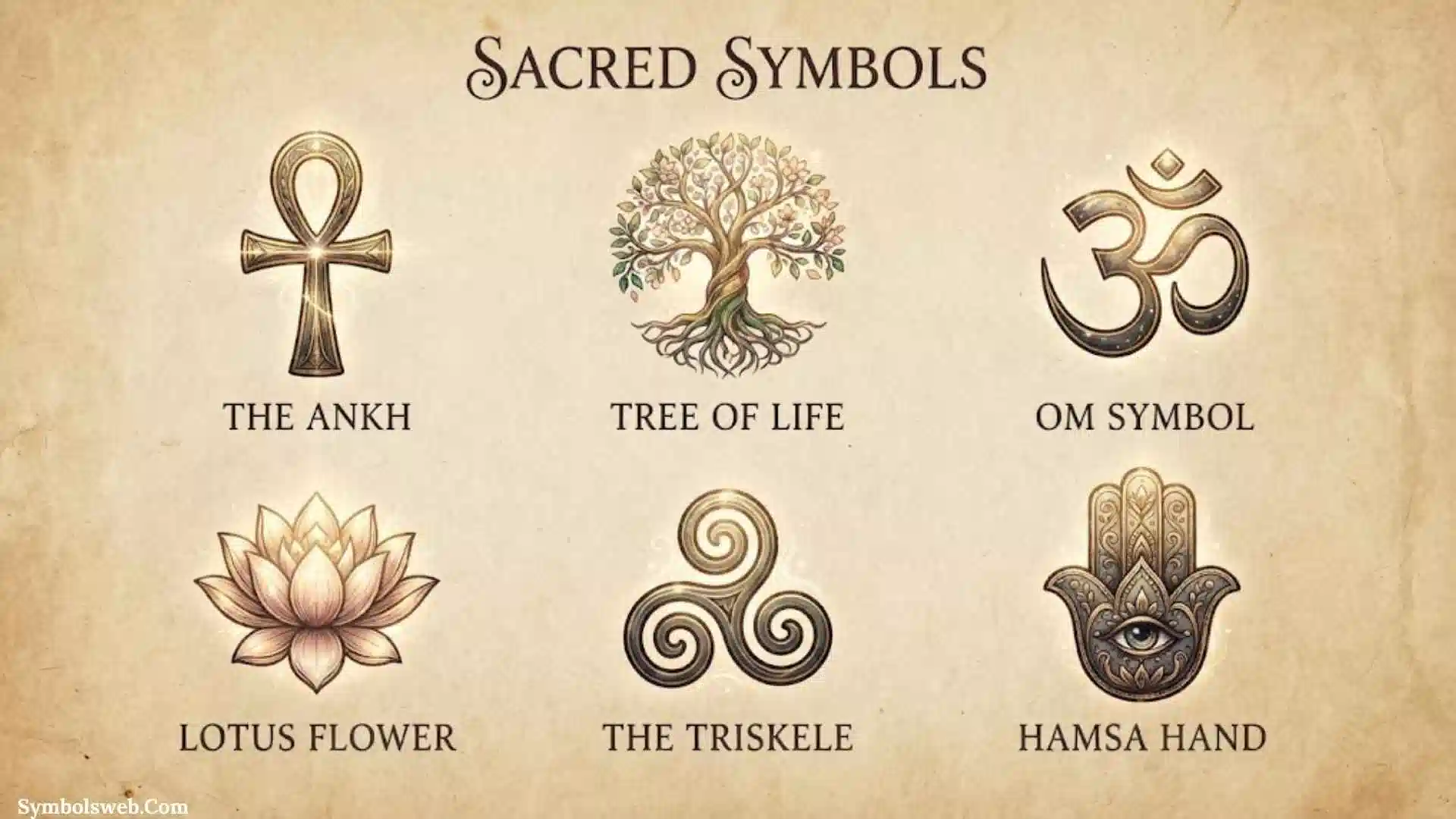
Sacred symbols have fascinated humanity for thousands of years. From ancient temples and religious texts to modern tattoos and jewelry, these powerful images carry meanings that reach deep into the human soul.
If carved into stone, painted on cave walls, or worn around the neck, sacred symbols help people connect with something greater than themselves. They tell stories, preserve wisdom, inspire faith, and reveal universal truths that transcend time and culture.
In this guide, you’ll discover the history, symbolism, spiritual significance, psychological power, and cultural meanings behind sacred symbols from around the world.
Quick Answer
Sacred symbols are visual representations of spiritual beliefs, divine principles, cosmic forces, or universal truths. Found in religions, mythologies, and ancient cultures worldwide, they help express ideas about life, death, protection, transformation, wisdom, and the connection between humanity and the sacred.
Quick Facts About Sacred Symbols
| Aspect | Information |
| Origin | Prehistoric civilizations and ancient spiritual traditions |
| Historical Significance | Used in religion, ritual, art, and cultural identity for thousands of years |
| Main Meaning | Connection between the physical and spiritual worlds |
| Spiritual Meaning | Divine guidance, protection, enlightenment, and transformation |
| Cultural Importance | Preserves beliefs, traditions, values, and collective identity |
| Modern Usage | Tattoos, jewelry, meditation, spirituality, fashion, branding, and art |
What Are Sacred Symbols?
Sacred symbols are meaningful images, shapes, signs, or patterns that represent spiritual concepts, religious beliefs, divine forces, or universal truths.
Humans have used symbols since the earliest civilizations. Long before written language existed, symbols served as powerful tools for communication. Ancient people used them to record stories, express beliefs, and connect with mysterious forces they believed shaped existence.
Many sacred symbols emerged from observations of nature. The sun, moon, stars, animals, trees, rivers, and mountains became symbolic representations of deeper spiritual realities.
As civilizations developed, these symbols evolved into important elements of religious and cultural traditions. They appeared in temples, manuscripts, ceremonial objects, and sacred architecture.
Throughout history, sacred symbols have remained important because they communicate complex spiritual ideas in a simple visual form. A single image can carry layers of meaning that words often cannot fully express.
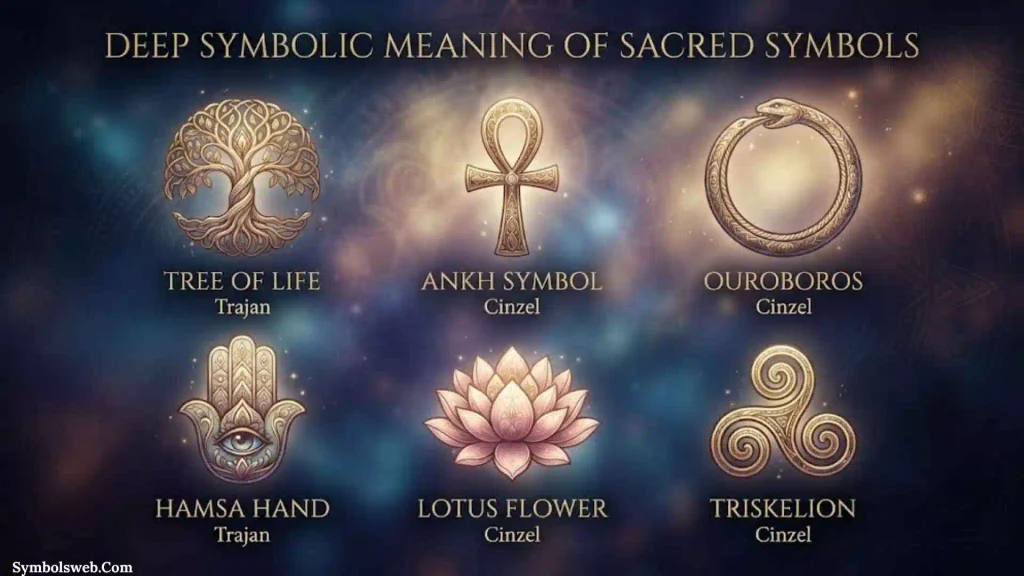
Deep Symbolic Meaning of Sacred Symbols
Spiritual Level
At the spiritual level, sacred symbols act as bridges between the visible and invisible worlds.
Many traditions teach that symbols are not merely decorative images. Instead, they serve as reminders of divine truths and spiritual realities.
For example:
- The circle often symbolizes eternity and unity.
- The lotus represents spiritual awakening.
- The tree symbolizes growth and connection between heaven and earth.
- The spiral represents personal evolution and transformation.
Meditation practitioners often focus on sacred symbols to deepen awareness and strengthen their spiritual connection.
Psychological Level
From a psychological perspective, sacred symbols resonate because they connect with universal human experiences.
Psychologist Carl Jung described symbols as expressions of archetypes that exist within the collective unconscious.
Common archetypal themes include:
- Birth and rebirth
- Wisdom
- Protection
- Heroic journeys
- Transformation
- Light overcoming darkness
Because these themes are shared across cultures, sacred symbols often evoke strong emotional responses even when people do not fully understand their historical origins.
Cultural Level
Every culture develops sacred symbols that reflect its values, beliefs, and worldview.
These symbols create social bonds and help communities preserve traditions across generations.
For example:
- Indigenous Consider use sacred animal symbols.
- Eastern traditions often emphasize balance and enlightenment.
- Ancient Mediterranean cultures focused on divine power and cosmic order.
Symbols become visual languages that unite communities and strengthen cultural identity.
Types and Variations of Sacred Symbols
The Cross
Visual Description: Two intersecting lines.
Meaning: Faith, sacrifice, redemption.
Symbolism: Spiritual salvation and divine love.
Cultural Connection: Christianity.
Where It Appears: Churches, art, jewelry, literature.
The Lotus Flower
Visual Description: Multi-petaled flower emerging from water.
Meaning: Purity and enlightenment.
Symbolism: Rising above challenges.
Cultural Connection: Hinduism and Buddhism.
Where It Appears: Temples, meditation practices, sacred art.
The Yin Yang
Visual Description: Circular symbol with black and white halves.
Meaning: Balance and harmony.
Symbolism: Unity of opposites.
Cultural Connection: Chinese philosophy.
Where It Appears: Martial arts, meditation, Eastern spirituality.
The Tree of Life
Visual Description: Large tree with spreading branches and roots.
Meaning: Growth, wisdom, interconnectedness.
Symbolism: Connection between all forms of life.
Cultural Connection: Found in many world traditions.
Where It Appears: Mythology, religious texts, jewelry.
The Spiral
Visual Description: Curving line winding inward or outward.
Meaning: Evolution and spiritual growth.
Symbolism: Life’s journey.
Cultural Connection: Celtic and Indigenous traditions.
Where It Appears: Ancient carvings, art, dream symbolism.
Sacred Symbols Across Different Cultures
Ancient Egypt
Ancient Egyptians believed symbols carried divine power.
Important examples include:
- Ankh represents life.
- Eye of Horus symbolizing protection.
- Scarab beetle symbolizing rebirth.
These symbols appeared in tombs, temples, and sacred ceremonies.
Ancient Greece
Greek sacred symbols reflected mythology and divine influence.
Examples include:
- Owls represent wisdom.
- Laurel wreath symbolizing victory.
- Thunderbolt associated with divine authority.
These images connected people with the gods and heroic ideals.
Roman Culture
Romans adopted many Greek symbols while adding their own interpretations.
Common sacred symbols included:
- Eagle representing power.
- Fasces symbolizing authority.
- Sacred fire represents divine presence.
These symbols reinforced civic and spiritual values.
Eastern Traditions
Eastern cultures developed some of the world’s most recognized sacred symbols.
Examples include:
- Lotus flower
- Yin Yang
- Om
- Dharma Wheel
These symbols emphasize harmony, enlightenment, and spiritual awakening.
Indigenous Traditions
Indigenous cultures often use sacred symbols inspired by nature.
Examples include:
- Animal totems
- Medicine wheels
- Sun symbols
- Feather motifs
These symbols reflect respect for nature and ancestral wisdom.
Modern Interpretations
Today, sacred symbols continue evolving.
People use them for:
- Personal growth
- Spiritual exploration
- Artistic expression
- Identity and meaning
Although interpretations may vary, their emotional power remains strong.
Similar Symbols and Their Meanings
| Symbol | Similarity | Difference |
| Lotus and Rose | Spiritual growth | Lotus emphasizes enlightenment while rose often symbolizes love |
| Cross and Ankh | Life and spirituality | Ankh focuses on eternal life, cross emphasizes redemption |
| Yin Yang and Spiral | Transformation | Yin Yang emphasizes balance, spiral emphasizes growth |
| Tree of Life and World Tree | Interconnectedness | Different cultural origins but similar concepts |
| Sun Symbol and Wheel | Cycles of life | Wheel often includes destiny and spiritual progress |
Common Misconceptions
Many people assume sacred symbols have only one meaning.
In reality, most symbols possess multiple layers of interpretation depending on culture, history, and spiritual tradition.
Sacred Symbols in Mythology and Folklore
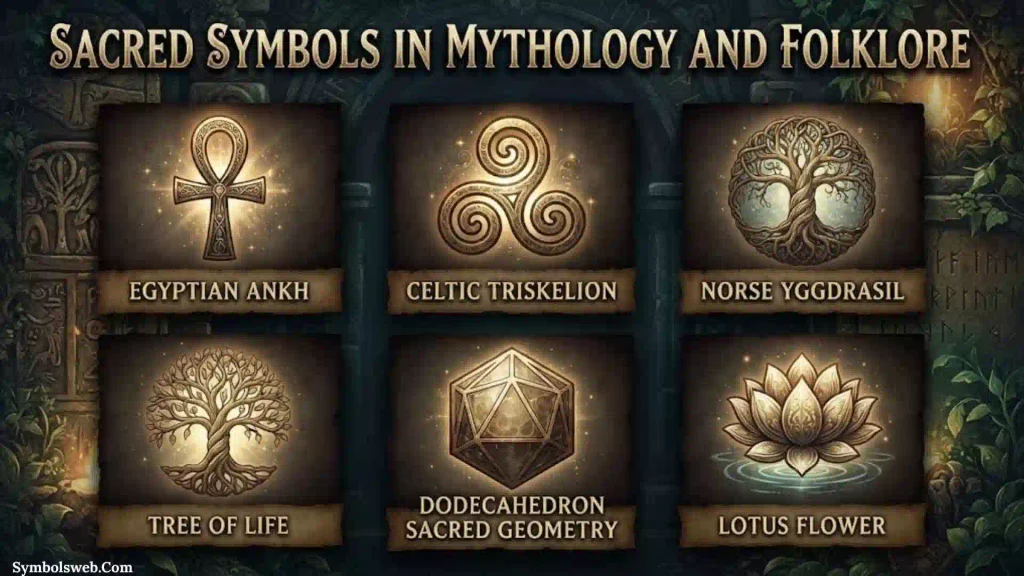
Mythology is filled with sacred symbols that shaped human imagination.
Ancient stories often used symbolic objects to represent divine truths.
Examples include:
- The World Tree connects different realms.
- Sacred serpents representing wisdom and transformation.
- Divine birds carrying messages from the heavens.
- Magical circles protecting against harmful forces.
Folklore transformed these symbols into memorable stories that passed wisdom from one generation to the next.
Even today, many myths continue influencing modern interpretations of sacred symbols.
Sacred Symbols in Art, Literature, Movies, and Pop Culture
Paintings
Artists have used sacred symbols for centuries to communicate spiritual ideas.
Religious paintings frequently feature halos, crosses, doves, and sacred geometric patterns.
Literature
Authors use symbols to add deeper meaning to stories.
A tree may represent growth, while a journey may symbolize spiritual transformation.
Poetry
Poets often employ sacred imagery to explore themes of faith, love, mortality, and enlightenment.
Movies and Television
Modern films frequently incorporate ancient symbols to represent destiny, mystery, or spiritual awakening.
Viewers may not consciously recognize these symbols, yet they often influence emotional responses.
Tattoos
Sacred symbols remain among the most popular tattoo designs.
People choose them to represent:
- Personal beliefs
- Life experiences
- Protection
- Transformation
- Spiritual identity
Fashion and Design
Many sacred symbols now appear in jewelry, clothing, architecture, and interior design.
Their timeless beauty continues attracting people worldwide.
Spiritual and Dream Meaning of Sacred Symbols
Dreams frequently feature sacred symbols because the subconscious communicates through imagery.
Common interpretations include:
Positive Messages
- Personal growth
- Spiritual awakening
- Guidance
- Protection
- Healing
- Inner wisdom
Cautionary Messages
- Need for self-reflection
- Unresolved emotions
- Spiritual imbalance
- Resistance to change
The meaning depends on personal experiences, cultural background, and the symbol itself.
Many spiritual traditions encourage individuals to reflect deeply on symbolic dreams rather than relying solely on fixed interpretations.
Positive and Negative Meanings of Sacred Symbols
| Positive Meaning | Negative Meaning |
| Protection | Dogmatism |
| Wisdom | Misinterpretation |
| Enlightenment | Spiritual pride |
| Unity | Exclusion of outsiders |
| Transformation | Fear of change |
| Faith | Blind belief |
| Hope | Unrealistic expectations |
| Guidance | Dependence on external signs |
Sacred symbols often contain both light and shadow aspects. Their meaning depends on context, intention, and interpretation.
Why Humans Are Attracted to Sacred Symbols
Humans are naturally drawn to symbols because the brain processes images faster than words.
Symbols simplify complex ideas and create emotional connections.
Several psychological factors explain their appeal:
Pattern Recognition
Humans instinctively search for meaning in patterns.
Symbols provide recognizable structures that help people understand the world.
Collective Memory
Many sacred symbols have existed for thousands of years.
Their continued presence creates a sense of familiarity and continuity.
Emotional Resonance
Symbols often represent universal experiences such as love, hope, loss, transformation, and belonging.
Personal Meaning
People frequently assign unique meanings to symbols based on their life experiences.
A symbol becomes powerful when it reflects a person’s journey and values.
Modern Uses of Sacred Symbols
Today, sacred symbols remain highly relevant.
Tattoos
Represent personal beliefs, healing, protection, and transformation.
Jewelry
Worn as reminders of faith, purpose, and spiritual connection.
Fashion
Used as meaningful design elements and cultural expressions.
Branding
Many organizations incorporate symbolic imagery to communicate values and identity.
Social Media
Sacred symbols frequently appear in digital art, wellness communities, and inspirational content.
Contemporary Spirituality
Meditation, mindfulness, yoga, and personal development movements often incorporate ancient symbols.
Home Decor
People use sacred imagery to create peaceful and meaningful environments.
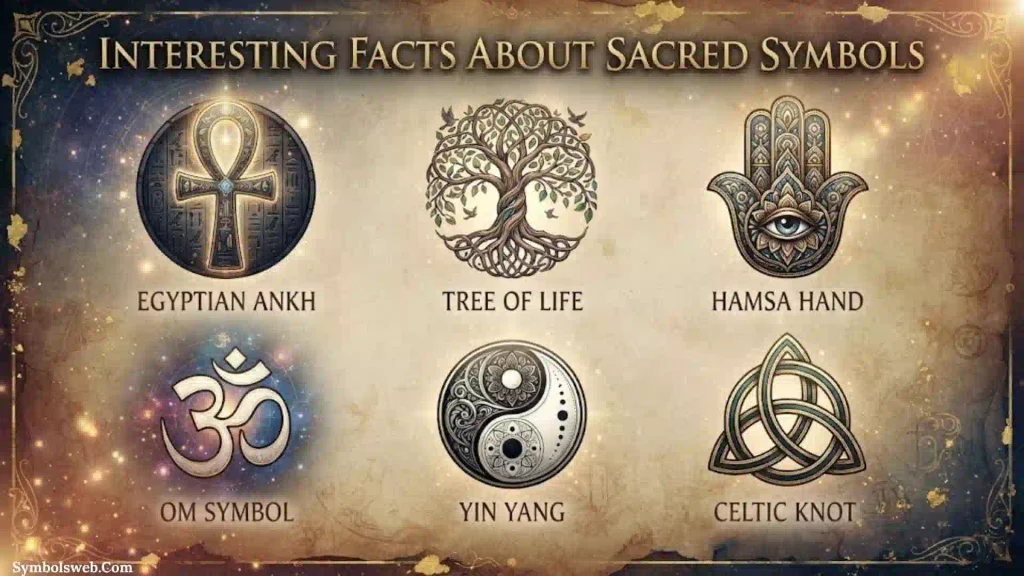
Interesting Facts About Sacred Symbols
- Some sacred symbols are more than 10,000 years old.
- Many cultures independently created similar symbols despite having no contact with one another.
- The circle is among the oldest sacred symbols in human history.
- Sacred geometry influenced ancient temples and monuments worldwide.
- The spiral appears in prehistoric cave art across multiple continents.
- Symbols often survive long after the civilizations that created them disappear.
- Many dream symbols overlap with ancient sacred imagery.
- Modern logos frequently borrow concepts from sacred symbolism.
- Sacred symbols are studied in psychology, anthropology, religion, and art history.
- The same symbol can have different meanings across cultures.
Frequently Asked Questions
What is the most powerful sacred symbol?
There is no universally most powerful sacred symbol. Symbols such as the cross, lotus, ankh, Yin Yang, and Tree of Life are among the most widely respected and spiritually significant.
Why are sacred symbols important?
Sacred symbols communicate spiritual truths, preserve cultural traditions, inspire faith, and help people connect with deeper aspects of life and identity.
Are sacred symbols connected to religion?
Many are associated with religions, but sacred symbols also appear in mythology, philosophy, psychology, folklore, and personal spirituality.
Can sacred symbols have different meanings?
Yes. The meaning often changes based on culture, historical period, religious tradition, and personal interpretation.
Do sacred symbols appear in dreams?
Frequently. Many dream researchers and spiritual traditions believe sacred symbols represent messages from the subconscious mind or spiritual insights.
Is sacred geometry considered a sacred symbol?
Yes. Sacred geometric patterns such as circles, spirals, and mandalas are widely regarded as sacred symbols because they represent cosmic order and universal harmony.
Conclusion
Sacred symbols are far more than simple images. They are living connections to humanity’s deepest questions, oldest traditions, and highest aspirations. Across cultures and centuries, these powerful symbols have guided spiritual journeys, preserved wisdom, and inspired countless generations.
If encountered in ancient temples, dreams, artwork, or everyday life, sacred symbols remind us that meaning exists beyond what we can immediately see. Their enduring power lies in their ability to unite history, spirituality, psychology, and human experience into a single timeless language.

Hi, I’m Ethan Holloway, and I’ve always believed that a few meaningful words can change the way we think, feel, and live. I enjoy collecting timeless quotes, studying their deeper meanings, and sharing inspiring messages that help people stay motivated through every stage of life.
Over the years, I’ve explored thousands of famous sayings from writers, leaders, philosophers, and everyday people. My goal is to make wisdom easy to understand and useful for everyone.
Books by Ethan Holloway
- The Power of Everyday Quotes
- Words That Inspire Greatness
 Jordan Hayes
 Eliana Foster