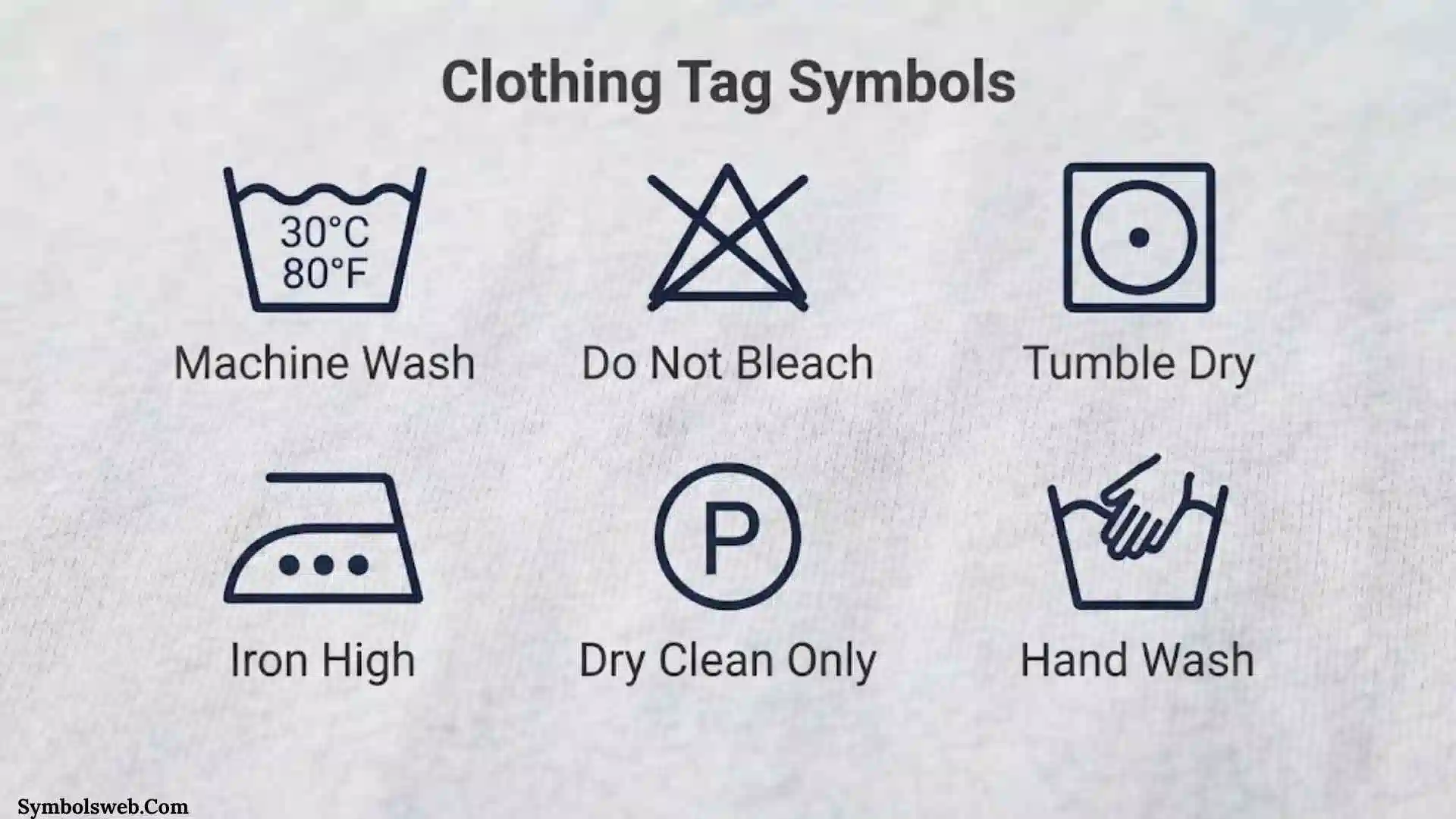
Clothing tag symbols can look like a tiny secret language hidden inside your favorite shirt. A simple tub, triangle, square, iron, or circle can tell you whether a garment can be washed, bleached, tumble dried, ironed, or professionally cleaned. Once you understand the system, those confusing little symbols become surprisingly easy to read.
These symbols matter because the wrong washing temperature, too much heat, harsh bleach, or excessive mechanical action can permanently change a garment. Care labels are designed to communicate the most severe treatment that should not cause irreversible damage to the textile when the instructions are followed.
But clothing tag symbols also have an interesting history. Their development is closely connected with modern textiles, international trade, synthetic fibers, and the need for care instructions that could work across language barriers. In this complete guide, you will learn what every major clothing tag symbol means, where the system came from, how the symbols differ across markets, and how to avoid the most common laundry mistakes.
Quick Answer
Clothing tag symbols are visual instructions that explain how a garment should be washed, bleached, dried, ironed, or professionally cleaned. The five basic symbols are the washtub, triangle, square, iron, and circle. Numbers, dots, lines, and crosses modify these symbols to show temperature, gentleness, or treatments that must not be used.
Quick Facts About Clothing Tag Symbols
| Aspect | Information |
| Origin | Modern textile-care symbols developed during the twentieth century as textiles and international clothing trade became more complex. GINETEX introduced its care-labeling system in 1963. |
| Historical Significance | The symbols helped make textile-care information easier to understand across language barriers. |
| Main Meaning | They communicate the appropriate maximum care treatment for a textile. |
| Spiritual Meaning | Standard clothing-care symbols have no recognized religious or spiritual meaning. Their official purpose is practical textile care. |
| Cultural Importance | They created a widely recognizable visual language for clothing care. |
| Modern Usage | They are used on clothing and many other textile products, although specific regulations and symbol systems vary by market. |
What Are Clothing Tag Symbols?
Clothing tag symbols are standardized or regulated pictograms placed on garments and textile products to communicate care instructions.
The international ISO system is built around five main care operations:
- Washing
- Bleaching
- Drying
- Ironing
- Professional textile care
ISO 3758:2023 establishes a graphic-symbol system for textile articles and explains the most severe treatments that should not cause irreversible damage during textile care. It covers domestic washing, bleaching, drying, and ironing, along with professional dry and wet cleaning.
The five basic shapes are easy to remember:
- Washtub = washing
- Triangle = bleaching
- Square = drying
- Iron = ironing
- Circle = professional textile care
The symbols can then be modified with numbers, dots, lines, letters, or crosses.
Why Did Clothing Tag Symbols Become Important?
Modern clothing is much more complicated than clothing was in many earlier periods.
A single garment may contain:
- Natural fibers
- Synthetic fibers
- Blended fibers
- Dyes
- Prints
- Coatings
- Decorative trims
- Zippers
- Buttons
- Linings
- Special finishes
Each component can react differently to water, heat, chemicals, or mechanical movement.
At the same time, clothing became increasingly international.
A garment manufactured in one country might be sold thousands of miles away to someone who does not speak the manufacturer’s language.
GINETEX explains that increasing international trade made verbal care instructions less sufficient, creating a need for symbols that could reduce dependence on different languages.
How Do Clothing Care Symbols Work?
The basic idea is simple.
The shape tells you the type of treatment.
The number or dot tells you about temperature.
The line underneath tells you to use a gentler process.
The cross tells you not to use the treatment.
This creates a compact visual language that can fit onto a very small clothing label.
The Five Basic Clothing Tag Symbols
Before learning individual variations, memorize these five symbols.
| Basic Symbol | Meaning |
| Washtub | Washing |
| Triangle | Bleaching |
| Square | Drying |
| Iron | Ironing |
| Circle | Professional textile care |
These five operations form the foundation of the international care-labeling system. ASTM’s textile-care guide also describes five basic symbols representing washing, bleaching, drying, ironing, and professional textile care.
Deep Symbolic Meaning of Clothing Tag Symbols
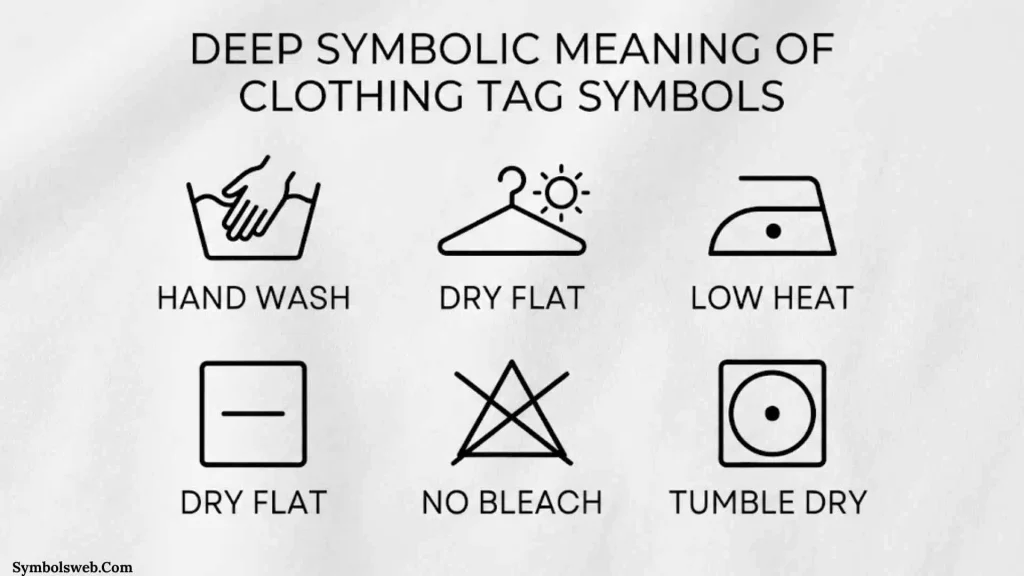
There is an important difference between symbolic shape and official symbol meaning.
A triangle, circle, or square may have symbolic meanings in art, religion, psychology, or mythology. However, when the same shape appears on a clothing care label, it has a specific technical meaning.
For example, a triangle may represent something completely different in religious artwork, but on a care label it represents bleaching.
Understanding this difference prevents a common mistake: assuming that every familiar geometric shape carries the same meaning in every context.
Spiritual Level
Standard clothing-care symbols do not have an established spiritual system.
There is no recognized religious tradition in which the modern washing tub means spiritual purification, the ironing symbol represents enlightenment, or the professional-care circle represents the soul.
People can certainly give personal meanings to these images.
For example, someone might personally associate washing with:
- Renewal
- Cleansing
- Fresh beginnings
- Letting go of the past
That can be a meaningful personal metaphor, but it should not be confused with the historical meaning of the care symbol.
Psychological Level
The psychological appeal of clothing symbols is easier to explain.
Humans are naturally good at recognizing simple shapes and visual patterns.
A pictogram can communicate an action without requiring a long sentence.
This is especially useful when:
- The label is very small.
- The garment is sold internationally.
- The consumer speaks another language.
- Several instructions must fit into a limited space.
The psychological strength of the system comes from visual recognition and pattern learning, rather than hidden symbolism.
Cultural Level
Clothing-care symbols have cultural importance because they help people communicate across linguistic boundaries.
A person does not necessarily need to understand English, French, German, or another language to recognize that a washtub relates to washing.
This makes the symbols a useful example of international visual communication.
Types and Variations of Clothing Tag Symbols
Washing Symbol
Visual Description: A washtub.
Meaning: Indicates whether domestic washing is permitted and provides information about the washing temperature or process.
Symbolism: Technically, it represents washing rather than a cultural or spiritual idea.
Cultural Connection: Its simple shape helps communicate across languages.
Where It Appears: Clothing, household textiles, and other applicable textile products.
Numbers inside the tub indicate the maximum washing temperature in degrees Celsius in the ISO/GINETEX system. A single bar underneath indicates a milder process, while two bars indicate a very mild process.
Hand-Wash Symbol
Visual Description: A hand inside a washtub.
Meaning: Hand washing is required under the applicable care system.
Symbolism: The hand visually communicates direct, gentle handling.
Cultural Connection: It is a practical pictogram rather than an ancient symbol.
Where It Appears: Delicate clothing, woolens, fine textiles, and garments requiring gentle treatment.
Bleaching Symbol
Visual Description: A triangle.
Meaning: Indicates whether bleaching is permitted.
Symbolism: The triangle has no special spiritual meaning within the care-label system.
Cultural Connection: Its value comes from standardized visual communication.
Where It Appears: Clothing and textile-care labels.
An empty triangle permits bleaching in the ISO/GINETEX system. Two diagonal lines indicate oxygen or non-chlorine bleach only. A crossed symbol means the treatment is not permitted.
Drying Symbol
Visual Description: A square.
Meaning: Provides information about drying.
Symbolism: The square is a technical pictogram.
Cultural Connection: Its meaning comes from the care-labeling standard, not mythology.
Where It Appears: Clothing and textile products.
A square containing a circle represents tumble drying. Dots indicate the temperature severity. A square without a circle can provide information about natural drying methods.
Ironing Symbol
Visual Description: An iron.
Meaning: Shows the permitted ironing temperature.
Symbolism: It visually resembles the household appliance itself.
Cultural Connection: It is an example of a functional pictogram.
Where It Appears: Garment labels where ironing information is relevant.
Dots inside the iron indicate the permitted temperature level.
Professional Textile-Care Symbol
Visual Description: A circle.
Meaning: Indicates professional textile-care processes.
Symbolism: The circle is not being used as a spiritual symbol here.
Cultural Connection: The symbol is part of an international technical system.
Where It Appears: Garments requiring or permitting professional cleaning.
Letters inside the circle specify permitted professional processes or solvents. Lines underneath indicate reduced process severity.
What Do Numbers on Clothing Tags Mean?
Numbers usually appear inside the washing symbol in the ISO/GINETEX system.
They indicate the maximum washing temperature in degrees Celsius.
For example:
| Number | Maximum Temperature |
| 30 | 30°C |
| 40 | 40°C |
| 60 | 60°C |
| 95 | 95°C |
The key word is maximum.
A 40°C symbol does not mean that the garment must always be washed at exactly 40°C.
GINETEX explains that milder treatments and lower temperatures than those shown on the label are permitted.
What Do Dots on Clothing Tags Mean?
Dots are commonly used to indicate temperature levels.
They are especially important for:
- Tumble drying
- Ironing
The general principle is easy:
Fewer dots = lower temperature.
More dots = higher temperature.
The exact temperature represented by dots depends on the symbol system and operation involved.
What Do Lines Under Clothing Symbols Mean?
Lines indicate a gentler process.
One line generally indicates a mild process with reduced mechanical action.
Two lines indicate a very mild process.
This is particularly important for washing and professional textile care. GINETEX explains that the double bar represents a very mild washing process, particularly suitable for woollen articles.
What Does a Cross on a Clothing Symbol Mean?
A crossed-out symbol means the represented treatment must not be used.
Examples include:
- Crossed washing symbol = do not wash
- Crossed triangle = do not bleach
- Crossed tumble dryer = do not tumble dry
- Crossed iron = do not iron
- Crossed professional-care circle = do not use the represented professional-care process
GINETEX describes the cross as a prohibition of the treatment represented by the symbol.
Washing Symbols Explained
Normal Washing
A plain washtub with a temperature number indicates washing at a maximum temperature.
For example, a tub marked 30 means the maximum temperature is 30°C.
Mild Washing
A single line underneath the tub indicates reduced mechanical action.
This can be important for easy-care and mechanically sensitive garments.
Very Mild Washing
Two lines underneath the tub indicate a very mild process.
This is particularly relevant to delicate textiles such as wool.
Hand Washing
A hand inside the tub indicates hand washing.
Hand washing does not simply mean putting the garment into cold water.
Delicate garments may also need careful detergent use, minimal rubbing, careful rinsing, and gentle removal of excess water.
Do Not Wash
A crossed tub means the garment must not be washed using that treatment.
It may require professional care instead.
Bleaching Symbols Explained
Empty Triangle
An empty triangle indicates that bleaching is permitted under the applicable system.
Triangle With Two Diagonal Lines
This indicates oxygen or non-chlorine bleach only in the ISO/GINETEX system.
Crossed Triangle
This means do not bleach.
This is especially important for dyed garments and materials that may be damaged by bleaching agents.
The U.S. FTC also distinguishes between products for which all commercially available bleaches are safe, products requiring non-chlorine bleach only, and products where bleach should not be used.
Drying Symbols Explained
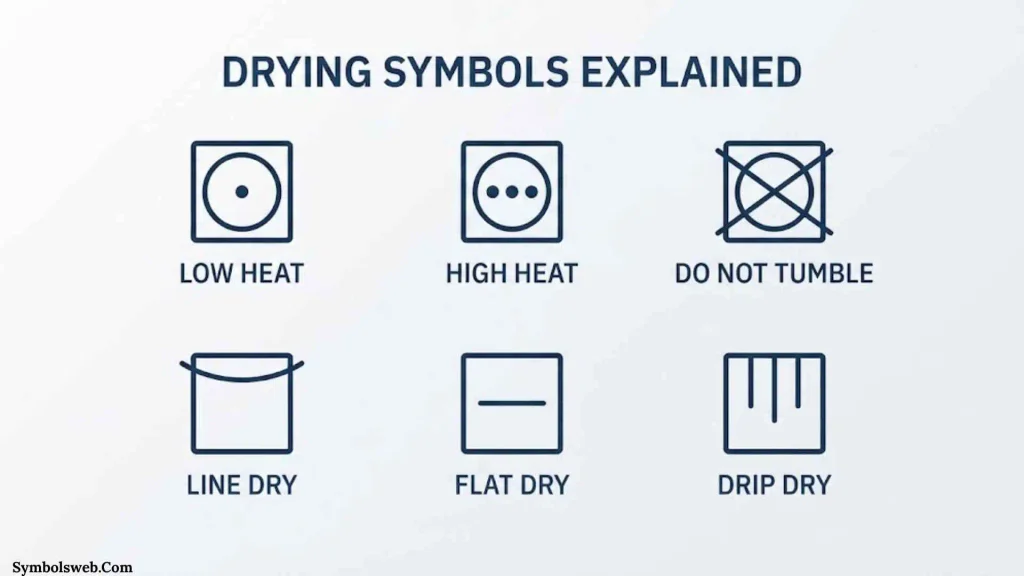
Square
The square is the basic drying symbol.
Square With Circle
A circle inside the square means tumble drying.
One Dot
One dot indicates a lower temperature level.
Two Dots
Two dots indicate a higher temperature level.
Natural Drying
A square without a circle can communicate natural drying instructions.
Depending on the exact symbol, this may include:
- Line drying
- Drip drying
- Flat drying
- Drying in the shade
Do Not Tumble Dry
A crossed-out tumble-dry symbol means the garment should not be put into a tumble dryer.
Heat and mechanical movement can be damaging to certain textiles, finishes, and garment constructions.
Ironing Symbols Explained
One Dot
A single dot represents a low ironing temperature.
Two Dots
Two dots represent a medium temperature.
Three Dots
Three dots represent a higher temperature.
Crossed Iron
A crossed iron means do not iron.
Iron With Steam Restrictions
Some care systems also provide additional information concerning steam.
This matters because heat is not the only factor involved in ironing. Moisture and steam can also affect certain fabrics and finishes.
Professional Cleaning Symbols Explained
The circle represents professional textile care.
Letters inside the circle communicate information to professional cleaners.
Depending on the system and market, professional-care symbols can distinguish different cleaning processes.
A line underneath the circle indicates a gentler professional process.
Two lines indicate a very mild process.
A crossed circle prohibits the represented professional-care treatment.
ISO 3758:2023 covers both professional dry and wet cleaning while excluding industrial laundering and professional carpet cleaning.
Clothing Tag Symbols Across Different Cultures
This topic needs an important historical distinction.
The modern clothing-care symbols themselves are not ancient cultural symbols. They are part of a modern textile-care system.
However, the individual shapes used in the system, such as circles, triangles, and squares, have appeared in many cultures for thousands of years.
That does not mean their modern clothing-label meanings came from those ancient traditions.
Ancient Egypt
Ancient Egyptian art used many geometric and pictorial forms, including circles, triangles, lines, and other visual signs.
Egyptian hieroglyphs functioned as a sophisticated writing system involving images and signs.
However, there is no credible evidence that the modern clothing-care triangle or washtub originated in ancient Egyptian textile symbolism.
The modern care-label system emerged much later from industrial textile and labeling needs.
Ancient Greece
Ancient Greek art and philosophy gave important cultural meanings to geometric forms.
Triangles, circles, symmetry, and proportion appeared in architecture, pottery, ornament, and mathematical thought.
But a triangle on a modern clothing label means bleaching, not an ancient Greek philosophical principle.
The visual resemblance is interesting, but the historical systems are separate.
Roman Culture
Roman culture inherited and developed many geometric motifs from earlier Mediterranean traditions.
Geometric patterns appeared in mosaics, architecture, textiles, and decorative arts.
Again, there is no historical basis for claiming that the modern clothing-care system originated in Roman symbolism.
The modern care-label triangle and circle are functional pictograms.
Eastern Traditions
Eastern religious and philosophical traditions contain rich symbolic systems.
Circles, mandalas, lotus imagery, geometric diagrams, and other forms can carry deep meanings in Buddhist, Hindu, Jain, Taoist, and other traditions.
A circle, for example, may have symbolic significance in a religious artwork.
But a circle on a clothing label has a completely different technical meaning: professional textile care.
This is a good example of why context determines meaning.
Indigenous Traditions
Indigenous cultures around the world have developed their own visual languages, patterns, textile traditions, and symbolic systems.
These include geometric designs, natural imagery, weaving patterns, and symbols connected to community, ancestry, place, spirituality, or identity.
However, there is no single “Indigenous meaning” for clothing-care symbols.
Indigenous cultures are extremely diverse, and the modern care-label system should not be projected backward onto their traditional visual languages.
Modern Interpretations
Modern consumers sometimes reinterpret ordinary care symbols creatively.
A clothing symbol might appear in:
- Graphic design
- Streetwear
- Tattoos
- Memes
- Fashion photography
- Advertising
- Art
- Social media
In these settings, the symbol can acquire an individual or artistic meaning.
That meaning should be separated from its standardized technical meaning on an actual care label.
Similar Symbols and Their Meanings
| Symbol or Shape | Care-Label Meaning | Possible Other Contexts |
| Triangle | Bleaching | Geometry, religion, warning signs, art |
| Circle | Professional textile care | Unity, cycles, spirituality, design |
| Square | Drying | Stability, structure, geometry |
| Tub | Washing | Water, cleaning, household activity |
| Iron | Ironing | Heat, pressing, household work |
| Cross | Treatment prohibited when superimposed | Religious, mathematical, medical, or cultural meanings |
Common Misconception
The same shape does not always have the same meaning.
A triangle can mean bleaching on a care label.
A triangle can have completely different meanings in religion, mathematics, architecture, or art.
Context is essential.
Clothing Tag Symbols in Mythology and Folklore
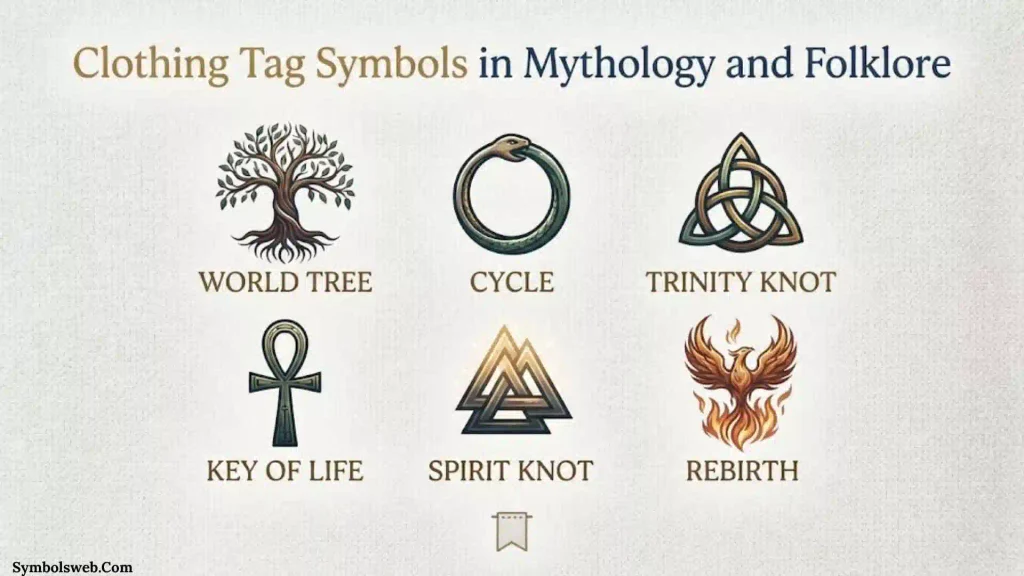
Modern care-label symbols are not derived from mythology.
There are no established ancient legends in which the five modern care symbols represent washing, bleaching, drying, ironing, and professional textile care.
However, some of the ideas represented by the symbols have older cultural associations.
Washing and Purification
Water has been associated with purification in many religious and cultural traditions.
Ritual washing or bathing appears in many religious practices.
This does not mean the modern washing symbol is a religious symbol.
It simply means that humans have long connected water and cleanliness with ideas beyond physical hygiene.
Fire, Heat and Transformation
Heat has also held symbolic meanings in many traditions.
Fire can represent:
- Transformation
- Destruction
- Renewal
- Purification
- Energy
Yet the dots on an ironing symbol do not represent these ideas.
They indicate permitted temperature levels.
Circles in Mythology
Circles are among the most widespread geometric forms in human symbolism.
They can represent ideas such as:
- Cycles
- Wholeness
- Unity
- Eternity
- The sun
But the circle on a care label means professional textile care.
The symbolic meaning belongs to the cultural context, not the laundry label.
Clothing Tag Symbols in Art, Literature, Movies and Pop Culture
Paintings
Care symbols occasionally appear in contemporary art because they are instantly recognizable pieces of everyday visual culture.
Artists can use them to comment on:
- Consumerism
- Domestic work
- Fashion
- Identity
- Labor
- Modern life
The artistic interpretation depends on the artist.
Literature
Writers may use clothing labels metaphorically.
A label can represent:
- Identity
- Social expectations
- Classification
- Judgment
- Instructions
- Consumer culture
Again, these are literary metaphors rather than official meanings.
Movies and Television
Laundry and clothing labels may appear as small details in scenes involving domestic life, fashion, shopping, or everyday routines.
They can also become comic props when a character misunderstands a care instruction.
Tattoos
People sometimes choose ordinary household symbols as tattoos because they find them funny, ironic, nostalgic, or personally meaningful.
There is no universal tattoo meaning for a clothing-care symbol.
Fashion
Fashion designers sometimes borrow familiar everyday icons for visual effect.
Care-label imagery can communicate ideas about:
- Modern consumer culture
- Clothing production
- Instructions
- Identity
- The relationship between people and garments
Spiritual and Dream Meaning of Clothing Tag Symbols
There is no scientifically established dream dictionary that assigns a universal spiritual meaning to clothing-care symbols.
Dream interpretation is subjective.
If someone dreams about a clothing label, the personal associations may matter more than the symbol’s official technical meaning.
For example:
A washing symbol might personally remind someone of starting over.
A clothing label might remind someone of rules or expectations.
A crossed-out iron might become a personal metaphor for avoiding pressure.
These can be useful reflections, but they should not be presented as universal spiritual facts.
A Balanced Way to Interpret Such Dreams
Ask:
- What was happening in the dream?
- What emotion did the symbol create?
- What does clothing mean to you personally?
- Are you currently dealing with rules or expectations?
- Does cleaning or renewal have a personal meaning for you?
This approach treats dream interpretation as personal reflection rather than established science.
Positive and Negative Meanings of Clothing Tag Symbols
Because care symbols are technical rather than mystical, their positive and negative meanings are best understood through their practical effects.
| Positive Meaning | Negative Meaning |
| Protects garments | Can look confusing at first |
| Helps prevent accidental damage | Misreading a symbol can damage clothing |
| Saves consumers from guessing | Different regional systems can cause confusion |
| Makes instructions more compact | Tiny labels can be difficult to read |
| Helps communicate across languages | Some professional-care symbols require specialist knowledge |
| Can extend garment life when followed correctly | Correct care does not guarantee stain removal |
| Helps consumers understand delicate fabrics | Special-care garments may cost more to maintain |
The same care instruction can therefore feel helpful to one person and inconvenient to another.
Why Humans Are Attracted to Clothing Tag Symbols
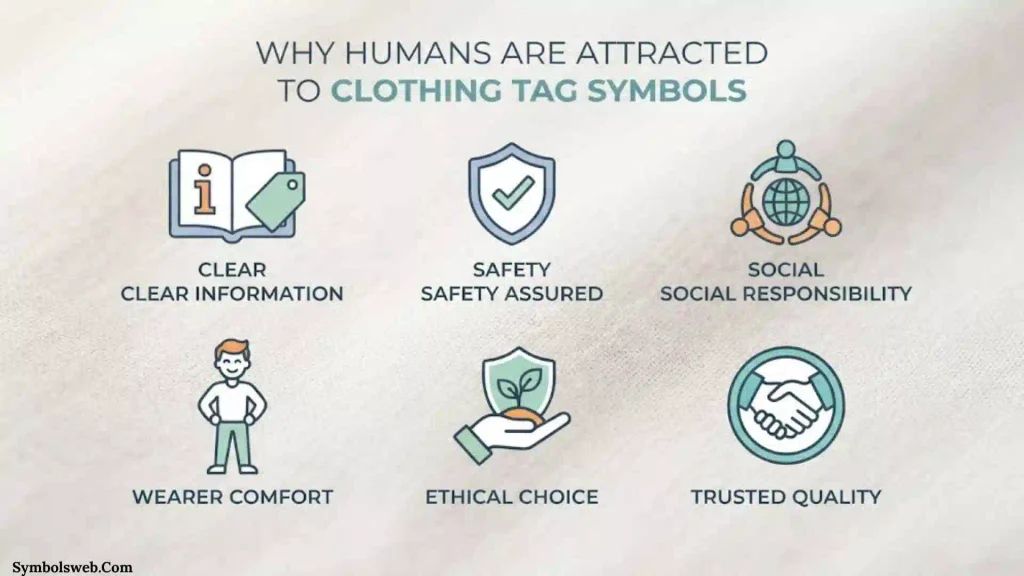
The attraction is mostly explained by visual simplicity.
Humans constantly use visual signs to navigate the world.
Think about:
- Road signs
- Airport symbols
- Recycling symbols
- Medical icons
- Weather symbols
- Computer icons
- Maps
Clothing-care symbols belong to the same broad family of visual communication.
A person can learn that a tub means washing without needing to read a paragraph.
This makes the system especially useful for international commerce.
Pattern Recognition
Once someone learns the five basic shapes, unfamiliar combinations become easier to understand.
A tub plus a number becomes a temperature instruction.
An iron plus dots becomes a heat instruction.
A symbol plus a cross becomes a prohibition.
The system works because the brain learns relationships between simple visual elements.
Cultural Memory
People who grow up seeing care labels may recognize them almost automatically.
That familiarity can create a sense that the symbols are universal.
They are widely recognizable, but exact standards and legal requirements can still vary between markets.
Modern Uses of Clothing Tag Symbols
Clothing
This remains the most obvious use.
Care symbols appear on:
- Shirts
- Trousers
- Dresses
- Jackets
- Coats
- Underwear
- Sportswear
- Children’s clothing
- Formalwear
Household Textiles
Care labeling can also be relevant to:
- Bedding
- Towels
- Curtains
- Fabric products
- Other household textiles
Fashion Branding
Care symbols can become part of visual branding and design.
Social Media
Care-symbol charts are useful educational content because many consumers recognize the symbols but do not know their exact meanings.
Contemporary Design
Graphic designers sometimes use care symbols to represent modern life, clothing, consumption, domestic work, or fashion culture.
Personal Expression
People can use care-label imagery on:
- Posters
- Stickers
- Tattoos
- T-shirts
- Digital graphics
- Memes
In these cases, the creator may give the symbol a new personal meaning.
Clothing Tag Symbols and Sustainability
Care labels can also play a role in more responsible textile use.
A garment that is cared for correctly may avoid premature damage.
Some practical habits include:
- Washing only when necessary
- Using an appropriate temperature
- Avoiding unnecessary high heat
- Following delicate-care instructions
- Avoiding prohibited bleach
- Choosing the correct drying method
- Avoiding unnecessary ironing
However, care labels are primarily designed to communicate textile-care requirements.
They are not complete sustainability guides.
GINETEX also operates sustainability-related consumer initiatives, including clevercare.info, which provides guidance intended to help reduce the environmental impact of textile care.
Clothing Tag Symbols and Fabric Types
Cotton
Cotton can often tolerate ordinary washing, but the garment’s construction, dye, finish, and blend can change the recommended care method.
Never rely only on the word “cotton.”
Read the complete label.
Wool
Wool can be sensitive to:
- Heat
- Agitation
- Moisture handling
- Improper drying
A wool garment with a very mild washing instruction should be treated accordingly.
Silk
Silk may require careful handling because heat, water, chemicals, and mechanical action can affect it.
Always follow the garment-specific instructions.
Polyester
Polyester is generally durable, but heat can affect some polyester garments, especially those with special finishes, prints, or blends.
Linen
Linen can usually tolerate certain washing methods, but it may wrinkle and respond differently to heat and moisture depending on construction and finishing.
Viscose and Rayon
Viscose and rayon can behave differently when wet compared with when dry.
Never assume that a garment is safe for ordinary machine washing just because it feels strong when dry.
Clothing Tag Symbols in Different Countries
One of the most important EEAT points is that not every country uses exactly the same labeling rules.
International ISO System
ISO 3758:2023 provides the international care-labeling code using symbols. The current edition was published in December 2023 and replaced ISO 3758:2012.
GINETEX System
GINETEX developed an internationally applicable textile-care system and says its symbols are the origin of the EN ISO 3758 international standard.
GINETEX also states that its five care symbols are protected trademarks in many countries, so companies should not assume that the symbols are simply unrestricted generic artwork.
United States
The United States has a separate regulatory history.
The Federal Trade Commission’s Care Labeling Rule requires covered textile wearing apparel to provide appropriate care information. The rule addresses washing, drying, ironing, bleaching, and warnings, while allowing certain alternative labeling arrangements.
The FTC also recognizes ASTM care-symbol guidance for certain uses.
ASTM Care Symbols
ASTM D5489 provides a system of textile-care symbols intended to reduce language-dependent instructions.
The ASTM system uses five basic care operations:
- Washing
- Bleaching
- Drying
- Ironing
- Professional textile care
GINETEX has noted that U.S. ASTM symbols and GINETEX/ISO symbols are similar in concept but can differ in graphics and specific content.
This is why a care symbol seen on a U.S. garment should not automatically be assumed to be identical in every detail to an ISO/GINETEX symbol.
Why Clothing Care Labels Matter Legally
Care labels are not merely decorative.
In the United States, for example, the FTC requires manufacturers and importers covered by the Care Labeling Rule to have a reasonable basis for the care instructions they provide. That basis can include reliable evidence, testing, technical literature, past experience, or industry expertise.
The FTC also explains that care information must account for components such as linings, trim, buttons, and other parts of the garment.
This illustrates an important principle:
A care label is supposed to describe the garment as a whole, not merely the main fabric.
Common Clothing Tag Mistakes
Ignoring the Care Label
Many people remove the tag because it feels uncomfortable and then forget the instructions.
If you remove a label, photographing it before removal can be useful.
Washing Everything at the Same Temperature
Different garments have different limits.
A 30°C instruction should not be treated like a 60°C instruction.
Assuming All Bleach Is the Same
Bleach instructions can distinguish between unrestricted bleaching, non-chlorine bleaching, and no bleaching.
Ignoring Drying Instructions
A garment that survives washing can still be damaged by inappropriate tumble drying.
Using High Heat on Everything
High heat can cause problems with some fabrics, finishes, prints, elastic materials, and garment constructions.
Treating the Fabric Name as the Entire Instruction
“100% cotton” does not tell you everything you need to know.
The garment’s dye, construction, finish, and accessories also matter.
Clothing Tag Symbols and Stain Removal
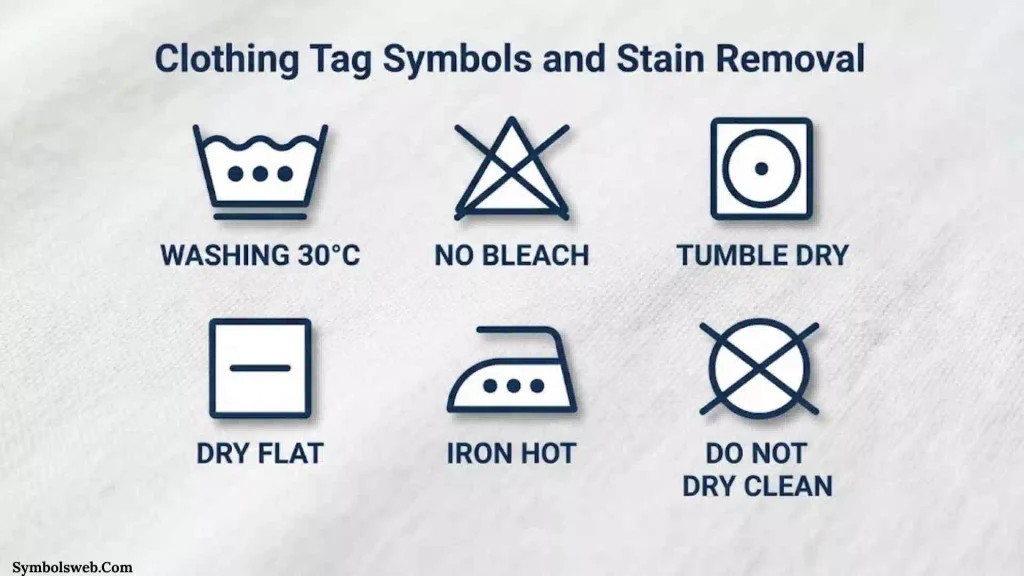
A care label tells you what treatment the textile can tolerate.
It does not necessarily tell you how to remove every stain.
GINETEX explicitly notes that following care information protects the textile from irreversible damage but does not guarantee that every type of dirt or stain will be removed.
That distinction is important.
A garment may safely tolerate washing at 40°C while a particular oil, ink, wine, or protein stain may still require a different treatment.
How to Read a Clothing Care Label in Seconds
Use this five-step method.
Step 1: Find the Washing Symbol
Look for the tub.
Check:
- Temperature
- Hand-wash instruction
- Lines underneath
- Cross
Step 2: Check Bleaching
Find the triangle.
Ask:
- Is bleaching allowed?
- Is only non-chlorine bleach allowed?
- Is bleaching prohibited?
Step 3: Check Drying
Find the square.
Look for:
- Tumble drying
- Temperature dots
- Natural drying instructions
- Shade instructions
- Cross
Step 4: Check Ironing
Find the iron.
Count the dots.
Then check for a cross or additional steam instructions.
Step 5: Check Professional Care
Find the circle.
If there is a letter or line, follow the relevant professional-care instruction.
A Simple Memory Trick
Remember:
Tub = Wash
Triangle = Bleach
Square = Dry
Iron = Iron
Circle = Professional Care
Then remember:
Number = Maximum wash temperature
Dots = Temperature level
Lines = Gentler process
Cross = Do not use
This is enough to understand most everyday clothing labels.
Interesting Facts About Clothing Tag Symbols
- GINETEX was founded in Paris in 1963. It was created after international textile-care discussions during the late 1950s.
- The system was partly a response to international trade. Different languages made verbal care instructions less practical as textile commerce became more international.
- There are five basic care operations. Washing, bleaching, drying, ironing, and professional textile care form the foundation of the system.
- A washing number is a maximum. A 40°C mark does not mean the garment must be washed at exactly 40°C.
- Lines indicate gentler treatment. A single bar means a mild process, while two bars indicate a very mild process.
- A circle does not simply mean “washing.” It is associated with professional textile care.
- A square is associated with drying. Adding a circle inside it indicates tumble drying.
- The symbols are not identical in every market. ISO/GINETEX and U.S. ASTM systems have similarities but also differences.
- GINETEX’s symbols have trademark protection in many countries. This is one reason companies should use official symbol guidance rather than casually redrawing the system.
- Modern care labeling is still evolving. ISO 3758:2023 replaced the 2012 edition as the current international standard.
Frequently Asked Questions
What do clothing tag symbols mean?
Clothing tag symbols provide instructions for washing, bleaching, drying, ironing, and professional textile care. Numbers, dots, lines, and crosses add information about temperature, gentleness, or prohibited treatments.
What are the five main clothing care symbols?
The five main symbols are the washtub for washing, triangle for bleaching, square for drying, iron for ironing, and circle for professional textile care.
What does a triangle mean on a clothing tag?
A triangle relates to bleaching. In the ISO/GINETEX system, an empty triangle allows bleaching, a triangle with two diagonal lines indicates oxygen or non-chlorine bleach only, and a crossed triangle means do not bleach.
What does a circle mean on a clothing label?
A circle represents professional textile care. Letters inside the circle can identify permitted professional cleaning processes, while lines underneath indicate a milder process.
What does a square mean on a clothing tag?
A square represents drying. A circle inside the square means tumble drying. Other markings can indicate temperature or natural drying methods.
What does a cross over a laundry symbol mean?
A crossed-out symbol means the treatment represented by that symbol must not be used.
What do the dots mean on clothing tags?
Dots generally indicate temperature levels. Fewer dots indicate lower temperatures, while more dots indicate higher permitted temperatures.
What does one line under a washing symbol mean?
One line indicates a milder washing process with reduced mechanical action. Two lines indicate a very mild process.
Does a 40°C clothing symbol mean I must wash at 40°C?
No. In the ISO/GINETEX system, the number indicates the maximum washing temperature. A lower temperature may be used as a milder treatment.
Are clothing tag symbols universal?
They are widely standardized, but not completely identical across every market. ISO 3758 provides an international system, while countries such as the United States also have their own regulatory framework and ASTM guidance.
Do clothing tag symbols have spiritual meanings?
Standard care symbols do not have recognized spiritual meanings. A person can create a personal interpretation of a symbol, but that should not be confused with its official textile-care meaning.
Do clothing tag symbols come from ancient Egypt or Greece?
No reliable evidence shows that the modern clothing-care system originated in ancient Egyptian or Greek symbolism. Although circles, triangles, and other shapes appear in ancient cultures, the modern care-label system developed from modern textile-care and international labeling needs.
Can I ignore a clothing care label if I know the fabric?
It is better not to. Fabric composition is only one factor. Dye, construction, finishes, trims, linings, and other components can affect the appropriate care method.
Conclusion
Clothing tag symbols may look like tiny secret codes, but they actually provide important instructions about how to care for your clothes. A small tub, triangle, square, iron, or circle can tell you how to wash, bleach, dry, iron, or professionally clean a garment. Understanding these symbols can help prevent shrinking, fading, stretching, and other common clothing damage.
These simple symbols also have an interesting history connected to modern textiles and international clothing trade. They were created to make care instructions easier to understand across different languages and countries. In this guide, you will learn what the most common clothing tag symbols mean and how to use them correctly.

Hi, I’m Ethan Holloway, and I’ve always believed that a few meaningful words can change the way we think, feel, and live. I enjoy collecting timeless quotes, studying their deeper meanings, and sharing inspiring messages that help people stay motivated through every stage of life.
Over the years, I’ve explored thousands of famous sayings from writers, leaders, philosophers, and everyday people. My goal is to make wisdom easy to understand and useful for everyone.
Books by Ethan Holloway
- The Power of Everyday Quotes
- Words That Inspire Greatness
 Jordan Hayes
 Eliana Foster