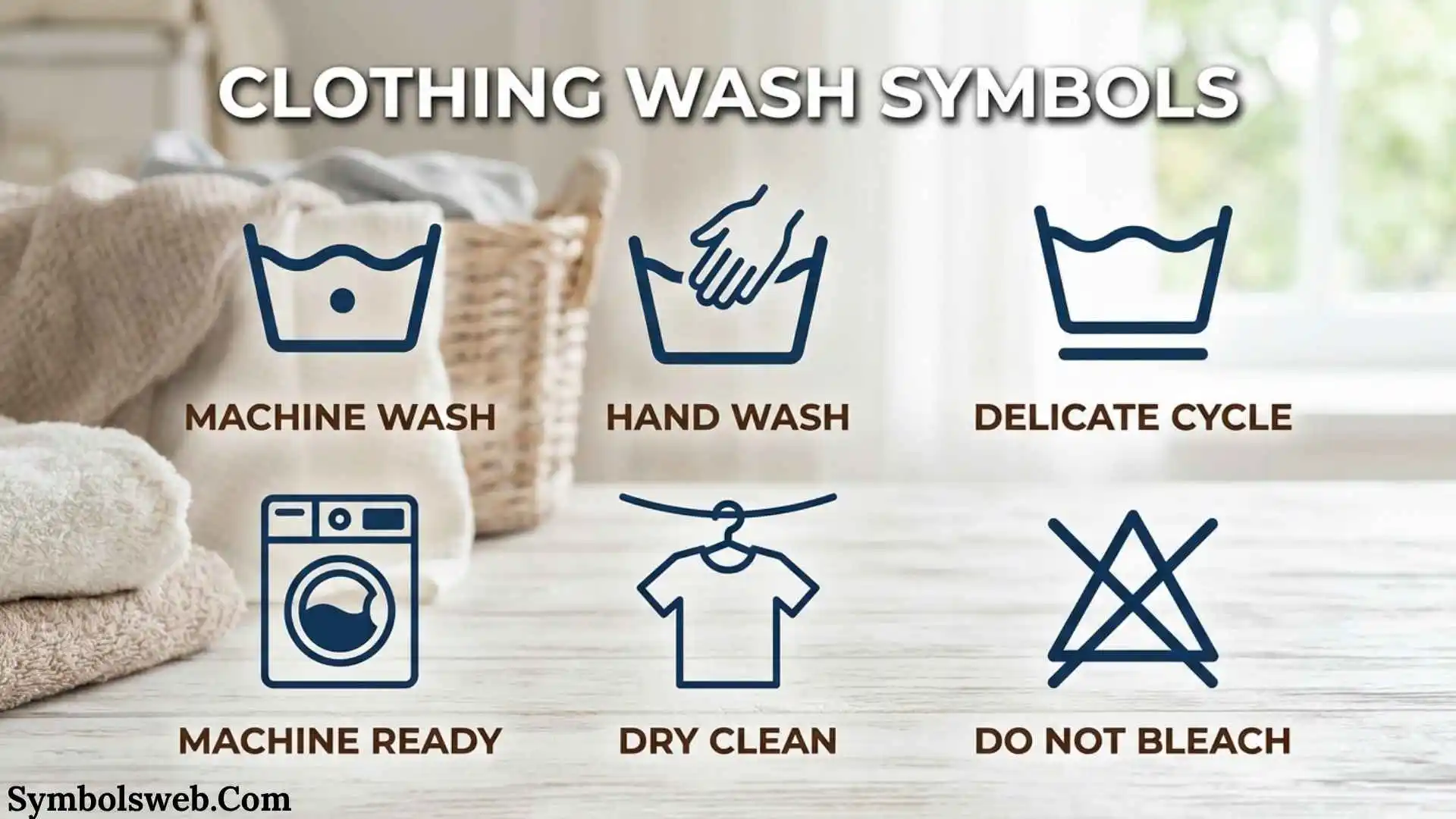
Clothing wash symbols can feel like a tiny secret code hidden inside your favorite clothes. A wash tub, triangle, square, dots, lines, or crossed out symbol may look confusing at first, but each mark has a specific purpose. These simple symbols tell you how to wash, dry, bleach, iron, or professionally clean a garment without accidentally damaging its fabric, color, or shape.
Learning clothing wash symbols is more than just understanding laundry instructions. It gives you a simple way to protect the clothes you value and make them last longer. These symbols also represent an interesting piece of modern design history, showing how people created a visual language that can communicate across different countries and languages. Once you know what each symbol means, reading a care label becomes quick, simple, and surprisingly easy.
Clothing Wash Symbols Explained: (Quick Answer)
Clothing wash symbols are standardized pictograms printed or sewn onto garment care labels to explain how a textile should be cleaned and maintained. They show the safest maximum treatment, including washing temperature, gentle cycles, bleaching, drying, ironing, and professional cleaning. The international system is standardized through ISO 3758, with the current edition published in 2023.
Quick Facts About Clothing Wash Symbols
| Aspect | Information |
| Origin | The modern international care-symbol system was introduced in 1963 through GINETEX and has roots in Switzerland. |
| Historical Significance | Symbols helped replace complicated multilingual written instructions with a visual system that could be understood across borders. |
| Main Meaning | They explain the maximum care treatment a textile can safely receive without irreversible damage. |
| Spiritual Meaning | Clothing wash symbols have no established universal spiritual meaning. Any spiritual interpretation is personal rather than part of the official system. |
| Cultural Importance | Their greatest cultural role is practical: creating a shared visual language for textile care across countries and languages. |
| Modern Usage | They appear on clothing and textile products worldwide, covering washing, bleaching, drying, ironing, and professional textile care. |
The current international standard is ISO 3758:2023, Textiles, Care labelling code using symbols. It covers domestic washing, bleaching, drying and ironing, as well as professional textile care.
What Are Clothing Wash Symbols?
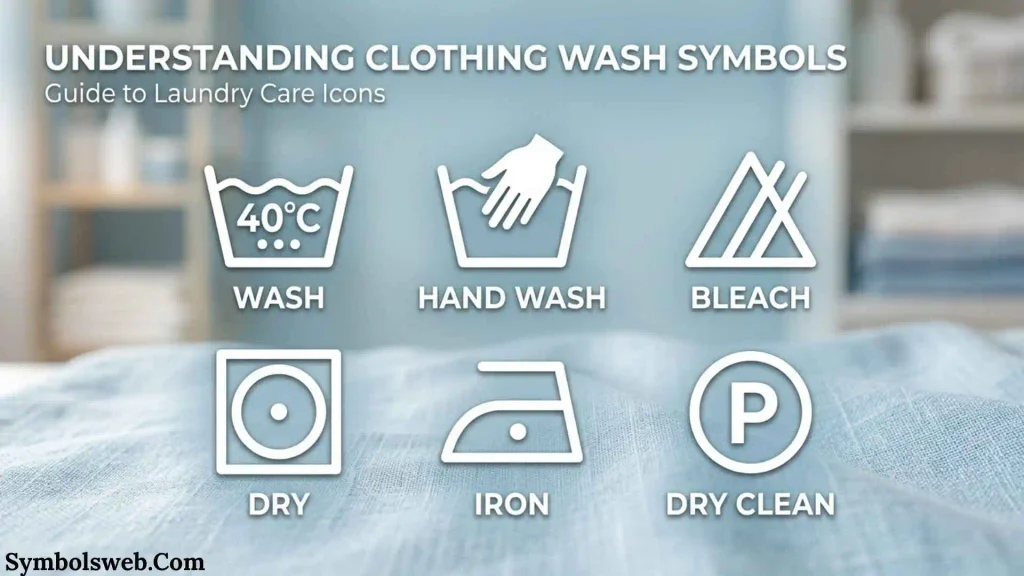
Clothing wash symbols are small graphic instructions found on garment care labels. Instead of giving every instruction in words, manufacturers use familiar shapes to communicate the appropriate treatment.
The five major care categories are:
- Washing, represented by a wash tub
- Bleaching, represented by a triangle
- Drying, represented by a square
- Ironing, represented by an iron
- Professional textile care, represented by a circle
This sequence is used in the international care-label system.
The important point is that the symbols are not merely suggestions about how someone might prefer to wash a garment. They communicate the maximum treatment that should not cause irreversible damage when the care instructions are followed correctly. A milder treatment is generally acceptable.
Why Do Clothing Labels Use Symbols?
Imagine selling the same shirt in France, Germany, Japan, Pakistan, the United States and dozens of other markets. A long paragraph of washing instructions would need to be translated into many languages.
A visual symbol solves part of that problem.
The modern system was developed as international textile manufacturing became more complex. During the middle of the 20th century, synthetic fibers and new textile finishes became increasingly common. At the same time, international trade was expanding, making language-independent care information more valuable. GINETEX traces the introduction of its care-label symbols to 1963.
The Difference Between a Wash Symbol and a Care Symbol
People often use “wash symbols” to describe the entire collection of clothing-care icons.
Technically, however, the wash tub is only one category.
A complete care label can tell you:
- How to wash the garment
- How hot the water may be
- Whether a gentle cycle is required
- Whether bleach is permitted
- Whether tumble drying is allowed
- Whether the garment should be dried flat or hung
- How hot an iron may be
- Whether professional dry cleaning is allowed
- Which professional cleaning process may be used
This distinction matters because washing a garment correctly does not automatically mean that every drying or ironing method is safe.
The Complete Clothing Wash Symbols Chart
The easiest way to understand care labels is to learn what each shape represents.
| Symbol Shape | Category | What It Tells You |
| Wash tub | Washing | Whether and how the garment can be washed |
| Triangle | Bleaching | Whether bleach can be used |
| Square | Drying | How the garment should be dried |
| Square with circle | Tumble drying | Whether a dryer can be used and at what heat level |
| Iron | Ironing | The maximum ironing temperature |
| Circle | Professional care | Professional dry-cleaning or wet-cleaning instructions |
| Crossed symbol | Treatment prohibited | The treatment must not be used |
The international system uses these shapes because each one represents a particular stage of textile care.
Washing Symbols: What the Tub Really Means
The wash tub is the symbol most people think of when they hear “clothing wash symbols.”
It tells you whether the garment can be washed and, when a temperature appears inside the tub, the maximum washing temperature.
Tub With a Number
A number inside the wash tub represents the maximum water temperature in degrees Celsius.
Common examples include:
- 30°C: cold or cool washing
- 40°C: warm washing
- 60°C: hotter washing
- 95°C: very hot or boil washing for suitable textiles
The number is a maximum, not a target.
If a garment says 40°C, washing it at 30°C is normally a gentler choice. Washing it above 40°C can increase the risk of damage. GINETEX specifically explains that the number in the tub indicates the maximum temperature that must not be exceeded.
Tub With One Line Underneath
One line under the wash tub means a milder washing process.
This generally indicates reduced mechanical action and is commonly associated with easy-care or mechanically sensitive garments.
In practical terms, the garment needs more gentle treatment than a normal cycle.
Tub With Two Lines Underneath
Two lines indicate a very mild washing process.
This is especially important for delicate textiles such as some wool garments.
A very mild cycle usually means reduced agitation and careful handling. The exact program depends on the washing machine and the garment, so selecting the machine’s delicate, wool, or equivalent program may be appropriate when it matches the label.
Hand Wash Symbol
The hand symbol inside the wash tub means the garment should be washed by hand rather than through a standard machine cycle.
For delicate hand-wash garments, avoid aggressive rubbing, twisting and wringing. GINETEX recommends careful agitation, gentle handling and careful removal of excess water.
Crossed-Out Wash Tub
A crossed-out wash tub means:
Do not wash.
The garment may be unsuitable for domestic washing or may be sensitive to wet treatment.
This is one of the symbols you should never ignore.
What the Numbers and Lines Really Tell You
A useful way to remember the wash tub is:
Number = temperature
One line = gentler
Two lines = very gentle
Hand = hand wash
Cross = do not wash
This simple pattern makes many labels much easier to read.
Bleaching Symbols: The Triangle Explained
The triangle belongs to the bleaching category.
It tells you whether bleach can safely be used on the garment.
Empty Triangle
An empty triangle traditionally indicates that bleaching is permitted, including chlorine and oxygen-based bleach under the applicable care system.
However, always check the specific product directions before using bleach. A care symbol does not mean that every stain-removal method is suitable for every situation.
Triangle With Two Diagonal Lines
A triangle with two diagonal lines means that only oxygen or non-chlorine bleach is permitted.
Chlorine bleach should not be used.
Crossed Out Triangle
A crossed triangle means:
Do not bleach.
Use a bleach-free detergent or another appropriate cleaning method instead.
Drying Symbols: Why the Square Matters
If the wash tub tells you how to clean the garment, the square tells you how to dry it.
This distinction is easy to miss.
Square With a Circle
A square containing a circle represents tumble drying.
Dots inside the circle indicate the permitted temperature level.
A practical memory trick is:
Square = drying
Circle inside square = dryer
One Dot in the Dryer Symbol
One dot indicates a lower-temperature tumble-drying treatment.
This is generally used for garments that need gentler heat.
Two Dots in the Dryer Symbol
Two dots indicate a higher permitted tumble-drying temperature than the one-dot symbol.
Always follow the label rather than assuming that a fabric is safe simply because it feels sturdy.
Crossed-Out Dryer Symbol
A crossed-out tumble-dryer symbol means:
Do not tumble dry.
Heat and mechanical movement can cause shrinking, distortion, surface damage or other problems in garments that are not designed for machine drying.
Natural Drying Symbols
Not every garment should go into a dryer.
The square can also contain lines that describe natural drying.
Vertical Line
A vertical line inside the square indicates line drying.
Two Vertical Lines
Two vertical lines indicate drip line drying.
This means the garment can be dried while water is allowed to drip away rather than being aggressively spun or wrung.
Horizontal Line
A horizontal line indicates flat drying.
This is particularly useful for garments that can stretch or lose their shape when hung.
Two Horizontal Lines
Two horizontal lines indicate drip flat drying.
Diagonal Line
A diagonal line within a natural-drying symbol indicates drying in the shade.
These distinctions are particularly useful for delicate textiles and garments whose shape or color may be affected by excessive heat or direct sunlight.
Ironing Symbols: Read the Dots
The iron symbol is another easy category once you understand the pattern.
One Dot
One dot indicates a low ironing temperature.
This is commonly associated with heat-sensitive materials.
Two Dots
Two dots indicate a moderate ironing temperature.
Three Dots
Three dots indicate a high ironing temperature.
The key rule is simple:
More dots = more heat.
GINETEX notes that the maximum ironing temperature should be determined from the care label rather than simply from the fiber name.
Crossed-Out Iron
A crossed-out iron means:
Do not iron.
Using an iron can cause irreversible changes or damage to the garment.
Professional Cleaning Symbols: The Circle
A circle on a clothing label generally relates to professional textile care.
This is where care labels can become more technical because letters inside the circle provide information intended primarily for professional cleaners.
A circle may indicate professional dry cleaning or professional wet cleaning, depending on the symbol system and markings.
Why Do Some Clothes Need Professional Cleaning?
Some garments contain combinations of fibers, dyes, finishes, linings, trims, adhesives, buttons or decorative elements that make ordinary home washing risky.
Professional cleaners have equipment and controlled processes that are different from a household washing machine.
This is why a garment can have a relatively simple appearance while carrying surprisingly specific care instructions.
What Does a Crossed Out Symbol Mean?
A cross over a care symbol means that the treatment represented by that symbol should not be used.
For example:
- Crossed wash tub = do not wash
- Crossed triangle = do not bleach
- Crossed dryer = do not tumble dry
- Crossed iron = do not iron
- Crossed professional-care symbol = do not use that professional process
The cross is one of the most important visual signals on a care label.
How to Read an Entire Clothing Care Label
Instead of looking at one symbol in isolation, read the entire sequence.
A typical international care label follows this order:
Washing → Bleaching → Drying → Ironing → Professional Care
This sequence has been used in the GINETEX care-label system since 2006.
For example, imagine a shirt has:
- Tub with 30°C
- Crossed triangle
- Square with one-dot tumble dryer
- Iron with two dots
- Circle crossed out
You could interpret it as:
Wash at a maximum of 30°C, do not bleach, tumble dry at the permitted low temperature, iron at the permitted moderate temperature, and do not dry clean.
The label works like a small instruction manual.
Why Clothing Wash Symbols Matter
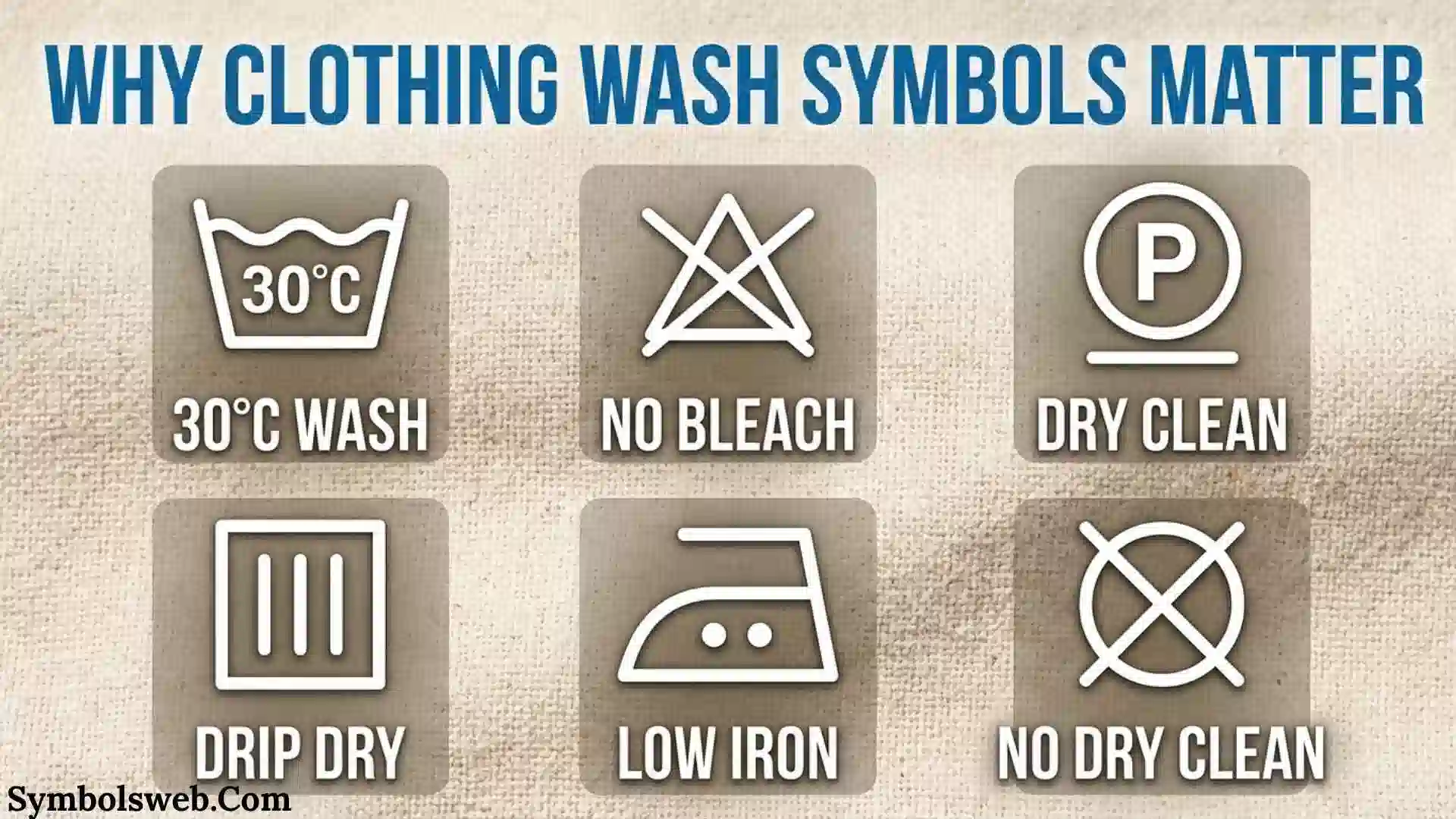
It is tempting to cut the label out and forget about it.
That small decision can sometimes turn an expensive garment into a shrunken, faded or misshapen one.
Care labels matter because modern clothing is made from many different materials and combinations. Cotton, linen, wool, silk, viscose, polyester, nylon, acrylic and blended fabrics can respond differently to water, heat, friction, chemicals and pressure.
Even two garments made from the same fiber may need different treatment because of dyes, finishes, construction or decorative components.
The care label is therefore not simply telling you what the fabric is. It is telling you how the finished garment should be treated.
Clothing Wash Symbols and the History of Textile Care
The modern care symbol system has an interesting history.
Before standardized symbols became common, clothing-care instructions relied heavily on written language. That worked reasonably well when textile production and clothing markets were more local.
The situation changed during the 20th century.
The Rise of Synthetic Fibers
During the 1950s and 1960s, synthetic fibers became increasingly important. At the same time, manufacturers introduced new textile finishes and easier-care treatments.
Older washing routines were no longer enough for every new type of fabric.
GINETEX’s historical account explains that the development of synthetic fibers and new finishing processes helped create the need for clearer textile-care information.
1963: The Modern Symbol System Takes Shape
GINETEX was founded in Paris on March 26, 1963, following international discussions and symposiums about textile care labelling.
Its founders included the Benelux countries, France, Switzerland and the Federal Republic of Germany.
The goal was practical but important: create a visual language that could communicate textile-care instructions across linguistic boundaries.
From GINETEX to ISO 3758
The care symbols developed through this work became the foundation for an international standard.
ISO 3758:2023 is the current fourth edition of the international standard for textile care labelling using symbols. It replaced the 2012 edition.
This history shows why the symbols are more than random little drawings. They are part of a long effort to create a common visual language for textile care.
Clothing Wash Symbols Across Different Cultures
Unlike religious icons or traditional symbols, clothing wash symbols do not have separate spiritual meanings in Ancient Egypt, Ancient Greece, Roman culture or Indigenous traditions.
Their cultural importance is different.
They represent the modern idea that a visual language can communicate practical information across national and linguistic boundaries.
European Textile Culture
Europe played an important role in the development of the modern international care-label system, particularly through GINETEX and its founding members.
The system grew alongside increasingly international textile trade and manufacturing.
North American Clothing Labels
The United States has its own regulatory framework for clothing care labels.
The U.S. Federal Trade Commission’s Care Labeling Rule requires covered manufacturers and importers to provide appropriate care instructions for textile wearing apparel. The FTC also recognizes that U.S. care symbols and international ISO symbols are similar but not necessarily identical.
This is an important reminder: a symbol that looks familiar may not always belong to exactly the same national labeling system.
Eastern Traditions and Modern Global Clothing
In countries across Asia and other regions, consumers commonly encounter internationally recognizable textile-care symbols on garments made for global markets.
Their significance is primarily functional rather than religious or spiritual.
A wash tub does not carry the same cultural mythology as a lotus, mandala or religious emblem. Its meaning comes from standardized design and shared consumer understanding.
Indigenous Traditions
There is no credible basis for claiming that modern clothing-care symbols originated from Indigenous spiritual traditions.
Indigenous textile cultures around the world have their own rich traditions involving weaving, dyeing, pattern, color and material knowledge. Those traditions should not be retroactively presented as the source of modern standardized care-label pictograms without historical evidence.
The Psychology Behind Clothing Wash Symbols
Although clothing wash symbols are technical rather than psychological symbols, they still reveal something interesting about how humans process information.
Why Simple Shapes Work
Human beings are highly responsive to visual patterns.
A tub suggests water.
A triangle suggests a warning or treatment category.
A square suggests a container or process.
An iron looks like an iron.
A circle inside a square suggests a machine process involving rotation.
The system works partly because the visual forms provide clues about their function.
Pattern Recognition Makes Labels Easier
Once someone learns that:
- Numbers relate to temperature
- Lines usually indicate gentler treatment
- Dots indicate heat levels
- Crosses mean “do not”
the entire system becomes easier to decode.
This is a classic example of learned visual pattern recognition.
Why People Ignore the Symbols
The opposite is also interesting.
People often understand the idea of care labels but ignore them because:
- The symbols appear too small
- The label looks complicated
- Laundry feels routine
- People assume familiar fabrics are safe
- A garment was inexpensive
- Someone has washed similar clothing before without problems
The danger is that one successful wash does not prove that every future treatment is safe.
Symbolic Meaning of Clothing Wash Symbols
There is no established spiritual or mythological meaning attached to the official care symbols.
However, the system can be understood metaphorically.
Washing as Renewal
Water has long carried ideas of cleansing and renewal in many human cultures.
That broader cultural association can make the wash symbol feel intuitively connected to ideas of cleanliness and renewal.
However, this is a general human association with water, not a hidden spiritual meaning encoded by the clothing-care standard.
The Cross as Restriction
A crossed symbol visually communicates prohibition.
This is a broader design convention used in road signs, instructions, packaging and safety information.
Its meaning is therefore practical:
Do not perform this treatment.
Dots as Degrees of Intensity
Dots provide a visual scale.
One dot means less heat, while additional dots indicate greater heat in relevant care categories.
This makes the label readable even when a person does not speak the language printed elsewhere on the garment.
Clothing Wash Symbols in Art, Literature and Pop Culture
Clothing-care symbols rarely appear as major symbols in classical mythology or literature.
Their modern cultural role is more subtle.
Fashion
Fashion designers and clothing brands sometimes treat care labels as part of the garment’s visual identity.
A label can become deliberately visible, especially in streetwear, experimental fashion and conceptual design.
Tattoos
Some people have used laundry symbols as humorous or minimalist tattoo ideas.
In that setting, the meaning is personal. A person might choose a care symbol to represent simplicity, domestic life, irony, perfectionism or an inside joke.
There is no universal tattoo meaning for these symbols.
Modern Design
The clean geometric shapes of care symbols fit naturally into modern information design.
Their strength comes from simplicity. A person can understand the broad category without reading a paragraph.
Clothing Wash Symbols and Personal Meaning
A care label can even become a small reminder of something surprisingly human: we often take better care of things when we understand what they need.
That applies to clothes, furniture, plants, tools and even relationships.
The official meaning of a wash symbol remains technical. But a person may still attach a private emotional meaning to it.
Someone might see a hand-wash symbol and remember a grandmother carefully washing delicate clothing.
Someone else might associate an old sweater with a childhood memory.
The emotion does not come from the symbol itself. It comes from the experience connected to the garment.
Positive and Negative Meanings of Clothing Wash Symbols
Because these are functional symbols, it is more accurate to discuss their practical positive and negative associations than to assign invented spiritual meanings.
| Positive Meaning | Negative Meaning |
| Protection | Restriction |
| Care | Extra work |
| Preservation | Confusion |
| Longevity | Fear of damaging clothing |
| Clear instructions | Complicated labels |
| Responsible maintenance | Inconvenience |
| Better garment care | Risk when ignored |
The same label can feel helpful to one person and frustrating to another.
For someone who has ruined an expensive sweater, the care label may feel like a lifesaver.
For someone rushing through laundry, it may look like an annoying collection of tiny symbols.
Why Humans Are Attracted to Simple Clothing Symbols
The appeal is not mysterious.
People generally prefer information that is easy to recognize and remember.
A short visual instruction can be processed more quickly than a paragraph.
The care-label system also creates a sense of certainty. Instead of asking, “Can I put this in the dryer?”, you can look for the dryer symbol and make a more informed decision.
That small moment of certainty is one reason standardized symbols remain useful in an increasingly global clothing industry.
Clothing Wash Symbols and Environmental Awareness
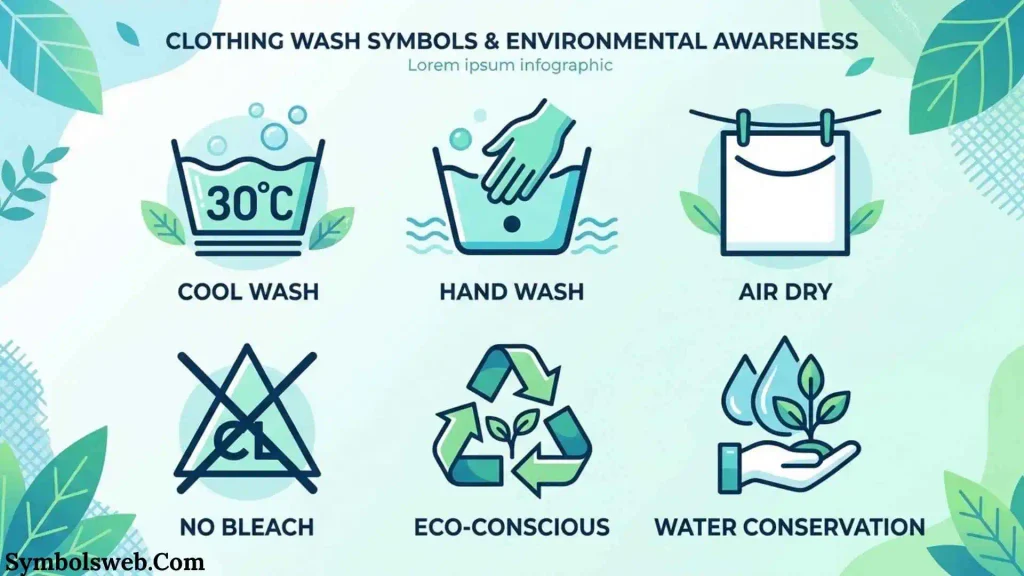
Care symbols can also support more thoughtful clothing care.
A garment that lasts longer does not need to be replaced as quickly.
Gentler washing and lower-temperature drying can sometimes help protect fabrics, colors and shape. Air drying can also be an alternative when the label permits it.
However, care labels should not be treated as environmental guarantees.
A care label primarily tells you what treatment is appropriate for the textile. It does not by itself tell you the garment’s total environmental impact.
Clothing Wash Symbols in Modern Clothing
Today, care symbols appear on an enormous variety of garments and textile products.
You may find them on:
- T-shirts
- Jeans
- Dresses
- Shirts
- Jackets
- Sweaters
- Underwear
- Sportswear
- Children’s clothing
- Bedding
- Towels
- Delicate fabrics
- Workwear
- Fashion garments
The symbols are particularly valuable for international brands because one visual system can communicate basic care information across markets.
U.S. Symbols vs International Clothing Wash Symbols
One important detail is often overlooked.
The United States has its own care-labeling framework, while ISO 3758 is an international standard used widely around the world.
The FTC explains that U.S. ASTM care symbols are similar to, but not identical to, the ISO symbols used in many European countries.
Therefore, if you encounter a symbol that looks slightly different from one you learned online, do not automatically assume the label is wrong.
Consider:
- Which country the garment is sold in
- Whether the label uses ISO-style or another national system
- The written instructions accompanying the symbols
- The manufacturer’s specific guidance
Common Mistakes People Make With Clothing Wash Symbols
Washing at the Maximum Temperature Every Time
A 40°C symbol means 40°C is the maximum permitted temperature under the care instruction. It does not mean that every wash must be performed at 40°C.
Ignoring Lines Under the Tub
The lines are important.
One line means a gentler process, while two lines indicate an even milder process.
Assuming All Cotton Can Be Washed the Same Way
Cotton garments can have different dyes, finishes, construction methods and blended materials.
Always follow the garment’s care label.
Putting Every Garment in the Dryer
Some clothing should be line dried, drip dried or dried flat.
A crossed-out tumble-dryer symbol should be taken seriously.
Choosing Iron Temperature Based Only on Fabric Name
The care label should take priority over assumptions based solely on fiber content.
Using Bleach Without Checking the Triangle
A crossed triangle means no bleach, while the striped triangle restricts the type of bleach that may be used.
Cutting Off the Label Too Quickly
If you remove the label, you remove a useful reference.
If the label is uncomfortable or causes irritation, consider recording or photographing the care instructions before removing it.
How to Make Clothes Last Longer Using Wash Symbols
Reading the label is only the first step.
A few simple habits can make the information more useful.
Follow the Temperature Limit
Do not exceed the temperature shown inside the wash tub.
Choose a Gentler Cycle When Required
If the label has one or two lines under the tub, use an appropriate gentle or very gentle cycle.
Avoid Unnecessary Bleaching
If bleach is not permitted, do not experiment with it.
Respect Drying Instructions
If the garment says to dry flat, do not automatically hang it.
If it says not to tumble dry, keep it out of the dryer.
Use the Correct Iron Temperature
More dots mean greater permitted heat, while a crossed-out iron means no ironing.
Take Professional-Care Symbols Seriously
If a garment requires professional cleaning, a household washing machine is not an equivalent substitute.
Interesting Facts About Clothing Wash Symbols
- The modern care-symbol system dates to 1963. GINETEX traces its introduction to that year.
- The system was created partly to overcome language barriers. Visual symbols can communicate basic care information without relying entirely on written language.
- ISO 3758:2023 is the current international standard. It was published in December 2023 and replaced ISO 3758:2012.
- A number inside the wash tub is a maximum temperature. It is not simply a recommendation to always wash at that temperature.
- Lines under the wash tub indicate gentler mechanical treatment. Two lines indicate a very mild process.
- A square represents drying. A circle inside the square specifically points to tumble drying.
- Dots can indicate heat intensity. They are used in tumble-drying and ironing symbols to communicate temperature levels.
- The care label is about the finished garment, not just the fiber. Components such as linings, trims, buttons and other details can affect the required care instructions. The U.S. FTC specifically requires care considerations to account for garment components.
- Milder treatment is generally allowed. GINETEX explains that treatments milder than those specified on the label are permitted.
- The symbols are protected in many countries. GINETEX states that its care symbols are protected trademarks in most countries.
Frequently Asked Questions About Clothing Wash Symbols
What do clothing wash symbols mean?
Clothing wash symbols are visual instructions that explain how a garment should be washed, bleached, dried, ironed and professionally cleaned. The wash tub specifically tells you whether and how the garment can be washed, including its maximum permitted temperature.
What does a number inside a washing symbol mean?
A number inside the wash tub indicates the maximum washing temperature in degrees Celsius. For example, 30 means the garment should not be washed above 30°C under that care instruction.
What do the lines under a wash symbol mean?
One line under the wash tub means a mild washing process with reduced mechanical action. Two lines mean a very mild process, commonly used for particularly delicate textiles.
What does a crossed-out washing symbol mean?
A crossed-out wash tub means the garment must not be washed. It may be sensitive to wet treatment or unsuitable for domestic washing.
What does the triangle on a clothing label mean?
The triangle represents bleaching. An empty triangle indicates bleaching is allowed, a triangle with two diagonal lines indicates oxygen or non-chlorine bleach only, and a crossed triangle means do not bleach.
What does a square with a circle mean on clothing?
A square with a circle represents tumble drying. Dots inside the circle indicate the permitted drying temperature level. A crossed-out version means the garment should not be tumble dried.
Conclusion
Clothing wash symbols are a simple visual language designed to help you care for your clothes correctly. From the washing tub and temperature numbers to the triangle, dryer, iron, and professional-care symbols, each mark provides important information about how a garment should be treated. Understanding these symbols can help prevent shrinking, fading, stretching, heat damage, and other common laundry mistakes.
The next time you look at a care label, do not see it as a confusing collection of tiny shapes. See it as a guide created to help your clothes stay useful, comfortable, and beautiful for longer. A few seconds spent understanding clothing wash symbols can save a favorite garment from damage and turn everyday laundry into smarter clothing care.

Hi, I’m Ethan Holloway, and I’ve always believed that a few meaningful words can change the way we think, feel, and live. I enjoy collecting timeless quotes, studying their deeper meanings, and sharing inspiring messages that help people stay motivated through every stage of life.
Over the years, I’ve explored thousands of famous sayings from writers, leaders, philosophers, and everyday people. My goal is to make wisdom easy to understand and useful for everyone.
Books by Ethan Holloway
- The Power of Everyday Quotes
- Words That Inspire Greatness
 Jordan Hayes
 Eliana Foster