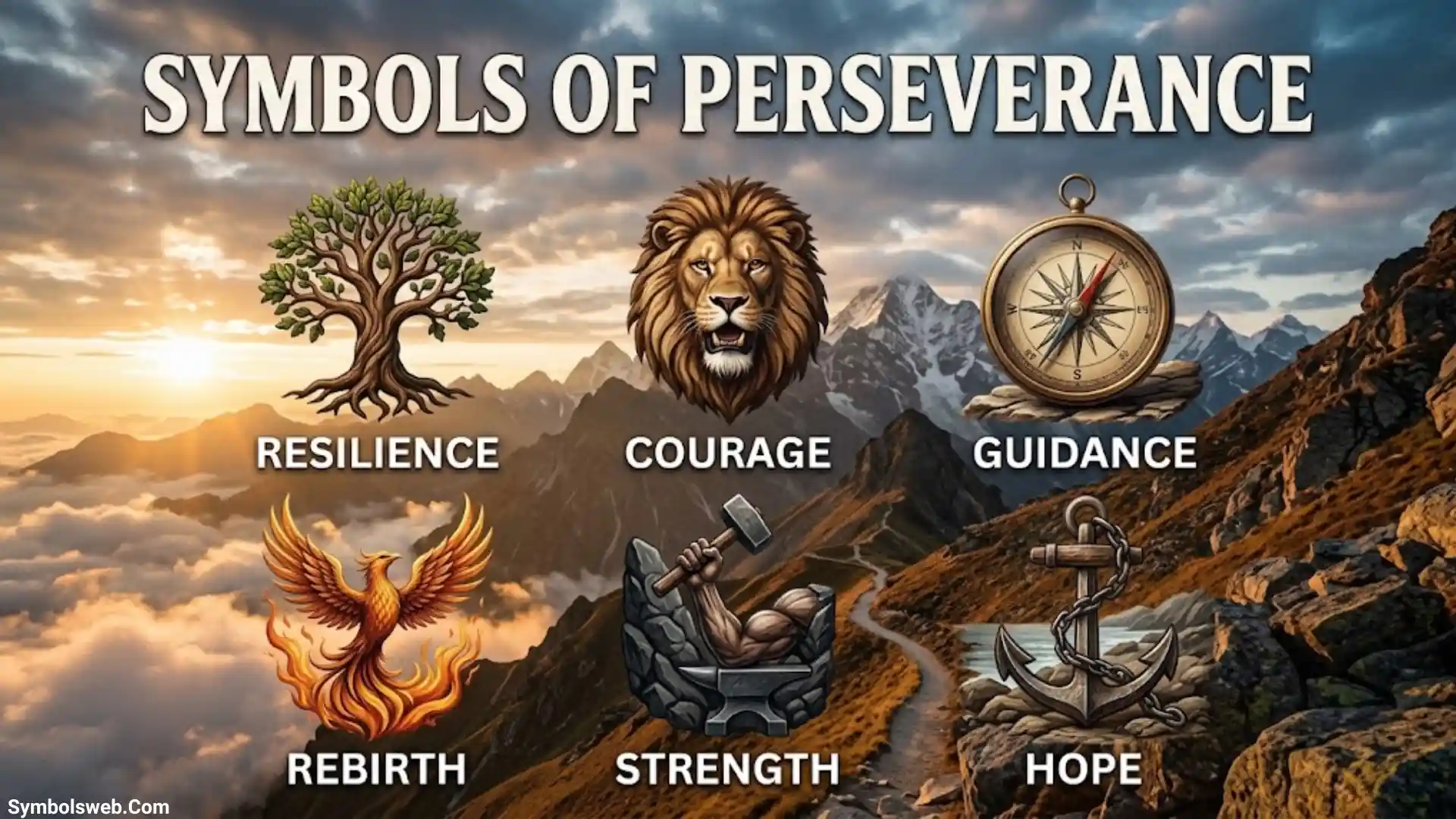
Symbols of perseverance have helped people express one of humanity’s oldest promises: I may fall, but I will rise again. Across history, people have looked to nature, mythology, religion, and everyday objects for signs of strength and endurance. A mountain, lotus, turtle, or rising phoenix can turn an invisible quality like courage into something we can see, remember, and carry with us.
These symbols matter because perseverance is part of every human life. We all face moments when progress feels slow, failure feels painful, or the path ahead seems uncertain. From ancient civilizations to modern tattoos and jewelry, symbols of perseverance continue to remind us that difficult circumstances do not have to define our ending.
Symbols of perseverance hold personal meanings based on our experiences, beliefs, and goals. They remind us to overcome obstacles, stay patient, and keep moving forward. If chosen for motivation, tattoos, or jewelry, these symbols represent inner strength and the determination to never give up.
Symbols of Perseverance: (Quick Answer)
Symbols of perseverance are images, objects, animals, plants, or mythical figures that represent the ability to continue through difficulty. Common examples include the Daruma, phoenix, lotus, oak tree, turtle, mountain, anchor, and bamboo. They can symbolize resilience, determination, patience, courage, hope, spiritual growth, and the strength to continue despite obstacles.
Quick Facts About Symbols of Perseverance
| Aspect | Information |
| Origin | Symbols of perseverance have appeared independently in many ancient cultures, religions, myths, and folk traditions. |
| Historical Significance | They have helped people express endurance, survival, courage, renewal, and hope through visual stories and sacred imagery. |
| Main Meaning | Persistence, resilience, determination, endurance, patience, courage, and hope. |
| Spiritual Meaning | Inner transformation, faith, renewal, spiritual discipline, and growth through adversity. |
| Cultural Importance | Different societies connect perseverance with trees, mountains, animals, flowers, fire, water, and other natural forces. |
| Modern Usage | Tattoos, jewelry, artwork, motivational designs, branding, home décor, social media, and personal expression. |
What Are Symbols of Perseverance?
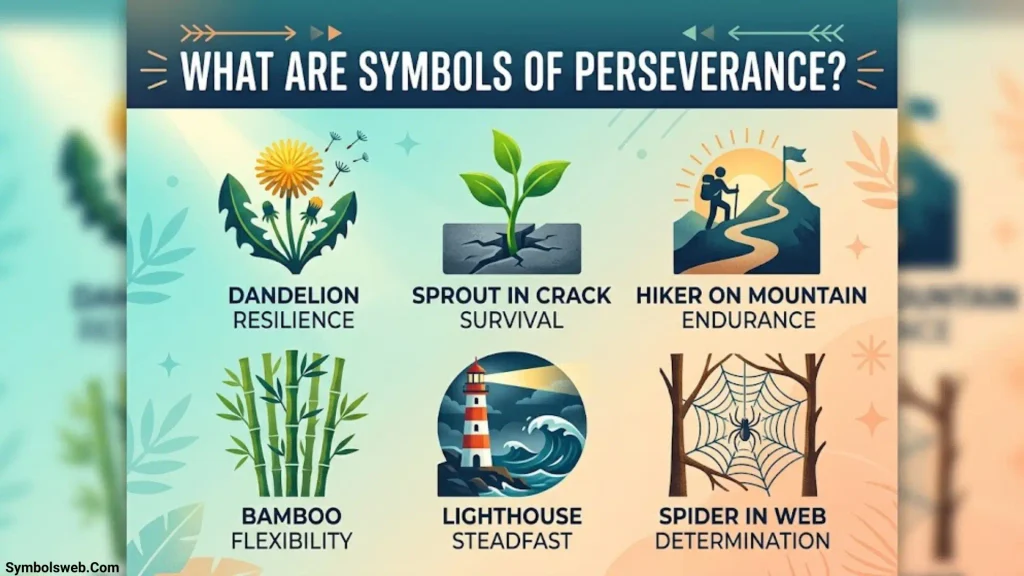
Symbols of perseverance are visual representations of the human ability to continue despite pain, failure, uncertainty, or obstacles.
Perseverance is closely connected with words such as resilience, persistence, determination, endurance, courage, patience, strength, hope, commitment, and grit. However, these concepts are not exactly the same.
Perseverance usually describes continuing toward a goal despite difficulties. Resilience focuses more on adapting and recovering after adversity, while grit is commonly associated with sustained effort and passion toward long-term goals.
That distinction helps explain why different symbols communicate different forms of perseverance.
A mountain can represent the challenge itself.
An anchor can represent stability during a storm.
A turtle can represent patient progress.
A phoenix can represent the beginning again after destruction.
A Daruma can represent commitment to a goal.
The symbol gives an invisible quality, such as determination, a visible form.
Why Did Humans Create Symbols of Perseverance?
Human beings have always faced forces they could not easily control. Disease, war, loss, natural disasters, poverty, failure, and uncertainty have been part of human experience throughout history.
Nature provided powerful examples of survival.
A tree could remain standing after a storm. A flower could emerge from muddy water. A small plant could push through hard soil. A river could slowly shape stone. The sun could disappear at night and return the following morning.
These repeated patterns gave people a way to understand their own struggles.
A person facing hardship could look at a tree and see more than branches and leaves. They could see endurance.
That is one reason symbols remain emotionally powerful even in the modern world.
Symbol of perseverance animal
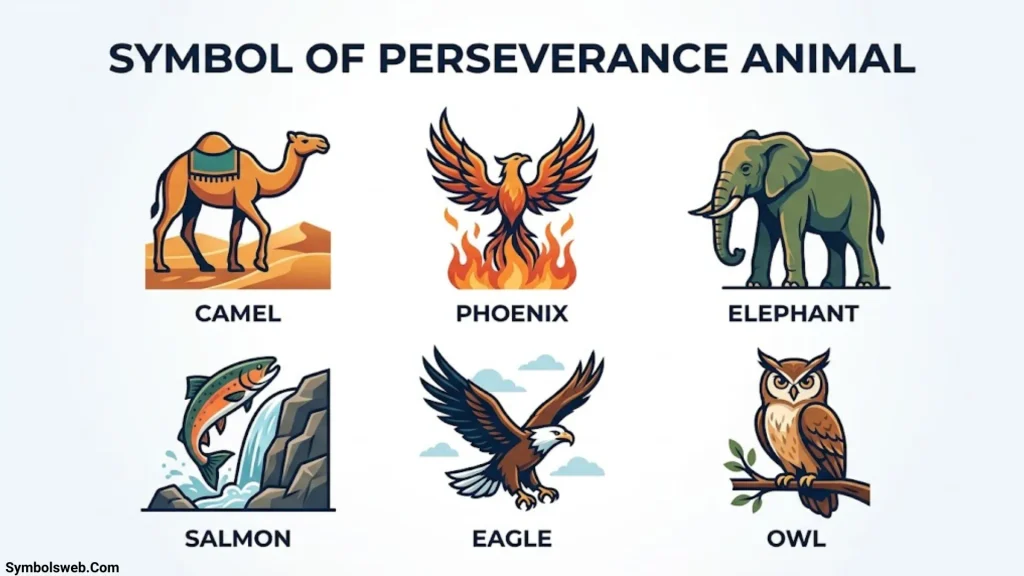
Animals can represent perseverance because their natural behavior often reflects endurance, patience, adaptability, and determination. One of the strongest examples is the tortoise, which is commonly associated with patience, longevity, and steady progress. Its symbolism is especially meaningful because it shows that moving slowly does not mean failing; consistent effort can eventually lead to the goal.
The salmon is another powerful symbol of perseverance because it is known for swimming against strong currents during its life cycle. The ant represents persistence through continuous effort, while the elephant can symbolize strength, patience, and endurance. In Asian art traditions, the carp or koi has also been associated with perseverance and strength, particularly through the well-known story of a carp overcoming rapids.
For someone looking for an animal symbol of perseverance, the best choice depends on the meaning they want to express. A tortoise can represent patience, a salmon determination, a koi overcoming obstacles, and an ant with the power of consistent effort.
Symbols of perseverance and strength
Symbols of perseverance and strength represent the ability to remain determined when facing obstacles, setbacks, or difficult circumstances. The mountain is a particularly clear symbol because reaching its summit requires patience, endurance, and continued effort. It can represent a difficult challenge and the determination needed to overcome it.
The oak tree is another strong symbol of endurance and resilience. Its long life and ability to withstand difficult conditions have contributed to its association with strength and perseverance in different cultural traditions. The phoenix represents another form of perseverance: recovering after destruction, beginning again, and becoming stronger through adversity.
Other symbols can express different aspects of strength. An anchor can represent stability during difficult times, while an arrow can suggest moving forward after a setback. A lotus flower can symbolize growth through challenging circumstances. Together, these symbols show that perseverance is not only about physical strength but also about patience, resilience, hope, and the willingness to continue.
Ancient symbols of perseverance
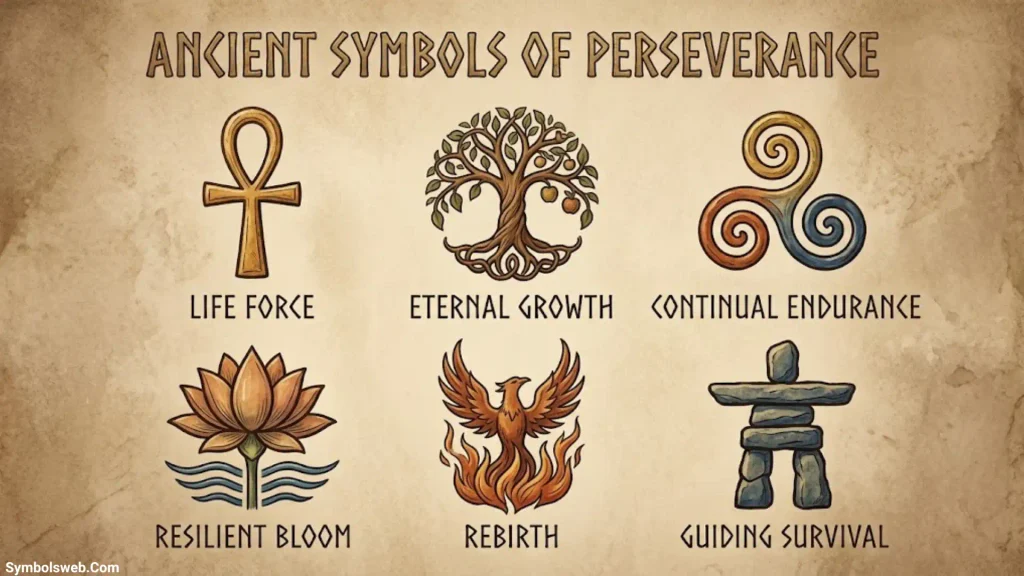
Ancient symbols of perseverance can be found in mythology, religion, art, and natural imagery. Many early cultures used objects, animals, plants, and mythical figures to express qualities such as endurance, courage, victory, and resilience.
The oak tree is one important example. Ancient Celtic, Greek, and Roman traditions gave the oak considerable importance, and its strength and longevity helped connect it with endurance and resilience. The laurel was strongly associated with victory, honor, and achievement in the ancient Mediterranean world, making it a useful symbol of the rewards that can follow sustained effort.
The phoenix is another enduring symbol found in ancient mythology. Its story of rising again after destruction has made it a widely recognized representation of renewal, transformation, hope, and perseverance. Ancient symbolism also shows that perseverance was often expressed through the idea of surviving hardship and beginning again rather than simply avoiding difficulties.
Symbols of perseverance in the Bible
The Bible presents perseverance primarily through themes of faith, endurance, steadfastness, and remaining committed during trials. Rather than identifying one single object as the official symbol of perseverance, biblical imagery and stories provide several powerful ways to represent this quality.
The tree planted by water is a meaningful biblical image of stability, growth, and remaining rooted. The cedar is also used in biblical imagery to convey strength and deep roots, while the olive tree is associated with flourishing, fruitfulness, and enduring spiritual imagery.
The eagle is another biblical image often connected with renewed strength and endurance. Isaiah 40:31 describes those who hope in the Lord as rising on wings like eagles, creating a powerful connection between faith, renewed strength, and continuing through hardship. The Bible also repeatedly teaches perseverance through the experiences of people who remained faithful during suffering and uncertainty.
For a Christian symbol of perseverance, a cross, eagle, tree, olive branch, or rooted tree can therefore carry meaningful associations with faith, endurance, hope, and remaining steadfast.
Symbols of perseverance tattoos
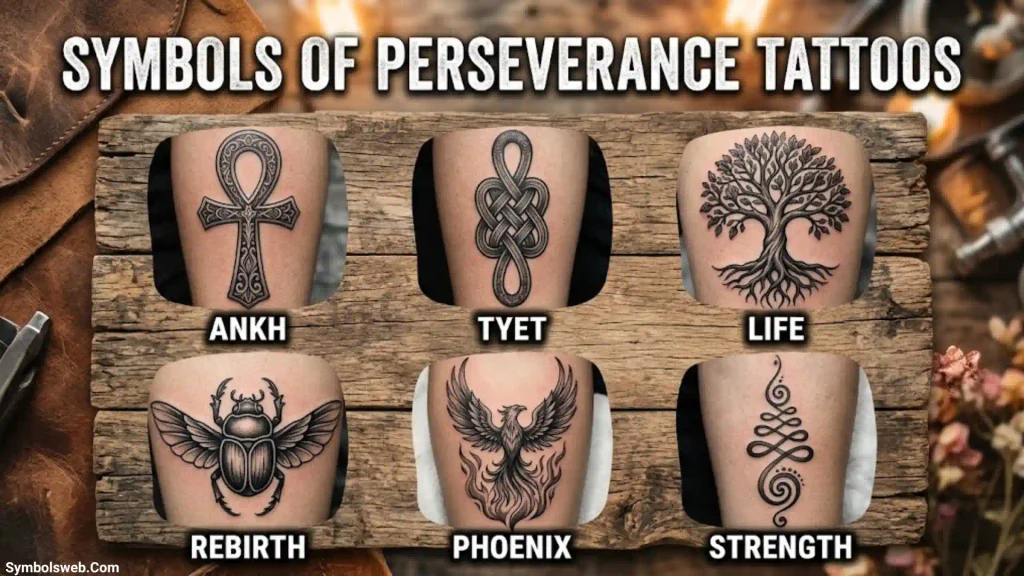
Perseverance tattoos are often chosen as permanent reminders of surviving difficult experiences, overcoming obstacles, or continuing toward a personal goal. Because tattoos can carry highly personal meanings, the most suitable design is usually one that reflects the individual’s own journey.
A mountain tattoo can represent overcoming challenges and reaching a difficult destination. A phoenix tattoo can symbolize rebuilding life after hardship, while a lotus tattoo can represent growth and beauty emerging from difficult circumstances. An anchor can express stability and remain grounded when life becomes turbulent.
Animal tattoos can also communicate perseverance. A tortoise can represent patience and steady progress, a koi fish can represent determination, and an elephant can suggest strength and endurance. Adding meaningful details such as a date, initials, short word, or personal symbol can make the tattoo more connected to the experience it represents.
Perseverance symbol flower
Flowers can represent perseverance because their growth often demonstrates the ability to develop despite challenging conditions. The lotus is one of the most recognizable flowers associated with overcoming adversity. Its growth from muddy water has made it a widely used symbol of transformation, growth, and the emergence of beauty from difficult surroundings.
The dandelion can also work as a perseverance symbol because its seeds can travel and establish themselves in many different environments. The thistle is another meaningful choice because its strong appearance and protective spines can represent toughness, resilience, and the ability to withstand challenges.
For a flower tattoo or personal emblem, the lotus is particularly suitable when the intended message is growth through hardship, while a thistle can emphasize strength and resilience. The meaning of any flower can also vary by culture, so its symbolism should be considered alongside the personal meaning the design holds for you.
Celtic symbols of perseverance
Celtic symbolism includes several designs that can be connected with continuity, strength, growth, and endurance. The Celtic knot is especially popular because its interwoven lines create continuous patterns. Today, these designs are commonly interpreted as representing continuity, interconnectedness, and enduring relationships.
The Celtic tree of life is another meaningful design for perseverance. Its roots can represent stability and connection to one’s foundations, while its trunk and branches suggest growth, strength, and the continuing journey of life. The Celtic bull also has historical associations with strength, endurance, fertility, and virility in discussions of Celtic symbolism.
It is important to distinguish historical meaning from modern interpretation. Not every Celtic pattern was originally created as a specific symbol of perseverance. However, continuous knots, trees, and strong animal imagery can be used today to express endurance and resilience while drawing inspiration from Celtic artistic traditions.
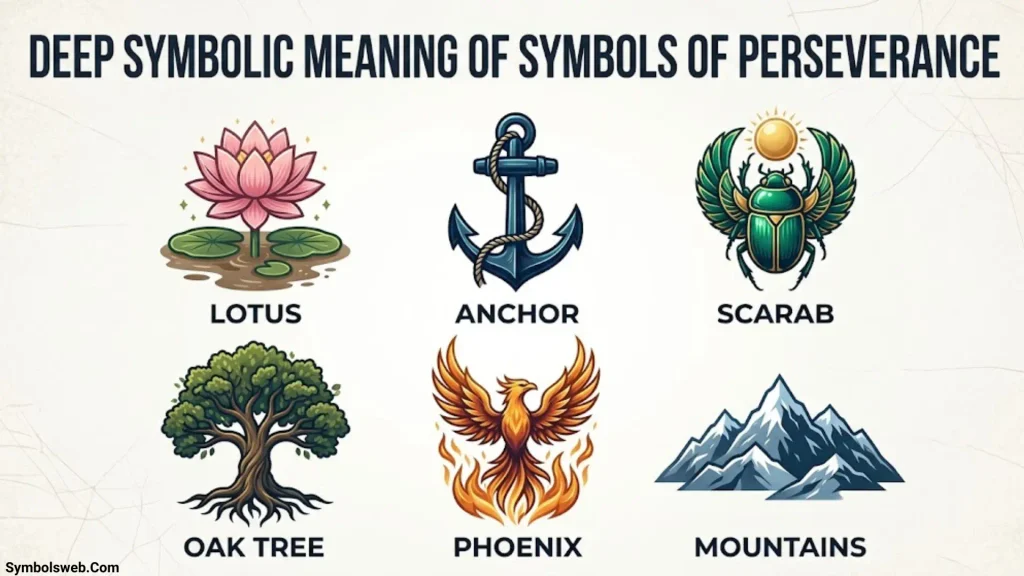
Deep Symbolic Meaning of Symbols of Perseverance
Spiritual Meaning
On a spiritual level, perseverance is often understood as the ability to remain committed when the path becomes difficult.
Many spiritual traditions view hardship as a possible period of transformation, reflection, discipline, or renewal. This does not mean suffering is automatically good. Instead, the symbolism suggests that difficult experiences can sometimes become part of a deeper journey.
The lotus is one of the clearest examples. It grows in muddy water but rises above the surface and blooms. In Buddhist traditions, the lotus is strongly associated with purity and enlightenment. In Hindu traditions, lotus imagery is closely connected with divine figures and spiritual awakening. Ancient Egyptian traditions also used lotus imagery in connection with creation and renewal.
The image creates a powerful spiritual message: difficult surroundings do not necessarily determine the final form of a person’s life.
Psychological Meaning
Psychologically, perseverance is more complicated than simply telling yourself to never give up.
Persistence often involves returning to a goal after interruptions, dealing with setbacks, adjusting strategies, and continuing when motivation changes.
This is why the Daruma is such a powerful image.
It does not stay upright because nothing ever touches it.
It stays upright because its design allows it to return.
That difference is important.
Psychological resilience is also not the same as refusing to change. Healthy resilience can include flexibility, adaptation, coping, and learning from difficult experiences.
Jungian and Archetypal Meaning
From an archetypal perspective, symbols of perseverance often represent the struggle between a person and adversity.
The hero faces a difficult road.
The traveler climbs the mountain.
The wounded person heals.
The seed breaks through the soil.
The bird rises from destruction.
These patterns appear in many stories because they express a basic human experience. A person encounters something greater than their current strength and must develop, adapt, endure, or transform.
However, archetypal interpretations should not be confused with the historical meaning of a symbol. Different cultures can give the same image very different meanings.
Cultural Meaning
Culturally, symbols preserve memories and values.
A community may use a tree to represent strength, a turtle to represent protection and perseverance, or a religious image to represent spiritual discipline. Over generations, these images can become part of art, architecture, ceremonies, stories, clothing, jewelry, and everyday life.
This is why the meaning of a symbol cannot always be separated from the people and traditions that created it.
A turtle, for example, can have one meaning in one community and another meaning elsewhere. Among the Diné, turtle shell symbolism is associated with perseverance and protection, while turtle imagery also appears in creation traditions among other Indigenous peoples of North America.
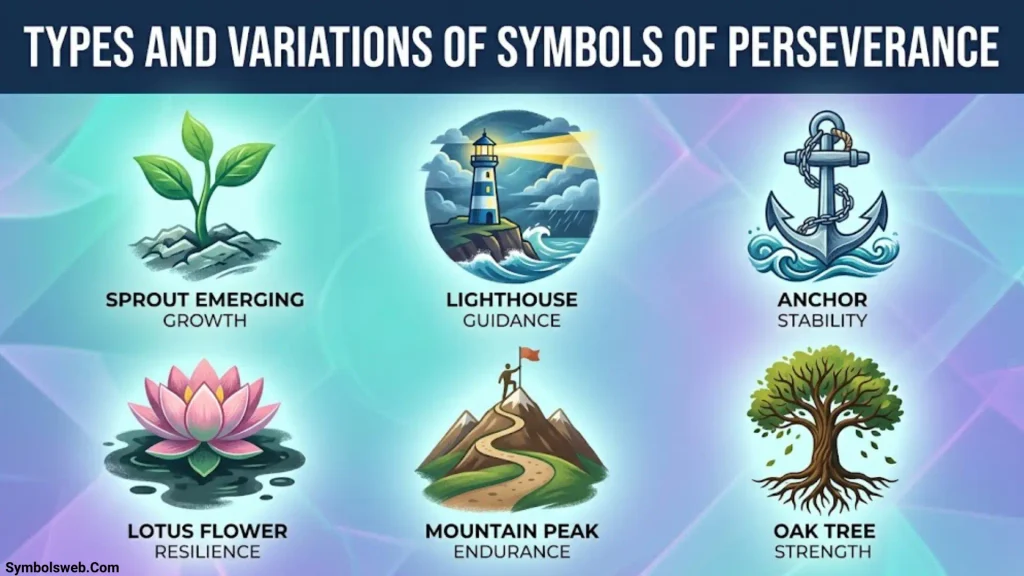
Types and Variations of Symbols of Perseverance
Daruma
Visual description: A round Japanese figure, commonly red, with a determined facial expression and traditionally incomplete eyes.
Meaning: Perseverance, determination, goal setting, good fortune, and commitment.
Symbolism: The Daruma’s weighted shape allows it to return upright after being knocked down. This physical characteristic became a visual metaphor for resilience and persistence.
The tradition is associated with Bodhidharma, the Buddhist monk traditionally linked with the transmission of Chan Buddhism to China and later Zen traditions in Japan.
The familiar practice of painting one eye when setting a goal and completing the second eye after achieving it turns perseverance into a visible ritual.
Phoenix
Visual description: A mythical bird commonly associated with fire, destruction, renewal, and rebirth.
Meaning: Renewal, transformation, survival, endurance, and beginning again.
Symbolism: The phoenix is traditionally portrayed as a creature that returns after destruction. Its symbolism therefore goes beyond simply surviving. It suggests that a person can enter a new stage of life after an ending.
The ancient Egyptian Benu bird was associated with creation and renewal and was later connected by Greek writers with the phoenix tradition.
Lotus Flower
Visual description: A flower emerging from water, often shown with open petals.
Meaning: Spiritual growth, renewal, purity, rebirth, resilience, and enlightenment.
Symbolism: The lotus is powerful because its natural environment creates a strong metaphor for human struggle. It grows from muddy water yet emerges above the surface and blooms.
In ancient Egyptian symbolism, lotus imagery was associated with creation and renewal. In Hindu and Buddhist traditions, the flower became deeply connected with spiritual purity and awakening.
Oak Tree
Visual description: A large tree with a thick trunk, deep roots, and broad branches.
Meaning: Strength, endurance, stability, longevity, courage, and perseverance.
Symbolism: The oak’s ability to survive harsh weather and its long lifespan have made it a natural metaphor for strength.
In ancient Greek tradition, the oak was associated with Zeus, especially at the sanctuary of Dodona.
The oak therefore represents a different form of perseverance from the phoenix. The phoenix symbolizes renewal after destruction, while the oak suggests strength through continued existence.
Turtle
Visual description: A slow-moving animal protected by a hard shell.
Meaning: Patience, protection, endurance, stability, and steady progress.
Symbolism: The turtle teaches a simple lesson: progress does not have to be fast to be meaningful.
Among the Diné, turtle shell symbolism has been documented as representing perseverance and protection.
Turtle imagery also appears in the cultural traditions and creation stories of several Indigenous peoples.
Mountain
Visual description: A high peak rising above the surrounding landscape.
Meaning: Challenge, endurance, achievement, courage, spiritual growth, and overcoming obstacles.
Symbolism: A mountain represents something difficult but possible to climb.
It is also one of the easiest modern symbols to understand because the metaphor is simple. You do not climb a mountain in one step.
You climb it gradually.
Anchor
Visual description: A heavy object designed to hold a ship in place.
Meaning: Stability, hope, strength, faith, security, and endurance.
Symbolism: An anchor does not stop a storm. It helps a vessel remain grounded while the storm passes.
For this reason, anchors are often used to represent stability during difficult periods.
Bamboo
Visual description: A tall, segmented plant that can bend considerably without easily breaking.
Meaning: Flexibility, resilience, patience, strength, and adaptability.
Symbolism: Bamboo offers an important lesson about perseverance: strength does not always mean being rigid.
Sometimes survival requires bending.
This makes bamboo an especially useful symbol of flexible resilience, where a person changes their approach without abandoning their deeper purpose.
Mountain Climbing Path
Visual description: A trail leading upward toward a distant summit.
Meaning: Progress, discipline, effort, personal growth, and achievement.
Symbolism: A climbing path emphasizes the journey rather than simply the destination.
It reminds us that major goals are usually reached through many small actions rather than one dramatic moment.
Unbroken Knot
Visual description: A continuous line or knot with no obvious beginning or ending.
Meaning: Continuity, commitment, endurance, connection, and persistence.
Symbolism: Knot imagery appears in many artistic and religious traditions, although its precise meaning varies by culture. In modern symbolic design, an unbroken knot can represent remaining connected to a promise or continuing through difficulty.
Staircase
Visual description: A sequence of steps leading upward.
Meaning: Progress, development, discipline, achievement, and perseverance.
Symbolism: A staircase shows that major progress happens one step at a time.
It is particularly common in modern motivational designs because the meaning is easy to understand.
Semicolon
Visual description: A punctuation mark made from a period above a comma.
Meaning: Continuation, survival, and choosing to continue one’s story.
Symbolism: In modern culture, the semicolon became associated with mental health awareness and the idea that a person’s story can continue when it could have ended.
Unlike ancient symbols such as the lotus or oak, the semicolon is a distinctly modern symbolic development.
Sun
Visual description: A radiant sun rising above the horizon.
Meaning: Renewal, hope, life, persistence, and another beginning.
Symbolism: The daily cycle of sunset and sunrise provides one of humanity’s oldest natural metaphors for returning after darkness.
Ancient Egyptian solar imagery connected cycles of the sun with renewal and rebirth.
Butterfly
Visual description: A butterfly emerging from its earlier form.
Meaning: Transformation, growth, change, freedom, and renewal.
Symbolism: The butterfly is more accurately a symbol of transformation than perseverance alone. However, its transformation makes it a popular modern symbol for surviving difficult stages and becoming something new.
Rising Flame
Visual description: A flame continuing upward through darkness.
Meaning: Hope, determination, courage, passion, and inner strength.
Symbolism: Fire can destroy, but it can also provide light and warmth. A single flame can therefore represent the possibility that hope remains alive during difficult circumstances.
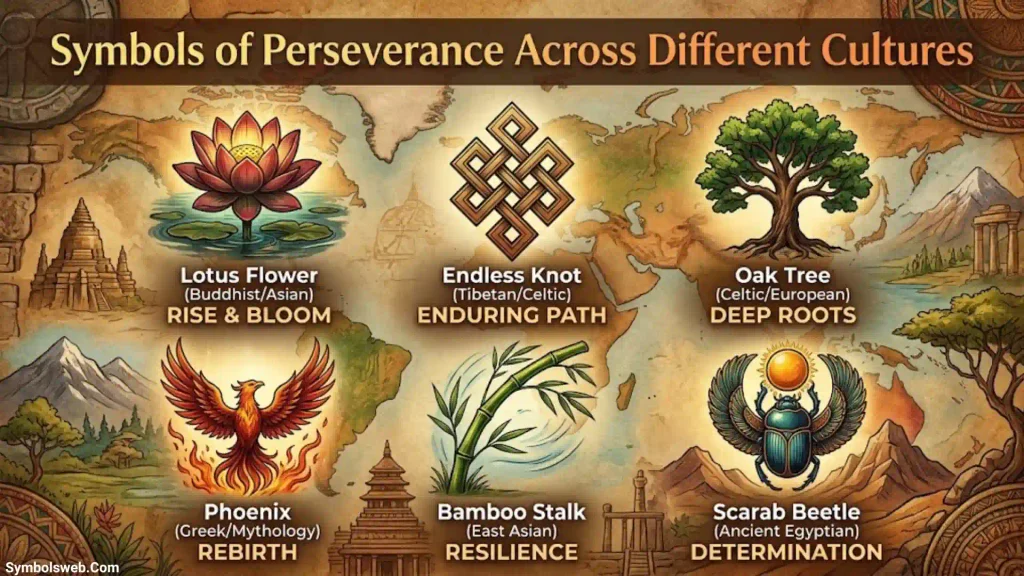
Symbols of Perseverance Across Different Cultures
Ancient Egypt
Ancient Egyptian symbolism frequently connected renewal with natural cycles.
The lotus was associated with creation and rebirth, while the Benu bird became associated with creation and renewal and was later connected by Greek tradition with the phoenix.
Egyptian funerary imagery also frequently used ideas of renewal and continued existence in connection with the afterlife.
The Egyptian example is important because perseverance was not always expressed as working harder. It could be expressed through renewal, rebirth, and the continuation of life.
Ancient Greece
Greek culture produced many stories about endurance, struggle, and the consequences of refusing to surrender.
The oak was associated with Zeus, while myths such as the story of Odysseus placed endurance at the center of a long journey filled with danger.
The story of Sisyphus offers a more complicated example.
Sisyphus repeatedly pushes a boulder uphill only to watch it roll back down. Today, people sometimes describe him as a symbol of perseverance because he continues his task. However, the original myth does not present his labor as an inspirational achievement. His endless work is a punishment.
That distinction matters because a symbol can represent endurance while also warning about meaningless repetition.
Roman Culture
Roman culture inherited and adapted many Greek myths and symbols.
The laurel became strongly associated with victory, honor, achievement, and public recognition. Although it is not exclusively a symbol of perseverance, it can represent the reward associated with sustained effort.
Roman culture also valued virtues such as constantia, a concept associated with steadfastness and firmness of character.
This demonstrates that perseverance can be represented not only by an object but also by a moral quality.
Eastern Traditions
Eastern traditions contain some of the world’s most recognizable perseverance symbols.
The lotus is deeply important in Hindu and Buddhist traditions, while the Daruma became a widely recognized Japanese symbol of determination and goal pursuit.
Daruma imagery is connected with Bodhidharma, who is traditionally associated with prolonged meditation and spiritual discipline.
The Daruma therefore combines spiritual discipline, folk tradition, intention, good fortune, and perseverance.
Indigenous Traditions
Indigenous cultures should not be treated as one single symbolic system. Different nations have their own languages, histories, spiritual traditions, and relationships with animals and land.
Among the Diné, the turtle’s shell has a documented association with perseverance and protection.
The Smithsonian also documents turtle traditions among Indigenous peoples, including the Haudenosaunee creation story involving Turtle Island.
These examples show why cultural context matters. A symbol should not be given one universal “Indigenous” or “Native American” meaning.
Modern Interpretations
Modern society has expanded the language of perseverance.
Today, people may choose a phoenix tattoo after surviving a major life change, a mountain design to represent a difficult goal, a semicolon to represent continuation, or a Daruma to mark a personal objective.
Modern symbolism is often more personal than traditional symbolism.
The meaning may come from history, but it can also come from the individual’s own story.
Similar Symbols and Their Meanings
Many perseverance symbols appear similar at first, but they communicate different kinds of strength.
| Symbol | Main Meaning | Type of Perseverance |
| Daruma | Determination and goal commitment | Returning to a goal |
| Phoenix | Rebirth and renewal | Starting again after destruction |
| Lotus | Growth and spiritual awakening | Rising above difficult conditions |
| Oak | Strength and longevity | Remaining strong over time |
| Turtle | Patience and protection | Slow, steady endurance |
| Mountain | Challenge and achievement | Overcoming obstacles |
| Anchor | Stability and hope | Remaining grounded during hardship |
| Bamboo | Flexibility and resilience | Bending without breaking |
| Sun | Renewal and hope | Beginning again |
| Semicolon | Continuation | Choosing to continue one’s story |
Perseverance vs. Resilience
These concepts overlap but are not identical.
Perseverance focuses on continuing toward a goal.
Resilience focuses on adapting and recovering after adversity.
A person may persevere by continuing to study for an examination.
A resilient person may recover after failing the examination, change their approach, and try again.
The strongest symbols can represent both qualities.
Perseverance vs. Strength
Strength can mean power.
Perseverance means sustained effort.
A mountain is strong because it remains in place.
A climber demonstrates perseverance because they keep moving toward the summit.
That is why strength and perseverance are related but different concepts.
Perseverance vs. Stubbornness
Perseverance does not mean refusing to change no matter what happens.
Healthy persistence can involve changing the strategy while preserving the larger goal.
Sometimes the bravest form of perseverance is not pushing harder.
It is finding another way forward.
Symbols of Perseverance in Mythology and Folklore
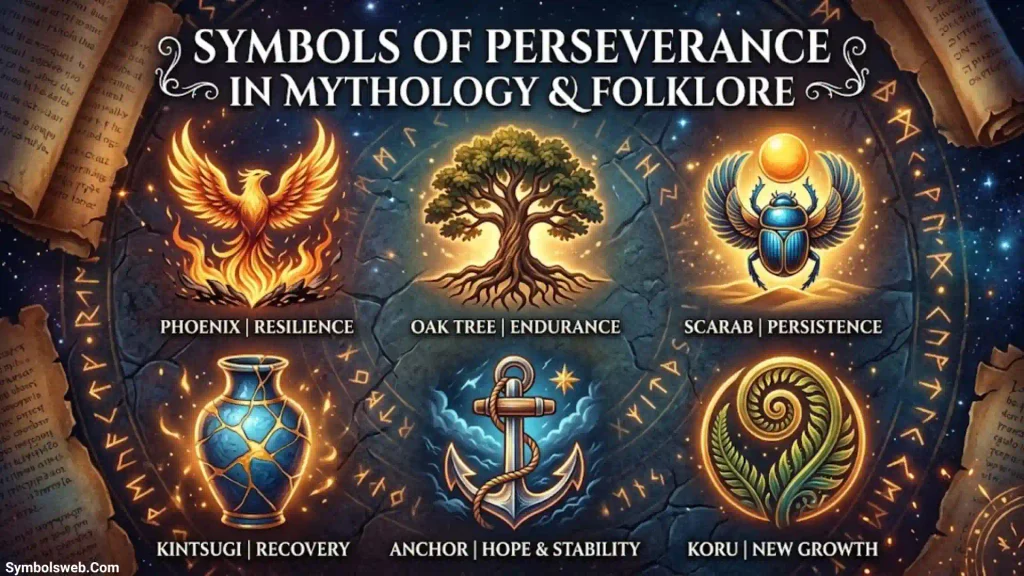
The Phoenix and the Cycle of Renewal
The phoenix became one of the most famous images of rebirth in Western imagination.
Its story transforms destruction into renewal. The message is powerful because it speaks to a fear nearly everyone understands: the fear that something important has ended forever.
The phoenix offers another possibility.
An ending can become the beginning of something else.
The historical relationship between the Egyptian Benu and later phoenix traditions is complex, but the two became closely connected in later interpretations of renewal and rebirth.
Sisyphus and Endless Effort
Sisyphus is often described online as a symbol of perseverance.
That interpretation is incomplete.
His endless labor can certainly be read as a metaphor for continuing despite repeated failure, but the myth presents his work as punishment rather than a goal worth achieving.
Later philosophical interpretations, especially those associated with Albert Camus, transformed Sisyphus into a broader symbol of human struggle, meaning, and the absurd.
Bodhidharma and the Daruma
The Daruma tradition is connected with stories about Bodhidharma’s dedication to meditation.
Japanese art repeatedly portrayed Bodhidharma as a figure of concentration and spiritual discipline.
The modern Daruma combines this history with folk traditions surrounding luck, wishes, determination, and goal setting.
Its ability to return upright makes the message particularly memorable.
The Turtle and Creation Stories
Turtle imagery has appeared in many Indigenous traditions, but its meanings differ by nation.
The Haudenosaunee creation story is one well-known example. Smithsonian Ocean describes a tradition in which the Earth comes to rest on the back of a sea turtle after Sky Woman falls from the sky.
This is more than a story about endurance. Turtle imagery can also connect with earth, stability, creation, and the relationship between humans and the natural world.
Symbols of Perseverance in Art, Literature, Movies and Pop Culture
Paintings and Visual Art
Artists have long used symbolic images to make invisible emotions visible.
A stormy sea can represent adversity.
A ship’s anchor can represent stability.
A mountain can represent an obstacle.
A rising bird can represent freedom or renewal.
Daruma and Bodhidharma have also appeared extensively in Japanese art.
Literature and Poetry
Literature often uses perseverance as a central theme rather than relying on one physical symbol.
The journey, road, mountain, storm, seed, fire, and dawn are recurring literary images.
A character walking through darkness toward a distant light can communicate perseverance without ever using the word.
This is one reason symbolic storytelling is so effective. Readers can feel the meaning before they consciously define it.
Movies and Television
Modern films often turn perseverance into a visual journey.
A character may train after failure, climb toward a difficult goal, return after defeat, or protect something important despite overwhelming odds.
Sports films frequently use mountains, roads, running tracks, and repeated training scenes to represent perseverance.
Fantasy and superhero stories often use fire, wings, scars, broken objects, and rebirth imagery to communicate the same theme.
Tattoos
Perseverance is one of the most meaningful themes for tattoos because a tattoo can become a permanent reminder of a temporary struggle.
Common designs include:
- Phoenix
- Lotus
- Mountain
- Turtle
- Anchor
- Daruma
- Bamboo
- Sun
- Semicolon
- Unbroken line
- Rising bird
- Tree with deep roots
The best design is usually not the one with the most dramatic appearance. It is the one whose history and meaning connect with the person’s own story.
Fashion and Jewelry
Small symbols can carry large emotional meanings.
A lotus pendant may represent spiritual growth.
A mountain necklace may represent overcoming a challenge.
An anchor may represent stability.
A Daruma figure may represent a personal goal.
Jewelry works especially well for symbolic perseverance because the object can remain close to the wearer without needing to explain itself to anyone else.
Modern Design and Branding
Brands often use mountains, arrows, rising suns, trees, roads, and flames to communicate strength, progress, endurance, or ambition.
However, effective symbolic design depends on context.
A mountain can mean adventure to one audience and an overwhelming obstacle to another.
A flame can represent passion, destruction, or hope.
Symbolism is therefore powerful but never completely universal.
Spiritual and Dream Meaning of Symbols of Perseverance
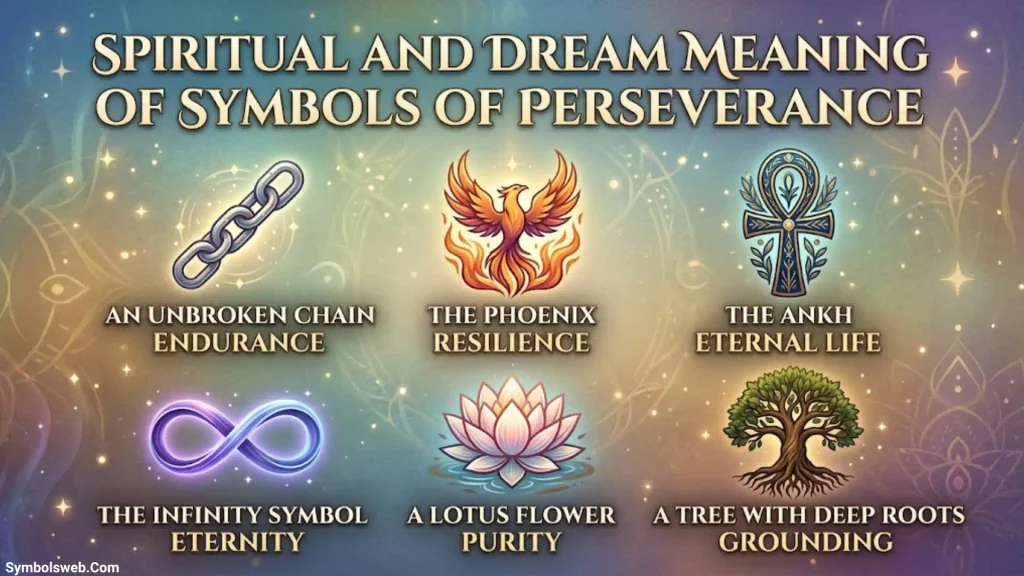
Dream symbolism is personal, so there is no scientifically established dictionary that gives one fixed meaning to every image.
Still, certain interpretations are common in psychological and spiritual traditions.
Dreaming of a Mountain
A mountain may represent a major challenge, ambition, responsibility, or long-term goal.
Climbing upward may feel like progress.
Standing at the bottom may reflect uncertainty.
Reaching the summit may represent achievement or relief.
The most meaningful interpretation usually depends on the dreamer’s emotions and personal circumstances.
Dreaming of a Phoenix
A phoenix may symbolize renewal, transformation, or the end of one life chapter.
It can become a powerful image when someone is thinking about rebuilding after a difficult period.
Dreaming of a Lotus
A lotus may suggest growth, purity, renewal, or emotional development.
In spiritual interpretations, it may represent awakening.
In psychological interpretations, it can be viewed as a metaphor for emerging from a difficult emotional environment.
Dreaming of a Turtle
A turtle may represent patience, protection, safety, or slow progress.
If the turtle is moving steadily, the dream may feel connected to persistence.
If it retreats into its shell, the image may instead reflect a desire for protection or withdrawal.
Meditation and Spiritual Encounters
During meditation, prayer, or personal reflection, people may naturally connect with symbols that already have emotional meaning for them.
A symbol can become a focus point for intention.
For example, someone trying to remain committed to a long-term goal may use a mountain as a reminder that progress can be gradual.
This does not mean the symbol has one supernatural meaning. Its power may come from attention, memory, personal belief, and emotional association.
Positive and Negative Meanings of Symbols of Perseverance
The same symbol can carry both a light side and a shadow side.
| Symbol | Positive Meaning | Negative Meaning |
| Daruma | Determination, commitment, resilience | Obsession with one goal |
| Phoenix | Renewal, transformation | Destruction, painful endings |
| Lotus | Growth, purity, awakening | Romanticizing suffering |
| Oak | Strength, stability, longevity | Rigidity, resistance to change |
| Turtle | Patience, protection, endurance | Slowness, withdrawal |
| Mountain | Achievement, courage, challenge | Isolation, overwhelming pressure |
| Anchor | Stability, hope, grounding | Feeling stuck |
| Bamboo | Flexibility, resilience | Excessive bending or weak boundaries |
| Flame | Passion, hope, courage | Anger, destruction, burnout |
| Semicolon | Continuation, survival | Its meaning may be misunderstood outside its context |
This duality is important.
Perseverance is not automatically healthy simply because it looks admirable.
A person can remain committed to a harmful goal.
A person can work until burnout.
A person can refuse to accept necessary change.
True resilience includes flexibility.
Why Humans Are Attracted to Symbols of Perseverance
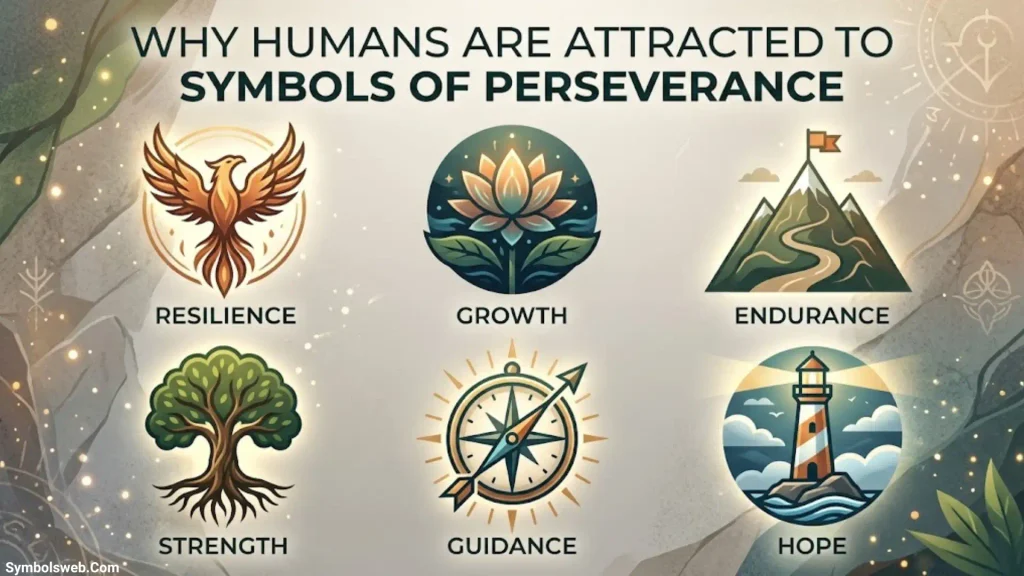
Symbols work because they turn abstract ideas into something the mind can easily remember.
“Keep going” is a sentence.
A mountain is an image.
“Recover after failure” is an idea.
A Daruma physically standing again is a visual metaphor.
This makes symbols especially useful as emotional reminders.
Symbols Create Emotional Anchors
Imagine someone training for years to reach a personal goal.
On a difficult day, they see a small mountain tattoo on their wrist.
The tattoo cannot do the work for them.
But it can remind them why they started.
That reminder can matter.
Symbols Give Meaning to Struggle
People often find hardship easier to face when they can connect it with a meaningful purpose.
A symbol can become part of a larger personal story.
The lotus can remind someone of growth.
The phoenix can represent rebuilding.
The mountain can represent an unfinished goal.
The anchor can represent stability.
Symbols Support Personal Identity
Someone who chooses a phoenix tattoo may be saying:
“I rebuilt my life.”
Someone who chooses a mountain may be saying:
“I am still climbing.”
Someone who chooses a turtle may be saying:
“I will move at my own pace.”
The symbol becomes part of personal identity.
Humans Recognize Patterns in Nature
Trees survive storms.
Rivers cut through rock.
Seeds break through soil.
The sun returns after darkness.
Animals travel across enormous distances.
These natural patterns give humans ready-made metaphors for endurance.
The symbols feel powerful because they connect personal struggles with something larger than the individual.
Modern Uses of Symbols of Perseverance
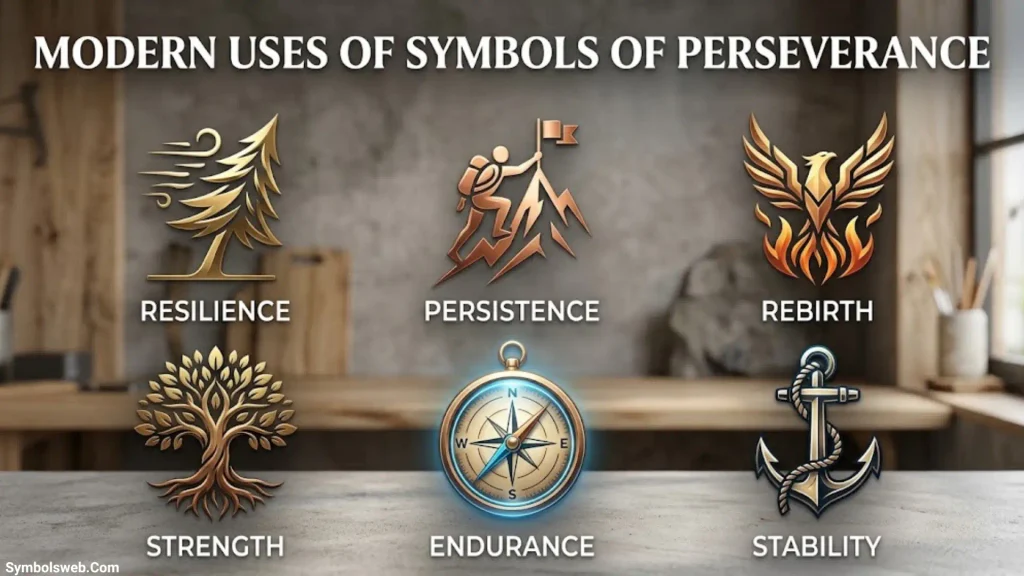
Tattoos
Tattoos are perhaps the most personal modern use of perseverance symbolism.
People commonly choose them after major life transitions, difficult achievements, personal milestones, or periods of transformation.
Jewelry
A small pendant or bracelet can function as a private reminder.
The symbol does not have to be understood by everyone.
Its meaning can belong entirely to the wearer.
Fashion
Symbols of strength and resilience appear on clothing, accessories, prints, patches, and artistic designs.
Their meanings often shift according to trends and personal interpretation.
Branding
Businesses may use mountains, trees, arrows, flames, and rising shapes to communicate strength, progress, endurance, or ambition.
The strongest branding symbols usually remain simple enough to recognize quickly.
Social Media
Modern social media has turned symbolic images into motivational language.
A mountain photograph can represent a difficult goal.
A sunrise can represent a new beginning.
A phoenix can represent rebuilding.
A short quote beside a symbol can become a personal statement of resilience.
Contemporary Spirituality
People often use symbolic objects as reminders during meditation, journaling, prayer, or goal setting.
A Daruma is particularly suited to this because its traditional eye ritual turns an intention into a physical object that remains visible.
Home Décor
A framed mountain, lotus sculpture, tree artwork, or Daruma can transform a room into a reminder of personal values.
The object becomes more than decoration when the owner attaches a story to it.
Interesting Facts About Symbols of Perseverance
- The Daruma is designed to return upright. Its rounded, weighted construction makes physical recovery part of its symbolism.
- Daruma’s traditional goal ritual uses the eyes. One eye is commonly completed when setting an objective and the other when the goal is fulfilled.
- The phoenix has a connection to Egyptian renewal imagery. The Egyptian Benu bird was associated with creation and renewal and was later connected by Greek tradition with the phoenix.
- The lotus has ancient Egyptian as well as South Asian symbolic history. Its meanings include renewal in Egyptian contexts and spiritual awakening in Hindu and Buddhist traditions.
- The turtle has documented associations with perseverance among the Diné. Its shell is associated with perseverance and protection.
- Turtle imagery is connected with creation stories among Indigenous peoples. The Haudenosaunee tradition involving Turtle Island is one well-known example.
- Bodhidharma has been represented extensively in Japanese art. Japanese artworks have portrayed him in meditative and contemplative forms.
- Perseverance does not mean constant effort. Persistence can involve stopping, adapting, restarting, and returning to a goal.
- Grit and resilience are related but different. Grit emphasizes sustained effort toward long-term goals, while resilience emphasizes adaptation and recovery after adversity.
- Personal meaning can make a symbol especially powerful. Historical meaning gives a symbol cultural depth, while personal experience can give it emotional significance.
Frequently Asked Questions
What is the most powerful symbol of perseverance?
There is no single universally recognized symbol of perseverance. The Daruma is one of the clearest symbols of determination and getting back up after setbacks. The phoenix represents renewal, the lotus represents growth through difficult conditions, the turtle represents patience and endurance, and the mountain represents overcoming challenges.
What flower symbolizes perseverance?
The lotus is one of the strongest flowers associated with perseverance, renewal, spiritual growth, and overcoming difficult surroundings. Its symbolism comes partly from its ability to grow in muddy water and bloom above the surface. It has important religious and cultural meanings in ancient Egypt, Hinduism, and Buddhism.
What animal symbolizes perseverance?
The turtle is a strong symbol of perseverance because it represents patience, protection, endurance, and steady progress. Among the Diné, turtle shell symbolism is specifically associated with perseverance and protection.
What symbol represents never giving up?
The Daruma is especially associated with the idea of getting back up after being knocked down. Its self-righting form and Japanese goal-setting tradition make it a powerful symbol of perseverance and determination. The phoenix is another popular symbol because it represents renewal after destruction.
What symbolizes strength and perseverance?
The oak tree, mountain, turtle, Daruma, anchor, bamboo, and phoenix can all symbolize different forms of strength and perseverance. The oak suggests lasting strength, the mountain represents overcoming challenges, bamboo represents flexible resilience, and the Daruma represents commitment to a goal.
What is a spiritual symbol of perseverance?
The lotus is one of the most widely recognized spiritual symbols associated with perseverance, renewal, and awakening. The Daruma also has spiritual roots connected with Bodhidharma and Zen traditions, although its modern meaning includes folk beliefs, good fortune, and goal setting.
Conclusion
Symbols of perseverance remind us that strength is not always about being unbreakable. Sometimes it means bending like bamboo, standing like an oak, moving patiently like a turtle, climbing like a traveler, or rising again like the Daruma. Across cultures and centuries, these images have given people a way to understand struggle, hope, renewal, and courage.
The deeper message behind these symbols is simple: falling does not mean the journey is over. Perseverance means finding the courage to continue, learning from setbacks, and taking another step even when the destination feels far away. Sometimes, the smallest step forward is proof that you are stronger than the obstacle in front of you.

Hi, I’m Ethan Holloway, and I’ve always believed that a few meaningful words can change the way we think, feel, and live. I enjoy collecting timeless quotes, studying their deeper meanings, and sharing inspiring messages that help people stay motivated through every stage of life.
Over the years, I’ve explored thousands of famous sayings from writers, leaders, philosophers, and everyday people. My goal is to make wisdom easy to understand and useful for everyone.
Books by Ethan Holloway
- The Power of Everyday Quotes
- Words That Inspire Greatness
 Jordan Hayes
 Eliana Foster