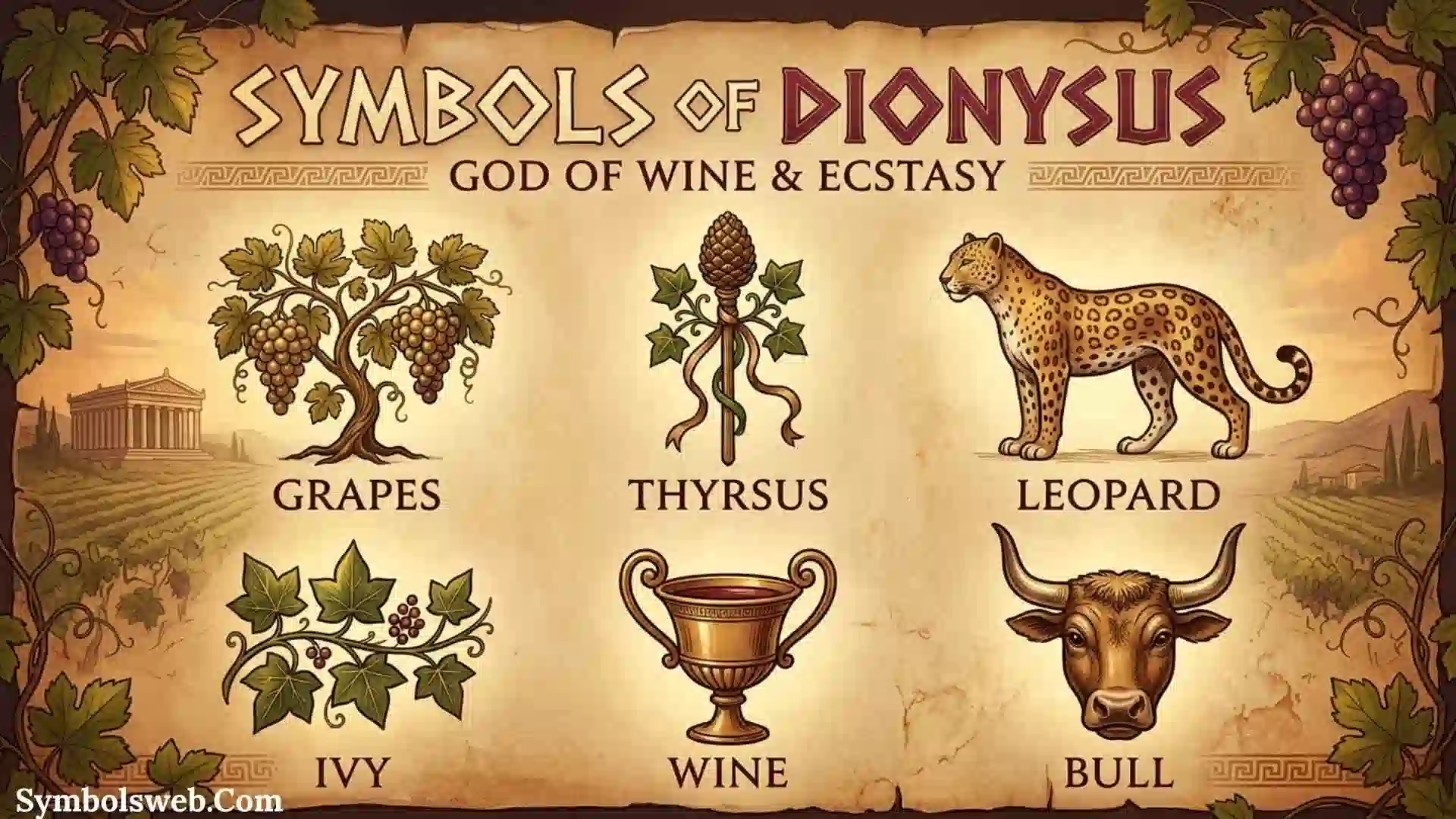
Symbols of Dionysus reveal a fascinating side of ancient Greek culture where wine, nature, freedom, theater, transformation, pleasure, and danger all meet. At first glance, his symbols may look like simple objects, plants, or animals, but each one carries a deeper story.
Dionysus was never simply a god of wine. He represented the power that could make people celebrate, lose their usual restraints, enter altered states, and experience the world differently. His symbols therefore speak to something deeply human: the desire to escape limits while still confronting the consequences of doing so.
From the pinecone-tipped thyrsus to the living grapevine, the evergreen ivy, and the fierce panther, Dionysian imagery reflects both joy and chaos. Understanding these symbols helps explain why Dionysus remained important in Greek religion, art, theater, literature, and later Western culture.
Symbols of Dionysus: (Quick Answer)
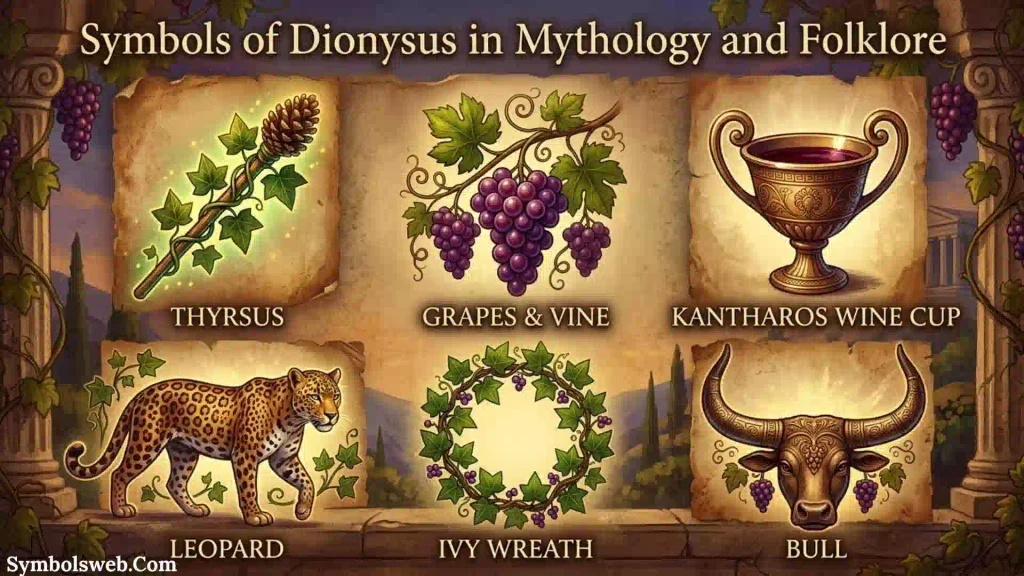
The main symbols of Dionysus are the thyrsus, grapevine, grapes, wine cup, ivy, pine tree, panther or leopard, bull, serpent, theatrical mask, and phallic imagery. They represent themes connected with wine, vegetation, fertility, ecstasy, transformation, theater, rebirth, freedom, nature, and the breaking of ordinary social boundaries.
Also Check This Post: 135+ Elden Ring Symbols: The Complete Guide for Beginners
Quick Facts About the Symbols of Dionysus
| Aspect | Information |
| Origin | Ancient Greek religion and mythology |
| Historical Significance | Connected Dionysus with wine, vegetation, fertility, ritual, theater, and altered states |
| Main Meaning | Transformation, vitality, celebration, freedom, and the power of nature |
| Spiritual Meaning | Modern interpretations often connect Dionysian symbols with inner transformation, liberation, and confronting the hidden self |
| Cultural Importance | Central to Dionysian festivals, Greek art, drama, religious practice, and later Roman Bacchic traditions |
| Modern Usage | Tattoos, jewelry, art, fashion, literature, theater, contemporary spirituality, and symbolic design |
| Most Famous Symbol | The thyrsus, a staff traditionally topped with a pinecone and associated with Dionysus and his followers |
| Sacred Plants | Grapevine, ivy, and pine are strongly associated with Dionysian imagery |
| Sacred Animals | Panther or leopard, bull, serpent, goat, and other animals appear in Dionysian traditions and art |
What Are the Symbols of Dionysus?
The symbols of Dionysus are visual signs and attributes associated with the Greek god Dionysus, also known as Dionysos. They appear in ancient literature, religious practices, vase paintings, sculpture, theater, festivals, and later Roman art.
Dionysus was associated with wine and viticulture, but his sphere was much wider. Ancient evidence connects him with vegetation, fertility, ecstatic experience, theater, transformation, and the tension between civilization and untamed nature. The National Archaeological Museum of Greece describes him as a god connected with vegetation, fertility, wine, ecstatic madness, transformation, death, and rebirth.
His symbolism is powerful because it often contains two sides at once.
Wine can bring friendship and celebration, but excessive drinking can produce disorder.
Nature can provide food and life, but it can also be wild and uncontrollable.
Ecstasy can feel liberating, but it can also remove ordinary restraints.
Theater allows people to become someone else, while also revealing truths about themselves.
This duality is one of the most important ideas for understanding Dionysian symbolism.
Dionysus and the World of Ancient Greece
Dionysus became deeply established in Greek religious life. His worship was connected with festivals, processions, performances, wine, music, dance, and communal celebration.
In Athens, the Sanctuary and Theatre of Dionysus became an important center of worship. The Acropolis Museum notes that the sanctuary was founded after the middle of the sixth century BCE and that the City Dionysia became one of Athens’ major celebrations. Drama developed within this religious and festival environment, including tragedy, comedy, and satyr plays.
This connection explains why theatrical masks became associated with Dionysus. Theater was not simply entertainment in ancient Athens. It was part of a larger cultural and religious world.
Why Dionysus Has So Many Symbols
Dionysus had an unusually broad symbolic identity.
He was connected to:
- Wine and viticulture
- Grapes and vineyards
- Vegetation
- Fertility
- Ecstatic dance
- Music
- Theater
- Masks
- Transformation
- Rebirth
- Wild animals
- Nature
- Social celebration
- Ritual frenzy
- Freedom from ordinary restraints
Because of this wide sphere, there is no single symbol that explains Dionysus completely.
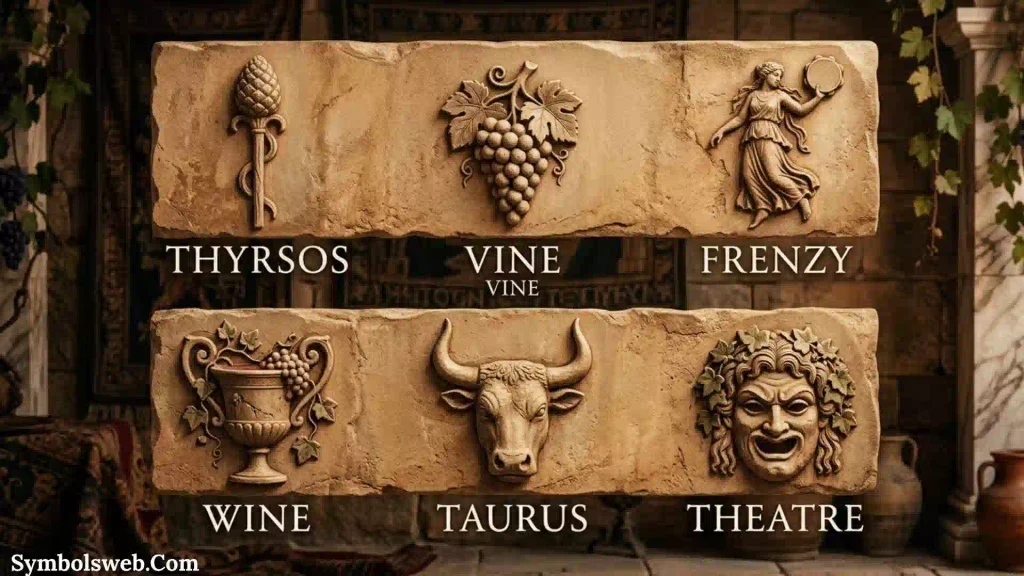
The thyrsus may immediately identify him, but the grapevine explains his relationship with wine and vegetation, while the panther reflects his wild and powerful side. The theatrical mask points toward performance and altered identity.
Together, these symbols create a much fuller picture.
Deep Symbolic Meaning of the Symbols of Dionysus
Spiritual Meaning
Dionysian spirituality is best understood through ancient Greek religious ideas rather than modern assumptions.
Dionysus could represent the movement from an ordinary state of awareness into an extraordinary one. Ritual, music, dance, wine, masks, and communal celebration could all become part of experiences that challenged normal boundaries.
For modern readers, this can be interpreted symbolically as a journey of inner transformation.
The Dionysian message can therefore be imagined as:
You are more complex than the identity you show every day.
This does not mean that ancient Greeks had one universal doctrine saying exactly this. Dionysian worship varied by place and period. Modern spiritual interpretations should therefore be treated as contemporary readings rather than direct statements of ancient belief.
Inner Transformation
One of the strongest themes in Dionysian symbolism is transformation.
The grape becomes wine.
The performer becomes a character.
The ordinary person becomes part of a ritual crowd.
The controlled individual may temporarily enter a state of ecstasy.
The god himself is associated in different traditions with death, return, and renewal.
This makes Dionysian imagery especially attractive to people who think about personal change, identity, creativity, and freedom.
Psychological Meaning
From a psychological perspective, Dionysian symbolism can be read as an image of the parts of human nature that are difficult to control.
People have rational sides, but they also have emotions, instincts, desires, imagination, playfulness, aggression, sexuality, and a need for connection.
Dionysus became a useful cultural image for this tension.
A modern psychological interpretation may therefore see him as an archetypal figure representing the release of suppressed energy and the confrontation with the less controlled parts of the personality.
This interpretation can be compared with Carl Jung’s ideas about archetypes and the shadow, although Jung did not create the ancient Dionysian tradition and should not be treated as its original interpreter.
The important distinction is that Dionysian symbolism is ancient, while many psychological interpretations of it are modern.
Cultural Meaning
At the cultural level, Dionysian symbols helped communities create spaces where ordinary social roles could temporarily change.
Festivals brought people together.
Music encouraged collective participation.
Masks allowed performers to take on different identities.
Wine became part of social and religious practices.
Theater allowed communities to explore violence, love, power, fate, humor, grief, and human weakness.
In this sense, Dionysian symbolism was not only about individual pleasure. It was also about the relationship between individuals and society.
The Most Important Symbols of Dionysus
The Thyrsus
The thyrsus is perhaps the most recognizable physical symbol of Dionysus.
It was a staff or wand usually represented with a pinecone at its top. Ancient descriptions and artistic evidence also show versions decorated with vines, grapes, ivy leaves, or berries. It was carried by Dionysus, Maenads, Bacchants, and other participants in Dionysian rites.
Visual description: A long staff, commonly topped with a pinecone and decorated with foliage.
Symbolic meaning: Ecstasy, fertility, ritual power, nature, transformation, and Dionysian identity.
Cultural connection: Dionysian worship and the followers of the god.
Where it appears: Greek vase paintings, sculpture, literature, Roman art, modern tattoos, jewelry, and contemporary Dionysian imagery.
The thyrsus is particularly interesting because it looks like a harmless natural staff, yet ancient sources connect it with ecstatic religious activity.
It visually combines cultivated and wild nature. A straight staff gives it structure, while the pinecone, leaves, and vines make it part of the living world.
The Pinecone
The pinecone is strongly connected with the thyrsus.
Because the pine tree remains evergreen, the pinecone can be interpreted in modern symbolic language as an image of endurance, regeneration, and continuing life.
However, it is important not to assume that every modern meaning attached to pinecones was an official ancient Greek doctrine.
In Dionysian imagery, its strongest historical connection is through the thyrsus itself.
Grapes
Grapes are one of the clearest symbols of Dionysus.
Dionysus was closely associated with viticulture and wine. Ancient art frequently shows him with vines, grapes, drinking vessels, or people engaged in drinking and celebration.
The transformation of grapes into wine also provides a powerful symbolic image.
Something natural becomes something culturally produced.
The fruit becomes a social and ritual substance.
That transformation mirrors the wider Dionysian theme of crossing boundaries.
The Grapevine
The grapevine represents more than wine.
It connects Dionysus with vegetation, agriculture, fertility, growth, and the seasonal cycles of nature.
The National Archaeological Museum of Greece connects Dionysus with vegetation and reproductive forces of nature and preserves artistic scenes showing vines, satyrs, Pan, and other members of his divine circle.
The vine therefore represents life that grows, spreads, produces fruit, and returns through seasonal cycles.
The Wine Cup
The drinking cup, particularly the kantharos, is another important Dionysian attribute.
Wine was central to Dionysian identity, but wine also had an important social role in ancient Greece.
The symposium was a structured social gathering where wine was diluted with water and shared among participants. The Metropolitan Museum of Art notes that drinking vessels and Dionysian imagery were closely connected in Greek art.
Symbolically, the cup can represent:
- Celebration
- Community
- Pleasure
- Hospitality
- Altered consciousness
- Social bonding
- Loss of restraint
Its meaning therefore depends heavily on context.
Ivy
Ivy is one of the most recognizable plants associated with Dionysus.
Unlike the grapevine, which is seasonal and produces fruit, ivy is evergreen. This made it an especially effective visual companion for a god associated with continuing vitality and nature.
Dionysian figures are frequently shown wearing ivy wreaths.
The ivy wreath also helped visually distinguish Dionysus and his followers in ancient art.
The Panther or Leopard
The panther, often described in modern writing as a leopard, is one of Dionysus’ most striking animal symbols.
It represents the untamed and dangerous side of the god.
Dionysus is not merely the friendly god of a vineyard. His mythology also contains violence, madness, pursuit, transformation, and supernatural power.
A panther fits this side of his character perfectly.
The Archaeological Museum of Thessaloniki describes a Dionysian relief in which a panther appears behind the god and identifies the animal as sacred to Dionysus.
The Bull
The bull is another animal connected with Dionysian symbolism.
It represents physical strength, fertility, virility, and powerful natural energy.
In some Dionysian and later Orphic traditions, the bull could also participate in more complex ideas about divine transformation and sacrifice.
The bull therefore adds another layer to the god’s connection with life, death, and rebirth.
The Serpent
Serpents appear within Dionysian religious imagery and the wider group of beings associated with him.
The snake is naturally suited to symbolic traditions involving transformation because it sheds its skin.
Modern readers often interpret this as a symbol of renewal or rebirth. That can be a useful symbolic reading, although the precise meaning of every ancient serpent image depends on its specific context.
The Goat
Goats appear frequently in the wider Dionysian world, especially through satyrs and other rustic figures.
The goat connects Dionysian culture with mountains, wilderness, sexuality, fertility, rural life, and untamed nature.
It also helps explain why Dionysian imagery often feels very different from the orderly imagery associated with civic or warrior gods.
The Theatrical Mask
The theatrical mask is strongly connected with Dionysus because of his relationship with ancient Greek theater.
The Theater of Dionysus in Athens became one of the most important locations in the history of drama. Major works by Aeschylus, Sophocles, Euripides, Aristophanes, and other dramatists were performed in the Dionysian theatrical tradition.
The mask symbolizes:
- Performance
- Transformation
- Hidden identity
- Emotional expression
- Comedy and tragedy
- The difference between appearance and reality
This is one reason Dionysian symbolism remains relevant to modern theater and performance.
Types and Variations of Dionysian Symbols
| Symbol | Visual Description | Main Meaning | Cultural Connection |
| Thyrsus | Staff with pinecone and foliage | Ecstasy, nature, ritual power | Dionysian worship |
| Grapevine | Vine with leaves and grapes | Growth, wine, fertility | Viticulture |
| Grapes | Clusters of fruit | Abundance and transformation | Wine culture |
| Ivy | Evergreen vine and wreath | Vitality and Dionysian identity | Religious imagery |
| Pinecone | Cone placed on thyrsus | Nature and ritual symbolism | Thyrsus |
| Wine cup | Drinking vessel | Celebration and altered states | Symposium and ritual |
| Panther | Large wild cat | Untamed power | Dionysian mythology |
| Bull | Powerful horned animal | Strength and fertility | Dionysian religious imagery |
| Serpent | Coiled or moving snake | Transformation and mystery | Dionysian and mystery traditions |
| Mask | Theater face | Identity and transformation | Greek theater |
| Phallic imagery | Fertility symbol | Reproduction and generative power | Rural festivals and fertility traditions |
Symbols of Dionysus Across Different Cultures
Dionysus originated within the Greek religious world, but his identity and symbols traveled widely.
It is important, however, to avoid a common mistake: not every culture that had a wine, fertility, vegetation, serpent, or animal symbol was worshipping Dionysus. Similar symbols can arise independently.
Ancient Greece
Ancient Greece is the primary cultural setting for Dionysian symbolism.
Here, Dionysus was connected with wine, vegetation, fertility, ecstatic ritual, theater, and festivals.
The City Dionysia in Athens became especially important. The religious festival created a setting in which drama developed into one of the defining artistic achievements of ancient Greece.
Roman Culture
The Romans adopted and transformed many Greek religious traditions.
Dionysus became closely associated with Bacchus, while Roman religious culture also connected him with Liber Pater.
Roman art frequently continued Greek Dionysian imagery, including vines, drinking vessels, satyrs, maenads, panthers, theatrical masks, and ecstatic scenes.
The result was not simply a direct copy of Greek religion. Roman artists and worshippers adapted Dionysian themes to their own cultural environment.
Ancient Egypt
Dionysian symbolism also entered the religious and artistic world of the Hellenistic and Roman Mediterranean.
However, it would be inaccurate to say that ancient Egyptians originally had Dionysus as one of their traditional gods.
In later periods, Greek and Egyptian religious traditions sometimes identified or associated gods across cultures. The Metropolitan Museum of Art, for example, notes Roman-period Egyptian material in which Dionysus was equated with Osiris, particularly around themes of death, rebirth, and theater.
This is better understood as religious syncretism rather than proof that Dionysian symbols originated in ancient Egyptian religion.
Eastern Traditions
There is no single “Eastern Dionysian tradition” that can accurately be treated as an equivalent of ancient Greek Dionysian worship.
Greek influence traveled eastward after the conquests of Alexander the Great, and Dionysian imagery appeared in the wider Hellenistic world. In these settings, Dionysian ideas could interact with local artistic and religious traditions.
Nevertheless, similarities between Dionysus and figures from Indian, Buddhist, Persian, or other traditions should not automatically be treated as evidence that they were the same deity.
Shared themes such as wine, fertility, ecstatic experience, vegetation, and rebirth can appear independently in different cultures.
Indigenous Traditions
Dionysian symbols should also not be automatically assigned to Indigenous traditions around the world.
Many Indigenous cultures have their own powerful traditions involving plants, animals, altered states, fertility, masks, dance, and spiritual transformation. Those traditions deserve to be understood on their own terms.
A panther, snake, vine, or mask in an Indigenous culture does not become a “symbol of Dionysus” simply because a similar image appears in Greek mythology.
This distinction is important for historically responsible cultural writing.
Modern Interpretations
Today, Dionysian symbols are often separated from their ancient religious setting.
A person may use the thyrsus to represent freedom, a grapevine to represent growth, a panther to represent wildness, or a theatrical mask to represent transformation.
These meanings can be personally meaningful, but they should be described as modern interpretations rather than universal ancient definitions.
Also Check This Post: 133+ Pagan Symbols and Meanings: Complete Beginner’s Guide
Similar Symbols and Their Meanings
Dionysian symbols are often confused with symbols belonging to other gods and traditions.
| Symbol | Dionysian Connection | Similar Association | Important Difference |
| Grapevine | Wine and vegetation | Agriculture and fertility gods | Dionysus has an especially strong wine connection |
| Ivy | Dionysian identity | Evergreen plants in other traditions | Its association with Dionysus is especially strong in Greek art |
| Panther | Wild power | Other hunting or wilderness gods | It is a distinctive Dionysian animal attribute |
| Bull | Fertility and strength | Zeus and other gods | Dionysian bull symbolism has its own ritual contexts |
| Serpent | Mystery and transformation | Many Mediterranean religions | Meaning changes greatly by tradition |
| Mask | Theater and transformation | General theater symbolism | Greek theater was deeply connected with Dionysian festivals |
| Pinecone | Thyrsus | General fertility imagery in later interpretations | Its clearest Dionysian connection is through the thyrsus |
Dionysus and Apollo
Dionysus and Apollo are sometimes presented as complete opposites.
Apollo is often associated with order, prophecy, music, harmony, and measured form.
Dionysus is associated with ecstasy, transformation, wine, theater, and the breaking of ordinary boundaries.
The contrast is useful, but it should not be exaggerated.
Ancient Greek religion did not always treat the two gods as enemies. In Delphi, traditions could associate Dionysus with Apollo in complex ways.
The relationship suggests that Greek culture could imagine both order and ecstasy as necessary parts of human experience.
Symbols of Dionysus in Mythology and Folklore
Dionysian mythology is filled with stories about transformation.
The Birth of Dionysus
One famous tradition describes Dionysus as the son of Zeus and Semele.
Semele’s tragic death leads to Zeus carrying the unborn Dionysus until his birth. This contributes to the later idea of Dionysus as a god associated with unusual or repeated birth.
His unusual birth story fits his broader symbolism.
Dionysus repeatedly crosses boundaries that other beings cannot easily cross.
He moves between human and divine worlds.
He connects civilization with wilderness.
He turns grapes into wine.
He appears through theater and masks.
He is associated with death and return.
Dionysus and Ariadne
The story of Dionysus and Ariadne became especially important in later art and literature.
After Ariadne is abandoned by Theseus on Naxos, Dionysus encounters her and becomes her husband in later mythological traditions.
Their story gives Dionysian mythology another emotional theme: transformation after abandonment.
A woman left behind becomes the companion of a god.
A painful ending becomes the beginning of a new life.
This is one reason Dionysus and Ariadne became a popular subject for later European painters.
Dionysus and the Vine
Another important tradition connects Dionysus with the spread of viticulture.
Ancient Greek stories described Dionysus as teaching people about vines and wine. The National Archaeological Museum connects him with the myth of Ikarios, whom Dionysus taught about viticulture and wine production.
The story reflects something larger than drinking.
Wine represented agricultural knowledge, trade, hospitality, social ritual, celebration, and danger.
Dionysus and the Maenads
The Maenads were female followers of Dionysus who appear in mythology and art as participants in ecstatic worship.
They are often depicted with flowing hair, animal skins, thyrsi, musical instruments, and energetic movements.
Their presence represents the temporary collapse of ordinary social restraint.
But the myths also show the danger of uncontrolled frenzy.
This duality is central to Dionysian mythology.
Symbols of Dionysus in Art, Literature, Movies, and Pop Culture
Dionysus in Ancient Art
Dionysian imagery appears extensively on ancient Greek pottery.
Vases show Dionysus with satyrs, maenads, vines, drinking vessels, and other attributes.
The Metropolitan Museum of Art holds Greek vessels featuring Dionysian imagery, including masks of Dionysus and scenes involving satyrs and maenads.
These images show that Dionysian symbolism was not confined to temples.
It became part of everyday visual culture.
Dionysus in Theater
The connection between Dionysus and theater is one of his most lasting cultural legacies.
Ancient Greek tragedy and comedy developed within festivals connected with Dionysus.
The Theater of Dionysus in Athens became a foundational site in world theater history.
The theatrical mask therefore carries a powerful Dionysian meaning even today.
Dionysus in Literature
Dionysus appears in ancient Greek poetry and drama, including Euripides’ The Bacchae.
In that play, Dionysus becomes a frightening figure who challenges the refusal of King Pentheus to recognize the god.
The story shows the dangerous side of denying forces that cannot simply be controlled by reason and political authority.
Dionysus in Later European Art
Renaissance, Baroque, and later European artists repeatedly returned to Bacchus and Dionysian themes.
Artists used wine, grapes, crowns, animals, dancing figures, and theatrical scenes to explore pleasure, beauty, sensuality, excess, and transformation.
The image of Bacchus often became more focused on pleasure than the complex religious identity of ancient Dionysus.
Dionysus in Movies and Popular Culture
Modern films and television often use Dionysian imagery without directly naming the god.
A wild party, a mysterious masked figure, a vineyard, a theatrical transformation, or a character who represents uncontrolled freedom can all evoke Dionysian ideas.
Modern pop culture also uses the name Dionysus directly in stories about mythology, fantasy, gods, demigods, and supernatural worlds.
Dionysus in Tattoos
Dionysian tattoos commonly use:
- Thyrsi
- Grapes
- Grapevines
- Ivy leaves
- Panthers
- Theater masks
- Wine cups
- Greek lettering
- Dionysus portraits
- Satyrs
- Maenads
The meaning depends on the person.
A thyrsus tattoo might represent freedom.
A grapevine might represent growth.
A panther might represent wildness.
A mask might symbolize transformation or the different identities a person carries.
Spiritual and Dream Meaning of the Symbols of Dionysus
Dream interpretations are not fixed ancient rules.
There is no reliable historical evidence showing that every dream containing grapes, panthers, ivy, or wine had one universal Dionysian meaning.
However, people today may use Dionysian symbolism as a framework for personal reflection.
Dreaming of Grapes
Modern symbolic interpretation may associate grapes with:
- Abundance
- Growth
- Pleasure
- Harvest
- Transformation
- Reward after effort
If the grapes are rotten or damaged, a person might personally associate them with lost opportunities or excess.
These are interpretive possibilities, not universal psychological facts.
Dreaming of a Panther
A panther may personally symbolize:
- Courage
- Instinct
- Hidden strength
- Independence
- Wildness
- A powerful emotion
For someone studying Dionysus, the image may also evoke the god’s untamed side.
Dreaming of a Mask
A mask can naturally evoke questions about identity.
Who are you showing to other people?
What part of yourself do you hide?
Are you performing a role that no longer fits?
These questions make the theatrical mask one of the most psychologically interesting Dionysian symbols.
Spiritual Encounters and Meditation
Some modern practitioners use Dionysian imagery during meditation or spiritual reflection.
A person may visualize the thyrsus, grapevine, ivy, or panther while thinking about creativity, freedom, emotional release, or transformation.
Such practices belong to modern spirituality unless there is specific historical evidence connecting them to an ancient ritual.
Positive and Negative Meanings of the Symbols of Dionysus
Dionysian symbols are powerful partly because they can represent both positive and negative forces.
| Positive Meaning | Negative Meaning |
| Freedom | Loss of control |
| Celebration | Excess |
| Creativity | Chaos |
| Transformation | Instability |
| Pleasure | Addiction or overindulgence |
| Community | Mob mentality |
| Emotional release | Emotional overwhelm |
| Nature | Untamed danger |
| Self-expression | Recklessness |
| Spiritual ecstasy | Destructive frenzy |
| Renewal | Death and loss |
| Breaking limitations | Breaking necessary boundaries |
This dual meaning is essential.
Dionysus is not simply a symbol of “having fun.”
His mythology repeatedly asks what happens when human beings move beyond ordinary limits.
Sometimes the result is liberation.
Sometimes the result is destruction.
Why Humans Are Attracted to the Symbols of Dionysus
There is something deeply relatable about Dionysian symbolism.
Modern life often demands control.
People manage their schedules, careers, identities, emotions, social behavior, and public image.
Dionysian imagery represents the opposite impulse.
Dance.
Music.
Nature.
Celebration.
Emotion.
Creativity.
Transformation.
The desire to step outside the normal role.
This does not mean people literally want chaos. Often, the attraction is to the possibility of feeling fully alive.
The Psychology of the Mask
The mask is especially powerful because everyone has social roles.
A person can be a parent at home, a professional at work, a friend in a social setting, and a completely different person when alone.
The Dionysian mask asks an uncomfortable question:
Which version of you is the real one?
Perhaps the answer is that all of them are real.
The Psychology of the Wild Animal
The panther offers another powerful image.
Humans often admire animals that appear independent, strong, and difficult to control.
The panther therefore works well as a modern symbol of instinct and personal power.
Within Dionysian imagery, it also reminds us that nature is not always gentle.
Cultural Memory
Symbols survive because they can communicate ideas faster than words.
A grapevine immediately suggests wine and agriculture.
A theatrical mask suggests performance.
A panther suggests wildness.
A thyrsus suggests Dionysus to someone familiar with Greek mythology.
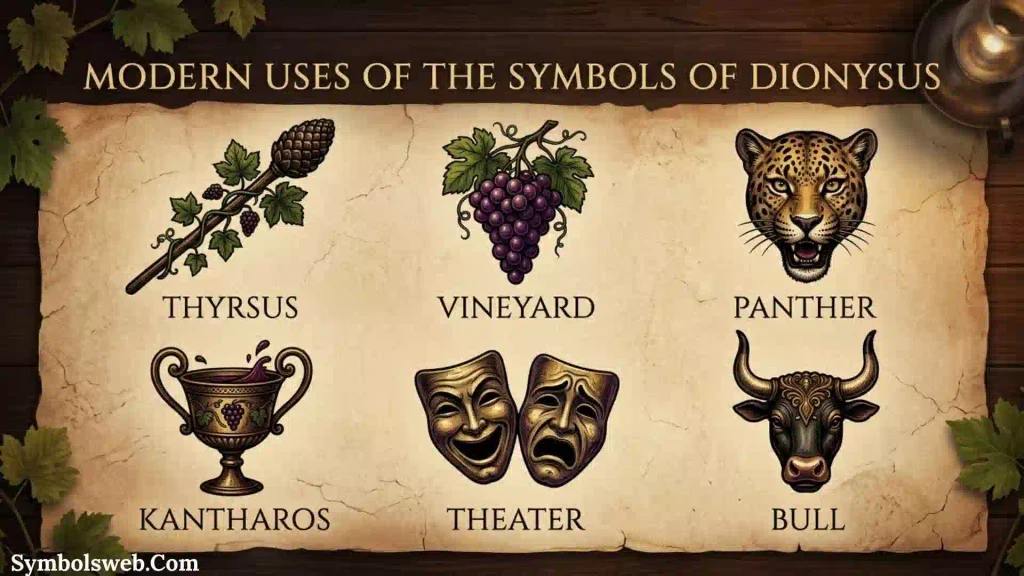
This is why ancient symbols continue to appear in tattoos, artwork, literature, fashion, and design thousands of years after their original religious context.
Modern Uses of the Symbols of Dionysus
Tattoos
Dionysian tattoos are often chosen by people interested in Greek mythology, personal transformation, freedom, creativity, or the balance between order and instinct.
The thyrsus is especially suitable for a mythology-focused tattoo because it is strongly associated with Dionysus.
Jewelry
Ivy leaves, grape clusters, Greek-inspired pendants, panthers, and thyrsi can all be used in jewelry.
Modern jewelry often removes the original religious context and turns the symbol into a personal statement.
Fashion
Dionysian themes can appear through:
- Ivy patterns
- Vine designs
- Leopard or panther imagery
- Greek-inspired motifs
- Laurel and foliage
- Theater masks
- Wine imagery
Branding
Wine companies, restaurants, vineyards, theaters, and entertainment brands may use Dionysian ideas because they naturally connect with celebration, creativity, luxury, and performance.
However, using Dionysian imagery in branding does not necessarily mean the company follows or promotes ancient Dionysian religion.
Social Media
Dionysian symbols are also used online as aesthetic imagery.
People may post Greek statues, vines, wine, theater masks, or panthers to communicate a mood of mystery, freedom, sensuality, creativity, or mythology.
Contemporary Spirituality
Some modern spiritual communities engage with Dionysus as a deity or archetypal figure.
Interpretations vary widely.
Some focus on ancient reconstruction.
Others focus on personal liberation, creativity, nature, ecstatic experience, or psychological symbolism.
These modern approaches should be distinguished from the diverse religious practices of ancient Greece.
Home Decor
Dionysian imagery can appear in:
- Greek-style statues
- Wine-themed artwork
- Vine decorations
- Ivy motifs
- Classical paintings
- Theater masks
- Mythological wall art
The result often combines classical beauty with the symbolic themes of celebration and transformation.
Interesting Facts About the Symbols of Dionysus
- The thyrsus is one of Dionysus’ most distinctive attributes. It was normally represented as a staff topped with a pinecone and sometimes decorated with vines or ivy.
- Dionysus was connected with theater as well as wine. The major Athenian theater festival dedicated to him played an important role in the development of Greek drama.
- The panther was a sacred animal of Dionysus. Ancient art frequently depicts the god riding or accompanied by wild animals.
- Ivy was closely associated with Dionysus. Ancient representations commonly show the god wearing an ivy wreath.
- Dionysian imagery was popular on drinking vessels. Greek pottery frequently used Dionysus, satyrs, and maenads as decorative subjects.
- Dionysus was connected with vegetation and fertility. His symbolism extended far beyond wine to the productive forces of nature.
- Dionysian religion spread beyond mainland Greece. Worship was especially important in regions where grape cultivation and wine production were significant.
- Roman culture transformed Greek Dionysian traditions. The god became associated with Bacchus and interacted with Roman religious ideas.
- Dionysian symbolism often contains opposites. Joy can exist beside fear, freedom beside danger, and transformation beside destruction. The Archaeological Museum of Thessaloniki specifically describes Dionysus through this duality of joy, fear, panic, and chaos.
- Theater remains one of Dionysus’ greatest cultural legacies. The ancient Theater of Dionysus helped establish a tradition that continues to influence drama today.
Frequently Asked Questions
What is the most important symbol of Dionysus?
The thyrsus is generally considered Dionysus’ most distinctive symbol. It is a staff usually shown with a pinecone at the top and foliage around it. It is associated with Dionysus, his followers, ritual activity, nature, and ecstatic worship.
What does the thyrsus symbolize?
The thyrsus represents Dionysian power and is associated with nature, ecstasy, fertility, celebration, and ritual. Its pinecone and plant decorations also make it a strong visual connection between Dionysus and the natural world.
What animal represents Dionysus?
The panther or leopard is one of the best-known animals associated with Dionysus. Other animals connected with Dionysian imagery include the bull, serpent, goat, and various creatures appearing in his mythological entourage.
What plant represents Dionysus?
The grapevine and ivy are among the most important plants associated with Dionysus. Grapevines connect him with wine, agriculture, vegetation, and fertility, while ivy is commonly shown as a wreath worn by Dionysus and his followers.
Why is the mask a symbol of Dionysus?
Dionysus was strongly connected with ancient Greek theater. Festivals honoring him provided an important setting for dramatic competitions, and the Theater of Dionysus in Athens became a foundational site in the history of drama. The mask therefore represents performance, transformation, identity, comedy, and tragedy.
What does Dionysus symbolize spiritually?
In ancient Greek religion, Dionysus was associated with wine, vegetation, fertility, ecstasy, transformation, and theater. In modern spiritual interpretation, his symbolism may represent freedom, emotional release, creativity, transformation, and the integration of hidden aspects of the self. These modern meanings should not be confused with one universal ancient doctrine.
Conclusion
The symbols of Dionysus tell a story much larger than wine and celebration. The thyrsus, grapevine, ivy, panther, bull, serpent, wine cup, and theatrical mask reveal a god associated with nature, transformation, ecstasy, creativity, fertility, and the dangerous power of crossing boundaries.
Perhaps that is why Dionysian imagery has survived for so long. It speaks to a part of human nature that wants to feel free, creative, alive, and connected to something larger than everyday routine.
Also Check This Post: 119+ Symbols That Represent Love: and Their Hidden Meanings

Hi, I’m Ethan Holloway, and I’ve always believed that a few meaningful words can change the way we think, feel, and live. I enjoy collecting timeless quotes, studying their deeper meanings, and sharing inspiring messages that help people stay motivated through every stage of life.
Over the years, I’ve explored thousands of famous sayings from writers, leaders, philosophers, and everyday people. My goal is to make wisdom easy to understand and useful for everyone.
Books by Ethan Holloway
- The Power of Everyday Quotes
- Words That Inspire Greatness
 Jordan Hayes
 Eliana Foster