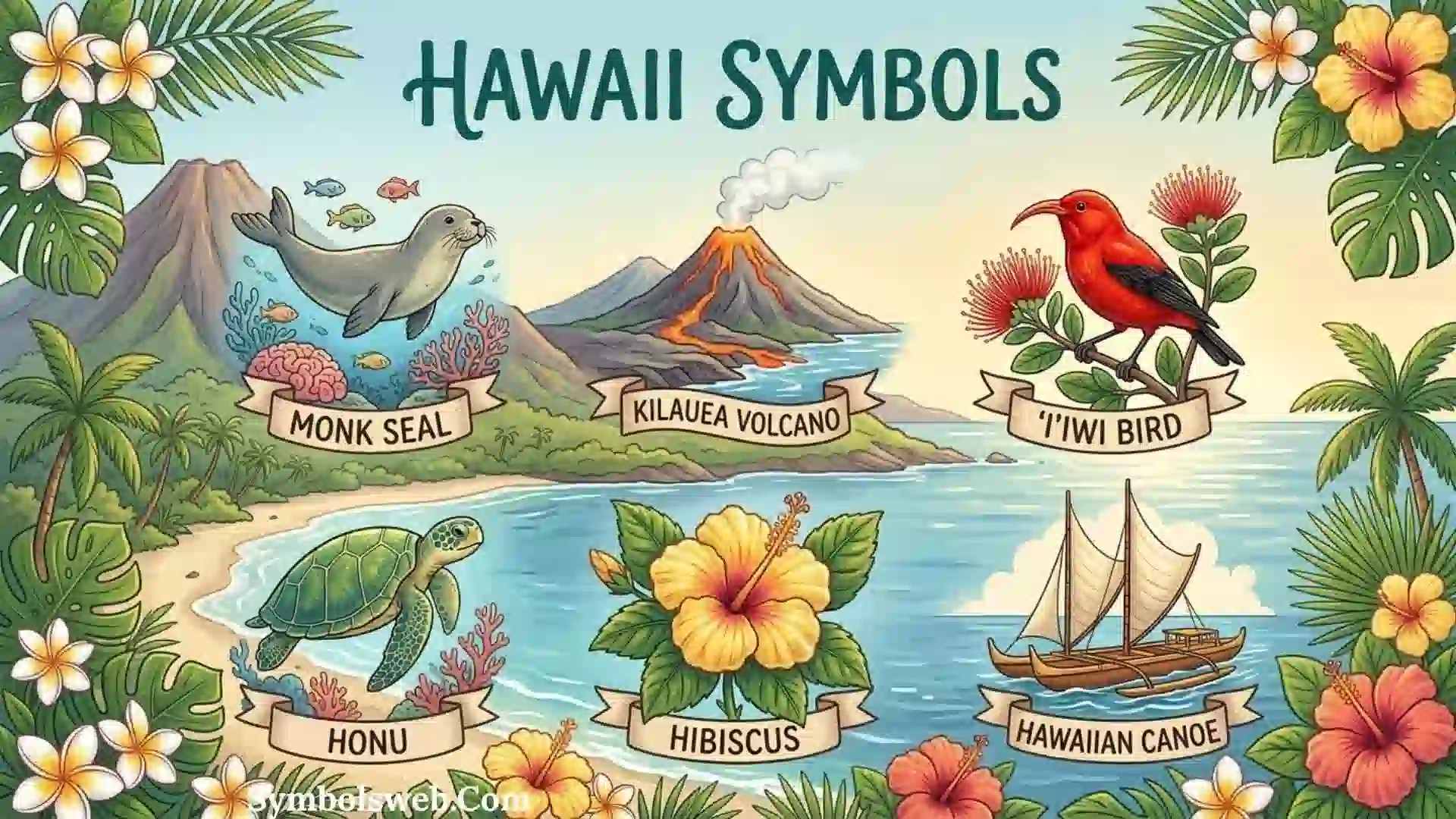
Hawaii symbols are more than beautiful flowers, ocean waves, traditional dances, and colorful designs. Each one carries a story about the islands, the people who have called them home, and the deep relationship between culture and nature. From the Hawaiian flag and state seal to the kukui tree, nēnē, kalo, hula, and shaka, these symbols reveal ideas of identity, aloha, history, family, and connection to the land.
What makes Hawaii symbols truly fascinating is that their meanings often go deeper than what we see on the surface. Some preserve ancient traditions, some reflect the history of the Hawaiian Kingdom, and others have become modern expressions of friendship and pride. As we explore these symbols, you will discover how a simple flower, plant, animal, gesture, or piece of art can hold generations of memory and meaning.
As you explore these symbols with me, you will discover the stories and traditions that make each one special. I will take you through their meanings and show you how they connect to Hawaiian culture, history, and everyday life. By the end, you will have a better understanding of why these symbols continue to be an important part of Hawaii today.
Hawaii Symbols: (Quick Answer)
Hawaii symbols are official emblems and culturally important icons that represent the Hawaiian Islands, their people, history, natural environment, and values. They include the Hawaiian flag, state seal, yellow hibiscus, kukui tree, nēnē, humuhumunukunukuāpuaʻa, kalo, hula, surfing, ukulele, shaka, and many others. Some are legally designated state symbols, while others are widely recognized cultural symbols.
Quick Facts About Hawaii Symbols
| Aspect | Information |
| Origin | Hawaiian and wider Polynesian traditions, Hawaiian Kingdom history, and modern state law |
| Historical Significance | Symbols preserve connections to the Hawaiian Kingdom, Native Hawaiian culture, land, ocean, and statehood |
| Main Meaning | Identity, aloha, connection, resilience, nature, community, and place |
| Spiritual Meaning | Guidance, ancestry, regeneration, protection, balance, and relationship with the natural world |
| Cultural Importance | Symbols appear in language, hula, mele, lei, art, ceremonies, architecture, clothing, and public life |
| Modern Usage | Government, education, tourism, jewelry, tattoos, fashion, branding, celebrations, and personal expression |
What Are Hawaii Symbols?
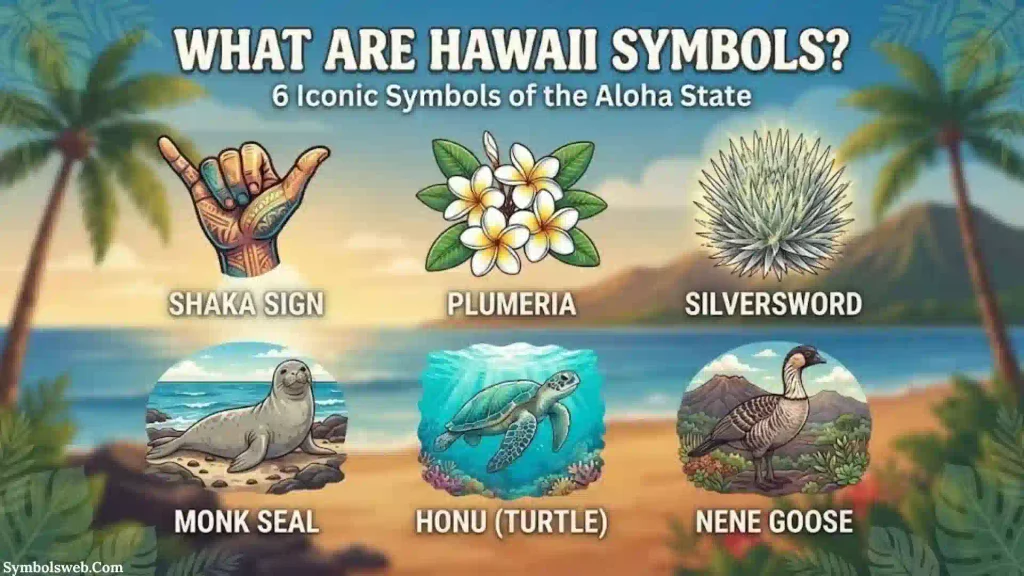
Hawaii symbols are a broad collection of official state emblems and culturally meaningful images associated with the Hawaiian Islands.
This distinction matters.
Not everything commonly called a “Hawaii symbol” is an official state symbol. Some symbols are established by Hawaii law, such as the state flower, bird, tree, fish, flag, seal, plant, sports, musical instruments, and dance. Others became powerful cultural symbols through generations of Hawaiian history and everyday life.
Hawaii’s official symbols are organized in Chapter 5 of the Hawaii Revised Statutes, which covers emblems and symbols. The list includes the state seal, languages, tree, motto, song, musical instruments, insect, fish, marine and land mammals, sports, gem, plant, flowers, island colors, bird, flag, dance, and the shaka gesture.
The state also continues to add symbols. In 2024, Hawaii officially recognized native snail species as state and island snails, reflecting the growing importance of conservation and native biodiversity.
Hawaii Symbols and the Idea of Identity
A symbol works because it turns a complicated idea into something people can see, hear, touch, or remember.
A flag can represent political history. A flower can represent a landscape. A tree can represent knowledge. A dance can preserve stories that were once passed through generations orally.
In Hawaii, this connection between symbol and identity is especially strong because the natural environment and human culture are deeply connected.
A Brief Historical Background
Hawaiian society developed over centuries through Polynesian navigation, settlement, agriculture, fishing, oral traditions, religion, arts, and relationships between people and place.
Later, the Hawaiian Kingdom developed its own diplomatic identity. The Hawaiian flag, for example, emerged in the early 19th century and reflected Hawaii’s historical relationship with Great Britain. The flag later remained an important symbol through the Hawaiian Kingdom, the Republic of Hawaii, the Territory of Hawaii, and statehood.
Hawaii became the 50th U.S. state in 1959. That history is directly represented in the state seal, which includes the year 1959 and a star representing Hawaii as the 50th star.
The Most Important Hawaii Symbols and Their Meanings
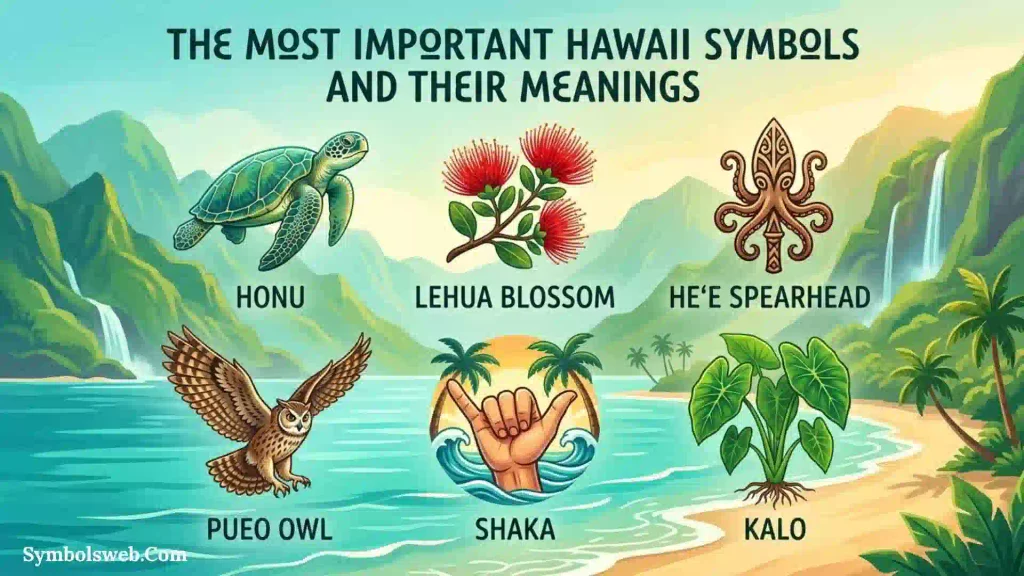
Hawaii has many official and cultural symbols. The following are among the most recognizable and meaningful.
Hawaiian Flag
The Hawaiian flag, known as Ka Hae Hawaiʻi, has eight horizontal stripes of white, red, and blue, with the Union Jack in the upper corner.
The eight stripes are commonly associated with the eight main Hawaiian islands. The Union Jack reflects Hawaii’s historic relationship with Great Britain and the diplomacy of King Kamehameha I. Hawaii law defines the flag’s design and proportions.
The flag therefore carries several layers of meaning at once:
- Hawaiian identity
- Political history
- International diplomacy
- The unity of the islands
- Continuity through political change
The Hawaiian flag is not simply a decorative tropical image. For many people, it represents history, sovereignty, identity, and belonging.
State Seal of Hawaii
The Hawaii State Seal is one of the richest symbolic designs in the state.
It includes Kamehameha I, the goddess of liberty, a rising sun, a star, the Hawaiian flag, a kapu ball and staff, a phoenix, taro leaves, banana foliage, and maidenhair ferns.
The rising sun represents the birth of a new state. The central star represents Hawaii as the 50th state. Eight stripes and eight taro leaves connect the design to the eight main islands. The phoenix represents death and resurrection, symbolizing the transition from monarchy to a democratic government.
At the bottom appears Hawaii’s state motto:
“Ua Mau ke Ea o ka ʻĀina i ka Pono.”
It is commonly translated as:
“The life of the land is perpetuated in righteousness.”
The phrase is attributed to Kamehameha III and has deep historical importance in Hawaiian political identity.
Yellow Hibiscus
Hawaii’s official state flower is the native yellow hibiscus, known as pua aloalo or maʻo hau hele, scientifically identified as Hibiscus brackenridgei.
Its bright yellow color naturally connects it with warmth, sunlight, beauty, and the tropical landscape.
Unlike the many flowers associated with Hawaii in tourism, the official state flower is specifically a native Hawaiian species. That distinction is important because it reflects Hawaii’s native ecological heritage rather than simply its popular vacation image.
Kukui Tree
The kukui, or candlenut tree, is Hawaii’s state tree.
The kukui became important because its nuts could be burned to provide light. Different parts of the tree were also used historically for food, medicine, dyes, tools, fishing, and other practical purposes.
This gives the kukui a particularly powerful symbolic meaning.
It represents:
- Light
- Knowledge
- Guidance
- Enlightenment
- Protection
- Practical wisdom
The idea of light is especially meaningful psychologically. When people think about light, they often associate it with understanding, hope, safety, and finding a way forward.
Nēnē
The nēnē, or Hawaiian goose, is Hawaii’s state bird.
It is an endemic Hawaiian species and one of the clearest examples of how Hawaii’s official symbols can also highlight conservation.
The nēnē represents the uniqueness of Hawaii’s wildlife and the importance of protecting species found nowhere else in the world.
Its status as a state symbol also reminds us that a symbol can carry responsibility. Celebrating an animal is not enough. Protecting its habitat matters too.
Humuhumunukunukuāpuaʻa
Hawaii’s state fish is the humuhumunukunukuāpuaʻa, scientifically known as Rhinecanthus rectangulus.
Its extraordinary Hawaiian name is one of the most memorable Hawaii symbols for visitors. The name is commonly explained as referring to a triggerfish with a pig-like snout.
The fish represents Hawaii’s relationship with the Pacific Ocean and the remarkable marine life surrounding the islands. Hawaii’s legislature permanently established it as the official state fish after a period when its status had been uncertain.
Kalo
Kalo, or taro, is Hawaii’s official state plant.
Its importance reaches far beyond agriculture.
Kalo is deeply connected with Hawaiian cultural identity, food, farming, family, and ideas of regeneration. Hawaiian legislative materials describe kalo as expressing the interdependence of the past, present, and future.
The plant also appears on the state seal.
This makes kalo a powerful symbol of continuity. A plant grows from the land, feeds people, produces new growth, and connects generations.
Hula
Hula is Hawaii’s official state dance.
But describing hula simply as a dance misses much of its cultural depth.
Hula can communicate history, place, genealogy, emotion, nature, and stories through movement, chant, music, and expression.
In this sense, hula can function almost like a living library. Instead of placing every story in a book, knowledge can be carried through bodies, voices, rhythms, and generations.
Surfing
Surfing is Hawaii’s official individual sport.
Its cultural importance is easy to understand when you consider Hawaii’s geography. The ocean is not merely scenery. It has historically been a source of food, travel, recreation, spiritual meaning, and community life.
Surfing therefore represents the relationship between people and the Pacific Ocean. Hawaii law recognizes surfing as the official individual sport.
Outrigger Canoe Paddling
Outrigger canoe paddling is Hawaii’s official team sport.
Its symbolism is especially powerful because canoe voyaging is closely connected with Polynesian exploration and navigation.
As a team sport, paddling also emphasizes cooperation. One person cannot move the canoe effectively alone. Every paddler contributes to a shared direction.
That makes the canoe a natural symbol of:
- Teamwork
- Community
- Navigation
- Perseverance
- Shared responsibility
Ukulele and Pahu
Hawaii officially recognizes two musical instruments in different cultural contexts.
The ukulele is the official ʻauana musical instrument, while the pahu is the official kahiko musical instrument.
The distinction matters because Hawaiian music includes both modern and traditional forms.
The ukulele became internationally associated with Hawaiian music, while the pahu has deeper roots in traditional Hawaiian performance and ceremony.
Hawaiian Language
Hawaiian and English are the official languages of Hawaii under the state’s constitutional framework.
The Hawaiian language, ʻŌlelo Hawaiʻi, is more than a communication system. It carries names, concepts, histories, place relationships, chants, songs, and cultural knowledge.
That is why preserving Hawaiian words is also a way of preserving cultural memory.
Shaka
The shaka is one of the most recognizable modern symbols of Hawaii.
The gesture is made by extending the thumb and little finger while curling the three middle fingers.
In 2024, Hawaii enacted legislation officially recognizing the shaka as the state’s official gesture. The law describes its positive associations with sharing aloha, fostering connection, and being pono.
The shaka can communicate friendliness, gratitude, encouragement, greeting, approval, or a relaxed spirit depending on context.
It is a remarkable example of a simple physical gesture becoming a global cultural symbol.
Hawaii Symbols And Meanings
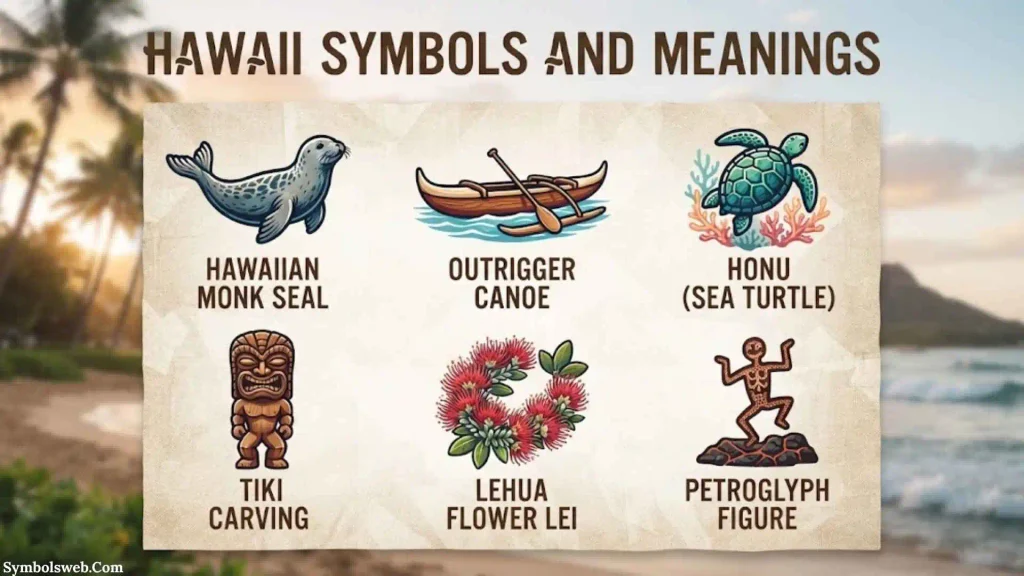
Hawaiian symbols can help you explore the islands’ connection with nature, family, love, ancestry, and culture. If you are looking for a Hawaiian symbol for a tattoo, artwork, gift, or personal meaning, understanding the story behind each symbol can help you choose one that truly connects with you.
When I explore Hawaiian symbols, I find that many of them are inspired by the ocean, plants, animals, family, and the natural environment. You can choose a symbol based on the meaning that best reflects your own story, relationship, or values.
Hawaii Symbols And Meanings
Hawaiian symbols often represent ideas such as family, protection, love, strength, nature, guidance, and connection. Many are inspired by plants, animals, flowers, and traditional cultural practices.
If you want to understand the meaning behind a Hawaiian symbol, you should look at its cultural context rather than its appearance alone. Some commonly recognized symbols include the honu, kukui, maile, kalo, hibiscus, and lei.
When I look at these symbols, I see how closely Hawaiian traditions are connected with the natural world. You can choose a symbol that reflects what matters most to you, whether that is family, love, protection, or connection to Hawaii.
Hawaiian Symbols For Family
Family is an important part of Hawaiian culture, and the concept of ʻohana is widely associated with family, belonging, and togetherness. If you want a Hawaiian symbol that represents your family, you can explore imagery connected with relationships, protection, ancestry, and community.
Some commonly associated symbols include:
- ʻOhana — family, belonging, and togetherness.
- Honu — sea turtle, often associated with protection, longevity, and connection.
- Kukui — commonly associated with light, guidance, and knowledge.
- Maile — associated with affection, respect, connection, and relationships.
- Lei — can express love, friendship, respect, welcome, and celebration.
If you are choosing a family symbol, I recommend thinking about the quality you want it to represent. You might choose the honu for protection or the concept of ʻohana when you want the meaning to focus directly on family.
Hawaiian Symbols For Love
Hawaiian symbolism offers many natural images that you can associate with love, affection, beauty, and lasting connections. Flowers, lei, and ocean-related imagery are especially common choices.
Some Hawaiian symbols associated with love include:
- Hibiscus — beauty, affection, and the temporary nature of life.
- Pikake — love, affection, and beauty.
- Maile — affection, respect, friendship, and connection.
- Plumeria — beauty, welcome, affection, and celebration.
- Lei — love, friendship, respect, and meaningful connection.
- Honu — protection, endurance, and longevity.
If you want to choose a Hawaiian love symbol for someone special, I would focus on the meaning you want to express. You can choose a flower for beauty and affection or a honu when you want to represent a lasting connection.
Hawaiian Symbols And Meanings For Females
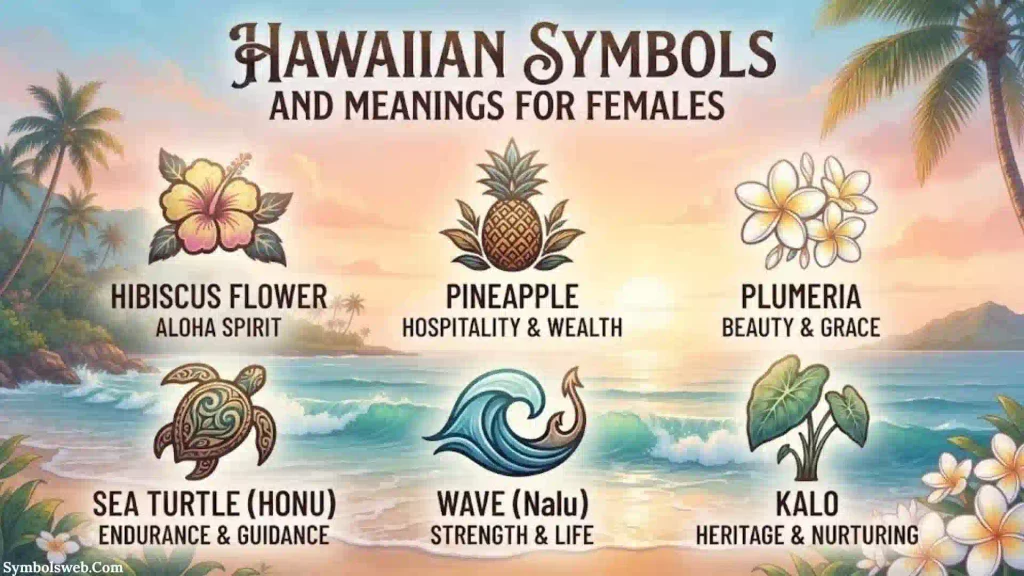
There is no single Hawaiian symbol that represents every woman. Instead, you can find different Hawaiian plants, flowers, animals, and cultural designs that may represent beauty, affection, strength, protection, or individuality.
Some commonly chosen examples include:
- Hibiscus — beauty and the temporary nature of life.
- Plumeria — beauty, affection, welcome, and celebration.
- Pikake — love, elegance, and affection.
- Honu — protection, endurance, and longevity.
- Maile — respect, affection, and connection.
- Kukui — light, knowledge, and guidance.
If you are looking for a meaningful symbol for yourself, you can choose one based on the quality you want it to express. I would consider the personal meaning first and the visual style second.
Ancient Hawaiian Symbols
Ancient Hawaiian symbolism developed through a close relationship with the land, ocean, plants, animals, ancestry, and traditional life of the islands. If you are researching ancient Hawaiian symbols, it is important to remember that their meanings can depend on their historical and cultural context.
Examples of important traditional imagery and natural symbols include:
- Kalo — taro, an important food plant with deep cultural significance.
- Kukui — a valuable plant associated with light and knowledge in modern interpretations.
- Honu — sea turtle and an important ocean creature.
- ʻUlu — breadfruit, an important traditional food plant.
- Niu — coconut, historically valuable for food and materials.
- Maile — a fragrant plant used in lei and cultural practices.
- ʻAumakua imagery — concepts involving ancestral or family guardians represented through particular forms.
If you use an ancient Hawaiian-inspired symbol, I recommend learning about its cultural background first. You can make your design more meaningful when you understand where the imagery comes from.
Traditional Hawaiian Symbols
Traditional Hawaiian symbols and motifs are closely connected with nature, family, the ocean, plants, animals, and cultural practices. You can find these themes in traditional arts, lei, carving, kapa, weaving, and other forms of cultural expression.
Common examples include:
- Honu — sea turtle.
- Kukui — candlenut tree and nut.
- Maile — fragrant native plant.
- Kalo — taro.
- Niu — coconut.
- ʻUlu — breadfruit.
- Hibiscus — an iconic Hawaiian flower.
- Lei — an expression of affection, respect, welcome, or celebration.
When I explore traditional Hawaiian symbols, I think it is important to look beyond their appearance. You can better appreciate these designs when you understand their connection to Hawaiian culture and history.
Native Hawaiian Symbols
Native Hawaiian symbols are connected with the islands’ environment, genealogy, spirituality, cultural practices, and relationship with nature. You may see imagery involving plants, animals, land, ocean life, and family traditions.
Examples include kalo, maile, kukui, honu, and imagery associated with ʻaumakua. The meaning of a particular symbol can vary according to its historical and cultural context.
If you are using Native Hawaiian imagery in a tattoo or artwork, I encourage you to learn about the symbol before using it. You can show greater respect for the culture when you understand what the design represents.
Symbols Of Hawaiian Culture
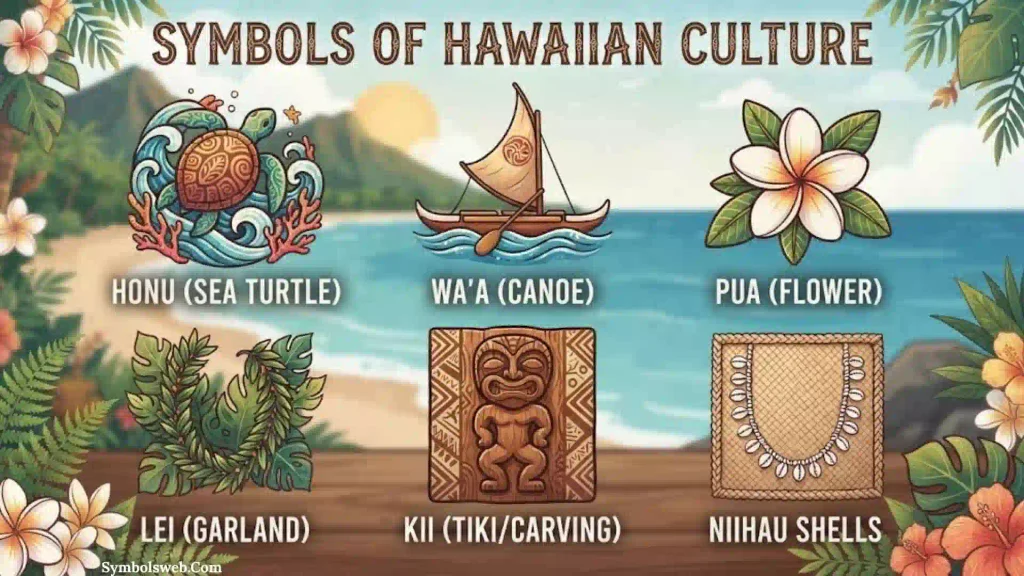
Many symbols can help you recognize important aspects of Hawaiian culture. They reflect the islands’ relationship with nature, family, community, history, and traditional practices.
Some well-known examples include:
- Lei — love, friendship, welcome, honor, and celebration.
- Hula — an important cultural practice involving dance, chant, movement, and storytelling.
- Kalo — a culturally significant plant connected with food, ancestry, and Hawaiian traditions.
- Honu — sea turtle and an important part of Hawaii’s marine environment.
- Kukui — traditionally valued for practical uses and commonly associated with light and knowledge.
- Maile — a culturally important plant used in lei and ceremonies.
- Hibiscus — one of the flowers most strongly associated with Hawaii.
When you learn these symbols, you can see how Hawaiian culture is deeply connected with the land and ocean. I find that this connection makes the symbols much more meaningful than simple decorative designs.
Hawaii State Flower And Bird
The official state flower of Hawaii is the yellow hibiscus, specifically Hibiscus brackenridgei. It is also known as pua aloalo and is a distinctive native Hawaiian flower.
Hawaii’s official state bird is the nēnē, or Hawaiian goose. The nēnē is native to the Hawaiian Islands and represents an important part of Hawaii’s unique wildlife.
If you are looking for official Hawaiian state symbols, the yellow hibiscus and nēnē are two important examples. You can use them when you want your artwork or project to represent Hawaii’s native plants and animals.
Maui Hawaii Symbols
Maui has many natural and cultural symbols that you can associate with the island. Some are connected with its mountains, ocean, native wildlife, plants, and cultural history.
Common Maui-related imagery includes:
- Haleakalā — the famous volcanic landscape of East Maui.
- Honu — sea turtles found in Hawaiian waters.
- Nēnē — Hawaii’s state bird, which can also be found on Maui.
- Kalo — an important traditional Hawaiian plant.
- ʻUlu — breadfruit and an important traditional food plant.
- Hibiscus and tropical flowers — representing Maui’s rich plant life.
- Ocean waves — reflecting Maui’s strong connection with the Pacific.
If you want a symbol specifically connected to Maui, I would choose imagery that reflects the island’s landscape or native environment. You can make the design more personal by combining a Maui symbol with a meaning that matters to you.
Hawaii Symbols Drawing
You can create simple Hawaiian symbol drawings using flowers, animals, plants, waves, mountains, and other natural imagery. If you want an easy design, you can start with one central symbol and build the drawing around it.
For example, you can:
- Choose a central symbol such as a hibiscus, honu, or kukui.
- Add simple ocean waves or leaves around it.
- Use clean and recognizable shapes.
- Add traditional patterns only after learning about their cultural background.
- Include the meaning of the symbol if you are creating the drawing for a school or personal project.
If you are new to drawing, I suggest starting with a simple honu or hibiscus. You can gradually add details once you are comfortable with the basic shape.
Hawaii Symbols And Art
Hawaiian art reflects the islands’ natural environment, history, culture, and traditions. You can find Hawaiian-inspired imagery in lei making, carving, weaving, kapa, contemporary artwork, and other artistic forms.
Common visual themes include hibiscus, plumeria, honu, waves, mountains, kukui, tropical plants, and geometric patterns. Traditional Hawaiian art can also have specific cultural meanings, so you should understand the background of a design before using it.
When I look at Hawaiian art, I appreciate how strongly it connects people with the land and ocean. If you are creating your own Hawaiian-inspired artwork, you can make it more meaningful by choosing symbols that represent something personal to you, such as family, love, nature, protection, or your connection to the islands.
Deep Symbolic Meaning of Hawaii Symbols
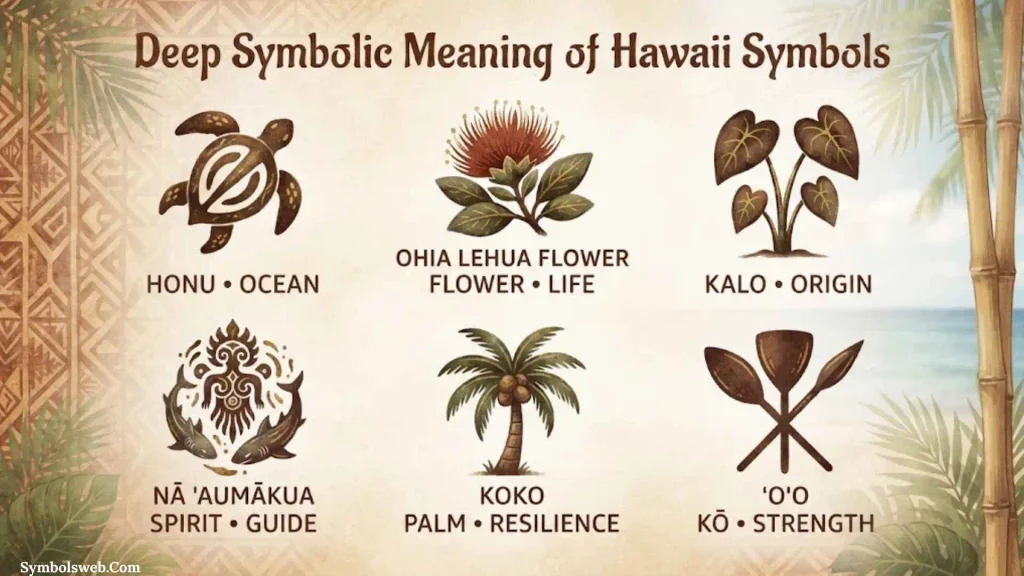
Hawaii symbols can be understood on several levels. Their legal meaning is only one layer.
Spiritual Level
Traditional Hawaiian culture contains complex relationships among people, ancestors, gods, land, ocean, plants, animals, and place.
For this reason, natural symbols can carry meanings that go beyond appearance.
The kukui can evoke light and guidance. Kalo can represent regeneration and continuity. The ocean can represent both life and power. Certain animals and natural forms can be connected to family traditions and spiritual relationships.
However, it is important not to treat every Hawaiian symbol as having one universal spiritual meaning. Hawaiian traditions are diverse, and meanings can depend on family, place, historical period, and cultural context.
Psychological Level
Symbols work because humans naturally attach emotion to images and objects.
A person who sees a hibiscus may remember a trip. Another person may associate it with family. Someone who receives a lei may remember a graduation, wedding, welcome, or farewell.
Psychologically, symbols can become containers for memory.
This is one reason Hawaii symbols are so emotionally powerful. They combine strong visual patterns with experiences of nature, family, travel, celebration, and identity.
Cultural Level
At the cultural level, symbols help a community express who it is.
A flag can represent political identity. A language can preserve ancestral knowledge. A dance can carry stories. A plant can represent food systems and relationships with the land.
Hawaii’s symbols therefore form a kind of cultural vocabulary.
Types and Variations of Hawaii Symbols
Hawaii symbols can be grouped into several broad categories.
| Type | Examples | What They Represent |
| Government Symbols | State seal, flag, motto | Political history and identity |
| Natural Symbols | Nēnē, kukui, yellow hibiscus | Native environment and biodiversity |
| Cultural Symbols | Hula, lei, kalo | Heritage, relationships, tradition |
| Ocean Symbols | Surfing, humuhumunukunukuāpuaʻa, canoe | Pacific life and navigation |
| Language Symbols | ʻŌlelo Hawaiʻi | Cultural knowledge and continuity |
| Musical Symbols | Ukulele, pahu | Hawaiian music and performance |
| Modern Symbols | Shaka, Hawaiian flag imagery | Aloha, connection, identity |
| Island Symbols | Island flowers and colors | Individual island identities |
Island Flowers and Colors
Each major Hawaiian island has its own flower or lei material and associated color.
These include:
- Hawaiʻi Island: ʻōhiʻa lehua, red
- Maui: lokelani, pink
- Oʻahu: ʻilima, yellow
- Kauaʻi: mokihana, purple
- Molokaʻi: kukui, green
- Lānaʻi: kaunaʻoa, orange
- Kahoʻolawe: hinahina, gray
- Niʻihau: pūpū shells, white
These island symbols add another layer to Hawaii’s identity. Instead of seeing Hawaii as one uniform place, they highlight the individuality of each island.
Hawaii Symbols Across Different Cultures
Hawaii symbols should not be forced into a simple comparison with ancient Egypt, Greece, or Rome.
The reason is important: Hawaii has its own Polynesian cultural history, and its symbols should be understood on their own terms.
Still, comparing symbolic systems can help explain why humans across different cultures use nature, animals, plants, celestial objects, and gestures to express abstract ideas.
Ancient Egypt
Ancient Egyptian culture often used animals, plants, the sun, and objects to represent complex ideas about life, death, kingship, truth, and the divine.
The Hawaiian state seal similarly uses natural and symbolic imagery to communicate political and cultural ideas. But the meanings come from different historical traditions.
Ancient Greece
Greek mythology frequently turned natural forces into stories involving gods, heroes, transformation, and human emotions.
Hawaiian moʻolelo also contains powerful relationships between people, gods, nature, ancestors, and place.
The similarity is not that Hawaiian and Greek symbols mean the same things. Rather, both traditions show how storytelling helps societies explain their world.
Roman Culture
Roman symbols often communicated authority, citizenship, military power, law, and political order.
Hawaii’s state seal also communicates political authority, but it does so through specifically Hawaiian history and the transformation of Hawaiian government.
Eastern Traditions
Many Asian traditions use natural elements such as flowers, mountains, water, animals, and plants as symbols of balance, renewal, wisdom, and spiritual development.
Hawaii’s symbols can also evoke similar human ideas, but their cultural meanings should not automatically be imported from Asian traditions.
Indigenous Traditions
Indigenous cultures around the world often maintain strong relationships between land, ancestry, animals, plants, language, and community.
This provides a useful comparison with Native Hawaiian traditions, where relationships with land and ancestry are central to understanding many cultural practices.
The important lesson is that nature in an Indigenous worldview may be more than an object of decoration. It can be part of a living cultural relationship.
Modern Interpretations
Today, Hawaii symbols often travel far beyond the islands.
A flower can become a fashion print. A shaka can become an emoji-like gesture. A Hawaiian flag can appear on clothing. A wave can become a brand logo.
These modern uses can keep symbols visible, but they can also simplify meanings that are much deeper in Hawaiian history.
Similar Symbols and Their Meanings
Several Hawaii symbols are often confused with one another.
| Symbol | Main Association | Key Difference |
| Hawaiian Flag | Identity, history, political heritage | Official flag |
| State Seal | Government, history, statehood | Official governmental emblem |
| Yellow Hibiscus | Native beauty and state identity | Official state flower |
| Kukui | Light, knowledge, guidance | Official state tree |
| Kalo | Food, continuity, regeneration | Official state plant |
| Nēnē | Native wildlife and conservation | Official state bird |
| Lei | Aloha, welcome, connection | Cultural symbol, not simply a decoration |
| Shaka | Aloha, friendliness, connection | Official state gesture |
| Hula | Storytelling, movement, cultural knowledge | Official state dance |
Common Misconceptions
One common mistake is assuming that every tropical object associated with Hawaii is an ancient Hawaiian symbol.
For example, plumeria is strongly associated with Hawaii today, especially through lei, tourism, jewelry, and fashion. However, it should not be confused with Hawaii’s official native state flower, which is the yellow hibiscus.
Another mistake is assuming that every symbol has one fixed meaning. Cultural symbols often change meaning according to context.
Hawaii Symbols in Mythology and Folklore
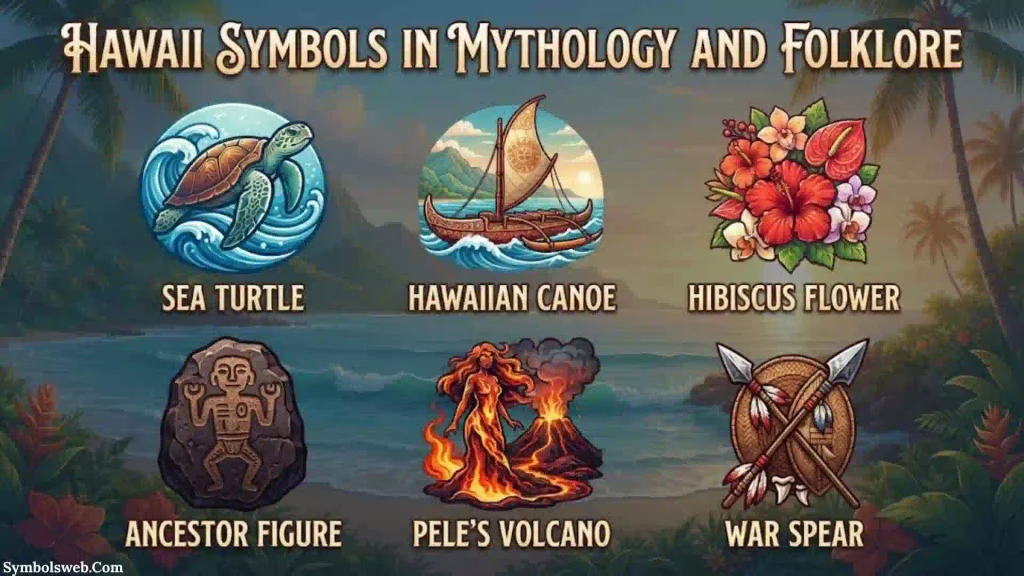
Hawaiian mythology and folklore are filled with stories involving gods, ancestors, heroes, nature, transformation, fire, water, mountains, plants, and animals.
One of the most important figures in Hawaiian tradition is Pele, associated with volcanoes and fire.
The ʻōhiʻa lehua flower is closely connected with stories involving Pele and the transformation of ʻŌhiʻa and Lehua. Legislative materials also describe ʻōhiʻa lehua as an important endemic plant referenced in Hawaiian moʻolelo, oli, mele, and hula, with blossoms associated symbolically with Pele’s fire, warfare, and the bounty of a generous chief.
Stories like these show why Hawaiian plants cannot always be understood simply through botanical descriptions.
A flower may also carry a story.
A mountain may carry a genealogy.
A place name may preserve history.
A chant may preserve knowledge.
That is the deeper world of Hawaiian symbolism.
Hawaii Symbols in Art, Literature, Movies and Pop Culture
Hawaii symbols have become highly visible in global popular culture.
Paintings and Visual Art
Artists frequently use flowers, waves, volcanoes, mountains, canoes, ocean scenes, and native plants to communicate ideas of place and identity.
The strongest Hawaiian art does more than show a tropical landscape. It can explore memory, genealogy, land, colonial history, environmental change, and cultural survival.
Literature and Poetry
Hawaiian literature often connects language, place, nature, ancestry, and memory.
Words such as aloha, ʻāina, ohana, pono, and moʻolelo have entered global vocabulary, although their meanings can be much richer than their simplified tourist translations suggest.
Movies and Television
Film and television frequently use Hawaii symbols to establish location quickly.
A palm tree, lei, surfboard, volcano, or shaka can tell viewers, almost instantly, “This is Hawaii.”
But popular culture can also reduce a complex culture into a vacation stereotype. Understanding the real meanings behind the symbols helps separate cultural identity from commercial imagery.
Tattoos
Hawaii-inspired tattoos often feature:
- Sea turtles
- Waves
- Flowers
- Kalo leaves
- Hawaiian lettering
- Canoes
- Sharks
- Geometric Polynesian patterns
- Honu imagery
A tattoo can be deeply personal, but cultural designs should be approached respectfully. Polynesian tattoo traditions contain specific histories and meanings, so copying a traditional pattern without understanding it can turn cultural heritage into decoration.
Fashion and Modern Design
Hawaii symbols are widely used in shirts, jewelry, home decor, tourism campaigns, logos, surf brands, and social media.
The challenge is balance.
A symbol can be both beautiful and meaningful. The more someone understands its history, the more respectfully they can use it.
Spiritual and Dream Meaning of Hawaii Symbols
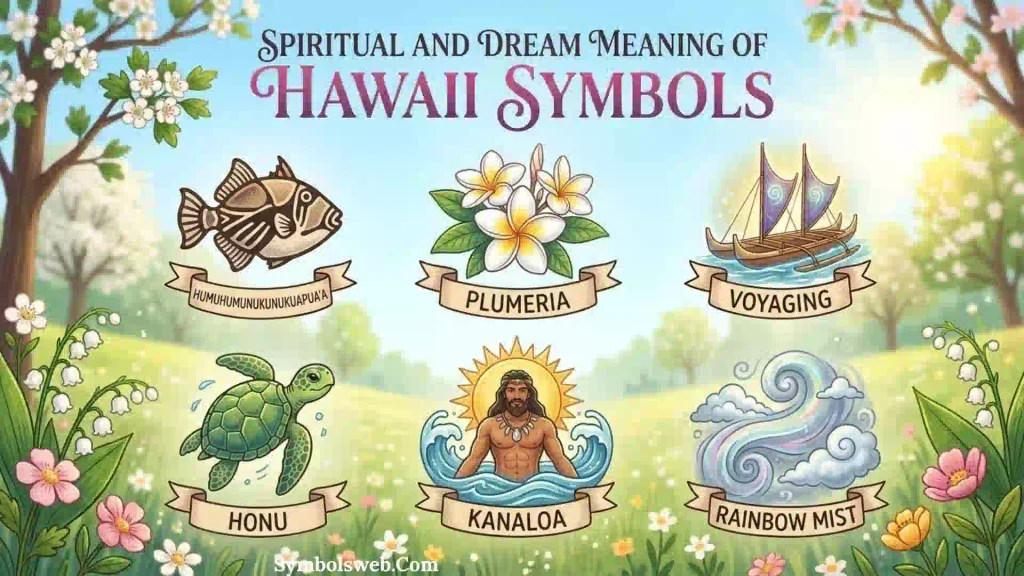
Dream interpretations are personal rather than scientific facts. There is no universal dream dictionary that can prove that a particular Hawaii symbol always means one thing.
Still, people may personally associate Hawaii symbols with certain themes.
Dreaming of the Ocean
The ocean may represent emotional depth, uncertainty, freedom, exploration, or a desire for renewal.
Dreaming of a Lei
A lei may personally symbolize welcome, love, celebration, connection, gratitude, or farewell.
Dreaming of a Flower
A flower can represent beauty, growth, temporary moments, relationships, or personal transformation.
Dreaming of a Turtle or Honu
A sea turtle may symbolize patience, endurance, protection, longevity, or a connection with the ocean.
Dreaming of the Shaka
A shaka may reflect friendliness, acceptance, social connection, gratitude, or the desire to relax and reconnect with others.
The most useful question is often not “What does this symbol always mean?” but “What did this symbol mean to me in the dream?”
Positive and Negative Meanings of Hawaii Symbols
A symbol can carry both positive and cautionary meanings.
| Positive Meaning | Negative or Cautionary Meaning |
| Connection | Cultural disconnection |
| Aloha | Superficial commercialization |
| Freedom | Escapism |
| Light and knowledge | Ignorance when knowledge is ignored |
| Natural beauty | Environmental exploitation |
| Community | Loss of cultural identity |
| Resilience | Forgetting historical suffering |
| Spiritual connection | Misusing sacred traditions |
| Celebration | Turning culture into a stereotype |
This balance is important.
A flower can symbolize beauty, but beauty can be commercialized.
A flag can symbolize pride, but history can also be complicated.
A cultural design can inspire people, but it should still be treated with respect.
Why Humans Are Attracted to Hawaii Symbols
There is a psychological reason Hawaii symbols are so memorable.
They combine strong visual images with powerful emotions.
Think about the difference between hearing the word “relaxation” and seeing a wave, a sunset, a lei, or a shaka.
The image creates an immediate emotional response.
Humans are naturally drawn to patterns, faces, colors, natural forms, and meaningful objects. When these images become connected to personal memories, their emotional power grows.
For someone who visited Hawaii with family, a hibiscus might bring back childhood memories.
For another person, the Hawaiian flag may represent cultural pride.
For someone else, the ocean may symbolize freedom.
The same symbol can therefore carry completely different personal meanings.
Modern Uses of Hawaii Symbols
Hawaii symbols appear throughout modern life.
Tattoos and Jewelry
Kalo leaves, flowers, waves, turtles, shells, and Hawaiian words are common design elements.
Jewelry often combines natural imagery with personal memories of the islands.
Fashion
Hawaiian flowers, surf imagery, tropical colors, and island motifs remain popular around the world.
Authentic cultural understanding becomes increasingly important as these designs travel outside Hawaii.
Branding
Businesses often use waves, flowers, palm trees, shaka gestures, and Hawaiian words to create an immediate association with Hawaii.
The shaka in particular has become a powerful global brand symbol. Hawaii’s 2024 law recognized its importance to state identity, resident pride, aloha, and connection.
Social Media
Hawaii symbols are now part of digital communication.
The shaka, wave imagery, hibiscus, palm tree, and ocean photographs can communicate a mood without words.
Contemporary Spirituality
People sometimes use Hawaiian-inspired symbols in meditation spaces, wellness practices, jewelry, and personal rituals.
However, Hawaiian culture should not be treated as a collection of interchangeable spiritual tools. Respect begins with understanding the original cultural context.
Home Decor
Hawaiian motifs appear in paintings, textiles, woodwork, prints, plants, and ocean-inspired interiors.
For many people, these objects represent calm, warmth, travel memories, and connection to nature.
Interesting Facts About Hawaii Symbols
- Hawaii has an official state gesture. The shaka was officially recognized by law in 2024.
- Hawaii has official state snails. In 2024, legislation recognized native snail species as state and island snails, bringing attention to Hawaii’s remarkable but threatened land-snail diversity.
- The state seal contains eight taro leaves. They represent the eight main Hawaiian islands and reinforce the cultural importance of kalo.
- The state seal contains a phoenix. The phoenix represents death and resurrection and symbolizes the transformation from monarchy to democratic government.
- The kukui was useful as a source of light. Its oily nuts could be burned, helping explain its association with light and knowledge.
- The Kamehameha butterfly is Hawaii’s state insect. It is one of only two native butterfly species in Hawaii.
- Hawaii has both a traditional and modern official musical instrument category. The pahu is recognized for kahiko, while the ukulele is recognized for ʻauana.
- The yellow hibiscus is the official state flower. Its official designation refers specifically to the native yellow hibiscus, rather than hibiscus flowers in general.
- The Hawaiian flag has eight stripes. Hawaii law officially defines the flag as having eight horizontal stripes alternating white, red, and blue.
- Black coral remains legally designated as Hawaii’s state gem under current law. A proposal to repeal the designation was introduced, but the legislation set the repeal for July 1, 2050, so it remains the statutory state gem as of 2026.
Frequently Asked Questions
What is the most famous symbol of Hawaii?
There is no single answer because Hawaii has many important symbols. The Hawaiian flag, state seal, hibiscus, kukui, nēnē, lei, hula, surfing, and shaka are among the most recognizable. The shaka is especially associated with modern ideas of Hawaii and aloha.
What does the Hawaiian symbol mean?
“Hawaii symbol” can refer to many different things. Symbols such as the flag represent history and identity, while the kukui can represent light and knowledge, kalo represents cultural continuity, hula represents storytelling and cultural expression, and the shaka represents aloha and connection.
What is Hawaii’s official state flower?
Hawaii’s official state flower is the native yellow hibiscus, known as pua aloalo or maʻo hau hele, scientifically Hibiscus brackenridgei.
What is the Hawaiian symbol for good luck?
There is no single universal Hawaiian symbol that officially means “good luck.” The shaka is strongly associated with positive feelings, aloha, connection, and friendliness, while different flowers, plants, animals, and cultural objects can carry different meanings depending on context.
What does the shaka mean in Hawaii?
The shaka is a friendly hand gesture made by extending the thumb and little finger while curling the middle fingers. It is associated with aloha, connection, friendliness, gratitude, and a positive attitude. Hawaii officially recognized it as the state gesture in 2024.
What plant symbolizes Hawaii?
Several plants are strongly associated with Hawaii. The kukui is the official state tree, the yellow hibiscus is the official state flower, and kalo is the official state plant. Each carries a different cultural and symbolic meaning.
Conclusion
Hawaii symbols are powerful because they bring together nature, history, culture, identity, and human emotion. A flower can carry the memory of a place, a tree can represent light and knowledge, a plant can connect generations, and a simple hand gesture can communicate aloha without saying a word.
The deeper meaning of Hawaii is therefore not found in one symbol, but in the relationships between land, ocean, people, language, and history. To understand these symbols is to see Hawaii not simply as a beautiful destination, but as a living culture with stories worth remembering and respecting.

Eliana Foster is a writer with a passion for exploring the meanings behind symbols, traditions, and cultural history. She enjoys breaking down complex topics into simple, engaging articles that are easy for everyone to understand. Eliana is also the fictional author of The Hidden Language of Silent Marks and Beyond the Circle of Ancient Signs, two original book concepts created for her author profile. When she’s not writing, she loves visiting museums, reading about mythology, and researching the stories behind symbols from around the world. Her goal is to help readers discover the fascinating meanings hidden in everyday signs and ancient emblems.
 Jordan Hayes
 Ethan Holloway