Ares, the ancient Greek god of war, represents the fierce and destructive side of battle. His name brings to mind warriors, bronze weapons, charging horses, and the chaos of the battlefield. Unlike Athena, who represents wisdom and military strategy, Ares embodies physical aggression, bloodshed, courage, and the uncontrollable force of combat.
The symbols of Ares reveal much more than his identity as a warrior. His helmet represents readiness for battle, his spear represents aggression, and his shield reflects the realities of ancient warfare. Animals such as serpents, vultures, and owls also appear in myths connected to him. Each association offers a different perspective on his character and influence.
In Greek mythology, Ares was the son of Zeus and Hera and one of the Twelve Olympians. His relationship with Aphrodite, his children Phobos and Deimos, and his involvement in the Trojan War helped shape his legendary identity. Understanding his symbols provides a deeper look into how ancient Greeks viewed warfare, violence, courage, and destruction.
Ares Symbols and Their Meanings
Ares had several recognizable attributes in ancient Greek literature and artwork. Most represented his role as a warrior and his connection to violent combat.
His most recognizable symbols include a helmet, spear, shield, sword, and serpent. Certain birds and other animals also appear in stories associated with him.
| Ares Symbol | Meaning | Mythological Association |
| Helmet | Protection and readiness for battle | Ares’s warrior appearance |
| Spear | Aggression and armed combat | Ancient Greek warfare |
| Shield | Defense and military protection | Greek hoplite equipment |
| Sword | Close-range fighting | Warrior equipment |
| Breastplate | Physical protection and strength | Ares’s armor |
| War chariot | Battlefield power and movement | Ares’s divine chariot |
| Horse | Speed and military strength | His chariot team |
| Serpent | Danger and guardianship | Ismenian and Colchian dragons |
| Vulture | Death and the aftermath of violence | Polyphonte’s family myth |
| Owl | Ominous signs and warfare | Ares-related bird mythology |
| Woodpecker | Hunting omens | Transformation story |
| Wild boar | Aggression and destructive force | Adonis mythology |
| Phobos | Fear and panic | Ares’s divine companion |
| Deimos | Terror and dread | Ares’s divine companion |
Important distinction: Ancient sources do not treat every animal or object as an equally established sacred symbol. Weapons and armor have particularly strong connections to Ares’s artistic representations. Some animal associations come from individual myths rather than formal religious worship.
Who Was Ares in Greek Mythology?
Ares was the Greek god of war, battlefield violence, and the aggressive force of combat. He belonged to the Olympian pantheon and lived among the gods on Mount Olympus.
His parents were Zeus, king of the gods, and Hera, queen of Olympus. Although he possessed tremendous divine strength, his behavior often brought him into conflict with other Olympians.
Ancient Greek writers frequently portrayed Ares as passionate about fighting. He enjoyed the noise of battle and the excitement of physical conflict. However, his impulsive nature sometimes made him appear reckless rather than wise.
Homer’s Iliad provides some of the clearest examples of his personality. Ares supports warriors during the Trojan War but also suffers painful defeats.
Ares and Athena: Two Different Gods of War
Ares and Athena represented contrasting sides of ancient Greek warfare.
Ares represented the violent experience of battle. Athena represented military intelligence, discipline, and strategic planning.
| Characteristic | Ares | Athena |
| Main role | God of war | Goddess of wisdom and strategic warfare |
| Personality | Aggressive and impulsive | Wise and disciplined |
| Warfare | Physical combat and violence | Planning and military strategy |
| Common attributes | Helmet, spear, shield | Helmet, spear, shield, aegis |
| Major association | Battlefield aggression | Intelligent leadership |
| Mythological character | Passion for fighting | Controlled and purposeful action |
Both deities carried weapons and appeared in battle scenes. However, their different personalities reveal how Greek mythology understood the complicated nature of warfare.
Ares Weapons and Armor Symbols
Weapons and armor form the strongest part of Ares’s symbolic identity. Ancient Greek artists regularly represented him as a warrior equipped for battle.
His appearance often included a peaked helmet, spear, shield, breastplate, and greaves. These objects reflected the military equipment familiar to ancient Greek audiences.
Helmet of Ares
The helmet of Ares is one of his most recognizable attributes. Ancient Greek artists frequently depicted the god wearing or holding a peaked warrior’s helmet.
Greek helmets protected soldiers from sword strikes, spear attacks, and other battlefield injuries. Some included decorative crests made from horsehair or other materials.
Ares’s helmet represents:
- Readiness for battle.
- Protection during combat.
- Military identity.
- Warrior strength.
- Courage in dangerous situations.
- Authority on the battlefield.
Unlike a helmet belonging to an ordinary soldier, Ares’s helmet helped artists identify his divine warrior identity.
However, ancient artwork did not establish one unique helmet design exclusively belonging to him. His appearance often resembled that of other Greek warriors.
Shield of Ares
The shield of Ares represents defense, protection, and survival during warfare.
Ancient Greek soldiers commonly carried a large round shield called an aspis. The same type of shield is also frequently called a hoplon.
These shields usually featured a wooden body covered with bronze or another protective material. Soldiers used them to block incoming weapons and protect themselves during close combat.
The shield symbolized several important qualities:
- Defense against enemies.
- Protection during battle.
- Military discipline.
- Survival and resistance.
- The responsibility of protecting fellow soldiers.
Ares sometimes appeared holding a shield decorated with an emblem. However, these decorations were not a single permanent design belonging to the god.
Ancient artists often used familiar shield patterns from their artistic traditions.
Spear of Ares
The spear of Ares represents aggression, military strength, and offensive warfare.
Spears were among the most important weapons in ancient Greek military history. Greek infantry soldiers commonly used a weapon called the doru.
The doru usually featured a wooden shaft with an iron or bronze spearhead. A metal butt spike at the opposite end helped balance the weapon and could serve another purpose during combat.
Ares’s spear reflects his preference for direct confrontation. It also represents the physical force used by warriors when attacking enemy formations.
In Greek mythology, the spear appears repeatedly in descriptions of Ares during battle.
Hesiod’s Shield of Heracles describes Ares as a terrifying warrior carrying his weapon while directing combat from his chariot.
Sword of Ares
The sword represents close-range combat and the violent reality of ancient warfare.
One common Greek sword was the xiphos, a double-edged weapon used by infantry soldiers. Warriors often carried it as a secondary weapon after their spear.
Another weapon was the kopis, a curved blade associated with cutting attacks.
These weapons had different shapes and practical uses. They should not be treated as interchangeable versions of one mythical sword belonging exclusively to Ares.
In symbolic interpretations, the sword represents:
- Direct confrontation.
- Physical aggression.
- Fighting strength.
- Military skill.
- The final stages of close combat.
Ares’s Armor and Warrior Clothing
Ancient Greek artwork often shows Ares wearing traditional warrior equipment.
His appearance could include:
Breastplate: The protective armor covering the chest and upper body.
Greaves: Protective coverings worn over the lower legs.
Short tunic: A garment commonly associated with Greek warriors.
Helmet: The distinctive peaked head covering that helped identify his warrior role.
Shield: A defensive weapon used during combat.
Artists sometimes portrayed Ares wearing complete armor. Other representations showed him nearly nude except for his helmet and shield.
This variation reflects artistic choices rather than a single fixed costume.
Ares Sacred Animals and Their Meanings
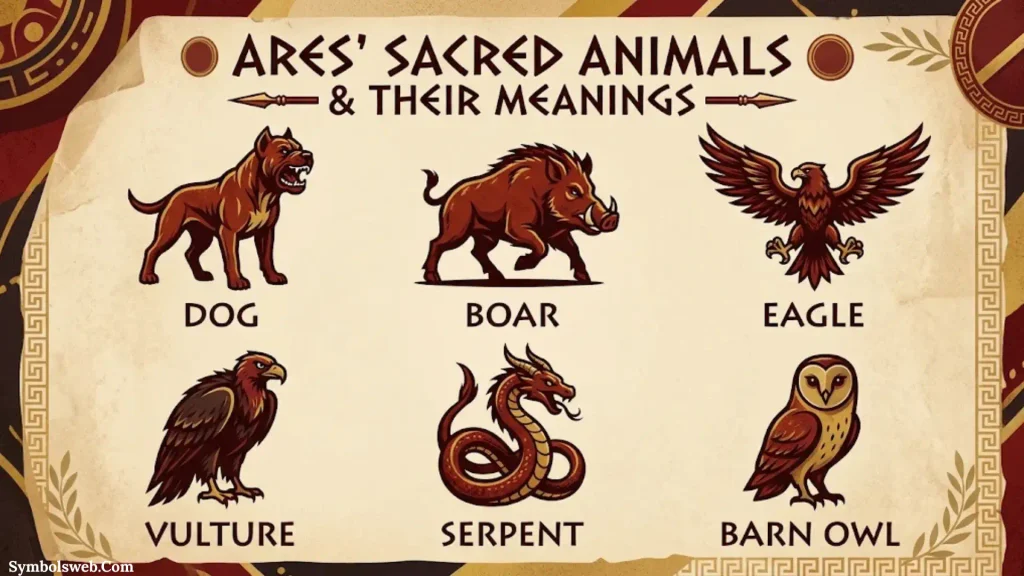
Animals connected to Ares reveal another side of his mythology. They appear in stories about divine guardians, ominous signs, violence, and transformation.
The serpent has a particularly direct connection to Ares. Several birds also appear in ancient stories involving his descendants.
However, the ancient evidence requires careful interpretation. Not every animal frequently listed online was necessarily worshipped as Ares’s official sacred animal.
Serpent: The Sacred Animal of Ares
The serpent has one of the strongest mythological connections to Ares.
Ancient Greek tradition associates him with the Ismenian dragon, a powerful serpent that guarded a sacred spring near Thebes.
Another famous creature was the Colchian Dragon, which guarded the Golden Fleece.
These creatures connected Ares with dangerous territory, divine guardianship, and powerful supernatural forces.
The serpent represents:
- Danger and destructive power.
- Guardianship of sacred places.
- Divine authority.
- Fear and confrontation.
- The mysterious forces of nature.
Ares and the Ismenian Dragon
The story of Cadmus provides an important example of Ares’s serpent association.
Cadmus was a Phoenician prince searching for his sister Europa. During his journey, he eventually reached the region where he founded Thebes.
His companions needed water and discovered a spring guarded by a fierce dragon associated with Ares.
The creature attacked and killed Cadmus’s companions. Cadmus then fought the dragon and eventually defeated it.
Following Athena’s instructions, he planted the dragon’s teeth in the ground.
Armed warriors emerged from the soil. These supernatural fighters became known as the Spartoi, meaning sown men.
The surviving warriors helped establish the legendary origins of Thebes.
This myth connects Ares with serpents, sacred springs, dragon mythology, and the violent origins of a Greek city.
Vulture: Death and the Aftermath of Battle
The vulture appears in an important Ares-related transformation story involving Polyphonte and her descendants.
According to Antoninus Liberalis in Metamorphoses, Ares intervened when Zeus ordered Hermes to punish members of Polyphonte’s family.
During the transformation, Polyphonte became a small owl. Her descendants also became birds.
Argios transformed into a vulture, a creature associated with consuming flesh and blood.
The vulture represents:
- Death.
- Decay.
- Battlefield destruction.
- The consequences of violence.
- The grim aftermath of conflict.
Its association with Ares reflects the darker consequences of warfare rather than the honor or glory sometimes connected with military victory.
Owl: Ominous Signs and Warfare
Several owl species appear in the same mythological tradition.
The small owl associated with Polyphonte was described as a bird whose nighttime call foretold war and sedition.
Her son Oreios became an eagle owl. Ancient mythology connected this bird with unfavorable omens.
These birds differ from Athena’s famous owl.
Athena’s owl represents wisdom, knowledge, and her connection to Athens. The owls appearing in Ares-related stories carry more ominous associations.
Their mythological meanings include:
- Nighttime warnings.
- Misfortune.
- Conflict.
- War and sedition.
- Unsettling omens.
Woodpecker: An Unusual Bird Associated With Ares
The woodpecker also appears in the transformation story of Polyphonte’s family.
According to Antoninus Liberalis, a female servant in the household became a woodpecker after Hermes and Ares intervened.
Unlike the other transformed family members, she received a more favorable outcome.
The woodpecker became a good omen for hunting and feasting.
This detail is important because it shows that not every bird connected with Ares carried negative symbolism.
The woodpecker represents a different side of the story, connecting the god’s mythology with hunting, nature, and favorable omens.
Wild Boar: Aggression and Destructive Strength
The wild boar is associated with Ares through the myth of Adonis.
Adonis was a beautiful mortal youth loved by Aphrodite. His beauty attracted the goddess and created a complicated relationship between love and jealousy.
In one tradition, Ares became jealous of Aphrodite’s affection for Adonis. He transformed into a wild boar and attacked the young hunter.
The attack caused Adonis’s death.
Other versions of the story differ in their explanation of the boar’s identity and the circumstances surrounding the attack.
The animal represents:
- Aggression.
- Physical power.
- Uncontrolled violence.
- Destruction.
- Jealousy and revenge.
The boar is an important animal in Ares-related mythology. However, its appearance in the Adonis story does not establish a universal ancient Greek cult tradition in which the boar was formally sacred to Ares.
Dog and Wolf: Canine Associations With War
Dogs and wolves sometimes appear in modern lists of Ares’s associated animals.
These associations usually reflect their connection with aggression, hunting, violence, and the harsh realities of survival.
Dogs also had a place in certain ancient Greek religious practices. Some traditions connect puppy sacrifices with Enyalios, a war deity closely associated with Ares.
However, claims about a universally sacred dog or wolf should be treated carefully.
Their symbolic interpretations include:
- Aggression and protective instincts.
- Loyalty and companionship.
- Hunting and survival.
- Physical strength.
- The dangerous environment of warfare.
The distinction between historical ritual evidence and modern symbolic interpretation is essential.
Ares’s Chariot and Horse Symbols
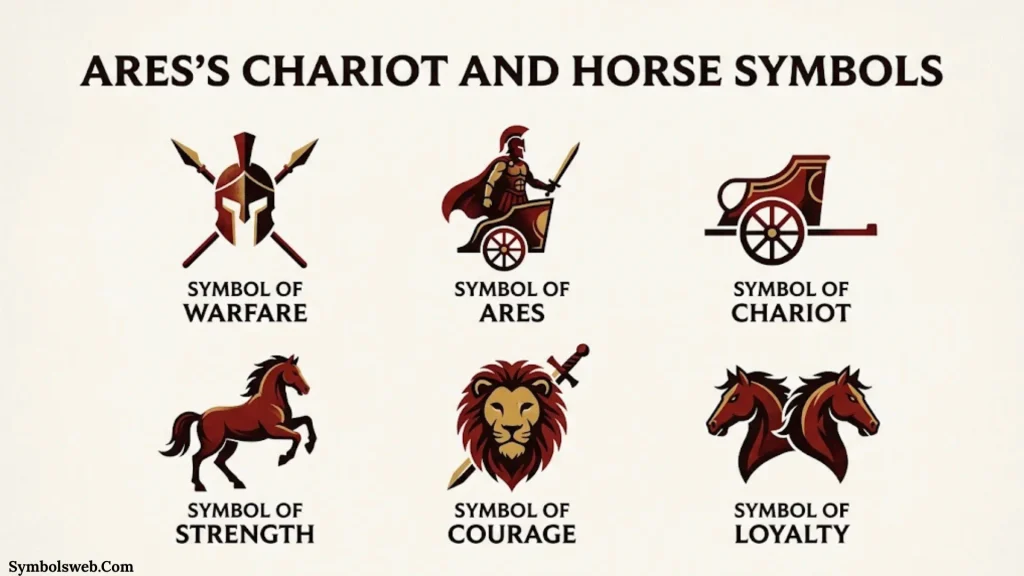
The war chariot is another important part of Ares’s identity.
Ancient Greek mythology frequently portrays gods and heroes traveling into battle using powerful chariots. Ares’s divine vehicle emphasizes his connection to speed, force, and battlefield destruction.
War Chariot of Ares
Ares’s chariot represents military power and the movement of divine forces across the battlefield.
Hesiod’s Shield of Heracles describes Ares arriving in his chariot during a violent battle scene.
His horses trample the ground as he moves through combat. The imagery emphasizes the terrifying strength of the god and his association with destruction.
The chariot symbolizes:
- Military movement.
- Battlefield power.
- Aggression.
- Speed and force.
- Divine participation in warfare.
Immortal Horses of Ares
Ares’s chariot was associated with powerful immortal horses.
In traditions describing their names, they include:
- Aithon: Associated with burning or blazing fire.
- Phlogios: Connected with flame.
- Konabos: Associated with battle noise or tumult.
- Phobos: Connected with fear.
These names reflect the atmosphere of warfare surrounding Ares.
His horses were not ordinary animals. Their supernatural qualities reinforced the idea that the god possessed tremendous power.
Phobos and Deimos: Fear and Terror
Phobos and Deimos were among the most important figures accompanying Ares.
They were children of Ares and Aphrodite in the tradition followed by Hesiod.
Their names describe two closely related emotions experienced during warfare.
Phobos represents fear and panic. His presence reflects the terror soldiers experience when facing danger.
Deimos represents dread and terror. His name emphasizes the frightening atmosphere surrounding violent combat.
Together, they represent the psychological effects of war.
Their presence beside Ares appears in descriptions of battlefield scenes, including Hesiod’s Shield of Heracles.
Phobos and Deimos: Powerful Symbols of War
These two divine figures deserve special attention because they reveal how Greek mythology understood fear during combat.
Phobos: The Symbol of Fear and Panic
The Greek word phobos means fear or terror. The name later became the source of the English word phobia.
In mythology, Phobos accompanied his father during warfare.
His symbolic meaning includes:
- Fear of physical injury.
- Panic during combat.
- Loss of confidence.
- Retreat from danger.
- Psychological pressure.
The name also survives in modern astronomy. Phobos is one of the two moons of Mars.
Deimos: The Symbol of Terror and Dread
Deimos represents terror, dread, and the overwhelming emotional experience of facing danger.
His mythology emphasizes the psychological side of violent conflict.
While Phobos represents fear and panic, Deimos emphasizes terror and dread.
Together, the brothers show that warfare involves more than weapons and physical strength. It also affects the minds of those who experience it.
Ares’s Personality, Powers, and Characteristics
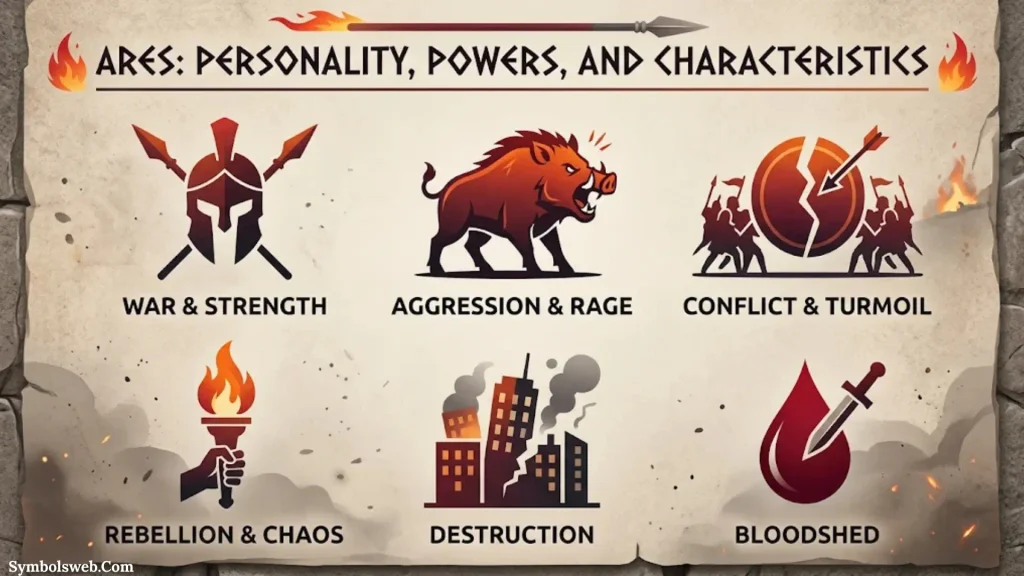
Ares was one of the physically powerful gods of Olympus. His mythology connects him with several qualities that shaped ancient Greek ideas about warfare.
God of War and Battlelust
Ares represented the violent side of warfare.
He enjoyed physical confrontation and often entered battles without carefully considering the consequences.
His role differed from Athena’s more disciplined approach to military conflict.
Strength, Courage, and Physical Power
Ares possessed tremendous physical strength.
His divine warrior appearance emphasized endurance, courage, and the ability to fight powerful enemies.
However, his mythology also shows that strength alone does not guarantee victory.
He was wounded by Diomedes during the Trojan War and defeated in other legendary confrontations.
Rage, Bloodshed, and Battlefield Violence
Ares frequently represented uncontrolled anger and destructive behavior.
His connection with bloodshed made him one of the more frightening Olympian gods.
Zeus himself expressed strong dislike toward Ares in Homer’s Iliad.
This portrayal demonstrates that Greek mythology did not always treat warfare as glorious. It also recognized its brutal and destructive nature.
Ares in Greek Mythology: Important Myths and Legends
Ares appears in several famous stories involving gods, heroes, monsters, and legendary battles.
These myths explain his personality and reveal the meaning behind many of his symbols.
Ares in the Trojan War
The Trojan War is one of the most important settings for Ares’s mythology.
During the conflict, Ares supported the Trojan side in important episodes. However, his involvement did not always lead to victory.
He frequently came into conflict with Athena, who supported the Greek warriors.
Their rivalry represented two opposing approaches to warfare.
Ares favored direct aggression and physical violence. Athena relied on intelligence, planning, and tactical skill.
Diomedes Wounds Ares
One of the most famous Ares stories appears in Book Five of Homer’s Iliad.
The Greek warrior Diomedes received divine assistance from Athena during the fighting.
With her guidance, he confronted Ares and wounded him with a spear.
Ares cried out in pain and returned to Mount Olympus.
His defeat shocked the battlefield and demonstrated that even an Olympian god could experience injury.
This episode also strengthens the contrast between Ares and Athena.
Ares and the Giants Otus and Ephialtes
Otus and Ephialtes were giant brothers known as the Aloadae.
They challenged the Olympian gods and captured Ares.
According to Homer, they imprisoned him inside a bronze vessel for thirteen months.
Ares remained trapped until Hermes eventually rescued him.
This story presents an unusual side of the war god. Despite his strength, he could become helpless when confronted by powerful enemies.
Ares and Aphrodite: The Love Affair
Ares and Aphrodite shared one of the most famous relationships in Greek mythology.
Aphrodite was the goddess of love and beauty. However, she was married to Hephaestus, the god of fire and metalworking.
Their secret relationship eventually became known to Hephaestus.
He created an invisible net that trapped the lovers together. He then invited the other gods to witness their humiliation.
The story appears in Homer’s Odyssey, particularly in the account sung by the poet Demodocus.
It connects Ares with love, jealousy, desire, and conflict.
Ares, Cadmus, and the Ismenian Dragon
The myth of Cadmus connects Ares with the legendary foundation of Thebes.
Cadmus killed a dragon guarding a sacred spring associated with Ares.
Following Athena’s instructions, he planted the dragon’s teeth in the earth.
Armed warriors emerged from the ground and became known as the Spartoi.
These warriors helped establish the legendary beginnings of Thebes.
The story provides one of the clearest explanations for the serpent’s connection with Ares.
Ares and the Birds of the Island of Ares
The Argonautica by Apollonius Rhodius describes the Argonauts’ encounter with dangerous birds associated with Ares.
The creatures lived on an island in the Black Sea region.
They attacked visitors by releasing sharp feathers that acted like weapons.
The Argonauts eventually drove the birds away with their shields and weapons.
This story connects Ares with dangerous birds, divine territory, and the journey of Jason and the Argonauts.
Ares and Adonis: The Wild Boar Myth
The story of Adonis reveals another connection between Ares and animal symbolism.
Aphrodite loved Adonis, a beautiful young hunter. Their relationship created jealousy and conflict in some versions of the myth.
Ares became associated with the wild boar responsible for Adonis’s death.
The story connects the boar with violence, jealousy, and destructive aggression.
It also shows how the mythology of Ares extends beyond traditional battlefield scenes.
Ares and the Death of Halirrhothius
Another important myth connects Ares with the Areopagus in Athens.
Halirrhothius was the son of Poseidon. He attacked Alcippe, the daughter of Ares.
Ares killed him in response.
Poseidon then demanded justice, leading to a divine trial.
According to the mythological tradition, the trial took place on a hill in Athens that became known as the Areopagus.
The story connects Ares with justice, family protection, and the legendary origins of an important Athenian location.
Ares’s Family Tree and Relationships
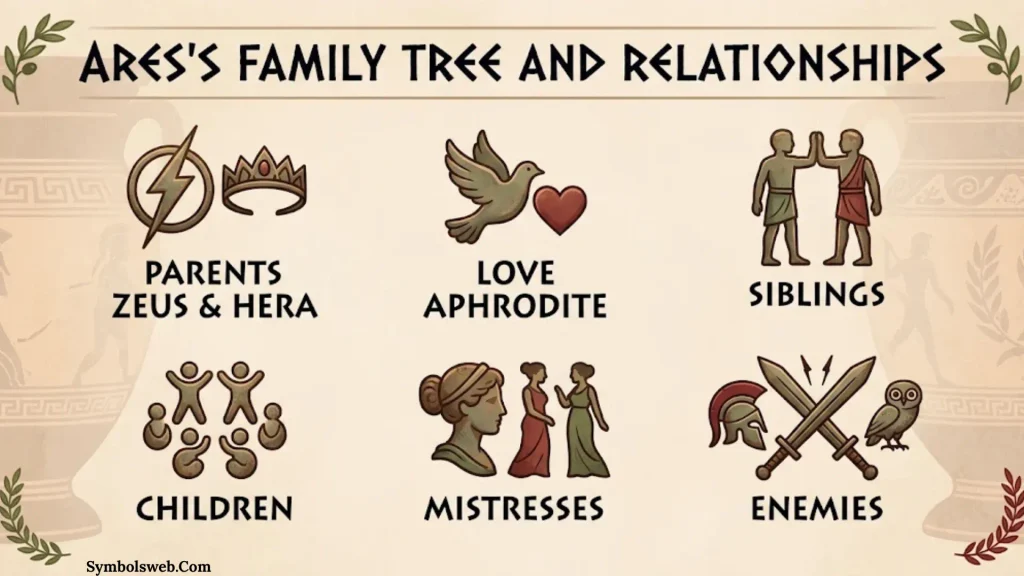
Ares belonged to the Olympian family and maintained relationships with several important gods and goddesses.
His family connections explain many of the stories involving love, warfare, and divine rivalry.
Who Were the Parents of Ares?
Ares was the son of:
- Zeus: King of the Greek gods and ruler of Mount Olympus.
- Hera: Queen of Olympus and goddess associated with marriage and family.
He was part of the central Olympian family and appeared in several stories involving his parents.
Ares and Aphrodite
Aphrodite was Ares’s most famous romantic partner.
Their relationship produced several children in different mythological traditions.
Their connection brought together two seemingly opposite forces: love and war.
Children of Ares
Some of the children associated with Ares include:
| Child | Mythological Association |
| Phobos | Fear and panic |
| Deimos | Terror and dread |
| Harmonia | Harmony and concord |
| Eros | Love and desire in traditions identifying him as their child |
| Anteros | Reciprocal love in certain traditions |
Their identities and parentage sometimes vary between ancient accounts.
Phobos and Deimos are especially important because their mythology directly reflects their father’s role as the god of war.
Ares Worship in Ancient Greece
Although Ares appears frequently in Greek mythology, his religious importance varied across ancient Greece.
Some communities honored him through local cult practices and sanctuaries. Others placed greater emphasis on different deities connected with warfare.
Athena, for example, held a particularly important place in Athenian religious life.
How Did Ancient Greeks Worship Ares?
Ancient Greeks honored Ares through religious offerings, sanctuaries, altars, and local ceremonies.
His worship reflected the military concerns of different communities.
Historical evidence does not support treating every later claim about his sacrifices or rituals as a universal Greek practice.
Ancient religious traditions varied between regions and periods.
Ares Worship in Sparta
Sparta had a strong military culture and maintained religious traditions connected with warfare.
Ares and Enyalios appeared in traditions associated with Spartan military life.
Pausanias also recorded a statue of Ares in chains at Sparta.
The image has often been interpreted as representing the desire to keep military strength and victory within the city.
Temple of Ares in Athens
The Temple of Ares in the Athenian Agora provides important archaeological evidence of his worship.
The temple stands out because it demonstrates that Ares received religious recognition even in a city strongly associated with Athena.
Its history also illustrates how ancient Greek religious buildings could be relocated and reused.
The temple’s remains help researchers understand the physical presence of Ares worship in Athens.
Ares Altars and Religious Offerings
Ancient Greek worship often involved offerings at altars and sanctuaries.
People presented offerings to gods for protection, blessings, and favorable outcomes.
Evidence for specific Ares rituals differs between locations.
Claims about universal dog sacrifices, horse sacrifices, or human sacrifices should not be accepted without reliable historical evidence.
Ares vs. Mars: Greek and Roman Gods of War
Ares and Mars are closely connected because Roman religion identified Mars with the Greek god of war.
However, they did not have identical religious identities.
Who Was Mars in Roman Mythology?
Mars was the Roman god of war and one of the most important deities in Roman religion.
Unlike the often destructive personality associated with Ares, Mars had a stronger connection with Roman agriculture, civic protection, military power, and the security of the state.
Romans honored him through important festivals and religious ceremonies.
Differences Between Ares and Mars
| Feature | Ares | Mars |
| Mythology | Greek | Roman |
| Main role | God of war | God of war |
| Character | Aggressive and impulsive | Protector and military guardian |
| Parentage | Zeus and Hera | Jupiter and Juno in Roman identification |
| Romantic counterpart | Aphrodite | Venus |
| Main association | Battlefield violence | Military power and Roman identity |
| Religious importance | Varied across Greek regions | Central to Roman state religion |
Ares and Aphrodite vs. Mars and Venus
Aphrodite was the Greek goddess of love and beauty. Venus held a similar position in Roman mythology.
Ares and Aphrodite became famous for their romantic relationship.
Roman mythology also connected Mars and Venus.
Their relationship became an important theme in Roman literature and artistic traditions.
Ares in Ancient Greek Art and Symbolism
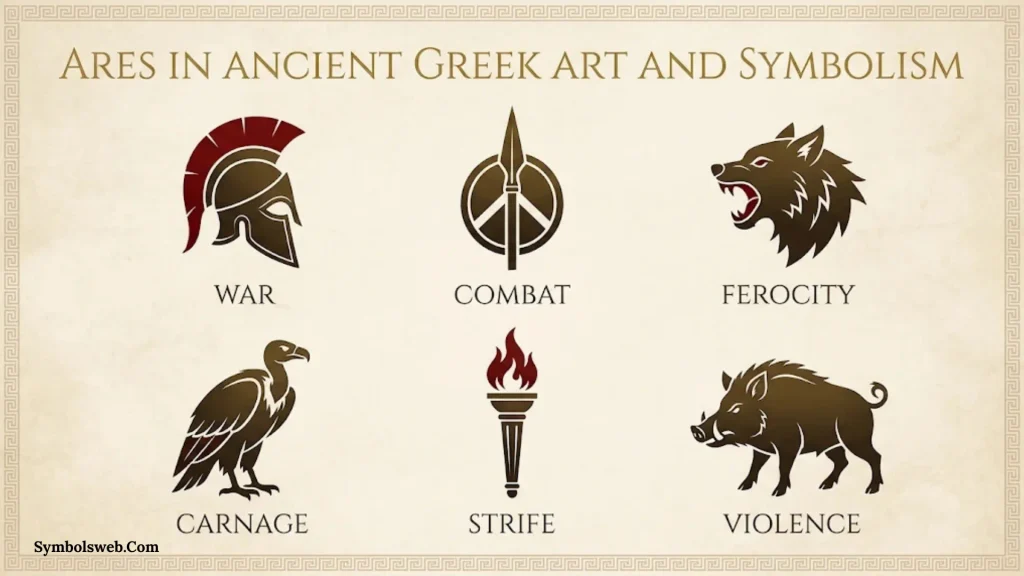
Ancient Greek artists represented Ares as a warrior using familiar military equipment.
His appearance helped audiences recognize his connection with combat and battlefield violence.
Ares in Greek Vase Paintings
Greek pottery provides important evidence of how ancient artists portrayed Ares.
Black-figure and red-figure vase paintings sometimes show him wearing armor and carrying weapons.
He often appears among other gods in mythological scenes.
Because his clothing resembled that of ordinary Greek warriors, inscriptions or surrounding characters sometimes helped identify him.
Ares in Greek Sculptures and Reliefs
Sculptures and reliefs also portrayed Ares as an armed warrior.
His physical appearance could include a helmet, spear, shield, and breastplate.
Some later Roman artworks adapted Greek representations of the god.
These images helped preserve his warrior identity across different artistic periods.
Ares in Ancient Greek Literature
Several classical works provide important information about Ares’s mythology.
| Ancient Work | Author | Importance |
| Iliad | Homer | Ares’s role in the Trojan War |
| Odyssey | Homer | His relationship with Aphrodite |
| Theogony | Hesiod | His divine family and children |
| Shield of Heracles | Hesiodic tradition | His chariot and battlefield imagery |
| Argonautica | Apollonius Rhodius | Birds associated with Ares |
| Metamorphoses | Antoninus Liberalis | Polyphonte’s family and bird transformations |
These works help separate ancient mythological traditions from modern interpretations of Ares symbols.
What Do Ares Symbols Represent?
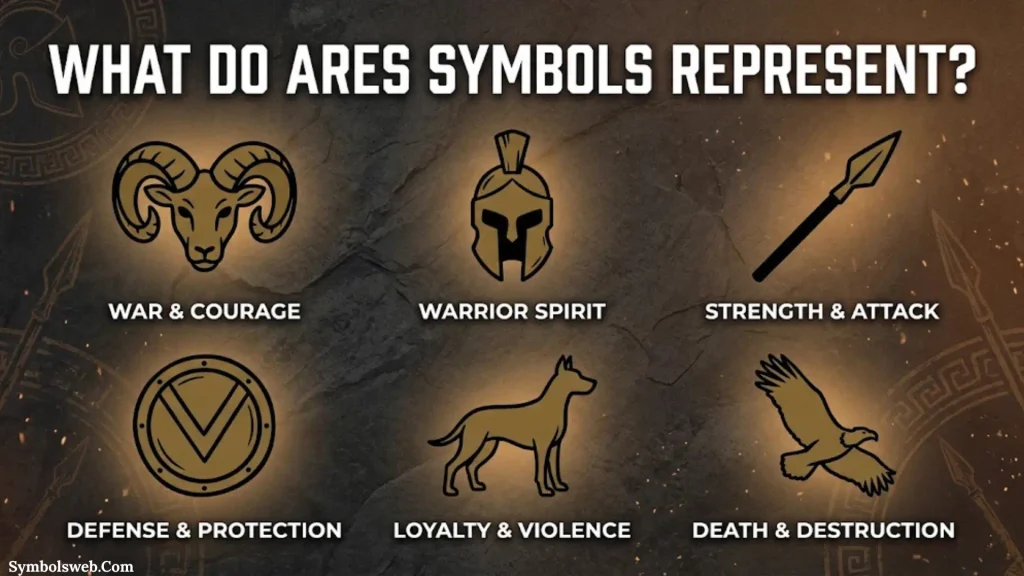
The symbols of Ares represent several connected ideas. Together, they explain his identity as a god of warfare and physical conflict.
Symbols of Strength and Physical Power
The helmet, spear, shield, sword, and armor reflect the physical strength required during combat.
They also connect Ares with military equipment and the warrior’s role.
Symbols of Aggression and Violence
The spear, sword, wild boar, and battlefield chariot represent direct confrontation and destructive force.
These symbols reflect Ares’s preference for physical fighting.
Symbols of Fear and Destruction
Phobos and Deimos represent the emotional consequences of warfare.
The vulture and certain ominous birds connect his mythology with death and misfortune.
Symbols of Protection and Defense
The helmet, shield, breastplate, and greaves represent protection against physical danger.
They also reflect the equipment ancient Greek warriors used to survive battle.
Symbols of Conflict and Divine Authority
The serpent, war chariot, and immortal horses connect Ares with divine power and dangerous supernatural forces.
They reveal how his mythology combines physical warfare with the mysterious world of Greek gods and monsters.
Frequently Asked Questions About Ares Symbols
What Are the Main Symbols of Ares?
The main symbols of Ares include the helmet, spear, shield, and sword. His armor and war chariot also appear in ancient Greek artwork and literature. The serpent is his most clearly identified sacred animal in traditional mythological descriptions.
What Is the Sacred Animal of Ares?
The serpent has a particularly strong mythological association with Ares. The Ismenian dragon guarded a sacred spring near Thebes, while the Colchian Dragon guarded the Golden Fleece. Vultures and certain owls also appear in stories connected with the god.
What Does the Ares Symbol Mean?
The symbols of Ares represent warfare, physical strength, aggression, courage, and battlefield destruction. His helmet represents warrior identity, his spear represents offensive combat, and his shield represents protection.
What Is Ares’s Sacred Bird?
Several birds appear in Ares-related mythology, including the vulture, barn owl, eagle owl, and woodpecker. Their associations come from ancient stories involving Polyphonte’s family and their transformation into birds.
Why Is the Wild Boar Associated With Ares?
The wild boar is associated with Ares through the death of Adonis. One tradition describes Ares transforming into a boar because he became jealous of Aphrodite’s affection for the young hunter.
Why Is the Serpent Associated With Ares?
The serpent is associated with Ares through the Ismenian dragon near Thebes and the Colchian Dragon guarding the Golden Fleece. These creatures connect the god with sacred territory, danger, and supernatural power.
What Weapons Did Ares Carry?
Ares was commonly depicted with a spear, shield, and helmet. Some artistic representations also show him carrying a sword. His armor could include a breastplate, short tunic, and greaves.
Who Are Phobos and Deimos?
Phobos and Deimos are divine personifications of fear and terror. They were children of Ares and Aphrodite in Hesiod’s tradition. Both accompanied their father during warfare and represented the psychological effects of battle.
Who Are the Parents of Ares?
Ares was the son of Zeus and Hera. Both were important Olympian deities and rulers of Mount Olympus.
Who Are the Children of Ares?
His best known children include Phobos, Deimos, and Harmonia. Eros and Anteros are also associated with Ares and Aphrodite in certain traditions.
What Is the Difference Between Ares and Athena?
Ares represents violent combat, physical aggression, and battlefield destruction. Athena represents wisdom, military strategy, and disciplined warfare. Both are important Greek deities associated with fighting.
Is Ares the Same as Mars?
Ares is the Greek counterpart of the Roman god Mars. Both are associated with warfare, but Mars held a broader role in Roman agriculture, civic protection, and military identity.
How Was Ares Worshipped in Ancient Greece?
Ancient Greeks honored Ares through regional cults, religious offerings, altars, and sanctuaries. His worship had connections with places such as Sparta and Athens. Specific practices differed between communities.
Why Was Ares Feared by the Ancient Greeks?
Ares represented the destructive side of warfare. His connection with bloodshed, anger, battlefield violence, and destruction made him a frightening figure in Greek mythology.
Conclusion: Understanding the Symbols of Ares
The symbols of Ares reveal the many sides of the ancient Greek god of war. His helmet, spear, shield, and sword establish his identity as a powerful warrior. His chariot and horses represent battlefield force, while the serpent connects him with sacred guardians and dangerous mythological creatures.
His associated animals also reveal important details about his mythology. The vulture represents death and the aftermath of violence. Certain owls appear as ominous signs, while the woodpecker carries a more favorable association. The wild boar connects Ares with the tragic death of Adonis.
Phobos and Deimos provide perhaps the clearest explanation of his influence. They represent the fear and terror that follow armies into battle. Together, these symbols show that Ares was more than a god carrying weapons. He represented the aggression, danger, destruction, and psychological pressure that defined warfare in ancient Greek imagination.

Jordan Hayes is a writer with a passion for exploring the history, meanings, and cultural significance behind symbols from around the world. He enjoys turning complex topics into clear, engaging content that anyone can understand. Jordan is also the fictional author of The Silent Language of Ancient Marks and Hidden Symbols Beyond the Surface, two original book concepts created for his author profile. When he’s not writing, he spends time researching myths, traditions, and forgotten stories that inspire his work. His goal is to help readers discover the deeper meanings behind the symbols they encounter every day.
 Eliana Foster
 Ethan Holloway