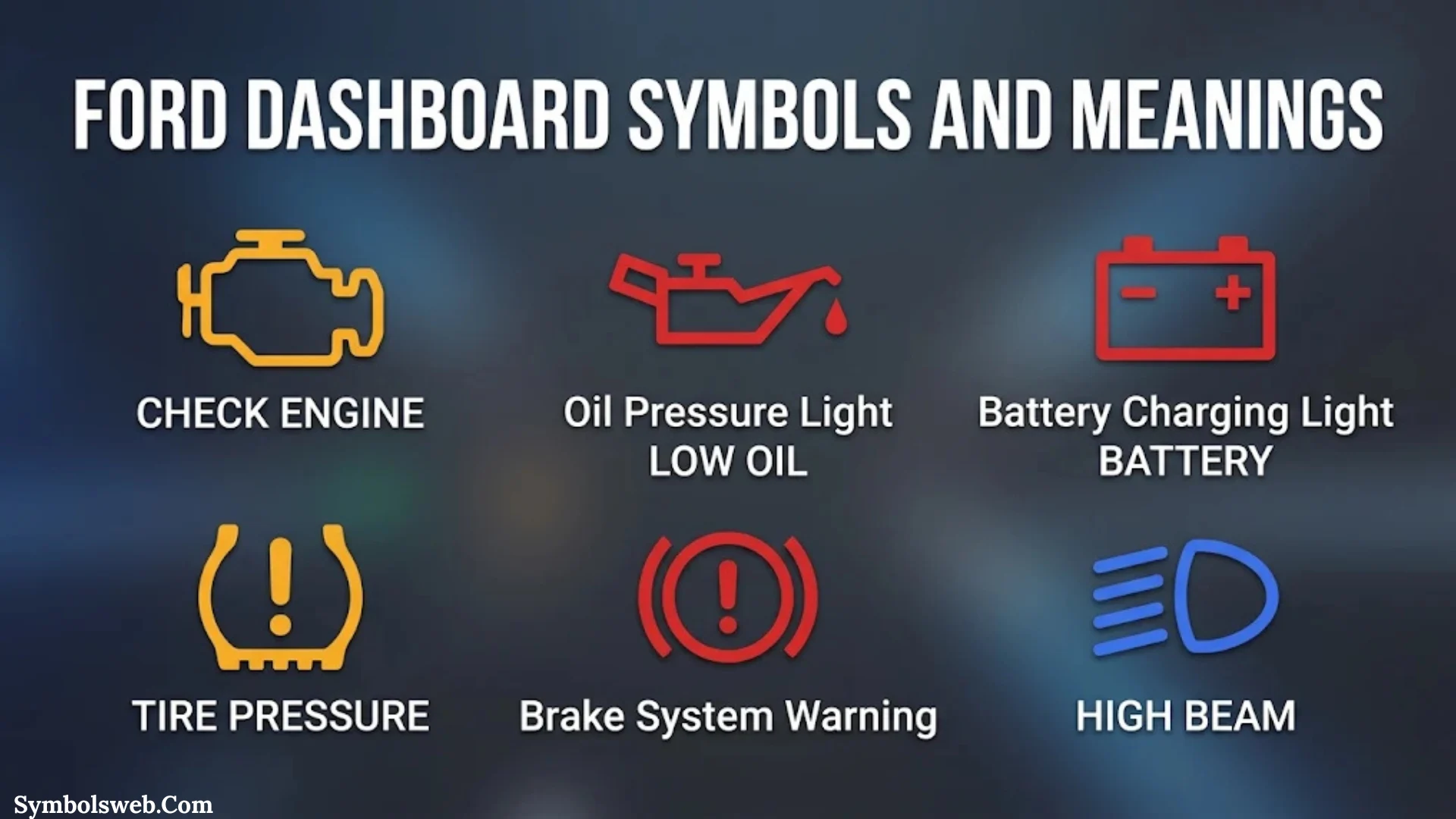
Understanding Ford dashboard symbols and meanings is essential for every Ford owner. Your vehicle’s dashboard displays important warning lights and indicators that help you monitor its condition, identify potential problems, and drive safely. Some symbols are normal indicators, while others warn you about issues that may need immediate attention.
In this guide, we’ll explain the most common Ford dashboard warning lights, what each symbol means, and what action you should take when it appears. From the check engine light and battery warning to oil pressure, tire pressure, and brake system alerts, you’ll learn how to recognize each symbol.
If you drive a Ford F 150, Escape, Explorer, Focus, Fusion, or Mustang, this guide will help you understand your dashboard alerts. By knowing what these symbols mean, you can avoid unnecessary repairs, respond to problems early, and keep your Ford running safely and smoothly.
Ford Dashboard Symbols and Meanings: (Quick Answer)
Ford dashboard symbols and meanings refer to the warning lights, indicator icons, and information symbols displayed on a Ford vehicle’s instrument cluster. They alert drivers to mechanical problems, safety concerns, maintenance needs, and active vehicle features. Their colors usually indicate urgency, but exact meanings vary by Ford model and year.
Quick Facts About Ford Dashboard Symbols and Meanings
| Aspect | Information |
| Origin | Automotive instrument panels and standardized vehicle warning indicators |
| Historical Significance | Developed to communicate vehicle conditions through simple visual icons |
| Main Meaning | Alerts drivers to vehicle faults, safety concerns, maintenance needs, and active features |
| Warning Colors | Red, amber, yellow, green, blue, and sometimes white |
| Main Categories | Engine, brakes, battery, tires, safety, transmission, lighting, and driver assistance |
| Cultural Importance | Dashboard symbols create a shared visual language that helps drivers understand vehicle conditions |
| Modern Usage | Used in Ford cars, SUVs, trucks, hybrids, and electric vehicles |
What Are Ford Dashboard Symbols and Meanings?
Ford dashboard symbols are visual indicators that appear on the instrument cluster to communicate information about your vehicle. They help you recognize problems, monitor important systems, and understand which driving features are currently active.
These symbols can appear when you turn the ignition on, start the engine, or drive your vehicle. Some disappear after a few seconds because they are part of a normal system check. Others remain illuminated to warn you about a problem.
The History of Dashboard Warning Symbols
Early automobiles relied heavily on mechanical gauges and simple indicator lamps. Drivers had to monitor basic information such as fuel levels, engine temperature, and oil pressure.
As vehicles became more advanced, manufacturers introduced additional warning lights to communicate problems with electrical systems, brakes, airbags, and engine controls.
Ford gradually expanded its instrument panel indicators as vehicle technology developed. Modern Ford vehicles use a combination of illuminated symbols, digital displays, audible alerts, and written messages.
Today, a Ford dashboard can communicate information about dozens of systems without requiring drivers to understand complicated mechanical details.
Why Ford Dashboard Symbols Are Important
Dashboard warning lights provide an early indication that something may need attention.
For example, an illuminated oil pressure warning could indicate that the engine isn’t receiving enough lubrication. Ignoring it may lead to serious engine damage.
Similarly, a tire pressure warning can alert you to an underinflated tire before it affects handling or causes additional tire damage.
Understanding these symbols helps you:
- Recognize dangerous vehicle conditions.
- Identify problems before they become more expensive.
- Understand when professional inspection is necessary.
- Monitor fuel consumption and engine performance.
- Keep important safety systems working correctly.
- Avoid unnecessary breakdowns and roadside emergencies.
Understanding Ford Dashboard Warning Light Colors
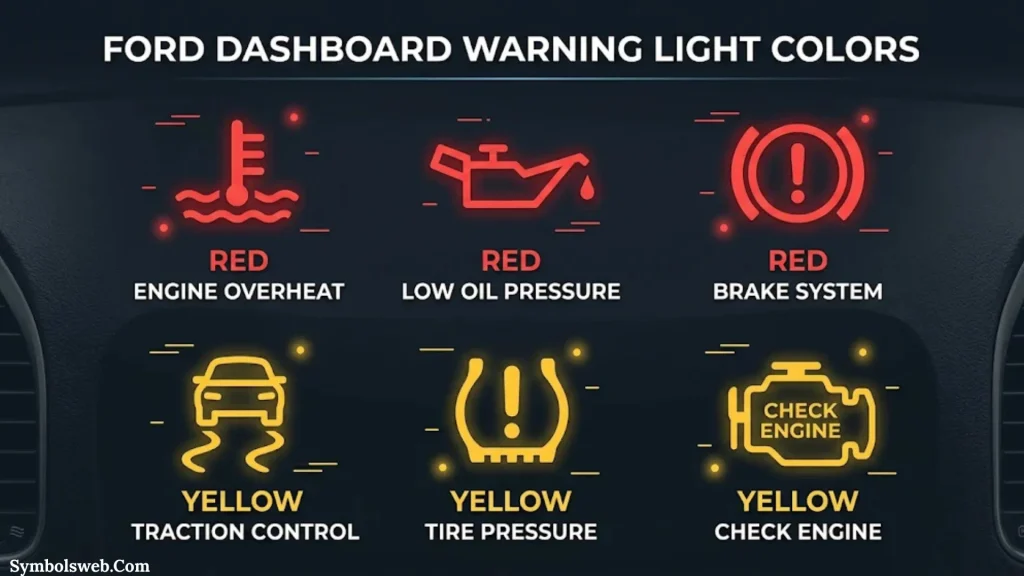
The color of a Ford dashboard symbol provides an important clue about its meaning and urgency. However, color alone doesn’t tell you everything. Always consider the accompanying message and the vehicle’s behavior.
Red Dashboard Warning Lights
Red warning lights generally indicate a serious condition that may affect vehicle safety or cause mechanical damage.
Examples include:
- Engine oil pressure warning.
- Engine coolant temperature warning.
- Brake system warning.
- Battery charging warning.
- Seatbelt warning.
- Some airbag and restraint system warnings.
If a red warning appears while driving, stop as soon as it is safe when the warning indicates an immediate hazard. Switch off the engine when instructed.
Amber or Yellow Dashboard Warning Lights
Amber and yellow lights usually indicate a fault, reduced functionality, or a maintenance requirement.
Examples include:
- Check engine light.
- ABS warning.
- Tire pressure warning.
- Traction control warning.
- Transmission or powertrain warning.
- Diesel particulate filter warning.
Check the owner’s manual and arrange an inspection when necessary. Some amber warnings, especially flashing check engine lights, require immediate action.
Green Dashboard Indicator Lights
Green symbols usually show that a vehicle feature is active or operating.
Examples include:
- Turn signal indicators.
- Cruise control indicators.
- Low-beam headlights.
- Lane-keeping assistance indicators.
- Auto Start-Stop indicators.
Blue Dashboard Indicator Lights
Blue dashboard indicators commonly show that a particular lighting or vehicle function is active.
The most familiar example is the high-beam headlight indicator.
Important: Ford uses different colors and display designs across its vehicle range. The owner’s manual provides the exact interpretation for your model.
Common Ford Dashboard Symbols and Their Meanings
The following guide explains some of the most important Ford dashboard warning lights and indicators. The descriptions include their typical appearance, meaning, and recommended response.
Check Engine Light
Meaning: Engine or emissions system problem.
Color: Amber or yellow.
Appearance: An illuminated engine-shaped outline.
The check engine light, also called the malfunction indicator lamp (MIL), is one of the most recognizable Ford dashboard symbols.
It means the onboard diagnostic system has detected a problem involving the engine, emissions equipment, or related components.
Possible causes include:
- Loose or damaged fuel cap.
- Faulty oxygen sensor.
- Defective mass air flow sensor.
- Spark plug or ignition coil problems.
- Fuel injection issues.
- Catalytic converter problems.
- Vacuum leaks.
What should you do?
If the light stays on continuously and the vehicle runs normally, arrange a diagnostic inspection soon. If it flashes, reduce speed, avoid heavy acceleration, and seek immediate service. A flashing light can indicate an engine misfire that may damage the catalytic converter.
Engine Oil Pressure Warning Light
Meaning: Low engine oil pressure or lubrication system fault.
Color: Red.
Appearance: An oil can with a dripping drop.
This is one of the most serious Ford dashboard warning lights.
Engine oil lubricates moving components and reduces friction inside the engine. When oil pressure drops, important parts may not receive enough lubrication.
Common causes include:
- Low engine oil level.
- Oil pump failure.
- Oil leaks.
- Blocked oil passages.
- Incorrect engine oil.
- Worn internal engine components.
What should you do?
Stop the vehicle safely and turn off the engine. Check the oil level after parking on level ground and following the owner’s manual instructions.
If the oil level is low, use the correct oil specification. However, adding oil doesn’t automatically solve a pressure problem.
Do not continue driving if the warning remains illuminated. Arrange professional assistance.
Engine Coolant Temperature Warning Light
Meaning: Engine overheating.
Color: Red.
Appearance: A thermometer above wavy lines.
The coolant temperature warning tells you that the engine may be overheating.
Your Ford’s cooling system controls engine temperature and prevents excessive heat from damaging internal components.
Possible causes include:
- Low coolant level.
- Coolant leaks.
- Faulty thermostat.
- Damaged radiator.
- Water pump failure.
- Cooling fan problems.
What should you do?
Pull over safely and switch off the engine. Allow it to cool before checking the coolant level.
Never remove a hot coolant reservoir cap because pressurized coolant can cause severe burns.
If the warning returns or the engine continues overheating, arrange professional inspection.
Battery Warning Light
Meaning: Charging system malfunction.
Color: Red.
Appearance: A battery outline with plus and minus signs.
The battery warning light usually indicates a problem with the vehicle’s charging system rather than simply a weak battery.
Possible causes include:
- Faulty alternator.
- Damaged battery cables.
- Loose electrical connections.
- Worn drive belt.
- Defective battery.
- Charging system wiring problems.
What should you do?
Turn off unnecessary electrical equipment and find a safe place to stop. Have the charging system inspected as soon as possible.
If the alternator stops charging, your vehicle may eventually lose electrical power and stall.
Brake System Warning Light
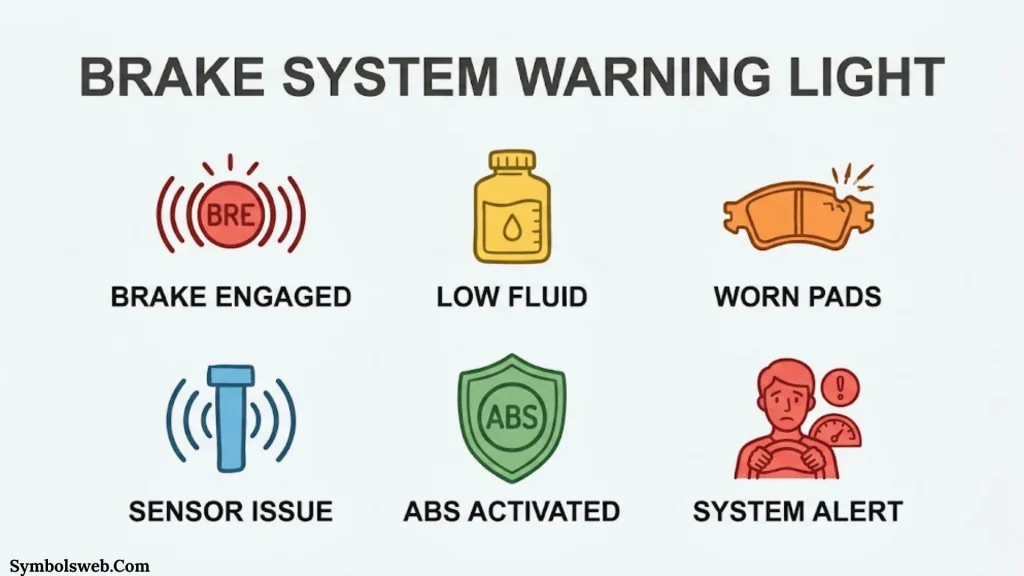
Meaning: Parking brake engaged, low brake fluid, or brake system fault.
Color: Red.
Appearance: An exclamation mark inside a circle.
The brake warning light indicates that your Ford’s braking system needs attention.
It may illuminate when the parking brake is engaged. However, if it remains on after you release the parking brake, a more serious issue may exist.
Possible causes include:
- Low brake fluid.
- Brake fluid leakage.
- Parking brake malfunction.
- Hydraulic brake system problems.
- Brake system sensor failure.
What should you do?
Check whether the parking brake is fully released. If the warning remains on, stop safely and avoid continuing your journey until the braking system has been checked.
A brake warning light should never be ignored because it may indicate reduced braking performance.
Anti Lock Braking System (ABS) Warning Light
Meaning: Anti-lock braking system malfunction.
Color: Amber or yellow.
Appearance: ABS letters inside a circle.
The ABS warning light indicates a problem with the anti-lock braking system.
ABS helps prevent the wheels from locking during hard braking. This allows drivers to maintain better steering control in emergency braking situations.
Possible causes include:
- Faulty wheel speed sensor.
- Damaged ABS wiring.
- ABS control module failure.
- Faulty wheel bearing sensor.
- Low system voltage.
What should you do?
Drive cautiously and arrange an inspection as soon as possible. Normal braking may remain available, but the anti-lock function may not work.
If the red brake warning light appears alongside the ABS warning, stop safely and seek professional assistance.
Tire Pressure Monitoring System (TPMS) Warning Light
Meaning: One or more tires have low air pressure.
Color: Amber or yellow.
Appearance: A horseshoe-shaped tire with an exclamation mark.
The tire pressure warning light alerts you when one or more tires have pressure below the recommended level.
Low tire pressure can affect:
- Steering control.
- Braking performance.
- Fuel efficiency.
- Tire lifespan.
- Vehicle stability.
What should you do?
Check all four tires with a reliable pressure gauge. Inflate them according to the recommended pressure on the driver’s door label or in the owner’s manual.
Don’t rely on the maximum pressure printed on the tire sidewall as the recommended vehicle pressure.
If the TPMS light flashes before remaining illuminated, the monitoring system may have a fault rather than simply low tire pressure.
Airbag Warning Light
Meaning: Supplemental restraint system malfunction.
Color: Usually red.
Appearance: A seated person with a circle representing an airbag.
The airbag warning light indicates a possible problem with the supplemental restraint system (SRS).
This system includes airbags, sensors, wiring, and related safety components.
Possible causes include:
- Faulty airbag sensors.
- Damaged wiring.
- Seatbelt pretensioner problems.
- Defective airbag control module.
- Electrical connection issues.
What should you do?
Arrange an inspection as soon as possible. If this warning remains illuminated, some airbags or restraint features may not operate correctly during a collision.
Never attempt to repair airbag wiring or components without proper training.
Seatbelt Warning Light
Meaning: Driver or passenger seatbelt is not fastened.
Color: Usually red.
Appearance: A seated person wearing a seatbelt.
The seatbelt warning reminds occupants to fasten their seatbelts.
Some Ford vehicles also produce an audible warning until the seatbelt is secured.
What should you do?
Fasten your seatbelt before driving. Check that passengers are also wearing theirs.
If the warning remains illuminated despite properly fastened seat belts, the buckle sensor or related wiring may need inspection.
Traction Control Warning Light
Meaning: Traction control system is active or has detected a fault.
Color: Amber.
Appearance: A car with wavy skid marks.
Ford’s traction control system helps prevent the drive wheels from spinning excessively when accelerating.
You may notice this light flashing when driving on slippery roads, loose gravel, or wet surfaces.
What should you do?
If the light flashes briefly, the system may simply be working to maintain traction. Reduce acceleration and drive carefully.
If it stays illuminated, the system may be disabled or experiencing a fault. Have it checked.
Traction Control Off Light
Meaning: Traction control has been switched off.
Color: Amber.
Appearance: A skidding car symbol with OFF underneath.
This symbol appears when you manually disable the traction control system or when a vehicle condition prevents normal operation.
What should you do?
If you didn’t intentionally disable traction control, check the vehicle settings and owner’s manual.
Reactivate the system when appropriate, especially before driving on slippery roads.
Power Steering Warning Light
Meaning: Power steering system malfunction.
Color: Red or amber.
Appearance: A steering wheel with an exclamation mark.
This warning indicates that your Ford may have a problem with its power steering system.
Modern Ford vehicles often use electric power-assisted steering (EPAS).
Possible causes include:
- Electrical system problems.
- Steering angle sensor faults.
- Power steering control module issues.
- Wiring problems.
- Low system voltage.
What should you do?
Be prepared for heavier steering. Reduce speed and stop safely if steering becomes difficult or unpredictable.
Arrange professional inspection before continuing normal driving.
Low Fuel Warning Light
Meaning: Fuel level is low.
Color: Amber or yellow.
Appearance: A fuel pump icon.
The low fuel warning appears when the fuel level approaches the reserve level.
It gives you time to find a fuel station before the tank becomes empty.
What should you do?
Refuel as soon as possible. Don’t depend on a fixed remaining driving distance because fuel consumption and reserve capacity vary between Ford models.
Door Ajar Warning Light
Meaning: One or more doors are not properly closed.
Color: Usually red.
Appearance: A vehicle outline showing an open door.
The door ajar symbol warns you that a door isn’t fully closed.
Some Ford models also display the specific door that needs attention.
What should you do?
Stop safely and check all doors, including the rear doors. Make sure each one is properly latched.
Seatbelt Pretensioner or Restraint System Warning
Meaning: Possible fault in the seat belt restraint system.
Color: Usually red.
Appearance: May resemble the airbag or SRS warning.
Some Ford vehicles display separate restraint-related messages.
These can indicate problems with seatbelt pretensioners, occupancy sensors, or related safety equipment.
What should you do?
Have the restraint system inspected by a qualified technician. Avoid interfering with seatbelt pretensioners or electrical connectors.
Transmission Temperature Warning Light
Meaning: Transmission temperature is too high.
Color: Usually red or amber.
Appearance: A gear or transmission symbol with a temperature indicator.
This warning indicates that the automatic transmission may be overheating.
Possible causes include:
- Heavy towing.
- Extended driving under high load.
- Transmission fluid problems.
- Cooling system faults.
- Transmission component failure.
What should you do?
Follow the warning message and owner’s manual instructions. Stop safely if instructed and allow the transmission to cool.
Don’t continue towing or driving under heavy load while the warning remains active.
Wrench or Powertrain Malfunction Warning Light
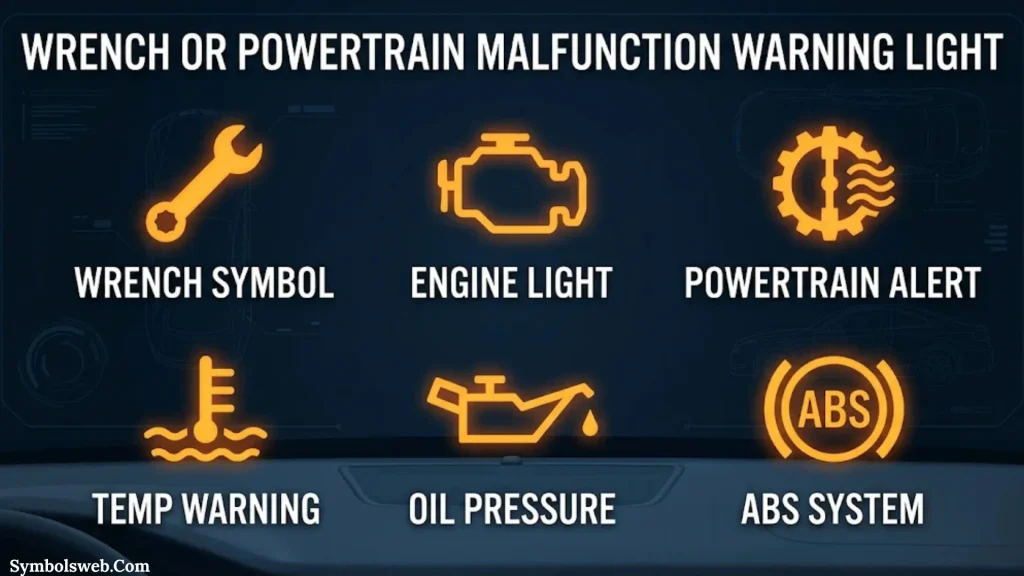
Meaning: Powertrain or electronic throttle control fault.
Color: Often amber.
Appearance: A wrench or spanner symbol.
Ford uses the wrench symbol on certain models to indicate a powertrain malfunction.
The powertrain includes important components such as the engine, transmission, and related electronic controls.
Possible causes include:
- Electronic throttle control faults.
- Transmission problems.
- Engine management faults.
- Sensor failures.
- Electrical problems.
What should you do?
Check whether the vehicle has reduced power or unusual transmission behavior. Arrange a diagnostic inspection as soon as possible.
If the vehicle becomes unsafe to operate, stop and arrange recovery.
Glow Plug Warning Light
Meaning: Diesel engine preheating system.
Color: Usually amber.
Appearance: A horizontal coil or heating element.
The glow plug indicator appears in Ford diesel vehicles.
Glow plugs help heat the combustion chambers during cold starts.
What should you do?
Wait for the indicator to turn off before starting the engine when the owner’s manual instructs you to do so.
If it flashes or remains illuminated after starting, the diesel engine management system may have detected a fault.
Diesel Particulate Filter (DPF) Warning Light
Meaning: Diesel particulate filter requires attention or regeneration.
Color: Usually amber.
Appearance: An exhaust filter symbol with small particles or dots.
The diesel particulate filter captures soot particles from diesel exhaust.
Over time, the filter collects soot and needs regeneration to burn it away.
Possible reasons for a warning include:
- Repeated short journeys.
- Interrupted regeneration.
- Heavy soot accumulation.
- DPF system faults.
What should you do?
Follow the regeneration instructions in your specific Ford owner’s manual. Some vehicles require a suitable period of steady driving under particular conditions.
If the warning remains illuminated or another engine warning appears, seek professional assistance.
Diesel Exhaust Fluid (DEF or AdBlue) Warning Light
Meaning: Low diesel exhaust fluid or an emissions system fault.
Color: Amber or yellow.
Appearance: DEF or AdBlue fluid container symbol.
Some Ford diesel vehicles use selective catalytic reduction (SCR) technology to reduce nitrogen oxide emissions.
This system requires diesel exhaust fluid, commonly called DEF or AdBlue.
What should you do?
Check the fluid level and refill using the correct product if necessary. If the warning indicates a system fault or poor fluid quality, arrange an inspection.
Some vehicles display a countdown before restricting or preventing another engine start if the fluid runs out.
Cruise Control Indicator
Meaning: Cruise control is switched on or engaged.
Color: Usually green.
Appearance: A speedometer with an arrow or indicator.
This indicator shows that your Ford’s cruise control system is active.
Depending on the model, the display may distinguish between cruise control being switched on and a driving speed being set.
What should you do?
No repair is usually necessary when the indicator appears during normal operation.
Adaptive Cruise Control Warning or Indicator
Meaning: Adaptive cruise control status or system limitation.
Color: Varies by operating mode.
Appearance: A vehicle with distance bars or a speed control symbol.
Adaptive cruise control helps maintain a selected speed and following distance from the vehicle ahead.
Depending on the Ford model, different symbols may show whether the system is active, paused, unavailable, or displaying a warning.
What should you do?
Check the instrument display for additional messages. If the system becomes unavailable, drive manually and maintain a safe following distance.
Lane Keeping Assist Warning Light
Meaning: Lane-keeping assistance status.
Color: Usually green or amber.
Appearance: A vehicle between lane markings.
Lane Keeping Assist helps drivers remain within marked road lanes.
The system uses a forward-facing camera to monitor lane markings and may provide steering assistance or warnings.
What should you do?
If the indicator shows the feature is active, no action is normally necessary.
If a warning appears, check whether the camera view is blocked or whether road conditions prevent the system from detecting lane markings.
Blind Spot Information System (BLIS) Warning Light
Meaning: Blind spot monitoring status or fault.
Color: Usually amber for warnings.
Appearance: A vehicle with nearby detection markings.
Ford’s Blind Spot Information System helps detect vehicles in areas that may be difficult to see through your mirrors.
A warning light or mirror indicator can alert you when another vehicle enters the monitored area.
What should you do?
Check your mirrors and blind spots before changing lanes. If the system displays a fault, arrange an inspection.
Hill Descent Control Indicator
Meaning: Hill descent control is active or available.
Color: Usually green or amber.
Appearance: A vehicle moving down a steep slope.
Hill Descent Control helps maintain a controlled speed when traveling down steep or slippery slopes.
The system can automatically apply braking to help prevent the vehicle from accelerating too quickly.
What should you do?
When the indicator shows normal activation, follow the system’s operating instructions and maintain control of the vehicle.
Auto Start Stop Indicator
Meaning: Engine automatically stops or the system is unavailable.
Color: Green or amber, depending on status.
Appearance: Letter A surrounded by a circular arrow.
The Auto Start-Stop system automatically switches off the engine when the vehicle stops under suitable conditions.
It restarts the engine when you are ready to move again.
What should you do?
A normal green indicator generally means the feature is operating. An amber indicator or fault message may indicate a problem that needs inspection.
High Beam Indicator
Meaning: High-beam headlights are active.
Color: Blue.
Appearance: A headlamp symbol with straight horizontal light rays.
This symbol appears when your Ford’s high-beam headlights are switched on.
High beams provide stronger forward illumination for dark roads.
What should you do?
Switch to low beams when approaching other vehicles or when driving behind another vehicle to avoid dazzling other drivers.
Low Beam Headlight Indicator
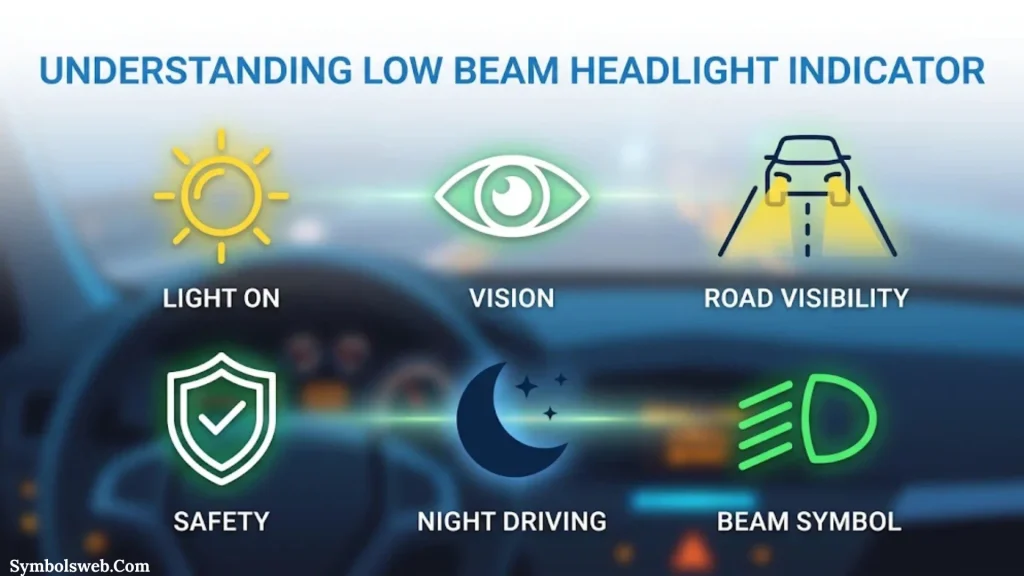
Meaning: Low-beam headlights are switched on.
Color: Usually green.
Appearance: Headlight symbol with downward-sloping light rays.
The low-beam indicator confirms that your regular headlights are active.
These lights are suitable for normal nighttime driving and situations where high beams could distract other road users.
Fog Light Indicator
Meaning: Front or rear fog lights are switched on.
Color: Green for front fog lights and commonly amber for rear fog lights.
Appearance: Headlamp symbol with a wavy line.
Fog light indicators confirm that the vehicle’s fog lights are active.
Front fog lights improve visibility in certain poor weather conditions. Rear fog lights help following drivers see your vehicle when visibility is severely reduced.
What should you do?
Use fog lights only when weather conditions justify them. Switch them off when visibility improves.
Turn Signal Indicator
Meaning: Left or right turn signal is activated.
Color: Green.
Appearance: Left or right pointing arrows.
The turn signal indicators flash when you activate your vehicle’s direction indicators.
If one arrow flashes much faster than usual, a turn signal bulb or circuit may have a problem.
What should you do?
Check the exterior indicator lights and replace any failed bulbs or arrange electrical repairs.
Door Lock or Security System Indicator
Meaning: Vehicle anti-theft system is activated.
Color: Usually red.
Appearance: A security light or vehicle lock symbol.
Ford vehicles equipped with the SecuriLock passive anti-theft system may display a flashing security indicator when the vehicle is locked or the system is armed.
What should you do?
A flashing security indicator can be normal when the vehicle is secured. If the vehicle refuses to start or displays an anti-theft fault, check the key and owner’s manual.
Windshield Washer Fluid Warning Light
Meaning: Washer fluid level is low.
Color: Usually amber.
Appearance: A windshield with spray lines.
This symbol indicates that your windshield washer reservoir needs more fluid.
What should you do?
Refill the reservoir with suitable windshield washer fluid. Avoid using products that could damage the washer system.
Rear Window Defrost Indicator
Meaning: Rear window heating is activated.
Color: Usually amber or orange.
Appearance: A rectangular window with upward wavy lines.
This indicator appears when the rear window defroster is switched on.
The heating elements help remove condensation, frost, and light ice from the rear glass.
What should you do?
Allow the system to clear the window. Switch it off when visibility is restored if it doesn’t deactivate automatically.
Frost or Low Outside Temperature Warning
Meaning: Outside temperature is low and icy conditions may occur.
Color: Blue or amber, depending on model.
Appearance: A snowflake symbol.
The frost warning alerts drivers when outside temperatures approach freezing conditions.
Even when the road looks dry, bridges, shaded areas, and exposed surfaces may become slippery.
What should you do?
Reduce speed, increase following distance, and avoid sudden braking or steering movements.
Low Washer or Coolant Fluid Messages
Some Ford models display separate fluid-related messages instead of traditional warning symbols.
Examples include:
- Low engine coolant.
- Low windshield washer fluid.
- Low brake fluid.
- Low diesel exhaust fluid.
Read the accompanying message carefully because different fluids require different responses. Never treat a low coolant or brake fluid warning as a routine maintenance reminder.
Types and Variations of Ford Dashboard Symbols
Ford dashboard symbols can be divided into several groups based on the vehicle system they monitor.
| Category | Common Symbols | Main Purpose |
| Engine and powertrain | Check engine, wrench, oil pressure | Monitor engine and transmission health |
| Braking system | Brake, ABS, parking brake | Monitor braking performance |
| Electrical system | Battery, charging system | Monitor electrical power |
| Tire and stability | TPMS, traction control | Support tire safety and vehicle control |
| Passenger safety | Airbag, seatbelt | Monitor occupant protection |
| Driver assistance | BLIS, lane keeping, adaptive cruise | Support driving awareness |
| Lighting | High beam, low beam, fog lights | Show lighting status |
| Diesel systems | Glow plug, DPF, DEF | Monitor diesel engine and emissions systems |
| Convenience features | Cruise control, Auto Start-Stop | Show active vehicle functions |
Warning Lights
Warning lights indicate a condition that may require attention.
They can be related to engine operation, brakes, battery charging, tire pressure, or vehicle safety.
Indicator Lights
Indicator lights confirm that a particular feature is switched on or operating.
Examples include turn signals, headlights, cruise control, and traction control activation.
Maintenance Reminder Symbols
Some Ford vehicles display reminders for scheduled servicing, oil changes, and other maintenance tasks.
These reminders are designed to help owners follow the recommended maintenance schedule.
Digital Dashboard Messages
Newer Ford vehicles use digital instrument clusters that can display text messages alongside traditional symbols.
For example, the dashboard might show a warning such as “Engine Coolant Over Temperature” or “Transmission Limited Function.”
These messages provide additional information that a symbol alone may not communicate.
Ford Dashboard Symbols Across Different Models
Not every Ford vehicle uses the same dashboard layout or warning symbols. Equipment, engine type, model year, and available technology all influence which indicators appear.
Ford F 150 Dashboard Symbols
The F-150 can display engine, towing, trailer, tire pressure, transmission, and driver assistance indicators. Some versions also include specialized off-road and four-wheel-drive messages.
Ford Ranger Dashboard Symbols
Ranger dashboards may include diesel engine warnings, DPF indicators, four-wheel-drive status, hill descent control, and trailer-related messages, depending on configuration.
Ford Mustang Dashboard Symbols
Mustang models may display performance-related indicators, engine warnings, tire pressure alerts, stability control, and selectable driving mode information.
Ford Escape Dashboard Symbols
Escape dashboards commonly include hybrid system indicators on equipped versions, along with engine, braking, tire pressure, and driver assistance warnings.
Ford Explorer Dashboard Symbols
Explorer models may feature adaptive cruise control, lane keeping, blind spot monitoring, four-wheel-drive indicators, and powertrain warnings.
Ford Focus Dashboard Symbols
Focus dashboards can display common engine, ABS, battery, tire pressure, traction control, and electronic steering warnings.
Ford EcoSport Dashboard Symbols
Depending on the market and model year, the EcoSport may display engine, braking, fuel, battery, airbag, and stability control indicators.
Ford Mustang Mach-E Dashboard Symbols
The electric SUV uses additional indicators for battery charge, high-voltage systems, regenerative braking, and electric powertrain conditions.
These examples are general model-family guides. The actual indicators depend on the vehicle’s year, market, and equipment.
Ford Dashboard Symbols in Hybrid and Electric Vehicles
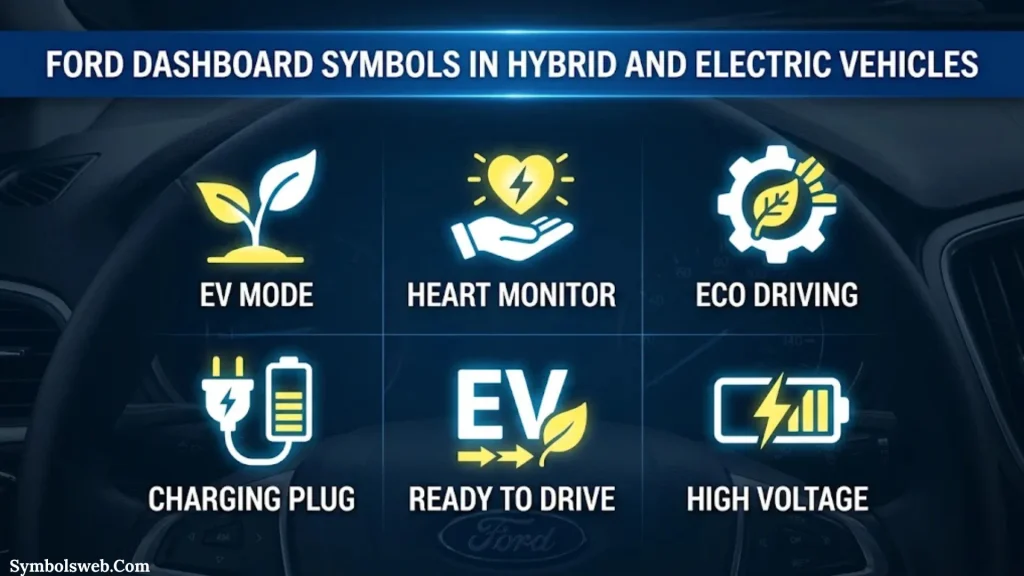
Hybrid and electric Ford vehicles use some traditional warning lights alongside indicators for high-voltage batteries, electric motors, and charging systems.
Hybrid System Warning Light
This warning indicates a possible problem with the hybrid powertrain.
It may involve the electric motor, hybrid battery, power electronics, or related control systems.
What should you do? Follow the dashboard message and arrange a professional inspection. Avoid attempting to service high-voltage components yourself.
High-Voltage Battery Warning
This symbol or message indicates a possible issue with the vehicle’s high-voltage battery system.
The battery supplies energy to the electric motor and supports hybrid or electric driving.
What should you do? Stop safely if instructed and contact an authorized Ford service center.
Electric Vehicle Charging Indicator
This indicator shows the charging status of an electric Ford vehicle.
Depending on the model, it may communicate charging activity, charging completion, or a problem with the charging connection.
What should you do? Check the charging cable, connector, and dashboard message if charging doesn’t begin or complete as expected.
Regenerative Braking Indicator
Regenerative braking helps recover some energy during deceleration and braking.
The system converts vehicle movement into electrical energy that can recharge the battery.
What should you do? A normal indicator requires no action. If a fault message appears, follow the instructions on the instrument display.
Similar Dashboard Symbols and Their Differences
Some Ford dashboard symbols look similar but communicate different conditions. Understanding these differences helps prevent unnecessary confusion.
| Dashboard Symbols | Main Difference |
| Check engine vs. wrench | Check engine generally relates to engine or emissions faults; wrench can indicate a powertrain or electronic throttle fault on equipped models |
| Brake warning vs. ABS | Brake warning can indicate parking brake engagement or a brake system problem; ABS indicates an anti-lock braking fault |
| Traction control vs. traction control OFF | One indicates system activity; the other indicates that the system is switched off |
| Oil pressure vs. oil change reminder | Oil pressure indicates a potentially serious lubrication problem; an oil change reminder indicates scheduled maintenance |
| Battery vs. low battery key warning | Battery warning relates to the vehicle charging system; a key warning generally concerns the remote key battery |
| High beam vs. low beam | High beam provides stronger forward lighting; low beam is intended for regular road use |
| Airbag vs. seat belt | Airbag indicates a restraint system issue; seatbelt reminds occupants to fasten their belts |
| DPF vs. check engine | DPF relates to the diesel particulate filter; check engine can indicate various engine or emissions faults |
Check Engine Light vs. Wrench Light
These two indicators are particularly easy to confuse.
The check engine light generally points to an engine management or emissions-related issue.
The wrench light on certain Ford vehicles indicates a powertrain or electronic throttle control concern.
Neither symbol identifies one exact failed part. A diagnostic scan may be needed to determine the underlying cause.
ABS Light vs. Brake Warning Light
The ABS warning generally indicates that the anti-lock braking function has developed a fault.
The red brake warning can indicate a more serious braking issue, including low brake fluid.
If both appear together, take the warning seriously and stop safely.
Oil Pressure Warning vs. Oil Change Reminder
An oil pressure warning requires immediate attention because insufficient oil pressure can damage the engine.
An oil change reminder indicates that scheduled engine oil maintenance is due.
These symbols communicate very different levels of urgency.
What to Do When a Ford Dashboard Warning Light Appears
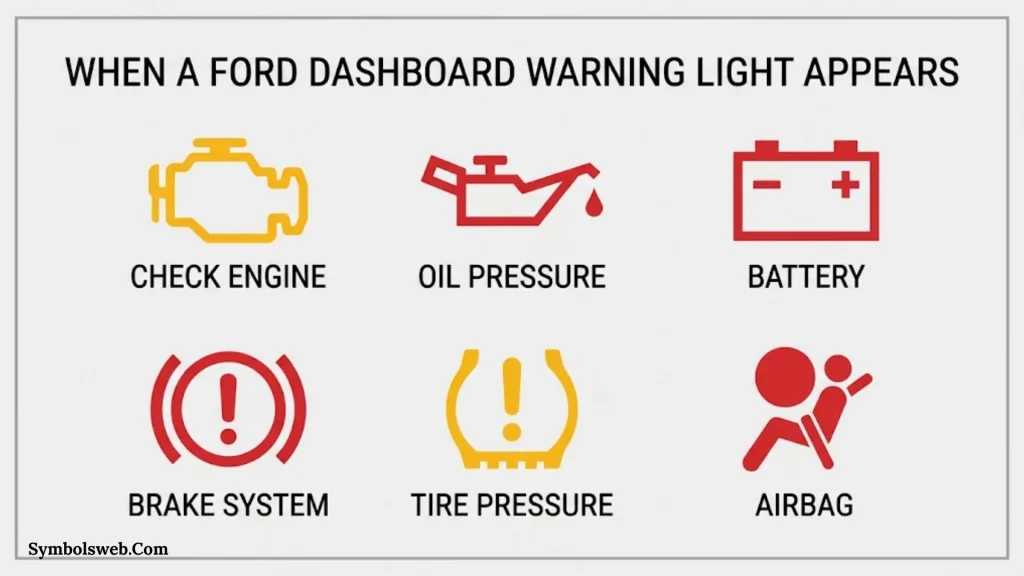
Seeing an unfamiliar warning light can be stressful, especially when you’re traveling or driving in heavy traffic. However, a calm response can prevent a small issue from becoming a major problem.
Follow these steps when a new symbol appears.
Identify the Warning Symbol
Look at the instrument cluster and identify the symbol or message.
If you cannot recognize it, consult the warning lamps section of your Ford owner’s manual.
Don’t try to identify a symbol while driving. Pull over safely before checking the display.
Check the Warning Color
Look at the color of the warning light.
- Red generally indicates a serious condition.
- Amber or yellow usually indicates a fault or system concern.
- Green generally confirms an active feature.
- Blue commonly identifies a lighting or other operating status.
Remember that some amber warnings also require immediate action.
Pay Attention to Sounds and Messages
Your Ford may produce a chime or display a message alongside the warning light.
For example, a warning message might explain that the engine is overheating or the transmission needs attention.
Read the message because it can provide important information about what to do next.
Check Whether the Vehicle Behaves Normally
Notice any changes in vehicle performance.
Important signs include:
- Unusual engine noises.
- Smoke coming from the engine area.
- Burning smells.
- Reduced engine power.
- Difficulty steering.
- Changes in braking performance.
- Unusual vibrations.
- Excessive engine temperature.
If the vehicle behaves abnormally, stop safely and seek assistance.
Use an OBD II Scanner When Appropriate
An OBD-II scanner can retrieve diagnostic trouble codes from compatible vehicle systems.
These codes help technicians investigate problems related to engine performance, emissions, and other supported systems.
However, a diagnostic code doesn’t always identify the exact failed component.
A proper diagnosis may require additional testing.
Contact a Qualified Technician
If a warning light remains illuminated, arrange an inspection.
Don’t clear a warning simply to make the dashboard look normal. The underlying problem may still exist.
For critical brake, steering, oil pressure, overheating, or high-voltage warnings, follow the vehicle’s stop or service instructions.
Why Do Ford Dashboard Warning Lights Come On and Then Disappear?
Not every dashboard light indicates a problem.
Many warning lights briefly illuminate when you switch on the ignition. This is part of a normal instrument cluster self-check.
The vehicle checks whether certain indicator lamps and systems are functioning.
A light that disappears after the engine starts may simply be completing this routine check.
However, a warning that appears while driving and then disappears can still indicate an intermittent problem.
Possible reasons include:
- Temporary sensor readings.
- Loose electrical connections.
- Changing battery voltage.
- Intermittent communication faults.
- Operating conditions that trigger a warning.
If the same warning repeatedly appears and disappears, arrange an inspection rather than assuming the problem has fixed itself.
Why Do Multiple Ford Dashboard Warning Lights Appear at Once?
Several warning lights can sometimes illuminate together.
This doesn’t always mean that several separate components have failed.
A single electrical or communication problem can affect multiple vehicle systems.
Common causes include:
Weak or Failing Battery
A weak battery can cause voltage fluctuations that interfere with electronic control modules.
This may trigger several warning lights simultaneously.
Alternator or Charging System Problems
If the alternator isn’t charging correctly, electrical systems may stop receiving the power they need.
This can produce multiple warning messages.
Faulty Wheel Speed Sensor
A wheel speed sensor provides information used by systems such as ABS and traction control.
If the sensor fails, several related warning indicators may appear.
Damaged Wiring or Electrical Connections
Loose connectors, corrosion, and damaged wiring can interrupt communication between vehicle systems.
Control Module Communication Problems
Modern Ford vehicles contain multiple electronic control modules.
A communication problem can affect several systems and produce related warnings.
What should you do?
Record the warning symbols and any accompanying messages. Have the vehicle scanned using suitable diagnostic equipment.
Avoid replacing several parts based only on the number of warning lights displayed.
How to Reset Ford Dashboard Warning Lights
The correct reset method depends on the warning and the vehicle model.
Some indicators disappear automatically after the underlying condition is corrected. Others require a manual reset or diagnostic procedure.
Resetting the Tire Pressure Warning Light
If the TPMS light appears because of low tire pressure:
- Park your Ford safely.
- Check the pressure in all tires.
- Inflate them to the recommended pressure.
- Drive the vehicle if the owner’s manual requires a relearning process.
- Follow the specific TPMS reset instructions for your model.
Some Ford vehicles automatically relearn tire pressure information. Others require a specific reset procedure.
Resetting the Oil Change Reminder
An oil change reminder can usually be reset through the instrument cluster settings or a model-specific button procedure.
However, reset it only after completing the required oil change.
Resetting the reminder without servicing the engine can lead to missed maintenance.
Resetting the Check Engine Light
The check engine light should not be reset before identifying and correcting the underlying problem.
A diagnostic scanner may clear the stored code after repairs. However, the warning can return if the fault remains.
Resetting Other Warning Indicators
Brake, airbag, ABS, steering, and powertrain warnings may require professional diagnostic equipment.
Never disconnect the battery or clear diagnostic codes simply to hide a safety-related warning.
Common Mistakes Drivers Make When Reading Ford Dashboard Symbols
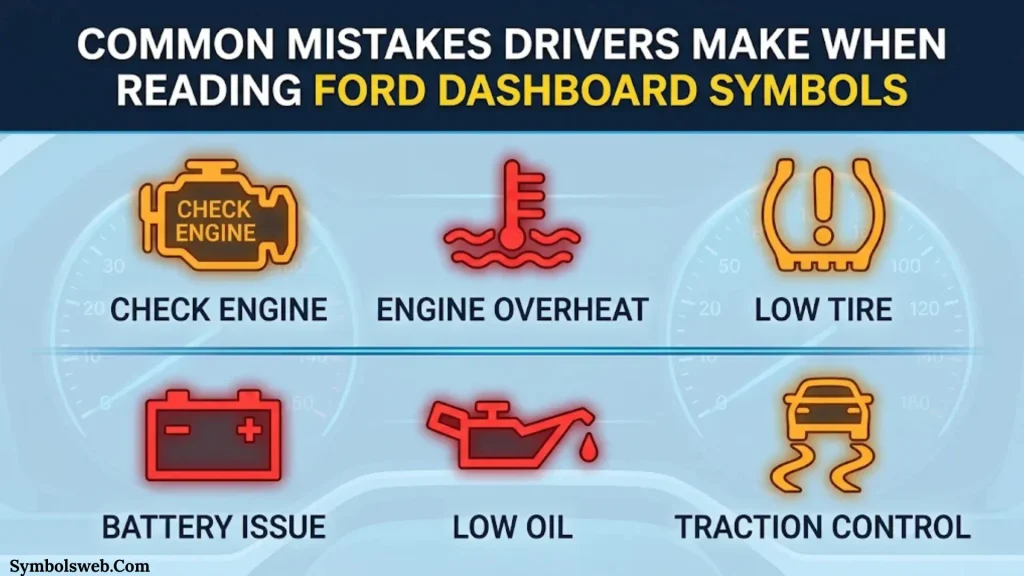
Understanding dashboard indicators is only useful when you respond correctly. Several common mistakes can increase repair costs or create unnecessary safety risks.
Ignoring a Red Warning Light
A red warning can indicate a serious problem.
Continuing to drive with an oil pressure or overheating warning may cause extensive engine damage.
Assuming Every Yellow Light Is Harmless
Amber warnings are not always minor.
A flashing check engine light can indicate a misfire that may damage the catalytic converter.
Confusing an Indicator With a Warning
A green cruise control symbol usually confirms that a feature is active.
It doesn’t mean the vehicle has developed a fault.
Resetting Warning Lights Without Repairs
Clearing a warning doesn’t necessarily solve the problem.
The underlying fault may remain and affect vehicle performance.
Using the Wrong Fluid or Replacement Part
Ford vehicles require fluids and parts that meet specific specifications.
Using the wrong engine oil, coolant, or other fluid can create additional problems.
Ignoring Written Dashboard Messages
A symbol may provide only a general warning. The accompanying message can explain the actual system condition and recommended response.
Always read both.
Interesting Facts About Ford Dashboard Symbols
1. Many warning symbols are internationally recognizable. Automotive pictograms allow drivers to understand basic vehicle conditions without reading lengthy instructions.
2. Some lights illuminate during startup without indicating a fault. This is a normal self-check performed by the instrument cluster.
3. A flashing check engine light can be more urgent than a steady one. It may indicate an active engine misfire.
4. Not every Ford uses the same dashboard layout. Instrument clusters change with model year, equipment, and market.
5. Modern Ford dashboards combine symbols and written messages. Digital displays provide additional details about vehicle conditions.
6. The wrench symbol has a specific role on certain Ford models. It can indicate powertrain or electronic throttle control problems.
7. Electric Ford vehicles use additional warning indicators. High-voltage batteries, charging systems, and electric powertrains require their own status information.
8. A flashing traction control symbol can indicate normal operation. It may mean the system is actively helping prevent wheel spin.
9. A low tire pressure warning doesn’t tell you which tire is damaged in every model. Some vehicles provide individual pressure readings while others require manual inspection.
10. The owner’s manual remains the most reliable reference. Ford advises owners to consult the correct manual because symbols can vary between models and over time.
Frequently Asked Questions About Ford Dashboard Symbols and Meanings
What are the most common Ford dashboard warning lights?
The most common Ford dashboard warning lights include the check engine light, oil pressure warning, battery warning, brake system warning, ABS light, tire pressure warning, airbag light, and coolant temperature warning.
Some indicators show normal vehicle functions, while others require immediate attention.
What does a red warning light mean on a Ford?
A red warning light generally indicates a serious vehicle condition that may affect safety or cause mechanical damage.
Examples include low oil pressure, engine overheating, and brake system problems. Stop safely and follow the instructions in your owner’s manual.
What does an orange or yellow light mean on a Ford dashboard?
An orange or yellow dashboard light usually indicates a fault, maintenance requirement, or system limitation.
Common examples include the check engine light, ABS warning, and tire pressure monitoring light. Some warnings require urgent inspection.
Why is my Ford check engine light flashing?
A flashing check engine light can indicate an active engine misfire.
This can increase exhaust temperatures and damage the catalytic converter. Reduce speed, avoid heavy acceleration, and arrange immediate professional inspection.
Can I drive my Ford with the check engine light on?
You may be able to drive a short distance if the check engine light stays on continuously and the vehicle operates normally. However, arrange a diagnostic inspection as soon as possible.
If it flashes, the engine runs roughly, or the vehicle loses power, stop safely and seek professional assistance.
Where can I find the meaning of a specific Ford dashboard symbol?
The best place to find the exact meaning is the owner’s manual for your vehicle.
You can also visit the official Ford Support website and access information for your specific vehicle. Look under the instrument cluster, warning lamps, and indicators.
Conclusion
Ford dashboard symbols and meanings help you understand your vehicle’s condition and recognize potential problems before they become serious. Every warning light has a purpose, from monitoring engine health to protecting passengers and improving driving safety.
Learning the difference between red warnings, amber alerts, and green indicators makes it easier to respond correctly. Never ignore a serious warning or reset a light without understanding its cause.
Your dashboard communicates with you every time you drive. Understanding its language can help keep your Ford reliable, safe, and ready for the road.

Eliana Foster is a writer with a passion for exploring the meanings behind symbols, traditions, and cultural history. She enjoys breaking down complex topics into simple, engaging articles that are easy for everyone to understand. Eliana is also the fictional author of The Hidden Language of Silent Marks and Beyond the Circle of Ancient Signs, two original book concepts created for her author profile. When she’s not writing, she loves visiting museums, reading about mythology, and researching the stories behind symbols from around the world. Her goal is to help readers discover the fascinating meanings hidden in everyday signs and ancient emblems.
 Ethan Holloway
 Jordan Hayes