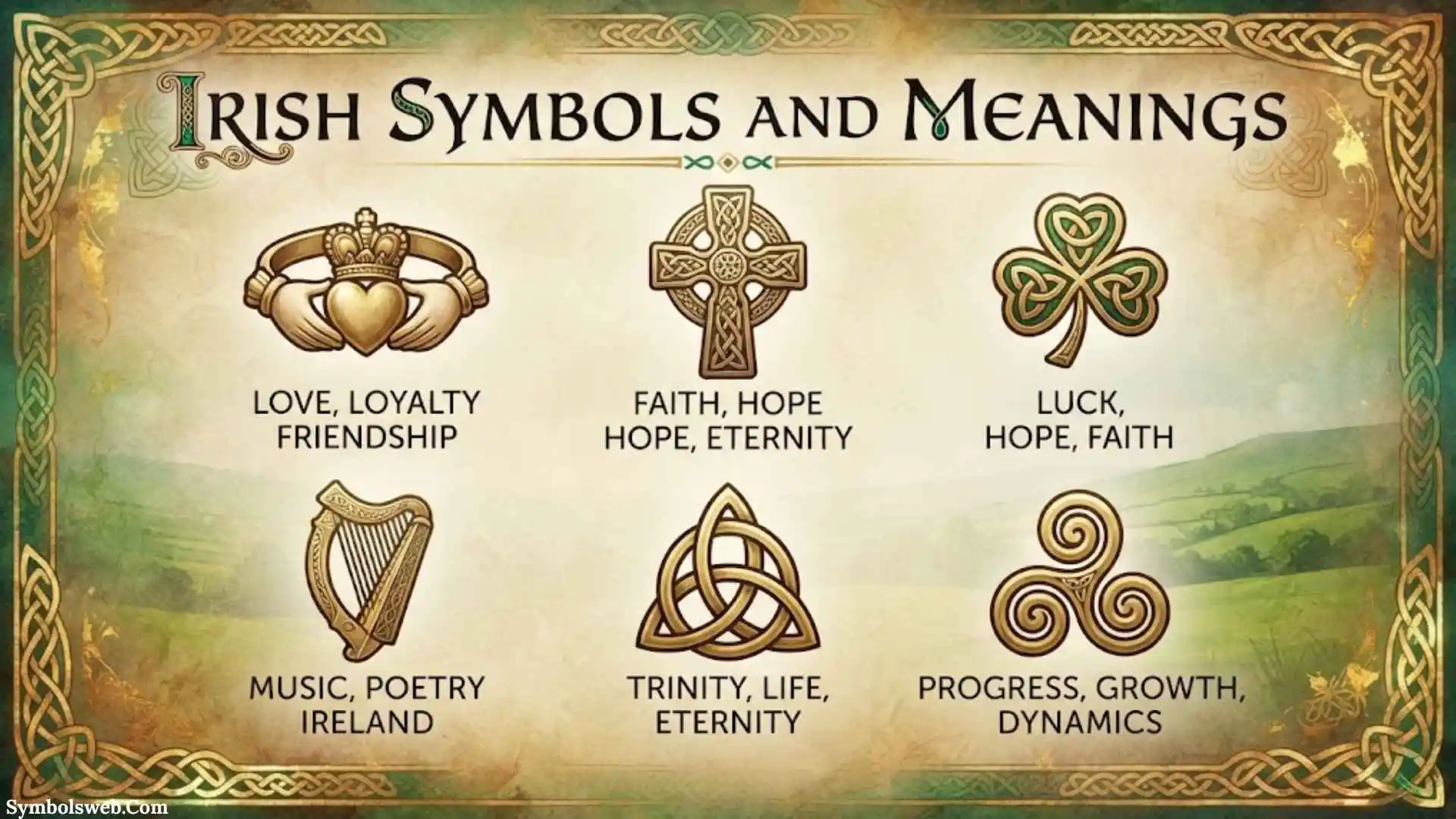
Irish symbols carry centuries of history, culture, spirituality, and tradition. From the famous shamrock and Celtic knots to the Claddagh and ancient crosses, each symbol can tell a meaningful story. If you have ever wondered what these beautiful designs represent, exploring Irish symbols and meanings can help you understand the deeper ideas behind them.
When you look at an Irish symbol, you may notice more than just an attractive pattern or traditional design. Many symbols represent love, loyalty, friendship, protection, faith, strength, family, and the connection between people and nature. I find these meanings especially fascinating because a simple symbol can preserve stories and beliefs passed down through generations.
In this guide, you will discover the meanings behind popular Irish symbols in a simple and easy to understand way. Whether you are researching your Irish heritage, choosing a meaningful tattoo, learning about Celtic traditions, or simply curious about these historic designs, you can explore each symbol and find the meaning that speaks to you.
Irish Symbols and Meanings: (Quick Answer)
Irish symbols are visual signs that represent Ireland’s history, culture, spirituality, identity, and traditions. The best-known include the harp, shamrock, Irish tricolour, Celtic cross, Claddagh ring, St Brigid’s Cross, Celtic knotwork, and the four-leafed clover. Their meanings range from national identity and faith to love, friendship, protection, unity, and heritage.
Quick Facts About Irish Symbols and Meanings
| Aspect | Information |
| Origin | Irish symbols come from different periods, including pre-Christian Celtic culture, medieval Christianity, Irish folklore, political history, and later popular traditions. |
| Historical Significance | Symbols helped express Irish identity, religion, community, political independence, family heritage, and cultural memory. |
| Main Meaning | Irish identity, belonging, heritage, faith, resilience, love, friendship, and connection to Ireland. |
| Spiritual Meaning | Protection, renewal, faith, transformation, unity, blessing, and connection with nature or the sacred. |
| Cultural Importance | Symbols such as the harp and shamrock are closely associated with Ireland and remain part of national and cultural life. |
| Modern Usage | Tattoos, jewelry, clothing, artwork, tourism, sports, government imagery, celebrations, home décor, and personal expressions of Irish heritage. |
What Are Irish Symbols and Meanings?
Irish symbols are images, objects, plants, designs, colors, and traditions that have come to represent some aspect of Ireland or Irish culture.
However, there is an important detail to understand.
There is no single ancient list of “Irish symbols.” Different symbols emerged at different times and for different reasons.
The harp has a long history as a symbol of Ireland. The National Museum of Ireland notes that harps appeared in Irish imagery centuries ago, while government sources trace the harp as an Irish heraldic symbol to the medieval period. Today, it is the principal emblem of the Irish state.
The shamrock has a different story. Irish tradition connects it with St Patrick and his teaching about the Christian Trinity. Yet the National Museum of Ireland points out that the famous story connecting St Patrick specifically with the shamrock is relatively late and should not simply be presented as an undisputed ancient fact.
Other symbols, such as the Claddagh ring, developed much later. The oldest known surviving Claddagh ring is associated with Galway goldsmith Richard Joyce and dates to around 1700.
This mixture of ancient tradition, Christianity, folklore, politics, craftsmanship, and modern identity is what makes Irish symbolism so fascinating.
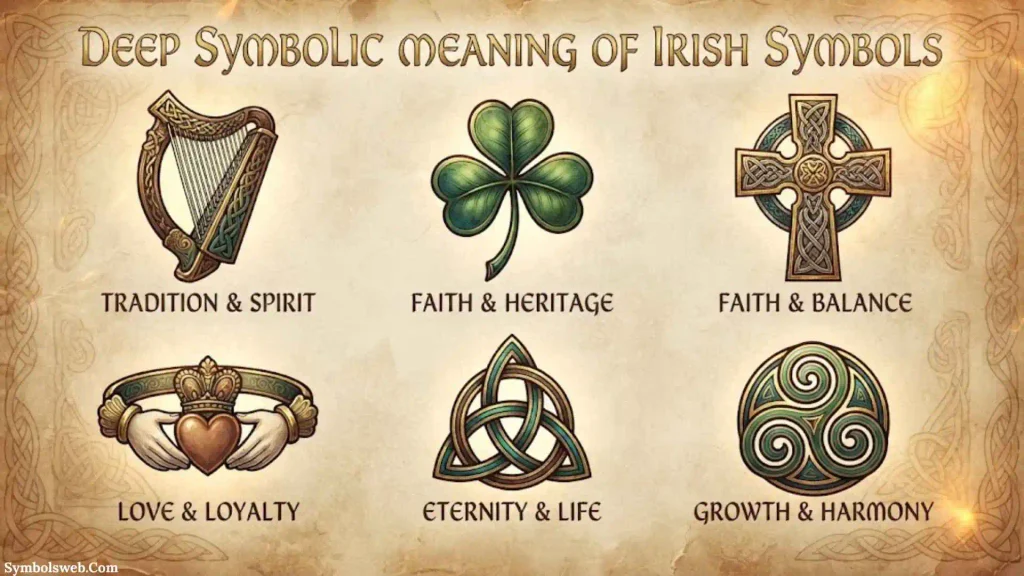
Deep Symbolic Meaning of Irish Symbols
Spiritual Level
Irish symbolism often reflects a desire to connect everyday life with something greater.
The shamrock can suggest faith and the idea of threefold unity. St Brigid’s Cross is connected with blessing and protection of the home. The Celtic cross combines Christian symbolism with an artistic tradition strongly associated with medieval Ireland.
The harp can also take on a spiritual quality. Music has held an important place in Irish culture for centuries, and traditional Irish harping is connected with mythology, folklore, literature, and community life.
For many people today, these symbols are not used as formal religious signs. Instead, they can represent inner strength, continuity, gratitude, hope, or a connection with family and ancestry.
Psychological Level
Symbols work because humans naturally attach stories and emotions to images.
A heart suggests love before anyone explains it. A ring suggests commitment because it forms an unbroken circle. A tree suggests growth because we see it change through seasons.
Irish symbols work in a similar way.
The Claddagh combines hands, a heart, and a crown. Together, the design creates a powerful emotional message involving friendship, love, and loyalty.
From a Jungian perspective, symbols can function as archetypal images. This does not mean every Irish symbol has one universal psychological meaning. Rather, familiar images can become containers for personal memories, family stories, cultural identity, and emotional experiences.
A person wearing a Claddagh ring may see romance.
Another person may see family heritage.
Someone else may simply see Galway.
The physical object is the same, but the psychological meaning can be deeply personal.
Cultural Level
At the cultural level, Irish symbols help answer a basic human question:
Where do I belong?
The National Museum of Ireland describes symbols as things that can represent something else and help people feel attachment to a group or country.
This is why Irish symbols became especially important among the Irish diaspora.
For people whose families left Ireland generations ago, a shamrock, harp, Claddagh ring, Irish flag, or Celtic design can become a visible link to an ancestral homeland.
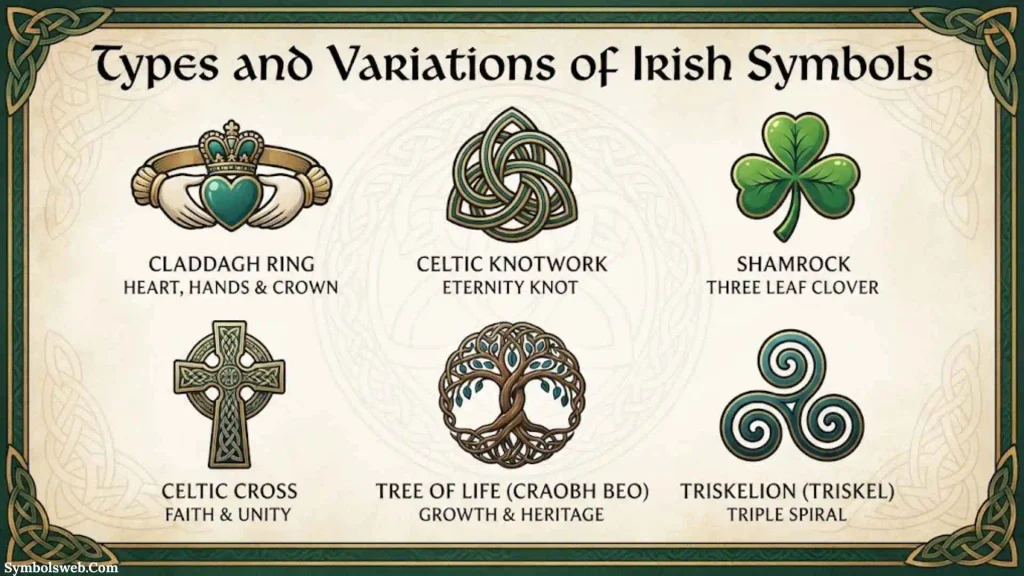
Types and Variations of Irish Symbols
The Irish Harp
Visual Description
The Irish harp is a stringed musical instrument with a curved frame and vertical strings. The heraldic version is usually shown as a golden harp.
Meaning
The harp represents Ireland, music, cultural identity, and national sovereignty.
Symbolism
The harp has an unusually powerful place in Irish history because Ireland uses a musical instrument as its national emblem.
Ireland’s government describes it as the country’s official State emblem and notes that the harp was recorded as the arms of Ireland in medieval times.
Cultural Connection
Irish harping is more than an emblem. It is a living cultural tradition that has been practiced for more than 1,000 years.
Where It Appears
The harp appears on:
- Irish government documents
- State seals
- Irish coins
- Public buildings
- Official insignia
- Cultural organizations
- Irish music imagery
- Literature and poetry
- Modern tattoos and jewelry
The famous medieval harp at Trinity College Dublin is popularly known as the Brian Boru harp, although the identification of the instrument with the medieval king is a later tradition rather than proof that it belonged to him. The harp’s visual form nevertheless became deeply connected with Irish national identity.
The Shamrock
Visual Description
The shamrock is a small three-leafed plant, usually depicted as three green heart-shaped or rounded leaves joined at the center.
Meaning
The shamrock is associated with Ireland, St Patrick, Christianity, luck, and Irish identity.
Symbolism
The traditional story says St Patrick used the three leaves to explain the Christian Trinity.
But historical accuracy matters here.
The National Museum of Ireland notes that the tradition connecting St Patrick and the shamrock is relatively late. The first records of shamrock being worn as a St Patrick’s Day badge date from the 17th century.
Cultural Connection
The shamrock became one of the most recognizable symbols of Irish identity, especially through St Patrick’s Day celebrations around the world.
Today it is also associated with Irish sports teams, tourism, businesses, clothing, jewelry, and diaspora communities.
The shamrock and harp are officially protected State emblems in Ireland, with restrictions on certain commercial uses.
Where It Appears
You can find shamrock imagery in:
- St Patrick’s Day celebrations
- Irish sports
- Jewelry
- Tattoos
- Clothing
- Flags and decorations
- Tourism
- Irish-themed art
The Irish Tricolour
Visual Description
The Irish national flag consists of three vertical bands of green, white, and orange.
Meaning
The Irish tricolour represents inclusion and the aspiration for unity between people of different traditions on the island of Ireland.
The Irish government explains that green, white, and orange were intended to represent a relationship between different traditions, with white symbolizing a lasting peace between green and orange.
Historical Significance
Thomas Francis Meagher first flew the flag in Waterford in 1848. It was later flown over the General Post Office during the 1916 Easter Rising.
The flag became the flag of the Irish Free State in 1922 and was formally confirmed as the national flag in the 1937 Constitution.
Cultural Connection
The tricolour is more than a national decoration. It carries ideas of political history, identity, independence, reconciliation, and national unity.
The Celtic Cross
Visual Description
The Celtic cross typically consists of a Christian cross with a circular ring around the intersection of the arms.
Meaning
The Celtic cross is strongly associated with Christianity, medieval Ireland, Celtic art, heritage, and Irish identity.
Symbolism
The ring is sometimes given modern spiritual meanings involving eternity, the sun, or the cycle of life.
Those interpretations are popular, but they should not automatically be presented as established ancient Celtic beliefs.
Ireland’s medieval high crosses were complex monuments combining Christian imagery, inscriptions, biblical scenes, animals, people, and decorative interlace.
The Cross of Cong, for example, contains both Latin and Irish inscriptions and dates to the medieval period.
Cultural Connection
Today the Celtic cross appears frequently in:
- Irish churches
- Cemeteries
- Memorials
- Genealogy
- Tattoos
- Jewelry
- Irish-American heritage
- Celtic art
St Brigid’s Cross
Visual Description
St Brigid’s Cross is commonly made by weaving rushes, straw, reeds, or other materials into a distinctive cross shape.
Meaning
It is associated with St Brigid, blessing, protection, home, and Irish folk tradition.
Symbolism
Traditionally, St Brigid’s Crosses were placed inside homes and animal sheds to invoke the saint’s blessing.
Cultural Connection
The tradition remains alive.
The National Museum of Ireland records that making St Brigid’s Crosses on 31 January continues to be popular in Irish homes. Regional versions include diamond, interlaced, wheel-shaped, and two-, three-, or four-armed forms.
The Claddagh Ring
Visual Description
The Claddagh ring features two hands holding a heart topped with a crown.
Meaning
The traditional interpretation is:
- Hands: Friendship
- Heart: Love
- Crown: Loyalty
Symbolism
Together, these elements create one of Ireland’s most emotionally powerful symbols of human connection.
The design is closely associated with Galway and the historic Claddagh community.
Galway City Museum identifies the Claddagh ring as a Galway variation of an older European ring tradition and holds the oldest known surviving Claddagh ring, dating to around 1700.
Cultural Connection
The Claddagh became especially meaningful as an heirloom and relationship symbol.
Its popularity eventually spread far beyond Galway and Ireland, particularly among Irish communities abroad.
Where It Appears
The Claddagh is commonly found in:
- Engagement rings
- Wedding jewelry
- Friendship rings
- Family heirlooms
- Pendants
- Tattoos
- Irish heritage gifts
The popular tradition concerning which direction the ring faces can indicate relationship status, although wearing customs can vary between people and families.
Celtic Knotwork
Visual Description
Celtic knotwork consists of interwoven lines that appear to loop continuously without a clear beginning or end.
Meaning
Modern interpretations often associate Celtic knots with:
- Eternity
- Continuity
- Interconnection
- Family
- Life cycles
- Spiritual unity
Symbolism
Celtic interlace is a major feature of medieval Insular art.
However, the popular idea that every specific knot had a fixed ancient meaning is difficult to prove.
Many meanings assigned to Celtic knots today are modern interpretations rather than meanings documented by ancient Irish artists.
That distinction makes the symbolism more interesting, not less. It shows how cultures continue to create meaning from old visual traditions.
Where It Appears
Celtic knotwork is especially common in:
- Tattoos
- Jewelry
- Manuscript-inspired artwork
- Crosses
- Wedding designs
- Logos
- Home décor
- Modern Celtic art
The Celtic Tree of Life
Visual Description
The Celtic Tree of Life is usually represented as a tree whose branches reach upward while its roots spread below.
Meaning
It is commonly associated with:
- Growth
- Family
- Connection
- Balance
- Strength
- Nature
- Continuity
Historical Note
The modern Celtic Tree of Life is extremely popular, but its familiar modern design should not automatically be treated as a single ancient Irish symbol with one documented meaning.
Much of the symbolism comes from later interpretations of Celtic relationships with nature, trees, mythology, and interconnectedness.
This is an important lesson when researching Irish symbols: popular symbolism and historical evidence are not always the same thing.
The Four Leaf Clover
Visual Description
A four-leaf clover resembles the familiar three-leaf shamrock but has four leaflets.
Meaning
It is commonly associated with:
- Good luck
- Fortune
- Hope
- Rare opportunities
Symbolism
The four-leaf clover is often connected with Irish luck in modern popular culture.
But it should not be confused with the shamrock.
The shamrock has three leaves and has a specific connection with Irish identity and St Patrick’s Day traditions.
The four-leaf clover is primarily a broader symbol of good fortune.
Irish Symbols Across Different Cultures
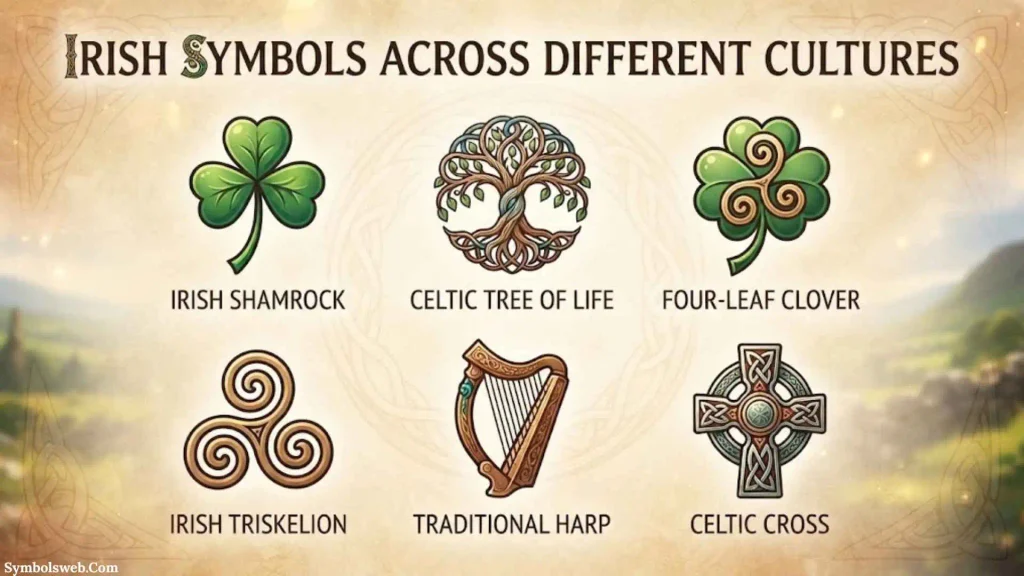
Irish symbolism has never existed in isolation.
Ireland’s visual culture developed through contact between pre-Christian traditions, Christianity, medieval European art, political movements, and later global culture.
Ancient Celtic Culture
Pre-Christian Celtic societies left archaeological and artistic evidence of complex beliefs involving animals, nature, weapons, fertility, sacred places, and supernatural beings.
However, surviving evidence does not provide a simple dictionary in which every ancient symbol has one fixed meaning.
Much of what is called “Celtic symbolism” today is reconstructed from archaeology, medieval literature, art, folklore, and modern interpretation.
Early Christian Ireland
Christianity transformed Irish visual culture.
Monasteries became important centers of art, manuscript production, metalwork, stone carving, and learning.
Crosses, biblical imagery, inscriptions, interlace, animals, and geometric designs became part of a distinctive Irish Christian artistic tradition.
Medieval Europe
Irish art did not develop completely apart from continental Europe.
The Claddagh ring provides an excellent example.
Its clasped hands belong to a wider European tradition of rings representing vows and fidelity, while the familiar crowned-heart design became strongly associated with Galway.
Irish Diaspora
Irish symbols took on new importance when millions of people of Irish origin lived outside Ireland.
A shamrock on St Patrick’s Day or a Claddagh ring passed through a family can become a portable piece of cultural memory.
The symbol becomes a way of saying:
This is where my story comes from.
Modern Global Culture
Today Irish symbols appear around the world.
They are used by Irish communities, tourists, designers, musicians, sports organizations, tattoo artists, jewelry makers, and people exploring family ancestry.
The result is a living symbolic tradition that continues to change.
Similar Symbols and Their Meanings
| Symbol | Main Meaning | Historical Note |
| Shamrock | Ireland, St Patrick, Christian tradition | Strongly associated with St Patrick’s Day and Irish identity |
| Four-leaf clover | Luck and good fortune | Broader symbol of luck, not the same as the shamrock |
| Irish harp | Ireland, music, national identity | Medieval heraldic history and modern State emblem |
| Celtic cross | Christianity, Irish heritage | Closely connected with medieval Irish high-cross traditions |
| Claddagh ring | Love, friendship, loyalty | Galway tradition with surviving examples from around 1700 |
| St Brigid’s Cross | Blessing and protection | Living Irish folk tradition |
| Celtic knot | Continuity and interconnectedness | Ancient interlace tradition, with many modern meanings |
| Irish tricolour | Unity and national identity | Modern political and constitutional history |
Irish Symbols in Mythology and Folklore
Irish folklore is filled with symbolic images.
The harp has an especially strong connection with Irish mythology and storytelling. Traditional Irish harpers were not simply musicians. The harp became part of the cultural imagination surrounding kings, poetry, memory, and national identity.
The shamrock belongs to a different kind of story. Its connection with St Patrick became a central part of Irish Christian folklore and later St Patrick’s Day tradition.
St Brigid occupies an important place between Christian devotion and older Irish seasonal customs. The making of Brigid’s Crosses, visits to holy wells, and household traditions helped keep her associated with protection, blessing, and renewal.
The Celtic cross also carries layers of story. Medieval Irish high crosses were not merely decorative objects. They could function as monuments, religious teaching tools, memorials, and statements of status.
Irish folklore therefore reminds us that symbols rarely have just one meaning.
A symbol can be religious to one person, historical to another, and deeply personal to someone else.
Irish Symbols in Art, Literature, Movies and Pop Culture
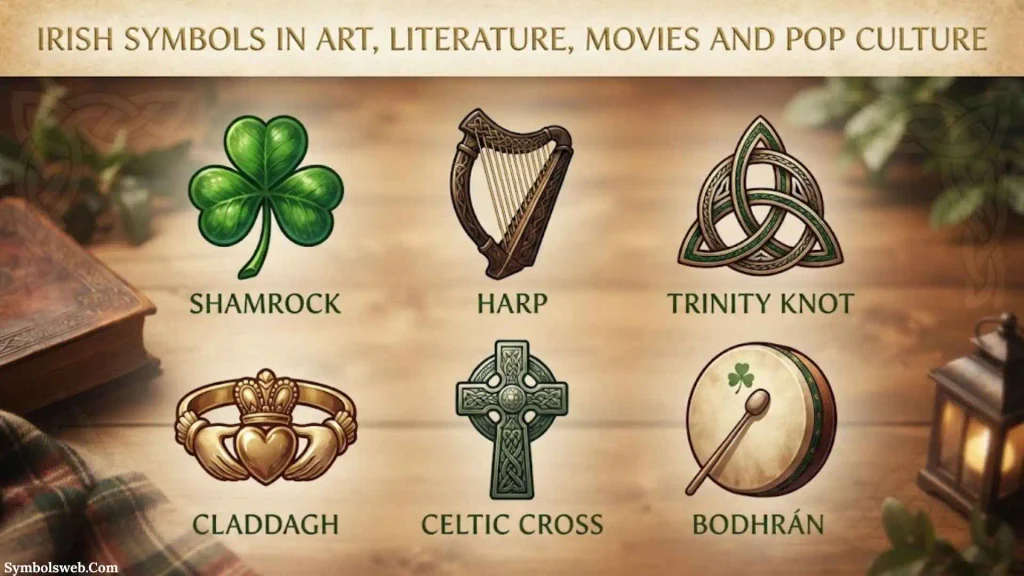
Irish symbols have traveled far beyond churches, museums, and historical monuments.
Paintings and Visual Art
Irish artists have repeatedly used the harp, Celtic interlace, landscapes, crosses, saints, and mythological imagery to explore identity and national memory.
During periods of cultural revival, medieval and Celtic-inspired designs became particularly important to artists seeking connections with Ireland’s past.
Literature and Poetry
Irish literature frequently draws on symbols of land, exile, memory, mythology, and national identity.
The harp, for example, became a powerful poetic image because music could represent both cultural survival and political longing.
Movies and Television
Modern films and television often use Irish symbols as visual shorthand.
A Claddagh ring may suggest romance.
A Celtic cross may suggest Irish ancestry.
A shamrock may immediately establish an Irish setting.
A harp may represent Ireland itself.
These shortcuts are useful, but they can also simplify a much more complicated culture.
Tattoos
Irish and Celtic tattoos remain extremely popular.
Common designs include:
- Celtic knots
- Celtic crosses
- Irish harps
- Shamrocks
- Claddagh designs
- Trees of Life
- Gaelic lettering
- Irish flags
- St Brigid’s Crosses
For many people, tattoos are less about historical accuracy and more about identity, family, remembrance, or personal connection.
Fashion and Jewelry
Irish symbolism works especially well in jewelry because many symbols already carry meanings involving relationships and identity.
The Claddagh is perhaps the clearest example.
A person can wear the same ring as an expression of love, friendship, family heritage, or Irish ancestry.
Spiritual and Dream Meaning of Irish Symbols
Dream interpretation is personal rather than scientifically fixed.
There is no universal psychological dictionary stating that dreaming of a shamrock or Celtic cross must mean one particular thing.
Still, people often interpret Irish symbols through their emotional associations.
Dreaming of a Shamrock
A shamrock may represent:
- Luck
- Hope
- Faith
- Opportunity
- Irish heritage
- A desire for protection
If the dream feels joyful, the symbol may reflect optimism or a positive opportunity.
If the dream feels anxious, it could reflect a desire for reassurance or good fortune.
Dreaming of a Claddagh Ring
A Claddagh ring may symbolize:
- Love
- Commitment
- Friendship
- Loyalty
- A relationship decision
- Family bonds
The emotional context matters more than a fixed dictionary meaning.
Dreaming of a Celtic Cross
A Celtic cross may represent:
- Faith
- Ancestry
- Mortality
- Spiritual reflection
- Cultural identity
- A connection with the past
Meditation and Spiritual Practice
People who use Irish symbols during meditation may focus on themes such as ancestry, nature, belonging, gratitude, protection, and continuity.
These interpretations are personal spiritual practices rather than established historical meanings.
Positive and Negative Meanings of Irish Symbols
| Positive Meaning | Negative Meaning |
| Love | Loss |
| Friendship | Separation |
| Loyalty | Conflict |
| Protection | Fear |
| Faith | Religious uncertainty |
| Unity | Division |
| Heritage | Nostalgia |
| Resilience | Struggle |
| Hope | Longing |
| Good fortune | Dependence on luck |
A symbol can contain both light and shadow.
The Irish tricolour can represent unity, but its history also reminds us of political conflict.
The harp represents national identity, but it has also appeared in political struggles.
The Claddagh represents love and loyalty, but it can also evoke memories of separation when worn as an heirloom.
This duality is part of what makes symbols powerful.
Why Humans Are Attracted to Irish Symbols
Humans are drawn to symbols because symbols make invisible ideas visible.
Love becomes a heart.
Continuity becomes a circle.
Heritage becomes a flag.
Faith becomes a cross.
Luck becomes a shamrock.
Identity becomes a harp.
The brain is naturally attracted to recognizable patterns and emotionally meaningful objects. When a symbol is repeated across families, ceremonies, stories, photographs, jewelry, and public spaces, it can become attached to powerful memories.
Irish symbols also benefit from something deeper: cultural memory.
Imagine someone whose grandmother wore a Claddagh ring.
Years later, that person inherits the ring.
The metal may be old, but the emotional meaning is new.
The ring now carries at least three stories:
The story of the symbol.
The story of the family.
And the story of the person wearing it.
That is how cultural symbols survive.
Modern Uses of Irish Symbols
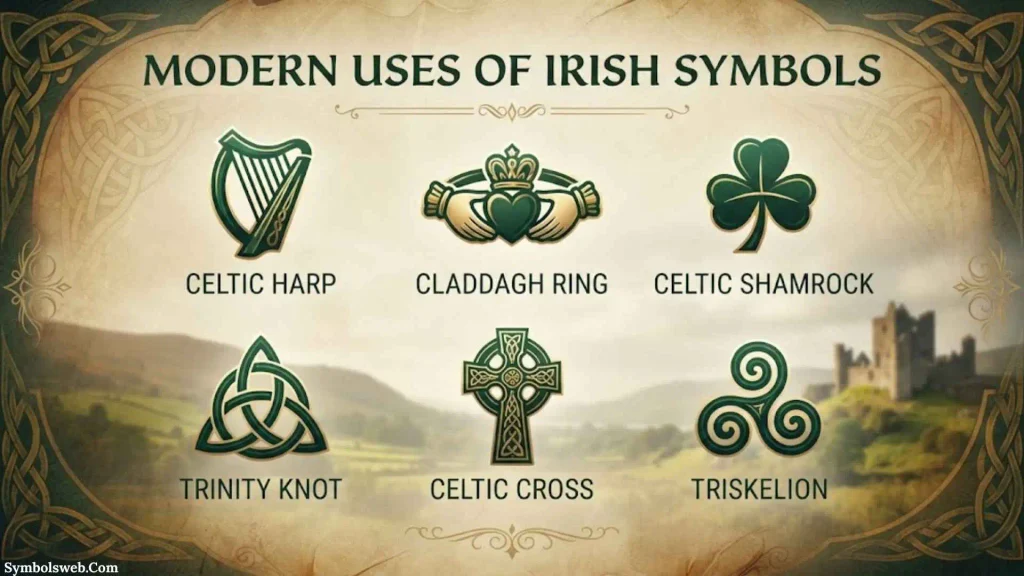
Irish symbols remain remarkably visible in modern life.
Tattoos
People use Irish symbols to represent ancestry, family, faith, love, remembrance, or personal identity.
Jewelry
Claddagh rings, shamrock pendants, Celtic crosses, knotwork, and harp designs are common choices.
Fashion
Irish motifs appear on scarves, shirts, accessories, wedding clothing, and St Patrick’s Day outfits.
Branding
Irish imagery is frequently used to communicate heritage, authenticity, tradition, craftsmanship, or connection to Ireland.
However, the Irish State protects the harp and shamrock as official State emblems, and commercial use can be subject to legal restrictions.
Social Media
On social platforms, Irish symbols are often used during:
- St Patrick’s Day
- Irish cultural festivals
- Genealogy discussions
- Family celebrations
- Irish sports events
- Heritage campaigns
Contemporary Spirituality
Modern spiritual communities may use Celtic-inspired symbols to explore nature, ancestry, cycles, meditation, and personal transformation.
These meanings should be understood as modern interpretations rather than automatically attributed to ancient Irish religion.
Home Décor
Irish crosses, Celtic knotwork, harps, shamrocks, and Brigid’s Crosses can appear in homes as reminders of faith, ancestry, culture, or family.
Interesting Facts About Irish Symbols
- Ireland is famous for having a musical instrument as its national symbol. The harp is the country’s official State emblem.
- The harp has medieval heraldic roots. It appeared as the arms of Ireland in medieval European heraldic material.
- The shamrock’s connection with St Patrick is older as a tradition than as securely documented history. The National Museum of Ireland specifically describes the famous teaching story as a relatively late tradition.
- The Claddagh ring originated in Galway. The historic Claddagh was a fishing community outside the medieval walls of Galway.
- The oldest known surviving Claddagh ring dates to around 1700. Galway City Museum attributes it to goldsmith Richard Joyce.
- St Brigid’s Crosses come in many forms. Traditional examples can be diamond-shaped, interlaced, wheel-shaped, or have two, three, or four arms.
- The Irish tricolour was first flown in Waterford in 1848. It was later flown over the GPO during the 1916 Rising.
- The Irish Constitution identifies the national flag as green, white, and orange. This is set out in Article 7.
- Irish harping is an active living tradition, not simply a historical symbol. Traditional harping continues to be practiced throughout the island of Ireland.
- Not every modern “Celtic symbol” has a documented ancient meaning. Some meanings commonly shared online are modern interpretations layered onto older artistic traditions.
Frequently Asked Questions
What is the most famous Irish symbol?
The harp and shamrock are among the most recognizable Irish symbols. The harp is especially important because it is an official State emblem of Ireland, while the shamrock is strongly associated with Irish identity and St Patrick’s Day.
What does the Irish harp symbolize?
The Irish harp symbolizes Ireland, national identity, music, cultural heritage, and sovereignty. Its history as an Irish emblem reaches back to the medieval period.
What does the shamrock symbolize in Ireland?
The shamrock symbolizes Ireland and is traditionally associated with St Patrick and the Christian Trinity. The National Museum of Ireland notes that the famous story of St Patrick using the shamrock to explain the Trinity is a relatively late tradition.
What do the symbols on a Claddagh ring mean?
The hands traditionally represent friendship, the heart represents love, and the crown represents loyalty. The Claddagh ring is closely associated with Galway and became one of Ireland’s best-known relationship symbols.
What does a Celtic knot symbolize?
Today, Celtic knots are commonly interpreted as symbols of eternity, continuity, interconnectedness, family, and life’s cycles. However, specific meanings for individual knot designs are often modern interpretations rather than meanings securely documented from ancient Ireland.
What does the Irish tricolour mean?
The green, white, and orange Irish tricolour was intended to represent inclusion and the aspiration for unity between different traditions on the island of Ireland. White represents the hope for lasting peace between those traditions.
Conclusion
Irish symbols are more than decorative designs. They are vessels of memory, carrying stories of faith, family, music, love, struggle, belonging, and hope across generations.
The harp can speak for a nation. The shamrock can evoke faith and Irish identity. The Claddagh can express love, friendship, and loyalty. A simple woven St Brigid’s Cross can connect a modern home with an enduring folk tradition.
Perhaps the deepest meaning of Irish symbolism is not found in one ancient definition. It is found in the human need to remember where we came from, what we value, and who we belong to.

Eliana Foster is a writer with a passion for exploring the meanings behind symbols, traditions, and cultural history. She enjoys breaking down complex topics into simple, engaging articles that are easy for everyone to understand. Eliana is also the fictional author of The Hidden Language of Silent Marks and Beyond the Circle of Ancient Signs, two original book concepts created for her author profile. When she’s not writing, she loves visiting museums, reading about mythology, and researching the stories behind symbols from around the world. Her goal is to help readers discover the fascinating meanings hidden in everyday signs and ancient emblems.
 Jordan Hayes
 Ethan Holloway