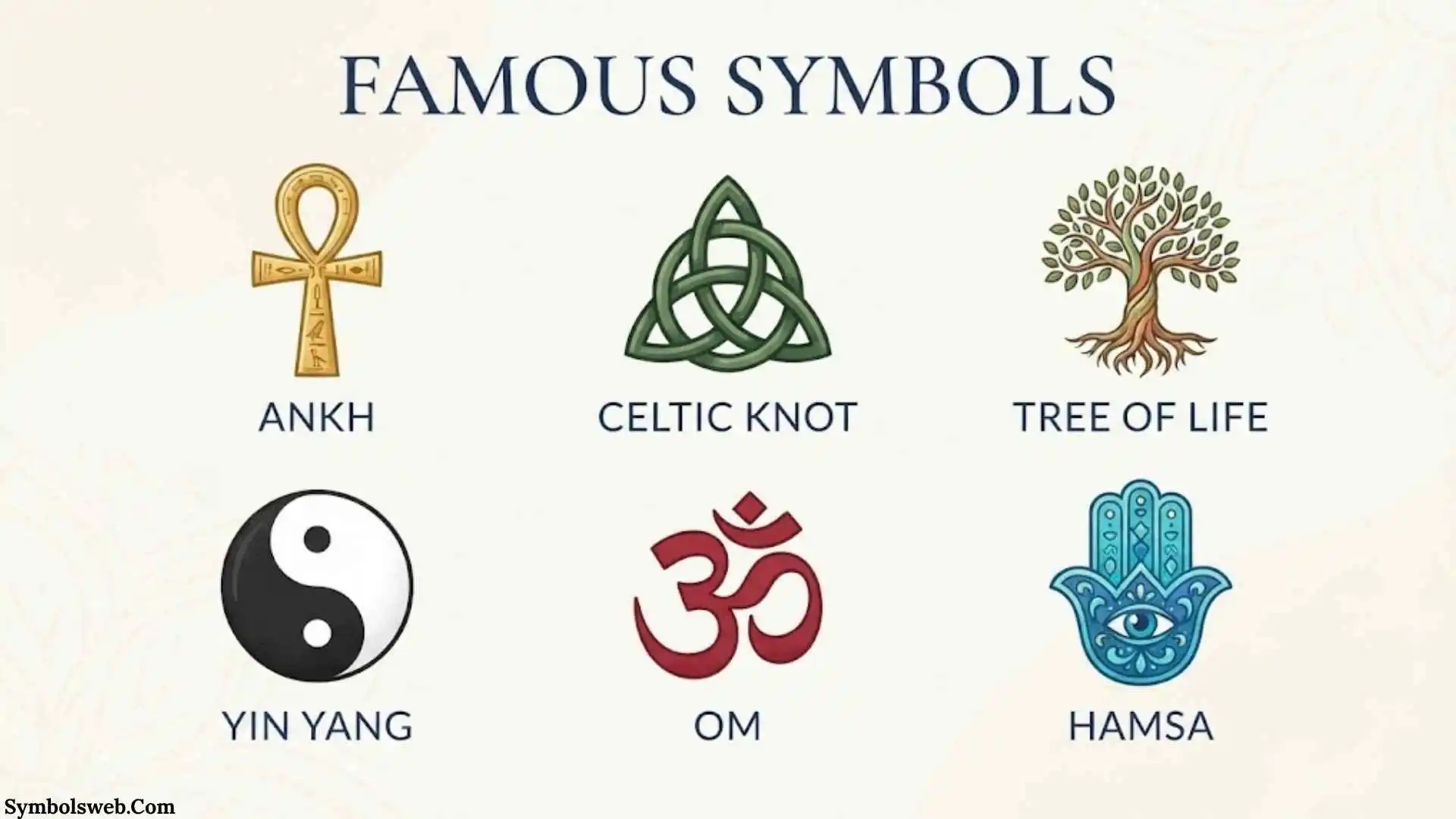
Famous Symbols have been part of human communication for thousands of years. You can find them in everyday life, art, religion, history, politics, and popular culture. A simple symbol can express an idea, emotion, belief, or message that may be difficult to explain with words. From the heart symbol representing love to the peace sign representing harmony, these familiar images often carry meanings that you instantly recognize.
When you learn about famous symbols, you can discover more than just what they look like. You can explore their origins, history, cultural importance, and the reasons they became widely recognized around the world. Some symbols have ancient roots, while others became popular through major historical events, movements, organizations, or modern culture. Their meanings can also change over time and may differ between cultures.
In this guide, you’ll discover some of the most famous symbols from around the world and learn what they mean. You’ll explore their history, significance, and interesting facts in a simple and easy-to-understand way. Whether you’re a student, a researcher, or simply curious about the meaning behind familiar signs, this guide will help you understand the stories and ideas represented by these powerful symbols.
Famous Symbols: (Quick Answer)
Famous symbols are widely recognized visual signs that represent ideas, beliefs, values, emotions, cultures, or spiritual concepts. Throughout history, symbols such as the cross, lotus, yin-yang, ankh, and dove have helped people communicate complex meanings, preserve traditions, express identity, and connect with deeper aspects of human experience.
Quick Facts About Famous Symbols
| Aspect | Information |
| Origin | Prehistoric human civilizations and ancient cultures |
| Historical Significance | Used for communication, religion, governance, and storytelling |
| Main Meaning | Representation of ideas, beliefs, emotions, and concepts |
| Spiritual Meaning | Connection between the physical and spiritual worlds |
| Cultural Importance | Preserves traditions, values, and collective identity |
| Modern Usage | Branding, tattoos, art, fashion, social media, and spirituality |
What Are Famous Symbols?
Famous symbols are visual representations that carry meanings beyond their physical appearance. A simple shape, image, or mark can communicate powerful ideas that transcend language barriers.
Humans have relied on symbols since prehistoric times. Ancient cave paintings discovered in Europe, Africa, and Asia reveal that early humans used symbolic imagery long before written language developed.
As civilizations evolved, symbols became central to religion, mythology, politics, and social identity. Ancient Egyptians used the Ankh to represent life. Greeks adopted the owl as a symbol of wisdom. Various cultures developed sacred geometric patterns to represent cosmic order.
Over time, symbols gained deeper layers of meaning. A single image could convey spiritual beliefs, social status, historical memory, and personal identity simultaneously.
Today, symbols remain just as influential. National flags, religious icons, emojis, corporate logos, and social movements all rely on symbolic communication.
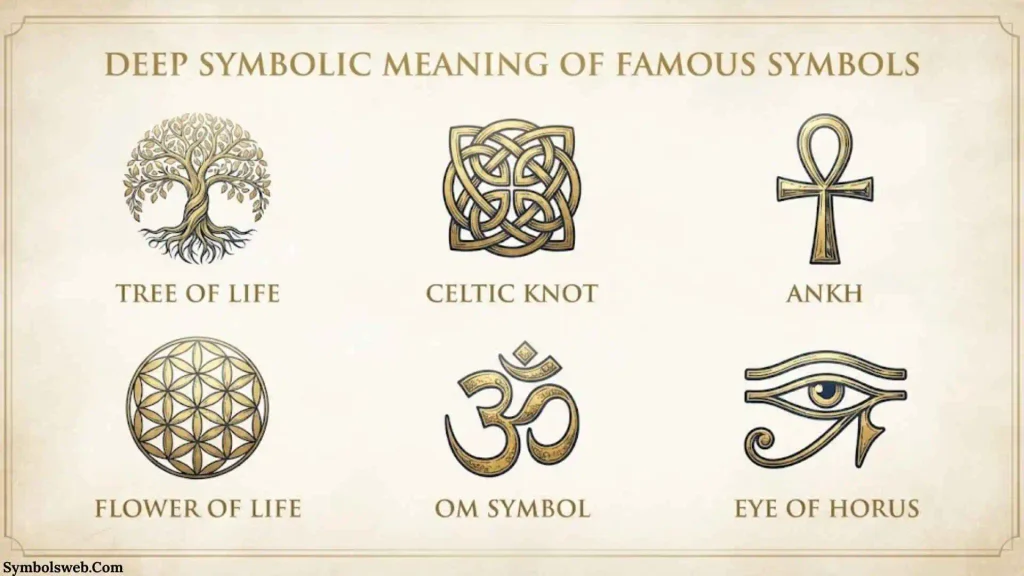
Deep Symbolic Meaning of Famous Symbols
Spiritual Level
Many famous symbols are believed to bridge the visible and invisible worlds.
Spiritual traditions often use symbols to express truths that are difficult to explain through ordinary language. The lotus flower symbolizes enlightenment emerging from hardship. The Tree of Life represents interconnected existence. Sacred circles often symbolize eternity and divine unity.
For many people, symbols serve as reminders of personal growth, faith, and transformation.
Psychological Level
Psychologist Carl Jung proposed that humans share universal symbolic patterns known as archetypes.
According to Jungian psychology, symbols resonate because they connect to the collective unconscious. Certain images repeatedly appear across cultures because they reflect fundamental human experiences.
Examples include:
- The sun representing vitality and consciousness
- The serpent symbolizing transformation
- The journey symbol representing personal growth
- The mother figure symbolizing nurturing and protection
People are naturally drawn to symbols because they communicate emotional truths quickly and powerfully.
Cultural Level
Every culture develops symbols that reflect its values and worldview.
A symbol may represent freedom in one society and authority in another. Cultural symbols strengthen group identity, preserve traditions, and help communities maintain continuity across generations.
For example, national emblems often unite millions of people under a shared identity and history.
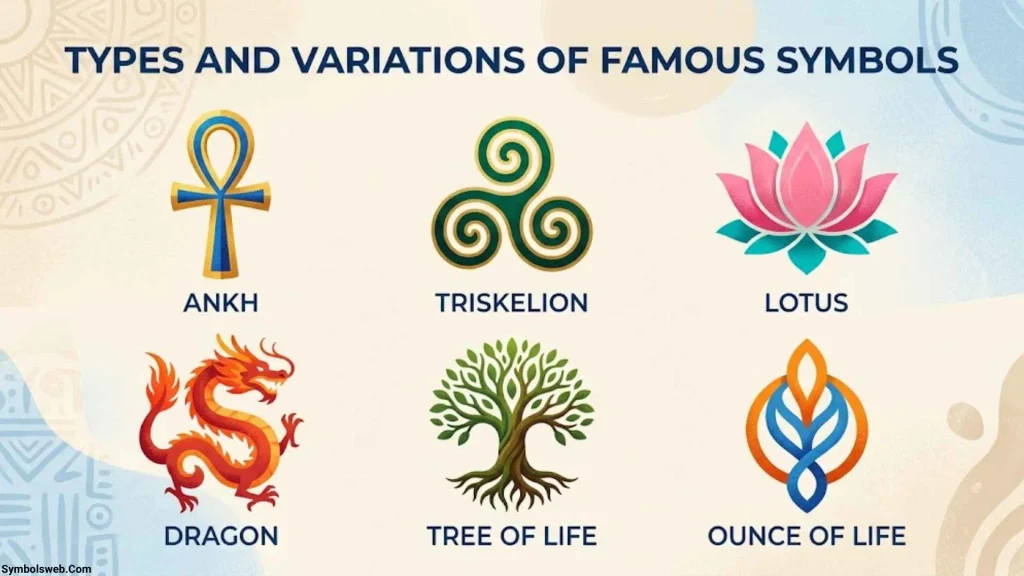
Types and Variations of Famous Symbols
The Cross
Visual Description: Intersecting vertical and horizontal lines
Meaning: Faith, sacrifice, redemption
Symbolism: Spiritual connection and hope
Cultural Connection: Christianity and Western civilization
Where It Appears: Churches, jewelry, literature, art
The Lotus Flower
Visual Description: Multi-petaled flower emerging from water
Meaning: Purity and enlightenment
Symbolism: Spiritual awakening
Cultural Connection: Hinduism and Buddhism
Where It Appears: Temples, meditation practices, artwork
Yin-Yang
Visual Description: Circular symbol divided into black and white halves
Meaning: Balance and harmony
Symbolism: Opposing forces working together
Cultural Connection: Chinese philosophy
Where It Appears: Martial arts, philosophy, wellness traditions
Ankh
Visual Description: Cross with a loop at the top
Meaning: Life and immortality
Symbolism: Eternal existence
Cultural Connection: Ancient Egypt
Where It Appears: Tombs, temples, jewelry
Dove
Visual Description: White bird in flight
Meaning: Peace and hope
Symbolism: Harmony and renewal
Cultural Connection: Many religious traditions
Where It Appears: Art, literature, peace movements
Tree of Life
Visual Description: Tree with expansive roots and branches
Meaning: Growth and interconnectedness
Symbolism: Unity of existence
Cultural Connection: Global mythologies
Where It Appears: Spiritual art, jewelry, folklore
Famous Symbols and Their Meanings
Famous symbols communicate ideas, beliefs, and emotions through recognizable images. Some represent peace and freedom, while others reflect love, cultural identity, power, or remembrance. When you understand their meanings, you can see how a simple image can carry a much deeper message.
Here are some well-known symbols and what they commonly represent:
- Dove: A widely recognized symbol of peace, hope, and reconciliation.
- Heart: Represents love, affection, and emotional connection.
- Olive Branch: Traditionally associated with peace and the end of conflict.
- Yin-Yang: Represents complementary forces and balance in Chinese philosophy.
- Lotus Flower: Symbolizes spiritual growth and purity in several Asian religious traditions.
- Infinity Symbol: Commonly represents endlessness, continuity, or eternal connection.
- Ankh: An ancient Egyptian symbol associated with life.
- Scales of Justice: Represent fairness, impartiality, and the administration of justice.
- Phoenix: Represents rebirth and renewal in many modern interpretations.
- Tree of Life: Often symbolizes growth, interconnectedness, and the relationship between different forms of life.
The meaning of a symbol can change depending on its historical background and cultural context. Before using a symbol in a tattoo, artwork, or personal project, consider researching the tradition it comes from.
Famous Symbols Across Different Cultures
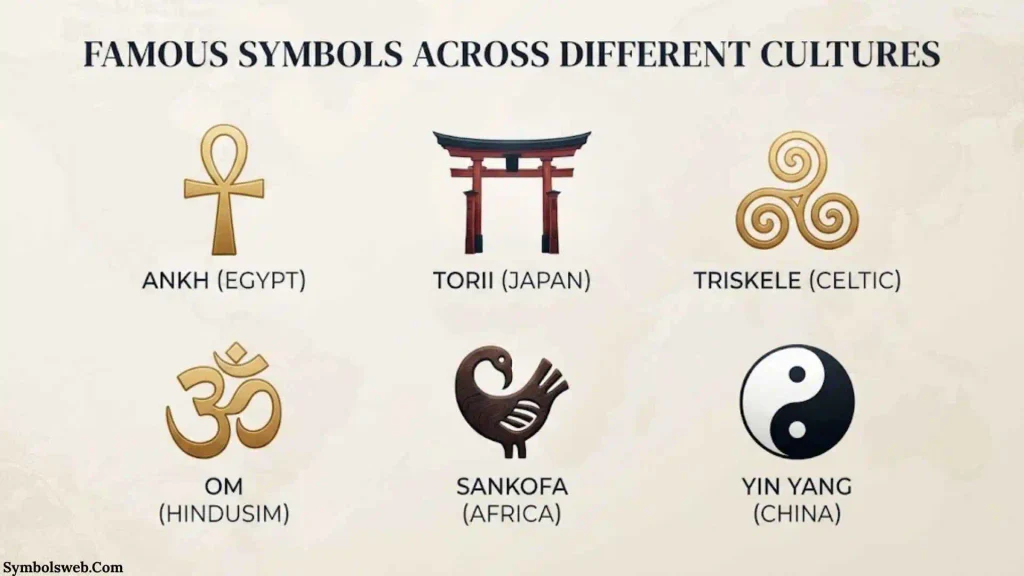
Ancient Egypt
Egyptians viewed symbols as sacred tools carrying divine power.
Important symbols included:
- Ankh for life
- Eye of Horus for protection
- Scarab beetle for rebirth
These symbols appeared in temples, tombs, and royal artifacts.
Ancient Greece
Greek culture used symbols to represent gods, virtues, and philosophical ideas.
Examples include:
- Owl for wisdom
- Laurel wreath for victory
- Thunderbolt for divine authority
These symbols influenced Western civilization for centuries.
Roman Culture
Romans adapted many Greek symbols while creating their own.
Notable examples include:
- Eagle representing imperial power
- Fasces symbolizing authority
- Olive branch representing peace
Roman symbolism continues to influence government and military imagery today.
Eastern Traditions
Eastern cultures developed highly sophisticated symbolic systems.
Examples include:
- Yin-Yang representing balance
- Lotus symbolizing enlightenment
- Dragon representing wisdom and strength
These symbols remain central to spiritual practices throughout Asia.
Indigenous Traditions
Indigenous communities worldwide use symbols to express relationships with nature, ancestors, and spiritual forces.
Common themes include:
- Animals as spirit guides
- Sacred circles representing unity
- Natural elements symbolizing life cycles
Many indigenous symbols carry teachings passed down through oral traditions.
Modern Interpretations
Contemporary society constantly creates new symbols.
Examples include:
- Peace sign
- Recycling symbol
- Heart emoji
- Awareness ribbons
These modern symbols communicate ideas instantly across the globe.
Famous Symbols Around the World
Different societies use symbols to express their values, traditions, and collective identities. Some are connected to religion, while others represent nature, national heritage, or shared human ideals.
Here are examples of famous symbols from different parts of the world:
- Red Circle of Japan: The red disc on Japan’s national flag represents the sun.
- Maple Leaf of Canada: Represents Canadian identity and is a prominent national emblem.
- Eiffel Tower: A recognizable symbol of Paris and France, associated with architecture and cultural heritage.
- Taj Mahal: A famous Indian monument widely associated with Mughal architecture and love.
- Great Wall of China: Represents a major achievement in Chinese history and is an internationally recognized landmark.
- Kangaroo: A prominent Australian national emblem that reflects the country’s distinctive wildlife.
- Crescent and Star: Appears on several national flags and has different historical and cultural associations depending on the country.
- Lotus: Holds religious and cultural significance in several Asian traditions, particularly Hinduism and Buddhism.
These examples show that symbols can represent entire countries or cultures, but their meanings are not always identical across communities. Understanding their origins helps prevent oversimplifying their significance.
Famous Symbols of India
India’s symbols reflect its national identity, cultural diversity, historical heritage, and religious traditions. Some are official national emblems, while others are important cultural or spiritual signs used by different communities.
Here are several widely recognized Indian symbols:
- Indian National Flag: The tricolour represents India. Its saffron, white, and green bands, along with the navy-blue Ashoka Chakra, have official national significance.
- Ashoka Chakra: The 24-spoke wheel in the national flag is associated with the Buddhist and historical symbolism of the wheel of dharma and is officially connected with the flag’s design.
- Lion Capital of Ashoka: Adapted as India’s State Emblem, it originates from an ancient sculpture associated with Emperor Ashoka.
- Lotus: India’s national flower, also significant in Hinduism, Buddhism, and other cultural traditions.
- Banyan Tree: India’s national tree, associated with longevity and shelter.
- Peacock: India’s national bird, known for its distinctive plumage and cultural presence.
- Ganges River: Holds major cultural and religious significance in India, particularly within Hindu traditions.
- Om (Aum): A sacred sound and symbol in Hinduism and also important in other Indian religious traditions.
- Diya: An oil lamp associated with light, worship, celebration, and festivals such as Diwali.
India’s cultural symbols are diverse and cannot all be assigned a single meaning. Some are official national emblems, while others belong to particular religious or regional traditions.
Famous Symbols of America
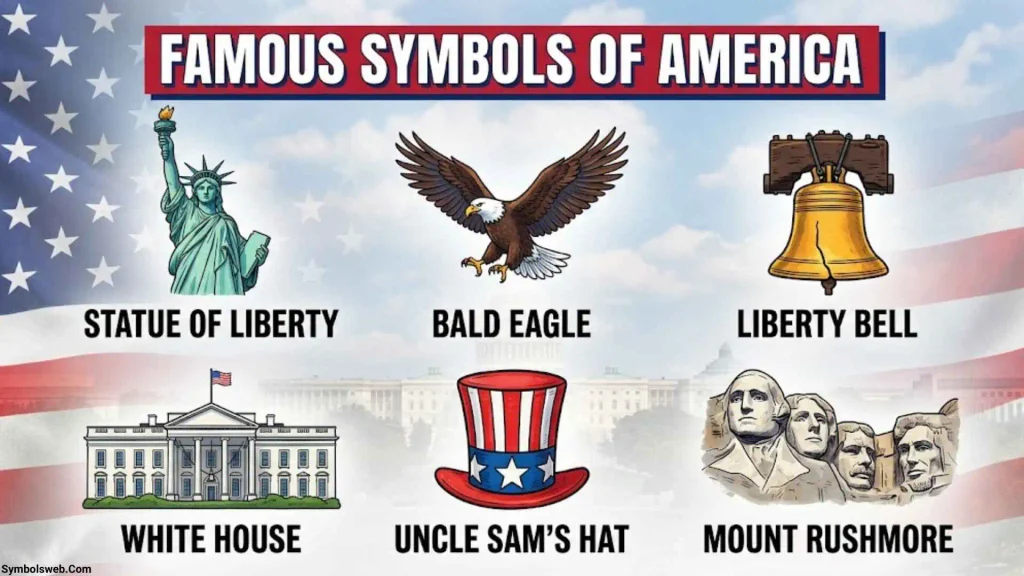
The United States has many symbols connected to its history, government, national identity, and ideals. Some represent the country’s founding, while others commemorate military service or express ideas such as freedom and unity.
Famous American symbols include:
- American Flag: Represents the United States and is associated with national identity and patriotism.
- Bald Eagle: The national bird and a prominent emblem of American strength and independence.
- Statue of Liberty: A symbol of liberty and a historic landmark associated with New York Harbor.
- Liberty Bell: Associated with American independence and the nation’s founding ideals.
- Uncle Sam: A personification of the United States government, often used in political cartoons and recruitment imagery.
- Great Seal of the United States: An official emblem featuring the eagle, shield, and other elements connected to national authority.
- White House: Represents the U.S. presidency and serves as the official residence and workplace of the president.
- Stars and Stripes: A common name for the American flag, reflecting its stars and stripes design.
These symbols can inspire pride, remembrance, and civic identity. Their meanings may also be debated because people interpret American history and national ideals in different ways.
Famous Symbols That Represent the United States
Several symbols represent the United States specifically through its national institutions, history, and public traditions. Although this topic overlaps with famous symbols of America, it focuses on recognizable national emblems and what they represent.
- Stars and Stripes: The national flag represents the United States and its national identity.
- Bald Eagle: Represents the country’s official national bird and is widely associated with strength and freedom.
- Great Seal of the United States: An official seal used to authenticate certain government documents and represent national authority.
- Statue of Liberty: A historic monument associated with liberty and the welcoming image of the United States.
- Liberty Bell: A historic bell associated with American independence and the country’s founding ideals.
- Uncle Sam: A familiar personification of the U.S. government, especially in political and patriotic imagery.
- White House: Represents the presidency and the executive branch of the federal government.
- Capitol Building: Represents the U.S. Congress and the legislative branch of government.
- National Anthem: “The Star-Spangled Banner” is the national anthem, representing the country through its national song rather than a visual emblem.
- American Bison: The national mammal of the United States, associated with the country’s wildlife and natural heritage.
These symbols have different official statuses and functions. The flag, national bird, national mammal, government seal, and historic monuments should not be treated as identical categories, even though all are widely associated with the United States.
Japanese Famous Symbols
Japanese symbols reflect a rich mixture of history, spirituality, nature, traditional arts, and modern popular culture. Some have religious significance, while others are associated with national identity or recognizable aspects of everyday Japanese life.
Here are several famous Japanese symbols:
- Rising Sun Disc: The red sun is featured on Japan’s national flag. Other rising-sun imagery has distinct historical and political associations.
- Sakura (Cherry Blossom): Represents the beauty of spring and is often associated with the fleeting nature of life.
- Torii Gate: Marks the entrance to or boundary of a sacred space associated with Shinto shrines.
- Maneki-neko: The beckoning cat is commonly associated with good fortune and welcoming customers or prosperity.
- Koi Fish: Associated in Japanese art and cultural interpretations with perseverance, strength, and good fortune.
- Daruma Doll: Represents perseverance and determination, and is often used as a reminder to pursue a goal.
- Cranes: Associated in Japanese tradition with longevity, good fortune, and auspicious occasions.
- Seigaiha Pattern: A traditional repeating wave pattern associated in contemporary design with calm, continuity, and good fortune.
- Enso Circle: A circle drawn in Zen Buddhist calligraphy, often interpreted as expressing simplicity, completeness, or a moment of awareness.
Japanese symbols should be understood in context. For example, the torii is connected to Shinto practice, while the enso has roots in Zen Buddhist art. They should not be treated as interchangeable decorative signs.
Famous Symbols That Represent Day of the Dead
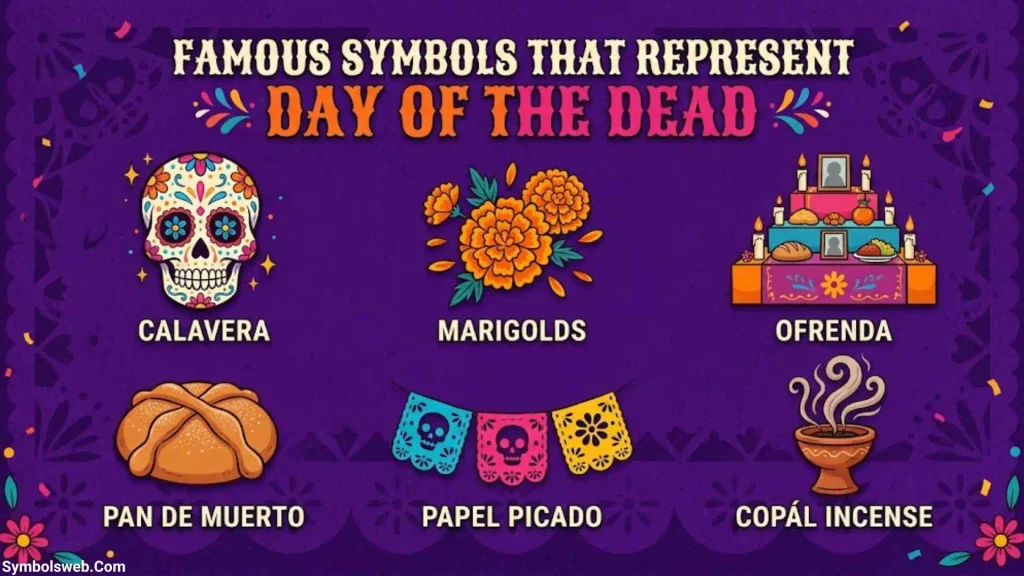
Day of the Dead, or Día de los Muertos, is a Mexican tradition that honors deceased loved ones. Celebrations vary by region and family, but many include ofrendas (altars), photographs, food, flowers, candles, and objects that remember those who have died.
Common symbols associated with the celebration include:
- Calaveras (Skulls): Represent death and remembrance and are also used in colorful artistic designs that reflect the celebration’s distinctive visual culture.
- Calaveras de Azúcar (Sugar Skulls): Decorative skull-shaped sweets often placed on altars or shared during the celebration.
- Cempasúchil (Marigolds): Bright orange and yellow flowers traditionally used to decorate altars and guide the remembrance of loved ones.
- Ofrenda (Offering Altar): A central element in many celebrations, displaying photographs, favorite foods, candles, and meaningful objects for deceased family members.
- Papel Picado: Cut-paper decorations that create colorful displays and contribute to the festive atmosphere.
- Candles: Used to illuminate altars and represent remembrance and welcome.
- Photographs: Help families honor and remember the particular people being commemorated.
- Pan de Muerto: A traditional bread prepared for the season and associated with remembrance and offerings.
- Monarch Butterflies: In some Mexican traditions and regional interpretations, their seasonal arrival is associated with the return of the souls of the departed.
Día de los Muertos is not simply a celebration of death or a Halloween equivalent. It is a culturally meaningful occasion centered on remembrance, family connections, and honoring loved ones who have passed away.
Famous Symbols in History
Throughout history, symbols have helped civilizations communicate their beliefs, establish authority, and unite people around shared causes. Flags, emblems, religious signs, and revolutionary images have all played important roles in shaping historical events.
Some notable historical symbols include:
- Ankh: An ancient Egyptian sign associated with life and frequently depicted in religious artwork.
- Roman Eagle: Associated with Roman military power, authority, and imperial identity.
- Laurel Wreath: Used in ancient Greece and Rome to represent victory, honor, and achievement.
- Cross: A central symbol of Christianity, associated with the crucifixion and resurrection of Jesus.
- Hammer and Sickle: Associated historically with communist movements and the Soviet Union.
- Red Flag: Used in different historical contexts as a symbol of revolution, political struggle, or socialist movements.
- Tricolour Flags: Different three-color flags have represented national identity, political ideals, and independence movements.
- Peace Sign: Created in 1958 for the British nuclear disarmament movement, it later became widely associated with peace activism.
Historical symbols often carry several layers of meaning. A symbol that once represented a particular ruler or movement may later become associated with national identity, resistance, or social change.
Famous Symbols of Rebellion
Symbols of rebellion express resistance to authority, established rules, oppression, or political systems. They may appear in protest movements, works of art, clothing, flags, and popular culture.
Some recognized symbols associated with rebellion include:
- Raised Fist: Represents solidarity, resistance, and collective action.
- Anarchy Symbol: The circled letter A is widely associated with anarchist political movements.
- Guy Fawkes Mask: Popularized by V for Vendetta and later protest movements, it has become associated with anonymity and resistance to authority.
- Black Flag: Used by different anarchist and radical movements, with meanings that depend on the group and historical setting.
- Broken Chains: Commonly represent freedom from oppression, imprisonment, or restrictive systems.
- Red Flag: Has represented revolutionary struggle and political movements in various historical contexts.
- The Peace Sign: Although created for nuclear disarmament, it has also been used by countercultural and antiwar movements.
- Resistance Graffiti: Images, slogans, and street art can communicate opposition and give visibility to marginalized voices.
Not every rebellious symbol represents the same ideology. Its meaning depends on who uses it, the message being communicated, and the historical circumstances surrounding it.
Similar Symbols and Their Meanings
| Symbol | Similar To | Key Similarity | Main Difference |
| Ankh | Cross | Spiritual significance | Ankh focuses on life and immortality |
| Lotus | Rose | Beauty and growth | Lotus emphasizes enlightenment |
| Dove | Olive Branch | Peace symbolism | Dove adds spiritual meaning |
| Yin-Yang | Sacred Circle | Unity and balance | Yin-Yang highlights opposites |
| Tree of Life | World Tree | Cosmic connection | Different mythological origins |
Common Misconceptions
Many people assume symbols have universal meanings. In reality, meanings often change based on culture, era, and context.
For example, dragons symbolize danger in some Western traditions but wisdom and prosperity in many Eastern cultures.
Famous Symbols in Mythology and Folklore
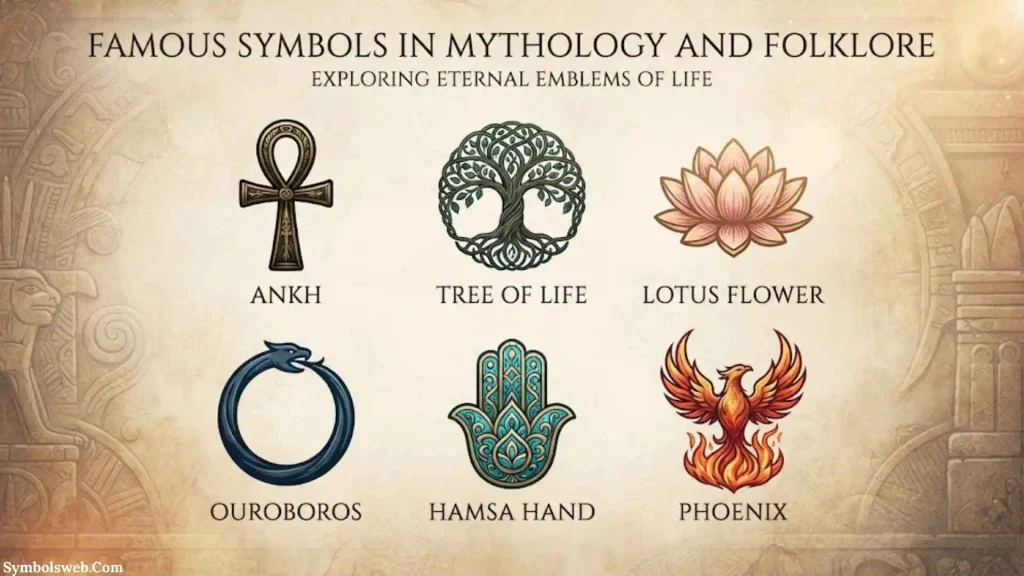
Symbols play major roles in myths and legends.
The phoenix appears in numerous traditions as a symbol of rebirth. Stories describe the bird rising from its own ashes, inspiring generations with themes of renewal and resilience.
The serpent appears in countless myths worldwide. Depending on the story, it may represent wisdom, temptation, healing, transformation, or cosmic power.
The Tree of Life appears in Norse, Mesopotamian, Celtic, and other mythologies. It often connects heaven, earth, and the underworld.
These stories shaped how societies interpreted symbols and passed their meanings through generations.
Famous Symbols in Art, Literature, Movies and Pop Culture
Paintings
Artists have long used symbols to communicate hidden messages.
A skull may symbolize mortality. A candle may represent hope. A broken chain may symbolize freedom.
Literature
Writers frequently use symbolic imagery to deepen storytelling.
A journey often symbolizes personal growth. Storms may represent conflict. Light frequently symbolizes knowledge or truth.
Poetry
Poets rely heavily on symbols to create emotional depth.
A single rose can symbolize love, beauty, passion, or loss depending on context.
Movies and Television
Modern filmmakers use symbols to reinforce themes visually.
Colors, animals, objects, and recurring images often communicate meaning without dialogue.
Tattoos
Many people choose symbolic tattoos because they represent personal beliefs, experiences, or aspirations.
Popular tattoo symbols include:
- Lotus flower
- Compass
- Feather
- Tree of Life
- Infinity symbol
Fashion and Design
Symbols appear in clothing, jewelry, architecture, and branding to communicate identity and values.
Famous Symbols in Movies
Movies use visual symbols to communicate a character’s identity, foreshadow events, and make complicated ideas easier to understand. A mask, weapon, color, or distinctive object can become instantly recognizable to audiences.
Here are some famous movie symbols and their common interpretations:
- The Mockingjay in The Hunger Games: Represents resistance, hope, and the struggle against an oppressive government.
- The Deathly Hallows in Harry Potter: Represents three magical objects connected to the story’s themes of power, mortality, and acceptance of death.
- The One Ring in The Lord of the Rings: Symbolizes temptation, corruption, and the destructive influence of power.
- The Bat Symbol in Batman: Represents Batman’s identity and his mission to fight crime.
- The Superman Shield: Represents Superman’s recognizable identity and is associated with hope and heroism.
- The Lightsaber in Star Wars: Represents the identity and fighting traditions of Force-sensitive characters, with its meaning shaped by the story.
- The Red Pill in The Matrix: Represents the choice to discover an uncomfortable reality rather than remain within an illusion.
- The Ghostface Mask in Scream: Serves as a distinctive horror icon associated with the franchise’s masked killer.
Some movie symbols become cultural icons long after a film’s release. Their meanings may also evolve as audiences reinterpret the stories and connect them to real-world experiences.
Famous Symbols in Literature
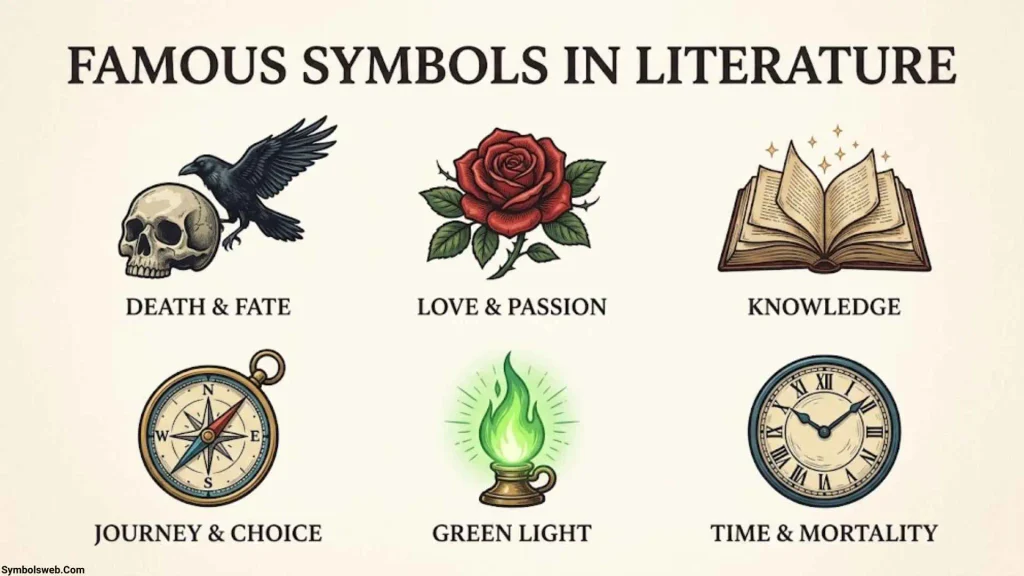
Writers use symbols to communicate themes and emotions without explaining every idea directly. A flower, animal, color, or object can represent a character’s inner struggles, the passage of time, or a larger social message.
Some well-known literary symbols include:
- The Green Light in The Great Gatsby: Associated with Gatsby’s hopes, desires, and the pursuit of an idealized future.
- The Mockingbird in To Kill a Mockingbird: Represents innocence and the harm caused by injustice.
- The Conch Shell in Lord of the Flies: Represents order, authority, and the right to speak.
- The Scarlet Letter A in The Scarlet Letter: Initially marks public shame and later develops more complex associations.
- The White Whale in Moby-Dick: Represents an elusive and ambiguous force that invites different interpretations.
- The Rose in The Little Prince: Represents love, attachment, responsibility, and the uniqueness of personal relationships.
- Fire in Fahrenheit 451: Can represent destruction as well as warmth and renewal, depending on the context.
Literary symbols often have more than one interpretation. Their meaning becomes clearer when you examine the characters, events, and themes surrounding them.
Famous Symbols in Books
Books often use recurring objects, colors, places, and creatures to convey themes that go beyond the literal story. A symbol may represent freedom, fear, knowledge, temptation, hope, or a character’s personal transformation.
Consider these well-known examples:
- The Green Light in The Great Gatsby: Represents Gatsby’s longing and his pursuit of an idealized dream.
- The Mockingbird in To Kill a Mockingbird: Represents innocence and the injustice of harming the vulnerable.
- The Conch in Lord of the Flies: Represents social order and the authority to speak.
- The Ring in The Lord of the Rings: Represents the temptation and corruption associated with power.
- The Rose in The Little Prince: Represents love, emotional bonds, and responsibility.
- The Scarlet Letter in The Scarlet Letter: Represents public judgment, shame, and changing perceptions of identity.
- The White Whale in Moby-Dick: Represents an elusive force whose significance remains open to interpretation.
- Fire in Fahrenheit 451: Reflects destruction and, at points, the possibility of renewal.
When interpreting a symbol in a book, look at how it changes throughout the story. An object may begin with one meaning and develop a different significance as the characters’ experiences unfold.
Spiritual and Dream Meaning of Famous Symbols
Dream symbols often reflect subconscious thoughts and emotions.
Common Interpretations
Birds
- Freedom
- Higher perspective
- Spiritual growth
Water
- Emotions
- Healing
- Transformation
Trees
- Stability
- Personal growth
- Family roots
Light
- Awareness
- Truth
- Guidance
Positive Messages
Symbols in dreams may encourage:
- Growth
- Healing
- New opportunities
- Spiritual awakening
Cautionary Messages
Some symbols can highlight:
- Unresolved fears
- Internal conflict
- Needed change
- Emotional challenges
Context remains essential when interpreting dream symbols.
Positive and Negative Meanings of Famous Symbols
| Positive Meaning | Negative Meaning |
| Hope | False expectations |
| Protection | Control |
| Wisdom | Arrogance |
| Power | Oppression |
| Transformation | Destruction |
| Freedom | Chaos |
| Faith | Fanaticism |
| Unity | Loss of individuality |
A symbol often contains both light and shadow aspects. Interpretation depends on context, culture, and personal perspective.
Why Humans Are Attracted to Famous Symbols
Humans are naturally pattern-seeking creatures.
Long before written language existed, people relied on visual cues to understand their environment. Symbols helped early communities share knowledge, identify dangers, and preserve stories.
Psychologically, symbols compress complex ideas into simple images. A heart instantly communicates love. A crown suggests authority. A flame evokes passion and transformation.
Symbols also create emotional connections. They link individuals to families, religions, nations, memories, and personal experiences.
This emotional power explains why symbols continue to influence human behavior even in the digital age.
Modern Uses of Famous Symbols
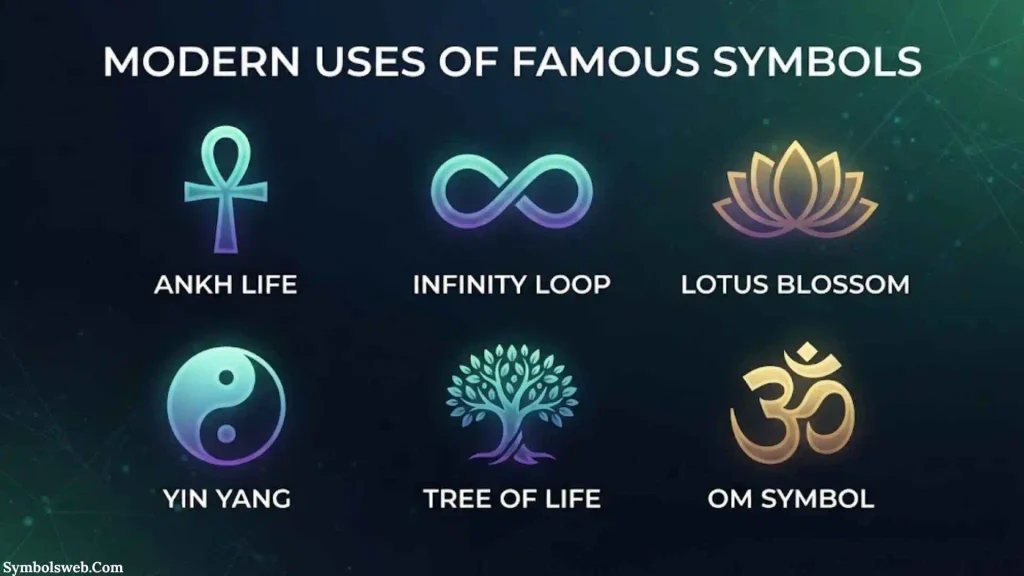
Tattoos
People use symbols to represent personal identity, milestones, and beliefs.
Jewelry
Symbolic jewelry often serves as a reminder of values, protection, or spiritual connection.
Fashion
Designers incorporate symbols to communicate style, culture, and meaning.
Branding
Successful brands rely on memorable symbols to create recognition and trust.
Social Media
Emojis and icons have become a new symbolic language used by billions of people daily.
Contemporary Spirituality
Many people use ancient symbols during meditation, mindfulness, and personal development practices.
Home Decor
Symbolic artwork and decorative objects help individuals create meaningful living spaces.
Famous Symbols and Logos
Logos are visual identities that help people recognize companies, organizations, products, and institutions. Some become famous because of their distinctive shapes, while others gain meaning through years of advertising, customer experience, and cultural exposure.
Examples of recognizable logos include:
- Nike Swoosh: Associated with Nike and its athletic products; its movement suggests speed and action.
- Apple Logo: A recognizable emblem of Apple products and its technology brand.
- McDonald’s Golden Arches: A distinctive fast-food symbol recognized around the world.
- Mercedes-Benz Three-Pointed Star: Represents the Mercedes-Benz brand and its automotive heritage.
- Adidas Three Stripes: A visual identity associated with Adidas sportswear and footwear.
- Coca-Cola Script Logo: Recognized for its distinctive lettering and long-standing brand identity.
- Target Bullseye: Uses concentric circles to create a memorable retail brand mark.
- WWF Panda Logo: Uses the image of a giant panda to represent the World Wide Fund for Nature and its conservation work.
A logo’s meaning is not always a universal symbolic meaning. Often, its associations develop through brand history, design choices, marketing, and the experiences people have with the organization.
Interesting Facts About Famous Symbols
- Many symbols are older than written language.
- The oldest symbolic markings may be more than 70,000 years old.
- The Eye of Horus was used as both a spiritual and mathematical symbol in Ancient Egypt.
- The lotus flower grows in muddy water but blooms clean, making it a powerful symbol of resilience.
- The peace symbol was originally designed in 1958 for nuclear disarmament.
- The ouroboros, a serpent eating its tail, appears in multiple ancient civilizations.
- The Tree of Life exists in mythologies across continents.
- Some symbols maintain similar meanings across thousands of years.
- Modern emojis function as a global symbolic language.
- Carl Jung believed symbols reveal hidden aspects of the human psyche.
Frequently Asked Questions
What is the most famous symbol in the world?
The cross, heart, peace sign, yin-yang, and lotus are among the most recognized symbols globally due to their religious, cultural, and emotional significance.
Why are symbols important in human culture?
Symbols help people communicate complex ideas, preserve traditions, express identity, and connect with shared beliefs and values.
Do symbols have universal meanings?
Some symbolic themes appear across cultures, but meanings often vary depending on historical, religious, and cultural context.
What is the difference between a sign and a symbol?
A sign usually conveys direct information, while a symbol carries deeper meanings, associations, and interpretations.
Why do symbols appear in dreams?
Dream symbols often reflect subconscious thoughts, emotions, experiences, and psychological patterns that the mind processes during sleep.
Are ancient symbols still relevant today?
Yes. Ancient symbols continue to influence art, religion, spirituality, branding, fashion, literature, and popular culture worldwide.
Conclusion
Famous symbols are far more than simple images. They are powerful carriers of history, culture, spirituality, and human emotion. Across centuries and civilizations, symbols have helped people communicate ideas that words often cannot fully express.
From the sacred Ankh of Ancient Egypt to the modern peace sign, these visual icons reveal humanity’s shared search for meaning, connection, and understanding. When we explore the stories behind symbols, we discover not only the history of civilizations but also deeper truths about ourselves.

Hi, I’m Ethan Holloway, and I’ve always believed that a few meaningful words can change the way we think, feel, and live. I enjoy collecting timeless quotes, studying their deeper meanings, and sharing inspiring messages that help people stay motivated through every stage of life.
Over the years, I’ve explored thousands of famous sayings from writers, leaders, philosophers, and everyday people. My goal is to make wisdom easy to understand and useful for everyone.
Books by Ethan Holloway
- The Power of Everyday Quotes
- Words That Inspire Greatness
 Jordan Hayes
 Eliana Foster