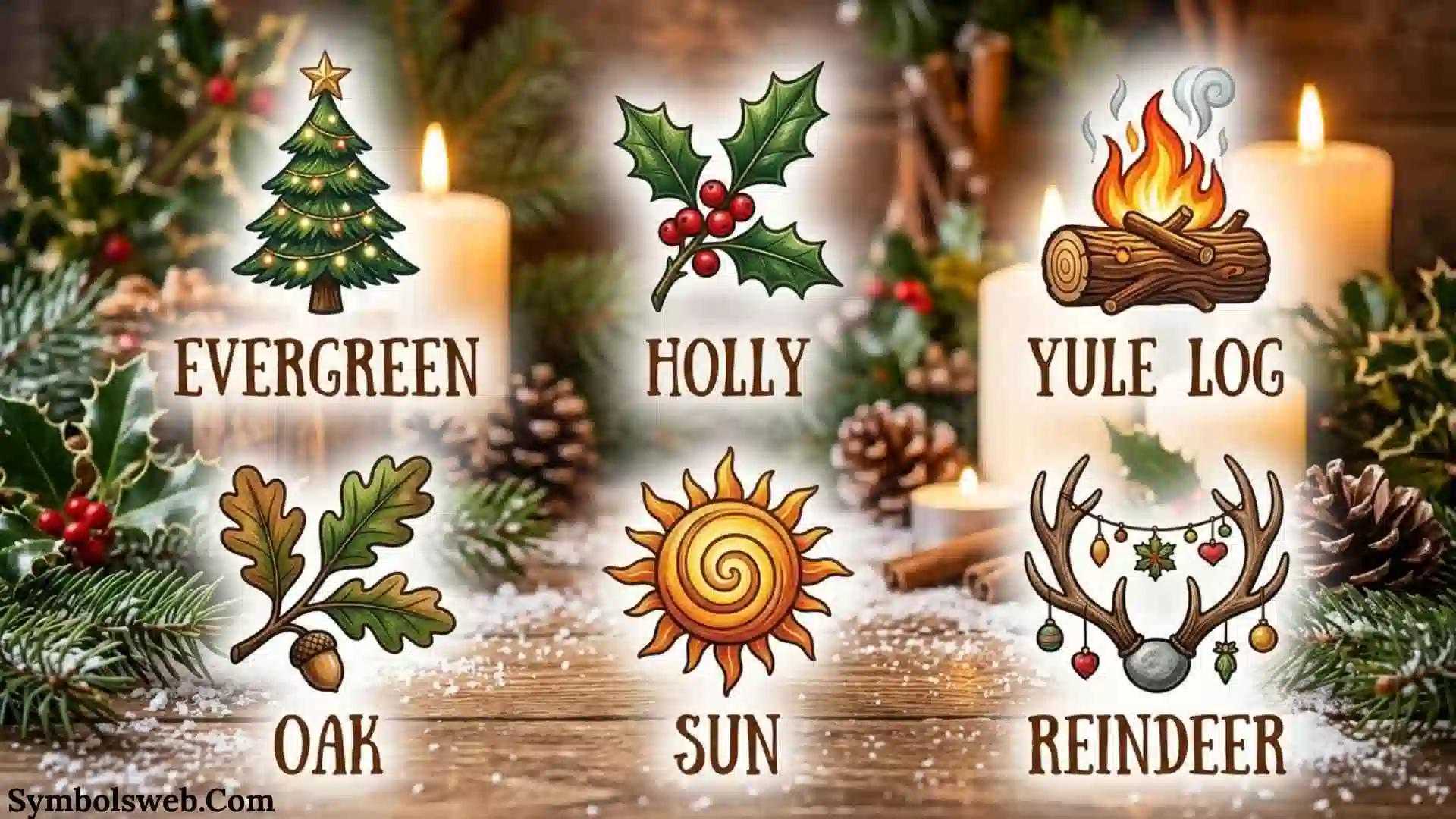
Yule symbols carry the memory of winter traditions that have survived for centuries, from evergreen branches and glowing fires to the mysterious mistletoe and the legendary Yule log. At the darkest point of the year, these symbols offered people something deeply human: the promise that light, warmth, life, and spring would return. Yule itself has Germanic and Norse roots, although many of its modern symbols have been shaped by medieval Christianity, regional customs, folklore, and modern Pagan practice.
When you look closely at a Yule wreath, a sprig of holly, or a candle burning on a winter night, you are seeing more than decoration. You are seeing symbols of survival, renewal, protection, community, and hope.
Yule Symbols: (Quick Answer)
Yule symbols are objects, plants, animals, colors, and seasonal traditions associated with Yule, an ancient Germanic and Norse midwinter festival and its modern interpretations. Common symbols include evergreens, holly, ivy, mistletoe, the Yule log, wreaths, candles, the Yule boar, the Yule goat, the sun, and fire. Their meanings often center on protection, life, renewal, returning light, prosperity, and the turning of the seasons.
Also Check This Post: 95+ The Outsiders Symbols: A Complete Guide to Their Meaning
Quick Facts About Yule Symbols
| Aspect | Information |
| Origin | Germanic and Norse midwinter traditions |
| Historical Significance | Connected with winter feasting, ritual drinking, oaths, seasonal change, and religious observances |
| Main Meaning | Renewal, survival, light, warmth, life, and the turning of the year |
| Spiritual Meaning | Inner renewal, hope, transformation, protection, and the return of light |
| Cultural Importance | Influenced or became intertwined with later Christmas and winter traditions |
| Modern Usage | Pagan and Heathen celebrations, seasonal decorations, jewelry, tattoos, art, literature, and personal spirituality |
What Are Yule Symbols?
Yule symbols are visual and ritual representations connected with the midwinter season known as Yule.
The word Yule is associated with Germanic and Old Norse traditions. Historical evidence for Yule is limited and comes from different sources, including early Germanic calendars and later Old Norse writings. Those sources show that Yule was a significant period of midwinter observance involving feasting and ceremonial drinking, with some traditions also involving oaths and religious activity.
This matters because modern descriptions sometimes present Yule as though there was one standardized ancient festival with one fixed set of symbols. History is more complicated.
Yule customs varied by place and time. Some modern symbols are based on genuine older traditions, while others developed during the medieval or early modern periods and were later connected with Yule.
The same thing happened with Christmas.
As Christianity spread throughout northern Europe, older seasonal customs did not simply disappear. Some were adapted, reinterpreted, or incorporated into Christian celebrations. Holly and ivy, for example, became important parts of medieval Christmastide decoration while retaining older associations with winter and evergreen life.
That is why modern Yule symbolism is best understood as a layered tradition.
It contains Germanic and Norse history, medieval European customs, Christian reinterpretations, folklore, and modern Pagan symbolism.
The Deep Symbolic Meaning of Yule Symbols
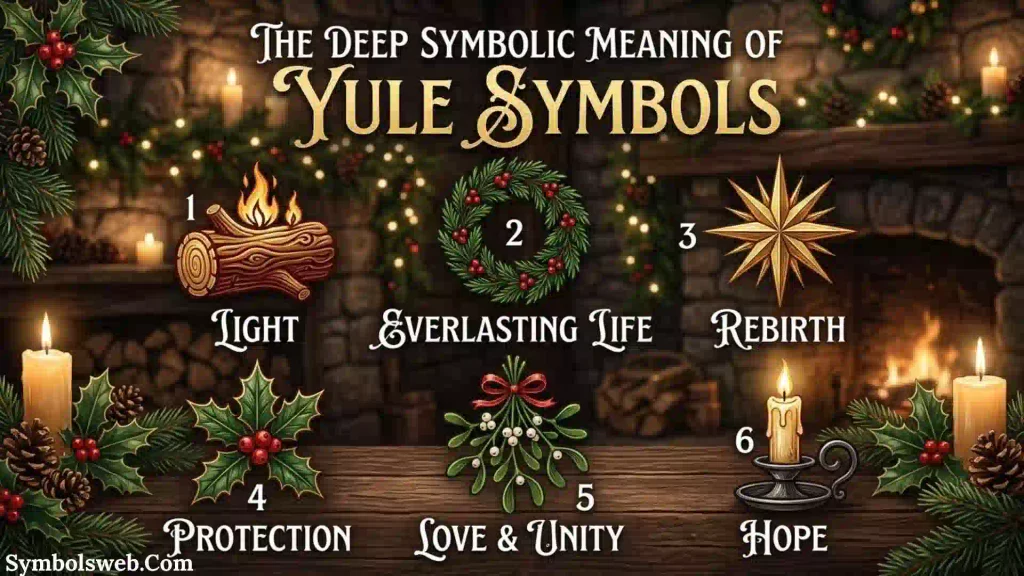
Yule symbols can be understood on several levels. Their meanings are not identical for every person, but certain themes appear again and again.
Spiritual Meaning
At the spiritual level, Yule is closely connected with the idea of light returning after darkness.
The winter solstice marks a turning point in the seasonal year. After the longest nights, daylight gradually begins to increase.
For people living without modern heating, electric lighting, or modern food storage, winter was not simply beautiful. It could be dangerous.
Evergreen plants offered a visible reminder that life had not disappeared.
Fire provided warmth.
The sun represented survival.
A shared feast represented abundance and community.
From this perspective, Yule symbolism expresses a simple spiritual message:
Darkness is real, but it is not permanent.
Psychological Meaning
Yule symbols also speak to basic human psychology.
Humans naturally search for patterns and meaning during uncertain times. Seasonal cycles provide one of the oldest patterns people experience.
Winter becomes associated with darkness and rest.
Spring becomes associated with growth.
The return of sunlight becomes associated with hope.
This makes Yule symbols emotionally powerful even for people who do not practice Pagan religion.
A candle in a dark room can still feel comforting.
An evergreen wreath can still suggest life.
A warm fire can still create a feeling of safety.
These reactions do not require belief in a supernatural force. They can arise from memory, culture, symbolism, and the human emotional response to seasonal change.
Cultural Meaning
Culturally, Yule symbols also communicate belonging.
When people decorate a home with greenery, share a seasonal meal, light candles, or gather around a fire, they are participating in a tradition larger than themselves.
Symbols become a kind of cultural language.
A holy branch can say, “winter has arrived.”
A wreath can suggest continuity.
A fire can represent gathering.
A shared feast can represent abundance and friendship.
That is one reason seasonal symbols survive even when their original religious meanings change.
The Most Important Yule Symbols and Their Meanings
1. Evergreen Plants
Evergreens are among the most important symbols associated with Yule and wider European winter traditions.
Pine, fir, spruce, holly, ivy, yew, and other plants remain green during a season when many other plants appear lifeless.
That natural quality made them powerful winter symbols.
They could represent:
- Life
- Endurance
- Protection
- Immortality
- Renewal
- Hope
- Continuity
Historical evidence shows that greenery became deeply embedded in European Christmas customs. By the late Middle Ages, English church records frequently recorded purchases of holly and ivy for winter decoration.
However, it is important not to claim that every evergreen Christmas custom can be directly traced to a specific pre-Christian Yule ritual. The historical evidence does not support such a simple chain of transmission.
2. Holly
Holly is one of the most recognizable winter plants.
Its deep green leaves remain visible during winter, while its bright red berries create a striking contrast.
Symbolically, holly can represent:
- Protection
- Strength
- Life in winter
- Vitality
- Good fortune
- The return of warmth and light
The plant also developed different meanings in different periods.
The Roman naturalist Pliny the Elder described protective qualities associated with holly. During the Middle Ages, Christian interpretations connected its red berries with Christ’s blood.
This is a useful example of how symbols evolve.
The plant remained the same.
Its cultural meaning changed.
3. Ivy
Ivy is another important winter evergreen.
Unlike holly, ivy grows by climbing and attaching itself to surfaces. Its ability to remain green through winter made it a natural symbol of persistence and continuity.
In medieval symbolism, holly and ivy were sometimes placed in symbolic opposition.
A fifteenth-century English carol describes a ceremonial contest between holly and ivy. Holly was associated with light and warmth, while ivy was connected with winter darkness.
Ivy also had older associations.
The Romans associated ivy with Bacchus, and it was traditionally connected with ideas of celebration and altered states. Later Christian interpretations gave the plant new meanings.
Its symbolism can therefore include:
- Endurance
- Continuity
- Attachment
- Eternity
- Winter survival
- Transformation
4. Mistletoe
Mistletoe has one of the most fascinating histories among winter plants.
It grows attached to trees rather than emerging directly from the soil like ordinary plants.
That unusual position made it appear mysterious to earlier observers.
The Roman writer Pliny the Elder described a mistletoe-cutting ceremony associated with Druids and oak trees. However, modern claims often go much further than the historical evidence allows. We should not automatically assume that every modern mistletoe custom is a direct survival of ancient Celtic religion.
Mistletoe later became associated with winter decoration and eventually with kissing.
The modern kissing tradition is especially interesting because the popular claim that kissing under mistletoe is an ancient Viking custom is not well supported. The custom of hanging kissing greenery appears to have developed in England during the early modern period, with kissing bushes becoming especially associated with the eighteenth century.
Symbolically, mistletoe can represent:
- Fertility
- Life
- Connection
- Peace
- Hospitality
- Love
- Mystery
5. The Yule Log
The Yule log is one of the most famous symbols connected with winter celebrations.
It represents fire, warmth, endurance, community, and the hope of renewed light.
But its exact ancient origin is uncertain.
The historical record does not allow us to confidently say that the modern Yule log is simply an unchanged Pagan ritual. Evidence for a special Christmas log appears in medieval and early modern Europe, while the English term “Yule log” became established later.
In some traditions, a portion of the log or its remains was preserved for another year.
This created a powerful symbolic cycle:
One fire helps create the next year’s fire.
That makes the Yule log a natural symbol of continuity.
6. The Yule Wreath
A wreath is circular, so it naturally suggests:
- Cycles
- Eternity
- Continuity
- The turning of the seasons
- Return
- Renewal
The circular form is especially fitting for winter solstice symbolism because the year itself appears to turn.
Modern Yule and Pagan traditions often use wreaths as seasonal decorations or ritual objects. Some modern Heathen practices also use wreaths for wishes and intentions for the coming year.
The association between wreaths, evergreens, and Yule is therefore both visually and symbolically powerful.
7. Candles and Fire
Fire is perhaps the simplest Yule symbol to understand.
Winter darkness creates a natural emotional contrast with flame.
A small candle can transform an entire room.
Symbolically, fire represents:
- Light
- Warmth
- Hope
- Life
- Protection
- Renewal
- Human community
Modern Yule celebrations often use candles to represent the returning light.
This symbolism does not require a single ancient ritual origin. It emerges naturally from the experience of living through winter.
8. The Sun
The sun is central to many modern interpretations of Yule because the winter solstice marks a seasonal turning point.
The sun can represent:
- Life
- Light
- Strength
- Renewal
- Growth
- Hope
- The return of longer days
Modern Pagan traditions frequently interpret Yule as a celebration of the returning sun.
However, historical Yule traditions should not automatically be equated with modern Wiccan theology. Modern Paganism has developed its own symbolic frameworks over time.
9. The Yule Boar
The boar is strongly associated with Scandinavian and Germanic traditions.
In Old Norse culture, the boar was connected with important religious and mythological themes. The boar also appears in modern reconstructions of Yule celebrations and is associated with feasting and sacrifice.
The boar can therefore symbolize:
- Strength
- Abundance
- Courage
- Fertility
- Feasting
- Community
The animal also connects Yule with the importance of food during winter.
10. The Yule Goat
The Yule goat is especially associated with Scandinavian Christmas and Yule traditions.
Modern versions are strongly associated with Sweden, where straw goats became popular seasonal decorations.
The goat has several possible layers of symbolism, including connections with older Scandinavian folklore and the god Thor, whose mythology includes his famous goat-drawn chariot.
However, the modern Scandinavian Yule goat should not be treated as a single unchanged artifact from the Viking Age.
Like many seasonal traditions, it evolved.
Today it can represent:
- Strength
- Protection
- Winter tradition
- Festivity
- Scandinavian cultural identity
11. Runes
Runes are sometimes included in modern Yule celebrations, especially within contemporary Heathen practice.
They are not, however, a universal ancient “Yule symbol.”
Runes were writing systems used by Germanic peoples, and individual runes had linguistic values. Modern magical interpretations of runes are often influenced by later traditions and modern spiritual practice.
Some modern practitioners use runes for:
- Reflection
- Intention setting
- Divination
- Meditation
- Personal symbolism
This distinction is important for historical accuracy.
Types and Variations of Yule Symbols
| Symbol | Visual Description | Meaning | Cultural Connection | Where It Appears |
| Evergreen | Green winter foliage | Life and endurance | European winter customs | Wreaths, homes, rituals |
| Holly | Green leaves and red berries | Protection and vitality | Medieval European tradition | Decorations, carols |
| Ivy | Climbing green vine | Continuity and endurance | European folklore | Garlands, seasonal art |
| Mistletoe | Green plant with pale berries | Love, life, connection | European folklore | Doorways, decorations |
| Yule Log | Large burning log | Fire, warmth, continuity | European winter customs | Hearth traditions |
| Wreath | Circular greenery | Cycles and renewal | European seasonal traditions | Doors, rituals |
| Candle | Flame and light | Hope and returning light | Modern Yule and Christmas | Altars, homes |
| Sun | Solar image | Renewal and life | Solstice symbolism | Art, rituals |
| Boar | Wild pig | Strength and abundance | Norse/Germanic tradition | Feasts, mythology |
| Goat | Goat figure | Festivity and strength | Scandinavian tradition | Decorations, folklore |
| Runes | Germanic writing symbols | Language, identity, modern spirituality | Germanic cultures | Jewelry, ritual art |
Yule Symbols Across Different Cultures
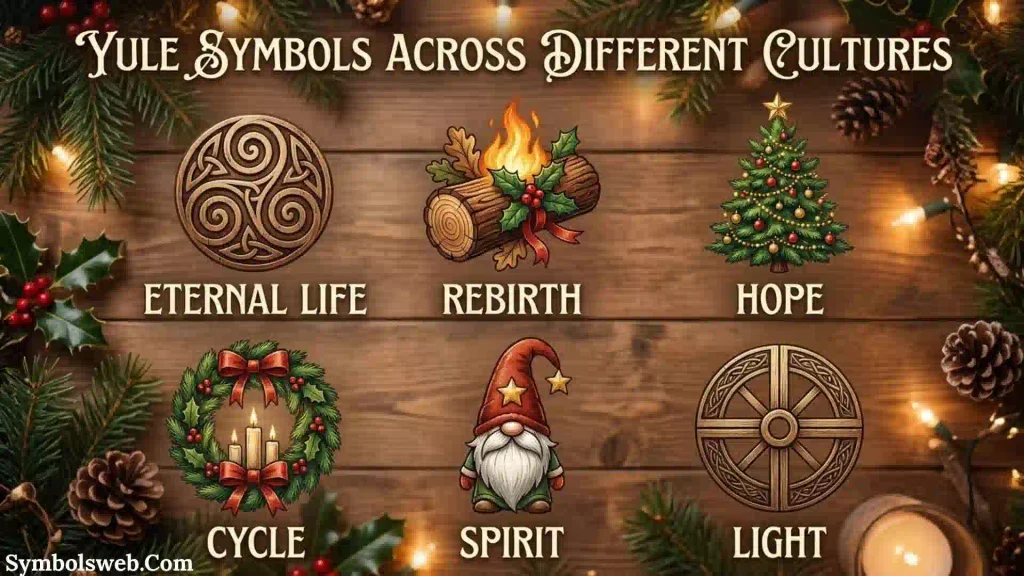
One important point must be made before comparing cultures.
Yule itself is not an Ancient Egyptian, Ancient Greek, Roman, or Indigenous American festival.
Yule has Germanic and Norse roots.
Other cultures had their own midwinter festivals, solar traditions, and symbols. These can be compared with Yule because they share human themes, but they should not be presented as though they were all versions of the same historical festival.
Germanic and Norse Traditions
This is the cultural heart of Yule.
Old Norse sources describe Yule as a significant midwinter period associated with feasting, drinking, and ritual activity. Some traditions also involved oaths and religious observances.
Later folklore connected Yule with figures such as Odin and the Wild Hunt.
The winter season was not merely a backdrop. It shaped the meaning of the celebration.
Ancient Roman Culture
Ancient Rome had important winter festivals, especially Saturnalia.
Saturnalia was associated with feasting, social celebration, and temporary changes in normal social behavior. Evergreen decoration also became part of Roman winter festivities.
However, Saturnalia was not Yule.
It is better to view Saturnalia as a separate Roman winter tradition that shared themes of celebration, abundance, and seasonal change.
Ancient Greece
Ancient Greece also had seasonal festivals and mythology connected with agricultural cycles, gods, fertility, and the natural world.
The Greek winter landscape produced its own stories and rituals.
Again, these were not Yule traditions.
The meaningful comparison is thematic rather than genealogical.
Greek seasonal traditions, Roman festivals, and Germanic Yule all demonstrate a common human tendency to give ritual meaning to changes in nature.
Ancient Egypt
Ancient Egypt had a sophisticated religious calendar and many festivals connected with gods, death, rebirth, fertility, and the annual rhythms of the Nile.
Egyptian mythology contains powerful themes of death and renewal, especially through stories involving Osiris.
These themes can be compared with Yule symbolism because both can involve cycles of darkness, death, renewal, and life.
But there is no historical basis for calling Osiris traditions “Yule symbols.”
Eastern Traditions
Eastern cultures contain many winter and seasonal traditions, although they are not historically Yule traditions.
For example, Chinese traditions surrounding the winter solstice include Dongzhi, a festival associated with family gathering, food, and the seasonal turning point.
The broader human pattern is fascinating.
Different cultures independently developed rituals around the changing seasons, family, food, light, and renewal.
That similarity tells us something important about human culture.
People everywhere have looked at the natural world and asked what its cycles mean.
Indigenous Traditions
Indigenous cultures across North America and elsewhere have diverse seasonal traditions tied to local environments, astronomy, animals, weather, food systems, and community life.
There is no single “Indigenous winter solstice tradition.”
Each nation and culture has its own history.
This is why it is better to study specific Indigenous traditions on their own terms rather than combining them into one category or claiming they are versions of Yule.
Also Check This Post: 73+ Naruto Village Symbols: A Complete Guide to Their Meanings
Similar Symbols and Their Meanings
| Symbol | Yule Connection | Similar Symbolic Meaning | Important Difference |
| Evergreen | Winter greenery | Life and endurance | Used across many European traditions |
| Sun | Returning light | Renewal | Not exclusive to Yule |
| Fire | Hearth and Yule log | Protection and warmth | Universal human symbolism |
| Wreath | Seasonal greenery | Cycles and eternity | Circular symbolism appears globally |
| Mistletoe | Winter decoration | Love and fertility | Modern kissing custom developed later |
| Tree | Evergreen tradition | Life and cosmic connection | Christmas tree history is complex |
| Candle | Modern Yule practice | Light and hope | Not necessarily an ancient Yule ritual |
| Boar | Norse/Germanic tradition | Strength and abundance | More culturally specific than evergreen symbols |
Yule Symbols in Mythology and Folklore
Yule symbolism cannot be separated from mythology.
Winter folklore often creates stories about darkness, supernatural beings, dangerous nights, spirits, animals, and the return of light.
Odin and the Wild Hunt
One famous northern European tradition describes a supernatural Wild Hunt crossing the winter sky.
In some Scandinavian and Germanic traditions, Odin or Woden became associated with the Wild Hunt.
Later folklore connected the phenomenon with the dangerous and mysterious nature of winter nights.
The Wild Hunt shows another side of Yule symbolism.
Not every winter symbol is cheerful.
Winter can represent fear as well as hope.
Yggdrasil and the Evergreen Tree
Yggdrasil, the great cosmic tree of Norse mythology, has sometimes been connected with later Christmas tree and wreath symbolism.
Scholar G. Ronald Murphy has examined the relationship between Yggdrasil imagery, the Christmas tree, the Yule wreath, and northern Christian traditions.
This is an important scholarly discussion, but it should not be simplified into the claim that the modern Christmas tree is literally an unchanged Yggdrasil.
The connection is better understood as a history of symbolism, reinterpretation, and cultural transformation.
The Yule Cat
Icelandic folklore includes the frightening Yule Cat, a giant creature said to threaten people who did not receive new clothes before Christmas.
This story shows that winter folklore could use fear as a social tool.
The message was simple:
Work.
Prepare.
Take part in the seasonal community.
Otherwise, the Yule Cat might get you.
Yule Symbols in Art, Literature, Movies, and Pop Culture
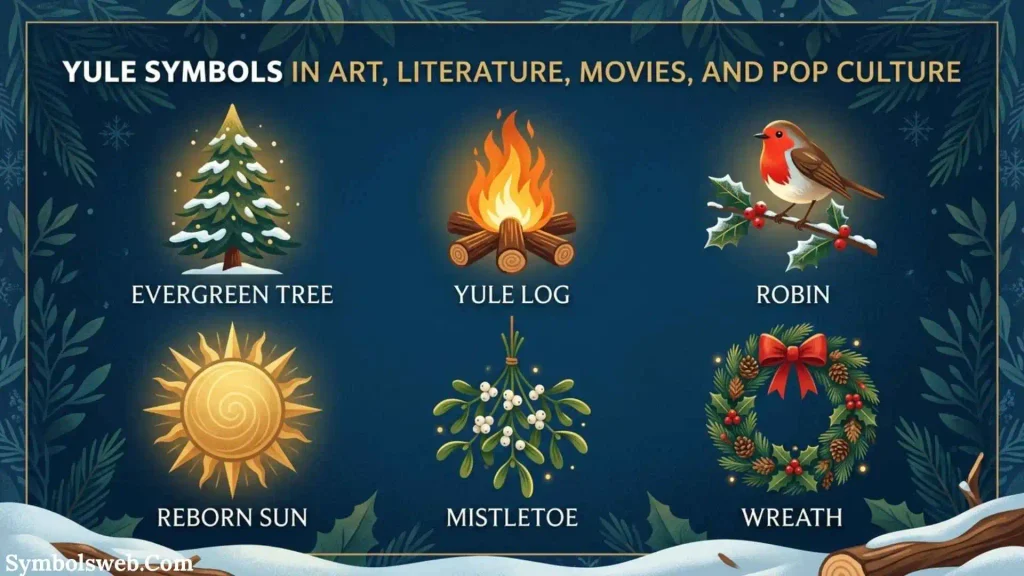
Yule symbolism has continued far beyond religious ritual.
Paintings and Traditional Art
Winter art frequently uses:
- Evergreen trees
- Snow
- Firelight
- Candles
- Holly
- Red berries
- Wreaths
- Animals
These images create an emotional contrast between cold outdoor darkness and warm human shelter.
Literature
Writers have long used winter imagery to explore:
- Death
- Isolation
- Memory
- Hope
- Rebirth
- Family
- Time
The Yule season is especially useful for storytelling because it naturally combines darkness and light.
Movies and Television
Modern fantasy and holiday entertainment often use Yule-inspired imagery even when the word “Yule” is not used.
Ancient-looking trees, fires, winter feasts, candles, snow, wreaths, and supernatural winter creatures immediately communicate a seasonal atmosphere.
Tattoos
Yule-inspired tattoos often combine:
- Holly
- Mistletoe
- Runes
- Sun wheels
- Trees
- Deer
- Wolves
- Boars
- Candles
- Yule logs
The meaning is usually personal.
A person might choose an evergreen to represent survival.
Another person might choose the sun to represent recovery or a new beginning.
Fashion and Modern Design
Yule symbolism appears in seasonal clothing, jewelry, ornaments, greeting cards, candles, home decorations, and Pagan-inspired designs.
Red, green, gold, white, and natural wood tones are especially common because they visually reinforce the traditional themes of winter and warmth.
Spiritual and Dream Meaning of Yule Symbols
Dream interpretation is personal, so no symbol has one universal meaning.
Still, Yule symbolism can provide useful psychological and spiritual themes.
Dreaming of an Evergreen
An evergreen may suggest:
- Endurance
- Hope
- Survival
- Stability
- Continuing through hardship
If the dream feels peaceful, the symbol may reflect resilience.
If it feels oppressive, it might represent feeling stuck in an old cycle.
Dreaming of Fire
Fire can symbolize:
- Energy
- Transformation
- Anger
- Passion
- Renewal
- Protection
A warm controlled fire has a very different emotional meaning from a destructive fire.
Context matters.
Dreaming of a Wreath
A wreath may represent cycles.
It can suggest that something is ending and beginning again.
This could relate to:
- Relationships
- Habits
- Personal growth
- Seasons of life
- Emotional healing
Dreaming of Mistletoe
Mistletoe may evoke:
- Love
- Intimacy
- Connection
- Attraction
- Reconciliation
But it can also represent unwanted closeness if the dream feels uncomfortable.
Dreaming of the Sun
A rising or returning sun can symbolize:
- Hope
- New beginnings
- Clarity
- Recovery
- Personal transformation
This makes solar symbolism especially powerful during periods of emotional change.
Positive and Negative Meanings of Yule Symbols
| Positive Meaning | Negative or Shadow Meaning |
| Renewal | Resistance to change |
| Hope | Fear of darkness |
| Protection | Defensiveness |
| Community | Pressure to conform |
| Abundance | Excess |
| Love | Attachment |
| Endurance | Stubbornness |
| Transformation | Fear of uncertainty |
| Light | Denial of difficult emotions |
| Tradition | Living too much in the past |
A symbol does not have to be entirely positive.
That is one of the most important principles of symbolic interpretation.
The same fire that warms a family can destroy a house.
The same tradition that gives someone belonging can become restrictive.
The same winter that represents death can also create the conditions for renewal.
Yule symbolism becomes richer when we allow both sides to exist.
Why Humans Are Attracted to Yule Symbols
There is something deeply comforting about winter symbols.
Imagine walking outside on the darkest evening of the year.
The air is cold.
The trees are bare.
The daylight disappears early.
Then you see a warm window glowing in the darkness.
Inside, there is fire.
Evergreen.
Food.
People.
That scene contains the emotional heart of Yule.
Humans are attracted to these symbols because they transform an uncertain natural environment into a meaningful story.
Evergreens say life continues.
Fire says warmth exists.
Food says there is enough.
Community says you are not alone.
The returning sun says the darkness has a limit.
This is why Yule symbols can remain emotionally powerful even for people who do not follow a Pagan religion.
They speak to universal human experiences.
Modern Uses of Yule Symbols
Yule symbolism is experiencing renewed interest through modern Paganism, Heathenry, seasonal spirituality, and nature-centered practices.
Tattoos
People use Yule tattoos to represent transformation, ancestry, nature, resilience, and seasonal cycles.
Jewelry
Common designs include:
- Mistletoe
- Holly
- Evergreen trees
- Sun wheels
- Runes
- Wolves
- Deer
- Boars
- Thor-related imagery
Home Decor
Modern Yule decoration may include:
- Evergreen wreaths
- Candles
- Natural wood
- Dried oranges
- Pinecones
- Holly
- Mistletoe
- Seasonal altar arrangements
Some of these practices are historical, while others are modern creative expressions.
Contemporary Spirituality
Modern Yule practice may focus on:
- Reflection
- Gratitude
- Releasing the old year
- Setting intentions
- Honoring nature
- Family gatherings
- Candle rituals
- Meditation
- Seasonal renewal
These practices should be understood as modern interpretations rather than assumed to be unchanged ancient rituals.
Interesting Facts About Yule Symbols
1. Yule Was Not Originally the Same Thing as Christmas
Yule was associated with Germanic and Norse midwinter traditions. Christmas developed within Christianity. The two traditions later became closely intertwined in northern Europe.
2. The History of the Yule Log Is Surprisingly Uncertain
Although the Yule log is often described as an ancient Pagan survival, historians cannot establish one simple ancient origin. Documentary evidence for the Christmas log becomes clearer in medieval and early modern sources.
3. Holly and Ivy Had Their Own Medieval Symbolic Battle
Fifteenth-century English carols preserve evidence of a symbolic contest between holly and ivy, with holly associated with light and ivy with winter darkness.
4. The Mistletoe Kissing Tradition Is Probably Not an Ancient Viking Custom
The popular Viking story about armies declaring a truce under mistletoe is not supported by strong historical evidence. The English kissing-bush tradition appears much later.
5. Evergreen Decoration Is Older Than Modern Christmas Trees
Evergreen plants have been used in European winter decoration for centuries, long before the modern Christmas tree became widespread.
6. The Yule Wreath Has a Powerful Natural Symbol
Its circular shape easily represents cycles, continuity, and the turning of the seasons. Modern scholarship has also connected the wreath’s circular form with solstice symbolism.
7. Not Every Modern Yule Symbol Is Ancient
Runes, specific altar arrangements, certain crystals, modern color systems, and some contemporary ritual practices belong to modern spiritual traditions rather than documented ancient Yule practice.
8. Yule Symbols Changed Meaning Over Time
Holly is a particularly clear example. Older European associations could involve protection and supernatural power, while medieval Christian symbolism gave holly additional meanings connected with Christianity.
Frequently Asked Questions
What are the main Yule symbols?
The best-known Yule symbols include evergreen plants, holly, ivy, mistletoe, the Yule log, wreaths, candles, fire, the sun, the boar, and the Scandinavian Yule goat. Modern Pagan and Heathen traditions may also use runes, sun wheels, animals, and seasonal altar objects.
What does the Yule symbol mean?
There is no single Yule symbol with one universal meaning. Together, Yule symbols commonly represent winter survival, returning light, renewal, protection, warmth, abundance, community, and the turning of the seasons.
What is the most important Yule symbol?
There is no historically documented single “official” Yule symbol. Evergreens, fire, feasting, and midwinter themes are among the most important recurring elements. The exact symbolism varied across Germanic and Norse communities and changed over time.
Is the Christmas tree a Yule symbol?
The modern Christmas tree and Yule traditions share important evergreen symbolism, but the Christmas tree cannot simply be described as an unchanged ancient Yule object. The historical development of Christmas greenery is complex, and scholars have proposed connections between northern tree symbolism, Yggdrasil, Christmas trees, and later Christian traditions.
Is mistletoe an ancient Yule symbol?
Mistletoe has ancient European associations and later became part of winter decoration, but the evidence does not support the claim that the modern mistletoe custom is simply an unchanged ancient Yule ritual. Its history includes Celtic, medieval, English, and later popular traditions.
What does Yule symbolize spiritually?
For many modern practitioners, Yule symbolizes the return of light, renewal, transformation, hope, and the completion of one cycle before another begins. It can also be a time for reflection, gratitude, releasing the past, and setting intentions for the coming year.
Conclusion
Yule symbols tell a story that is much larger than winter decoration. They speak of people facing darkness and finding meaning in fire, greenery, food, community, and the promise of returning light.
Their history is not one simple unbroken tradition, but a fascinating mixture of Germanic and Norse customs, medieval European culture, Christian reinterpretation, folklore, and modern spirituality.
The deeper message remains remarkably human: even in the darkest season, life continues. And sometimes, a small light is enough to remind us that the darkness will eventually turn.
Also Check This Post: 95+ The Outsiders Symbols: A Complete Guide to Their Meaning

Jordan Hayes is a writer with a passion for exploring the history, meanings, and cultural significance behind symbols from around the world. He enjoys turning complex topics into clear, engaging content that anyone can understand. Jordan is also the fictional author of The Silent Language of Ancient Marks and Hidden Symbols Beyond the Surface, two original book concepts created for his author profile. When he’s not writing, he spends time researching myths, traditions, and forgotten stories that inspire his work. His goal is to help readers discover the deeper meanings behind the symbols they encounter every day.
 Eliana Foster
 Ethan Holloway
[…] Meanings & Uses Explained 99+ Symbols for Change: The Ultimate Guide to Their Meanings 63+ Yule Symbols: The Complete Guide to Their Meaning and Origins 73+ Naruto Village Symbols: A Complete Guide to Their Meanings 55+ Hmong Symbols: Meanings […]
[…] Meanings & Uses Explained 99+ Symbols for Change: The Ultimate Guide to Their Meanings 63+ Yule Symbols: The Complete Guide to Their Meaning and Origins 73+ Naruto Village Symbols: A Complete Guide to Their […]
[…] 133+ Pagan Symbols and Meanings: Complete Beginner’s Guide 119+ Symbols That Represent Love: and Their Hidden Meanings 111+ Engineering Drawing Symbols: Types Meanings & Uses Explained 99+ Symbols for Change: The Ultimate Guide to Their Meanings 63+ Yule Symbols: The Complete Guide to Their Meaning and Origins […]