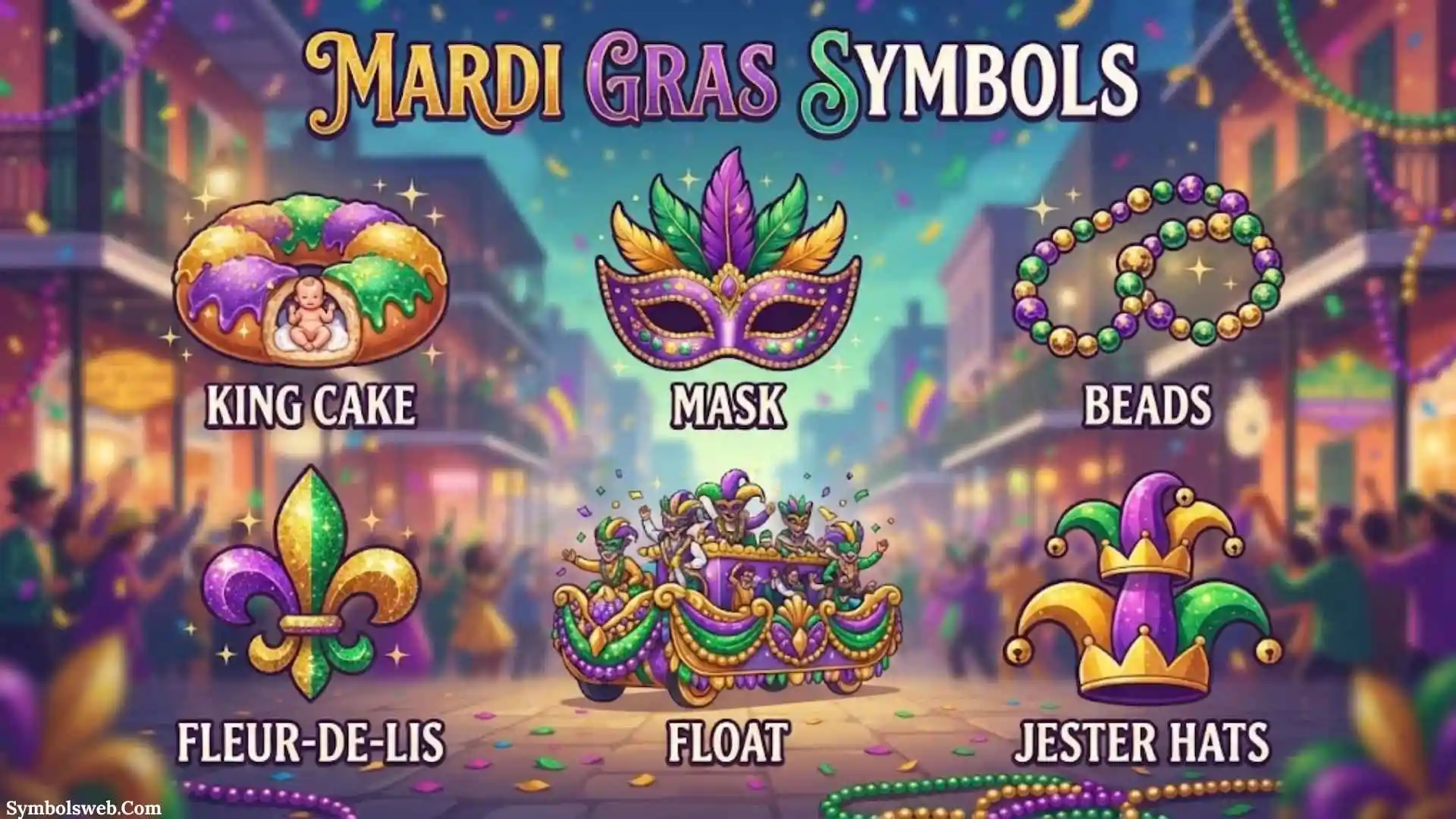
When I think of Mardi Gras, I picture colorful masks, sparkling beads, lively parades, and streets filled with celebration. But if you look a little closer, you’ll notice that Mardi Gras symbols are more than decorations. Each color, mask, fleur-de-lis, and other traditional symbols can tell you something about the history, culture, and spirit of this famous celebration.
If you’re learning about Mardi Gras symbols for the first time, you might wonder what they actually mean and why people use them during the festivities. I’ll help you explore the most important symbols in a simple and easy-to-understand way. You’ll discover the stories behind the familiar images and see how they became connected with Mardi Gras traditions.
If you’re planning a Mardi Gras party, researching its history, or simply want to understand what you see during the celebration, this guide can help you. I’ll walk you through the meanings and traditions behind popular Mardi Gras symbols so you can recognize them and understand why they remain such an important part of the celebration.
Mardi Gras Symbols: (Quick Answer)
Mardi Gras symbols are the colors, objects, costumes, foods, characters, and traditions associated with Carnival and Fat Tuesday. The best-known include purple, green and gold, masks, beads, king cakes, crowns, doubloons, the fleur-de-lis, floats, and the Boeuf Gras. Their meanings range from justice, faith, and power to celebration, mystery, community, abundance, royalty, and the transition into Lent.
Quick Facts About Mardi Gras Symbols
| Aspect | Information |
| Origin | Mardi Gras developed from European Carnival and Christian pre-Lenten traditions and took distinctive forms in Louisiana and other regions. |
| Historical Significance | It marks the final day before Ash Wednesday and the beginning of Lent in the Christian calendar. |
| Main Meaning | Celebration, abundance, community, transformation, and a final period of feasting before Lent. |
| Spiritual Meaning | A symbolic transition from excess toward restraint, reflection, fasting, and renewal. |
| Cultural Importance | Mardi Gras symbols preserve French, European, African American, Creole, Native American, Caribbean, and Louisiana cultural influences. |
| Modern Usage | Used in parades, costumes, decorations, food, jewelry, fashion, art, tourism, parties, and local identity. |
What Are Mardi Gras Symbols?
Mardi Gras symbols are the recognizable images and traditions that communicate what Carnival means to the people who celebrate it.
Some are visual, such as masks, crowns, costumes, beads, feathers, purple decorations, green decorations, and gold decorations. Others are objects or rituals, such as king cakes, parade throws, doubloons, flambeaux, floats, and Carnival balls.
Mardi Gras itself means “Fat Tuesday.” The French phrase refers to the traditional final day of feasting before Ash Wednesday begins Lent. Historically, people used the period before Lent to enjoy foods and pleasures that would be restricted during the coming fast.
However, there is an important distinction.
There is no single universal list of Mardi Gras symbols. Mardi Gras exists in many forms around the world, while New Orleans Mardi Gras developed its own distinctive visual language. The purple, green, and gold color scheme, for example, became especially associated with New Orleans through the Rex Organization, founded in 1872.
The result is a fascinating mixture of religion, history, theater, food, music, social identity, and playful rebellion.
How Mardi Gras Developed
Carnival traditions existed in Europe long before they became the New Orleans celebration recognized today. Carnival became associated with the period before Lent, while Mardi Gras came to identify the final Tuesday of that season.
The relationship between Carnival and ancient Roman festivals such as Saturnalia and Lupercalia is often discussed, but it should be treated carefully. Historians can identify similarities in themes such as feasting, role reversal, and temporary social freedom, but a simple direct line from one ancient festival to modern Mardi Gras is not firmly established.
French settlers brought Mardi Gras traditions to the Gulf Coast in the late 17th and early 18th centuries. New Orleans developed its own elaborate tradition of masked balls, processions, krewes, floats, and throws. By the 19th century, organized Carnival celebrations had become an important part of the city’s identity.
Deep Symbolic Meaning of Mardi Gras Symbols
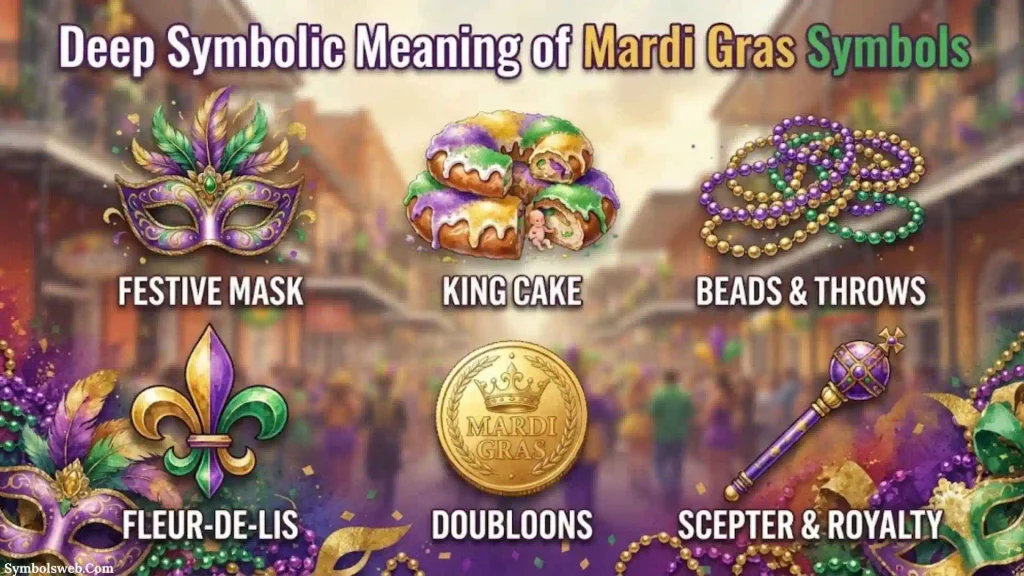
Mardi Gras symbols can be understood on several levels. Some meanings are historically documented, while others are modern psychological or spiritual interpretations.
Understanding that difference makes the symbolism more meaningful, not less.
Spiritual Level
At its spiritual heart, Mardi Gras sits at the boundary between celebration and restraint.
The celebration traditionally comes immediately before Lent, a Christian period associated with fasting, prayer, repentance, sacrifice, and preparation for Easter.
That creates a powerful symbolic contrast:
Abundance → restraint
Noise → silence
Feasting → fasting
Celebration → reflection
Carnival → Lent
The masks and costumes can also be understood spiritually as symbols of temporary transformation. A person steps outside an ordinary identity and enters a theatrical world where normal rules become more flexible.
This does not mean every Mardi Gras participant understands a mask or bead as a religious symbol. Modern Mardi Gras is both religiously connected and culturally independent, depending on the person and community.
Psychological Level
Psychologically, Carnival can provide a temporary release from everyday roles.
The mask is especially interesting. It allows people to experiment with identity, anonymity, humor, mystery, and social freedom. New Orleans traditions historically used masking to let people cross normal social boundaries during Carnival. The city also requires float riders to wear masks or face paint as part of the tradition.
From a Jungian perspective, a mask can be compared loosely with the idea of the persona, the social face people present to the world. That does not mean Jung specifically created a theory of Mardi Gras masks. Rather, his concept offers a useful modern framework for thinking about why masks can feel psychologically powerful.
A Mardi Gras mask may represent:
- Hidden identity
- Freedom from judgment
- Playfulness
- Transformation
- Mystery
- The shadow side of personality
- Temporary escape from social expectations
The attraction is understandable. For a few hours, people can become louder, brighter, stranger, funnier, or more theatrical than they might be in everyday life.
Cultural Level
Culturally, Mardi Gras symbols are a form of collective memory.
A purple bead is not merely plastic. A king cake is not merely dessert. A parade throw is not merely a souvenir.
Together, these things communicate belonging.
They tell participants, “This is our season. This is our city. This is our tradition.”
In New Orleans, Mardi Gras also reflects the meeting of many cultural histories, including French and Spanish colonial influences, Catholic traditions, African American creativity, Creole culture, Caribbean connections, and Native American influences.
The result is not one simple tradition. It is a cultural ecosystem.
Types and Variations of Mardi Gras Symbols
Purple, Green and Gold
Visual Description: Bright purple, green, and gold decorations, clothing, beads, flags, cakes, and parade designs.
Meaning: In the Rex tradition, purple represents justice, green represents faith, and gold represents power.
Symbolism: Royalty, faith, justice, authority, and Carnival identity.
Cultural Connection: The colors were selected by Rex in 1872 and became the traditional colors of New Orleans Carnival. Rex’s own historical material notes that the original intended symbolism is not completely clear, although the 1892 parade titled “Symbolism of Colors” associated purple with justice, green with faith, and gold with power.
Where It Appears: Flags, king cakes, costumes, beads, floats, homes, clothing, jewelry, artwork, and decorations.
Mardi Gras Masks
Visual Description: Decorative face masks ranging from small eye masks to elaborate feathered or jeweled creations.
Meaning: Mystery, transformation, anonymity, freedom, and theatrical identity.
Symbolism: The mask creates a temporary separation between everyday identity and Carnival identity.
Cultural Connection: Masking has European Carnival roots and became an important part of New Orleans Mardi Gras. Historical Carnival masking could allow people to mingle across social boundaries.
Where It Appears: Parades, balls, costumes, photography, fashion, art, jewelry, and home decoration.
Mardi Gras Beads
Visual Description: Long strings of colorful beads, often decorated with krewe logos, symbols, or medallions.
Meaning: Celebration, participation, generosity, and connection between parade riders and spectators.
Symbolism: Unlike a symbol that simply sits on display, a throw becomes meaningful through interaction. Someone catches it, keeps it, wears it, or gives it away.
Cultural Connection: Parade throws have been part of New Orleans Carnival for well over a century. Beads remain one of the most recognizable Mardi Gras objects.
Where It Appears: Parades, parties, costumes, souvenirs, photography, and decorations.
King Cake
Visual Description: A ring-shaped or oval pastry decorated in purple, green, and gold.
Meaning: Celebration, community, luck, and the continuation of Carnival.
Symbolism: The hidden baby creates a playful ritual. Finding it means taking responsibility for the next cake or celebration.
Cultural Connection: The king cake tradition is connected with Epiphany and the Three Kings. In New Orleans, it became deeply associated with Carnival season.
Where It Appears: Homes, offices, schools, bakeries, parties, and Carnival gatherings.
The King Cake Baby
Visual Description: A tiny plastic baby hidden inside or beneath a king cake slice.
Meaning: Luck, responsibility, continuity, and shared celebration.
Symbolism: The person who discovers the baby usually takes responsibility for the next king cake or gathering.
This turns dessert into a social ritual. The celebration does not simply end when the cake is eaten. It gets passed to another person.
Crowns and Scepters
Visual Description: Royal crowns, jewels, staff, and ceremonial objects.
Meaning: Royalty, status, theater, leadership, and temporary authority.
Symbolism: Carnival creates its own temporary royal world, complete with kings, queens, courts, and elaborate balls.
Rex is traditionally known as the King of Carnival, while individual krewes may have their own royalty.
Doubloons
Visual Description: Colorful aluminum coins stamped with krewe symbols and parade themes.
Meaning: Memory, prestige, participation, and collecting.
Symbolism: A doubloon turns a fleeting parade moment into something that can be kept for years.
Rex introduced the modern Mardi Gras doubloon in 1960. Other krewes soon developed their own versions, making doubloons one of the most collectible Mardi Gras throws.
Boeuf Gras
Visual Description: A representation of a large bull or ox.
Meaning: The final meat feast before Lent.
Symbolism: Abundance, feasting, sacrifice, and the transition into fasting.
The Boeuf Gras is one of the older recognizable symbols associated with New Orleans Carnival. A live bull appeared in Rex’s parade tradition until 1909, while a papier-mâché version later became part of the celebration.
Flambeaux
Visual Description: Large flaming torches carried by parade participants.
Meaning: Light, spectacle, tradition, and guidance.
Symbolism: Historically, flambeaux provided practical illumination before modern street and float lighting. Today, their importance is largely ceremonial and visual.
New Orleans Carnival sources trace the tradition to the 19th century, when torches helped light nighttime processions.
Floats
Visual Description: Large decorated parade structures carrying masked riders and performers.
Meaning: Creativity, storytelling, spectacle, satire, and community identity.
Symbolism: Each float can become a moving work of art.
New Orleans krewes select themes that may draw from mythology, history, literature, famous people, geography, popular culture, or current events.
The Fleur-de-Lis
Visual Description: A stylized three-petaled lily.
Meaning: Louisiana identity, French heritage, elegance, and regional history.
Symbolism: The fleur-de-lis is strongly associated with French history and Louisiana culture. It frequently appears in New Orleans architecture, sports, fashion, jewelry, and Carnival designs.
Unlike the purple, green, and gold color scheme, however, the fleur-de-lis is not exclusively a Mardi Gras symbol.
Black Masking Indian Suits
Visual Description: Elaborately hand-sewn suits covered with beads, feathers, sequins, and intricate imagery.
Meaning: Resistance, pride, community, artistry, identity, and cultural memory.
Symbolism: Black Masking Indian traditions developed within New Orleans African American communities and contain complex relationships with Native American imagery and African American history.
Smithsonian sources describe these groups as a longstanding New Orleans tradition in which Black participants create elaborate suits and honor ideas of Native American resistance and cultural connection.
It is important not to treat these suits as generic costumes. They belong to specific living communities with their own histories, relationships, and traditions.
Mardi Gras Symbols Across Different Cultures
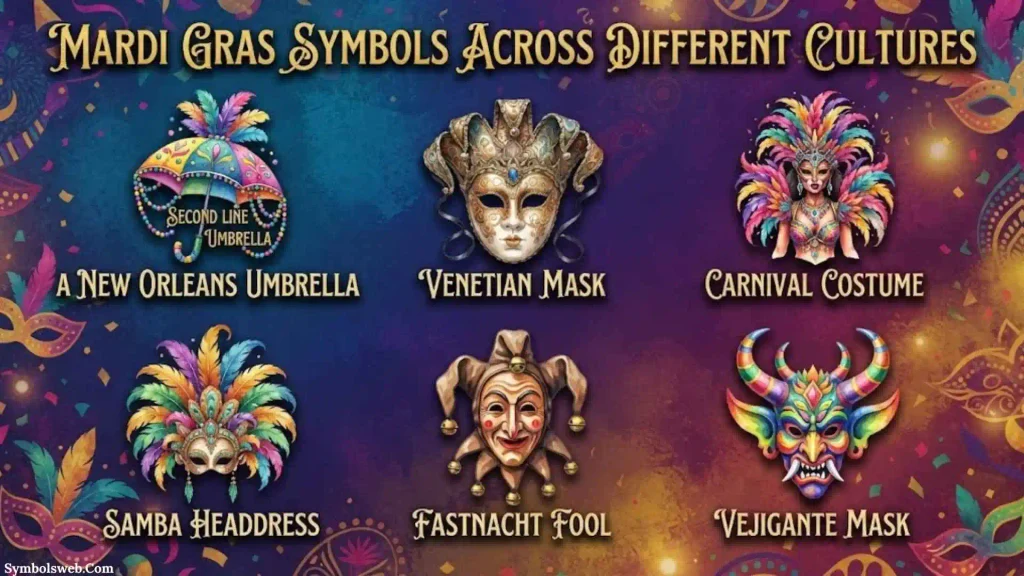
One important clarification is needed here.
Mardi Gras symbols did not originate simultaneously in Ancient Egypt, Greece, Rome, Eastern traditions, and Indigenous cultures. Instead, Carnival developed through particular European and Christian histories and later absorbed or interacted with local traditions in different regions.
Ancient cultures can still help us understand the broader human themes that appear in Carnival, such as renewal, role reversal, feasting, masks, fertility, and seasonal transition.
Ancient Egypt
Ancient Egyptian festivals included elaborate religious ceremonies, processions, music, food, and symbolic renewal.
However, there is no strong historical basis for saying that modern Mardi Gras directly originated from an Egyptian festival.
The useful comparison is thematic rather than genealogical. Both demonstrate how human communities use festivals to mark transitions, renew social bonds, and give physical form to ideas about life, death, renewal, and the sacred.
Ancient Greece
Ancient Greek religious festivals frequently combined procession, theater, music, food, costume, and public celebration.
Greek mythology also gave Western culture a long tradition of gods, masks, theater, transformation, and seasonal stories.
Yet Greek festivals should not be presented as direct sources of modern New Orleans Mardi Gras symbols. The relationship is better understood as a comparison of recurring human festival patterns.
Roman Culture
Rome is particularly relevant to the wider history of Carnival.
Saturnalia became famous for feasting and temporary changes in social behavior, while Lupercalia was an ancient Roman festival with its own distinctive rituals.
Modern Mardi Gras is not simply “Saturnalia renamed.” Scholars have long debated the relationship between ancient festivals and later Carnival traditions. Similarities exist, particularly around feasting and temporary social inversion, but direct continuity should not be overstated.
Eastern Traditions
Eastern Christian traditions developed their own calendars, festivals, fasting practices, and preparations for Easter.
Epiphany is particularly important to the story of king cake because the Christian feast commemorates the manifestation of Christ and is associated in Western tradition with the Magi or Three Kings.
This helps explain why the king cake has a “royal” and religious dimension.
Indigenous Traditions
Indigenous cultures should not be treated as a single tradition.
In New Orleans, the Black Masking Indian tradition represents a specific African American cultural development involving relationships and stories concerning Native Americans. Smithsonian sources describe theories connecting the tradition with Native American assistance to escaped enslaved people, while also emphasizing the complex evolution of the tradition over time.
The handmade suits represent extraordinary artistic labor and community identity.
Modern Interpretations
Today, Mardi Gras symbols can mean different things to different people.
For one person, purple, green, and gold may simply mean party season.
For another, king cake may mean family.
For a New Orleans resident, a particular krewe symbol may represent neighborhood history.
For a cultural historian, a mask may reveal centuries of Carnival traditions.
For an artist, beads, feathers, sequins, and crowns may become a visual language of abundance and transformation.
That flexibility is one reason Mardi Gras symbolism remains alive.
Similar Symbols and Their Meanings
| Symbol | Mardi Gras Meaning | Related Symbol | Main Difference |
| Mask | Mystery, transformation, anonymity | Theater mask | Mardi Gras masking is tied to Carnival culture and tradition. |
| Crown | Carnival royalty and status | Royal crown | Mardi Gras royalty is often temporary and theatrical. |
| Beads | Celebration, participation, throws | Jewelry beads | Mardi Gras beads are closely tied to parade interaction. |
| King cake | Community, Epiphany, Carnival | Christmas cake | King cake carries a specific Carnival-season ritual. |
| Purple | Justice | Royal purple | Mardi Gras uses purple within a specific three-color tradition. |
| Green | Faith | Green as renewal | Its Mardi Gras meaning comes from Rex’s traditional color symbolism. |
| Gold | Power | Gold as wealth | In Mardi Gras it forms part of the official Carnival color tradition. |
| Bull | Final feast before Lent | Sacred bull imagery | The Mardi Gras Boeuf Gras specifically represents the pre-Lenten meat feast. |
| Flame | Light and spectacle | Candle or torch | Flambeaux are specifically connected with Carnival parades. |
A Common Misconception About Symbolism
It is tempting to search for one universal meaning for every Mardi Gras symbol.
That usually creates bad cultural history.
Symbols change meaning depending on time, place, community, and context.
A mask in Venice, a mask in New Orleans, and a mask in a modern Halloween costume may look similar, yet they do not necessarily mean the same thing.
The same principle applies to crowns, beads, feathers, animals, colors, and food.
Mardi Gras Symbols in Mythology and Folklore
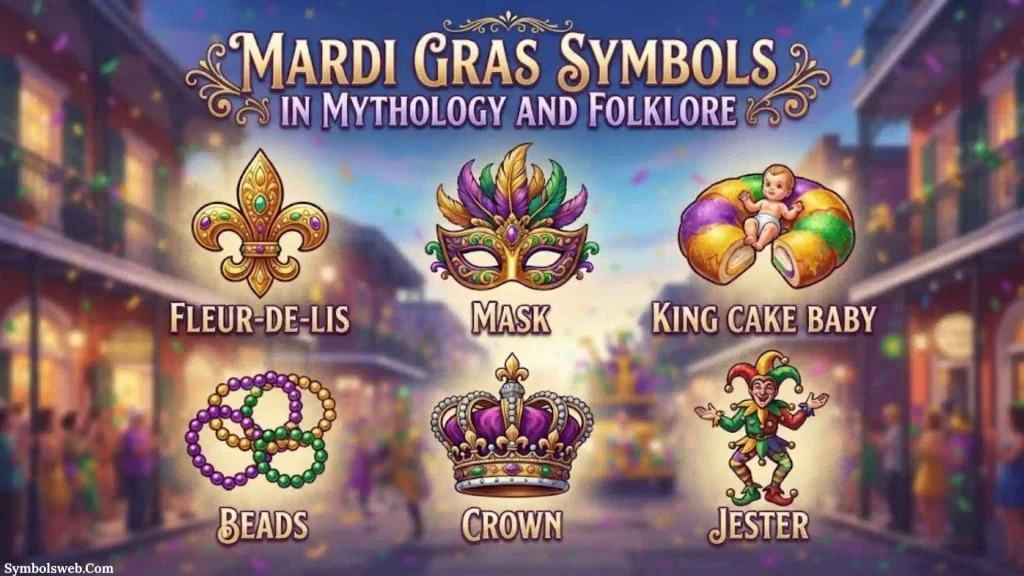
Mythology has always influenced Carnival storytelling.
New Orleans krewes have frequently chosen themes from Greek and Roman mythology, literature, historical figures, legends, fantasy, and popular culture. Parade floats transform those stories into enormous moving scenes.
This creates an interesting relationship between mythology and Mardi Gras.
Myth gives Carnival a library of characters.
Carnival gives those characters new costumes, jokes, political meanings, and visual interpretations.
A god might become a float.
A mythical monster might become a parade mascot.
A legendary hero might become a king.
A classical story might become a satire of modern life.
The symbolism is therefore constantly being rewritten.
The Trickster and Carnival
One recurring archetype connected with Carnival is the trickster.
The trickster crosses boundaries. The character can be foolish and wise, comic and dangerous, powerful and powerless.
Carnival has a similar energy.
The wealthy person may wear a ridiculous costume.
The ordinary citizen may become royalty for an evening.
A serious subject may become the target of satire.
That temporary reversal is one reason Carnival can feel psychologically liberating.
Mardi Gras Symbols in Art, Literature, Movies and Pop Culture
Mardi Gras has become one of the most recognizable visual cultures in the United States.
Paintings and Photography
Artists are drawn to Mardi Gras because it combines color, movement, costume, music, architecture, crowds, and strong human emotion.
Photographers have especially documented masks, parade crowds, Black Masking Indians, costumes, and neighborhood celebrations.
Smithsonian collections contain significant visual records of New Orleans Mardi Gras traditions and Black Masking Indian culture.
Literature and Poetry
Writers often use Carnival imagery to explore:
- Identity
- Desire
- Social class
- Hidden motives
- Freedom
- Excess
- Transformation
- The contrast between public and private life
A masked character is particularly useful in literature because the reader naturally asks: Who is behind the mask?
Movies and Television
Mardi Gras is frequently used in visual storytelling as shorthand for mystery, celebration, danger, romance, excess, or New Orleans identity.
The bright colors and crowded streets make it instantly recognizable.
But popular culture sometimes exaggerates Mardi Gras into a stereotype of nonstop partying. The real tradition is much broader, involving family gatherings, religious history, neighborhood culture, music, art, charity, food, and community organizations.
Tattoos
Mardi Gras-inspired tattoos often feature:
- Masks
- Fleur-de-lis
- Purple, green, and gold
- King cake babies
- Crowns
- Beads
- Musical instruments
- Parade imagery
- New Orleans architecture
In personal symbolism, such tattoos can represent home, memory, celebration, freedom, heritage, or a major life experience.
Fashion and Modern Design
Mardi Gras aesthetics are easy to recognize.
Sequins, feathers, masks, metallic details, crowns, beads, jewel tones, and theatrical makeup all communicate the Carnival mood.
Designers can use these elements to suggest luxury, mystery, playfulness, rebellion, or celebration.
Spiritual and Dream Meaning of Mardi Gras Symbols
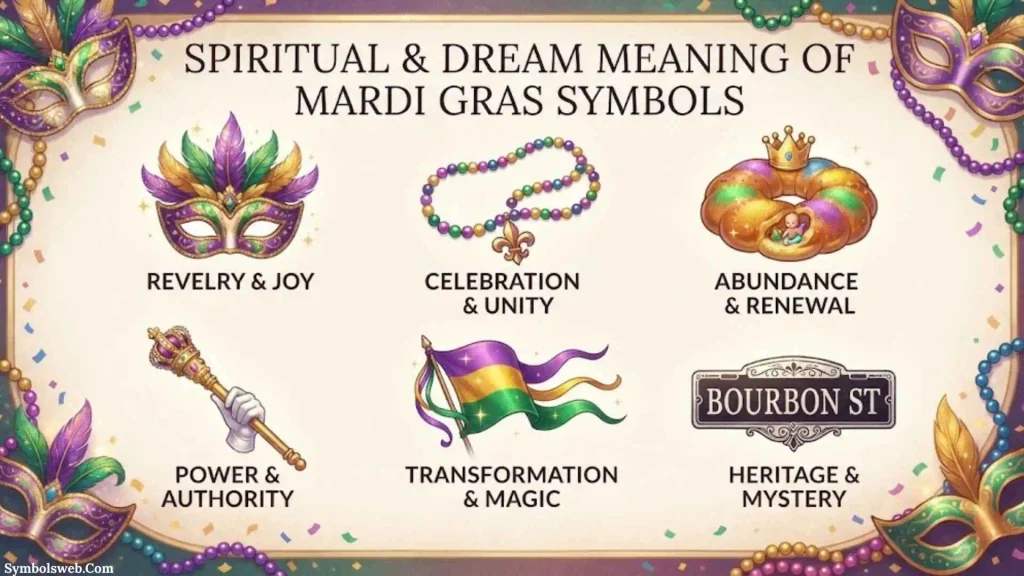
Dream interpretation is personal rather than scientifically fixed. There is no universal dictionary proving that every Mardi Gras image has one spiritual meaning.
Still, Mardi Gras imagery can be useful for reflective interpretation.
Dreaming About a Mardi Gras Mask
A mask may symbolize questions about identity.
You might ask:
- Am I hiding part of myself?
- Am I tired of playing a social role?
- Do I want more freedom?
- Am I worried about someone hiding their true intentions?
Dreaming About Mardi Gras Beads
Beads may represent connection, recognition, generosity, or social attention.
Because beads are passed from one person to another, they can also symbolize relationships and shared experiences.
Dreaming About a King Cake
A king cake may suggest community, celebration, reward, family traditions, or anticipation.
If the dream focuses on finding the baby, the image may personally suggest luck or unexpected responsibility.
Dreaming About Purple, Green and Gold
The three traditional colors can invite a simple reflective reading:
- Purple: justice, dignity, mystery
- Green: faith, growth, renewal
- Gold: power, achievement, value
These interpretations are symbolic rather than scientifically proven dream meanings.
Meditation and Spiritual Reflection
For someone using Mardi Gras imagery in meditation, the deeper theme may be transition.
Ask yourself:
What am I celebrating?
What am I ready to release?
What part of myself do I hide?
What do I need to carry forward into the next season of my life?
Those questions capture the deeper rhythm of Carnival: celebration followed by reflection.
Positive and Negative Meanings of Mardi Gras Symbols
| Positive Meaning | Negative Meaning |
| Celebration | Excess |
| Freedom | Loss of restraint |
| Community | Crowds and social pressure |
| Creativity | Chaos |
| Transformation | Identity confusion |
| Abundance | Overindulgence |
| Mystery | Deception |
| Playfulness | Recklessness |
| Tradition | Resistance to change |
| Cultural pride | Cultural misunderstanding |
The same symbol can contain both light and shadow.
A mask can represent freedom, but it can also represent hiding.
A feast can represent gratitude, but it can also represent excess.
Royal imagery can represent confidence, but it can also represent status and ego.
This duality is part of what makes Carnival symbolism so human.
Why Humans Are Attracted to Mardi Gras Symbols
Why do people love masks, glitter, crowns, beads, costumes, and enormous colorful floats?
Part of the answer is simple sensory pleasure.
Bright colors attract attention. Music creates rhythm. Crowds create emotional energy. Costumes transform ordinary people into characters.
But there is more.
Humans are meaning-making creatures.
We turn objects into memories.
A necklace can remind someone of a person.
A ticket can represent a journey.
A photograph can preserve a moment.
A Mardi Gras bead can remind someone of the first parade they attended with their family.
The object itself may be inexpensive. The memory is not.
Pattern Recognition
Humans naturally notice patterns, repetition, color, faces, symbols, and familiar objects.
Mardi Gras makes extraordinary use of all of them.
Purple, green, and gold immediately signal Carnival.
A mask signals mystery.
A crown signals royalty.
A king cake signals the season.
A parade float signals spectacle.
Together, these create a visual language that can be understood almost instantly.
Collective Memory
Symbols also allow communities to preserve history without writing everything down.
Children learn traditions by watching adults.
Families repeat recipes.
Krewes repeat rituals.
Artists teach younger members.
Costumes are recreated.
Songs return each year.
The result is cultural memory passed through participation.
Modern Uses of Mardi Gras Symbols
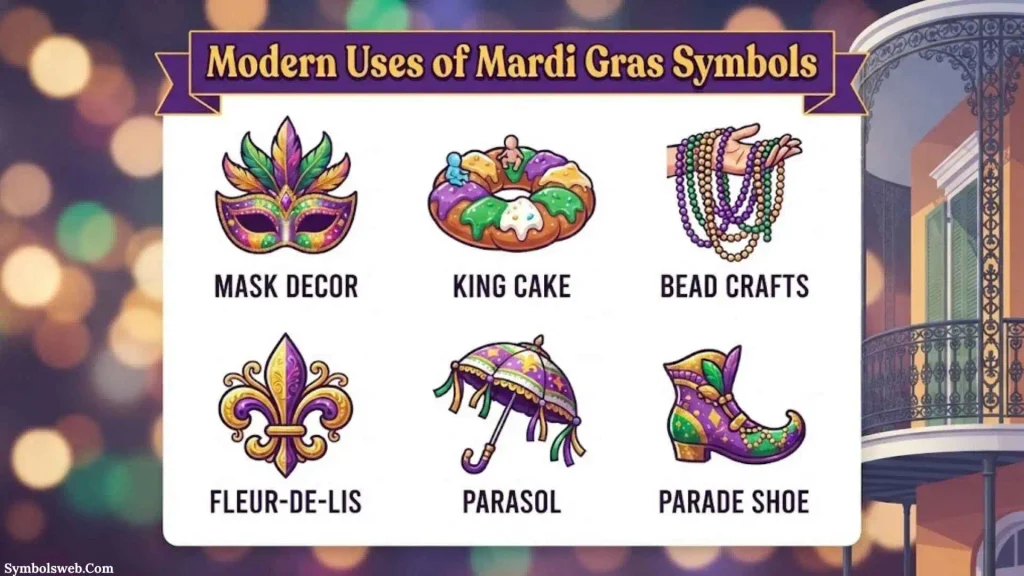
Mardi Gras symbols have moved far beyond parade day.
Tattoos
People use masks, fleur-de-lis designs, crowns, beads, and Mardi Gras colors to express identity, memory, hometown pride, or personal celebration.
Jewelry
Purple, green, and gold jewelry can turn Carnival colors into everyday fashion.
Doubloons may also become collectible keepsakes rather than simple parade souvenirs.
Fashion
Mardi Gras-inspired clothing often uses sequins, feathers, metallic fabrics, masks, crowns, and vivid colors.
Branding
Businesses connected with New Orleans, Louisiana tourism, hospitality, food, entertainment, and events frequently use Mardi Gras imagery to communicate local identity.
Social Media
Mardi Gras symbols are especially effective online because they are visually strong.
Masks, king cakes, beads, parade floats, and purple-green-gold decorations are immediately recognizable in photographs and short videos.
Contemporary Spirituality
Some people use Carnival imagery as a personal metaphor for transformation.
The mask can represent the self we show others.
The unmasking can represent honesty.
The feast can represent gratitude.
The transition into Lent can represent discipline and renewal.
This is a modern personal interpretation rather than a traditional religious doctrine.
Home Decor
Mardi Gras decorations often include:
- Masks
- Crowns
- Fleur-de-lis designs
- Purple, green, and gold accents
- Beads
- Parade artwork
- New Orleans architectural motifs
- King cake imagery
These designs can function as celebration, regional pride, or reminders of travel and family.
Interesting Facts About Mardi Gras Symbols
1. The official Mardi Gras colors have a specific New Orleans history
Rex selected purple, green, and gold in 1872. The colors later became associated with Carnival throughout New Orleans.
2. The original meaning of the colors is not completely certain
Rex’s own historical account notes that the original symbolism was never clearly documented. The 1892 “Symbolism of Colors” parade later associated purple with justice, green with faith, and gold with power.
3. Mardi Gras beads are only one type of throw
Krewes may throw beads, cups, stuffed animals, doubloons, decorated objects, and special signature items.
4. Doubloons became a major tradition in the 1960s
Rex introduced its aluminum doubloon in 1960, and other krewes soon followed with their own collectible coins.
5. Some Mardi Gras symbols are edible
King cake is one of the season’s most important traditions, with purple, green, and gold decoration and a hidden baby connected with the social ritual of continuing the celebration.
6. The Boeuf Gras represents the final meat feast
The fatted bull or ox is associated with the end of Carnival and the beginning of the Lenten fasting period.
7. Masks have a history of social freedom
Carnival masking historically created opportunities to move beyond ordinary social boundaries. In modern New Orleans, float riders continue the tradition.
8. Black Masking Indian suits can take enormous amounts of work
Smithsonian sources describe costumes made with extensive beadwork, feathers, and sewn designs, with preparation often taking much of the year.
9. Mardi Gras is a season, not simply one parade
In New Orleans, Carnival season begins on January 6, or Twelfth Night, and continues through Fat Tuesday.
10. Not every Mardi Gras tradition is about partying
Behind the beads and floats are family traditions, religious history, artistic communities, social organizations, music, food, neighborhood identity, and cultural memory.
Frequently Asked Questions
What are the main symbols of Mardi Gras?
The main symbols associated with New Orleans Mardi Gras include purple, green and gold, masks, beads, king cakes, crowns, doubloons, floats, the Boeuf Gras, flambeaux, fleur-de-lis imagery, and elaborate Carnival costumes. Different communities and krewes have additional symbols and traditions.
What do the Mardi Gras colors purple, green and gold mean?
In the Rex tradition, purple represents justice, green represents faith, and gold represents power. Rex established these colors in 1872, and they became the traditional colors of New Orleans Carnival.
What does the Mardi Gras mask symbolize?
A Mardi Gras mask can symbolize mystery, anonymity, transformation, play, and temporary freedom from ordinary social roles. Historically, Carnival masks could allow people to mingle across social boundaries.
What does the baby in a king cake symbolize?
The king cake baby is traditionally associated with the Christ child and the Epiphany or Three Kings tradition. In modern New Orleans practice, finding the baby also creates a social obligation, commonly requiring the finder to provide the next king cake or host the next celebration.
Why are beads thrown at Mardi Gras?
Beads are part of the tradition known as Mardi Gras “throws.” They create direct interaction between parade riders and spectators. Over time, krewes developed many other throws, including doubloons, cups, toys, coconuts, shoes, and other signature items.
Is Mardi Gras based on ancient pagan festivals?
Mardi Gras belongs to the Christian Carnival tradition surrounding the period before Lent. Ancient Roman festivals such as Saturnalia and Lupercalia are often discussed as possible cultural parallels or influences on broader Carnival traditions, but it is too simplistic to say modern Mardi Gras is simply an ancient pagan festival that was renamed. The historical relationship is more complicated.
Conclusion
Mardi Gras symbols give you a better way to understand the celebration beyond its colorful parades and festive atmosphere. When I look at the masks, beads, fleur-de-lis, and traditional colors, I can see how each one adds meaning to the traditions. Learning these symbols helps you appreciate the history and culture that make Mardi Gras so unique.
If you’re celebrating Mardi Gras, decorating for a party, or simply exploring its traditions, I hope this guide helps you recognize the symbols you see. When you know what they represent, you can enjoy the celebration with a deeper understanding of its traditions, stories, and festive spirit.

Jordan Hayes is a writer with a passion for exploring the history, meanings, and cultural significance behind symbols from around the world. He enjoys turning complex topics into clear, engaging content that anyone can understand. Jordan is also the fictional author of The Silent Language of Ancient Marks and Hidden Symbols Beyond the Surface, two original book concepts created for his author profile. When he’s not writing, he spends time researching myths, traditions, and forgotten stories that inspire his work. His goal is to help readers discover the deeper meanings behind the symbols they encounter every day.
 Eliana Foster
 Ethan Holloway