Math symbols help you solve problems, compare numbers, understand shapes, and express complicated ideas in a simple way. From the familiar plus sign to advanced calculus notation, each symbol communicates a specific mathematical idea.
If you’ve ever wondered what a symbol means in an equation or how to read an unfamiliar mathematical expression, this guide will help. You’ll find a practical math symbols list, clear definitions, examples, and tables covering arithmetic, fractions, geometry, algebra, measurement, logic, and more.
Whether you’re learning basic math, helping a child with homework, or reviewing higher-level mathematics, you can use this guide as a quick reference. Let’s explore the most common mathematical symbols and learn how to use them correctly.
Common Math Symbols and Their Meanings
Mathematical symbols are signs, letters, and marks that represent numbers, operations, relationships, and mathematical concepts. They help you communicate calculations without writing lengthy explanations.
For example, instead of writing “add three to five and get eight,” you can write (3 + 5 = 8). The symbols make the statement shorter while preserving its meaning.
Basic Math Symbols Chart
Use this math symbols chart to find common signs, their names, meanings, and examples.
| Symbol | Name | Meaning | Example |
| + | Plus sign | Addition | (4 + 3 = 7) |
| − | Minus sign | Subtraction | (9 – 5 = 4) |
| × | Multiplication sign | Multiplication | (3 \times 4 = 12) |
| ÷ | Division sign | Division | (12 \div 3 = 4) |
| = | Equal sign | Both sides have the same value | (5 + 2 = 7) |
| ≠ | Not equal to | Values are different | (4 \ne 6) |
| < | Less than | The left value is smaller | (2 < 8) |
| > | Greater than | The left value is larger | (9 > 3) |
| ≤ | Less than or equal to | Smaller than or equal to | (x \le 10) |
| ≥ | Greater than or equal to | Larger than or equal to | (x \ge 4) |
| ≈ | Approximately equal to | Values are close but not necessarily identical | (\pi \approx 3.14) |
| % | Percent | Parts per hundred | (25% = 25/100) |
| √ | Square root | Principal square root | (\sqrt{25} = 5) |
| ^ or superscript | Exponent | A power of a number | (3^2 = 9) |
| ± | Plus or minus | Indicates positive and negative possibilities | (x = \pm 2) |
| ∞ | Infinity | An unbounded quantity or process | (x \to \infty) |
| π | Pi | Circle circumference divided by diameter | (\pi \approx 3.14159) |
| ∠ | Angle | Identifies an angle | (\angle ABC) |
| ∥ | Parallel | Lines that do not intersect in a plane | (AB \parallel CD) |
| ⊥ | Perpendicular | Lines meeting at a right angle | (AB \perp CD) |
These symbols form the foundation of many math concepts. However, a symbol’s meaning can change with its context. For example, (x) may represent an unknown number, while (\times) represents multiplication.
Basic Math Operations and Symbols
Arithmetic starts with four basic operations: addition, subtraction, multiplication, and division. These math signs and meanings help you calculate totals, find differences, multiply quantities, and divide items into equal groups.
Addition Symbol (+)
The addition symbol (+) tells you to combine two or more quantities. The answer is called the sum, and the numbers being added are called addends.
For example:
[
6 + 4 = 10
]
If you have six apples and receive four more, you now have ten apples. Addition expresses that change in quantity.
You can use addition to calculate shopping totals, combine measurements, count objects, or add scores in a game.
Subtraction Symbol (−)
The subtraction symbol (−) tells you to take one quantity away from another or find the difference between two values.
For example:
[
15 – 7 = 8
]
If you have $15 and spend $7, you have $8 remaining. The answer is called the difference.
Subtraction also helps you compare values. If one team scores 18 points and another scores 12, subtracting 12 from 18 shows that the first team scored six more points.
Multiplication Symbols (×, *, and ⋅)
The multiplication symbol shows that you should multiply quantities. You may see multiplication written with a times sign ((\times)), an asterisk ((*)), or a centered dot ((\cdot)).
For example:
[
4 \times 3 = 12
]
This means four groups of three contain twelve items altogether. Multiplication also represents repeated addition:
[
3 + 3 + 3 + 3 = 4 \times 3 = 12
]
In algebra, mathematicians often omit the multiplication sign between a number and a variable. For example, (5x) means (5 \times x).
Be careful not to confuse the multiplication sign with the letter (x). The first represents an operation, while the second often represents a variable.
Division Symbols (÷ and /)
The division symbol (÷) tells you to divide one quantity by another. Division can represent sharing equally or determining how many groups of a certain size fit into a quantity.
For example:
[
24 \div 6 = 4
]
If you share 24 cookies equally among six people, each person receives four cookies.
You may also see division written with a slash or fraction bar:
[
24/6 = 4
]
The answer to a division problem is called the quotient. Division by zero is undefined in ordinary arithmetic because no number multiplied by zero produces a nonzero dividend.
Order of Operations and Grouping Symbols
When an expression contains several operations, you need to follow the correct order. In the United States, students commonly learn PEMDAS:
- P: Parentheses
- E: Exponents
- MD: Multiplication and division, from left to right
- AS: Addition and subtraction, from left to right
Consider this expression:
[
2 + 3 \times 4 = 14
]
You multiply (3 \times 4) first, then add 2. The answer is 14, not 20.
Parentheses can change the result:
[
(2 + 3) \times 4 = 20
]
Here, you add the numbers inside the parentheses before multiplying. This example shows why grouping symbols matter in mathematical expressions.
Equality, Inequality, and Comparison Symbols
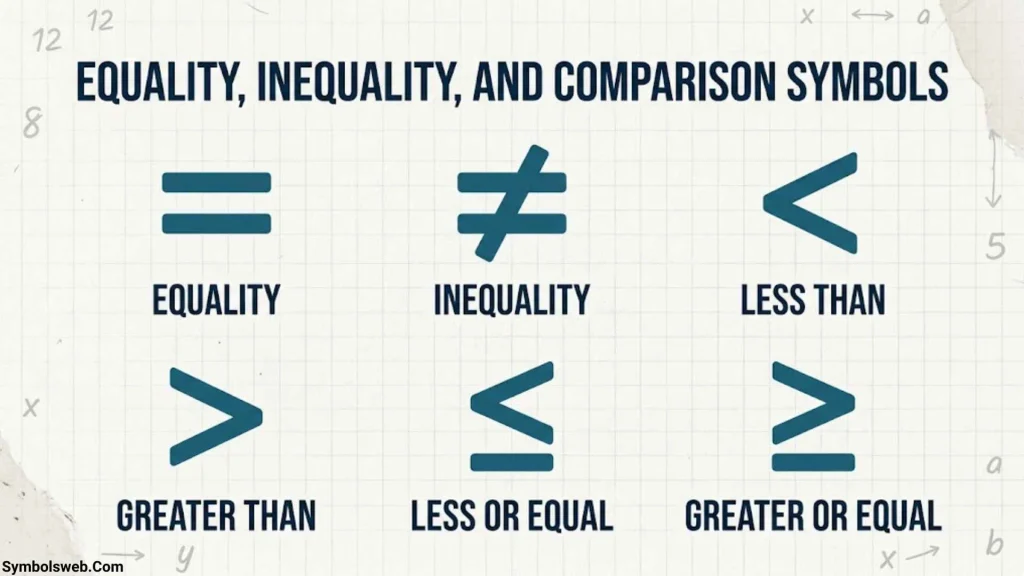
Comparison symbols show whether two values are equal, different, larger, or smaller. They appear throughout arithmetic, algebra, statistics, and everyday calculations.
Equal To (=) and Not Equal To (≠)
The equal sign (=) states that two expressions have the same value.
For example:
[
8 + 2 = 10
]
Both sides equal ten. An equation can also contain an unknown value:
[
x + 3 = 9
]
Solving the equation gives (x = 6).
The not equal sign (≠) states that two values differ. For example, (4 \ne 9) means four is not equal to nine.
Remember that the equal sign does not simply mean “write the answer next.” It expresses a relationship between the values on both sides.
Greater Than (>) and Less Than (<)
The greater-than symbol (>) indicates that the value on the left is larger than the value on the right. The less-than symbol (<) indicates that the left value is smaller.
Examples:
- (10 > 6): Ten is greater than six.
- (3 < 7): Three is less than seven.
- (5 < 12): Five is smaller than twelve.
A useful trick is to imagine the sign as an open mouth. The wider opening faces the larger number.
For instance, in (8 > 2), the opening faces eight. This simple visual cue can help children remember the difference.
Less Than or Equal To (≤) and Greater Than or Equal To (≥)
These symbols include equality as well as comparison.
- (x \le 10) means (x) is less than or equal to ten.
- (x \ge 4) means (x) is greater than or equal to four.
If a ride requires visitors to be at least 48 inches tall, you can express the requirement as (h \ge 48), where (h) represents height in inches.
The value 48 qualifies because the inequality includes equality. A height of 47 inches does not meet the requirement.
Approximately Equal To (≈) and Equivalent To (≡)
The approximately equal symbol (≈) indicates that a value is close to another value rather than exactly equal to it.
For example:
[
\pi \approx 3.14159
]
Pi has infinitely many nonrepeating decimal digits, so 3.14159 is an approximation.
The symbol (\equiv) has several meanings depending on context. It can indicate an identity, a congruence in geometry, or a congruence relation in number theory. In modular arithmetic, for example, (17 \equiv 5 \pmod{12}) because 17 and 5 leave the same remainder when divided by 12.
Always check the surrounding notation before assigning a meaning to a symbol with several uses.
Fractions, Decimals, and Percentage Symbols
Fractions, decimals, and percentages provide different ways to represent quantities and parts of a whole. Understanding their relationships makes calculations easier in school, shopping, cooking, and measurement.
Fraction Bar, Numerator, and Denominator
A fraction represents a quantity as one number divided by another. The numerator appears above the fraction bar, while the denominator appears below it.
For example:
[
\frac{3}{4}
]
- Numerator: 3, the number of parts being considered.
- Denominator: 4, the number of equal parts in the whole.
If you cut a pizza into four equal slices and eat three, you’ve eaten (\frac{3}{4}) of the pizza.
Fractions can be proper or improper. A proper fraction has a numerator smaller than its positive denominator, such as (\frac{2}{5}). An improper fraction has a numerator greater than or equal to its denominator, such as (\frac{7}{4}).
Equivalent fractions represent the same value. For example:
[
\frac{1}{2} = \frac{2}{4} = \frac{4}{8}
]
Each fraction represents one-half.
Decimal Point and Decimal Notation
A decimal point separates the whole-number portion from the fractional portion of a decimal number.
For example, in 12.75:
- 12 represents the whole-number portion.
- 7 represents seven tenths.
- 5 represents five hundredths.
Therefore:
[
12.75 = 12 + \frac{7}{10} + \frac{5}{100}
]
Decimals are useful when you need to express money, measurements, or quantities that fall between whole numbers. A price of $4.50, for instance, represents four dollars and fifty cents.
Percent Symbol (%)
The percent symbol (%) means “per hundred.” It expresses how many parts out of 100 a quantity represents.
For example:
[
25% = \frac{25}{100} = 0.25
]
You can convert a decimal into a percentage by multiplying it by 100 and adding the percent sign. To convert a percentage into a decimal, divide by 100.
| Form | Example |
| Fraction | (1/4) |
| Decimal | (0.25) |
| Percentage | (25%) |
Suppose a $60 jacket has a 20% discount. First, calculate the discount: (60 \times 0.20 = 12). Then subtract $12 from $60. The sale price is $48 before any applicable taxes.
Rational and Irrational Number Symbols
A rational number can be written as a fraction of two integers with a nonzero denominator. The symbol (\mathbb{Q}) represents the set of rational numbers.
Examples include:
[
\frac{3}{4}, \quad -2, \quad 0.5
]
An irrational number cannot be expressed as a ratio of two integers. Its decimal expansion continues forever without repeating a fixed pattern.
Examples include (\sqrt{2}) and (\pi).
The real numbers include both rational and irrational numbers. You may see the symbol (\mathbb{R}) used to represent this set.
Geometry Symbols and Their Meanings
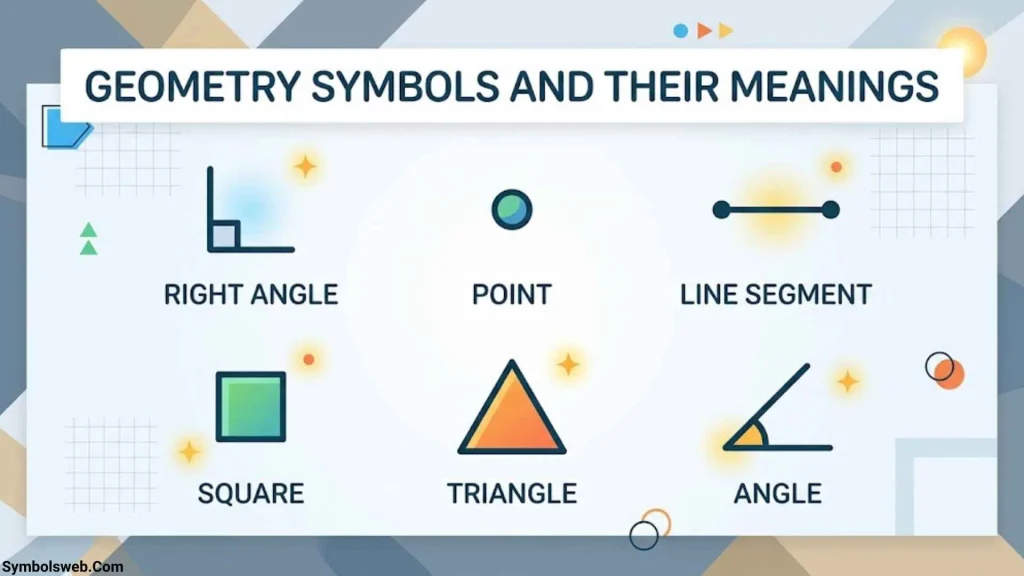
Geometry symbols describe shapes, angles, lines, and spatial relationships. They help you communicate measurements and properties without lengthy written explanations.
Angle Symbol (∠) and Degree Symbol (°)
The angle symbol (∠) identifies an angle, while the degree symbol (°) indicates an angle measurement in degrees.
For example, (\angle ABC = 90^\circ) means the angle formed by the rays BA and BC measures 90 degrees. The middle letter identifies the vertex.
Common angle measurements include:
| Angle type | Measurement | Description |
| Acute angle | Greater than 0° and less than 90° | Smaller than a right angle |
| Right angle | 90° | Forms a square corner |
| Obtuse angle | Greater than 90° and less than 180° | Wider than a right angle |
| Straight angle | 180° | Forms a straight line |
| Full rotation | 360° | Completes one full turn |
You can find angles in clock hands, roof designs, road intersections, and many other everyday objects.
Triangle (△), Square (□), and Other Shape Notation
Geometry uses letters and symbols to identify shapes and their properties. A triangle has three sides, while a quadrilateral has four sides.
The symbol (\triangle ABC) refers to a triangle with vertices A, B, and C. A square symbol such as □ may represent a square in a diagram, a missing value in an exercise, or another object depending on context.
Common geometric shapes include:
- Triangle: Three sides and three angles.
- Square: Four equal sides and four right angles.
- Rectangle: Four right angles with opposite sides equal.
- Circle: A set of points in a plane at a fixed distance from a center.
- Quadrilateral: A polygon with four sides.
The symbol alone may not tell you every property. Read any accompanying labels, measurements, and instructions.
Parallel (∥) and Perpendicular (⊥) Lines
The parallel symbol (∥) indicates that two lines in the same plane never meet. They remain the same distance apart.
For example:
[
AB \parallel CD
]
The perpendicular symbol (⊥) indicates that two lines intersect at a right angle.
[
AB \perp CD
]
You can recognize parallel lines in railway tracks or the opposite edges of a rectangular table. Perpendicular lines appear where a wall meets a level floor at a right angle.
Pi (π), Radius, Diameter, and Circumference
The Greek letter pi (π) represents the ratio of a circle’s circumference to its diameter. Its value begins 3.14159 and continues without ending or repeating.
Three important circle measurements are:
- Radius ((r)): The distance from the center to the circle’s edge.
- Diameter ((d)): A line segment through the center connecting two points on the circle.
- Circumference ((C)): The distance around the circle.
The diameter is twice the radius:
[
d = 2r
]
You can calculate circumference with either formula:
[
C = 2\pi r
]
[
C = \pi d
]
The area of a circle is:
[
A = \pi r^2
]
For a circle with a radius of 3 inches, the area is (9\pi) square inches, or approximately 28.27 square inches.
Geometry and Trigonometry Notation
Trigonometry studies relationships between angles and sides, especially in triangles. Its basic functions include sine (sin), cosine (cos), and tangent (tan).
For an angle (\theta) in a right triangle:
[
\sin \theta = \frac{\text{opposite}}{\text{hypotenuse}}
]
[
\cos \theta = \frac{\text{adjacent}}{\text{hypotenuse}}
]
[
\tan \theta = \frac{\text{opposite}}{\text{adjacent}}
]
These ratios help calculate heights, distances, and angles. Engineers, architects, surveyors, and students use trigonometry to solve problems involving triangles and periodic patterns.
Mathematical Measurement Symbols and Units
Measurement symbols identify the units used to describe length, mass, volume, temperature, and other quantities. The number alone often isn’t enough; you also need the correct unit.
For example, 10 meters and 10 miles describe very different distances. Including units makes your answer meaningful and prevents costly mistakes.
Length and Distance Symbols
Length units measure how far apart points are or how long an object is.
| Symbol | Unit | Common use |
| mm | Millimeter | Small dimensions |
| cm | Centimeter | Small objects and body measurements |
| m | Meter | Room dimensions and object lengths |
| km | Kilometer | Longer distances |
| in | Inch | US customary measurements |
| ft | Foot | Height and room dimensions |
| mi | Mile | Road and travel distances |
Useful metric conversions include:
- 10 millimeters = 1 centimeter.
- 100 centimeters = 1 meter.
- 1,000 meters = 1 kilometer.
For US customary units, 12 inches equal 1 foot, and 5,280 feet equal 1 mile.
Mass and Weight Units
Mass measures the amount of matter in an object. Weight measures the force of gravity acting on that mass. Everyday speech often uses these terms interchangeably, but science distinguishes them.
| Symbol | Unit |
| mg | Milligram |
| g | Gram |
| kg | Kilogram |
| oz | Ounce |
| lb | Pound |
| t | Metric tonne, when defined that way |
One kilogram equals 1,000 grams. One gram equals 1,000 milligrams. In the US customary system, one pound equals 16 ounces.
Be careful with the symbol t because its meaning can vary by context. A metric tonne equals 1,000 kilograms, while a US short ton equals 2,000 pounds.
Volume and Capacity Symbols
Volume describes the space an object occupies. Capacity usually describes how much a container can hold.
Common measurement abbreviations include:
- mL: Milliliter
- L: Liter
- fl oz: Fluid ounce
- pt: Pint
- gal: Gallon
One liter equals 1,000 milliliters. US liquid measurements differ from metric units, and US fluid ounces differ from imperial fluid ounces.
When following a recipe, check which measurement system it uses. Mixing up US and imperial units can change the amount of liquid substantially.
Temperature Symbols (°F, °C, K)
Temperature symbols show which scale you’re using.
- °F: Degrees Fahrenheit.
- °C: Degrees Celsius.
- K: Kelvin, the SI unit of thermodynamic temperature.
Water freezes at 32°F or 0°C under standard atmospheric pressure. It boils at 212°F or 100°C under the same conditions.
To convert Celsius to Fahrenheit, use:
[
°F = \frac{9}{5}(°C) + 32
]
To convert Fahrenheit to Celsius, use:
[
°C = \frac{5}{9}(°F – 32)
]
Kelvin uses a different notation because its unit name doesn’t take a degree sign. The conversion is (K = °C + 273.15).
Currency Symbols ($, €, ¥, £)
Currency symbols identify monetary units in prices, financial calculations, and shopping totals.
| Symbol | Common currency |
| $ | US dollar in US contexts |
| € | Euro |
| ¥ | Japanese yen or Chinese yuan, depending on context |
| £ | British pound sterling in UK contexts |
A currency symbol doesn’t always identify a currency by itself. Several countries use the dollar sign, for example. For international transactions, include the currency code when clarity matters, such as USD, EUR, JPY, or GBP.
Algebra Symbols and Their Uses
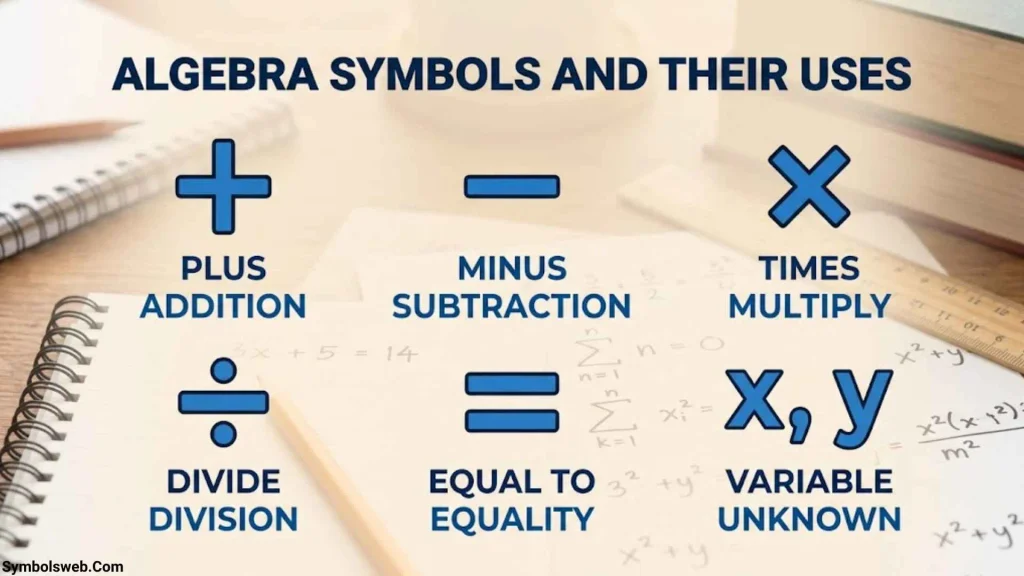
Algebra symbols let you represent unknown values, describe relationships, and solve equations. Instead of working only with known numbers, you can use letters to express general rules.
Variables and Constants (x, y, a, b, n)
A variable represents a value that may change or an unknown quantity. Common variable names include (x), (y), (a), (b), and (n).
A constant represents a fixed value within a given expression or problem.
Consider:
[
x + 5 = 12
]
The variable (x) represents the unknown number. Subtracting five from both sides gives (x = 7).
Letters don’t have fixed meanings across all mathematics. The letter (n) often represents an integer or counting number, while (a) and (b) may represent constants. The problem’s definitions determine their roles.
Algebraic Expressions and Equations
An algebraic expression combines numbers, variables, and operations. For example, (3x + 4) is an expression.
An equation states that two expressions have equal values. For example:
[
3x + 4 = 19
]
To solve it, subtract four from both sides:
[
3x = 15
]
Then divide both sides by three:
[
x = 5
]
The solution works because substituting five for (x) makes both sides equal 19.
Parentheses ( ), Brackets [ ], and Braces { }
Grouping symbols show which parts of an expression belong together. Parentheses and brackets often serve similar purposes in algebra, especially when expressions contain several layers.
For example:
[
2[3 + (4 \times 2)] = 22
]
First, multiply four by two to get eight. Then add three to get eleven. Finally, multiply eleven by two.
Braces also appear in set notation, where they enclose a collection of elements, such as ({1, 2, 3}).
Plus or Minus (±) and Minus or Plus (∓)
The plus-or-minus symbol (±) represents two possible signs. It appears in equations, measurement tolerances, and statements involving positive and negative values.
For example:
[
x = \pm 4
]
This means (x) may equal 4 or −4.
The paired symbol (\mp) means minus or plus. In a paired expression such as (a \pm b) and (c \mp d), the signs are often chosen in corresponding opposite order.
Exponents, Square Roots, and Absolute Value
An exponent tells you how many times to multiply a base by itself when the exponent is a positive integer.
[
3^2 = 3 \times 3 = 9
]
The small raised number is the exponent. Here, three is the base and two is the exponent.
A square root symbol (√) identifies the principal square root:
[
\sqrt{36} = 6
]
Absolute value uses vertical bars:
[
|-8| = 8
]
Absolute value measures a number’s distance from zero on the number line, so it cannot be negative.
Advanced Math Symbols and Notation
Advanced mathematics uses specialized symbols to express patterns, sets, logical statements, and change. You don’t need to master every symbol at once. Learning them by topic makes the notation easier to understand.
Infinity Symbol (∞)
The infinity symbol (∞) represents an unbounded quantity or process. It appears in limits, infinite sequences, and descriptions of sets that have no finite endpoint.
For example:
[
\lim_{x \to \infty} \frac{1}{x} = 0
]
This expression says that (1/x) approaches zero as (x) grows without bound.
Infinity isn’t an ordinary real number. You shouldn’t treat it exactly like a finite number in routine arithmetic.
Greek Letters in Mathematics (θ, π, Σ, Δ)
Greek letters appear frequently in mathematical notation.
| Symbol | Name | Common use |
| θ | Theta | An angle or unknown parameter |
| π | Pi | Circle calculations |
| Σ | Capital sigma | Summation |
| Δ | Capital delta | Change or difference |
| μ | Mu | Mean or parameter in statistics |
| σ | Lowercase sigma | Standard deviation or another defined quantity |
For example, (\Delta x) often represents a change in (x). If a value rises from 5 to 9, its change is (9 – 5 = 4).
Greek letters don’t have one universal meaning in every subject. Always check the definitions provided in the problem.
Summation Symbol (Σ)
The summation symbol (Σ) represents adding a sequence of terms. It lets you write a long addition problem in a compact form.
For example:
[
\sum_{i=1}^{4} i = 1 + 2 + 3 + 4 = 10
]
The lower limit tells you where the index begins. The upper limit tells you where it ends. The expression to the right of sigma identifies what you add at each step.
Summation notation is useful in algebra, statistics, finance, and calculus because it describes repeated addition without listing every term separately.
Set Theory Symbols (∈, ∉, ⊂, ⊆, ∪, ∩)
Set theory studies collections of objects called sets. Its symbols describe membership and relationships between collections.
| Symbol | Meaning | Example |
| ∈ | Is an element of | (3 \in {1,2,3}) |
| ∉ | Is not an element of | (5 \notin {1,2,3}) |
| ⊆ | Is a subset of, possibly equal | ({1,2} \subseteq {1,2,3}) |
| ∪ | Union of sets | ({1,2} \cup {2,3} = {1,2,3}) |
| ∩ | Intersection of sets | ({1,2} \cap {2,3} = {2}) |
The union combines the elements from both sets without listing duplicates. The intersection contains only the elements shared by both sets.
Some textbooks use (\subset) to mean a proper subset, while others use it more broadly. Follow the convention established by your textbook or instructor.
Mathematical Logic Symbols (∧, ∨, ¬, ⇒, ⇔)
Logic symbols describe how statements relate to one another.
- ∧: Logical AND. Both statements must be true for the combined statement to be true.
- ∨: Logical OR. At least one statement must be true in standard inclusive logic.
- ¬: Logical NOT. It negates a statement.
- ⇒: Implies. It indicates that one statement leads to another.
- ⇔: If and only if. It expresses a two-way logical relationship.
For example, let (P) mean “the number is even” and (Q) mean “the number is divisible by two.” The statements (P) and (Q) describe the same property for integers, so they can be connected by a logical equivalence.
These symbols are common in proofs, discrete mathematics, computer science, and formal reasoning.
Calculus Symbols (lim, ∫, d/dx, ∂)
Calculus studies change and accumulation. Its symbols may look unfamiliar at first, but each represents a specific idea.
| Symbol | Meaning | Basic purpose |
| (\lim) | Limit | Describes a value approached by a function |
| (\int) | Integral | Represents accumulation or signed area |
| (\frac{d}{dx}) | Derivative operator | Measures a function’s rate of change |
| (\partial) | Partial derivative notation | Measures change with respect to one variable |
For example, if (f(x) = x^2), its derivative is:
[
\frac{d}{dx}(x^2) = 2x
]
This tells you the instantaneous rate of change of the function at a given value of (x).
An integral can represent the accumulated quantity under a function over an interval. Partial derivatives extend these ideas to functions involving several variables.
How to Read and Use Mathematical Symbols
Learning a symbol’s name is only the first step. To understand mathematical notation, you also need to know what the symbol connects, how the expression is grouped, and what the problem asks you to find.
Reading Mathematical Expressions
Start by reading each symbol in order and identifying its role.
Consider:
[
5 + 3 \times 2
]
You can read this as “five plus three times two.” However, the correct calculation follows the order of operations:
[
5 + (3 \times 2) = 11
]
Reading aloud helps you notice the operations, but grouping and mathematical conventions determine how you calculate the answer.
Understanding Mathematical Equations
An equation states that two expressions have equal values. To solve one, identify the unknown and use operations that preserve equality.
For example:
[
2x + 4 = 10
]
Subtract four from both sides:
[
2x = 6
]
Divide both sides by two:
[
x = 3
]
Check the answer by substituting three into the original equation. Since (2(3) + 4 = 10), the solution is correct.
Recognizing Symbols With Multiple Meanings
Some symbols take on different roles depending on the subject.
For example:
- (x) may be an unknown variable.
- (\times) represents multiplication.
- (|x|) means absolute value.
- (|A|) may represent the number of elements in a finite set (A).
- (\Sigma) can indicate summation.
- (\sigma) may represent standard deviation or another defined quantity.
Context matters. Look at the surrounding expression, definitions, and subject before deciding what a symbol means.
Common Math Symbol Mistakes and How to Avoid Them
Even familiar signs can cause confusion when you rush through a calculation. Recognizing common errors can help you improve accuracy and build confidence.
Confusing Greater Than and Less Than
Students sometimes reverse (>) and (<). To avoid this, compare the numbers on a number line or use the open-mouth trick.
Remember:
[
3 < 7 \quad \text{and} \quad 9 > 4
]
The smaller value sits to the left of the larger value on a standard number line.
Misunderstanding the Equal Sign
The equal sign connects two expressions with the same value. It doesn’t mean that the answer must appear on the right.
For example:
[
4 + 3 = 5 + 2
]
Both sides equal seven. Understanding this relationship makes it easier to solve equations and recognize equivalent expressions.
Confusing Multiplication Signs and Variables
The letter (x) and the multiplication sign (\times) look similar, but they have different purposes.
- (4 \times 5 = 20) represents multiplication.
- (4x) means four multiplied by the variable (x).
In algebra, a multiplication sign is often omitted between a coefficient and a variable. Check the notation before calculating.
Forgetting Units and Misreading Fractions
A numerical answer may be incomplete if you omit its measurement unit. For example, a room’s length should include a unit such as feet or meters.
Fractions also require attention. In (\frac{2}{5}), two is the numerator and five is the denominator. Reversing them changes the value.
Write units with your final answer and double-check which number appears above and below the fraction bar.
Misusing Parentheses and Division Notation
Grouping can change the result of a calculation.
For example:
[
\frac{12}{3+1} = 3
]
But:
[
12/3 + 1 = 5
]
In the first expression, the denominator includes both three and one. In the second, division happens before addition under the usual order of operations.
Use parentheses when you need to make the intended calculation clear.
Math Symbols for Kids and Students
Students learn mathematical notation in stages. Younger children usually begin with counting and basic arithmetic, while older students gradually encounter variables, exponents, functions, and advanced symbols.
Math Symbols for Preschool and Elementary Students
Young learners benefit from concrete examples. Instead of memorizing symbols in isolation, connect each one to an activity.
Start with these symbols:
- (+): Combine groups of objects.
- (−): Take objects away.
- (=): Show that two quantities are equal.
- (>): Compare larger and smaller quantities.
- (<): Compare smaller and larger quantities.
- (\times): Represent equal groups.
- (\div): Share objects equally.
For example, place three pencils beside two more pencils. Ask the child to count the total and connect the activity to (3 + 2 = 5).
Math Symbols for Middle School Students
Middle school mathematics introduces more complex relationships. Students typically encounter fractions, decimals, percentages, negative numbers, exponents, roots, and basic algebra.
Useful practice activities include:
- Converting fractions to decimals.
- Comparing numbers using inequalities.
- Solving equations with one variable.
- Calculating percentages and discounts.
- Using angle and line symbols in geometry.
- Applying the order of operations.
Encourage students to explain each step in words. When they can translate a symbolic expression into a sentence, they’re more likely to understand the underlying concept.
Math Symbols for High School and College Students
High school and college courses introduce additional notation in algebra, trigonometry, geometry, statistics, logic, and calculus.
Students may encounter (\sin), (\cos), (\tan), (\sum), (\int), (\lim), (\in), and (\mathbb{R}). Rather than memorizing every sign at once, learn each symbol alongside an example and its mathematical purpose.
A personal reference sheet can help. Organize symbols by subject, write a short definition, and include one correct example for each.
Practical Math Symbols in Everyday Life
Math notation isn’t limited to classrooms. You use mathematical ideas when comparing prices, measuring ingredients, tracking distances, or checking temperatures.
Shopping, Money, and Discounts
Suppose you buy two books for $12 each. Multiplication gives the total:
[
2 \times $12 = $24
]
If the store offers a 10% discount, calculate the discount as (0.10 \times 24 = $2.40). Subtract it from the original total to get $21.60 before taxes.
Here, multiplication, percentages, subtraction, and the dollar sign work together to solve a practical problem.
Cooking and Measurement
Fractions help you adjust recipes. If a recipe calls for (\frac{1}{2}) cup of milk and you double the recipe, you need:
[
2 \times \frac{1}{2} = 1 \text{ cup}
]
Measurement symbols also help you distinguish grams from kilograms and milliliters from liters. Always check whether the recipe uses US customary or metric units.
Sports Scores and Everyday Comparisons
Comparison symbols make it easy to compare scores. If one basketball team scores 98 points and another scores 91, you can write:
[
98 > 91
]
The first team scored seven more points. Subtraction gives the difference, while the greater-than sign expresses the relationship between the totals.
Time, Distance, and Temperature
Suppose you drive 180 miles in three hours. Average speed is distance divided by time:
[
180 \div 3 = 60 \text{ miles per hour}
]
Units make the result useful because they explain what the number measures. Similarly, temperature symbols tell you whether a weather report uses Fahrenheit or Celsius.
Mathematical symbols help turn everyday information into clear, useful calculations.
Frequently Asked Questions About Math Symbols
What Are the Most Common Math Symbols?
The most common math symbols include plus (+), minus (−), multiplication (×), division (÷), equal to (=), not equal to (≠), greater than (>), less than (<), and percentage (%). Students also frequently use square roots (√), exponents, and parentheses. These symbols form the foundation of arithmetic, algebra, and many other areas of mathematics.
What Do Basic Math Symbols Mean?
Basic math symbols represent operations and relationships. The plus sign adds quantities, the minus sign subtracts them, multiplication combines equal groups, and division splits a quantity into parts. The equal sign states that two values are the same, while comparison signs show whether one value is larger or smaller than another.
How Many Mathematical Symbols Are There?
There is no single fixed number of mathematical symbols. Mathematics uses a large and continually expanding collection of signs, letters, operators, and notation conventions across arithmetic, geometry, algebra, calculus, statistics, and logic. Some symbols are used widely, while others appear only in specialized fields. Their meanings also depend on context.
What Is the Difference Between a Math Symbol and Mathematical Notation?
A math symbol is an individual sign or character, such as (+), (=), or (\sqrt{}). Mathematical notation refers to the broader system used to express mathematical ideas. For example, (x^2 + 3 = 12) combines several symbols into a mathematical expression and equation.
How Can Kids Learn Math Symbols Easily?
Kids can learn math symbols through visual examples, hands-on activities, short practice sessions, and everyday problems. Use toys to demonstrate addition and subtraction, compare numbers with a number line, and practice matching symbols with their meanings. As children improve, introduce equations and ask them to explain each symbol in their own words.
Conclusion
Understanding common math symbols and their meanings makes mathematics easier to read, explain, and apply. Basic signs such as addition, subtraction, multiplication, division, and equality help you solve everyday problems. Fractions, percentages, geometry symbols, measurement units, and algebra notation build on those foundations.
As you advance, you’ll encounter Greek letters, set theory, logic, summation, and calculus symbols. Learn each sign in context, practice with clear examples, and pay attention to grouping and units. With regular practice, this math symbols list can become a useful reference for homework, teaching, and real-life calculations.

Eliana Foster is a writer with a passion for exploring the meanings behind symbols, traditions, and cultural history. She enjoys breaking down complex topics into simple, engaging articles that are easy for everyone to understand. Eliana is also the fictional author of The Hidden Language of Silent Marks and Beyond the Circle of Ancient Signs, two original book concepts created for her author profile. When she’s not writing, she loves visiting museums, reading about mythology, and researching the stories behind symbols from around the world. Her goal is to help readers discover the fascinating meanings hidden in everyday signs and ancient emblems.
 Jordan Hayes
 Ethan Holloway