Music symbols help you understand how a piece of music should sound, feel, and flow. Whether you’re learning piano, playing guitar, singing in a choir, or reading an orchestral score, these small marks communicate essential instructions that words alone can’t express as efficiently.
From notes and rests to sharps, flats, crescendos, and repeat signs, every symbol has a purpose. Some tell you which pitch to play, while others control rhythm, volume, articulation, or the structure of a composition.
In this guide, you’ll learn 60 music symbols and their meanings, discover how musicians use them in written music, and explore a practical music symbols chart for quick reference. You’ll also learn how to read common sheet music symbols, recognize markings that look similar, and build a solid foundation in music theory.
What Are Music Symbols?
Music symbols are written signs and markings that communicate musical instructions. They form part of musical notation, the system musicians use to record and interpret compositions.
A printed musical score uses these symbols to show which notes to play, how long to hold them, when to pause, how loudly to perform, and when to repeat a section. Without notation, musicians would have to rely much more heavily on memory, demonstrations, or spoken instructions.
Music symbols appear in different forms, including:
- Notes: Represent musical pitches and durations.
- Rests: Indicate periods of silence.
- Clefs: Establish the pitch assigned to each staff position.
- Accidentals: Raise or lower written pitches.
- Dynamics: Indicate changes in loudness.
- Articulation marks: Explain how notes should be attacked, connected, or shortened.
- Navigation symbols: Guide performers through repeats, alternate endings, and concluding sections.
- Instrument-specific markings: Provide instructions for techniques such as bowing or using a piano pedal.
For example, a note with a staccato dot generally sounds shorter and more detached than the same note without that marking. A crescendo tells you to increase the volume gradually, while a repeat sign directs you to play a passage again.
These markings work together to communicate the composer’s intentions and help performers deliver a more accurate interpretation.
Music Symbols Chart: Names, Meanings, and Uses
The following music symbols chart groups common notation marks by their main functions. The exact appearance of some symbols varies by notation software, musical tradition, and instrument.
| Music symbol or marking | Meaning | Main use |
| Accent (>) | Emphasize a note | Articulation |
| Arpeggio | Play chord notes successively | Chords and expression |
| Bar line | Separate measures | Musical structure |
| Brace | Connect related staves | Piano and keyboard scores |
| Breath mark (,) | Indicate a breathing point | Vocal and wind music |
| Caesura (//) | Mark a deliberate break | Phrasing |
| Clef | Establish staff pitch positions | Reading notes |
| Coda | Direct performers to a concluding section | Musical navigation |
| Common time (C) | Represent 4/4 meter | Rhythm |
| Cut time (¢) | Represent 2/2 meter | Rhythm |
| Crescendo () | Gradually grow softer | Dynamics |
| Da Capo (D.C.) | Return to the beginning | Repetition |
| Dal Segno (D.S.) | Return to the segno sign | Repetition |
| Flat (♭) | Lower a note by one semitone | Pitch |
| Natural (♮) | Cancel an applicable sharp or flat | Pitch |
| Sharp (♯) | Raise a note by one semitone | Pitch |
| Double flat (♭♭) | Lower a note by two semitones | Pitch |
| Double sharp (𝄪) | Raise a note by two semitones | Pitch |
| Fermata (𝄐) | Prolong a note or rest | Expression |
| Fortepiano (fp) | Play strongly, then immediately softly | Dynamics |
| Glissando | Slide between pitches | Expression |
| Grace note | Add a musical ornament | Ornamentation |
| Key signature | Establish a pattern of sharps or flats | Tonality |
| Marcato (typically ^) | Mark a strongly emphasized note | Articulation |
| Multi-measure rest | Rest across several measures | Rhythm |
| Note | Represent a pitch and duration | Written music |
| Ottava alta (8va) | Play an octave higher | Octave displacement |
| Ottava bassa (8vb) | Play an octave lower | Octave displacement |
| Quintuplet | Divide a span into five notes | Rhythm |
| Repeat signs | Replay a designated section | Musical form |
| Rest | Indicate silence | Rhythm |
| Segno (𝄋) | Mark a navigation point | Musical structure |
| Sextuplet | Divide a span into six notes | Rhythm |
| Sforzando (sfz) | Apply a sudden, strong emphasis | Dynamics |
| Slur | Connect notes smoothly | Phrasing |
| Staccato (.) | Play notes detached | Articulation |
| Staff | Provide lines and spaces for notation | Pitch |
| Sustain pedal markings | Control piano sustain | Instrument technique |
| Tenuto (—) | Give a note its full value or gentle emphasis | Articulation |
| Time signature | Define the meter | Rhythm |
| Tremolo | Indicate rapid repetition or alternation | Rhythm and expression |
| Trill (tr) | Rapidly alternate adjacent pitches | Ornamentation |
| Up-bow (∨) | Direct an upward bow stroke | String instruments |
| Down-bow (Π or similar) | Direct a downward bow stroke | String instruments |
| Volta brackets | Identify alternate endings | Musical navigation |
Remember: A symbol’s meaning sometimes depends on context. A mark that indicates a particular technique in a piano score may not have the same application in a percussion or string score.
Complete List of Music Symbols and Their Meanings
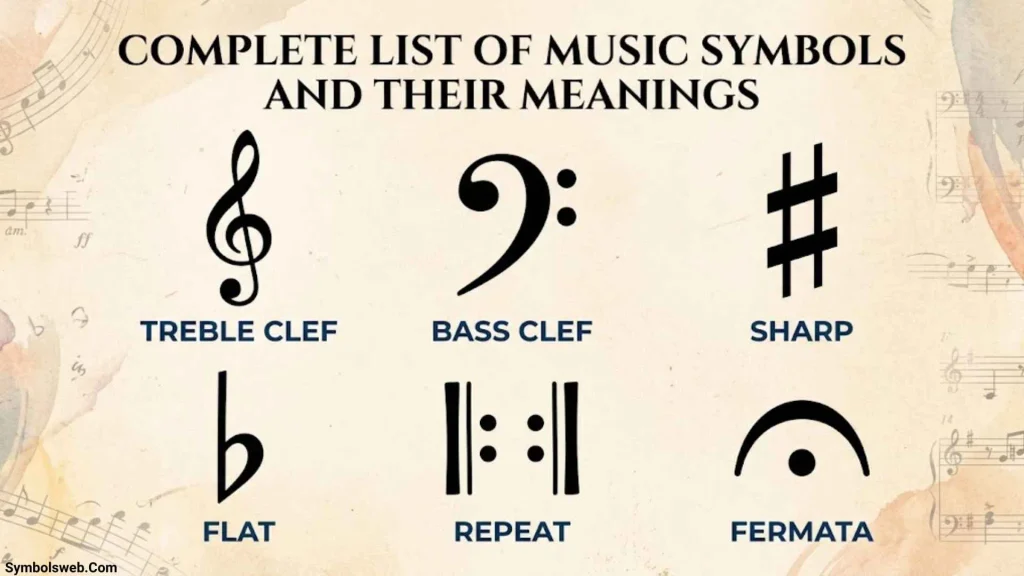
The best way to learn music symbols and definitions is to understand what each marking tells you to do. Some symbols change a note’s pitch, others shape its sound, and several help you navigate a composition from beginning to end.
The explanations below cover all 60 symbols from the original list, including specialized markings that beginners may encounter less often.
Accent
An accent tells you to emphasize a particular note. Musicians generally play or sing it with more stress than the surrounding notes, giving the phrase a stronger rhythmic shape.
The symbol usually resembles a small sideways wedge placed above or below the note. Its exact effect depends on the instrument and musical style.
Arpeggio
An arpeggio instructs a musician to play the notes of a chord one after another instead of simultaneously. On a piano, the performer might play C, E, and G in quick succession rather than pressing all three keys together.
Arpeggios add movement to harmonies and appear in piano accompaniments, guitar parts, orchestral music, and technical exercises.
Bars
A bar, also called a measure, is a unit of musical time. Bar lines divide the staff into these units so performers can organize beats and follow the rhythm.
In a piece written in 4/4 time, each complete measure normally contains four quarter-note beats. The actual number of notes can vary because shorter and longer note values can combine to fill the same measure.
Brace
A brace is a curved line that connects two or more staves that performers read together. You’ll most often see it connecting the treble and bass staves in piano music.
Together, these staves form the grand staff. The brace helps pianists read the right-hand and left-hand parts as one coordinated musical passage.
Breath Mark
A breath mark indicates where a singer or wind instrumentalist can take a breath. It often looks like a small comma above the staff.
The mark may also indicate a slight separation between phrases. Performers should follow the composer’s phrasing while ensuring that the breath doesn’t disrupt the musical flow.
Caesura
A caesura indicates a deliberate break in the music. Its symbol often resembles two diagonal lines, although notation styles vary.
Unlike an ordinary breath mark, a caesura can signal a more pronounced interruption. The conductor or performer determines the precise length of the pause according to the musical context.
Chord Numerals
Chord numerals, commonly written as Roman numerals, identify chords according to their relationship with a musical key. For example, in C major, the chords built on C, F, and G are labeled I, IV, and V.
These numerals help musicians analyze harmony, recognize chord progressions, and transpose music into different keys. They’re particularly useful in music theory, composition, and arranging.
Clef
A clef establishes which pitches correspond to the lines and spaces of a staff. Without a clef, a note’s position alone doesn’t identify its exact pitch.
The most familiar clefs are:
- Treble clef: Commonly used for higher-pitched instruments and the upper staff of piano music.
- Bass clef: Commonly used for lower-pitched instruments and the lower piano staff.
- Alto and tenor clefs: Used in particular instrumental contexts, especially for viola and some other string or orchestral parts.
- Neutral clef: Often used for unpitched percussion notation.
For more on the fundamentals, see the OpenLearn introduction to music theory.
Coda
A coda is a concluding section that brings a composition or movement toward its ending. The coda symbol tells the performer where to find that section when the score includes navigation instructions.
A coda isn’t necessarily the same as the final few measures. It can contain new material or develop musical ideas heard earlier.
Common Time
Common time represents the 4/4 time signature and is often written as a capital C. The music typically contains four quarter-note beats per measure.
This meter appears in many pop songs, rock tracks, marches, and classical compositions. Although the symbol looks like a letter, it represents a time signature rather than a clef or dynamic marking.
Crescendo
A crescendo instructs musicians to increase the volume gradually. It may appear as the abbreviation cresc. or as a hairpin that opens toward the right.
For example, a quiet piano passage can build into a powerful chorus through a crescendo. The marking generally applies across the span indicated in the score.
Cut Time
Cut time represents 2/2 meter and often uses a C with a vertical line through it. Each measure contains two half-note beats.
Musicians frequently feel cut time in two larger pulses rather than four smaller ones. This can make a passage feel more flowing, brisk, or broadly grouped, depending on the tempo.
Da Capo
Da Capo, abbreviated D.C., is an Italian instruction meaning “from the beginning.” It tells the performer to return to the start of the piece or the designated beginning point.
A score may include instructions such as D.C. al Fine, meaning to return to the beginning and continue until the marked ending point, labeled Fine.
Dal Segno
Dal Segno, abbreviated D.S., means “from the sign.” It directs performers to return to the location marked by a segno symbol.
The instruction may appear with additional words explaining where to stop or how to continue. For example, D.S. al Coda directs the performer back to the segno before following the score’s coda instructions.
Damp
A damp marking tells a performer to stop or reduce a ringing sound. The exact technique depends on the instrument and notation convention.
For example, a percussionist may damp a vibrating instrument to shorten its resonance. Harpists and other instrumentalists also use damping techniques to control lingering sounds and keep musical passages clear.
Damp All
Damp all instructs a performer to stop the resonance of all relevant sounding strings or instruments covered by the marking. Its meaning depends on the instrument and the score’s notation system.
This instruction can be especially important when several notes or strings continue ringing together. Damping them helps create a clean transition into the next passage.
Decrescendo
A decrescendo tells musicians to decrease the volume gradually. It’s often written as decresc. or shown with a hairpin that closes toward the right.
A decrescendo can make a melody feel calmer, create a fading ending, or reduce the intensity after a musical climax. Diminuendo is another common term for a gradual decrease in loudness.
Demi Flat
A demi flat generally refers to a quarter-tone lowering in notation systems that use microtonal accidentals. It changes a pitch by less than the semitone used in standard Western equal-tempered notation.
Because symbols for quarter tones can differ between systems, check the score’s legend or the composer’s instructions before interpreting an unfamiliar marking.
Demi Sharp
A demi sharp generally raises a pitch by a quarter tone in notation systems that use microtonal accidentals. It allows composers and performers to represent pitches between the usual semitone steps.
These markings occur in some contemporary music and musical traditions that use microtonal intervals. They’re not interchangeable with ordinary sharps.
Double Flat
A double flat (♭♭) lowers a written note by two semitones in standard equal-tempered notation. For example, B double flat sounds at the same pitch as A on a conventional equal-tempered keyboard.
Although the resulting sound may match another note name, the spelling matters for harmonic and theoretical reasons. Double flats often appear in keys and chord progressions where the written note must preserve a specific musical relationship.
Double Sharp
A double sharp (𝄪) raises a written note by two semitones. For example, F double sharp sounds like G on a standard equal-tempered keyboard.
The symbol may look unusual at first, but it serves a clear purpose in musical spelling. Composers use it when the harmony or key requires a raised version of a note that already has a sharp in its normal pitch context.
Down-Bow
A down-bow marking tells a string player to move the bow from the frog toward the tip. The symbol is often represented by a shape resembling a square or a downward bowing mark.
Bowing direction affects phrasing, articulation, and the distribution of bow strokes. Violinists, violists, cellists, and bassists use these markings to coordinate technique and musical expression.
Dynamic Notation
Dynamic notation tells performers how loudly or softly to play. Standard dynamic markings commonly use Italian terms or their abbreviations.
| Dynamic marking | Meaning |
| pp — pianissimo | Very soft |
| p — piano | Soft |
| mp — mezzo-piano | Moderately soft |
| mf — mezzo-forte | Moderately loud |
| f — forte | Loud |
| ff — fortissimo | Very loud |
The words piano and forte refer to loudness in this context. Dynamic markings help shape musical emotion, create contrast, and balance different instruments within an ensemble.
Fermata
A fermata tells a performer to hold a note or rest longer than its written duration. It often appears as a curved arc with a dot beneath it.
The extra time isn’t fixed. The performer or conductor decides how long to sustain the sound based on the style, phrasing, and musical setting.
Flat
A flat (♭) lowers a written pitch by one semitone in standard equal-tempered notation. For example, B flat sounds one semitone below B natural.
A flat can appear in a key signature or as an accidental beside a note. The key signature establishes a recurring pattern of altered pitches, while an accidental changes a note within the applicable passage.
Fortepiano
Fortepiano, abbreviated fp, instructs the performer to begin a note or passage strongly and then immediately become soft. It creates a sudden dynamic contrast rather than a gradual change.
This marking differs from piano, which simply means soft. It also differs from crescendo, which indicates a gradual increase in loudness.
G-Clef Ottava Alta
A G-clef ottava alta marking combines the treble clef with an octave-transposition instruction. In common notation, an 8va marking tells the performer to sound the written notes one octave higher.
The clef identifies the staff’s pitches, while the octave marking changes the sounding register. This distinction helps performers read high passages without excessive ledger lines.
G-Clef Ottava Bassa
A G-clef ottava bassa marking indicates that notes written in the treble-clef context should sound one octave lower when the notation specifies that transposition.
An 8vb or similar octave indication may appear above or below the staff, depending on the notation convention. Always follow the direction and placement of the marking in the score.
Glissando
A glissando instructs the performer to move smoothly between pitches. The marking may appear as a line connecting the starting and ending notes, sometimes accompanied by the abbreviation gliss.
The technique differs by instrument. A pianist might sweep across a series of keys, while a string player may slide a finger along the string. The exact sound depends on the instrument and the musical context.
Grace Note
A grace note is a small ornamental note that decorates a principal note. It often appears in a smaller type size than the main notes and may have a slash through its stem.
Grace notes can add elegance, energy, or stylistic character. Their timing depends on the score, historical period, and performance tradition.
Hemiola
A hemiola creates a temporary rhythmic shift in how beats are grouped or felt. A common example occurs when six beats that might be felt as two groups of three are perceived as three groups of two.
This rhythmic effect can add motion and tension, especially in dance music and classical compositions. The notes themselves may remain unchanged while the listener perceives a different grouping.
Key Signature
A key signature appears after the clef at the beginning of a staff. It displays the sharps or flats that apply throughout a passage unless altered by relevant notation rules.
For example, a key signature with one sharp indicates F sharp in the conventional major/minor key system. Reading the key signature helps you identify likely tonal centers and anticipate which notes are altered.
Marcato Accent
A marcato accent tells the performer to give a note a strong, clearly marked attack. It often appears as a small wedge or caret above or below the note.
Marcato typically calls for more pronounced emphasis than a light accent, although the exact performance depends on the style. The goal is to make the note stand out clearly from the surrounding music.
Multi Rest
A multi-measure rest represents several consecutive measures in which a performer doesn’t play. Rather than printing an individual rest in every measure, the score may display a long rest symbol with a number above it.
For example, a marking with the number 8 can indicate eight measures of rest. Performers count those measures carefully so they can re-enter at the correct point.
Music End
A piece often ends with a final bar line, usually represented by a thin line followed by a thicker line. This marks the end of the notated composition or section.
A final bar line differs from a repeat sign, which sends the performer back to an earlier passage. The precise ending instructions still depend on the score, especially when navigation marks are present.
Natural
A natural sign (♮) cancels an applicable sharp or flat. For example, if a note is marked F sharp, an F natural sign restores the natural pitch under the standard notation rules.
Naturals also appear when a note needs to differ from the pitch implied by the key signature. Understanding this symbol is essential when reading chromatic passages or music that moves between harmonies.
Neutral Clef
A neutral clef is commonly used for instruments whose parts don’t rely on conventional pitched-staff positions, particularly unpitched percussion. Instead of identifying ordinary note pitches, the notation may assign staff positions to specific instruments or sounds.
A drum kit score, for example, can use different staff positions to represent the snare drum, bass drum, cymbals, and toms. The score’s legend helps identify the exact assignments.
Note
A musical note represents a pitch and a rhythmic duration. Its appearance depends on the notehead, stem, flags, beams, and dots.
In common Western notation, a filled notehead with a stem usually represents a quarter note, while an open notehead with a stem represents a half note. An open notehead without a stem represents a whole note.
The duration of each note depends on the meter and tempo. Notes work with rests to organize sound and silence into recognizable rhythms.
Ottava Alta
Ottava alta, commonly indicated by 8va, tells the performer to play the marked passage one octave higher than written. The marking often appears above the staff and extends over the notes it affects.
Composers use octave displacement to make music easier to read, especially when a melody would otherwise require many ledger lines. The written notes remain in their original positions, but their sounding pitches move up an octave.
Ottava Bassa
Ottava bassa, commonly indicated by 8vb or a similar notation, tells the performer to sound the marked passage one octave lower than written.
This marking often appears below the staff. It can simplify notation for low passages and help performers distinguish written pitch from sounding pitch.
Percussion Clef
A percussion clef identifies a staff used for percussion notation. Unlike a treble or bass clef, it doesn’t ordinarily assign the standard pitch names to staff positions.
Composers use it for drums and other percussion instruments. The exact placement of each instrument depends on the notation system, so performers often consult the score’s key or legend.
Quintuplet
A quintuplet is a group of five notes played within a specified rhythmic span. A number 5 above or below the notes commonly identifies the grouping.
The duration depends on the notes being subdivided and the meter. A quintuplet doesn’t always mean five notes occupy the same amount of time in every context; read it in relation to the surrounding rhythm.
Repeat
A repeat sign tells performers to play a section of music again. It typically uses a pair of dots beside a double bar line.
Some scores mark both the beginning and end of a repeated section. Others use a repeat ending or combine repeat signs with instructions such as Da Capo or Dal Segno.
Rest
A rest represents silence for a specific rhythmic duration. Each rest symbol corresponds to a note value, allowing performers to count the silent beats just as carefully as the sounding ones.
Rests are essential for rhythm, phrasing, and ensemble coordination. They give music breathing room and help distinguish one phrase from another.
Segno
A segno is a navigation symbol that marks a location in the score. The abbreviation D.S. directs the performer to return to this sign.
The segno doesn’t necessarily indicate a musical ending or a repeat by itself. Its function becomes clear when it appears alongside navigation instructions.
Sextuplet
A sextuplet is a group of six notes fitted into a specified rhythmic span. A number 6 often appears above or below the group.
Its precise timing depends on the musical context and notation convention. Sextuplets can create flowing subdivisions or rapid passages that don’t fit the most basic note groupings.
Sforzando
Sforzando, often abbreviated sfz, indicates a sudden, forceful emphasis. It can make one note or chord stand out sharply against the surrounding music.
Unlike a crescendo, sforzando doesn’t ask for a gradual rise in volume. It calls for an immediate accent, with the exact duration of the emphasis determined by the musical context.
Sharp
A sharp (♯) raises a written note by one semitone in standard equal-tempered notation. For example, C sharp sounds one semitone above C natural.
Sharps appear in key signatures and as accidentals. They can alter a pitch within a melody or establish the tonal framework for an entire passage.
Simile
Simile tells performers to continue using a pattern or technique already established in the score. It may appear in instrumental music to avoid rewriting a repeated rhythmic figure or playing instruction.
For example, a percussion part may use simile to indicate that a previously shown pattern should continue. The performer must refer to the preceding notation to understand exactly what to repeat.
Slur
A slur is a curved line connecting two or more notes of different pitches or, in some cases, notes that form a phrase. It generally indicates smooth, connected playing.
On a wind instrument, the performer may change notes without tonguing each one separately. On strings, a slur often means playing multiple notes in one bow stroke.
A slur is not the same as a tie. A tie joins notes of the same pitch and combines their durations.
Staccato
A staccato dot placed above or below a note indicates a short, detached articulation. The note sounds more separated from its neighbors than it would without the mark.
Staccato can give music a playful, crisp, or sharply defined character. The exact note length depends on the instrument, tempo, and musical style.
Staff
A staff consists of five horizontal lines and four spaces. Each position represents a different pitch within the clef’s system.
Notes can appear on the lines or in the spaces. When a pitch falls outside the five-line staff, short additional lines called ledger lines extend the notation upward or downward.
The staff forms the foundation of conventional written music. Notes, rests, clefs, key signatures, time signatures, and expressive markings work together around it.
Sustain Pedal Engage
A sustain pedal engagement marking tells a pianist to press the sustain pedal. This allows notes to continue ringing after the performer releases the keys.
The pedal can create a fuller sound and connect harmonies. However, careless use may blur the music, especially when chords change quickly.
Sustain Pedal Release
A sustain pedal release marking instructs the pianist to lift the sustain pedal, stopping the pedal’s sustaining effect on the strings.
The timing matters because releasing too late can cause harmonies to overlap unintentionally. Many scores show pedal engagement and release using lines or specialized pedal notation.
Tenuto
A tenuto marking, often shown as a short horizontal line above or below a note, tells the performer to give the note its full value or a slight emphasis, depending on context.
Tenuto can help a melody sound deliberate and supported. It differs from staccato, which generally shortens the note, although performance conventions can overlap with other articulation instructions.
Time Signature
A time signature appears at the beginning of a piece or section, after the clef and key signature. Its numbers explain how beats are organized into measures.
In 3/4 time, a measure typically contains three quarter-note beats. In 6/8 time, the music commonly groups six eighth notes into two larger beats.
| Time signature | Common interpretation |
| 2/4 | Two quarter-note beats per measure |
| 3/4 | Three quarter-note beats per measure |
| 4/4 | Four quarter-note beats per measure |
| 2/2 | Two half-note beats per measure |
| 6/8 | Six eighth-note units, commonly felt in two main beats |
The time signature describes the meter, not how fast the music goes. Tempo markings or a metronome indication provide that information.
Tremolo
A tremolo indicates rapid repetition of a note or rapid alternation between notes, depending on the instrument and notation. On bowed strings, it may involve fast repeated bow strokes; on a piano, it can indicate quick alternation between pitches or chords.
Tremolo creates energy, suspense, or a shimmering texture. Its execution depends on the written pattern and instrument-specific conventions.
Trill
A trill is an ornament that rapidly alternates between a written note and an adjacent pitch. The marking often uses tr above the note.
The exact pitches and duration depend on the musical period, key signature, and surrounding notes. Trills appear in many classical styles and can add sparkle or tension to a melodic line.
Up-Bow
An up-bow marking tells a string player to move the bow from the tip toward the frog. It often resembles a small V-shaped mark.
Up-bow and down-bow instructions help string players plan bow distribution, accents, and phrasing. They can also help an ensemble perform coordinated passages consistently.
Volta Brackets
Volta brackets identify alternate endings in a repeated passage. A first ending may appear under a bracket marked 1, while a second ending appears under a bracket marked 2.
The performer plays the first ending on the initial pass, returns to the repeat, and then follows the second ending on the next pass. These markings let composers repeat musical material without writing out the entire passage again.
Types of Music Symbols Explained by Category
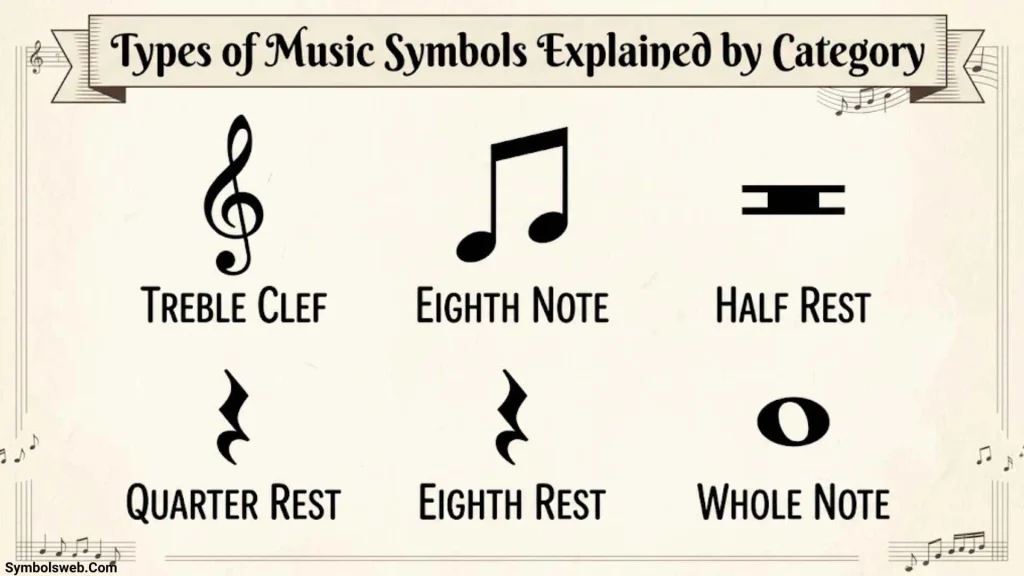
Understanding music notation symbols becomes easier when you group them according to their purpose. Instead of memorizing dozens of unrelated markings, learn how each category helps you read a musical score.
Notes and Rest Symbols
Notes and rests control the relationship between sound and silence. A note tells you when to produce a sound and how long its written duration lasts, while a rest indicates a period of silence.
Common note values include:
- Whole note: Often lasts four quarter-note beats in 4/4 time.
- Half note: Often lasts two quarter-note beats in 4/4 time.
- Quarter note: Often lasts one beat in 4/4 time.
- Eighth note: Lasts half a quarter-note beat in 4/4 time.
- Sixteenth note: Lasts one-quarter of a quarter-note beat in 4/4 time.
These values change relative to the beat and meter. For example, four quarter notes can fill a 4/4 measure, while two half notes can fill the same measure.
A rest has a corresponding duration. If a measure contains a quarter rest, you count one quarter-note beat of silence before continuing.
Clefs and Staff Symbols
The staff provides the visual framework for written music, while the clef identifies the pitches assigned to its lines and spaces.
The treble clef commonly serves higher-pitched parts, including many flute, violin, and right-hand piano passages. The bass clef serves lower-pitched parts, such as bassoon, cello, and left-hand piano passages.
The C clefs, including alto and tenor clefs, place middle C on different staff lines. These clefs remain useful in specific orchestral and instrumental settings.
A brace connects staves that performers read together. Ledger lines extend the staff when notes fall outside its normal five-line range.
Pitch and Accidental Symbols
Pitch symbols help musicians identify and alter notes. The three most important accidentals for beginners are the sharp, flat, and natural.
- Sharp (♯): Raises a note by one semitone.
- Flat (♭): Lowers a note by one semitone.
- Natural (♮): Cancels an applicable sharp or flat.
- Double sharp (𝄪): Raises a note by two semitones.
- Double flat (♭♭): Lowers a note by two semitones.
A key signature establishes the usual sharps or flats for a key. An accidental changes the pitch of a particular note according to the notation rules in effect.
Quarter-tone accidentals, such as demi-sharp and demi-flat markings, belong to systems that represent pitches between standard semitone steps.
Rhythm and Time Symbols
Rhythm symbols explain how notes fit into time. Time signatures establish the meter, while note values, rests, and tuplets determine how musical events fill each measure.
Common time and cut time are familiar examples of meter-related notation. Quintuplets and sextuplets represent irregular subdivisions, allowing musicians to fit five or six notes into a specified rhythmic span.
Hemiola changes the perceived grouping of beats. Tremolo can introduce rapid repetition, while a fermata allows a note or rest to last longer than its written value.
Dynamics and Volume Symbols
Dynamics tell performers how loudly or softly to play. They also help shape the emotional direction of a musical passage.
The basic dynamic levels range from pianissimo (very soft) through piano, mezzo-piano, mezzo-forte, and forte to fortissimo (very loud).
Crescendo and decrescendo indicate gradual changes. Fortepiano creates a sudden shift from strong to soft, while sforzando marks an abrupt, forceful emphasis.
These musical signs and symbols are especially important when several instruments perform together. Dynamics help the melody stand out without overpowering the accompaniment.
Articulation and Expression Symbols
Articulation markings tell musicians how to begin, sustain, connect, or separate notes.
- Staccato: Produces short, detached notes.
- Slur: Connects notes smoothly.
- Tenuto: Gives a note its full value or a slight emphasis.
- Accent: Highlights a particular note.
- Marcato: Gives a note a strong, marked attack.
- Fermata: Extends a note or rest beyond its written duration.
- Glissando: Creates a sliding movement between pitches.
- Arpeggio: Plays chord notes successively.
- Trill: Rapidly alternates between neighboring pitches.
These marks can transform the character of a melody even when its pitches and rhythms remain unchanged.
Repetition and Musical Navigation Symbols
Navigation markings tell musicians where to go next in a score. Repeat signs send them back through an earlier section, while Da Capo and Dal Segno provide specific return instructions.
The segno identifies a point in the music, and the coda directs performers toward a concluding passage. Volta brackets identify alternate endings.
These symbols make longer compositions easier to read. Instead of printing repeated material several times, composers can indicate which passages performers should replay and where they should continue.
Instrument-Specific Music Symbols
Some sheet music symbols relate to a particular instrument or playing technique.
String players use up-bow and down-bow markings to organize their bow strokes. Pianists follow sustain-pedal instructions to control resonance and connect harmonies.
Percussionists may encounter neutral clefs, damping instructions, and instrument-specific staff positions. Singers and wind players use breath marks to plan phrasing.
Because these symbols can vary across instruments and notation systems, performers should consult the score’s instructions whenever a marking isn’t familiar.
How to Read Music Symbols on Sheet Music
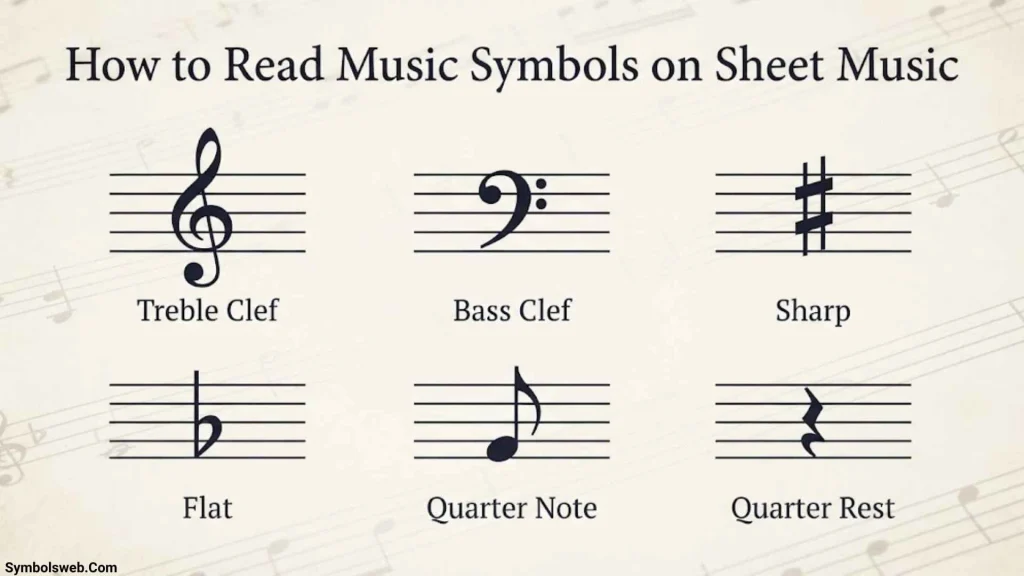
Reading sheet music may look difficult at first. However, you don’t need to memorize every symbol before you begin. Learn the basic framework, then add more complex markings as your skills improve.
Start by Identifying the Clef
Look at the beginning of the staff and identify the clef. This tells you how to interpret the lines and spaces.
For example, the treble clef places G above middle C on the second line from the bottom. The bass clef places F below middle C on the fourth line from the bottom.
Once you know the clef, you can identify the written notes more accurately.
Read the Key Signature
Next, check the key signature immediately after the clef. It tells you which notes are normally sharp or flat throughout the passage.
A key signature with one sharp, for instance, typically indicates F sharp. Recognizing these alterations helps you avoid repeatedly stopping to work out the pitch of every note.
Check the Time Signature
Look at the time signature to understand the meter. In 4/4 time, four quarter-note beats typically fill a measure; in 3/4 time, three quarter-note beats do.
Count the beats as you read. This helps you recognize where each measure ends and prepares you for rests, syncopation, and unusual rhythmic groupings.
Identify Notes and Rests
Study the noteheads, stems, flags, beams, and rests. Their shapes indicate relative durations, while their positions on the staff identify pitches.
Try clapping a rhythm before playing it. This separates the rhythmic challenge from the pitch-reading challenge and makes difficult passages easier to practice.
Follow Dynamics and Articulation
After identifying the notes and rhythm, look for expression markings. A crescendo may require you to build intensity across several measures, while staccato dots ask you to shorten particular notes.
Don’t overlook these details. Two musicians can play the same pitches correctly yet produce noticeably different results if one ignores the articulation and dynamics.
Follow Repeats and Alternate Endings
Finally, check for repeat signs, D.C., D.S., coda, and volta brackets. These markings affect the order in which you perform the music.
Read the navigation instructions before starting a longer piece. Otherwise, you may reach the end of a passage and miss the direction that sends you back to an earlier section.
Common Music Symbols for Beginners
If you’re just starting to read music, focus on a small group of frequently used markings first. These form the foundation for understanding more advanced notation.
| Symbol or term | What to learn first |
| Treble clef | How staff positions identify pitches |
| Bass clef | How lower-register notes are written |
| Staff | How five lines and four spaces organize pitches |
| Notes and rests | How sound and silence occupy time |
| Sharp, flat, and natural | How accidentals change pitch |
| Key signature | How a group of accidentals establishes a tonal pattern |
| Time signature | How beats are grouped into measures |
| Piano and forte | How to play softly and loudly |
| Crescendo and decrescendo | How to change volume gradually |
| Staccato and slur | How to separate or connect notes |
| Repeat signs | How to replay a passage |
A simple practice routine: Choose a short piece, identify the clef and key signature, clap the rhythm, and then play the notes slowly. Add the dynamics and articulation once you can perform the basic passage comfortably.
This approach helps you understand how symbols work together rather than memorizing isolated definitions.
Music Symbols That Are Often Confused
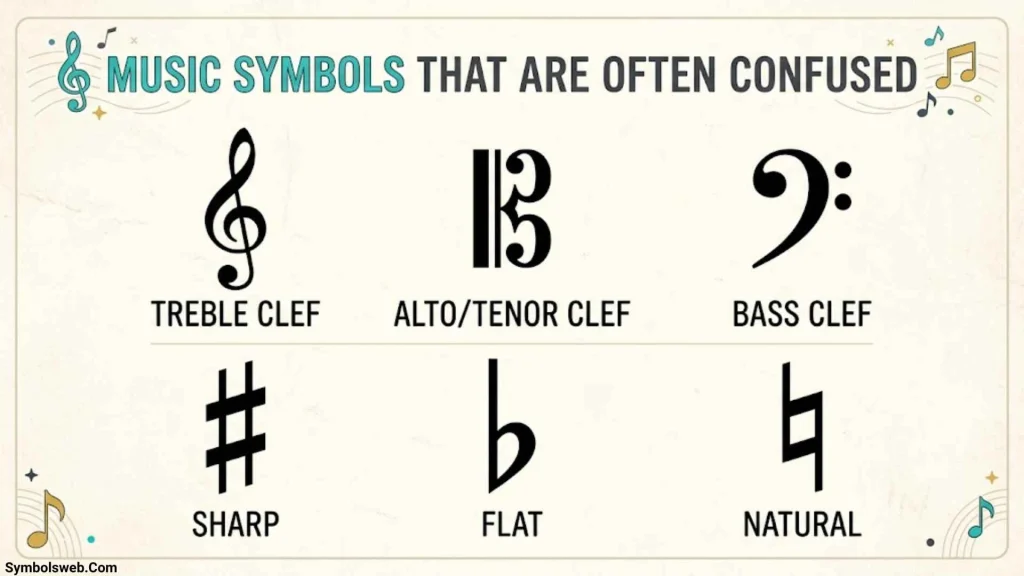
Some notation marks look similar or perform related functions. Knowing their differences helps you avoid mistakes when reading a score.
Sharp vs. Double Sharp
A sharp raises a written note by one semitone. A double sharp raises it by two semitones.
The distinction matters when reading complex keys and harmonic progressions. Although two differently spelled notes may sound the same on a standard keyboard, their written names can serve different theoretical purposes.
Flat vs. Double Flat
A flat lowers a note by one semitone, while a double flat lowers it by two semitones.
For example, B flat sounds one semitone below B natural. B double flat sounds two semitones below B natural, matching A on a conventional equal-tempered keyboard.
Slur vs. Tie
A slur indicates smooth, connected playing across notes. A tie connects notes of the same pitch and combines their written durations into one sustained sound.
For instance, two tied quarter notes of the same pitch last as long as a half note. The performer doesn’t strike the second note again.
Staccato vs. Tenuto
Staccato indicates a short, detached note. Tenuto generally asks the performer to give a note its full written value or a slight emphasis.
These markings shape articulation in different ways. Their exact execution depends on the instrument, musical period, and surrounding instructions.
Crescendo vs. Sforzando
A crescendo gradually increases volume across a passage. Sforzando creates a sudden, strong emphasis on a note or chord.
Think of a crescendo as a gradual climb and sforzando as an abrupt accent. Both affect dynamics, but they communicate different musical gestures.
Trill vs. Tremolo
A trill rapidly alternates between a written note and a neighboring pitch. Tremolo generally indicates rapid repetition or alternation, depending on the instrument and notation.
The distinction matters because the two markings can produce different textures. A trill often decorates a melody, while tremolo can create suspense or a sustained sense of movement.
Time Signature vs. Tempo
A time signature tells you how beats are organized within measures. Tempo tells you how fast those beats occur.
A piece in 4/4 can be slow, moderate, or fast. The meter remains the same even when the tempo changes.
Bar Line vs. Measure
A bar line is the vertical line that separates measures. A measure is the unit of musical time between two bar lines.
In other words, the bar line marks the boundary, while the measure contains the beats and notes within that boundary.
Why Are Music Symbols Important?
Music symbols allow musicians to communicate detailed musical ideas with a shared written system. They help preserve compositions and make it possible for performers to study music without relying entirely on recordings or demonstrations.
Here are some of their main benefits:
- Accurate pitch: Clefs, staff positions, and accidentals tell performers which notes to play.
- Clear rhythm: Notes, rests, meter, and tuplets organize musical time.
- Expressive performance: Dynamics and articulation communicate changes in loudness, emphasis, and phrasing.
- Better coordination: Shared notation helps ensembles follow the same musical instructions.
- Consistent interpretation: Written markings provide a common reference for performers, teachers, conductors, and composers.
- Efficient composition: Repeat signs and navigation instructions reduce unnecessary rewriting.
Music notation doesn’t capture every detail of a performance. Tone color, subtle timing, and stylistic interpretation may depend on experience and musical tradition. Still, a well-written score gives musicians a detailed framework for bringing a composition to life.
For a deeper look at the fundamentals, explore Open Music Theory’s guide to basic notation and the OnMusic Dictionary’s musical symbol chart.
Frequently Asked Questions About Music Symbols
What Are the Most Common Music Symbols?
The most common music symbols include the treble clef, bass clef, notes, rests, sharps, flats, naturals, time signatures, dynamic markings, articulation marks, and repeat signs.
These symbols form the foundation of written music. Once you understand them, you can begin reading simple melodies and gradually move toward more complex scores.
How Many Music Symbols Are There?
There isn’t one fixed number of music symbols. Traditional Western notation includes many standard signs, while specialized instrumental notation, contemporary compositions, and other musical traditions use additional markings.
This guide explains 60 selected symbols, ranging from basic notes and accidentals to advanced rhythmic groupings and navigation instructions.
What Do Music Symbols Mean in Sheet Music?
Music symbols communicate pitch, rhythm, duration, loudness, articulation, phrasing, and musical structure.
For example, a clef establishes staff pitches, a time signature organizes beats, and a crescendo tells the performer to grow louder gradually. Together, these markings guide the performance.
What Are the Basic Music Symbols for Beginners?
Beginners should start with the staff, treble and bass clefs, notes, rests, basic accidentals, key signatures, time signatures, and simple dynamic markings.
After learning these, practice reading staccato dots, slurs, repeat signs, and crescendo markings. You can then move on to ornaments, tuplets, and instrument-specific notation.
What Is the Difference Between a Sharp and a Flat?
A sharp raises a written note by one semitone, while a flat lowers it by one semitone in standard equal-tempered notation.
For example, C sharp is one semitone above C natural, while B flat is one semitone below B natural. Both symbols can appear in key signatures or as accidentals.
What Does a Time Signature Tell You?
A time signature explains how beats are grouped within each measure and which note value represents the basic beat unit.
In 3/4 time, three quarter-note beats typically fill a measure. In 4/4 time, four quarter-note beats typically fill a measure.
What Do P and F Mean in Music?
The letter p stands for piano, meaning soft. The letter f stands for forte, meaning loud.
You may also see pp for very soft, ff for very loud, mp for moderately soft, and mf for moderately loud.
What Does a Crescendo Symbol Mean?
A crescendo tells musicians to increase the volume gradually. It may appear as the abbreviation cresc. or as an expanding hairpin beneath or above a passage.
The marking usually applies across the section it spans, helping build musical intensity toward a stronger moment.
What Is the Difference Between a Slur and a Tie?
A slur connects notes for smooth articulation, while a tie connects notes of the same pitch and combines their durations.
A slur changes how a passage is performed. A tie changes how long a pitch sounds without being struck or sung again.
How Can Beginners Learn to Read Music Symbols?
Start with the clef, staff, note positions, and basic rhythms. Then learn key signatures, time signatures, dynamics, and articulation.
Practice with short, simple pieces. Identify the symbols before playing, clap the rhythm, and gradually incorporate expressive markings. Regular practice builds recognition and confidence.
Conclusion
Music symbols are the foundation of written musical communication. They help you recognize pitches, count rhythms, control volume, shape articulation, and follow the structure of a composition.
Learning all 60 symbols may take time, but you don’t need to master them at once. Begin with the staff, notes, rests, clefs, accidentals, and time signatures. Then explore dynamics, articulation, ornaments, and navigation markings as you encounter them in real music.
Keep a music symbols chart nearby while practicing sheet music. With regular use, these signs will become easier to recognize, and reading music will feel less like decoding a foreign language and more like understanding a familiar set of instructions.

Jordan Hayes is a writer with a passion for exploring the history, meanings, and cultural significance behind symbols from around the world. He enjoys turning complex topics into clear, engaging content that anyone can understand. Jordan is also the fictional author of The Silent Language of Ancient Marks and Hidden Symbols Beyond the Surface, two original book concepts created for his author profile. When he’s not writing, he spends time researching myths, traditions, and forgotten stories that inspire his work. His goal is to help readers discover the deeper meanings behind the symbols they encounter every day.
 Eliana Foster
 Ethan Holloway