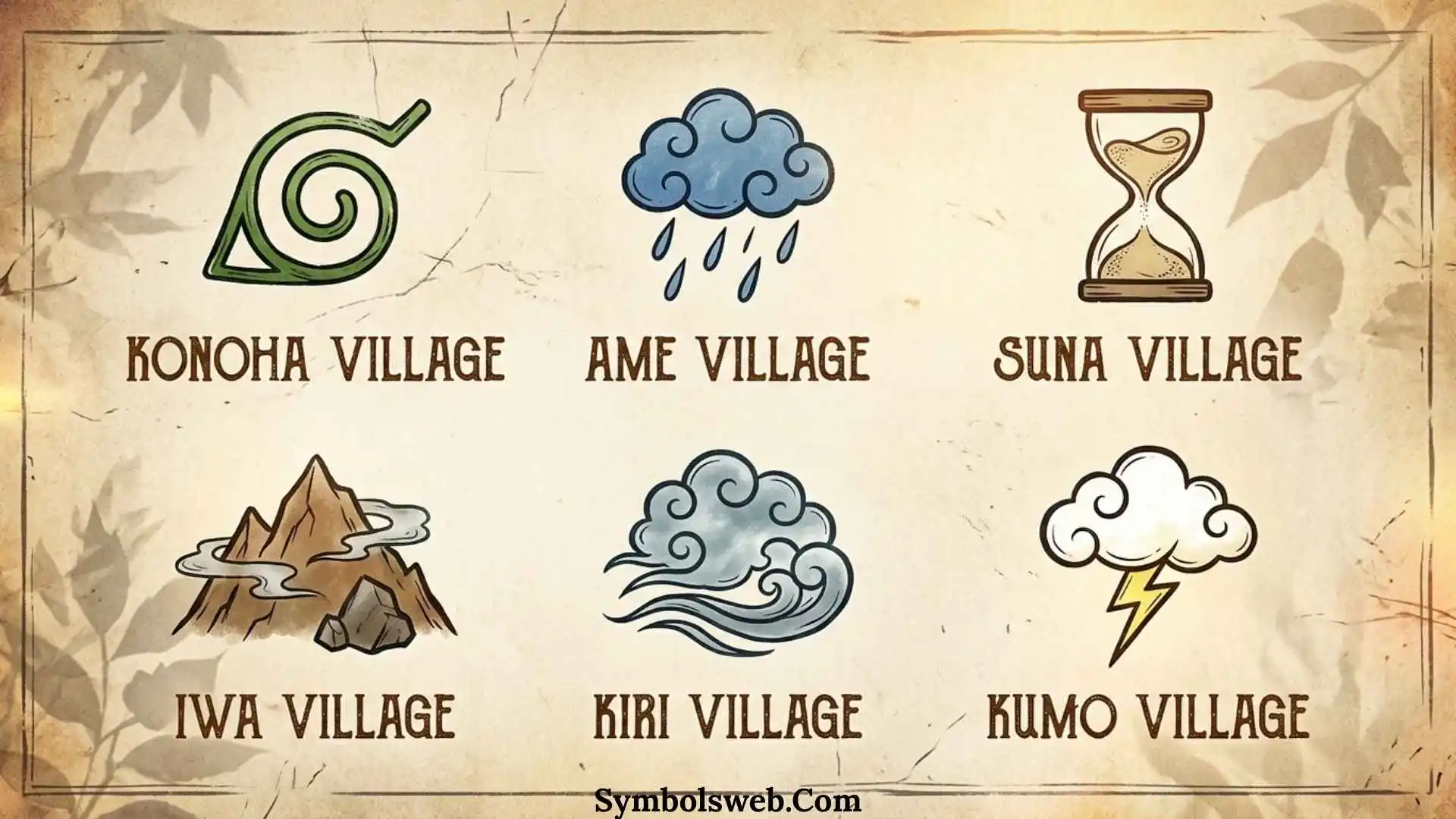
Naruto village symbols are more than simple designs carved into ninja forehead protectors. Each emblem identifies a hidden village and connects it to the land, environment, history, and identity of its shinobi. From the famous Hidden Leaf spiral to the sharp symbol of the Hidden Cloud, these small marks help make the Naruto world feel like a living culture with its own nations, rivalries, and traditions.
At first glance, the symbols may look like simple anime artwork. However, many of them visually reflect the names of their villages and the natural environments surrounding them. Understanding these symbols also makes the forehead protectors, village alliances, missing-nin markings, and major conflicts in Naruto easier to appreciate.
Naruto Village Symbols: (Quick Answer)
Naruto village symbols are emblems used to identify the hidden villages of the shinobi world. The most recognizable include the Hidden Leaf, Sand, Mist, Stone, and Cloud symbols, along with emblems for villages such as Rain, Grass, Waterfall, and Sound. They appear mainly on ninja forehead protectors and represent village identity, allegiance, and origin.
Also Check This Post: 55+ Hmong Symbols: Meanings Names and Cultural Significance
Quick Facts About Naruto Village Symbols
| Aspect | Information |
| Origin | Created as part of the fictional shinobi world of Naruto by Masashi Kishimoto |
| Historical Significance | They identify the hidden villages and their shinobi affiliations |
| Main Meaning | Village identity, allegiance, origin, and belonging |
| Spiritual Meaning | Mostly fictional and symbolic rather than tied to a real-world religion |
| Cultural Importance | They help distinguish different shinobi communities and nations |
| Modern Usage | Popular in anime fandom, cosplay, tattoos, artwork, clothing, and collectibles |
What Are Naruto Village Symbols?
Naruto village symbols are visual emblems associated with the hidden villages of the Naruto universe. The symbols are most commonly seen on forehead protectors, which are among the most recognizable pieces of shinobi equipment in the series.
A forehead protector does more than complete a ninja’s appearance. The engraved emblem tells viewers where a shinobi comes from. This makes the symbol a quick visual marker of identity and allegiance. Different village headbands therefore allow characters and viewers to recognize a shinobi’s background almost instantly.
The five most important hidden villages are:
- Konohagakure, the Hidden Leaf Village
- Sunagakure, the Hidden Sand Village
- Kirigakure, the Hidden Mist Village
- Iwagakure, the Hidden Stone Village
- Kumogakure, the Hidden Cloud Village
These villages belong to the Five Great Shinobi Countries, whose conflicts and alliances shape much of the Naruto storyline. The official Naruto site also describes the major villages coming together during the Fourth Great Ninja War, showing how village identity is central to the series’ larger story.
Why Are the Symbols on Ninja Headbands?
The forehead protector is one of the clearest ways a shinobi displays village affiliation. A village emblem engraved into its metal plate works almost like a national emblem or military insignia.
There is also an important variation. When a shinobi abandons their village and becomes a missing-nin, the village symbol can be crossed out. This creates an immediate visual message: the shinobi once belonged to that village but no longer represents it.
That scratched symbol becomes especially meaningful with characters such as Sasuke and other rogue ninja.
Deep Symbolic Meaning of Naruto Village Symbols
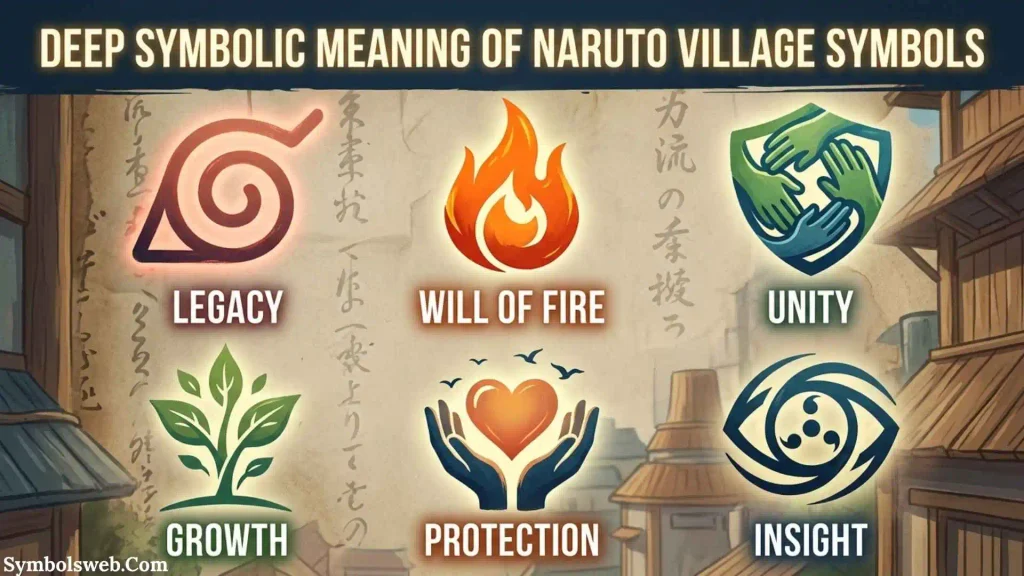
The symbols do not all have officially stated philosophical meanings beyond identifying their villages. Therefore, it is important to separate canon information from fan interpretation.
A leaf can reasonably suggest nature and growth, for example, but that does not mean every deeper interpretation was explicitly confirmed by the creator.
Spiritual Level
Naruto village symbols are fictional symbols, so they should not be treated as established spiritual symbols from real religions.
However, viewers can still find personal meaning in them.
The Hidden Leaf can inspire ideas of growth, belonging, and protecting one’s community. The Hidden Sand can suggest endurance and survival. The Hidden Stone can evoke strength and stability. The Hidden Cloud can suggest movement and power, while the Hidden Mist can create associations with mystery and uncertainty.
These are interpretive readings rather than official religious meanings.
Psychological Level
From a psychological perspective, symbols work because humans naturally recognize visual patterns and connect them with identity.
A shinobi wearing the Leaf symbol immediately communicates, “I belong here.”
That idea becomes powerful throughout Naruto because many characters struggle with belonging. Naruto himself begins the story as someone who feels rejected by his village. Over time, the same village emblem becomes connected to friendship, responsibility, recognition, and home.
The symbol therefore gains emotional power through the story surrounding it.
Cultural Level
Inside the Naruto universe, village symbols function almost like cultural badges.
They can communicate:
- Where someone comes from
- Which village trained them
- Which community they protect
- Whether they remain loyal to that village
- Whether they have abandoned it
- Which side they represent during conflict
This makes the symbols an important part of shinobi culture.
Types and Variations of Naruto Village Symbols
The most famous village symbols belong to the Five Great Shinobi Villages, but the Naruto world contains many smaller hidden villages as well.
Hidden Leaf Village Symbol
The Hidden Leaf symbol is one of the most recognizable designs in anime.
It resembles a stylized leaf combined with a spiral. It is associated with Konohagakure, the Village Hidden in the Leaves, located in the Land of Fire. The design is strongly connected with the village’s identity and is worn by many of Naruto’s central characters.
Visual Description: A curved spiral-like mark with a pointed extension resembling a leaf.
Meaning: Village identity and belonging.
Symbolism: Nature, growth, community, and continuity can be read into the design, although these deeper meanings are largely interpretive.
Cultural Connection: It becomes closely associated with the Will of Fire and the idea of protecting future generations.
Where It Appears: Ninja forehead protectors, village architecture, clothing, merchandise, and promotional artwork.
The Leaf symbol becomes especially meaningful because Naruto’s personal journey is deeply connected to Konoha. What begins as a mark of the village eventually becomes part of his identity.
Hidden Sand Village Symbol
The Hidden Sand Village, Sunagakure, is associated with the Land of Wind.
Visual Description: A stylized symbol resembling a gust or swirl of sand.
Meaning: Identification with Sunagakure.
Symbolism: The design naturally evokes wind, movement, and the harsh desert environment.
Cultural Connection: The symbol is strongly associated with characters such as Gaara and the Sand shinobi.
Where It Appears: Ninja forehead protectors, uniforms, and village-related imagery.
The Sand symbol also gains emotional meaning through Gaara’s transformation. His story changes from isolation and fear toward leadership and protection, giving the village emblem a stronger association with responsibility.
Hidden Mist Village Symbol
Kirigakure is the Village Hidden in the Mist and belongs to the Land of Water.
Visual Description: The emblem consists of flowing, wave-like lines.
Meaning: Identification with the Hidden Mist.
Symbolism: The flowing design fits the village’s association with water and mist.
Cultural Connection: Kirigakure is famous for its Seven Ninja Swordsmen and its difficult history.
Where It Appears: Forehead protectors, shinobi clothing, and village imagery.
The official Naruto material repeatedly identifies the Mist as one of the major hidden villages and places its shinobi within the larger history of the Five Great Nations.
Hidden Stone Village Symbol
Iwagakure is the Village Hidden in the Stone, located in the Land of Earth.
Visual Description: The emblem is made from angular shapes that resemble rocks or stones.
Meaning: Village affiliation.
Symbolism: Strength, endurance, stability, and the harshness of stone are natural interpretations of the design.
Cultural Connection: The village is led by the Tsuchikage and plays an important role in the history of the shinobi wars.
Where It Appears: Headbands, shinobi equipment, and village imagery.
The stone imagery is particularly direct. The emblem visually connects the village’s name with its surrounding environment.
Hidden Cloud Village Symbol
Kumogakure is the Village Hidden in the Clouds and belongs to the Land of Lightning.
Visual Description: The symbol uses a sharp, angular design that resembles lightning.
Meaning: Identification with the Hidden Cloud.
Symbolism: Power, speed, electricity, and energy are natural associations.
Cultural Connection: The village is known for powerful shinobi and its distinctive relationship with the other great villages.
Where It Appears: Forehead protectors, uniforms, and official village imagery.
The Cloud symbol is particularly easy to recognize because its shape visually contrasts with the softer curves of several other village emblems.
Hidden Rain Village Symbol
Amegakure is the Village Hidden in the Rain.
Its headband symbol uses repeated vertical markings that visually suggest falling rain. The village itself is known for its constant rainfall and industrial setting.
The Rain symbol becomes especially important because Amegakure is closely connected to Nagato, Konan, and Yahiko, as well as the origins of the Akatsuki.
The red clouds worn by the Akatsuki are a separate symbol and should not be confused with the Amegakure village emblem.
Hidden Grass Village Symbol
Kusagakure is the Village Hidden in the Grass.
Its emblem uses jagged lines that visually represent grass. The design is less elaborate than the symbols of the major villages, but it follows the same basic idea of turning the village’s name and environment into a recognizable mark.
Hidden Waterfall Village Symbol
Takigakure is the Village Hidden by a Waterfall.
Its symbol is associated with the village’s waterfall theme and appears on its shinobi forehead protectors. The village is less prominent than Konoha, Suna, Kiri, Iwa, and Kumo, but it is still part of the broader hidden-village system.
Hidden Sound Village Symbol
Otogakure is the Village Hidden in the Sound.
Unlike the major villages, its history is strongly tied to Orochimaru and his experiments. Because of that, the Sound symbol often carries a different emotional association for fans. Instead of representing a long-established community, it can remind viewers of artificial power, experimentation, and political manipulation.
Hidden Hot Water Village Symbol
Yugakure is the Village Hidden in Hot Water.
Its name and identity are connected with hot springs. It is an interesting example of how not every hidden village functions as a major military power.
The village later becomes associated with Hidan, whose story shows how a community’s identity can change over time.
Naruto Village Symbols Across Different Cultures
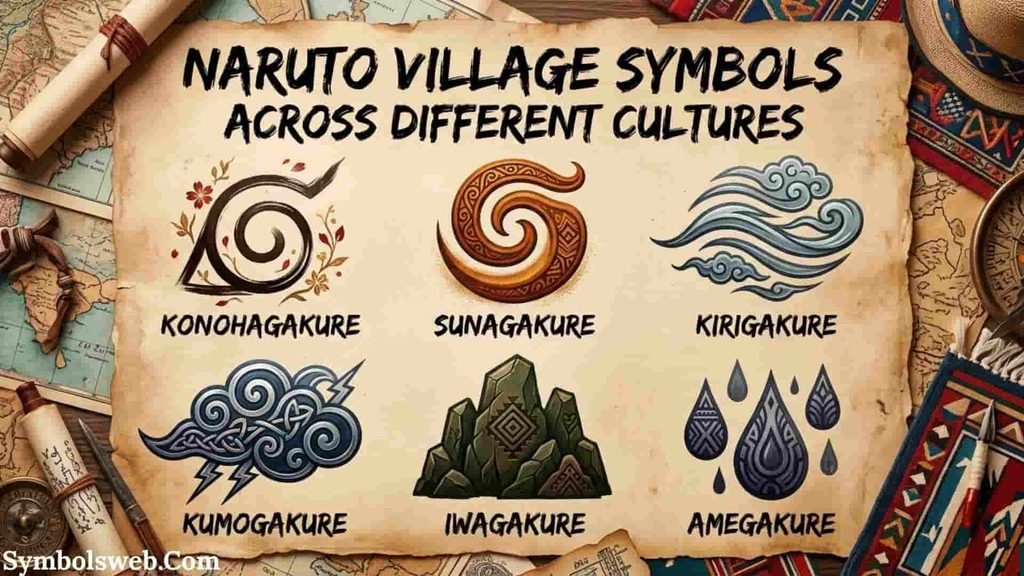
Unlike symbols from real civilizations, Naruto village symbols do not originate in Ancient Egypt, Greece, Rome, or indigenous religious traditions. They are fictional creations from a modern Japanese manga and anime series.
However, the series uses visual ideas that are easy for people from different cultures to understand.
Japanese Cultural Influence
The Naruto world draws heavily on Japanese language, visual design, mythology, historical warrior traditions, and the idea of shinobi.
The village system also creates a fictionalized version of competing political and military communities.
Eastern Traditions
Some broader ideas in Naruto, including chakra, elemental abilities, seals, and spiritual training, draw from or resemble concepts associated with Asian religious and philosophical traditions.
However, individual village emblems should not be presented as direct equivalents of Buddhist, Hindu, Shinto, Taoist, or other real-world religious symbols.
Modern Global Culture
Today, the village symbols have meaning beyond the fictional world. Fans use them to express their favorite characters, villages, or personal connection to the series.
A Leaf symbol may simply mean, “I love Naruto,” while another fan may choose the Sand or Mist symbol because they identify more strongly with Gaara, Zabuza, or another character.
Also Check This Post: 95+ The Outsiders Symbols: A Complete Guide to Their Meaning
Similar Symbols and Their Meanings
| Village Symbol | Visual Idea | Main Association |
| Hidden Leaf | Leaf and spiral | Nature, village identity, growth |
| Hidden Sand | Wind or sand-like shape | Desert, endurance, movement |
| Hidden Mist | Flowing lines | Water, mist, mystery |
| Hidden Stone | Angular stone shapes | Earth, strength, stability |
| Hidden Cloud | Sharp cloud/lightning form | Lightning, speed, power |
| Hidden Rain | Falling lines | Rain, hardship, Amegakure |
| Hidden Grass | Jagged grass-like lines | Nature and grassland |
| Hidden Waterfall | Water-themed design | Waterfall and village identity |
Common Misconceptions
One common mistake is assuming that every visual interpretation has been officially explained by Masashi Kishimoto.
Not every symbol has a detailed canonical explanation.
The safest approach is to distinguish between what the story establishes and what fans infer from the design.
Naruto Village Symbols in Mythology and Folklore
Naruto does not simply copy ancient mythology when creating its village symbols. Instead, the series builds its own fictional mythology.
The symbols become part of a larger storytelling system in which villages represent different political communities.
The Five Great Shinobi Villages are especially important because their identities are repeatedly placed against one another during periods of war and peace. During the Fourth Great Ninja War, former enemies eventually fight together as the Allied Shinobi Forces. The official Naruto site highlights how the Sand, Stone, Leaf, Mist, and Cloud identities are brought together under a common shinobi alliance.
That is one of the deepest uses of the symbols in the story.
At first, the symbols divide people.
Later, the characters learn that the people behind those symbols can stand together.
Naruto Village Symbols in Art, Literature, Movies and Pop Culture
Paintings and Fan Art
Artists frequently use village symbols as visual shortcuts. A single Leaf emblem can instantly tell viewers that an artwork belongs to the Naruto universe.
Literature
The symbols appear throughout manga panels, novels, guide material, and fan-created stories.
Anime
The anime makes extensive use of forehead protectors and village emblems to identify characters quickly.
Movies
Naruto films also use village identity as part of their wider stories. For example, Naruto Shippuden the Movie: The Will of Fire involves tensions surrounding several major hidden villages and the possibility of another great ninja war.
Tattoos
Village symbols are popular tattoo choices because they are small, recognizable, and connected with personal memories.
A fan may choose the Leaf symbol to represent perseverance, friendship, or a connection to Naruto’s journey.
Fashion
The symbols appear on shirts, hoodies, accessories, headbands, bags, and cosplay outfits.
Modern Design
Their simple shapes also make them suitable for digital artwork, wallpapers, logos for fan communities, and social media graphics.
Spiritual and Dream Meaning of Naruto Village Symbols
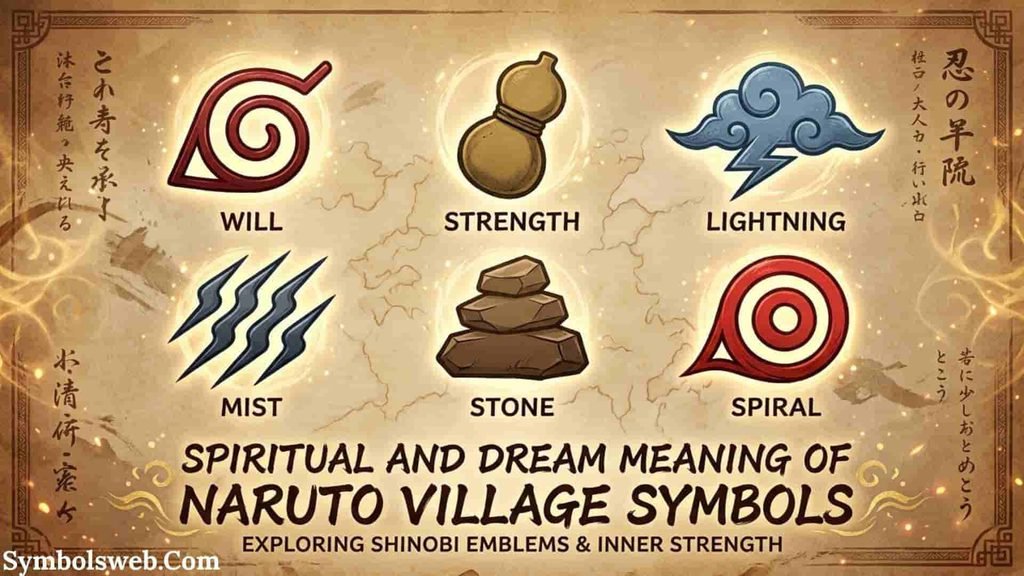
There is no established spiritual or dream interpretation for Naruto village symbols outside the fictional world.
Still, someone who dreams about a Leaf, Sand, Mist, or other village symbol may personally associate it with something meaningful.
For example:
- A Leaf symbol may remind someone of home or belonging.
- A Sand symbol may represent resilience during difficult circumstances.
- A Mist symbol may reflect uncertainty or hidden emotions.
- A Stone symbol may suggest stability or emotional strength.
- A Cloud symbol may represent freedom, movement, or ambition.
These interpretations are personal rather than scientifically established dream meanings.
Positive and Negative Meanings of Naruto Village Symbols
| Positive Meaning | Negative Meaning |
| Belonging | Division |
| Loyalty | Blind allegiance |
| Friendship | Rivalry |
| Protection | Conflict |
| Identity | Tribal thinking |
| Strength | Abuse of power |
| Community | Isolation |
| Hope | Memories of war |
This contrast is important because Naruto rarely presents village identity as completely good or completely bad.
A symbol can represent home and protection while also reminding characters of war, loss, discrimination, or political conflict.
That tension gives the symbols greater emotional depth.
Why Humans Are Attracted to Naruto Village Symbols
Humans naturally attach meaning to symbols.
A flag, team logo, family crest, school emblem, or national symbol can create a feeling of belonging. Naruto uses the same psychological idea through its village emblems.
Imagine a character arriving in a foreign village. Before they even speak, their forehead protector may reveal where they come from.
That tiny visual detail creates an instant story.
The viewer already knows there may be history between that person and the village they have entered.
This is why the symbols remain memorable even when they are only a few lines of metal engraving.
Identity
People want to feel that they belong to something larger than themselves.
Recognition
A familiar symbol can instantly trigger memories of characters, battles, and emotional moments.
Pattern Recognition
Simple shapes are easier for the brain to recognize and remember.
Cultural Memory
Within Naruto, each symbol carries memories of wars, alliances, leaders, and generations of shinobi.
Personal Meaning
Fans can also give the symbols meanings based on their own experiences with the series.
Modern Uses of Naruto Village Symbols
Naruto village symbols are now widely used in fan culture.
Tattoos
Fans often choose a village emblem as a permanent reminder of a favorite character or life lesson.
Jewelry
Symbols can appear on necklaces, rings, bracelets, and pendants.
Fashion
Headbands, shirts, hoodies, jackets, and bags frequently use the emblems.
Social Media
Fans use village symbols in profile pictures, posts, wallpapers, edits, and fan communities.
Cosplay
The forehead protector is one of the easiest ways to communicate a Naruto character or village affiliation.
Personal Expression
Choosing a village can become a playful way for fans to express personality. Someone might identify with Konoha’s community spirit, Suna’s resilience, Kiri’s mysterious history, Iwa’s toughness, or Kumo’s energy.
Interesting Facts About Naruto Village Symbols
- The Hidden Leaf symbol is one of the most recognizable Naruto designs. It is strongly associated with Naruto Uzumaki and Konoha.
- Village headbands can reveal a character’s origin. This makes them important visual storytelling tools.
- Scratching through a village symbol has meaning. It is commonly used to show that a shinobi has abandoned their village.
- The Hidden Grass symbol visually resembles grass. Its simple jagged design follows the same naming principle found throughout the shinobi world.
- The Hidden Rain symbol is different from the Akatsuki cloud. Amegakure has its own village emblem, while the red cloud is associated with the Akatsuki organization.
- The five major villages play a major role in the Fourth Great Ninja War. Their shinobi eventually cooperate as part of the Allied Shinobi Forces.
- Not every village has equal importance in the story. Konoha, Suna, Kiri, Iwa, and Kumo receive much more attention than many smaller villages.
- The symbols make cosplay instantly recognizable. A forehead protector can identify a character’s village without needing a name or explanation.
- The village symbols are fictional rather than ancient religious symbols. Their meanings should not be confused with established symbols from real-world religions or civilizations.
- The symbols help turn geography into identity. Leaf, sand, mist, stone, and cloud are not just village names. They create a visual language for the Naruto world.
Frequently Asked Questions
What do the symbols on Naruto headbands mean?
They identify the hidden village that a shinobi belongs to. The emblem acts as a visual marker of village identity and allegiance. Different villages have different symbols.
What is the most famous Naruto village symbol?
The Hidden Leaf Village symbol is arguably the most recognizable because Konoha is central to the story and Naruto wears its forehead protector.
Why are Naruto village symbols scratched out?
A scratched-out symbol generally indicates that a shinobi has abandoned or rejected their village. It is commonly associated with missing-nin and rogue shinobi.
What does the Hidden Leaf symbol represent?
At its basic level, it represents Konohagakure and village affiliation. Fans may also interpret its leaf and spiral design through ideas such as nature, growth, belonging, and continuity, although those deeper meanings are interpretive.
What are the five main Naruto village symbols?
The five major village symbols are associated with the Hidden Leaf, Hidden Sand, Hidden Mist, Hidden Stone, and Hidden Cloud villages.
Are Naruto village symbols based on real religions?
No. They are fictional emblems created for the Naruto universe. Some broader concepts in the series may resemble ideas from Asian traditions, but the village symbols themselves should not be treated as traditional religious symbols.
Conclusion
Naruto village symbols may look small, but they carry a surprising amount of storytelling power. A single emblem can reveal a shinobi’s home, allegiance, history, and place in the wider ninja world.
From the Leaf’s connection to Konoha to the Sand, Mist, Stone, and Cloud emblems of the Five Great Villages, each design helps turn the fictional world into something viewers can recognize and remember.
Also Check This Post: Also Check This Post: 85+ Strength Symbols: The Ultimate Guide to Powerful Meanings

Jordan Hayes is a writer with a passion for exploring the history, meanings, and cultural significance behind symbols from around the world. He enjoys turning complex topics into clear, engaging content that anyone can understand. Jordan is also the fictional author of The Silent Language of Ancient Marks and Hidden Symbols Beyond the Surface, two original book concepts created for his author profile. When he’s not writing, he spends time researching myths, traditions, and forgotten stories that inspire his work. His goal is to help readers discover the deeper meanings behind the symbols they encounter every day.
 Eliana Foster
 Ethan Holloway
[…] Guide to Their Meanings 63+ Yule Symbols: The Complete Guide to Their Meaning and Origins 73+ Naruto Village Symbols: A Complete Guide to Their Meanings 55+ Hmong Symbols: Meanings Names and Cultural Significance 95+ The Outsiders Symbols: A […]
[…] Guide to Their Meanings 63+ Yule Symbols: The Complete Guide to Their Meaning and Origins 73+ Naruto Village Symbols: A Complete Guide to Their Meanings 55+ Hmong Symbols: Meanings Names and Cultural […]