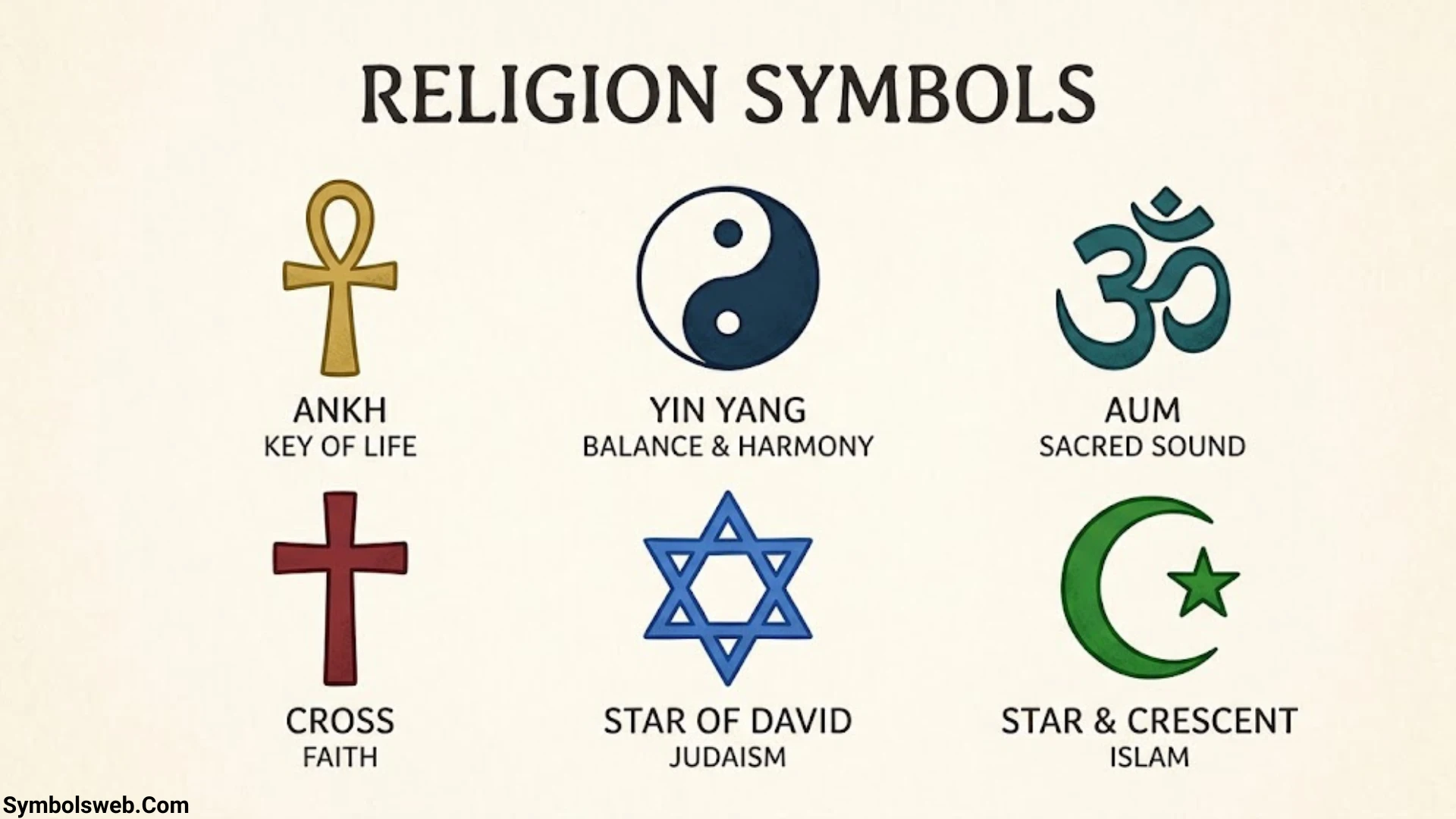
Religion symbols help people express faith, remember sacred teachings, and connect with traditions passed down through generations. From the Christian cross and Jewish Star of David to the Hindu Om and Buddhist Dharma Wheel, these symbols communicate beliefs that words alone cannot always explain. Some represent divine power, while others express peace, wisdom, protection, or spiritual awakening.
Across the world, religious symbols and their meanings reflect centuries of history, cultural exchange, sacred stories, and religious practices. You can find them carved into ancient temples, displayed in places of worship, embroidered on clothing, and carried as personal objects. Although some symbols appear in several traditions, their meanings often differ depending on the community that uses them.
Understanding religious symbols requires more than recognizing their shapes. You also need to consider their historical origins, cultural significance, and place within particular beliefs. This guide explores sacred symbols from major world religions, ancient civilizations, Indigenous traditions, and modern spiritual movements.
What Are Religious Symbols?
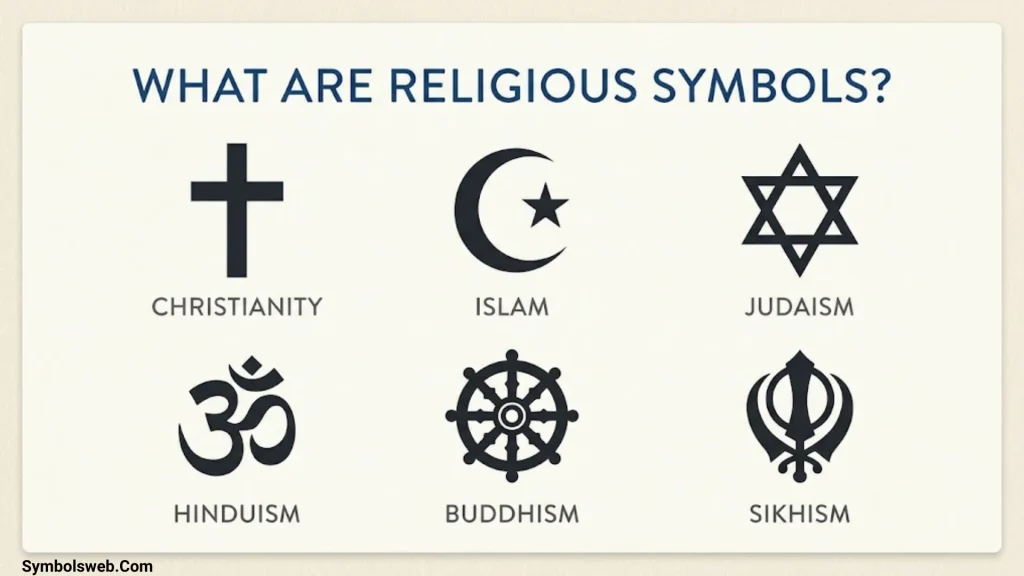
A religious symbol is an image, shape, object, sign, or visual pattern that represents a belief, sacred idea, deity, religious community, or spiritual practice. People use these symbols to communicate ideas about life, death, creation, morality, and the divine.
For example, Christians use the cross to remember Jesus Christ’s crucifixion and resurrection. Hindus use Om in prayer and meditation, while Buddhists recognize the Dharma Wheel as a representation of the Buddha’s teachings.
Religious symbols can take several forms:
- Geometric shapes: Circles, stars, spirals, crosses, and interlocking patterns.
- Sacred objects: Ritual lamps, prayer beads, ceremonial vessels, and religious staff.
- Animals and plants: The lotus flower, sacred bulls, doves, and other animals associated with religious traditions.
- Written symbols: Sacred characters, calligraphy, inscriptions, and abbreviated religious expressions.
- Architectural features: Torii gates, temple designs, and other structures that mark sacred spaces.
- Ceremonial objects: Items used during worship, festivals, initiations, and other religious observances.
The meaning of a symbol depends on its context. A circle might represent completeness in one tradition, while a particular circular design carries a specific theological meaning elsewhere.
Religious symbols also differ from ordinary decorative motifs. A pattern becomes religiously significant when a community connects it with sacred teachings, rituals, historical events, or spiritual beliefs.
Why Are Religious Symbols Important?
Religious symbols help people express complex beliefs through recognizable images and objects. They can also preserve traditions when communities pass their meanings from one generation to another.
Expressing Faith and Religious Identity
A familiar religious emblem can communicate someone’s religious affiliation without requiring an explanation. The Khanda, for example, identifies Sikh religious heritage, while the Star of David has become a widely recognized symbol of Jewish identity.
People may display these symbols on jewelry, clothing, buildings, flags, or personal belongings. Their meanings can be deeply personal as well as communal.
Representing God, Deities, and Divine Powers
Many religions use images and objects to communicate ideas about divine beings. Ancient Egyptian art often depicts deities holding the ankh, while Hindu religious art uses distinctive attributes to identify deities such as Shiva and Vishnu.
However, not every religious tradition represents the divine through images. Some communities emphasize sacred words, geometric patterns, or the limits of human attempts to depict God.
Communicating Spiritual Teachings
Symbols often make complex teachings easier to understand. The Buddhist Dharma Wheel, for instance, provides a visual connection to the Buddha’s teachings and the Noble Eightfold Path.
Similarly, the Yin-Yang symbol illustrates complementary forces within Chinese philosophical traditions. Its familiar black-and-white design communicates a relationship more easily than a lengthy explanation alone.
Supporting Worship and Religious Rituals
Religious symbols often appear during prayer, meditation, festivals, and ceremonies. A menorah has a specific place in Jewish religious history and practice, while sacred fire plays an important role in Zoroastrian worship.
Some symbols appear in homes rather than formal places of worship. Their presence can help people maintain a connection with their beliefs throughout everyday life.
Preserving Cultural Heritage
Religious symbols also carry historical memories. They connect present-day communities with ancestors, sacred places, important events, and inherited customs.
The meaning of a symbol may evolve over time. Studying its history helps distinguish its earlier uses from modern interpretations.
Religious Symbols and Their Meanings at a Glance
The following table introduces recognizable symbols from different religious traditions.
| Religious Symbol | Associated Religion or Tradition | Common Meaning or Association |
| Cross | Christianity | Crucifixion, resurrection, and salvation |
| Ichthys | Christianity | Christian identity and faith |
| Star of David | Judaism | Jewish identity and heritage |
| Menorah | Judaism | Sacred light and Jewish religious tradition |
| Star and Crescent | Some Muslim communities and historical Islamic states | Religious and cultural identity in particular contexts |
| Om | Hinduism | Sacred sound and spiritual reality |
| Dharma Wheel | Buddhism | The Buddha’s teachings and the path to liberation |
| Ahimsa Hand | Jainism | Nonviolence and the avoidance of harm |
| Khanda | Sikhism | Sikh identity and religious principles |
| Yin-Yang | Chinese philosophical and religious traditions | Complementary forces and their relationship |
| Torii | Shinto | Entrance marking a sacred area |
| Faravahar | Zoroastrian cultural and religious heritage | Spiritual ideals and ethical choice in modern interpretations |
| Ankh | Ancient Egyptian religion | Life and vitality |
| Eye of Horus | Ancient Egyptian religion | Protection and restoration |
| Nine-Pointed Star | Bahá’í Faith | Unity and the significance of nine |
| Flaming Chalice | Unitarian Universalism | Religious community and spiritual inspiration |
| Pentagram | Several religious and spiritual traditions | Meanings that vary by context |
These descriptions provide starting points rather than universal definitions. A symbol’s precise meaning can change across denominations, communities, historical periods, and individual practices.
Abrahamic Religious Symbols and Their Meanings
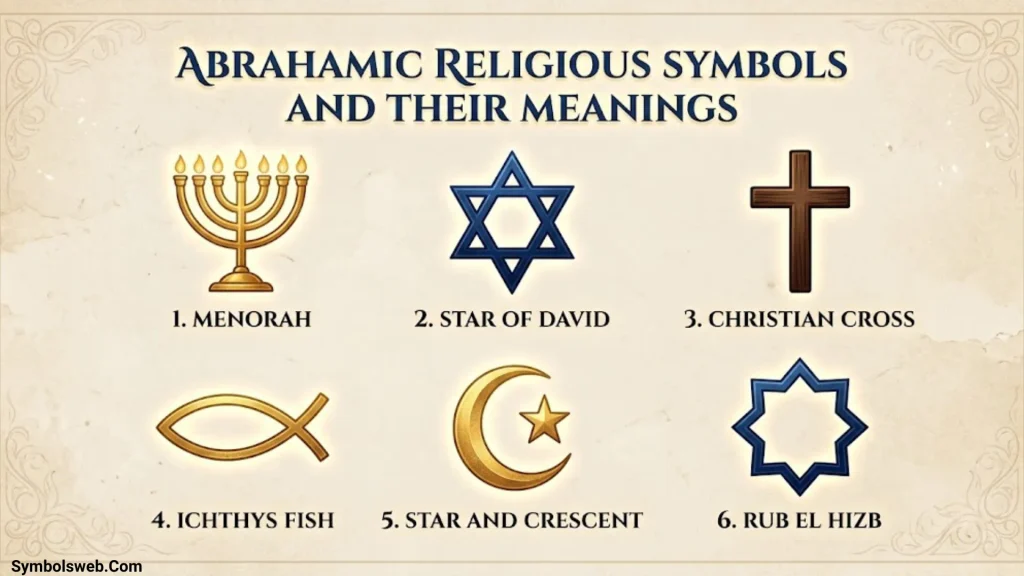
The Abrahamic religious traditions include Christianity, Islam, and Judaism. These religions share historical connections, including important figures and traditions, but they differ in theology, worship, and approaches to religious imagery.
Christian Symbols
Christian symbols express beliefs about Jesus Christ, salvation, the Bible, and the relationship between humanity and God.
The Cross
The cross is the best-known symbol of Christianity. It recalls Jesus Christ’s crucifixion and represents his death and resurrection in Christian belief.
Different Christian communities use different forms. A plain cross appears in many Protestant churches, while a crucifix includes a representation of Jesus on the cross.
The Ichthys
The Ichthys is a fish-shaped symbol associated with early Christianity. Its Greek name connects with a phrase meaning Jesus Christ, Son of God, Savior.
Today, Christians may use the fish symbol on jewelry, vehicles, and other personal items to express their faith.
Chi-Rho
Chi-Rho combines the first two Greek letters of Christos, the Greek word for Christ. Early Christians used this monogram in religious art and imperial contexts.
It remains recognizable in Christian art, manuscripts, and church decorations.
Alpha and Omega
Alpha and omega are the first and last letters of the Greek alphabet. In Christian scripture, they express God’s eternal nature and association with the beginning and the end.
The Dove
Christian art often uses the dove to represent the Holy Spirit. The image draws on biblical accounts in which a dove appears during Jesus’ baptism.
The dove can also communicate peace, although that meaning extends beyond Christianity.
The Eye of Providence
The Eye of Providence depicts an eye, sometimes surrounded by rays and enclosed within a triangle. It has appeared in Christian art and broader European symbolism.
However, it is not an exclusive emblem of Christianity. Its use in American civic imagery has also made it recognizable outside religious settings.
Islamic Symbols
Islam places central importance on the oneness of God, the Quran, prayer, and the teachings of the Prophet Muhammad. Islamic visual traditions include calligraphy, geometric designs, architectural patterns, and religious inscriptions.
Unlike Christianity’s cross, Islam has no single universally prescribed emblem that represents every Muslim community.
The Star and Crescent
The star and crescent is associated with some Muslim communities and historical Islamic states. Its use became particularly prominent through Ottoman flags and related cultural imagery.
However, the symbol does not originate as a universal Islamic religious requirement. Many Muslims and Muslim-majority countries do not use it as their primary emblem.
Rub el Hizb
Rub el Hizb is an eight-pointed geometric symbol formed from two overlapping squares. It appears in Islamic design and Quranic manuscripts, where it can help organize sections of text.
Its use illustrates how geometric forms can serve practical and artistic purposes within religious traditions.
Islamic Calligraphy
Arabic calligraphy holds an important place in Islamic art. Artists use carefully shaped letters to present Quranic passages, religious expressions, and other texts.
Calligraphy can decorate mosques, manuscripts, ceramics, and architectural surfaces. Its significance comes from the written message as well as the skill involved in its presentation.
Islamic Geometric Patterns
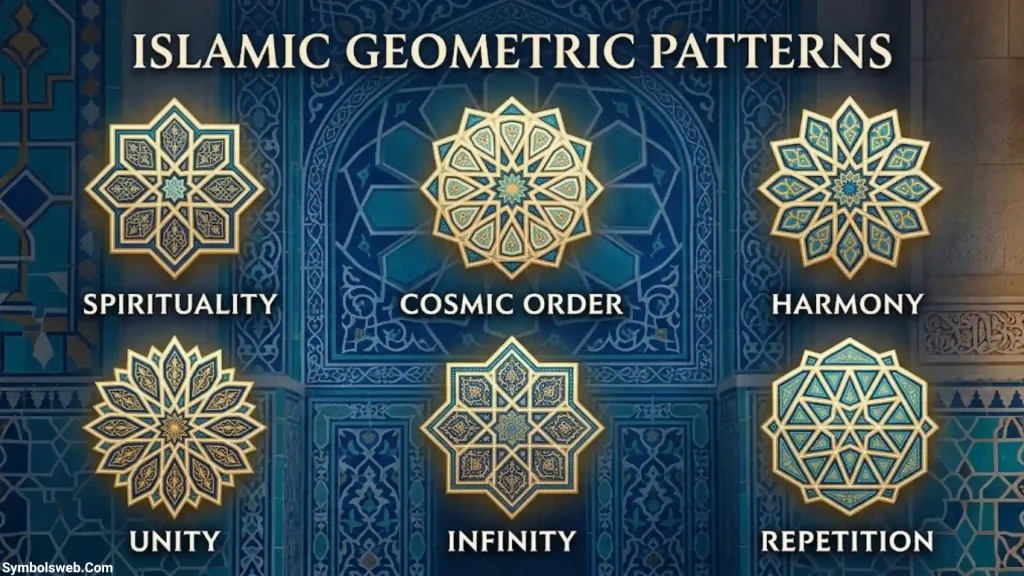
Many Islamic artistic traditions feature repeating stars, polygons, and interlocking shapes. These patterns can create intricate designs across large surfaces.
Their use reflects sophisticated artistic and mathematical traditions. Interpretations vary, so it is better not to assign one fixed spiritual meaning to every geometric pattern.
The Hamsa Hand
The Hamsa is a hand-shaped protective motif found in several Middle Eastern and Mediterranean cultures. Some Muslim communities associate it with protection, and some Jewish communities use it as well.
Its use crosses religious boundaries. Therefore, it should not be described as exclusively Islamic.
Jewish Symbols
Jewish symbols connect religious observance, sacred history, communal identity, and cultural heritage.
The Star of David
The Star of David consists of two overlapping triangles that form a six-pointed star. It is widely recognized as a symbol of Jewish identity.
Its association with Judaism developed over time. Today, it appears on synagogues, Jewish ceremonial objects, and the flag of Israel.
The Menorah
The seven-branched menorah is an ancient Jewish ritual lamp associated with the Tabernacle and the Jerusalem Temple.
A nine-branched Hanukkah lamp, commonly called a hanukkiah, is a different object used during the eight-day festival of Hanukkah. It holds eight lights for the festival nights and an additional light called the shamash.
Chai
Chai is the Hebrew word for life. The two-letter Hebrew form is commonly worn as jewelry or included in Jewish decorative art.
The symbol expresses the importance of life within Jewish culture and tradition.
The Shofar
A shofar is a horn traditionally made from a ram’s horn or another suitable animal horn. Jewish communities sound it during particular religious occasions, especially Rosh Hashanah and at the conclusion of Yom Kippur.
Its role comes from religious practice rather than decoration alone.
The Lion of Judah
The Lion of Judah draws on biblical imagery associated with the league of Judah. It also appears in Jewish history and other cultural and religious contexts.
Its meaning depends on the particular setting in which it appears.
What Do Abrahamic Religious Symbols Have in Common?
Christianity, Islam, and Judaism share important historical roots, yet their religious symbols are not interchangeable.
- All three traditions use sacred texts and ritual practices.
- Religious art and architecture play different roles across communities.
- Jewish and Christian traditions include several prominent historical visual symbols.
- Islamic art often emphasizes calligraphy and geometric patterns, although practices vary widely.
- The use of images of God and religious figures differs among denominations and schools of thought.
Understanding these differences helps prevent inaccurate assumptions about religious beliefs.
Dharmic Religious Symbols and Their Meanings
Dharmic religions originated in South Asia. Hinduism, Buddhism, Jainism, and Sikhism have distinct teachings, although they share historical and cultural connections.
Hindu Symbols
Hindu symbols express ideas about divine beings, sacred sound, spiritual discipline, creation, and the nature of existence.
Om (Aum)
Om is a sacred sound and written symbol used in many Hindu traditions. It appears in prayers, mantras, meditation, and religious texts.
Its interpretation varies among philosophical schools. Many traditions associate it with ultimate reality and the connection between sound and spiritual understanding.
The Swastika
The swastika is an ancient symbol associated with auspiciousness in Hinduism. It also appears in Jainism and Buddhism, with meanings that vary by tradition.
Nazi Germany appropriated and transformed the symbol into an emblem of racist ideology. That history makes context especially important when interpreting its appearance.
In Hindu religious settings, the swastika can appear during festivals, ceremonies, and the decoration of homes or sacred spaces.
The Lotus Flower
The lotus grows from muddy water and opens above the surface. Hindu traditions associate it with purity, beauty, spiritual growth, and particular deities.
Lotus imagery appears in religious art, temple sculpture, and depictions of divine figures.
The Shankha
The shankha is a conch shell used in Hindu worship. It is especially associated with Vishnu, who is often depicted holding one.
The conch may be sounded during religious ceremonies. Its sound marks ritual moments and calls attention to worship.
The Sri Yantra
The Sri Yantra is a sacred geometric diagram used in particular Hindu traditions, especially those connected with Sri Vidya.
Its interlocking triangles form a complex pattern used in meditation and ritual. The diagram carries specific theological meanings within the traditions that practice it.
The Trishula
The trishula is a three-pronged trident strongly associated with Shiva. It appears in religious art and devotional imagery.
Its meaning depends on the theological and artistic context rather than one universal interpretation.
Buddhist Symbols
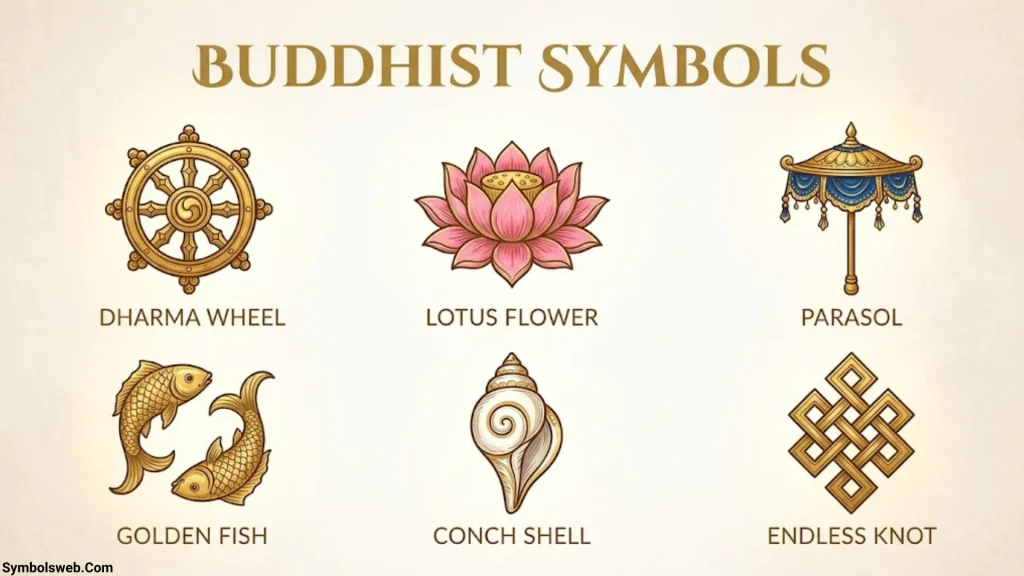
Buddhist symbols often express the Buddha’s teachings, ethical discipline, wisdom, compassion, and the path toward liberation.
The Dharma Wheel
The Dharma Wheel represents the Buddha’s teachings, known as the Dharma. Its eight spokes are commonly associated with the Noble Eightfold Path.
That path includes right understanding, intention, speech, action, livelihood, effort, mindfulness, and concentration.
The Lotus Flower
The lotus is a prominent symbol in Buddhist art. Its growth from muddy water offers a familiar image for spiritual development and awakening.
Different Buddhist traditions interpret lotus colors and forms in different ways.
The Bodhi Tree
The Bodhi Tree is the tree under which Siddhartha Gautama attained enlightenment according to Buddhist tradition. It is associated with awakening and the Buddha’s path to understanding.
The original tree’s religious importance helped establish the tree as a major Buddhist symbol.
The Three Jewels
The Three Jewels are the Buddha, the Dharma, and the Sangha. They represent the teacher, the teachings, and the community that follows them.
Buddhists often express commitment to these three foundations through the practice of taking refuge.
The Endless Knot
The Endless Knot appears among the Eight Auspicious Symbols in Tibetan Buddhist traditions. It is commonly associated with interdependence and the interconnected nature of existence.
Its interwoven design provides a visual expression of relationships without an obvious beginning or end.
Buddha’s Footprints
Buddha’s footprints appear in early Buddhist art and religious settings. They provide a way to represent the Buddha without depicting his full human form.
Their presence also reflects historical changes in Buddhist artistic traditions.
Jain Symbols
Jainism emphasizes nonviolence, truth, self-discipline, and liberation from the cycle of rebirth.
The Ahimsa Hand
The Ahimsa Hand shows an open palm, often with a wheel at its center. It communicates nonviolence and the commitment to avoid harm.
Ahimsa extends beyond physical actions. It also concerns harmful speech, intentions, and thoughts.
The Jain Swastika
In Jain symbolism, the swastika is associated with the four possible destinations of rebirth within Jain cosmology. These are commonly described as heavenly beings, human beings, animals or other earthly life forms, and hellish beings.
The symbol appears in Jain religious settings alongside other important signs.
The Jain Emblem
The modern Jain emblem combines several elements that express Jain teachings. These include the swastika, the Ahimsa Hand, and a representation of the universe.
The emblem communicates nonviolence and the goal of spiritual liberation.
Nandavarta
Nandavarta is an auspicious geometric symbol found in Jain and related Indian traditions. Its intricate form connects with traditional religious and ceremonial design.
Its precise interpretation depends on the context in which it appears.
Sikh Symbols
Sikh symbols express the oneness of God, devotion, service, equality, and commitment to religious principles.
The Khanda
The Khanda is a major emblem of Sikhism. Its design includes a double-edged sword, a circular chakkar, and two curved swords.
The elements are associated with Sikh religious principles and the relationship between spiritual commitment and responsibility in the world.
Ik Onkar
Ik Onkar expresses the Sikh teaching that God is one. It appears at the beginning of the doyen Granth Sahib, the central Sikh scripture.
The symbol represents divine unity and the presence of the Creator.
The Nishan Sahib
The Nishan Sahib is the Sikh flag displayed outside gurdwaras. It identifies a Sikh place of worship and serves as a visible sign of the community.
Its presence welcomes people to the gurdwara, where worshippers gather for prayer, scripture readings, and community service.
The Kara
The kara is a steel or iron bracelet worn by initiated Sikhs and many other Sikhs. It is one of the Five Ks associated with the Khalsa.
Its circular shape has inspired interpretations related to continuity and commitment, while its religious meaning comes from Sikh practice.
Shared Features of Dharmic Religious Symbols
Some symbols appear in more than one Dharmic tradition, but shared appearance does not always mean shared meaning.
| Symbol or Concept | Traditions | Important Distinction |
| Swastika | Hinduism, Buddhism, Jainism | Meanings differ among traditions |
| Lotus | Hinduism, Buddhism, Jainism | Associated interpretations vary |
| Dharma | Hinduism, Buddhism, Jainism, Sikhism in different contexts | The term does not mean exactly the same thing in every tradition |
| Wheel | Buddhism, Jainism, Hindu traditions | Specific teachings and meanings depend on context |
| Sacred sound | Hinduism and other Indian traditions | The meaning and use depend on the particular practice |
Middle Eastern and West Asian Religious Symbols
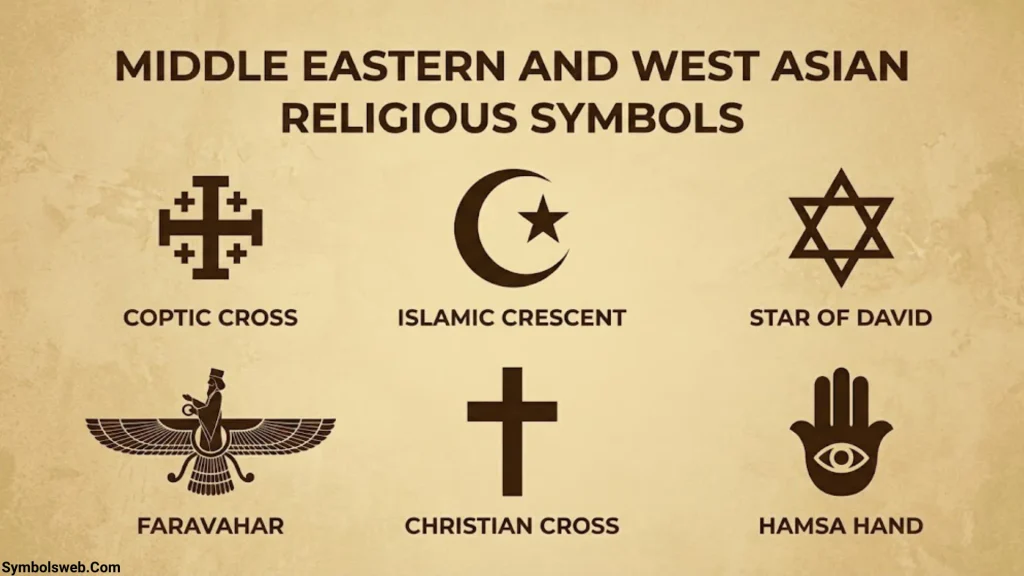
The Middle East and neighboring regions have produced religious traditions with distinctive symbols, sacred objects, and artistic practices.
Bahá’í Symbols
The Bahá’í Faith emphasizes the unity of God, religion, and humanity. Its symbols reflect these teachings.
The Nine-Pointed Star
The nine-pointed star is widely used as a symbol of the Bahá’í Faith. The number nine is associated with completeness and unity in Bahá’í symbolism.
The star appears in publications, community settings, and decorative designs.
The Ringstone Symbol
The Ringstone Symbol includes stylized lines and shapes arranged around a central vertical form. Bahá’ís use it in jewelry and other personal items.
Its design is associated with the relationship between God, the Manifestations of God, and humanity.
Zoroastrian Symbols
Zoroastrianism is an ancient Iranian religion associated with the teachings of Zarathustra, also known as Zoroaster.
The Faravahar
The Faravahar depicts a winged figure and is widely used as a symbol of Zoroastrian heritage. In modern Iranian culture, it also appears as a broader marker of Persian identity.
Its precise ancient interpretation remains debated. Modern explanations often connect it with ethical choice and spiritual ideals, but these explanations should not automatically be treated as settled ancient doctrine.
Sacred Fire
Fire has a central role in Zoroastrian worship. It represents purity and serves as a focus of religious ritual.
Zoroastrians do not simply worship fire as a god. Instead, sacred fire holds a distinctive place within their religious practices.
Druze Symbols
Druze religious tradition has distinctive teachings and community practices. Its symbolic meanings should be explained within that specific context.
The five-pointed Druze star uses five colors traditionally associated with important religious principles. Explanations of those colors vary in detail, so they should be presented with care rather than reduced to generic spiritual meanings.
Yazidi Symbols
The Yazidi religion has distinctive traditions connected with sacred history, pilgrimage, and the divine.
Roj, meaning sun in Kurdish, is associated with solar imagery in Yazidi cultural and religious contexts. The sun also appears in religious practices and decorative designs.
Yazidi beliefs and symbols should be discussed using sources that reflect Yazidi traditions rather than relying on outside assumptions.
East Asian Religious and Philosophical Symbols
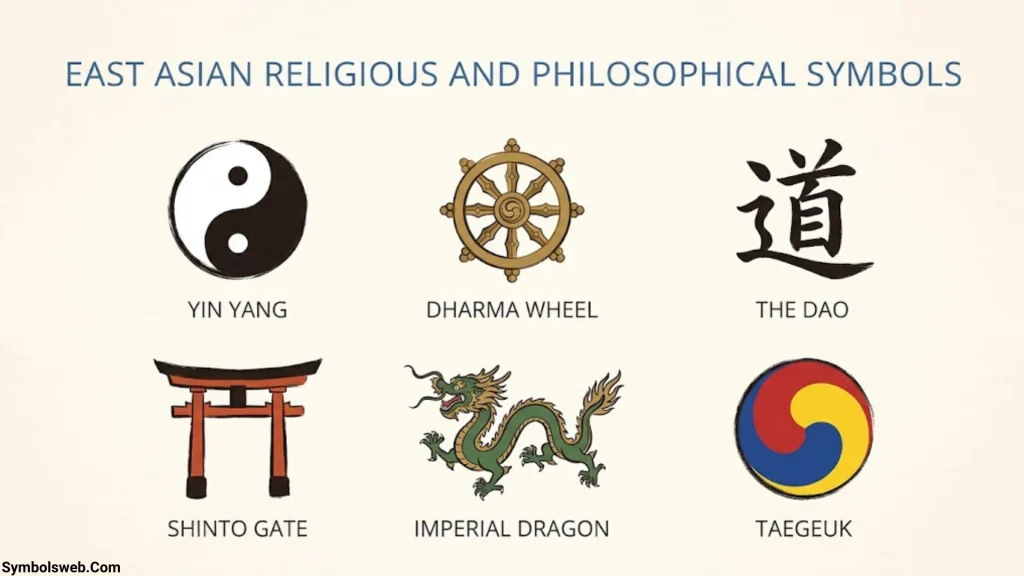
East Asian religious symbolism includes Chinese cosmological diagrams, Japanese sacred architecture, and visual motifs used in Korean traditions.
Taoist Symbols
Taoism includes religious practices and philosophical traditions associated with the Tao, often understood as the Way.
Yin-Yang (Taijitu)
The familiar Yin-Yang symbol consists of interlocking black and white shapes, each containing a dot of the opposite color.
It illustrates the relationship between complementary forces. Rather than representing a simple battle between good and evil, it emphasizes how contrasting qualities can depend on and transform into one another.
Bagua
The Bagua consists of eight trigrams formed from combinations of broken and unbroken lines. These trigrams appear in Chinese cosmological traditions and are associated with different natural and symbolic patterns.
The Bagua also plays a role in traditional divination and feng shui.
Wuji
Wuji is a concept in Chinese philosophy associated with an undifferentiated or limitless state. It is often discussed in relation to Taiji and the development of differentiated forces.
Its meaning is philosophical and cosmological rather than simply decorative.
Confucian Symbols
Confucianism emphasizes ethical conduct, education, social responsibility, respect, and ritual.
Unlike religions with a widely recognized emblem, Confucian traditions do not have one universally accepted symbol.
Portraits of Confucius, ceremonial vessels, written characters, and ritual objects appear in Confucian temples and ceremonies. Their importance comes from their connection with learning, moral cultivation, ancestral practices, and social traditions.
Shinto Symbols
Shinto is a Japanese religious tradition centered on kami, which may be understood as sacred presences associated with natural features, places, and other aspects of existence.
The Torii Gate
A torii marks the entrance to a Shinto shrine or another sacred area. Passing through it can represent entering a place associated with kami.
Torii gates vary in material, shape, and design. Their recognizable form makes them one of the most familiar symbols of Japanese religious architecture.
Shimenawa
A shimenawa is a sacred rope used to mark particular places, objects, or spaces associated with religious significance.
Paper streamers called shide may hang from the rope. Together, these elements help identify sacred boundaries in Shinto settings.
Tomoe
Tomoe is a swirling motif found in Japanese art and heraldry. It has several forms and historical uses, including associations with shrines and traditional Japanese imagery.
Its interpretation depends on the specific design and setting.
Korean Religious Symbolism
The Taegeuk is a circular design associated with complementary forces in Korean culture. It appears on South Korea’s national flag, where the red and blue sections represent a relationship between contrasting yet connected forces.
The three-part Samtaegeuk appears in certain Korean traditional and decorative contexts. Its meaning depends on the specific cultural tradition in which it is used.
Korean religious life has also been shaped by Buddhism, Confucianism, Christianity, shamanic traditions, and other influences.
Ancient Egyptian Religious Symbols and Their Meanings
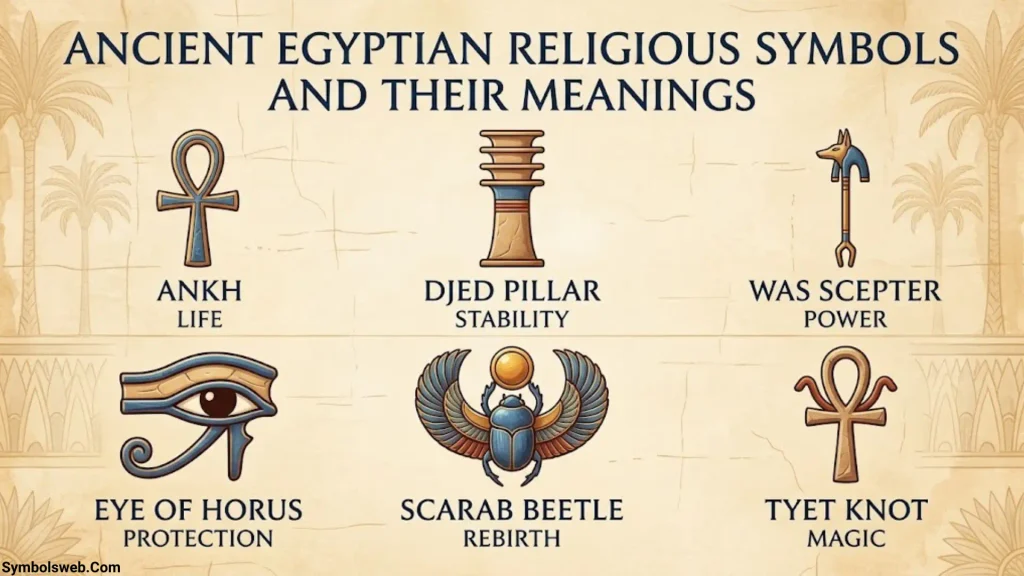
Ancient Egyptian religion used a rich visual language in temples, tombs, sculptures, jewelry, and funerary objects. Many symbols connected divine power with life, protection, stability, and the afterlife.
The Ankh
The ankh is a cross-shaped symbol with a loop at the top. It represents life and vitality in ancient Egyptian art.
Egyptian deities often appear holding the ankh or presenting it to a ruler. The symbol also appears on amulets and funerary objects.
The Eye of Horus
The Eye of Horus is associated with protection, restoration, and well-being. Its meaning connects with the myth of Horus and the restoration of his injured eye.
Ancient Egyptians used the symbol in jewelry, amulets, and funerary settings. It became one of the most recognizable symbols of ancient Egyptian religion.
The Eye of Ra
The Eye of Ra represents the power of the sun god Ra and can express divine protection or destructive force, depending on the myth.
Although the Eye of Ra and Eye of Horus look similar, they have distinct mythological associations. Treating them as interchangeable loses important historical detail.
The Djed Pillar
The Djed pillar symbolizes stability and is closely associated with Osiris. Its distinctive stacked form appears in temple reliefs, amulets, and other religious objects.
Egyptian ritual imagery sometimes depicts the raising of the Djed as an expression of renewed stability.
The Tyet
The Tyet, often called the Knot of Isis, is a protective symbol associated with the goddess Isis.
It appears on amulets and funerary objects. Its association with Isis connects it with protection and the preservation of the deceased.
The Scarab Beetle
The scarab beetle became a powerful symbol in ancient Egyptian religion. Its association with the sun’s movement connected it with renewal, transformation, and regeneration.
Scarab-shaped amulets and seals were common in ancient Egyptian material culture.
The Was Scepter
The Was scepter is a staff with a distinctive animal-like head and a forked base. It appears in depictions of gods and kings.
The object represents power and authority in ancient Egyptian visual traditions.
Other Important Egyptian Symbols
Other symbols include the uraeus, a rearing cobra associated with royal protection; the shen ring, associated with protection and eternity; and the Benben Stone, connected with creation traditions.
The concepts of ka and ba also played important roles in Egyptian understandings of the person and the afterlife. However, these are religious concepts rather than simple standalone emblems.
Ancient Greek, Roman, and Mediterranean Religious Symbols
Ancient Greek and Roman religions used recognizable objects and animals to identify deities, communicate divine attributes, and mark religious events.
Greek Religious Symbols
The Thunderbolt
The thunderbolt is associated with Zeus, the Greek god who ruled the sky and wielded thunder and lightning.
Artists used the object to identify Zeus and express his divine authority.
The Trident
The trident is associated with Poseidon, the Greek god of the sea. It appears in sculpture, pottery, and other representations of the deity.
The Caduceus
The caduceus is a staff entwined with two snakes and often topped with wings. It is associated with Hermes, the messenger god.
It is frequently confused with the Rod of Asclepius, a staff with one snake associated with medicine and healing. The two have different historical meanings.
The Gorgoneion
The Gorgoneion is an image of a Gorgon’s face, especially Medusa. Ancient Greek communities used such images in art and architecture, sometimes with protective intent.
Roman Religious Symbols
Roman religious imagery often connected divine figures with civic life, military authority, and public ceremonies.
- Eagle: Associated with Jupiter and Roman military imagery.
- Laurel wreath: Associated with victory, honor, and public achievement.
- Cornucopia: A horn-shaped object representing abundance and prosperity.
- Lituus: A curved staff used by Roman augurs during religious observation and divination.
These objects sometimes carried political meanings alongside their religious associations.
Phoenician and Carthaginian Symbols
The Sign of Tanit is a distinctive symbol associated with the Punic goddess Tanit and ancient Carthaginian religious contexts.
Its geometric form appears on stelae and other archaeological objects. Scholars study these objects to understand religious practices in the western Mediterranean.
Crescent shapes, discs, and other celestial motifs also appear in ancient Mediterranean settings. Their meanings depend on the artifact’s date, location, and cultural context.
Ancient Mesopotamian Symbols
Mesopotamian civilizations developed complex systems of religious imagery and writing.
The cuneiform sign Dingir was used in connection with divinity and could function as a determinative before the names of gods.
The horned crown appears in Mesopotamian art as a visual indicator of divine status. The star of Ishtar connects with the goddess’s associations with Venus.
These examples show how religious symbols could work through images, written signs, and objects.
Norse, Germanic, and Celtic Religious Symbols
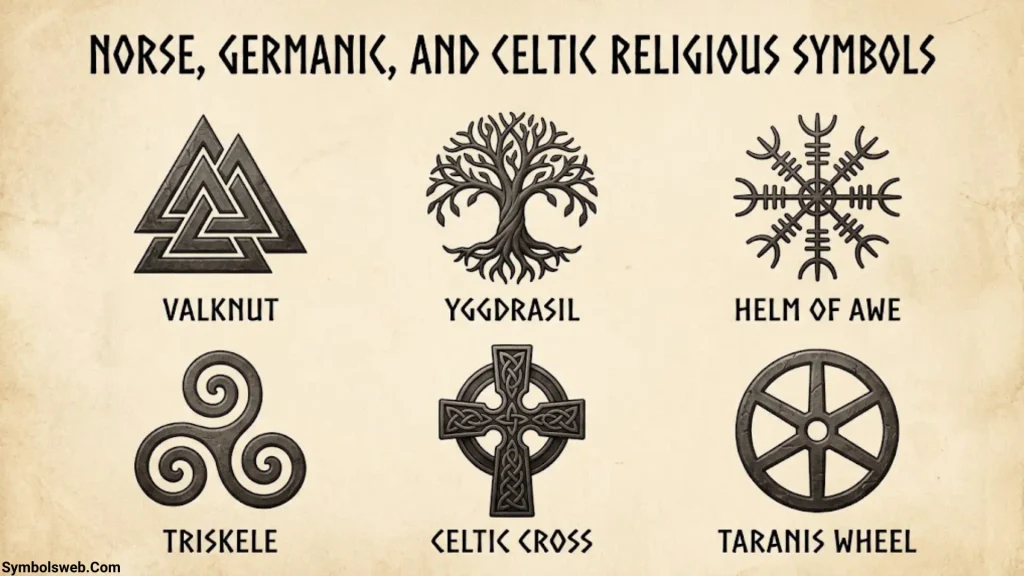
Northern European religious traditions include symbols connected with gods, cosmology, sacred landscapes, and later cultural identities. Modern interpretations sometimes go beyond what historical evidence can establish.
Norse Religious Symbols
Mjölnir
Mjölnir is Thor’s hammer in Norse mythology. It represents the god’s power and appears in archaeological finds, including pendants worn during the Viking Age.
Today, some people wear Mjölnir as an expression of modern Heathen religious identity or interest in Norse heritage.
Yggdrasil
Yggdrasil is the world tree in Norse cosmology. It connects different parts of the cosmos and appears in stories involving gods, humans, and other beings.
The tree represents a structure of relationships within the mythological universe.
Valknut
The Valknut is a design formed from three interlocking triangles. It appears on some archaeological objects associated with Norse culture.
Its precise historical meaning remains uncertain. Connections with Odin, death, and warriors appear in modern interpretations, but the evidence does not establish one definitive meaning.
Runes
Runes were characters used in historical Germanic writing systems. They appear in inscriptions on stone, wood, metal, and other materials.
Modern spiritual movements sometimes assign divinatory or magical meanings to individual runes. Those practices should be distinguished from the historical use of runes as writing.
Celtic Religious Symbols
The Celtic Cross
The Celtic cross combines a cross with a surrounding ring. It appears in historic Christian monuments, particularly in Ireland and parts of Britain.
Although modern explanations sometimes connect it with pre-Christian solar symbolism, the meaning of individual monuments requires historical evidence.
The Triquetra
The triquetra is a three-part interlaced motif. It appears in medieval Christian art and other historical and modern contexts.
Some Christians interpret it through the Trinity, while contemporary spiritual uses may assign other meanings.
The Triskelion
The triskelion consists of three connected spirals or bent forms radiating from a center. It appears in ancient Mediterranean and European art, including material associated with the island of Sicily and the Neolithic monument of Newgrange.
Its meaning varies across historical settings.
Brigid’s Cross
Brigid’s Cross is traditionally made from plant material woven into a distinctive cross shape. In Irish tradition, people associate it with Saint Brigid and household protection.
It remains a recognizable part of Irish cultural practice.
African Religious Symbols and Their Meanings
African religious traditions are diverse. Their symbols can communicate ideas about divine power, ancestry, ethical conduct, life cycles, and the relationship between physical and spiritual worlds.
Akan and Adinkra Symbols
Adinkra symbols developed among Akan-speaking communities, particularly in Ghana. They appear on textiles, artwork, and other cultural objects.
Many symbols communicate proverbs or ethical ideas.
Gye Nyame
Gye Nyame is widely interpreted as expressing the supremacy or uniqueness of God. Its name and associated proverb reflect Akan religious ideas about divine power.
Asase Ye Duru
Asase Ye Duru is associated with the Earth and its importance. It reflects the relationship between people, the natural world, and traditional Akan beliefs.
Nyame Dua
Nyame Dua is associated with God and traditional ritual settings. The symbol is linked to a sacred tree or wooden structure used in certain Akan practices.
Adinkra symbols are not merely decorative designs. Their meanings connect with language, community values, history, and cultural expression.
Kongo Religious Symbols
The Dikenga Cosmogram is associated with Bakongo understandings of the relationship between life, death, and spiritual existence.
Its circular form can represent movement through different stages of existence. Interpretations vary, and the symbol should be understood within Kongo cultural and religious contexts.
The concept of Kalûnga also appears in discussions of Kongo cosmology. It can describe a boundary or passage separating aspects of existence, although specific explanations vary among sources and communities.
Yoruba Religious Symbols
Yoruba religious traditions include the worship of orishas, divination practices, sacred objects, and ceremonial arts.
Rather than relying on one universal emblem, these traditions use different objects and visual forms associated with particular deities and practices.
For example, ritual objects associated with an orisha may communicate that deity’s attributes, stories, or role within religious life. Their meaning depends on the specific tradition and ceremony.
Serer Religious Symbols
The Yoonir, a star-shaped symbol associated with Serer traditions in Senegal, has connections with religious cosmology and cultural identity.
Serer religious tradition recognizes Roog as the supreme deity. Celestial imagery and traditional cosmological ideas form part of the wider context in which such symbols are understood.
Native American and Mesoamerican Religious Symbols
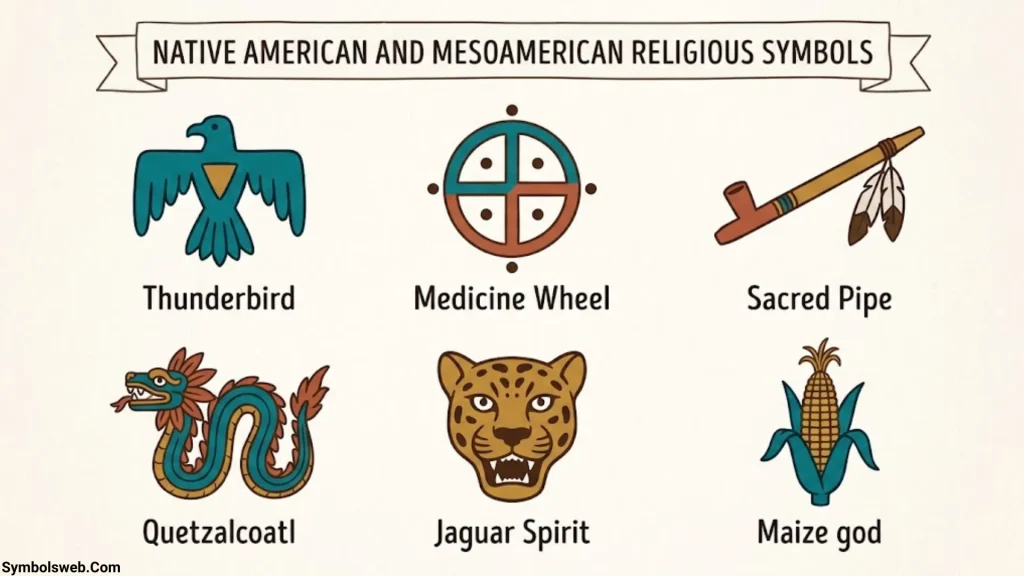
Indigenous religious traditions across the Americas are diverse. Symbols can carry meanings specific to individual nations, communities, languages, and ceremonial practices.
Native American Religious Symbols
There is no single symbol system shared by all Native American nations.
The Medicine Wheel
The term medicine wheel describes several circular designs and teachings found in particular Indigenous contexts. Some interpretations connect directions, seasons, colors, or stages of life.
However, meanings differ between nations and communities. A single explanation should not be applied to every Indigenous tradition.
Sacred Pipe
The sacred pipe holds ceremonial importance in certain Native American traditions. Its use and meaning depend on the community and specific religious practice.
It should not be treated as a generic object representing all Indigenous religions.
Animal Imagery
Animals appear in stories, artwork, and ceremonial traditions across Indigenous cultures. Their meanings depend on local teachings and relationships with the natural world.
A bear, eagle, turtle, or wolf may carry different meanings in different communities.
Maya Religious Symbols
Maya civilization developed sophisticated systems of writing, mathematics, astronomy, and calendrical timekeeping. Its religious symbols appear in inscriptions, architecture, pottery, and sculpture.
The Maya Calendar
Maya calendrical systems organized ritual and historical time. The Tzolk’in, a 260-day cycle, combined 20 day signs with 13 numbers.
The Haab’ was a 365-day calendar consisting of 18 periods of 20 days and an additional five-day period. These systems worked together within a broader calendar tradition.
K’awiil
K’awiil is a Maya deity associated with lightning, royal power, and other divine attributes. Artistic representations use distinctive visual features to identify the deity.
The World Tree
The world tree appears in Maya cosmological imagery and connects different regions of the universe. Its interpretation depends on particular inscriptions, artworks, and historical contexts.
Aztec Religious Symbols
Aztec religious imagery connected deities, calendrical systems, warfare, agriculture, and cosmic order.
The Sun Stone
The Aztec Sun Stone is a monumental carved object featuring calendrical and cosmological imagery. It is often called the Aztec Calendar Stone, although it is not simply a calendar used like a modern wall calendar.
Its central imagery and surrounding signs reflect important aspects of Mexica religious and political culture.
The Feathered Serpent
Quetzalcoatl, the Feathered Serpent, was an important deity in several Mesoamerican traditions. Related figures and interpretations appeared across different societies and periods.
Inca Religious Symbols
Inca religion included worship associated with celestial bodies, sacred landscapes, and ancestral traditions.
Inti
Inti was the Inca sun deity and held a central place in imperial religious life. The sun also connected with the authority of the Inca ruler.
Chakana
The Chakana is a stepped cross motif associated with Andean cultural traditions. Modern interpretations often connect it with cosmology and the organization of the universe.
However, individual claims about its ancient meaning should be supported by historical evidence.
Sacred Mountains
In Andean traditions, mountains can be associated with powerful sacred beings known as apus in certain regional contexts. These relationships remain important in some contemporary Andean communities.
Indigenous Oceanic and Polynesian Religious Symbols
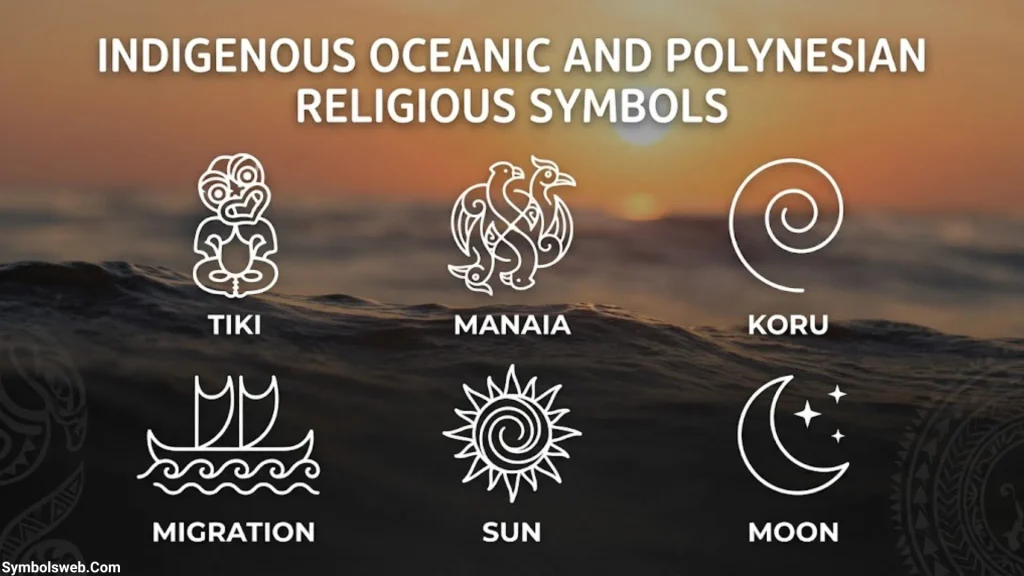
Oceanic cultures developed distinctive traditions connected with ancestors, the sea, land, spiritual relationships, and community identity.
Māori Symbols
Māori art includes carved forms, woven designs, and motifs that communicate cultural and historical meanings.
Koru
The koru resembles an unfurling fern frond. In contemporary Māori art, it is often associated with new growth and renewal.
Its use connects with the natural world and distinctive Māori artistic traditions.
Manaia
Manaia is a figure found in Māori carving and other forms of art. Its appearance and interpretation vary by artistic context.
Pikorua
Pikorua is a twist motif widely used in contemporary Māori jewelry and artwork. Modern interpretations often associate it with relationships and interconnected paths.
These interpretations should be understood alongside the cultural context of the particular artwork.
Polynesian Religious and Cultural Symbols
Polynesia includes many distinct societies and languages. Its artistic traditions cannot be reduced to a single system of religious symbols.
Carved figures, ancestor imagery, ocean motifs, and ceremonial objects can carry spiritual significance in particular communities.
For example, the meaning of a tiki figure depends on its cultural origin, material, and use. Similar-looking figures from different islands do not necessarily represent the same beliefs.
Indigenous Religious Symbols in Papua New Guinea
Papua New Guinea contains hundreds of distinct cultural and linguistic communities. Their traditions include masks, carved figures, ceremonial objects, and ancestral imagery.
A mask used during a particular ceremony may have a meaning tied to the community’s history and religious practice. Accurate interpretation requires identifying the specific culture rather than assigning a generalized meaning.
Modern Religious and Spiritual Symbols
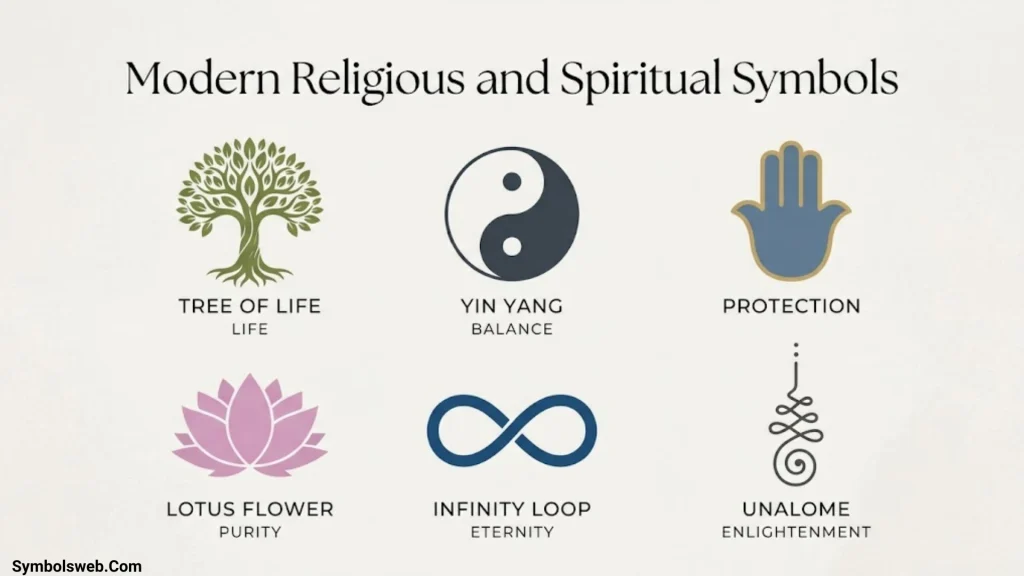
Modern religious movements have developed distinctive symbols, while older symbols continue to appear in contemporary spiritual practice.
Rastafari Symbols
Rastafari developed in Jamaica during the twentieth century. Its religious and cultural beliefs include important connections with Africa, Ethiopia, and biblical traditions.
The Lion of Judah
The Lion of Judah has biblical associations with the league of Judah. It became particularly important in Rastafari through its connection with Ethiopia and Emperor Haile Selassie.
Ethiopian Colors
The green, yellow, and red colors associated with Ethiopia appear prominently in Rastafari cultural expression. They can communicate African identity, heritage, and solidarity.
Unitarian Universalist Symbols
The Flaming Chalice
The flaming chalice is a widely recognized symbol of Unitarian Universalism. Its history includes the work of the Unitarian Service Committee during World War II.
The design combines a chalice with a flame. It is commonly associated with spiritual openness, community, and the search for truth.
Wiccan and Contemporary Pagan Symbols
Wicca is a modern Pagan religion with varied traditions and practices.
The Pentagram
A pentagram is a five-pointed star drawn with connected lines. In Wicca and other modern Pagan traditions, it may represent the elements and spirit.
Its meaning is not universal. Other traditions have used the same shape for different purposes.
The Triple Moon
The Triple Moon symbol typically shows a waxing crescent, full moon, and waning crescent. In some contemporary Pagan traditions, it represents aspects of the Goddess or cycles of life.
Its familiar modern meaning should not automatically be projected onto every ancient lunar image.
The Wheel of the Year
The Wheel of the Year represents eight seasonal festivals observed in many Wiccan traditions. These celebrations include solstices, equinoxes, and additional seasonal festivals.
Practices vary, and not every Pagan religion follows the same calendar.
Satanic Symbols
Satanism includes different movements with distinct beliefs. Some use Satan as a religious figure, while others interpret Satan symbolically.
The Sigil of Baphomet
The Sigil of Baphomet is a prominent emblem associated with the Church of Satan. It features an inverted pentagram containing a goat’s head and surrounding lettering.
Its modern organizational history matters when explaining its meaning.
The Sigil of Lucifer
The Sigil of Lucifer appears in certain modern occult traditions. Its meaning depends on the group or individual using it.
The Inverted Cross
The inverted cross has Christian historical associations with Saint Peter in some traditions. It has also appeared in modern art, horror, and anti-Christian imagery.
Therefore, its appearance does not automatically identify someone’s beliefs.
Deist and Pantheist Symbolism
Deism generally emphasizes belief in a creator who can be understood through reason and observation of the natural world. Pantheism identifies divinity with the universe or understands the universe itself as divine.
Neither tradition has one universally recognized symbol.
Some individuals use nature imagery, celestial objects, or geometric designs to express their beliefs. These personal choices should not be confused with officially established religious emblems.
Religious Symbols That Represent Common Spiritual Ideas
Some religious symbols appear to share broad themes, such as life, protection, or renewal. However, each tradition explains those themes through its own teachings and history.
Symbols of Life and Creation
The ankh represents life in ancient Egyptian religion. The lotus flower communicates spiritual development in Hindu and Buddhist contexts.
Sacred trees also appear in many religious traditions. Their meanings may involve creation, ancestry, sacred landscapes, or relationships between different parts of the cosmos.
Symbols of Death, Rebirth, and the Afterlife
Ancient Egyptian scarab imagery connects with renewal and regeneration. Christian crosses point toward Jesus’ crucifixion and resurrection.
Other traditions use funerary objects, sacred texts, or ritual practices to express beliefs about death and the afterlife.
These symbols do not all express the same understanding of what happens after death.
Symbols of Protection
Protection appears in many religious traditions, but its expression varies.
Examples include:
- Eye of Horus: Protection and restoration in ancient Egyptian religion.
- Hamsa: A hand-shaped motif used in several Middle Eastern and Mediterranean communities.
- Mjölnir: Thor’s hammer, which had religious and cultural significance in Norse contexts.
- Protective amulets: Objects used in particular traditions to express or seek protection.
The meaning of a protective object depends on its religious and cultural setting.
Symbols of Peace and Harmony
The dove is associated with peace in Christian imagery and broader cultural traditions.
The Yin-Yang symbol expresses relationships between complementary forces in Chinese philosophy. It does not simply represent peace, although balance and harmony may feature in related interpretations.
Jain Ahimsa offers another important example. It emphasizes nonviolence and the avoidance of harm toward living beings.
Symbols of Wisdom and Enlightenment
The Bodhi Tree represents the Buddha’s enlightenment. The Dharma Wheel connects with Buddhist teachings and the path toward liberation.
In Hindu traditions, Om appears in practices involving meditation, sacred sound, and spiritual understanding.
Each symbol expresses wisdom or spiritual insight through its own religious framework.
Symbols of Eternity and Interconnection
The Endless Knot is associated with interdependence in Tibetan Buddhist traditions.
The Ouroboros, a serpent or dragon eating its own tail, appears in several historical traditions. It has been associated with cycles, continuity, and renewal in different contexts.
The symbol’s meaning changes across historical settings, so it should not be assigned one universal definition.
Symbols of Fertility and Prosperity
The cornucopia appears in Greek and Roman imagery as a sign of abundance and prosperity.
Other religious traditions associate fertility with plants, animals, agricultural cycles, or particular deities. Such meanings should be tied to specific traditions rather than presented as universal interpretations.
Religious Shapes, Numbers, and Natural Motifs
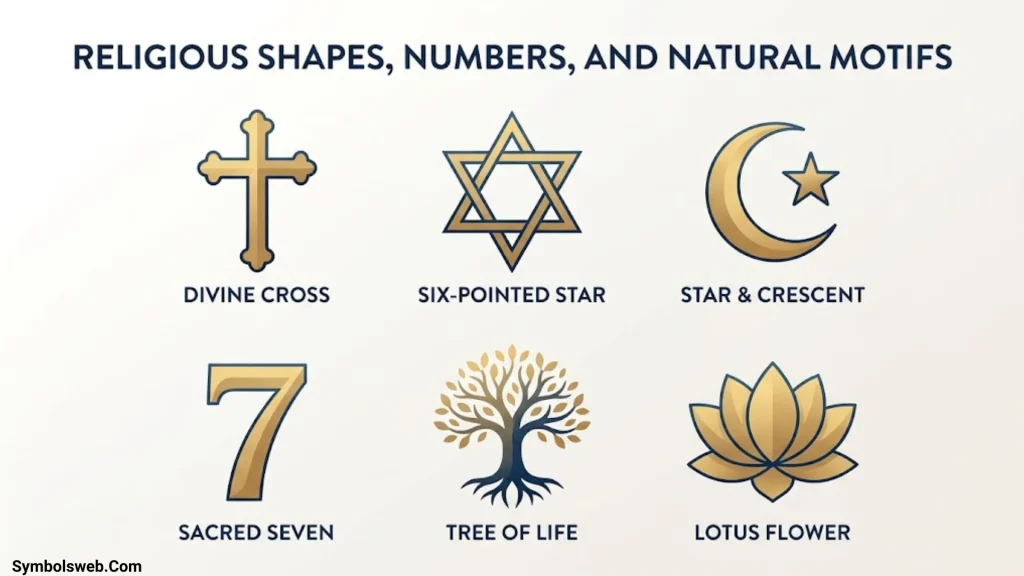
Geometric forms and natural objects often become religiously significant through repeated use in art, ritual, and sacred stories.
Circles and Spirals
Circles appear in mandalas, ritual designs, and many forms of religious art. Depending on the tradition, a circle may represent a sacred boundary, a cosmological structure, or a particular religious teaching.
Spirals appear in ancient and modern artwork across many regions. Their historical meanings depend on the specific object and culture.
A spiral carved into an ancient monument cannot automatically be assigned the same meaning as a spiral used in modern Pagan artwork.
Crosses, Stars, and Geometric Patterns
Crosses appear in Christianity and several other historical traditions, but their forms and meanings differ.
Stars also have varied uses. The Star of David is associated with Jewish identity, while the nine-pointed star is widely used in the Bahá’í Faith.
Geometric patterns in Islamic art, Hindu yantras, and Buddhist mandalas each have their own histories and religious contexts.
Religious Symbolism of the Sun and Moon
The sun appears in numerous religious traditions, including ancient Egyptian religion and Inca religion.
The moon also appears in many cultural and religious settings. However, the star and crescent should not be treated as an official universal emblem of Islam.
Solar and lunar imagery can express ideas about time, divine power, agricultural cycles, and cosmology. Specific interpretations depend on the tradition.
The Meaning of Sacred Numbers
Numbers can carry religious significance, particularly when they appear in sacred teachings, rituals, or traditional designs.
| Number | Example | Religious or Cultural Context |
| Three | The Christian Trinity | Christian theology |
| Three | Buddha, Dharma, and Sangha | Buddhism |
| Four | Four destinations of rebirth represented in Jain symbolism | Jainism |
| Five | Five Ks | Sikhism |
| Eight | Noble Eightfold Path | Buddhism |
| Nine | Nine-pointed star | Bahá’í Faith |
| Seven | Seven-branched menorah | Judaism |
A number’s meaning depends on the religious system in which it appears. Similar numbers do not necessarily point to a shared belief.
Why Do Religious Symbols Have Different Meanings Across Cultures?
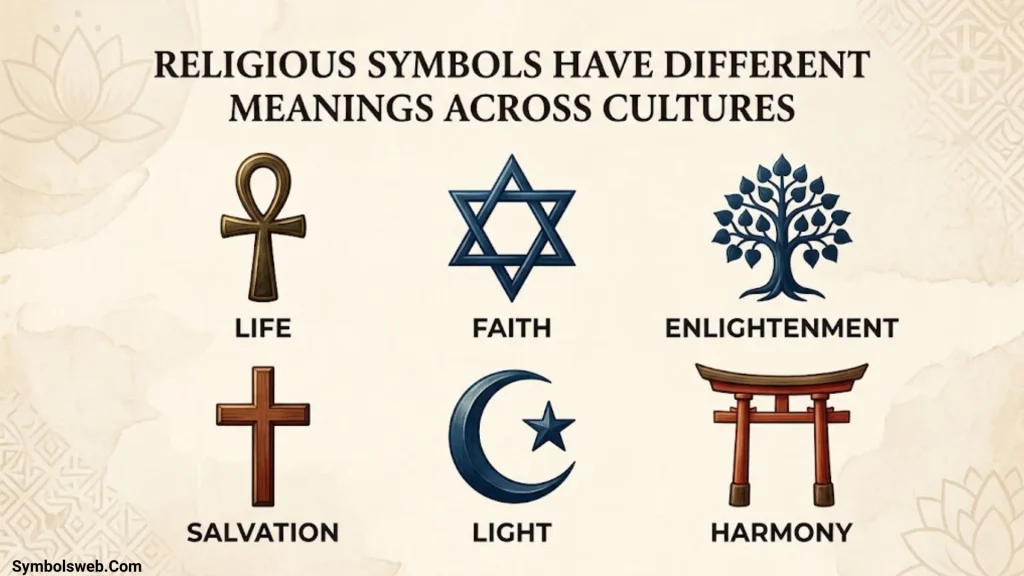
Symbols develop through history. Their meanings can change when communities encounter new beliefs, adopt new artistic styles, or reinterpret older traditions.
Trade, migration, conquest, and cultural exchange have all influenced religious art. Historical evidence shows that religious imagery did not always develop in isolation. Communities borrowed, adapted, and sometimes rejected visual forms as their religious identities changed. The Ashmolean Museum’s Imagining the Divine project explores these developments across several major religious traditions.
A few factors explain why interpretations differ.
- Historical period: A symbol’s ancient use may differ from its modern meaning.
- Geographic location: Communities in different regions may interpret the same form differently.
- Religious teachings: A symbol’s meaning often comes from specific scriptures, stories, or rituals.
- Cultural exchange: Contact between communities can introduce new uses or interpretations.
- Modern movements: Contemporary religious groups may adopt older designs for new purposes.
The swastika provides a clear example. It remains an auspicious religious symbol in Hinduism, Jainism, and Buddhism, yet Nazi Germany appropriated it for racist political purposes.
Similarly, the pentagram has appeared in different historical, religious, and artistic settings. Its meaning depends on how and where people use it.
How to Identify and Interpret a Religious Symbol
Identifying a symbol accurately requires more than matching its shape to an online image.
Identify the Symbol’s Shape and Details
Start by observing its basic features. Look at the number of points, lines, circles, figures, or other elements.
For example, a staff with one snake differs from a staff with two snakes. That detail helps distinguish the Rod of Asclepius from the caduceus.
Determine Its Historical and Geographic Origin
Find out where the object appeared and when people used it. An archaeological artifact from ancient Egypt requires a different explanation than a modern emblem created by a religious organization.
Museums and university publications can help establish the relevant historical context.
Identify the Community That Uses It
A symbol may belong to a particular denomination, Indigenous nation, religious organization, or regional tradition.
Avoid assuming that all followers of a religion interpret it identically.
Check Its Use in Rituals, Art, and Sacred Texts
A symbol’s meaning becomes clearer when you understand how people use it.
A torii gate marks a sacred area in Shinto settings. A menorah has a particular place in Jewish religious history and practice.
The object’s role can tell you more than its shape alone.
Compare Historical Evidence With Modern Interpretations
Modern spiritual websites sometimes assign ancient meanings without reliable evidence. Compare those claims with museum records, academic publications, archaeological studies, and sources from the relevant religious community.
The Smarthistory introduction to religion in art provides useful background on interpreting religious images and objects across traditions.
Common Misconceptions About Religious Symbols
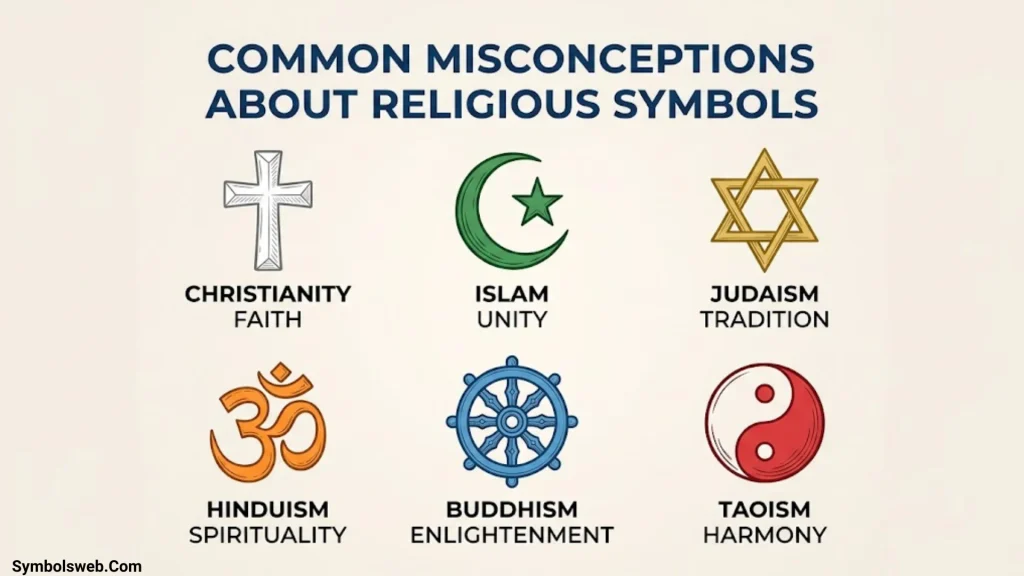
Religious symbolism often attracts simplified explanations. These common misconceptions deserve closer attention.
The Star and Crescent Is Not a Universal Islamic Symbol. Some Muslim communities and historical Islamic states use it, but Islam does not require one universal emblem.
The Swastika Did Not Originate With Nazi Germany. It has a much older history and remains sacred in several religions. Its Nazi appropriation created a separate and deeply harmful association.
The Pentagram Does Not Have One Fixed Meaning. It appears in different historical, religious, and modern spiritual settings.
The Caduceus Is Not the Same as the Rod of Asclepius. The caduceus has two snakes and is associated with Hermes. The Rod of Asclepius has one snake and is associated with medicine.
Not Every Celtic Knot Has a Proven Ancient Meaning. Many popular explanations reflect modern interpretations rather than established historical evidence.
Not Every Norse Symbol Has a Certain Meaning. Archaeological evidence supports the historical use of some motifs, but their exact significance remains debated.
Similar Shapes Do Not Prove Shared Beliefs. A circle, star, or cross can appear in unrelated traditions for different reasons.
Frequently Asked Questions About Religious Symbols
What Are the Most Common Religious Symbols?
Recognizable religious symbols include the Christian cross, Star of David, Om, Dharma Wheel, Khanda, Torii gate, Ankh, and Yin-Yang. Their meanings vary according to religious and cultural context.
What Is the Oldest Known Religious Symbol?
There is no single agreed-upon oldest religious symbol. Archaeologists have discovered prehistoric objects and images that may have held ritual or symbolic significance, but their precise meanings often remain uncertain.
The age of an object does not automatically establish its religious purpose.
Do All Religions Have Symbols?
Many religions use symbols, but not every religion has one official emblem. Some traditions emphasize sacred texts, rituals, objects, or places rather than a single recognizable design.
Even within the same religion, different communities may favor different symbols.
Which Religious Symbols Represent Peace?
The dove is widely associated with peace in Christian and broader cultural settings. Jain Ahimsa symbolizes nonviolence, while Yin-Yang imagery relates to complementary forces and their relationship.
These symbols communicate different ideas, even when people connect them with harmony.
Which Symbols Represent Life and Rebirth?
The ancient Egyptian ankh represents life, while the scarab is associated with renewal and regeneration. The lotus represents spiritual development in Hindu and Buddhist traditions.
Their meanings depend on the religious teachings and historical settings in which they appear.
Why Do Different Religions Use Similar Symbols?
Communities may develop similar shapes independently or exchange ideas through trade, migration, and cultural contact. Some forms are also simple geometric designs that people can use for many purposes.
Similar appearances do not necessarily prove that two religions share the same belief.
Is the Swastika a Religious Symbol?
Yes. The swastika has a long history in Hinduism, Jainism, and Buddhism, where it carries tradition-specific meanings, often including auspiciousness.
Nazi Germany appropriated the symbol for its racist ideology. Its interpretation today depends heavily on context, orientation, presentation, and historical setting.
What Is the Difference Between a Religious Symbol and a Spiritual Symbol?
A religious symbol usually connects with an identifiable religious tradition, community, or practice. A spiritual symbol may have a broader personal or philosophical meaning.
However, the categories overlap. A symbol can have religious significance for one person and a broader spiritual meaning for another.
Can One Symbol Belong to More Than One Religion?
Yes. The lotus, swastika, and Hamsa appear in more than one religious or cultural context.
Their meanings are not necessarily identical. Accurate explanations should identify the specific tradition and use.
How Can You Find the Meaning of an Unfamiliar Religious Symbol?
Begin by identifying its shape, location, historical period, and associated community. Then consult museum collections, academic publications, religious institutions, or sources produced by the relevant community.
If evidence remains uncertain, distinguish documented facts from modern interpretations rather than presenting speculation as established history.
Conclusion
Religion symbols provide a window into the beliefs, histories, and cultural identities of communities around the world. The Christian cross, Hindu Om, Buddhist Dharma Wheel, Jewish Star of David, and ancient Egyptian ankh each communicate distinctive religious ideas. Their significance comes from the traditions that preserve and interpret them.
Although symbols sometimes share shapes or broad themes, their meanings are rarely identical. Historical evidence, sacred teachings, and community practices help explain what each symbol represents. Understanding those differences encourages a more accurate and respectful view of world religions.
When exploring religious symbols and their meanings, look beyond appearance and consider the history behind each design. Reliable sources and tradition-specific explanations reveal how these symbols continue to shape worship, identity, art, and spiritual life.

Jordan Hayes is a writer with a passion for exploring the history, meanings, and cultural significance behind symbols from around the world. He enjoys turning complex topics into clear, engaging content that anyone can understand. Jordan is also the fictional author of The Silent Language of Ancient Marks and Hidden Symbols Beyond the Surface, two original book concepts created for his author profile. When he’s not writing, he spends time researching myths, traditions, and forgotten stories that inspire his work. His goal is to help readers discover the deeper meanings behind the symbols they encounter every day.
 Eliana Foster
 Ethan Holloway