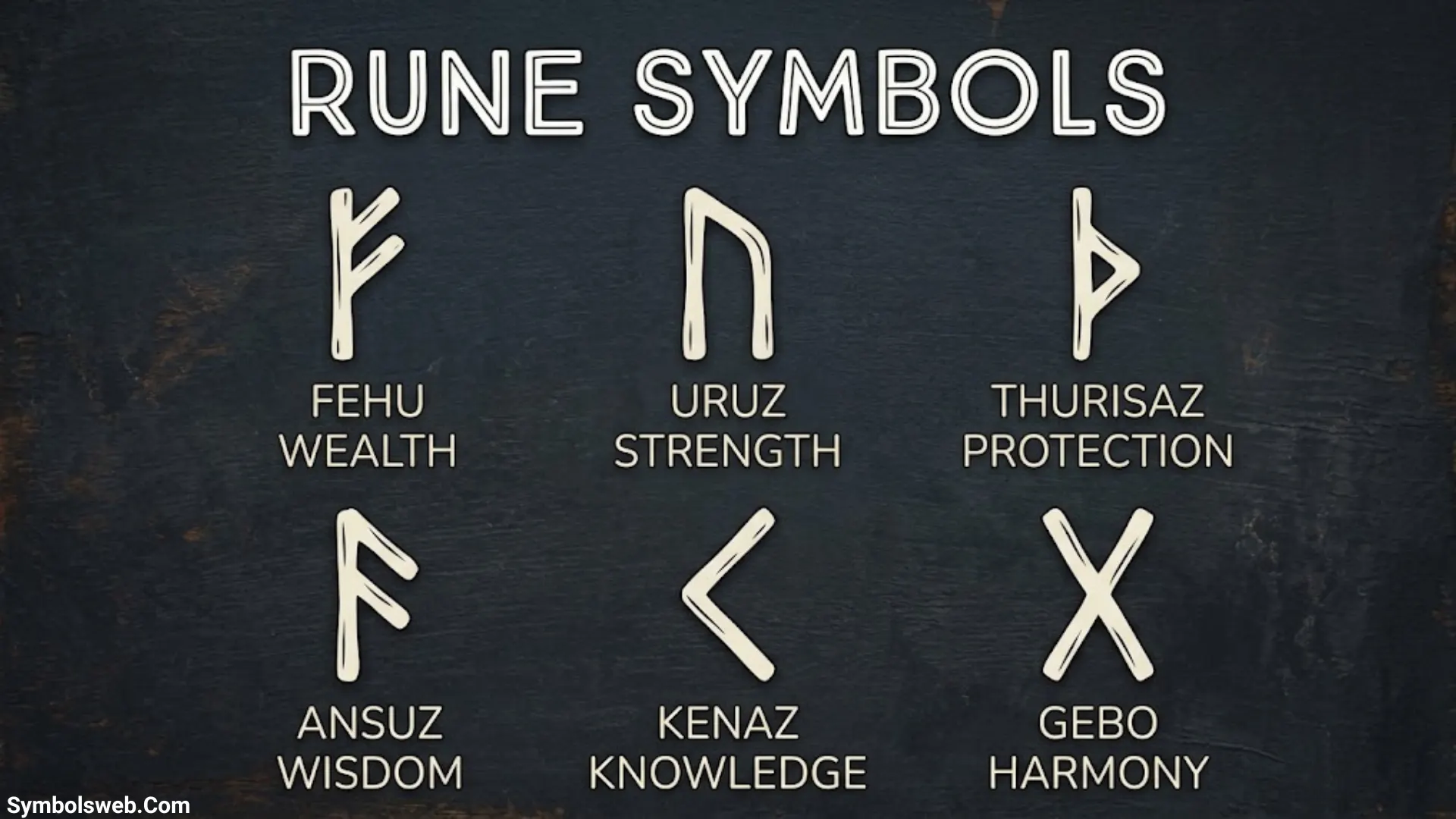
Rune symbols have fascinated people for centuries. These distinctive characters appear on ancient stones, jewelry, weapons, and other objects connected to early Germanic and Scandinavian cultures. Today, people also explore runes for their historical meanings, spiritual symbolism, personal reflection, and connections to Norse mythology.
But what do rune symbols actually mean? The answer depends on the context. Historically, runes formed writing systems used to represent sounds and record names, messages, and other information. In modern spiritual practices, people often interpret individual runes as symbols of wealth, strength, protection, love, transformation, and personal growth.
The Elder Futhark is one of the best-known runic alphabets. It contains 24 characters, each with a distinctive shape and a reconstructed name. Modern rune guides often associate these characters with symbolic themes, although not every popular interpretation has a clear historical basis.
Understanding rune symbols means looking at both sides of their story. Their historical use reveals how early Germanic communities communicated through writing, while modern interpretations show how people continue to find meaning in ancient symbols.
This guide explores all 24 Elder Futhark runes, their names and sounds, historical origins, common interpretations, and modern uses. You’ll also learn how rune reading works, how the Elder Futhark differs from the Viking Age Younger Futhark, and how to distinguish documented history from contemporary spiritual beliefs.
What Are Rune Symbols?
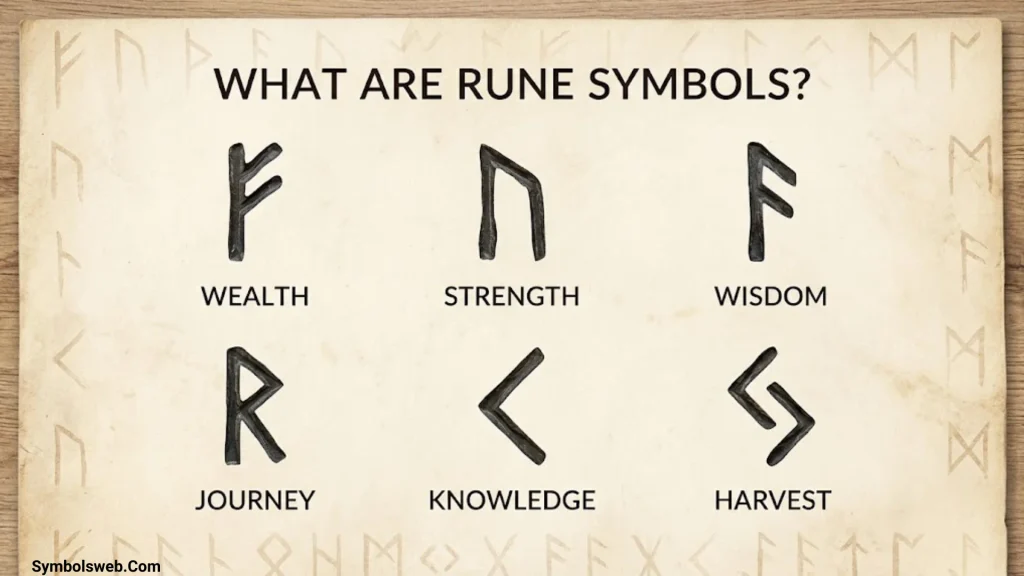
Rune symbols are characters belonging to historical writing systems used by Germanic-speaking peoples. The earliest runic inscriptions date to the first centuries CE, although scholars continue to investigate exactly how and where the writing system developed.
The word rune comes from a Germanic word associated with a secret, mystery, or whispered counsel. However, the word’s history doesn’t mean every rune originally carried a hidden spiritual message.
Runes primarily served as written characters. People carved them into stone, wood, metal, bone, and other materials to record information. Some inscriptions preserve personal names, memorials, ownership marks, and other short messages.
Over time, runes also acquired cultural and literary associations. Medieval rune poems connect rune names with recognizable objects and ideas. Modern spiritual traditions build on selected associations to create systems for reflection and divination.
What Do Rune Symbols Represent?
The meaning of a rune depends on how someone uses or studies it.
| Context | What rune symbols represent | Example |
| Historical writing | Sounds and written language | A rune used in a personal name |
| Linguistics | Reconstructed sounds and rune names | Fehu’s association with the sound represented by f |
| Historical symbolism | Associations preserved in inscriptions and rune poems | A rune name connected with an object or concept |
| Norse-inspired spirituality | Modern symbolic or spiritual ideas | Algiz as a symbol of protection |
| Rune reading | Themes used for reflection or divination | Jera as a prompt to consider effort and results |
| Modern art and jewelry | Decorative, cultural, or personal meaning | A runic inscription on a pendant |
One distinction matters throughout this guide: a rune’s historical meaning isn’t necessarily the same as its modern spiritual interpretation. Keeping these categories separate helps you understand the symbols without confusing documented evidence with later beliefs.
Are Rune Symbols the Same as Viking Symbols?
Not exactly. Runes are characters from writing systems, while the phrase Viking symbols can refer to a much wider range of designs associated with Viking Age material culture and later Norse-inspired traditions.
For example, the Younger Futhark is a runic alphabet closely associated with Viking Age Scandinavia. Other designs, such as the Mjölnir hammer, represent different aspects of Norse mythology and cultural symbolism.
Some designs combine runes with decorative patterns or mythological imagery. However, not every symbol commonly labeled a Viking symbol is a rune.
The Elder Futhark Alphabet and Its History
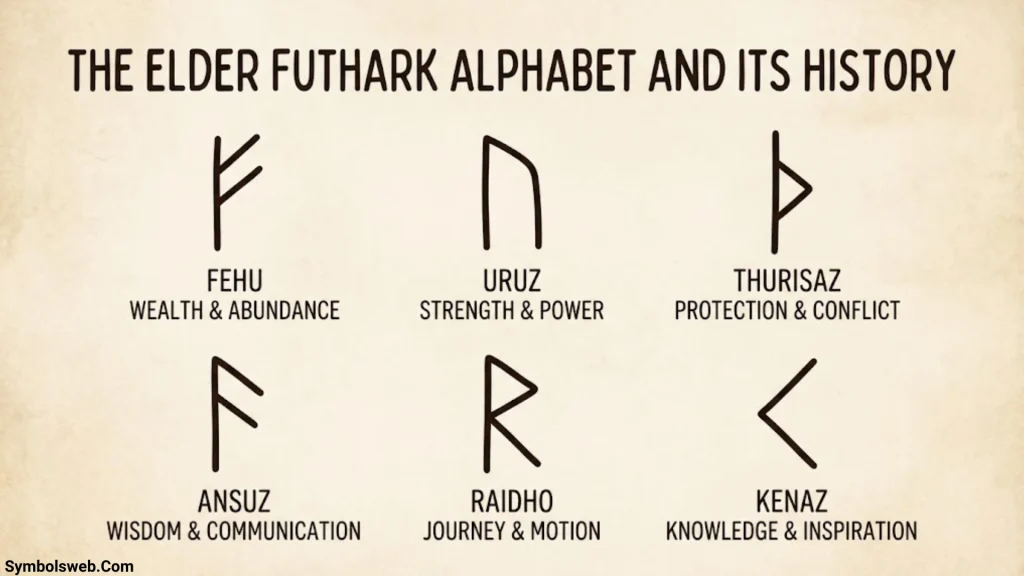
The Elder Futhark alphabet is the earliest widely recognized runic writing system. Its name comes from the first six characters in the traditional rune sequence: F, U, Þ, A, R, and K.
The system contains 24 runes arranged in a conventional order. Scholars generally associate its use with early Germanic-speaking communities from approximately the second to eighth centuries CE, although the chronology varies by region and individual inscription.
The Elder Futhark predates the Viking Age, which is conventionally dated from the late eighth century to the mid-eleventh century. This timeline is important because many modern guides use the phrase Viking runes when discussing the older 24-character alphabet.
Where Did Rune Symbols Originate?
The exact origins of runic writing remain a subject of scholarly research. The earliest surviving inscriptions appear in northern Europe during the first centuries CE.
Researchers have investigated possible connections between runic writing and earlier Mediterranean alphabets, including Latin and other writing traditions. However, no single explanation resolves every question about the system’s development.
Runes also suited the materials on which people often carved them. Their angular shapes worked well on hard surfaces such as wood and stone, although the shapes alone don’t prove why the writing system developed as it did.
Archaeological evidence provides important clues about how people used runes. Inscriptions on objects and monuments show that runic writing existed in several forms and served different purposes across time.
Important Historical Evidence for Runes
Several types of evidence help scholars understand the development of runic writing.
- Early runic inscriptions: Short inscriptions on objects help researchers study the alphabet’s early use.
- The Kylver Stone: This Swedish stone, discovered on Gotland, is famous for preserving a complete sequence of the 24 Elder Futhark characters.
- Runic memorial stones: Inscriptions on stones document names, commemorations, and other messages.
- Medieval rune poems: Later literary sources preserve traditional rune names and associations.
- Archaeological artifacts: Combs, tools, jewelry, and other objects provide evidence of runic writing beyond monumental stones.
These sources don’t all belong to the same period. A medieval poem can help explain a rune name, but it doesn’t automatically reveal how every earlier community understood that rune.
Odin and the Runes in Norse Mythology
In Norse mythology, Odin is closely associated with runic knowledge. The Old Norse poem Hávamál, preserved in a medieval manuscript tradition, contains an account in which Odin describes a powerful ordeal involving a tree and the acquisition of runic knowledge.
The passage connects runes with wisdom, sacrifice, and knowledge. Modern interpretations often link the tree with Yggdrasil, the world tree of Norse mythology.
However, mythological accounts should be read as literary and religious sources rather than straightforward archaeological records. They reveal how runes could be understood within Norse literary traditions, but they don’t prove that every rune-reading ritual used today existed in the Viking Age.
All 24 Elder Futhark Runes and Their Meanings
The most useful starting point for understanding rune meanings is the complete Elder Futhark sequence. Each rune has a character, a commonly reconstructed name, and an approximate sound value.
Modern rune-reading guides also assign symbolic themes to these characters. Some themes reflect recognizable historical associations, while others come from later spiritual interpretations.
The following chart distinguishes common modern interpretations from the runes’ historical names and associations.
Complete Elder Futhark Rune Meanings Chart
| Rune | Name | Approximate sound | Historical association | Common modern interpretation |
| ᚠ | Fehu | F | Cattle, movable wealth | Abundance, resources, prosperity |
| ᚢ | Uruz | U | Aurochs, a wild bovine | Strength, vitality, endurance |
| ᚦ | Thurisaz | Th | A giant or powerful being | Boundaries, defense, challenge |
| ᚨ | Ansuz | A | A god or divine figure | Communication, wisdom, inspiration |
| ᚱ | Raidho | R | Riding or a journey | Progress, travel, direction |
| ᚲ | Kenaz | K | Name and original meaning debated | Knowledge, creativity, illumination |
| ᚷ | Gebo | G | Gift | Generosity, exchange, partnership |
| ᚹ | Wunjo | W | Name associated with joy | Happiness, harmony, satisfaction |
| ᚺ | Hagalaz | H | Hail | Disruption, change, resilience |
| ᚾ | Nauthiz | N | Need or constraint | Patience, necessity, perseverance |
| ᛁ | Isa | I | Ice | Stillness, pause, concentration |
| ᛃ | Jera | J or Y-like sound, depending on reconstruction | Year or harvest | Cycles, results, gradual progress |
| ᛇ | Eihwaz | Often reconstructed with an EI-like value | Yew association | Endurance, transition, resilience |
| ᛈ | Perthro | P | Original name uncertain | Mystery, chance, the unknown |
| ᛉ | Algiz | Z-like value in common reconstructions | Original name and interpretation debated | Protection, awareness, boundaries |
| ᛊ | Sowilo | S | Sun | Energy, clarity, success |
| ᛏ | Tiwaz | T | Tyr, the Germanic god | Justice, courage, duty |
| ᛒ | Berkano | B | Birch | Growth, renewal, nurturing |
| ᛖ | Ehwaz | E | Horse | Trust, movement, cooperation |
| ᛗ | Mannaz | M | Human being or person | Identity, relationships, community |
| ᛚ | Laguz | L | Water | Intuition, emotions, adaptability |
| ᛜ | Ingwaz | NG | Ing, a name associated with a deity | Potential, development, completion |
| ᛞ | Dagaz | D | Day | Awakening, change, clarity |
| ᛟ | Othala | O | Inheritance or inherited property | Heritage, belonging, family roots |
Important: The sound values above are approximate guides, not exact English-letter equivalents. Rune names are reconstructed from related historical evidence, and some remain uncertain. The modern interpretations in the final column are not a single historically established divination system.
The Three Ætts of the Elder Futhark
The traditional 24-rune sequence is commonly divided into three groups of eight called ættir, the plural of ætt. The groupings are useful for organizing the alphabet.
Modern rune guides commonly call them Freyr’s ætt, Heimdall’s ætt, and Tyr’s ætt. These labels are familiar in contemporary rune literature, although the historical evidence doesn’t establish every detail of the modern system as an ancient spiritual framework.
Freyr’s Ætt: The First Eight Runes
The first group begins with Fehu and ends with Wunjo.
- Fehu (ᚠ): Associated with cattle and movable wealth. Modern readings often connect it with resources, prosperity, and the responsible management of what you possess.
- Uruz (ᚢ): Named from a word associated with the aurochs. Modern interpretations emphasize physical strength, endurance, and the ability to face difficult tasks.
- Thurisaz (ᚦ): Associated with a giant or powerful being in Germanic tradition. Modern readers often interpret it through the themes of defense, danger, boundaries, and confronting challenges.
- Ansuz (ᚨ): Associated with a god or divine figure. Contemporary interpretations frequently connect it with communication, wisdom, speech, and inspiration.
- Raidho (ᚱ): Connected with riding or a journey. Modern readings often explore travel, direction, progress, and the process of moving toward a goal.
- Kenaz (ᚲ): Its historical name and precise meaning require caution. Modern guides commonly use the image of a torch to represent knowledge, creative work, and illumination.
- Gebo (ᚷ): Associated with a gift. Contemporary interpretations emphasize generosity, reciprocal exchange, cooperation, and partnership.
- Wunjo (ᚹ): Associated with joy in reconstructed rune-name traditions. Modern readings often connect it with happiness, harmony, and satisfaction.
Together, these runes offer a convenient starting point for learning the Elder Futhark. However, the idea that each group represents one fixed spiritual stage belongs to interpretation rather than established historical fact.
Heimdall’s Ætt: The Middle Eight Runes
The second group begins with Hagalaz and ends with Sowilo.
- Hagalaz (ᚺ): Associated with hail. Modern interpretations often explore disruption, sudden change, and the challenge of adapting to difficult circumstances.
- Nauthiz (ᚾ): Connected with need or constraint. Contemporary readers often use it to reflect on patience, limitations, and the difference between needs and wants.
- Isa (ᛁ): Associated with ice. Modern interpretations commonly emphasize stillness, restraint, concentration, and the value of pausing before acting.
- Jera (ᛃ): Connected with the year and harvest. Modern readings often explore cycles, sustained effort, and results that develop over time.
- Eihwaz (ᛇ): Commonly associated with the yew. Modern interpretations frequently focus on endurance, resilience, and navigating transitions.
- Perthro (ᛈ): Its original name and meaning remain uncertain. Modern readings often connect it with chance, hidden information, mystery, or uncertainty.
- Algiz (ᛉ): Its reconstructed name and historical interpretation are debated. Modern rune guides commonly associate it with protection, awareness, and personal boundaries.
- Sowilo (ᛊ): Associated with the sun. Contemporary readings often connect it with vitality, clarity, confidence, and success.
This group is especially important when researching modern rune symbolism because several widely repeated interpretations go beyond what the surviving historical evidence can confirm.
For example, Algiz is frequently called a protection rune. That association is common in contemporary spiritual practice, but it shouldn’t be presented as an unquestionable translation of an ancient inscription.
Tyr’s Ætt: The Final Eight Runes
The third group begins with Tiwaz and ends with Othala.
- Tiwaz (ᛏ): Named in connection with Tyr. Modern interpretations often emphasize courage, fairness, responsibility, and commitment to principles.
- Berkano (ᛒ): Associated with birch. Contemporary readings frequently explore growth, nurturing, renewal, and new developments.
- Ehwaz (ᛖ): Associated with a horse. Modern symbolism often focuses on trust, cooperation, movement, and shared progress.
- Mannaz (ᛗ): Associated with a human being or person. Contemporary interpretations emphasize identity, community, relationships, and self-awareness.
- Laguz (ᛚ): Associated with water. Modern readings often explore emotions, intuition, adaptability, and the ability to respond to changing circumstances.
- Ingwaz (ᛜ): Associated with Ing, a name connected with a Germanic deity. Contemporary interpretations often emphasize potential, development, and the completion of a process.
- Dagaz (ᛞ): Associated with day. Modern readings commonly connect it with clarity, awakening, breakthroughs, and transitions.
- Othala (ᛟ): Associated with inheritance or inherited property. Contemporary interpretations often explore family roots, heritage, belonging, and legacy.
These modern themes can help beginners remember the symbols. They work best as interpretive prompts rather than rigid definitions that apply to every reading or historical context.
Detailed Rune Symbols and Their Meanings
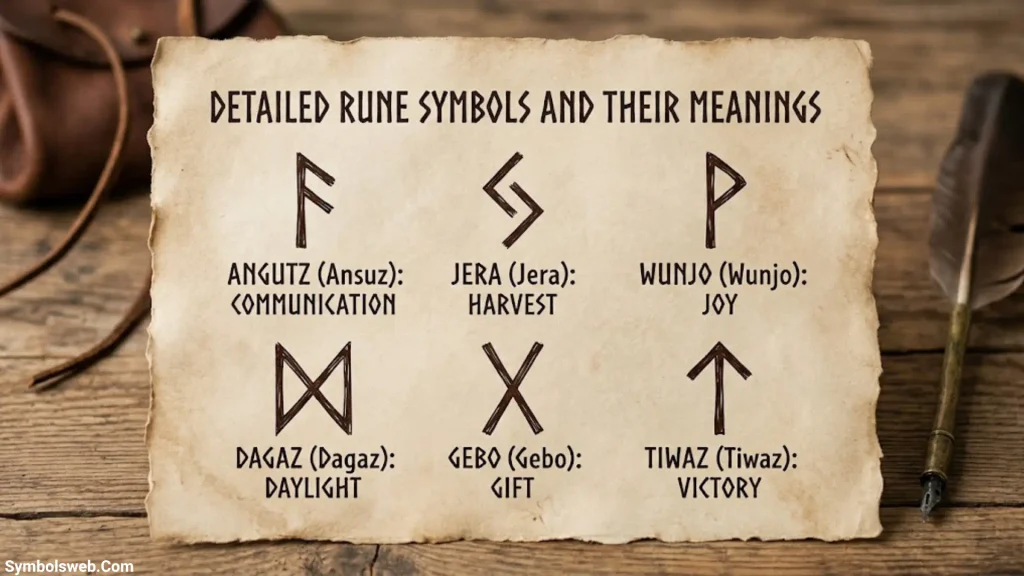
The complete chart provides a useful overview. However, several rune symbols and their meanings deserve closer attention because their historical associations differ from popular modern interpretations.
Fehu (ᚠ): Wealth, Resources, and Abundance
Fehu is one of the easiest runes to connect with a recognizable historical concept. Its reconstructed name is associated with cattle, a valuable form of movable wealth in early Germanic societies.
In modern spiritual practice, Fehu rune meaning often extends to money, prosperity, opportunity, and the management of resources.
People who use runes for personal reflection might consider questions such as:
- Am I managing my resources responsibly?
- Where could I create new opportunities?
- How can I use what I have to support my goals?
- Do I recognize the value of my time, skills, and relationships?
Fehu doesn’t guarantee financial gain. Its contemporary symbolism can instead encourage practical thinking about resources, generosity, and responsible growth.
Uruz (ᚢ): Strength and Endurance
Uruz is associated with the aurochs, a large wild bovine that lived in Europe and other parts of the world before becoming extinct in the seventeenth century.
Modern interpretations often connect Uruz with strength, vitality, stamina, and resilience. It can serve as a reminder to build skills gradually rather than waiting for confidence to appear on its own.
For example, someone preparing for a demanding project might use Uruz as a journaling prompt about persistence, preparation, and the habits needed to finish the work.
Thurisaz (ᚦ): Boundaries and Challenges
Thurisaz is associated with a giant or powerful being in Germanic traditions. Its modern symbolism often focuses on defense, confrontation, caution, and personal boundaries.
Some contemporary readers interpret it as a reminder to pause before reacting. Others connect it with the need to face a difficult situation directly.
The key is not to assume that Thurisaz always means danger. Its interpretation depends on the reading method and the question being considered.
Ansuz (ᚨ): Communication and Wisdom
Ansuz is commonly associated with a god or divine figure in reconstructed rune-name traditions.
Modern guides often connect Ansuz with communication, speech, inspiration, learning, and the exchange of ideas.
If you’re preparing for an important conversation, you might use its symbolism to consider whether you’re listening carefully, expressing yourself clearly, and checking your assumptions.
This reflective approach doesn’t require believing that a rune predicts the outcome. The symbol simply provides a framework for examining your choices.
Raidho (ᚱ): Travel and Direction
Raidho is associated with riding or a journey. Modern interpretations often extend this idea to progress, life changes, and movement toward a goal.
Its symbolism can encourage you to think about the difference between being busy and making meaningful progress.
For example, if you’re working toward a long-term goal, Raidho can prompt questions about your direction, preparation, and next practical step.
Kenaz (ᚲ): Creativity and Knowledge
Kenaz is often interpreted as a torch in modern rune guides. However, its historical name and precise original meaning are debated.
The torch association has made Kenaz a popular modern symbol of knowledge, creativity, discovery, and illumination.
A writer might use the rune as a prompt to explore a new idea. A student might use it to reflect on what they need to learn before tackling a difficult subject.
These are contemporary symbolic applications rather than proven ancient meanings.
Gebo (ᚷ): Gifts and Partnerships
Gebo is associated with a gift, making it one of the more straightforward examples of a reconstructed rune name with a recognizable historical association.
Modern interpretations often connect it with generosity, reciprocity, cooperation, and relationships.
A useful question inspired by Gebo is whether an exchange feels balanced. This could apply to friendship, teamwork, family relationships, or a business partnership.
The symbol can also prompt reflection on the difference between a freely given gift and an exchange that creates an unwanted obligation.
Wunjo (ᚹ): Joy and Harmony
Wunjo is commonly associated with joy. Modern readings often connect it with happiness, satisfaction, belonging, and harmony.
Rather than treating Wunjo as a promise that everything will go well, consider it a prompt to examine what contributes to a satisfying life.
That might mean strengthening a friendship, making time for a meaningful activity, or recognizing progress that you would otherwise overlook.
Algiz (ᛉ): Protection and Awareness
Algiz is among the most popular protection runes in modern spiritual literature. Its reconstructed name and historical interpretation remain debated, so its contemporary protective association needs careful labeling.
Modern practitioners may use Algiz as a symbol of awareness, caution, or personal boundaries.
For example, someone facing a difficult decision might reflect on the risks involved and identify reasonable steps to protect their time, privacy, or well-being.
A rune symbol can’t guarantee physical safety or prevent harm. Practical precautions remain essential.
Jera (ᛃ): Harvest and Gradual Progress
Jera is associated with the year and harvest. Its modern symbolism often focuses on cycles, patience, sustained effort, and the results of work over time.
This association offers a useful reminder that many worthwhile outcomes develop gradually.
A student who studies consistently, for example, may improve through repeated practice rather than one dramatic effort. Jera can serve as a symbol of that process.
Sowilo (ᛊ): Sunlight and Success
Sowilo is associated with the sun. Modern interpretations often connect it with clarity, energy, confidence, and success.
Its symbolism can encourage you to identify what helps you make progress and what distracts you from your goals.
However, Sowilo shouldn’t be treated as a guarantee of victory. Its modern meaning is best understood as an interpretive theme.
Tiwaz (ᛏ): Courage and Justice
Tiwaz is named in connection with Tyr, a Germanic god. Contemporary interpretations often emphasize courage, fairness, duty, and principled action.
This rune can serve as a prompt to consider what the right decision looks like when doing the right thing requires effort.
It may be especially relevant when examining accountability, leadership, or the responsibilities involved in working with others.
Berkano (ᛒ): Growth and Renewal
Berkano is associated with birch. Modern interpretations frequently connect it with growth, nurturing, renewal, and development.
Its symbolism can be applied to new projects, personal habits, or stages of change.
For example, someone beginning a new skill might use Berkano to reflect on the importance of steady practice and patience during the early stages.
Othala (ᛟ): Heritage and Belonging
Othala is associated with inheritance or inherited property. Modern interpretations often extend this association to family roots, heritage, belonging, and legacy.
Its symbolism can encourage reflection on what you’ve inherited from previous generations, including traditions, knowledge, responsibilities, and material resources.
However, Othala’s historical and contemporary political associations require care. Some forms of the rune have been appropriated by extremist movements. Its meaning in any specific design depends partly on context.
Rune Meanings for Manifestation, Protection, and Love
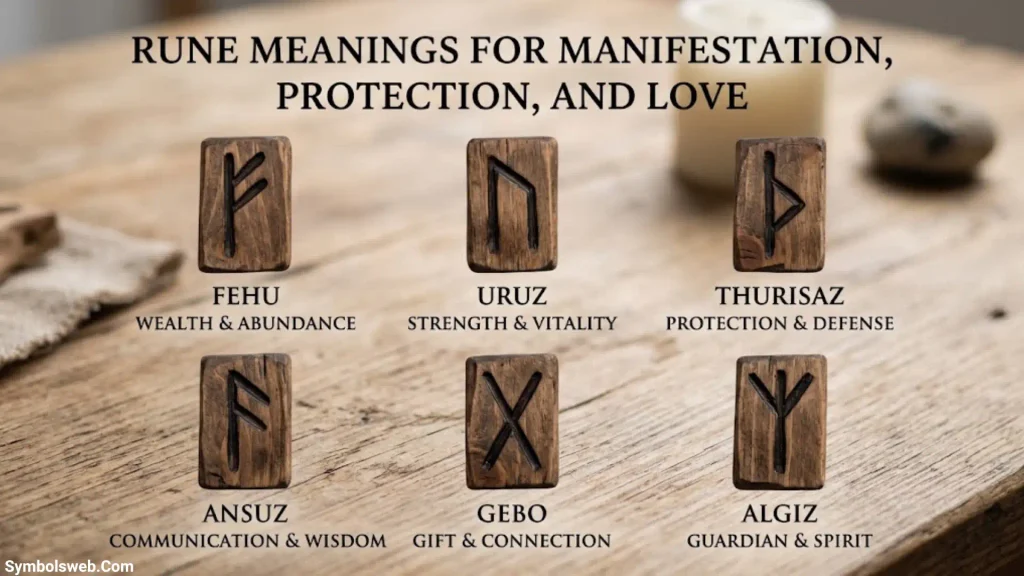
Modern rune guides often group symbols by themes such as abundance, protection, love, confidence, and personal growth. These groupings make the symbols easier to explore, but they don’t represent one universal ancient classification.
Rune Symbols for Manifestation and Abundance
Manifestation runes are used in some contemporary spiritual practices to represent goals, intentions, or desired changes.
Fehu is a popular choice because of its association with cattle and movable wealth. Jera is often paired with it to represent the relationship between effort, time, and results.
| Rune | Common modern association | Reflective question |
| Fehu (ᚠ) | Wealth and resources | How can I manage my resources more effectively? |
| Jera (ᛃ) | Harvest and results | What consistent actions will help me reach my goal? |
| Wunjo (ᚹ) | Joy and satisfaction | What would make this goal meaningful? |
| Sowilo (ᛊ) | Clarity and confidence | What deserves my attention right now? |
| Dagaz (ᛞ) | Change and fresh perspectives | What needs to change for me to move forward? |
You can use these associations to create a personal intention-setting exercise. Write down your goal, choose a rune whose modern symbolism fits the theme, and identify one realistic action you can take.
For example, someone hoping to improve their finances might choose Fehu as a reminder to track spending, build useful skills, and look for appropriate opportunities.
The rune doesn’t create wealth by itself. The practical actions provide the foundation for progress.
Rune Symbols for Protection
Protection runes are popular in modern Norse-inspired spiritual practices. Algiz is frequently associated with protection, while Thurisaz and Eihwaz are sometimes interpreted through themes of defense, resilience, and boundaries.
| Rune | Common modern protective theme | Possible reflective use |
| Algiz (ᛉ) | Awareness and protection | Consider risks and reasonable precautions. |
| Thurisaz (ᚦ) | Defense and boundaries | Identify situations that require caution. |
| Eihwaz (ᛇ) | Endurance and resilience | Reflect on how to handle a difficult period. |
| Tiwaz (ᛏ) | Courage and principled action | Decide how to act responsibly under pressure. |
Some practitioners draw these symbols on paper, incorporate them into jewelry, or include them in personal rituals.
These practices reflect modern spiritual beliefs. They don’t establish that a rune can prevent accidents, stop harmful behavior, or replace practical safety measures.
Rune Symbols for Love and Relationships
Modern rune meanings for love often focus on generosity, joy, connection, and mutual understanding.
Gebo is associated with gifts, making it a common choice for reflecting on reciprocity. Wunjo represents joy in modern interpretations, while Mannaz can prompt reflection on relationships and human connections.
Consider these themes:
- Gebo: Giving, receiving, cooperation, and mutual respect.
- Wunjo: Shared happiness, harmony, and emotional satisfaction.
- Mannaz: Self-awareness, friendship, and relationships with other people.
- Berkano: Growth, nurturing, and the development of a relationship.
Someone reflecting on a relationship might use these symbols to think about communication, shared responsibilities, and emotional needs.
However, runes can’t establish whether another person loves you or predict whether a relationship will succeed. Honest communication and mutual respect matter more than symbolic readings.
Rune Symbols for Creativity, Courage, and Personal Growth
Other common modern associations offer useful prompts for reflection.
| Theme | Runes commonly associated with it | Modern interpretive focus |
| Communication | Ansuz | Listening, expression, and learning |
| Creativity | Kenaz | Ideas, discovery, and creative work |
| Strength | Uruz | Persistence and endurance |
| Courage | Tiwaz, Uruz | Responsibility and determination |
| Calm and reflection | Isa, Laguz | Patience and emotional awareness |
| New beginnings | Berkano, Dagaz | Renewal and changing perspectives |
| Gradual progress | Jera, Raidho | Consistency and direction |
| Family and heritage | Othala, Mannaz | Belonging, identity, and inheritance |
These associations aren’t exclusive. Different modern authors and practitioners may assign different meanings to the same rune.
How to Read Rune Symbols for Beginners
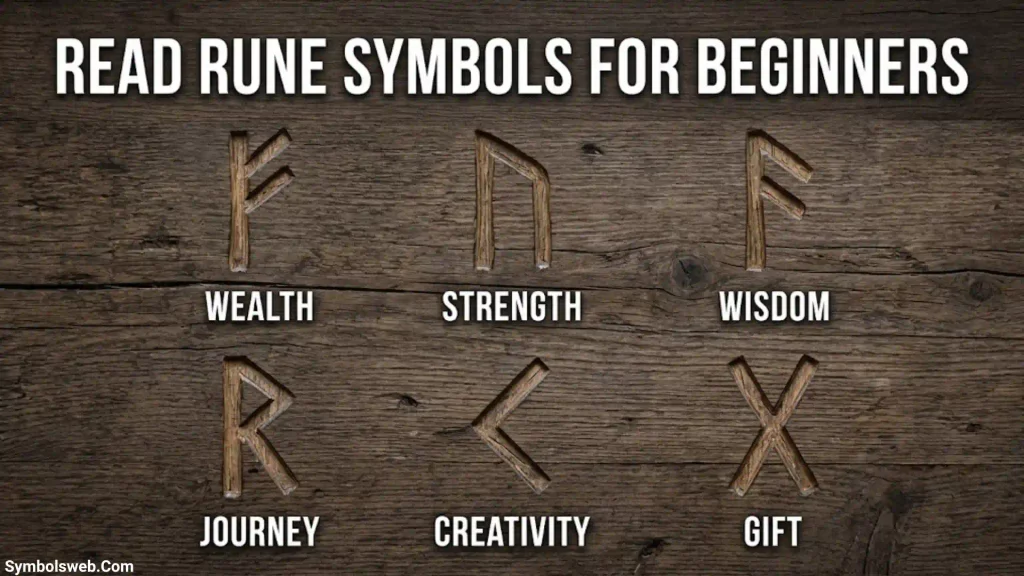
Rune reading is a modern interpretive practice in which people draw meaning from runic characters. Some approach it as divination, while others use it as a spiritual exercise or a way to organize personal reflection.
Reading runes doesn’t require an elaborate ritual. A basic understanding of the symbols, a clear question, and a consistent method provide a reasonable starting point.
How to Prepare for a Rune Reading
Before beginning a reading, follow these steps:
- Choose a rune set or use a reliable reference chart.
- Learn the names and shapes of the runes you’re using.
- Decide whether the exercise is for reflection, spiritual practice, or divination.
- Form an open-ended question.
- Keep a notebook to record your interpretation.
If you’re a beginner, focus on the Elder Futhark only if that’s the system you’ve chosen to study. Avoid mixing different runic alphabets without understanding their historical differences.
How to Do a One-Rune Reading
A one-rune reading is a simple way to practice interpreting symbols.
Step one: Choose a question. Focus on something you can reflect on, such as a challenge at work or a personal goal.
Step two: Draw a rune. Select one piece from your set or use another consistent random method.
Step three: Identify the symbol. Confirm its name and sound, then consult a reference for its historical associations and common modern interpretations.
Step four: Reflect on its relevance. Ask how the symbolic theme might relate to your question.
Step five: Record your thoughts. Write down your interpretation and one practical step you can take.
For example, drawing Jera might prompt you to examine whether your daily habits support a long-term goal. The symbol becomes a reflection tool rather than a prediction of a guaranteed result.
How to Perform a Three-Rune Reading
A three-rune spread uses three symbols assigned to different positions. The meanings of those positions depend on the method selected.
One common modern arrangement uses these positions:
| Position | Purpose | Question to consider |
| First rune | Current situation | What is happening now? |
| Second rune | Challenge | What needs attention? |
| Third rune | Possible next step | What action might help? |
Draw three runes and examine each symbol separately before considering the group as a whole.
Avoid forcing the symbols into a dramatic story. If a rune’s association doesn’t seem relevant, record that uncertainty instead of inventing a connection.
Three-rune readings are a contemporary interpretive technique. They shouldn’t automatically be described as a standardized practice inherited from ancient Germanic communities.
What Are Reversed Runes?
A reversed rune appears upside down in a reading. Some modern practitioners assign it a different interpretation from the same rune in its upright position.
For example, a reader who associates Raidho with progress might interpret its reversed position as a prompt to reconsider direction or preparation.
However, not every rune has a clearly distinguishable reversed shape. Some readers also ignore reversals entirely.
The use of reversed runes varies across modern systems. There isn’t one universally established historical rule requiring readers to interpret every rune this way.
What Does Merkstave Mean?
Merkstave is a term used in some modern rune-reading systems to describe a difficult or unfavorable interpretation of a rune.
Depending on the system, a reader might associate it with delay, obstacles, confusion, or an inward-facing aspect of a symbol.
However, merkstave isn’t a universal rule of ancient runic writing. Its use belongs to particular modern interpretive traditions, and the term doesn’t carry one agreed meaning across every approach.
What Is the Blank Rune?
The blank rune, sometimes called Odin’s rune, is a modern addition to certain rune-reading systems.
The Elder Futhark has 24 characters. It doesn’t contain a historically established blank twenty-fifth rune.
The blank rune became widely known through Ralph Blum’s The Book of Runes, first published in 1982. In modern readings, it may represent uncertainty, the unknown, or possibilities that haven’t yet taken shape.
It’s important to distinguish that interpretation from historical evidence. The blank rune is not an original character in the Elder Futhark alphabet.
Rune Casting and Divination
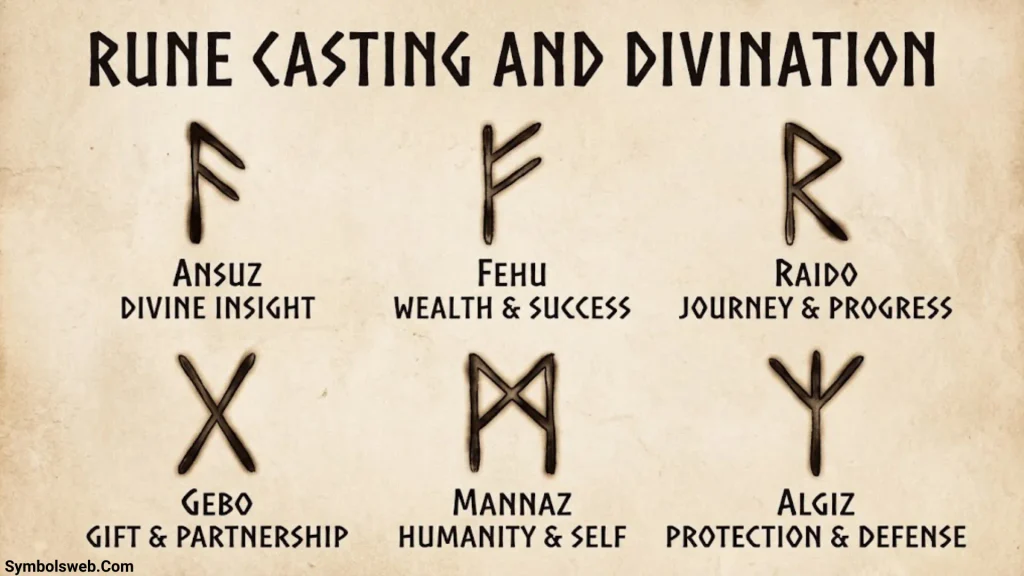
Rune casting is a modern divinatory practice that involves drawing or scattering rune-marked pieces and interpreting the results.
Some people draw runes from a pouch. Others place or scatter several pieces on a cloth. Methods vary, so there isn’t one mandatory procedure for every practitioner.
How to Cast Runes Step by Step
- Choose a rune set and a suitable surface.
- Decide on a question before selecting the runes.
- Choose a method, such as drawing one rune or scattering several pieces.
- Identify the runes and consult your reference guide.
- Consider the symbols in relation to the question and the chosen layout.
- Record the interpretation and any practical actions worth considering.
A cloth can help define the reading area, while a pouch keeps the pieces together. Neither accessory is essential.
How to Ask Questions During Rune Divination
Open-ended questions usually provide more room for reflection than questions that demand a definite prediction.
For example:
- Instead of asking, “Will I definitely get this job?” Consider, “What should I prepare for during this job search?”
- Instead of asking, “Will this relationship last forever?” Consider, “What could help me build a healthier relationship?”
- Instead of asking, “Will I become wealthy?” Consider, “What financial habits should I review?”
These questions keep the focus on decisions and actions you can influence.
Did Ancient Germanic People Cast Runes?
Historical evidence requires a careful answer. The Roman writer Tacitus described a Germanic practice involving marked pieces of wood in his work Germania, written around 98 CE.
However, Tacitus didn’t clearly identify those marks as runic characters. His account therefore cannot establish that the exact rune-casting methods used today existed in ancient Germanic communities.
Historical inscriptions, medieval texts, and contemporary divination manuals are different kinds of evidence. They should be examined separately rather than combined into one supposedly unbroken tradition.
Rune Rituals, Bindrunes, and Modern Spiritual Practices
Modern practitioners sometimes incorporate rune symbols into meditation, journaling, intention-setting, and personal rituals. These activities can offer a structured way to focus attention on a chosen theme.
However, the details of contemporary practices vary. Moonlight cleansing, crystal charging, and particular altar arrangements aren’t established requirements of historical runic writing.
Simple Rune Rituals for Beginners
A basic reflective practice can involve just one symbol and a notebook.
- Choose a rune whose modern association fits a theme you want to explore.
- Read about its historical name and relevant modern interpretations.
- Write an intention connected to that theme.
- Spend a few minutes considering how the intention relates to your life.
- Identify one practical action.
- Review your notes later to see what you’ve learned.
For instance, you might choose Berkano when beginning a new project. Write down what you want to develop, then identify a small action that will help you make progress.
The value comes from the reflection and follow-through, not from a guarantee of supernatural results.
What Is a Bindrune?
A bindrune combines two or more runic characters into one design. Some historical inscriptions contain combined runic forms, while modern practitioners also create custom designs for decorative or spiritual purposes.
A modern bindrune doesn’t automatically possess an established ancient meaning. Its interpretation often depends on the creator’s choices.
To create one responsibly:
- Choose a clear theme.
- Select runes based on their historical associations and any modern meanings you intend to use.
- Combine the characters into a legible design.
- Check each character against a reliable reference.
- Record your intended meaning and distinguish it from historical evidence.
Some modern designs combine Fehu and Jera to represent abundance and sustained effort, or Gebo and Wunjo to represent partnership and joy. These are contemporary symbolic combinations rather than verified ancient formulas.
Rune Cleansing and Charging
Some modern practitioners use the terms cleansing and charging for activities intended to refresh a rune set or focus a personal intention.
These practices may include meditation, wiping the pieces with a dry cloth, using sound, or placing the set in a chosen space.
There is no established historical requirement to charge Elder Futhark runes under the full moon. Physical cleaning should depend on the material, while spiritual cleansing remains a personal practice rather than a demonstrated way to change a rune’s powers.
For practical care:
- Keep wooden runes away from excessive moisture.
- Clean stone or crystal pieces according to the material’s care requirements.
- Store the set in a pouch or container.
- Avoid strong light or other conditions that might damage paint, finishes, or delicate materials.
Rune Stones, Materials, and Choosing a Rune Set
The term rune stones can refer to portable pieces used in modern readings or to historical stones bearing runic inscriptions. These are not the same thing.
Historical runestones often preserve written messages or commemorations. Modern divination sets usually contain individual pieces marked with selected runic characters.
Common Materials for Rune Sets
| Material | Characteristics | Practical consideration |
| Wood | Lightweight and easy to mark | Protect it from excessive moisture. |
| Natural stone | Durable with varied textures | Check that the runes are clearly visible. |
| Clay | Can be molded and engraved | Handle carefully if the pieces are brittle. |
| Ceramic | Often has a smooth, finished surface | Check the durability of painted symbols. |
| Crystal | Combines decorative material with modern crystal symbolism | Consider the material’s care needs rather than assuming spiritual superiority. |
Crystal sets may use rose quartz, amethyst, carnelian, tiger’s eye, or green aventurine. These stones have associations in contemporary crystal traditions, but those associations aren’t the historical meanings of the Elder Futhark runes.
How to Choose a Rune Set for Beginners
If you want to study the Elder Futhark, look for a set containing all 24 characters.
Check the following before buying or making a set:
- The characters match a reliable reference chart.
- The runes are easy to distinguish.
- The material suits your intended use.
- The set includes a guide that separates historical evidence from modern interpretations.
- The pieces are comfortable to handle and easy to store.
A simple, accurate set is more useful for learning than an expensive set with unclear symbols or unsupported claims about its powers.
Elder Futhark vs. Younger Futhark: What’s the Difference?
The Elder Futhark and Younger Futhark are two distinct historical runic writing systems. Although they share related characters, they belong to different periods and have different numbers of runes.
The Elder Futhark contains 24 characters and was used by early Germanic-speaking communities. The Younger Futhark contains 16 characters and became associated with Viking Age Scandinavia.
| Feature | Elder Futhark | Younger Futhark |
| Number of characters | 24 | 16 |
| Historical period | Approximately 150–700 CE, with regional variation | Approximately 725–1075 CE |
| Linguistic context | Early Germanic languages | Old Norse and related Scandinavian language stages |
| Common modern use | Rune-symbol reference guides and contemporary rune readings | Historical study of Viking Age inscriptions |
| Main distinction | Larger inventory of characters | Fewer characters representing a wider range of sounds |
The dates are approximate because writing systems don’t change everywhere at once.
Why Did the Younger Futhark Have Fewer Runes?
The Younger Futhark developed as the Scandinavian languages changed. Its reduced inventory meant that individual runes could represent more than one sound.
This approach worked within the writing conventions of the time, but it can make modern interpretation more challenging. A reader cannot always replace each Viking Age rune with a single modern English letter.
For example, a Younger Futhark inscription may require knowledge of historical language forms and spelling conventions before a reliable translation is possible.
If your goal is historical accuracy, identify the runic alphabet before attempting to interpret an inscription. A chart of the Elder Futhark isn’t a direct translation key for every Viking Age text.
Runes vs. Ogham: Are Celtic Runes Real?
Runes and Ogham are different writing systems with distinct histories.
Runes developed within Germanic writing traditions, while Ogham is an early Irish writing system associated with inscriptions in the Irish language and related historical contexts.
Ogham characters typically consist of groups of strokes or notches arranged along a central line or edge. Runes use a different set of character forms and developed within a different linguistic tradition.
How Runes Differ From Ogham
| Feature | Runes | Ogham |
| Historical context | Germanic-speaking communities | Early Irish writing traditions |
| Character structure | Individual runic characters | Groups of strokes arranged around a central line |
| Linguistic context | Various Germanic languages across different periods | Primarily early Irish in surviving inscriptions |
| Common historical materials | Wood, stone, metal, bone, and other objects | Particularly stone monuments, as well as other materials |
| Modern spiritual use | Rune reading and Norse-inspired symbolism | Modern interpretations sometimes associate it with Celtic spirituality |
The term Celtic runes can be misleading when it suggests that Ogham was a type of runic alphabet. Modern spiritual practices sometimes combine Celtic themes with runic characters, but that doesn’t make the two writing systems historically interchangeable.
Historical Rune Meanings vs. Modern Spiritual Interpretations
One of the most important parts of understanding rune symbols and meanings is knowing which claims historical evidence supports.
Runes originally served as written characters. Their shapes represented sounds, and inscriptions recorded information in different languages and contexts.
Modern spiritual guides often assign additional meanings to individual runes. These interpretations can be meaningful to practitioners, but they don’t all come from ancient inscriptions or medieval texts.
What Do Historical Sources Tell Us?
Researchers use several types of evidence to study runes:
- Runic inscriptions: Physical evidence of how people used runes to write names, messages, and other information.
- Rune names: Reconstructed forms based on related Germanic languages and later sources.
- Rune poems: Literary texts that associate rune names with objects, concepts, or short descriptions.
- Archaeological context: Information about where an inscription was found and how its original setting might affect its interpretation.
- Historical literature: Texts such as Hávamál that discuss runes within broader literary or religious traditions.
Each source has limitations. A later rune poem may preserve an older association, but researchers must evaluate how much can reasonably be inferred about earlier periods.
The University of Copenhagen’s runology resources and the National Museum of Denmark’s rune collection provide useful starting points for historical research. NORS
How Did Modern Rune Divination Develop?
Modern rune divination draws on historical rune names, symbolic associations, and contemporary spiritual interpretation.
One influential modern publication is Ralph Blum’s The Book of Runes, first published in 1982. Blum helped popularize a system of rune readings that includes approaches familiar from contemporary spiritual practice.
Modern readers may use rune pouches, one-rune draws, three-rune spreads, reversed interpretations, or a blank rune. These methods differ from the basic historical function of runes as written characters.
The distinction doesn’t mean contemporary practices cannot hold personal meaning. It means that personal or spiritual value should not be mistaken for proof of ancient origins.
Which Rune Meanings Are Uncertain?
Some rune names and historical interpretations are better supported than others.
Perthro is a notable example because its original name and meaning remain uncertain. Algiz also presents difficulties because its reconstructed name and historical interpretation are debated.
The names commonly used for the Elder Futhark are reconstructed largely from related Germanic language evidence, including later rune names and poems. They aren’t all preserved in a single surviving source from the period when the Elder Futhark was in use. Vikingeskibsmuseet
For a reliable rune reference, keep three categories separate:
- Documented facts: What inscriptions, artifacts, and historical texts show.
- Scholarly reconstructions: What researchers infer from linguistic and archaeological evidence.
- Modern interpretations: How contemporary practitioners use runes symbolically or spiritually.
This approach gives you a clearer understanding of what is known, what remains uncertain, and what belongs to modern belief.
Rune Symbols in Modern Culture
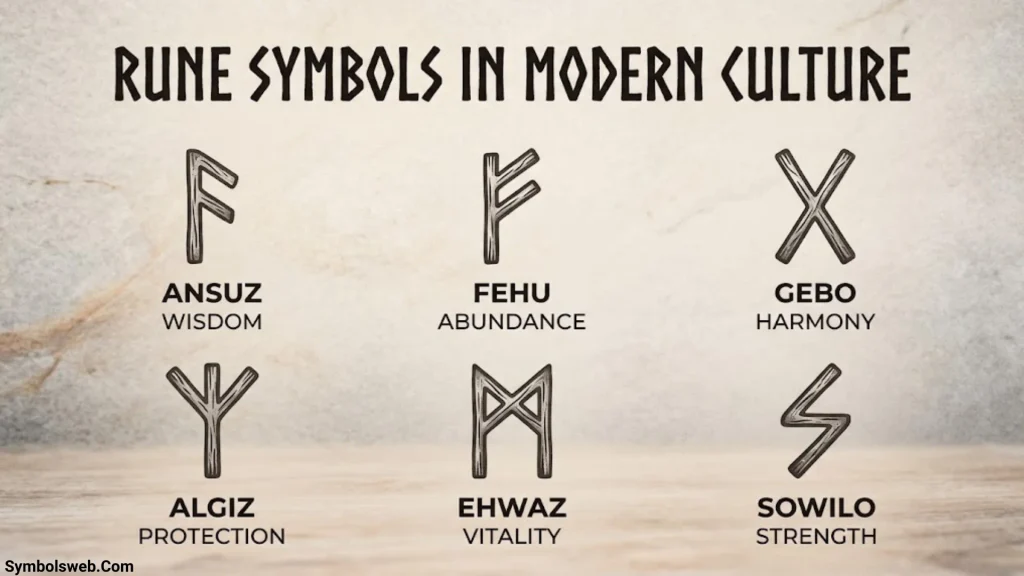
Rune symbols continue to appear in jewelry, tattoos, art, literature, games, and contemporary spiritual practices.
Some people choose a rune because of its reconstructed name or historical associations. Others use runes to represent personal values, commemorate an interest in Norse history, or create decorative designs.
Runes in Jewelry and Tattoos
Before using a rune in a tattoo or piece of jewelry, verify its character form and intended meaning.
A design based on the Elder Futhark should use the correct character for that system. If the goal is to reproduce a historical inscription, check the language, date, and spelling conventions as well.
It’s also worth researching the modern associations of a symbol. Some runic designs have been appropriated by Nazi and contemporary extremist movements.
That context doesn’t make every use of a runic character extremist. However, researching the particular design and the imagery surrounding it can help prevent unintended associations.
Runes in Norse Inspired Spirituality
Modern practitioners use rune symbols for meditation, journaling, divination, and personal rituals. Some connect the practice with Norse mythology, while others approach it as a personal symbolic system.
There is no single modern interpretation accepted by everyone. Different authors and practitioners may assign different themes to the same rune.
For that reason, it helps to identify the source of an interpretation before treating it as a traditional meaning.
Frequently Asked Questions About Rune Symbols
What Are Rune Symbols?
Rune symbols are characters used in historical Germanic writing systems. They represented sounds and appeared in inscriptions on objects such as stones, tools, jewelry, and weapons. Modern spiritual practices also use runes as symbols for reflection and divination.
What Are the 24 Elder Futhark Runes?
The 24 Elder Futhark runes are Fehu, Uruz, Thurisaz, Ansuz, Raidho, Kenaz, Gebo, Wunjo, Hagalaz, Nauthiz, Isa, Jera, Eihwaz, Perthro, Algiz, Sowilo, Tiwaz, Berkano, Ehwaz, Mannaz, Laguz, Ingwaz, Dagaz, and Othala.
What Is the Most Powerful Rune?
No rune has an objectively established ranking of spiritual power. Modern practitioners may consider Fehu, Algiz, Uruz, or other runes particularly meaningful, depending on their beliefs and interpretive system.
Which Rune Represents Protection?
Algiz is commonly associated with protection in modern rune-reading guides. Thurisaz and Eihwaz also appear in contemporary protective interpretations. These associations are symbolic and don’t guarantee physical or spiritual safety.
Which Rune Represents Wealth and Abundance?
Fehu is a popular choice because its reconstructed name is associated with cattle and movable wealth. Modern interpretations extend this association to prosperity, resources, and financial goals. Jera is often connected with harvest and gradual results.
Which Rune Represents Love?
Gebo is often associated with gifts and reciprocal relationships, while Wunjo represents joy in modern interpretations. Mannaz may also be used to reflect on human relationships and community. These are modern symbolic associations rather than universal historical definitions of love.
How Do You Read Rune Symbols for Beginners?
Start by learning the 24 Elder Futhark characters and their names. Choose a simple one-rune reading, consider the symbol’s historical associations and common modern interpretations, and record your thoughts in a journal.
What Is the Difference Between Rune Reading and Rune Casting?
Rune reading is the broader practice of interpreting rune symbols. Rune casting is one method in which people draw or scatter rune-marked pieces and interpret the results.
What Is a Reversed Rune?
A reversed rune appears upside down during a reading. Some modern practitioners assign it a different interpretation from the upright symbol, while others don’t use reversals. There is no universal historical rule requiring every rune to have a reversed meaning.
Is There a Blank Rune in the Elder Futhark?
No. The historical Elder Futhark contains 24 runes. The blank twenty-fifth rune belongs to a modern rune-reading system popularized by Ralph Blum in The Book of Runes.
Are Viking Runes and Elder Futhark Runes the Same?
No. The Elder Futhark predates the Viking Age, while the 16-character Younger Futhark is closely associated with Viking Age Scandinavia. The distinction matters when interpreting historical inscriptions.
Are Celtic Runes the Same as Ogham?
No. Runes belong to Germanic writing traditions, while Ogham is a distinct writing system associated with early Irish language and cultural history. The two systems shouldn’t be treated as interchangeable.
Can You Use Rune Symbols for Manifestation?
Some modern practitioners use rune symbols for intention-setting and personal reflection. For example, Fehu may represent resources and Jera may represent sustained effort. These symbolic practices don’t guarantee financial success or other outcomes.
How Do You Clean and Store Rune Stones?
Clean rune pieces according to their material. Keep wooden pieces away from excessive moisture and store the set in a pouch or container. Spiritual cleansing is optional and isn’t a historically established requirement for using runes.
Conclusion: Understanding Rune Symbols and Their Meanings
Rune symbols connect the history of early Germanic writing with a wide range of modern cultural and spiritual interpretations. The Elder Futhark’s 24 characters provide a useful starting point for learning rune names, approximate sounds, and commonly discussed symbolic associations.
However, understanding these symbols requires more than memorizing a list of meanings. Historical inscriptions, reconstructed rune names, medieval literature, and modern divination guides provide different kinds of evidence. Keeping those differences clear helps you appreciate the symbols without confusing modern interpretations with documented history.
If you’re studying Norse history, learning the Elder Futhark, exploring rune reading, or creating a personal symbol, start with reliable sources and a clear understanding of your chosen runic system. The most useful approach combines historical curiosity, thoughtful interpretation, and respect for the cultural context behind each symbol.

Eliana Foster is a writer with a passion for exploring the meanings behind symbols, traditions, and cultural history. She enjoys breaking down complex topics into simple, engaging articles that are easy for everyone to understand. Eliana is also the fictional author of The Hidden Language of Silent Marks and Beyond the Circle of Ancient Signs, two original book concepts created for her author profile. When she’s not writing, she loves visiting museums, reading about mythology, and researching the stories behind symbols from around the world. Her goal is to help readers discover the fascinating meanings hidden in everyday signs and ancient emblems.
 Ethan Holloway
 Jordan Hayes