
Satanic symbols and meanings can seem mysterious, dark, and even frightening when you first come across them. If you have ever seen an inverted pentagram, the Sigil of Baphomet, or an inverted cross and wondered what it really means, you are not alone. I want to help you look beyond the fear and understand the stories behind these powerful symbols.
When you explore their history, you will find that many symbols connected with Satanism have much older roots. Some come from religion, mythology, occult traditions, medieval folklore, and ancient cultures, while others became associated with modern Satanism much later. This makes their meanings far more complex than they may appear at first.
In this guide, I will take you through the history, spiritual ideas, psychology, cultural meanings, and modern uses of Satanic symbols. You will discover what these symbols can represent, why people are fascinated by them, and how their meanings have changed over time.
Satanic Symbols and Meanings: (Quick Answer)
Satanic symbols are images associated with Satan, Satanism, anti-Christian symbolism, occult traditions, or modern Satanic organizations. The best-known include the Sigil of Baphomet, inverted pentagram, inverted cross, and certain occult sigils. Their meanings vary by historical period and context, ranging from rebellion and individualism to ritual symbolism, religious inversion, and artistic provocation.
Quick Facts About Satanic Symbols and Meanings
| Aspect | Information |
| Origin | There is no single origin. Satanic symbolism developed from Christian imagery, occult traditions, medieval folklore, ceremonial magic, and modern Satanist movements. |
| Historical Significance | Many symbols now called satanic existed long before modern Satanism and had unrelated religious or magical meanings. |
| Main Meaning | Meanings commonly include opposition, rebellion, inversion, individualism, transgression, ritual identity, and confrontation with established religious authority. |
| Spiritual Meaning | Interpretations vary greatly. Some religious traditions see these images negatively, while some modern Satanists use them as philosophical or symbolic tools rather than signs of supernatural worship. |
| Cultural Importance | Satanic imagery has influenced occult art, literature, music, film, fashion, tattoos, and debates about religion and freedom of expression. |
| Modern Usage | Today, these symbols can appear in religious movements, art, entertainment, fashion, tattoos, jewelry, political expression, and popular culture. |
What Are Satanic Symbols?
Satanic symbols are visual signs, images, numbers, or designs that have become connected with Satan, Satanism, the Devil, demonic imagery, occult traditions, or opposition to conventional religious authority.
However, there is an important distinction.
A symbol that looks “satanic” is not necessarily a Satanic symbol.
The five-pointed pentagram is a good example. It has appeared in many religious, magical, artistic, and cultural settings. Its later association with Satanism developed through particular occult traditions and modern Satanic usage. The inverted pentagram became especially important in 19th-century European occultism and later in modern Satanism.
The same principle applies to the serpent, goat, inverted cross, and other images.
Symbols do not have one permanent meaning. The Library of Congress notes that symbols can have different interpretations depending on the source and context.
How Did Satanic Symbolism Develop?
The modern idea of Satanic symbolism is the result of several historical layers.
Christian art and theology developed visual representations of evil, temptation, demons, and opposition to God. Medieval and early modern writers added stories about witches, demons, magical practices, and heresy. Later, occult writers reused older symbols and developed new interpretations.
In the 19th century, occult writers such as Eliphas Lévi gave the pentagram an elaborate symbolic vocabulary. Lévi described the upright and inverted pentagram as capable of representing sharply different ideas depending on its orientation. His work became an important influence on later occult imagery.
Modern organized Satanism then gave some of these images a more recognizable identity.
The Church of Satan was founded by Anton Szandor LaVey in 1966. Its own historical materials identify the Sigil of Baphomet as its principal symbol and explain its development during the organization’s early years.
Deep Symbolic Meaning of Satanic Symbols
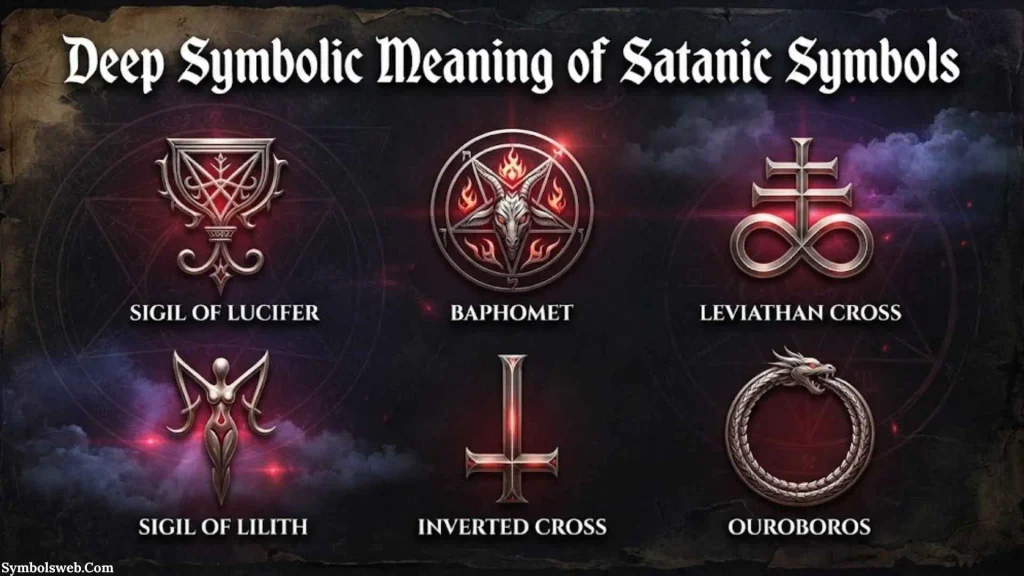
Spiritual Level
The spiritual meaning of a Satanic symbol depends heavily on who is using it.
In traditional Christian interpretations, Satan represents opposition to God, temptation, sin, or rebellion against divine authority. A Satanic image can therefore function as a warning or representation of spiritual danger.
Modern Satanist organizations can interpret the same imagery differently.
The Church of Satan, for example, describes its philosophy as atheistic and uses Satan as a symbol rather than presenting Satan as a supernatural being. Its official materials associate Satan with ideas such as individualism, opposition to conformity, and personal responsibility.
The Satanic Temple also describes itself through a non-theistic framework and publishes seven tenets emphasizing principles such as bodily autonomy, compassion, reason, and personal freedom.
Therefore, it is inaccurate to assume that every person displaying a Satanic symbol believes in a literal supernatural Satan.
Psychological Level
Satanic imagery can carry strong psychological power because it combines familiar religious imagery with reversal and transgression.
A person who sees an inverted cross or horned figure may immediately recognize it as a challenge to conventional religious expectations. That emotional reaction is part of the symbol’s cultural power.
From a psychological perspective, such imagery can represent:
- Rebellion against authority
- Independence
- Rejection of social conformity
- Curiosity about forbidden subjects
- Exploration of the shadow self
- Personal transformation
- Fear and fascination
- Identity formation
Jungian psychology can provide a useful interpretive framework here, although Jung did not create a definitive theory of “Satanic symbols.” The concept of the shadow, broadly understood as aspects of the personality that a person may reject or suppress, can help explain why dark or forbidden imagery sometimes becomes psychologically compelling.
This is an interpretation rather than a universal meaning.
Cultural Level
At the cultural level, Satanic symbols often communicate identity.
A symbol can tell others, “I reject this tradition,” “I value individual freedom,” “I am interested in occult history,” or simply “I want to challenge expectations.”
The same image can therefore mean something very different on a tattoo artist’s wall, in a horror movie, on an album cover, or inside a religious organization.
Types and Variations of Satanic Symbols
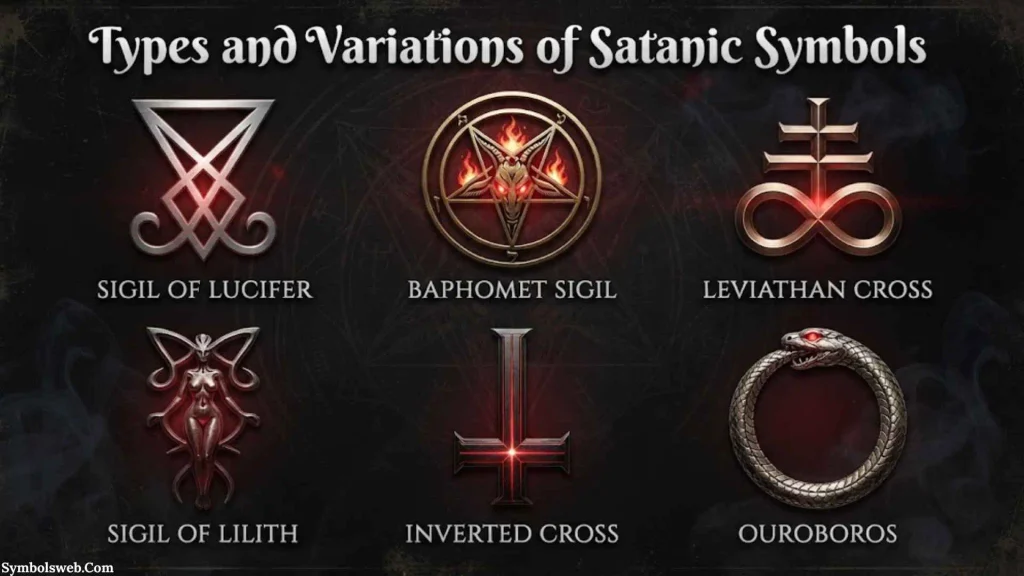
Sigil of Baphomet
Visual Description: A goat’s head appears inside an inverted pentagram, surrounded by circles and Hebrew lettering associated with the word “Leviathan” in the Church of Satan’s version.
Meaning: The Sigil of Baphomet is the best-known symbol specifically associated with the modern Church of Satan.
Symbolism: The Church of Satan describes the image as a combination of several historical and occult ideas. Its historical account connects the pentagram to older Pythagorean traditions, the goat imagery to the Goat of Mendes, and the surrounding symbolism to serpent and Leviathan traditions.
Cultural Connection: The image became widely recognizable through the Church of Satan’s use of it in the late 1960s.
Where It Appears: Satanic organizations, occult art, books, jewelry, tattoos, music, film, fashion, and popular culture.
An important historical detail is that the familiar modern image did not originate in antiquity as a complete “Satanic logo.” The Church of Satan’s own historical account traces important stages of the image through 19th- and early 20th-century occult publications before its adoption by Anton LaVey’s organization.
Inverted Pentagram
Visual Description: A five-pointed star is positioned with two points upward and one point downward.
Meaning: In modern Western occultism and Satanic imagery, the inverted pentagram can represent inversion, the material world, opposition, or the goat’s head.
Symbolism: Eliphas Lévi’s 19th-century writings helped establish an influential occult interpretation of pentagram orientation.
Cultural Connection: The inverted pentagram became increasingly connected with Satanic imagery during the modern occult revival and later through popular culture.
Where It Appears: Occult literature, modern Satanic imagery, horror films, heavy metal artwork, tattoos, jewelry, and fictional depictions of demons.
The pentagram itself is much older than Satanism, so calling every pentagram a Satanic symbol is historically inaccurate.
Goat Head
Visual Description: A goat or horned human-like face, sometimes depicted with a beard, horns, and intense eyes.
Meaning: The goat can represent wildness, nature, sexuality, rebellion, fertility, or the Devil depending on context.
Symbolism: In modern Satanic imagery, the goat is strongly connected with Baphomet and the inverted pentagram.
Cultural Connection: Goat imagery has a much longer history than modern Satanism. Its connection to Baphomet developed through medieval allegations, Renaissance and later occult literature, and 19th-century occult reinterpretations.
Where It Appears: Occult art, religious polemics, fantasy, horror, tattoos, album covers, and modern Satanic organizations.
Inverted Cross
Visual Description: A Christian cross is displayed upside down.
Meaning: In modern popular culture it can symbolize rejection or inversion of Christianity.
Historical Note: The upside-down cross does not inherently mean Satanism. Christian tradition associates an inverted cross with Saint Peter, who was traditionally believed to have been crucified upside down. The Church of Satan itself acknowledges this historical meaning while noting that Satanists may use the image for their own purposes.
Cultural Connection: Horror movies and popular culture helped turn the inverted cross into a familiar shorthand for Satanic imagery.
Where It Appears: Horror films, heavy metal, gothic fashion, tattoos, artwork, religious debate, and fiction.
Serpent
Visual Description: A snake or dragon, sometimes shown coiled in a circle or surrounding another symbol.
Meaning: The serpent can represent knowledge, transformation, danger, healing, rebirth, temptation, or hidden wisdom.
Symbolism: In Christian contexts, the serpent became strongly associated with temptation through the Genesis narrative. But serpent symbolism existed across many cultures long before modern Satanism.
Cultural Connection: Serpents can symbolize both positive and negative forces. The ancient Egyptian and Mesopotamian worlds, for example, used snakes and serpent-like beings in varied religious contexts.
Where It Appears: Mythology, religious art, occult symbolism, fantasy, tattoos, jewelry, literature, and modern Satanic imagery.
Leviathan
Visual Description: Leviathan is commonly represented as a huge serpent or sea monster.
Meaning: In biblical tradition, Leviathan is a powerful primordial creature associated with chaos and the sea.
Satanic Connection: Modern occult and Satanic imagery sometimes incorporates Leviathan symbolism. The Church of Satan’s Sigil of Baphomet includes the Hebrew name “Leviathan” around its central image.
Where It Appears: Biblical studies, mythology, occult literature, fantasy, tattoos, gaming, music, and modern Satanic art.
Occult Sigils
Visual Description: Abstract geometric designs, letters, lines, circles, or specially constructed signs.
Meaning: A sigil may represent a spirit, concept, magical intention, organization, or personal idea.
Symbolism: Not every occult sigil is Satanic. Many come from ceremonial magic, grimoires, astrology, or modern magical practices.
Cultural Connection: Sigils became particularly prominent in European occult traditions and later appeared throughout modern esoteric culture.
Where It Appears: Occult manuscripts, magical practice, tattoos, jewelry, books, games, music, and contemporary art.
Satanic Symbols Across Different Cultures
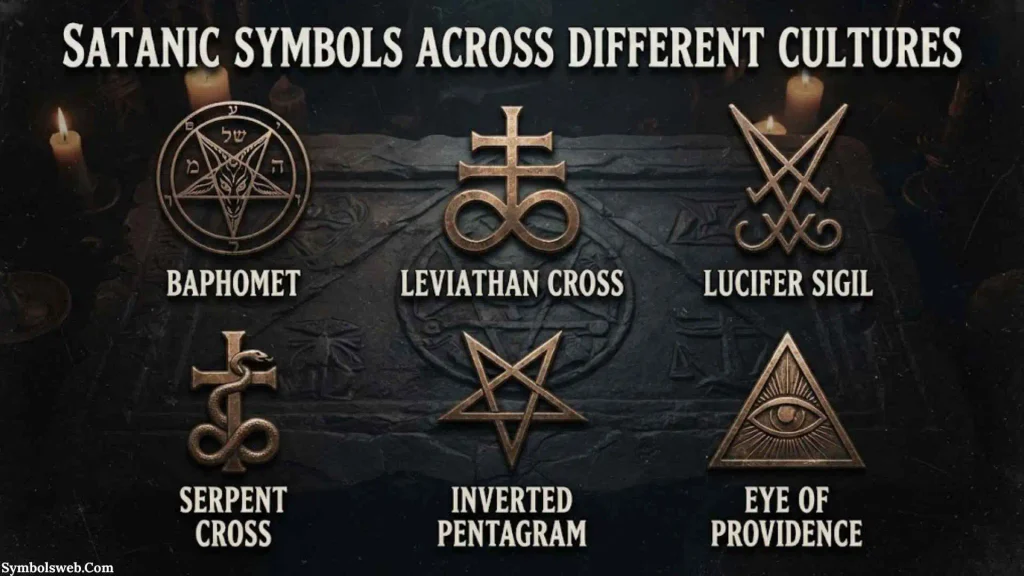
Ancient Egypt
Ancient Egyptian religion did not have “Satanic symbols” in the modern sense.
Egyptian religion contained complex ideas about gods, demons, death, protection, chaos, and cosmic order. Symbols were often connected with specific deities and religious concepts.
For example, the djed pillar represented permanence and later became associated with Osiris and his backbone. It was used in funerary contexts and had nothing inherently to do with modern Satanism.
The modern association between Egyptian imagery and Satanism is therefore largely a later cultural development.
Ancient Greece
Ancient Greek religion included gods and creatures that later influenced European ideas about demons and the Devil.
The horned and goat-like appearance of Pan, for example, became visually important in later Western representations of the Devil. That does not mean Pan was a Satanic figure in ancient Greek religion.
This is an important example of how cultures can reinterpret older religious images.
Roman Culture
Roman religion contained a large collection of gods, spirits, household deities, protective figures, and supernatural beings.
As Christianity expanded through the Roman world, some older pagan imagery was reinterpreted through Christian ideas about false gods, demons, or paganism.
Later European artists and writers sometimes borrowed these older visual traits when depicting the Devil.
Eastern Traditions
Eastern religions contain many symbols that Western audiences may misunderstand when viewed without context.
Buddhist and Hindu traditions, for example, use complex imagery involving deities, demons, cosmic cycles, death, transformation, and destruction.
A frightening figure is not automatically Satanic.
In Buddhist art, symbols can communicate major religious events and doctrines. For example, the wheel or cakra became a major Buddhist symbol associated with the Buddha’s teaching and important events in his life.
Indigenous Traditions
Indigenous cultures across the world have their own systems of sacred symbols, spirits, animals, ancestors, and cosmological ideas.
It is misleading to place these traditions into a Western “Satanic” framework simply because they contain frightening creatures, skulls, horns, snakes, or underworld imagery.
Symbols should be interpreted within the culture that created them.
Modern Interpretations
Modern Satanic symbolism is largely a Western cultural phenomenon shaped by Christianity, European occultism, modern Satanism, literature, music, cinema, and popular culture.
The Church of Satan was founded in 1966, while the Satanic Temple represents a separate modern Satanic organization with its own beliefs and symbolism. The two organizations should not be treated as interchangeable.
Similar Symbols and Their Meanings
| Symbol | Common Association | Important Difference |
| Inverted pentagram | Satanism, occultism, inversion | The pentagram itself predates modern Satanism. |
| Sigil of Baphomet | Church of Satan, modern Satanism | A specific modern emblem, not an ancient universal Satanic symbol. |
| Inverted cross | Anti-Christian imagery, Satanism in popular culture | Historically also associated with Saint Peter. |
| Serpent | Temptation, transformation, occultism | Serpent symbolism is ancient and appears in many unrelated religions. |
| Goat head | Baphomet, Devil, occultism | Goat imagery existed in mythology long before modern Satanism. |
| Leviathan | Chaos, sea monster, occult symbolism | Originates in ancient Hebrew and biblical traditions. |
| Occult sigils | Magic, spirits, esotericism | Most occult sigils are not specifically Satanic. |
Common Misconceptions
One of the biggest mistakes in studying Satanic symbols is assuming that appearance equals meaning.
A star is not automatically Satanic.
A snake is not automatically demonic.
A goat is not automatically a symbol of evil.
An upside-down cross is not historically exclusive to Satanism.
The meaning depends on history, orientation, surrounding imagery, creator, community, and intended use.
Satanic Symbols in Mythology and Folklore
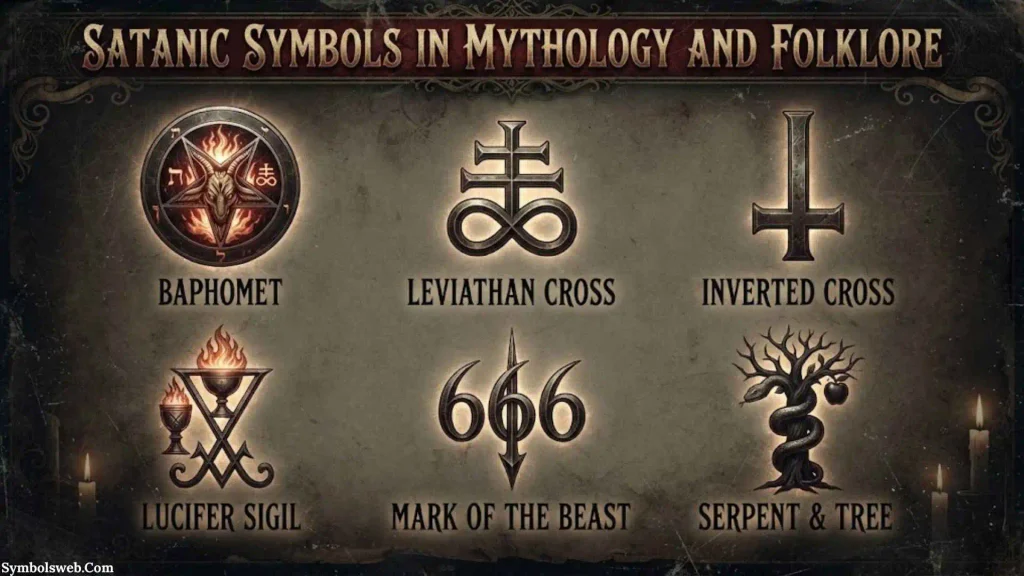
The modern visual image of Satan developed gradually.
The biblical Satan is not identical to every later European image of the Devil. Over centuries, Christian art and folklore brought together multiple visual traditions.
The Devil eventually became associated with features such as:
- Horns
- Hooves
- A tail
- Red or dark skin
- A pitchfork
- Goat-like features
- Fire
- Serpents
- Underworld imagery
Some of these features were influenced by older pagan and mythological figures.
Baphomet has a particularly complicated history.
The name appears in medieval records connected with the trials of the Knights Templar, but the historical evidence does not establish that the famous goat-headed image existed among the Templars. The familiar goat-and-pentagram image developed much later through occult literature. The Church of Satan’s own historical account traces major stages of that development through Eliphas Lévi, Stanislas de Guaita, Oswald Wirth, and eventually Anton LaVey.
This distinction matters because popular culture often compresses centuries of history into a single fictional story.
Satanic Symbols in Art, Literature, Movies and Pop Culture
Paintings and Visual Art
Artists have long used demons, monsters, serpents, horns, darkness, and inverted religious imagery to explore themes such as temptation, mortality, sin, rebellion, and human fear.
The symbol may therefore function as an artistic metaphor rather than a declaration of religious belief.
Literature
Satan became a major literary character in Western literature.
John Milton’s Paradise Lost, for example, helped shape later cultural ideas about Satan as a dramatic, rebellious, charismatic figure.
Later Gothic literature expanded the connection between darkness, forbidden knowledge, supernatural beings, and rebellion.
Movies and Television
Film and television often use Satanic symbols because they communicate danger instantly.
An inverted cross, pentagram, horned figure, or occult circle can establish a supernatural atmosphere without lengthy explanation.
This has also created confusion because fictional symbolism is often treated as historical fact.
Music
Satanic imagery became especially prominent in heavy metal, extreme metal, gothic music, and related subcultures.
In some cases it represents genuine philosophical or religious identification. In others, it functions as theatrical rebellion, horror imagery, shock value, or artistic storytelling.
Tattoos
Satanic tattoos can express very different things.
Someone might choose a pentagram because of occult interest. Another person might choose Baphomet as a symbol of individualism. Someone else might simply appreciate the dark aesthetic.
A tattoo therefore cannot reliably reveal someone’s beliefs without knowing the person’s own explanation.
Fashion and Modern Design
Dark religious imagery has become a recurring element of alternative fashion, gothic clothing, jewelry, album artwork, graphic design, and streetwear.
Once a symbol enters fashion, its meaning can become less religious and more aesthetic.
Spiritual and Dream Meaning of Satanic Symbols
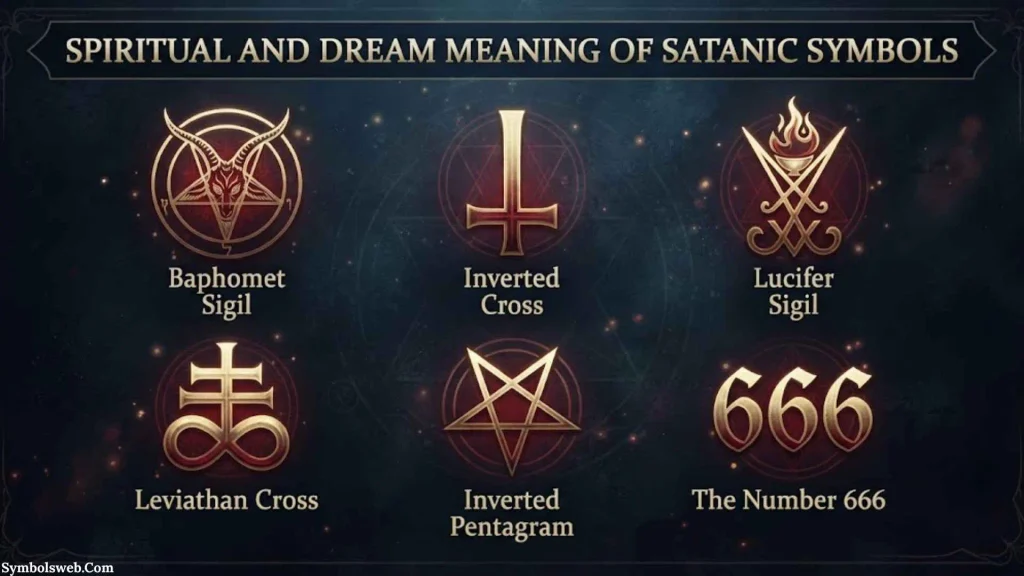
Dream symbolism should be approached carefully.
There is no scientifically established universal dream dictionary in which a pentagram, Devil, goat, or serpent always means one particular thing.
Instead, dream interpretation depends on personal associations.
Seeing a Satanic Symbol in a Dream
A Satanic symbol in a dream might reflect:
- Fear of losing control
- Conflict with authority
- Religious concerns
- Curiosity about taboo subjects
- Personal rebellion
- Anxiety
- A desire for independence
- Exposure to horror or occult imagery
For one person, a devil image might feel frightening. For another, it might represent freedom from restrictive expectations.
Meditation and Spiritual Experiences
People sometimes report seeing geometric shapes, religious imagery, animals, or archetypal figures during meditation or altered states of attention.
Such experiences can feel deeply meaningful.
However, a personal spiritual interpretation should not automatically be presented as proof of a supernatural event. The experience is real as a personal experience, while its ultimate explanation may remain uncertain.
Positive and Negative Meanings of Satanic Symbols
| Positive Meaning | Negative Meaning |
| Individual freedom | Rebellion without purpose |
| Independence | Defiance |
| Self knowledge | Obsession |
| Personal transformation | Fear |
| Questioning authority | Rejection of community |
| Critical thinking | Isolation |
| Acceptance of human nature | Excess or destructive behavior |
| Creative expression | Provocation for its own sake |
A symbol can contain both “light” and “shadow” depending on context.
For example, rebellion can mean courageous independence in one situation and harmful recklessness in another.
This is why symbolic interpretation requires context rather than a simple good-versus-evil label.
Why Humans Are Attracted to Satanic Symbols
Why do images considered dark or forbidden attract so much attention?
Part of the answer is simple human curiosity.
People are naturally interested in boundaries. When a symbol is presented as forbidden, dangerous, or taboo, it can become even more fascinating.
Rebellion and Identity
For some people, Satanic imagery communicates independence.
The symbol becomes a visual way of saying, “I will decide what I believe.”
Pattern Recognition
Humans are highly sensitive to faces, geometric patterns, symmetry, eyes, animals, and familiar religious forms.
A goat face inside a geometric star is visually powerful because several recognizable elements are combined into one striking image.
Cultural Memory
Centuries of religious art, folklore, literature, horror stories, and films have given certain images powerful emotional associations.
A horned figure may trigger a reaction before a person consciously thinks about its historical origin.
The Appeal of the Forbidden
Forbidden subjects often create curiosity.
The same psychological principle appears in fascination with ghosts, haunted places, occult books, secret societies, death symbolism, and supernatural folklore.
Interest does not automatically equal belief.
Modern Uses of Satanic Symbols
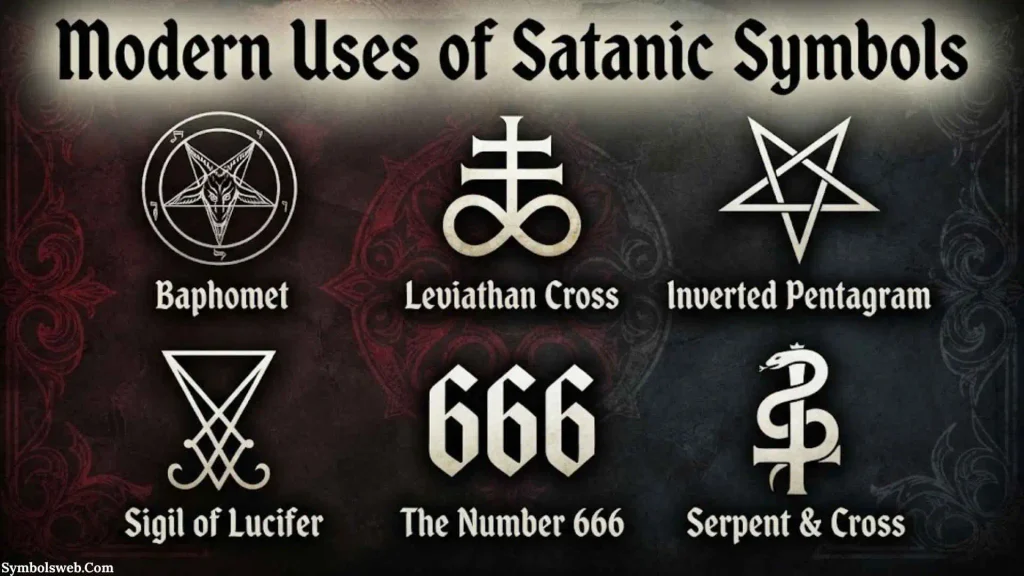
Tattoos
Satanic and occult tattoos can represent personal philosophy, rebellion, aesthetics, mythology, music culture, or spiritual identity.
Jewelry
Pentagrams, Baphomet imagery, serpents, inverted crosses, and occult sigils are commonly used in alternative jewelry.
The intended meaning depends on the wearer.
Fashion
Gothic and alternative fashion often borrows religious and occult imagery for dramatic visual effect.
Social Media
Satanic imagery is frequently used in profile pictures, memes, artwork, music promotion, and identity-based communities.
Digital culture can also strip symbols of their original historical meaning and turn them into visual trends.
Contemporary Spirituality
Some modern Satanists use Satanic symbolism within explicit philosophical or religious frameworks.
The Church of Satan describes itself as an atheistic philosophy and uses Satan as a symbol rather than a supernatural deity.
The Satanic Temple is a separate organization whose published principles include bodily autonomy, reason, compassion, and personal freedom.
Home Decor
Occult and Satanic imagery can also appear as posters, artwork, sculptures, candles, books, and decorative objects.
Here again, decoration does not necessarily indicate religious commitment.
Interesting Facts About Satanic Symbols
- The pentagram did not originate as a Satanic symbol. It has a long history in different religious, philosophical, magical, and artistic contexts.
- The familiar Sigil of Baphomet is relatively modern. Its development as a recognizable Satanic emblem belongs largely to 19th- and 20th-century occultism and modern Satanism.
- The inverted cross has a Christian history. It has traditionally been associated with Saint Peter’s martyrdom.
- Baphomet and Satan are not historically identical figures. Their connection developed through layers of medieval accusations, occult literature, and modern Satanic interpretation.
- The Church of Satan was founded in 1966. Anton LaVey established the organization and made the Sigil of Baphomet central to its identity.
- The Satanic Temple and Church of Satan are different organizations. They have distinct histories, philosophies, and organizational identities.
- A frightening symbol is not necessarily a Satanic symbol. Many cultures use skulls, serpents, monsters, darkness, or death imagery without any connection to Satanism.
- Symbols can change meaning over time. The Library of Congress specifically notes that sources may disagree about what symbols mean, making historical context essential.
- Modern popular culture has simplified Satanic imagery. Movies, music, games, and horror fiction often combine different historical symbols into a single fictional visual language.
- The Sigil of Baphomet has become one of the most recognizable images associated with modern Satanism. The Church of Satan identifies it as its official insignia.
Frequently Asked Questions
What is the most famous Satanic symbol?
The Sigil of Baphomet, featuring a goat’s head within an inverted pentagram, is among the most recognizable symbols associated with modern Satanism. It became particularly identified with the Church of Satan after its adoption in the late 1960s.
What does an inverted pentagram mean?
An inverted pentagram can represent Satanic or occult ideas in modern Western culture, including inversion, opposition, and the goat imagery associated with Baphomet. However, the pentagram itself is an ancient symbol with many meanings unrelated to Satanism.
Is every pentagram a Satanic symbol?
No. The pentagram has been used in many historical and religious contexts. Its meaning depends on orientation, surrounding imagery, culture, period, and intended use.
Does an upside-down cross always mean Satanism?
No. Although popular culture often uses the inverted cross as Satanic imagery, Christian tradition has also associated the inverted cross with Saint Peter. The Church of Satan itself acknowledges this historical meaning.
What does Baphomet mean?
Baphomet is a complex historical and occult figure whose name appears in medieval records associated with the Knights Templar. The famous goat-headed image associated with Baphomet developed much later, especially through 19th-century occultism. It should not simply be treated as an ancient image of Satan.
Are Satanic symbols always connected with evil?
Not necessarily. Their meaning depends on the person, organization, culture, and context. Some modern Satanists use Satanic symbols philosophically or symbolically rather than as representations of a supernatural evil being.
Conclusion
Satanic symbols and meanings cannot be understood by looking at a picture alone. Their stories stretch across Christianity, ancient mythology, medieval folklore, ceremonial magic, modern Satanism, literature, music, and popular culture.
The most important lesson is that symbols evolve. A pentagram can have one meaning in an ancient text, another in an occult book, and another on a modern tattoo.
Behind every supposedly “dark” symbol is a larger human story about fear, faith, rebellion, identity, imagination, and the desire to understand what lies beyond familiar boundaries.

Jordan Hayes is a writer with a passion for exploring the history, meanings, and cultural significance behind symbols from around the world. He enjoys turning complex topics into clear, engaging content that anyone can understand. Jordan is also the fictional author of The Silent Language of Ancient Marks and Hidden Symbols Beyond the Surface, two original book concepts created for his author profile. When he’s not writing, he spends time researching myths, traditions, and forgotten stories that inspire his work. His goal is to help readers discover the deeper meanings behind the symbols they encounter every day.
 Eliana Foster
 Ethan Holloway