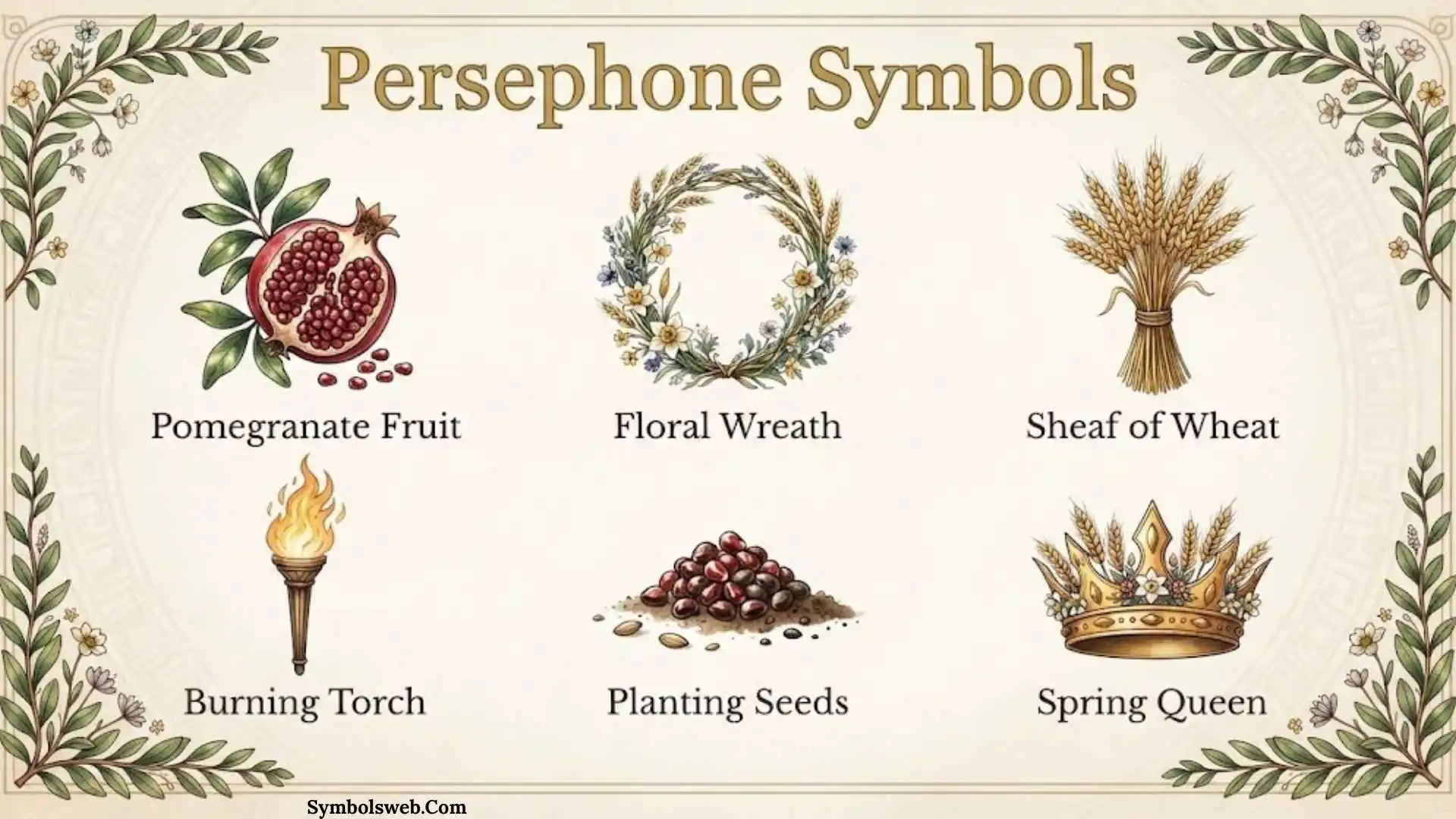
When I first explore Persephone symbols, I find that each one reveals a different part of Persephone’s story. From pomegranates and flowers to torches and wheat, these symbols connect her with love, transformation, nature, death, and rebirth. If you want to understand Greek mythology more deeply, learning what these symbols represent can make Persephone’s story much more meaningful.
You may already know Persephone as the Greek goddess associated with the Underworld and the daughter of Demeter. However, her mythology goes far beyond that simple description. When you look closely at her symbols, you can see the contrast between her life above and below the earth, as well as the powerful themes of seasonal change, feminine strength, and renewal.
In this guide, I’ll explain the most important Persephone symbols and their meanings in a simple and practical way. You’ll discover where these symbols appear in her mythology, what they represent, and why they continue to fascinate people today. Whether you’re new to Greek mythology or you simply want to learn more about Persephone, you can use this guide to understand her symbolism with greater clarity.
Persephone Symbols: (Quick Answer)
If you want a quick answer, Persephone symbols mainly represent transformation, fertility, death, rebirth, and the changing seasons. The pomegranate is one of her most important symbols because it connects her to the Underworld and her return to the world above. Flowers, wheat, torches, and the crown also reflect different parts of her mythology and identity.
When you explore these symbols, you can see how Persephone represents both life and death. I can use her symbols to understand the balance between darkness and renewal, while you can see why her story remains one of the most powerful myths in Greek mythology.
Quick Facts About Persephone Symbols
| Aspect | Information |
| Origin | Ancient Greek mythology and the cult of Demeter and Persephone |
| Historical Significance | Closely connected with the Persephone myth and the Eleusinian Mysteries |
| Main Meaning | Transformation, seasonal renewal, life, death, and return |
| Spiritual Meaning | Inner growth, descent, rebirth, acceptance of change, and transition |
| Cultural Importance | Especially important in Greek religion, art, funerary traditions, and mystery cults |
| Modern Usage | Tattoos, jewelry, artwork, literature, modern spirituality, fashion, and symbolic design |
What Are Persephone Symbols?
Persephone symbols are the objects and images traditionally connected with Persephone, the daughter of Demeter and the wife of Hades. In Greek mythology, Persephone occupies an unusual position because she belongs to two worlds. She is associated with the living earth and springtime, but she is also queen of the Underworld.
This dual identity explains why Persephone symbols often carry two meanings at once.
A flower can represent youth and beauty, but in her story flowers also appear immediately before her descent into the Underworld. A pomegranate can suggest fertility because it contains many seeds, yet eating its seeds binds Persephone to the realm of the dead. A torch can illuminate darkness, but it also recalls the search for Persephone during the Eleusinian story.
The best-known ancient literary source for the story is the Homeric Hymn to Demeter, generally dated to the 7th or 6th century BCE. The hymn tells how Persephone was taken by Hades while gathering flowers, how Demeter searched for her, and how Persephone’s return became connected with the cycle of growth and the Eleusinian religious tradition.
Over time, Greek and Roman artists developed many visual ways to represent her. In Roman culture, Persephone was identified with Proserpina, while Hades was associated with Pluto.
It is important, however, to distinguish ancient evidence from modern symbolism. Ancient Greeks did not necessarily assign one fixed meaning to every modern “Persephone symbol.” Some associations are strongly supported by mythology and archaeological evidence, while others are modern interpretations inspired by her story.
Deep Symbolic Meaning of Persephone Symbols
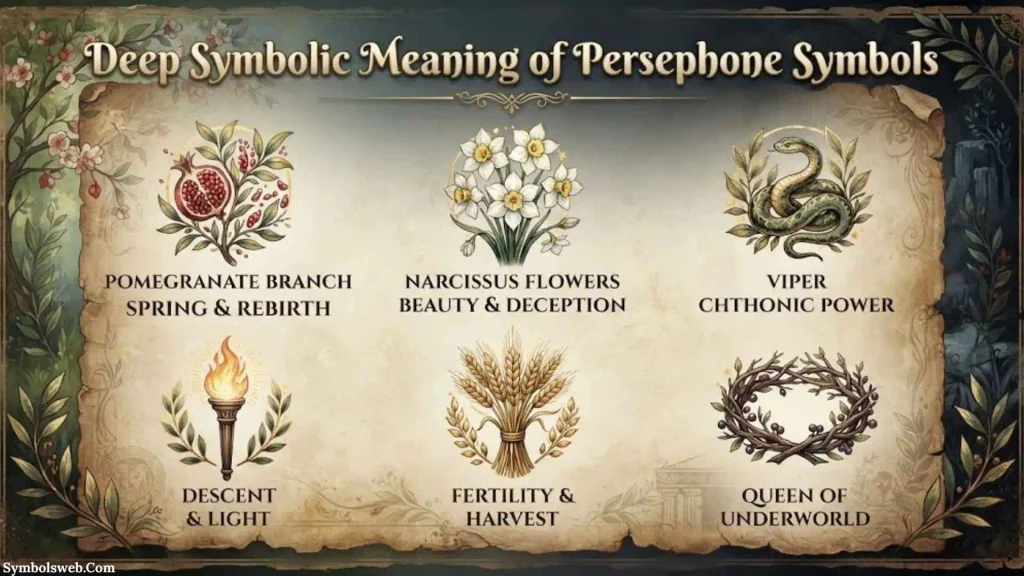
Spiritual Level
On a spiritual level, Persephone can symbolize a journey through profound change.
Her story begins with innocence and flowers, moves through separation and darkness, and eventually reaches a new form of power. She does not simply return to the person she was before. Her experience changes her identity.
This makes Persephone meaningful to people who think about:
- Personal transformation
- Spiritual growth
- Rebirth
- Facing difficult periods
- Moving through grief
- Accepting change
- Discovering inner strength
- Returning to the light after darkness
Her story can therefore be read as a symbolic journey of descent and return.
If you are going through a major transition in your own life, you might see Persephone as an image of becoming rather than remaining unchanged.
Psychological Level
Persephone also has strong psychological appeal because her story contains several opposing forces.
She is associated with:
- Youth and maturity
- Freedom and captivity
- Light and darkness
- Mother and partner
- Life and death
- Innocence and experience
- The conscious world and the hidden world
From a Jungian perspective, modern readers may interpret her Underworld journey as a descent into the unconscious or the parts of ourselves that we usually avoid.
This is a modern psychological interpretation, not a statement that ancient Greeks used Jungian psychology. Carl Jung lived thousands of years after the Greek myths developed.
Still, the story gives you a useful psychological metaphor. Sometimes personal growth requires you to confront fear, grief, loss, uncertainty, or hidden parts of your personality before you can emerge with a stronger sense of self.
Cultural Level
In ancient Greek culture, Persephone’s importance was closely connected with Demeter, agriculture, the seasonal cycle, and religious traditions surrounding death and the hope for a better existence after death.
The Eleusinian Mysteries were especially important. At Eleusis, Demeter and Persephone were worshipped together, and initiates participated in secret religious rites. Modern scholars know some broad features of the cult, but much of what actually happened inside the central initiation remains unknown because participants were expected to keep the mysteries secret.
That mystery is part of what makes Persephone’s symbolism so enduring.
Types and Variations of Persephone Symbols
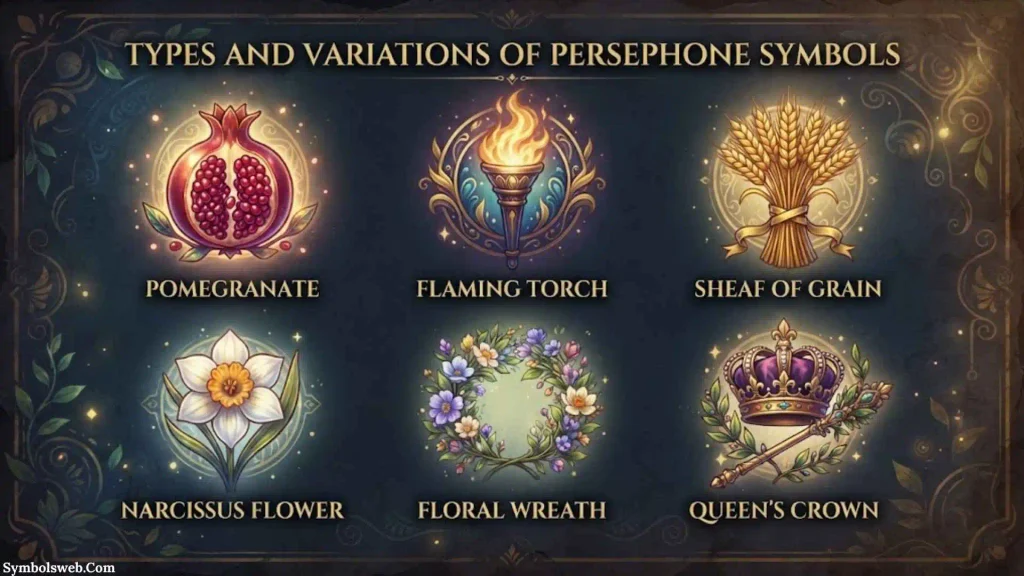
Pomegranate
Visual Description: A round red fruit filled with numerous seeds.
Meaning: Life, death, fertility, binding, transition, and the connection between the living world and the Underworld.
Symbolism: The pomegranate is probably the most famous Persephone symbol. After eating pomegranate seeds in the Underworld, Persephone could not remain permanently in the world above. The exact number of seeds varies across ancient and later versions of the story. The Homeric Hymn indicates that she ate the fruit, while later traditions provide different numbers.
Cultural Connection: Pomegranates were also associated with funerary beliefs in Greek art. The Metropolitan Museum of Art notes that the fruit had particular funerary and ritual associations and that its connection with Persephone is especially clear.
Where It Appears: Greek art, votive objects, funerary contexts, mythology, modern tattoos, jewelry, and contemporary spiritual artwork.
Flowers
Visual Description: Flowers such as narcissus, crocus, violets, roses, and other meadow flowers.
Meaning: Youth, beauty, spring, innocence, attraction, and the beginning of transformation.
Symbolism: Persephone was gathering flowers when Hades carried her away. The Homeric Hymn specifically names several flowers in the meadow scene.
Flowers therefore mark the beginning of Persephone’s transition.
Cultural Connection: The flower meadow is also important because it creates a dramatic contrast between the beauty of the surface world and the darkness that follows.
Where It Appears: Ancient vase painting, literature, poetry, paintings, tattoos, floral designs, and modern Persephone artwork.
Torch
Visual Description: A burning torch or pair of torches.
Meaning: Guidance, searching, revelation, transition, and finding one’s way through darkness.
Symbolism: Torches are particularly important in traditions surrounding Demeter, Persephone, and the Eleusinian Mysteries. In ancient artistic representations, Persephone may appear holding a torch, and the Eleusinian initiation involved torch-bearing and movement from darkness toward illumination.
Cultural Connection: Hekate, another important figure in the mythic tradition, is also strongly associated with torches. Ancient art can therefore combine Persephone, Demeter, Hekate, and Hermes in scenes related to her return.
Where It Appears: Greek art, Eleusinian imagery, mythology, modern spiritual artwork, tattoos, and jewelry.
Grain and Wheat
Visual Description: Wheat, grain ears, seeds, and agricultural plants.
Meaning: Agriculture, nourishment, fertility, growth, and human survival.
Symbolism: Grain is more directly associated with Demeter, but it belongs to the wider symbolic world of Demeter and Persephone. Their mythology was deeply connected with the agricultural cycle and the renewal of plant life.
The Great Eleusinian Relief, for example, depicts Demeter and Persephone with Triptolemos, a figure associated with the transmission of agriculture to humanity.
Where It Appears: Ancient religious art, vase painting, sculpture, agricultural symbolism, and modern mythology-inspired artwork.
Crown
Visual Description: A goddess’s headdress or crown, sometimes combined with other divine attributes.
Meaning: Authority, sovereignty, maturity, and divine status.
Symbolism: Persephone’s identity changes when she becomes queen of the Underworld. Her crown can therefore be interpreted as a visual expression of her authority.
Ancient Greek representations sometimes show figures identified as Persephone wearing a polos, a tall cylindrical headdress associated with goddesses.
Underworld
Visual Description: Darkness, caves, underground spaces, gates, shadows, or the realm of Hades.
Meaning: Death, mystery, hidden knowledge, transformation, and the unknown.
Symbolism: The Underworld is not simply a symbol of death in Persephone’s story. It is also the place where her identity changes.
Her descent makes the Underworld a symbolic threshold between one stage of life and another.
Pomegranate Seeds
The seeds deserve special attention because they are more specific than the whole fruit.
A single pomegranate contains many seeds, making it a natural image of fertility and abundance. Yet within the Persephone myth, consuming the seeds creates a lasting bond between Persephone and the Underworld.
This produces one of the myth’s most powerful contradictions:
The same fruit can symbolize abundance and death, desire and restriction, life and the realm of the dead.
Persephone Symbols Across Different Cultures
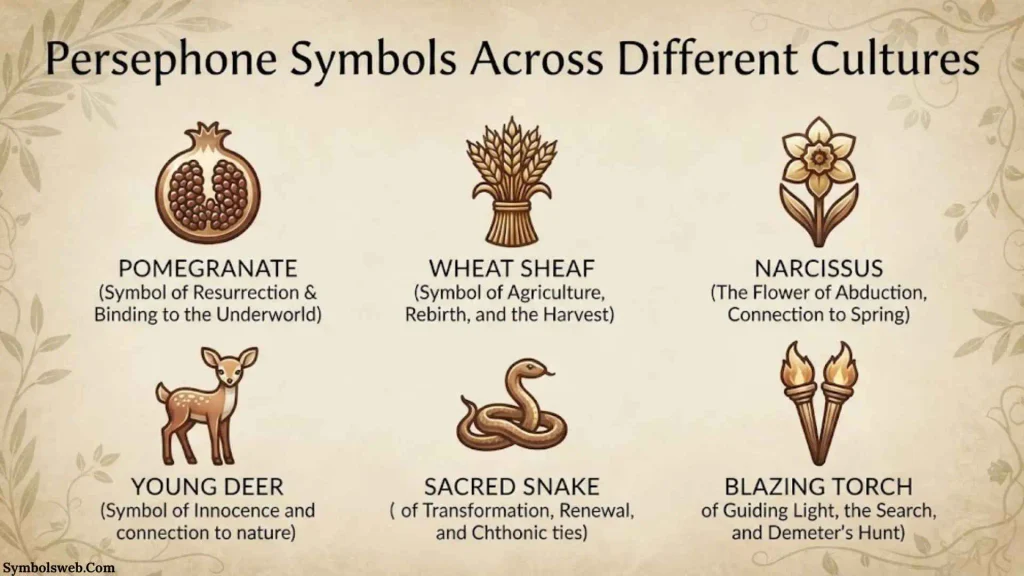
A careful approach is important here. Persephone is specifically a Greek goddess, so not every culture has an authentic traditional set of “Persephone symbols.”
Ancient Greece
Ancient Greece is the primary cultural setting for Persephone.
She was known as Kore, meaning “maiden,” as well as Persephone. Her story was closely tied to Demeter, agriculture, seasonal change, death, and the Eleusinian Mysteries.
Important Greek associations include:
- Pomegranate
- Flowers
- Grain
- Torches
- Underworld
- Marriage
- Seasonal renewal
- Mother-daughter relationship
Ancient Egypt
There is no ancient Egyptian tradition in which Persephone herself was a native goddess.
However, pomegranates existed in ancient Egyptian culture and appear in Egyptian archaeological material. The Metropolitan Museum, for example, records a New Kingdom Egyptian pomegranate pendant dating to the reign of Amenhotep III.
That does not mean Egyptians worshipped Persephone or used the fruit specifically as a Persephone symbol.
So if you encounter websites claiming that Persephone’s symbols were traditional Egyptian symbols, you should treat those claims carefully.
Roman Culture
The Romans associated Persephone with Proserpina.
Her story continued in Roman literature and art, including Ovid’s Metamorphoses. Roman artistic traditions helped carry the myth forward into later European culture.
The Metropolitan Museum notes that Ovid’s account of Proserpina’s abduction became an important source for later representations of the story.
Eastern Traditions
Persephone does not belong to Eastern religious traditions.
However, modern readers sometimes compare her story with other myths involving seasonal change, descent, death, or renewal. These comparisons can be useful for understanding recurring human themes, but they should not be presented as proof that the traditions are historically connected.
Indigenous Traditions
There is no single Indigenous tradition that can accurately be described as having “Persephone symbols.”
Indigenous cultures around the world have their own complex stories concerning seasons, death, ancestors, fertility, and renewal. Those traditions should be understood on their own terms rather than being treated as versions of the Persephone myth.
Modern Interpretations
Today, Persephone’s symbolism has expanded beyond ancient Greek religion.
You may encounter Persephone in:
- Modern pagan spirituality
- Feminist mythology
- Psychological writing
- Poetry
- Fiction
- Tattoos
- Jewelry
- Gothic fashion
- Fantasy art
- Social media
- Modern spiritual practices
These interpretations can be meaningful, but they are modern uses rather than direct evidence of ancient Greek beliefs.
Similar Symbols and Their Meanings
| Symbol | Connection to Persephone | Main Meaning |
| Pomegranate | Central mythological object | Death, fertility, transition |
| Flower | Present at her abduction | Beauty, youth, spring |
| Torch | Connected with Eleusinian imagery | Guidance and revelation |
| Grain | Connected with Demeter | Agriculture and renewal |
| Underworld | Her realm with Hades | Death, mystery, transformation |
| Crown | Represents divine status | Authority and sovereignty |
| Seed | Related to agricultural cycles | Potential and rebirth |
| Snake | Appears in some related chthonic imagery | Renewal, earth, mystery |
Persephone vs. Demeter
Persephone and Demeter are closely connected but represent different aspects of the myth.
Demeter is strongly associated with agriculture, grain, motherhood, and the nourishment of life.
Persephone embodies the movement between the world above and the Underworld.
Their relationship is central to the story. Demeter’s grief affects the earth, while Persephone’s return marks the restoration of growth.
Persephone vs. Hades
Hades represents the Underworld and the realm of the dead.
Persephone is its queen, but she also remains connected to the living world.
That is why the pair can symbolize opposing forces:
- Death and life
- Darkness and light
- Below and above
- Permanence and change
- Separation and reunion
Persephone Symbols in Mythology and Folklore
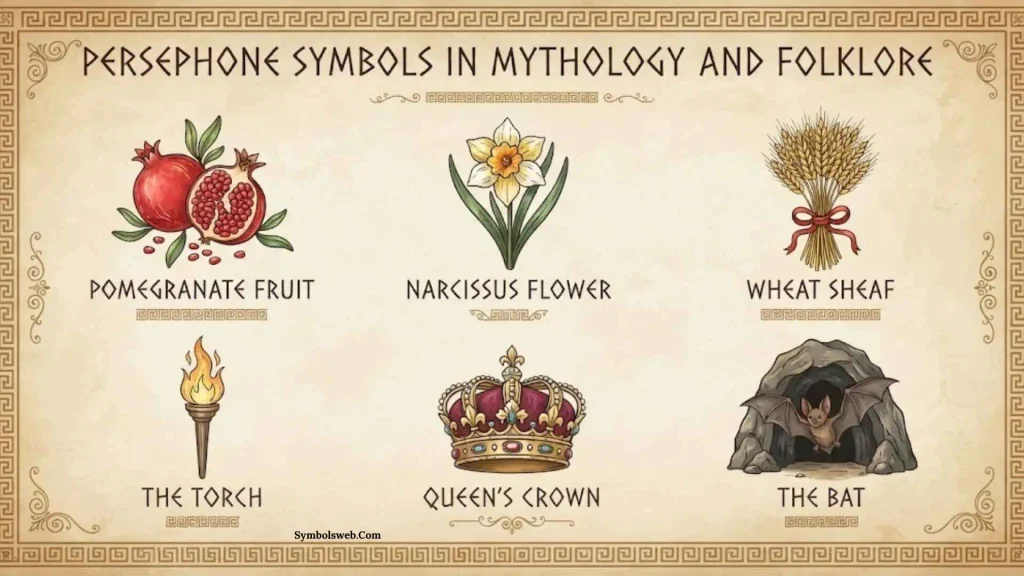
The central story begins in a meadow.
Persephone is gathering flowers with companions when the earth opens and Hades emerges. He takes her into the Underworld. Demeter, devastated by the disappearance of her daughter, searches for her.
Her grief has consequences for the earth.
The crops fail, and the natural world suffers. Eventually, the gods intervene. Persephone is allowed to return, but because she has eaten food from the Underworld, she cannot remain completely in the world above.
This creates the mythological pattern of descent and return.
Ancient artistic evidence shows how strongly this story resonated. A Greek bell-krater from around 440 BCE, attributed to the Persephone Painter, depicts Persephone ascending from the Underworld with Hermes and Hekate nearby while Demeter awaits her return.
The myth therefore became more than a story about one goddess.
It offered an explanation for the rhythm of the agricultural year and gave religious meaning to questions surrounding death, return, and human existence.
Persephone Symbols in the Eleusinian Mysteries
The connection between Persephone and the Eleusinian Mysteries is one of the most important parts of her historical significance.
The mysteries were celebrated at Eleusis, near Athens, and focused on Demeter and Persephone. Participants underwent initiation, but the central rites were secret. As a result, historians know the broad framework but cannot reconstruct every ritual detail with certainty.
Torchlight was particularly important in the ritual environment.
The Metropolitan Museum explains that initiates at Eleusis encountered torch-bearing ritual personnel before entering the central hall of the sanctuary. The movement from darkness toward the sacred space echoes the broader themes of searching, descent, discovery, and return found in the Persephone story.
This is one reason the torch remains such a powerful modern Persephone symbol.
Persephone in Art, Literature, Movies and Pop Culture
Paintings
Artists have repeatedly returned to the moment when Persephone disappears into the Underworld or returns to the earth.
Frederic Leighton’s The Return of Persephone, created around 1890 to 1891, presents Persephone rising from the Underworld while Demeter waits for her. The artwork uses the reunion to evoke renewal and seasonal change.
Ancient Greek vase painters also depicted her return. These works show that the visual tradition surrounding Persephone is much older than modern fantasy or contemporary pagan art.
Literature
Persephone appears in ancient Greek poetry, Roman literature, Renaissance art, and modern poetry.
The Roman name Proserpina became especially influential through Ovid’s Metamorphoses. Later writers frequently used her story as a metaphor for love, loss, seasonal change, captivity, and transformation.
Movies and Television
Modern film and television often reinterpret Persephone through fantasy, romance, mythology, or supernatural storytelling.
These versions can be creative, but they should not be confused with ancient sources. Modern adaptations often change Persephone’s personality, relationship with Hades, and role in the Underworld to fit contemporary storytelling.
Tattoos
Persephone tattoos often combine several symbols rather than using only one.
Popular designs include:
- Pomegranate
- Pomegranate seeds
- Flowers
- Half-dark, half-light imagery
- Torches
- Crowns
- Snakes
- Underworld gates
- Seasonal imagery
- Persephone and Hades
A pomegranate tattoo can communicate transformation and duality, while a flower-and-pomegranate design can emphasize the movement from innocence toward maturity.
Fashion and Jewelry
Pomegranate pendants, floral designs, dark crowns, botanical motifs, and seasonal colors can all evoke Persephone without directly depicting her.
Jewelry inspired by Persephone often works because the symbolism is subtle. You can carry an image of transformation without needing to explain the entire myth.
Spiritual and Dream Meaning of Persephone Symbols
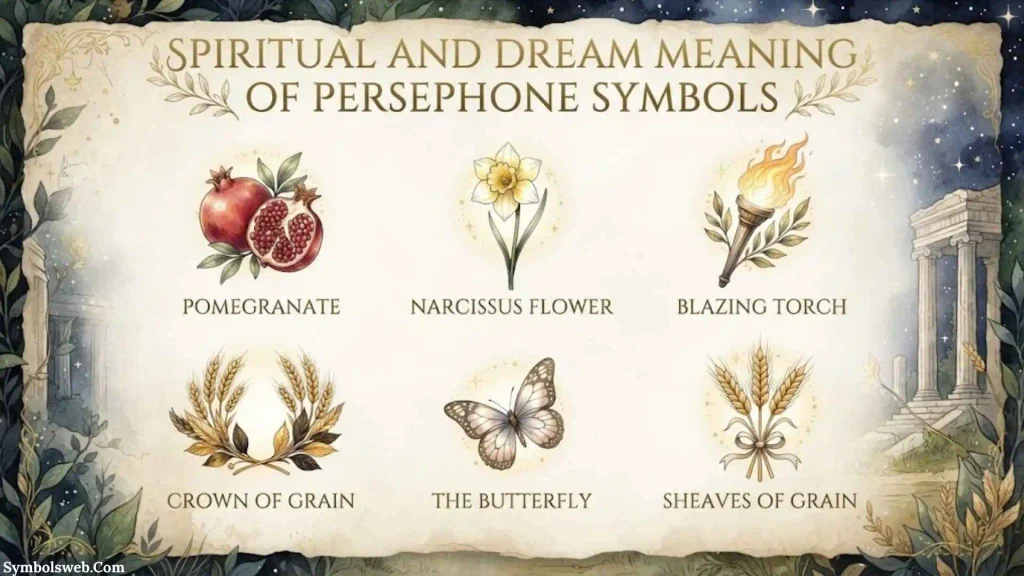
Dream interpretation is personal, so there is no scientifically proven universal meaning for seeing Persephone or her symbols in a dream.
Still, modern symbolic interpretation often connects Persephone imagery with transition.
Dreaming of a Pomegranate
A pomegranate might represent:
- A major life decision
- Hidden potential
- Desire
- Fertility
- A difficult choice
- Transformation
- Something that looks beautiful but carries consequences
The meaning depends heavily on your personal circumstances.
Dreaming of Flowers
Flowers may suggest:
- Youth
- Beauty
- New beginnings
- Emotional openness
- A temporary stage of life
Because flowers appear at the beginning of Persephone’s descent, they can also represent a moment just before major change.
Dreaming of a Torch
A torch can symbolize:
- Finding direction
- Seeking truth
- Moving through uncertainty
- Hope
- Illumination
- Guidance
If you are currently facing uncertainty, the torch may feel especially meaningful as a personal metaphor.
Dreaming of the Underworld
An Underworld image does not automatically mean something negative.
In symbolic psychology, darkness can represent the unknown, hidden emotions, grief, memory, or personal material that you have not fully explored.
The Persephone story adds another layer because the descent is followed by return.
Positive and Negative Meanings of Persephone Symbols
| Positive Meaning | Negative Meaning |
| Transformation | Loss |
| Rebirth | Grief |
| Inner strength | Separation |
| Renewal | Fear of change |
| Fertility | Death |
| Wisdom | Captivity |
| Emotional maturity | Uncertainty |
| Resilience | Descent into darkness |
| Hidden knowledge | Powerlessness |
| New beginnings | Endings |
The important lesson is that Persephone symbolism is rarely completely positive or negative.
Her story exists between opposites.
The pomegranate is a perfect example. It can suggest fertility and abundance because of its many seeds, yet it also represents Persephone’s continuing connection to the Underworld. Greek art itself connects the pomegranate with funerary beliefs as well as Persephone.
Why Humans Are Attracted to Persephone Symbols
People are naturally drawn to stories that explain experiences they cannot easily explain.
Everyone experiences change.
You may lose someone, leave home, begin a relationship, end one, change careers, grow older, or discover a side of yourself you did not know existed.
Persephone’s story gives these experiences a symbolic structure.
First, there is the familiar world.
Then something changes.
You enter an uncertain period.
You learn something.
Finally, you return with a different understanding of yourself.
This pattern is psychologically powerful because it resembles the way humans often describe personal transformation.
Human Nature
Humans look for meaning during difficult transitions. A symbol can make an abstract experience easier to understand.
A pomegranate is not simply a fruit anymore. In the Persephone story, it becomes an image of irreversible change.
Pattern Recognition
We naturally notice cycles such as:
- Day and night
- Summer and winter
- Birth and death
- Growth and decay
- Separation and reunion
Persephone’s story brings many of these cycles together.
Cultural Memory
Stories survive because later generations continue to find something recognizable inside them.
Even when religious beliefs change, the emotional structure of an ancient story can remain meaningful.
Modern Uses of Persephone Symbols
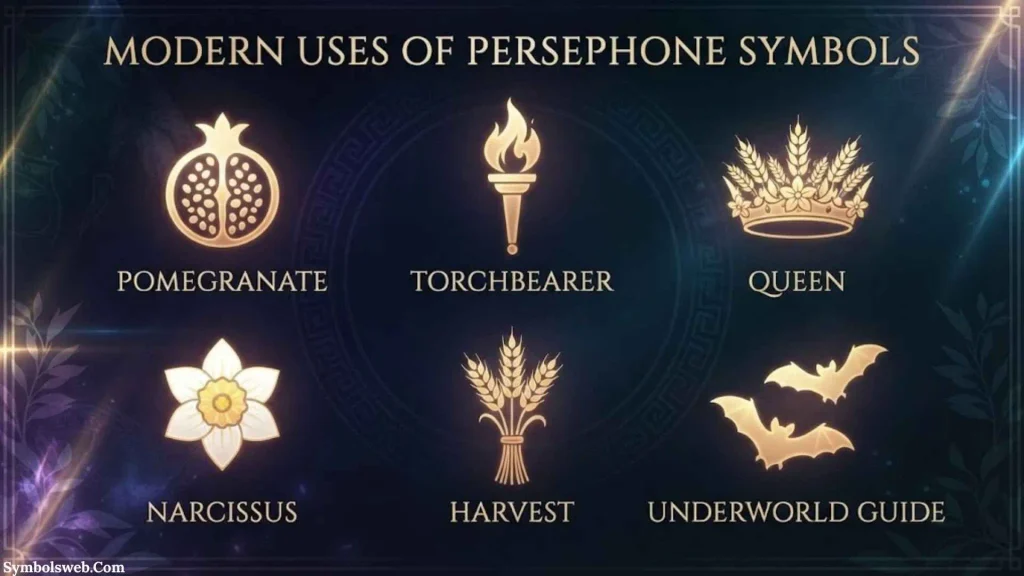
Tattoos
Persephone tattoos are often chosen to represent survival, transformation, feminine power, or moving through a difficult chapter.
Jewelry
Pomegranate pendants and floral jewelry offer a subtle way to carry the symbolism.
Fashion
Dark botanical designs, crowns, red fruit imagery, and seasonal motifs can reference Persephone without directly showing the goddess.
Branding
Modern designers sometimes use pomegranate, floral, or Underworld-inspired imagery to create an atmosphere of mystery, transformation, luxury, or feminine strength.
This is a modern aesthetic use rather than an ancient religious practice.
Social Media
You may see Persephone symbolism in:
- Mythology posts
- Poetry accounts
- Gothic aesthetics
- Feminine spirituality
- Book communities
- Tattoo inspiration
- Fantasy art
- Mental health metaphors
Contemporary Spirituality
Some modern practitioners work with Persephone as a deity or archetypal figure.
However, modern spiritual practices vary widely. They should not automatically be presented as direct continuations of ancient Greek religious practice.
Home Decor
Pomegranate artwork, floral arrangements, antique-style goddess imagery, and seasonal designs can create a Persephone-inspired aesthetic.
Frequently Asked Questions
What is the main symbol of Persephone?
The pomegranate is the most recognizable symbol of Persephone. It represents the connection between the living world and the Underworld, while also carrying associations with fertility, abundance, death, and transformation. Ancient Greek art and literature provide strong evidence for this connection.
What flowers symbolize Persephone?
Flowers associated with Persephone include narcissus, crocus, roses, violets, irises, and hyacinths in the Homeric Hymn to Demeter. Flowers symbolize her youthful life before the Underworld journey and connect her story with spring and renewal.
What does the Persephone pomegranate symbolize?
The Persephone pomegranate symbolizes fertility, life, death, attachment, transformation, and the consequences of crossing between worlds. Its many seeds can suggest abundance, while its role in the myth connects it with the Underworld and seasonal return.
What does Persephone symbolize spiritually?
In modern spiritual interpretation, Persephone can symbolize transformation, rebirth, emotional growth, shadow work, resilience, and returning from difficult experiences with greater wisdom. These interpretations are modern rather than direct statements of ancient Greek theology.
What does Persephone symbolize psychologically?
Psychologically, Persephone can serve as a metaphor for identity change, maturation, confronting hidden emotions, and moving through periods of loss or uncertainty. A Jungian reading may interpret the Underworld as a metaphor for the unconscious, but this is a modern psychological interpretation.
Is Persephone a symbol of death or rebirth?
She can symbolize both. Persephone’s connection with the Underworld links her with death and the hidden world, while her return to the earth connects her with renewal and the seasonal cycle. Ancient art and religious traditions repeatedly emphasize this movement between the two worlds.
Conclusion
Persephone symbols are powerful because they refuse to fit into one simple meaning. The pomegranate, flowers, torch, grain, crown, and Underworld each reveal another part of her story, from youthful beauty to descent, transformation, power, and return. Together, they create a rich symbolic language shaped by ancient Greek mythology, religion, art, and ideas about life and death.
When you look at Persephone this way, her story becomes more than an ancient tale about a goddess. It becomes a reminder that change can take you into unfamiliar darkness without meaning that your story has ended. Sometimes you return from that darkness carrying a deeper understanding of who you are.

Eliana Foster is a writer with a passion for exploring the meanings behind symbols, traditions, and cultural history. She enjoys breaking down complex topics into simple, engaging articles that are easy for everyone to understand. Eliana is also the fictional author of The Hidden Language of Silent Marks and Beyond the Circle of Ancient Signs, two original book concepts created for her author profile. When she’s not writing, she loves visiting museums, reading about mythology, and researching the stories behind symbols from around the world. Her goal is to help readers discover the fascinating meanings hidden in everyday signs and ancient emblems.
 Jordan Hayes
 Ethan Holloway