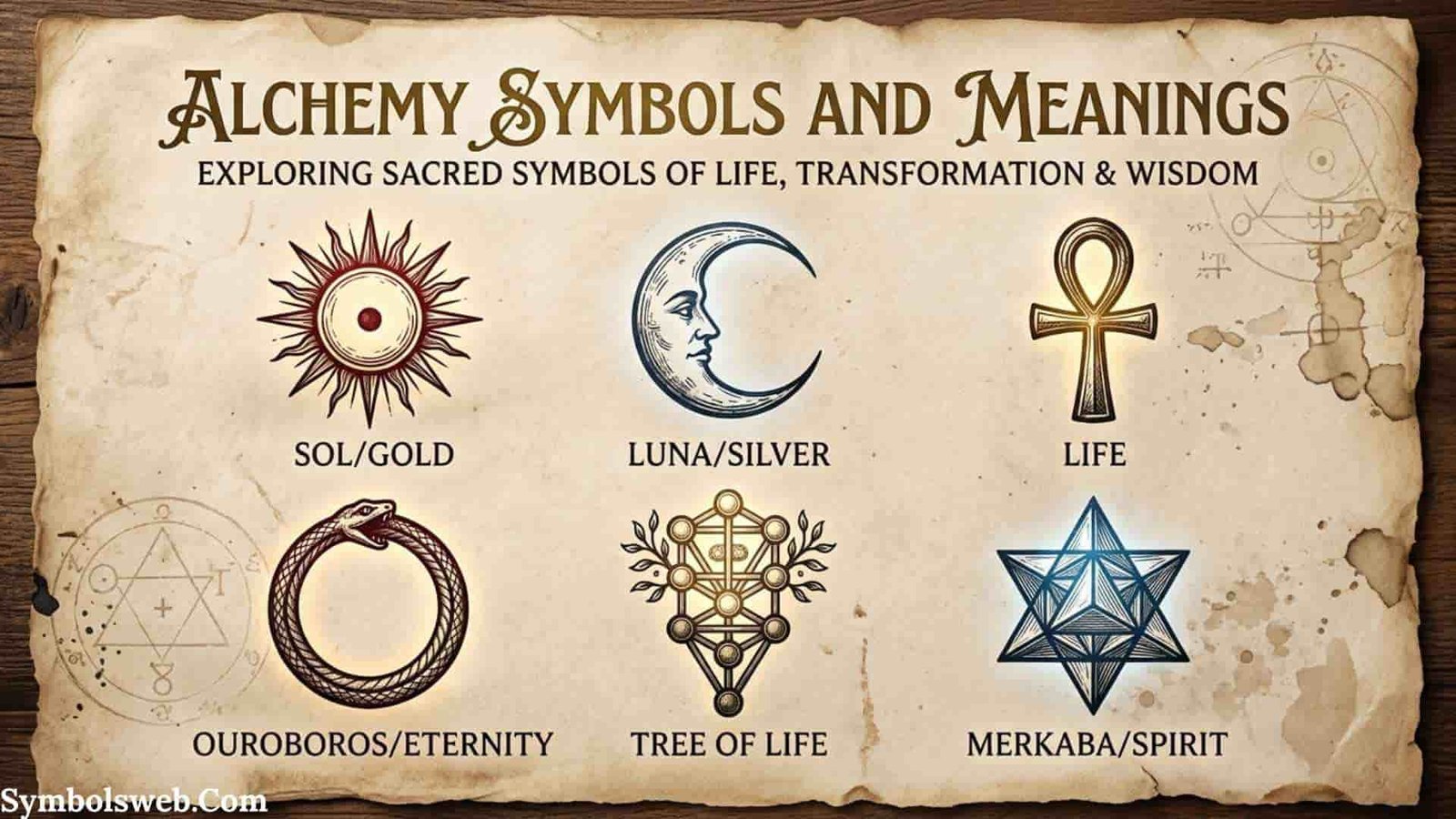
Alchemy symbols and meanings have fascinated humanity for thousands of years. Hidden within ancient manuscripts, mysterious illustrations, and secret teachings, these symbols tell stories of transformation, enlightenment, and the search for ultimate truth. More than simple drawings, they represent profound ideas about nature, the human soul, and the universe itself.
Whether you are interested in history, spirituality, psychology, or symbolism, understanding alchemical symbols opens a doorway into one of the world’s most intriguing traditions. In this guide, you’ll discover the origins, meanings, cultural significance, and modern interpretations of these powerful symbols.
Alchemy Symbols and Meanings: (Quick Answer)
Alchemy symbols are visual representations used by ancient alchemists to describe elements, metals, spiritual concepts, cosmic forces, and transformational processes. While they originally served practical purposes in early chemistry, they also carried deep spiritual, psychological, and philosophical meanings related to personal growth, enlightenment, and the transformation of the soul.
Also Check This Post: 55+ Food Symbols: Hidden Meanings Cultural Traditions and Powerful Symbolism
Quick Facts About Alchemy Symbols and Meanings
| Aspect | Information |
| Origin | Ancient Egypt, Greece, Mesopotamia, and later Medieval Europe |
| Historical Significance | Used in alchemy, early chemistry, medicine, and spiritual teachings |
| Main Meaning | Transformation, purification, and the search for perfection |
| Spiritual Meaning | Inner awakening, soul evolution, and enlightenment |
| Cultural Importance | Influenced science, philosophy, religion, art, and mysticism |
| Modern Usage | Tattoos, jewelry, psychology, spiritual practices, and design |
What Are Alchemy Symbols?
Alchemy symbols are visual signs developed by ancient alchemists to represent substances, elements, planets, metals, and spiritual principles.
Alchemy itself was an ancient practice combining science, philosophy, medicine, astrology, and spirituality. Its most famous goal was transforming ordinary metals into gold. However, many historians believe this physical quest symbolized a deeper journey toward spiritual perfection.
The earliest alchemical traditions can be traced to Ancient Egypt, where sacred knowledge was associated with the god Thoth, the divine patron of wisdom and writing. Greek scholars later merged Egyptian knowledge with their own philosophical ideas, creating the foundations of Western alchemy.
During the Middle Ages and Renaissance, alchemy flourished throughout Europe. Alchemists created elaborate symbols to record their discoveries and conceal knowledge from outsiders. These symbols became a secret language understood only by initiates.
Over time, many alchemical ideas influenced modern chemistry, medicine, psychology, and spirituality.
Spiritual Alchemy Symbols and Meanings
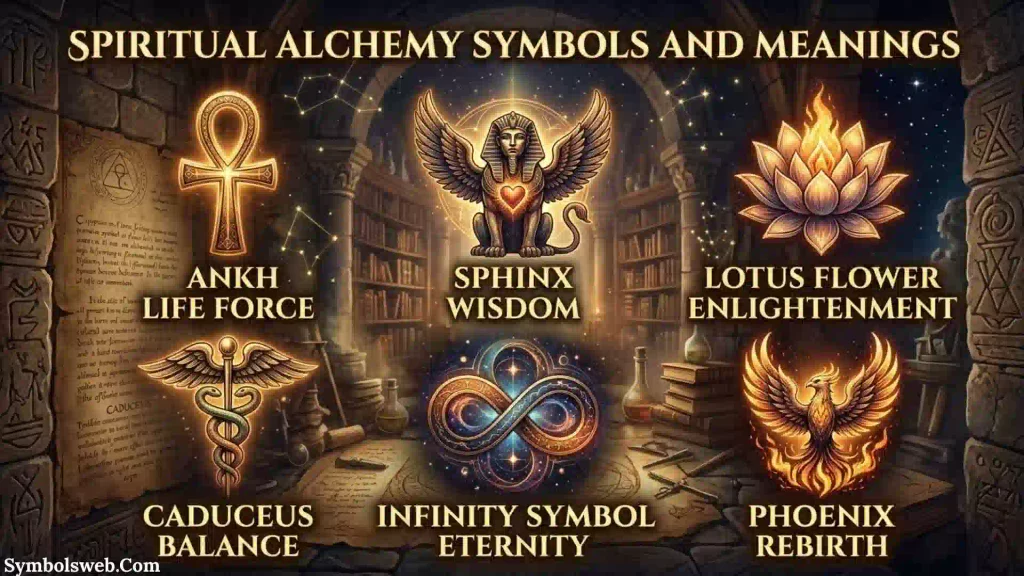
Spiritual alchemy symbols are often used to represent inner transformation, personal growth, and the journey toward greater awareness. While historical alchemy focused partly on the transformation of substances, later spiritual interpretations treated alchemy as a metaphor for transforming the mind, emotions, and character.
Several well-known symbols are commonly connected with spiritual alchemy. The sun can represent consciousness, vitality, illumination, and higher awareness, while the moon is often associated with intuition, emotions, and the hidden side of the self. Fire can symbolize purification and change, whereas water may represent emotional renewal and adaptability.
The ouroboros, shown as a serpent forming a circle by consuming its own tail, is another important image in alchemical symbolism. It can represent cycles, renewal, eternity, and the idea that transformation is an ongoing process.
The philosopher’s stone is also frequently given a spiritual interpretation. Beyond its legendary connection with the transformation of metals, it can symbolize the search for perfection, wisdom, and a transformed state of being. These interpretations can vary considerably between historical sources and modern spiritual traditions.
Alchemy Symbols List
Alchemy developed a complex symbolic vocabulary to describe materials, elements, metals, planets, and philosophical ideas. Because alchemy was practiced across different cultures and centuries, there was never one completely standardized symbol system.
Some of the most recognizable alchemical symbols are connected with the four classical elements: fire, air, water, and earth. Metals also had their own symbols. Gold was traditionally linked with the Sun, silver with the Moon, mercury with Mercury, copper with Venus, iron with Mars, tin with Jupiter, and lead with Saturn.
Other important images include the ouroboros, the philosopher’s stone, and various geometric figures used to communicate ideas about matter and transformation.
A useful way to understand an alchemy symbols list is to group symbols into categories:
- Elements: fire, air, water, and earth
- Metals: gold, silver, mercury, copper, iron, tin, and lead
- Processes: transformation, purification, dissolution, and combination
- Philosophical symbols: ouroboros and philosopher’s stone
- Planetary symbols: symbols associated with the classical planets and their corresponding metals
The exact meaning of an alchemical symbol should always be considered in its historical context because the same image can have different interpretations in different texts.
Alchemy Symbol for Death
There is no single universal historical alchemy symbol that means death. Instead, death is usually expressed through concepts of decay, dissolution, decomposition, and transformation.
One of the most relevant ideas is nigredo, traditionally described as a stage of blackening or decomposition in alchemical processes. Symbolically, it can represent the breakdown of an existing state before transformation takes place.
The skull is frequently used in modern alchemical and occult artwork to represent mortality, death, and the temporary nature of physical existence. However, it should not be presented as the one definitive historical symbol for death in alchemy.
From a symbolic perspective, death in alchemy can also mean the ending of an old condition. An old substance, identity, belief, or stage must metaphorically “die” before something new can emerge. This makes the idea of death closely connected with rebirth and transformation.
Alchemy Symbol for Creation
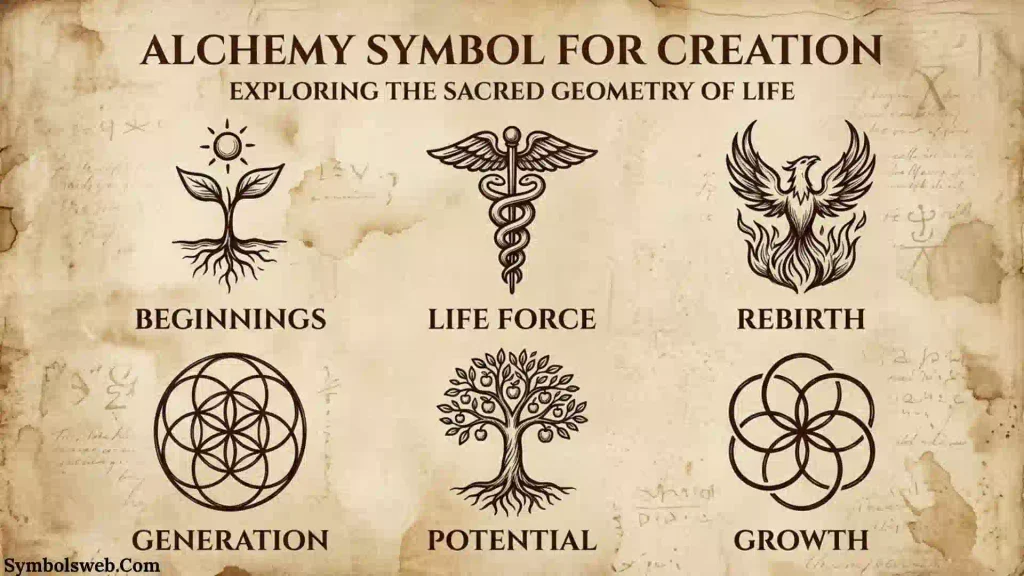
Alchemy does not have one universally accepted historical symbol specifically meaning “creation.” Instead, creation is commonly represented through ideas such as birth, combination, regeneration, renewal, and transformation.
The ouroboros is particularly suitable for a modern interpretation of creation because its circular form represents an endless cycle. The ending of one stage becomes the beginning of another, creating a continuous process of change.
The sun can also be interpreted as a symbol of life, energy, illumination, and creative force. In spiritual interpretations, its light may represent the emergence of knowledge or awareness from darkness.
Alchemy’s broader philosophy is closely connected with the idea that something can change into a new form. This is why modern writers often use alchemical symbolism as a metaphor for creativity, personal reinvention, and the creation of a new identity.
Alchemy Symbol for Gold
The traditional alchemical symbol for gold is a circle with a central point. The same symbol is associated with the Sun, reflecting the historical relationship between planetary symbolism and metals.
Gold held a special position in alchemical thought because it was rare, visually distinctive, resistant to corrosion, and regarded as exceptionally pure. Alchemists therefore associated it with qualities such as perfection, incorruptibility, purity, and completion.
The legendary goal of transforming base metals into gold became one of the most famous ideas associated with alchemy. However, gold also had a philosophical significance. In symbolic interpretations, the transformation into gold can represent the movement from an imperfect or undeveloped state toward a more complete one.
For this reason, the alchemy symbol for gold can have both a material meaning and a philosophical meaning. It can refer to the actual metal while also representing illumination, perfection, value, and transformation.
Alchemy Symbol for Sulfur
Sulfur was one of the important substances in traditional alchemy and was given its own symbolic representation. Historical versions of the sulfur symbol can vary, but the traditional form is generally composed of a cross-like structure combined with curved or triangular elements.
In alchemical philosophy, sulfur was associated with qualities such as heat, fire, activity, passion, and combustibility. It was also connected with one side of the influential sulfur mercury theory of matter.
Sulfur and mercury were often discussed as complementary principles. Sulfur was generally associated with active or fiery qualities, while mercury could represent volatility, fluidity, and a different set of properties.
Because historical alchemy combined practical experimentation with philosophical speculation, sulfur could have several layers of meaning depending on the source. Its symbolism therefore should be understood within the particular alchemical tradition being discussed.
Mental Alchemy Symbols and Meanings
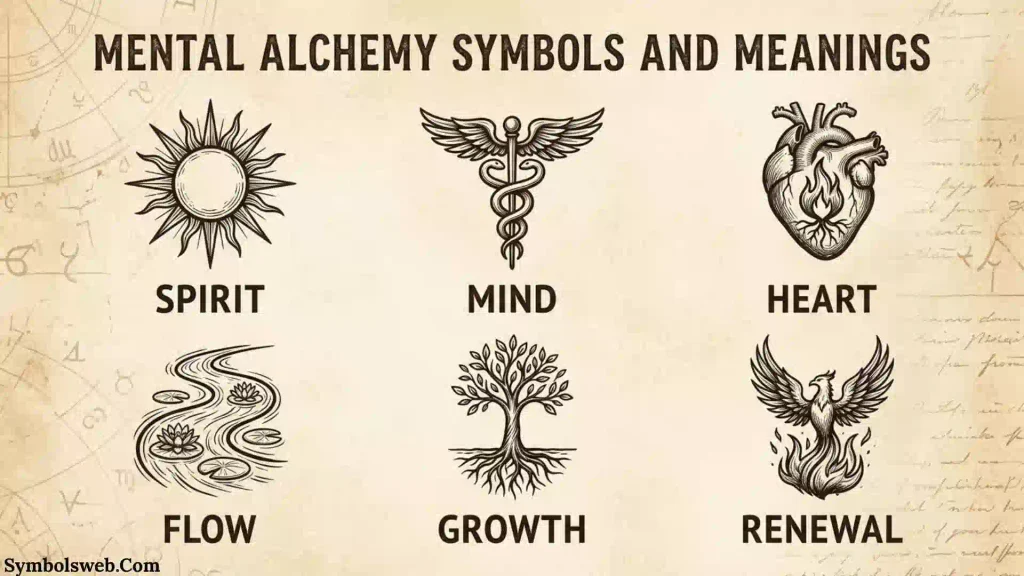
Mental alchemy is a modern way of applying the language of transformation to thoughts, beliefs, emotions, and personal development. Instead of turning a base metal into gold, mental alchemy describes the process of turning difficult experiences or limiting patterns into greater awareness and personal strength.
The ouroboros can represent the continuous cycle of self-reflection and renewal. The sun can symbolize clarity, consciousness, and understanding, while the moon can represent intuition, emotions, and the unconscious aspects of the mind.
Fire is another powerful metaphor for mental transformation. It can represent the process of confronting old beliefs, releasing destructive patterns, and developing a new perspective. Similarly, water can symbolize emotional movement, flexibility, and renewal.
It is important to note that these mental alchemy meanings are primarily modern and metaphorical interpretations. They should not automatically be presented as established psychological definitions or as the original meaning of every historical alchemical symbol.
Alchemy Symbols and Meanings Fullmetal Alchemist
Fullmetal Alchemist uses many ideas inspired by alchemy while creating its own fictional system of transmutation. As a result, the symbols seen in the series should be separated from the symbols and practices of historical alchemy.
One of the most recognizable examples is the Flamel symbol, which appears throughout the series. The design draws inspiration from the historical association of alchemy with Nicolas Flamel, a figure who later became famous in European alchemical and legendary traditions.
The series also features transmutation circles, which characters use as part of its fictional alchemical system. These circles may contain geometric patterns, symbols, and inscriptions that communicate the intended function of a particular transmutation.
Although Fullmetal Alchemist takes inspiration from real alchemical imagery, many of its symbols, rules, and meanings were created specifically for the fictional story. Therefore, an alchemy symbols and meanings guide should clearly distinguish between historical alchemy and Fullmetal Alchemist’s fictional symbolism.
Geometry Alchemy Symbols and Meanings
Geometric shapes are an important part of alchemical symbolism. Triangles, circles, squares, crosses, and combinations of these shapes can be found in historical and modern representations of alchemy.
The four classical elements are commonly represented using triangles. An upward-pointing triangle traditionally represents fire, while an upward triangle crossed by a horizontal line represents air. A downward-pointing triangle represents water, and a downward triangle crossed by a horizontal line represents earth.
The circle is also an important symbolic form. Its continuous shape can suggest completeness, unity, eternity, or a cycle without a clear beginning or ending. This helps explain why circular imagery appears frequently in discussions of transformation and the ouroboros.
Geometric alchemy symbols can therefore communicate complicated ideas through relatively simple shapes. However, their meanings are not always identical across every historical source, so context is essential when interpreting them.
Modern Alchemy Symbols and Meanings
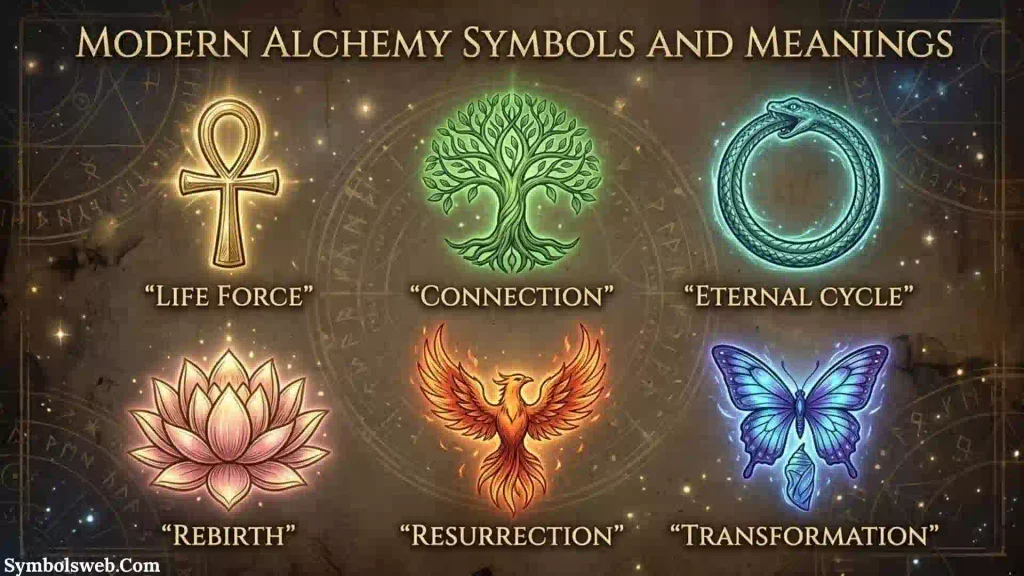
Modern alchemy symbols combine historical imagery with newer interpretations from spirituality, psychology, art, literature, tattoos, jewelry, and popular culture. As a result, many symbols now have meanings that are broader than their original historical uses.
The ouroboros is one of the most popular modern symbols. It can represent infinity, renewal, transformation, cycles, and the relationship between beginnings and endings.
The philosopher’s stone is another frequently used symbol. In modern spiritual interpretations, it may represent personal perfection, wisdom, enlightenment, or the discovery of something valuable within oneself.
The sun and moon are also commonly used together to express complementary forces such as light and darkness, conscious and unconscious awareness, or masculine and feminine principles. These modern interpretations can be meaningful, but they should not always be confused with documented historical definitions.
Modern alchemy is therefore best understood as a combination of historical symbolism and contemporary interpretation. The meaning of a symbol can change depending on how and where it is being used.
Black Magic Alchemy Symbols and Meanings
The phrase black magic alchemy symbols is commonly used in modern internet searches to describe dark, mysterious, or occult-looking imagery. Historically, however, alchemy and black magic were not simply the same practice.
Alchemy included several different areas of study, including metallurgy, medicine, natural philosophy, laboratory experimentation, and spiritual or philosophical speculation. Some alchemical imagery may appear dark because certain symbols were associated with death, decomposition, secrecy, darkness, and transformation.
The concept of nigredo is particularly relevant to this discussion. It is associated with blackening and decomposition and has often been interpreted symbolically as the destruction of an old state before a new stage can emerge.
Modern occult art sometimes combines alchemical imagery with symbols from other esoteric traditions. Because of this blending, an image described online as a “black magic alchemy symbol” may not actually have a historical connection to either alchemy or black magic.
The safest way to interpret these symbols is to look at their historical origin, cultural context, and intended use rather than judging their meaning purely from their appearance.
Deep Symbolic Meaning of Alchemy Symbols
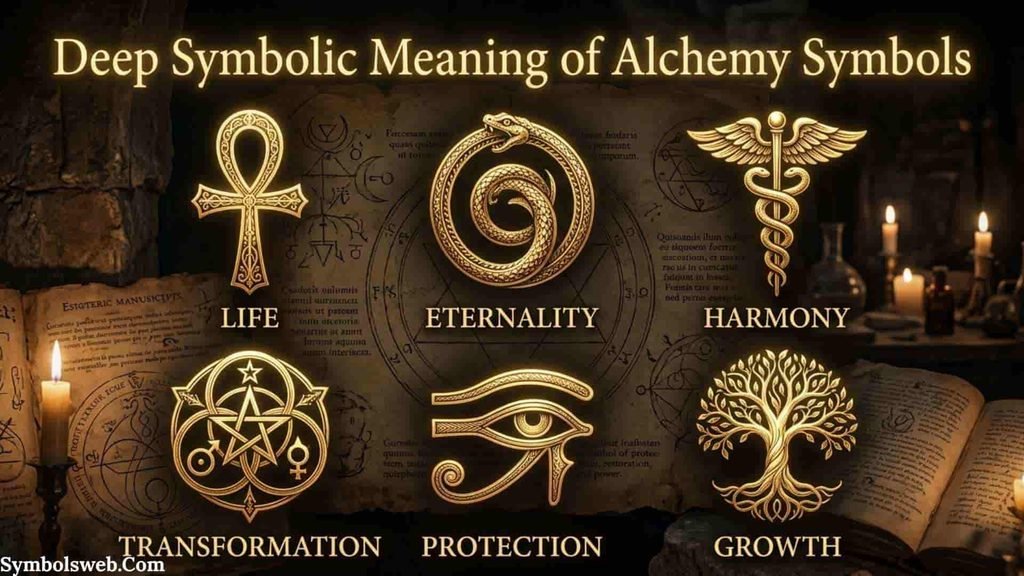
Spiritual Level
On a spiritual level, alchemy symbols represent transformation of the soul.
Ancient alchemists believed every human possessed untapped divine potential. The process of turning lead into gold mirrored the process of transforming ignorance into wisdom.
Common spiritual themes include:
- Purification
- Enlightenment
- Rebirth
- Unity with the divine
- Inner awakening
- Balance between opposing forces
Many spiritual traditions still use alchemical symbolism to describe personal growth and self-discovery.
Inner Transformation
The famous “Great Work” or Magnum Opus was believed to be both a physical and spiritual process.
The alchemist was not merely changing metals. They were transforming themselves.
Psychological Level
Psychologist Carl Jung played a major role in modern interpretations of alchemy.
Jung viewed alchemy as a symbolic map of psychological development.
According to Jung:
- Lead symbolizes unconscious limitations.
- Gold symbolizes psychological wholeness.
- The Philosopher’s Stone represents self-realization.
- Alchemical transformations mirror emotional healing.
Archetypes and Human Emotions
Alchemy symbols often represent universal archetypes such as:
- The Wise Sage
- The Shadow
- The Divine Feminine
- The Divine Masculine
- Death and Rebirth
These themes resonate deeply because they reflect common human experiences.
Cultural Level
Across cultures, alchemy symbols served as bridges between science and spirituality.
They appeared in:
- Temples
- Libraries
- Royal courts
- Secret societies
- Religious texts
- Philosophical writings
Many communities viewed alchemists as seekers of hidden wisdom rather than mere experimenters.
Types and Variations of Alchemy Symbols
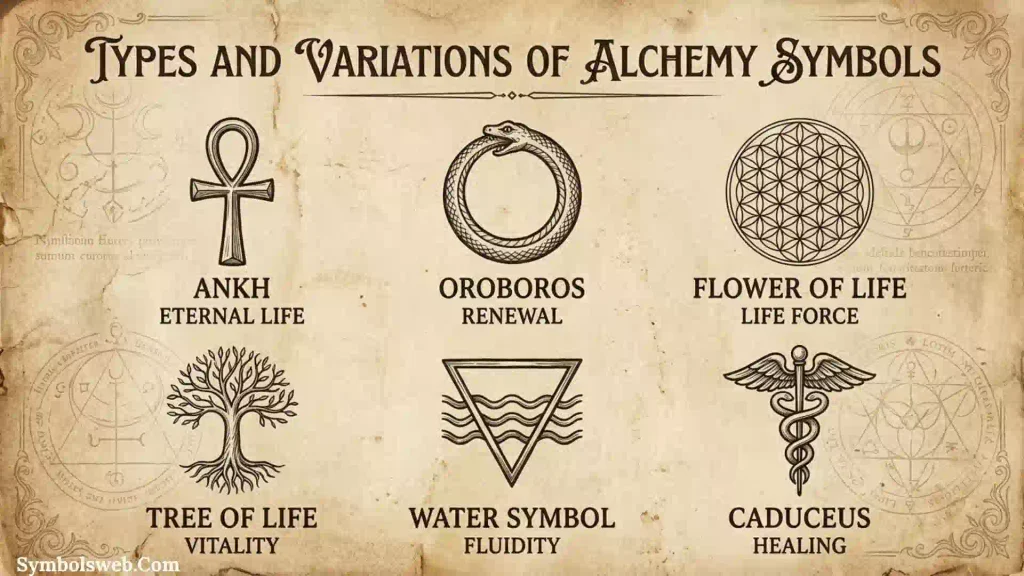
1. Philosopher’s Stone
Visual Description
Usually depicted as a circle within a square inside a triangle surrounded by another circle.
Meaning
The ultimate goal of alchemy.
Symbolism
- Perfection
- Enlightenment
- Divine wisdom
- Immortality
Cultural Connection
Appears throughout medieval alchemical texts and mystical traditions.
2. Sulfur Symbol
Visual Description
A triangle above a cross.
Meaning
Represents spirit and active energy.
Symbolism
- Passion
- Fire
- Transformation
- Masculine force
Where It Appears
- Alchemical manuscripts
- Esoteric teachings
- Occult symbolism
3. Mercury Symbol
Visual Description
A circle topped with a crescent and cross.
Meaning
Represents fluidity and transformation.
Symbolism
- Change
- Intelligence
- Communication
- Adaptability
Cultural Connection
Linked to the Roman god Mercury.
4. Salt Symbol
Visual Description
Circle divided by a horizontal line.
Meaning
Represents the body and material world.
Symbolism
- Stability
- Grounding
- Preservation
- Physical existence
5. Four Classical Elements
Fire
Triangle pointing upward.
Represents:
- Energy
- Passion
- Action
Water
Downward triangle.
Represents:
- Emotions
- Intuition
- Healing
Air
Upward triangle crossed by a line.
Represents:
- Thought
- Knowledge
- Communication
Earth
Downward triangle crossed by a line.
Represents:
- Stability
- Fertility
- Material reality
6. Ouroboros
Visual Description
A serpent eating its own tail.
Meaning
Eternal cycles.
Symbolism
- Infinity
- Rebirth
- Unity
- Life and death
Cultural Connection
Strongly associated with Hermes Trismegistus and ancient mystical traditions.
Also Check This Post: 59+ Maori Symbols: Ancient Meanings Spiritual Wisdom and the Powerful Stories Behind Them
Alchemy Symbols Across Different Cultures
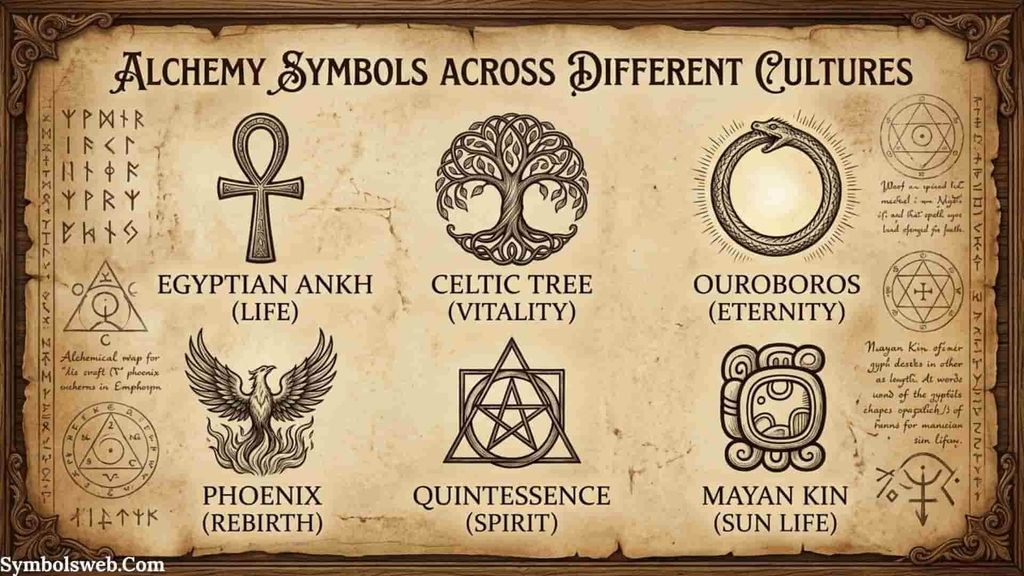
Ancient Egypt
Ancient Egyptians viewed transformation as sacred.
Alchemy was linked to:
- Divine creation
- Resurrection
- Cosmic order
Symbols often reflected the cycles of the sun and afterlife.
Ancient Greece
Greek philosophers integrated alchemy into theories of nature.
Thinkers such as Aristotle connected alchemy to the four elements:
- Earth
- Air
- Fire
- Water
These ideas became foundational to Western alchemy.
Roman Culture
Romans merged alchemy with astrology.
Planets became associated with metals:
| Planet | Metal |
| Sun | Gold |
| Moon | Silver |
| Venus | Copper |
| Mars | Iron |
| Jupiter | Tin |
| Saturn | Lead |
| Mercury | Quicksilver |
Eastern Traditions
In China and India, alchemy focused more on longevity and spiritual development.
Eastern alchemical symbolism emphasized:
- Harmony
- Energy flow
- Balance
- Immortality
Concepts similar to alchemy appear within Taoist traditions and yogic philosophy.
Indigenous Traditions
Many Indigenous cultures practiced symbolic transformation rituals involving:
- Fire
- Sacred plants
- Animal symbolism
- Vision quests
Although not always labeled as alchemy, the underlying theme of transformation remains similar.
Modern Interpretations
Today, alchemy symbols often represent:
- Self-improvement
- Personal transformation
- Spiritual awakening
- Psychological healing
Their meanings continue evolving while preserving ancient wisdom.
Similar Symbols and Their Meanings
| Symbol | Similarity to Alchemy Symbols | Key Difference |
| Mandala | Represents wholeness | More spiritual and meditative |
| Yin-Yang | Balance of opposites | Rooted in Chinese philosophy |
| Ankh | Transformation and life | Specifically Egyptian |
| Tree of Life | Spiritual growth | More associated with mystical traditions |
| Labyrinth | Personal journey | Focuses on path rather than transformation |
Common Misconceptions
Many people believe alchemy was solely about making gold.
In reality, most alchemical texts discuss:
- Spiritual evolution
- Human consciousness
- Inner transformation
- Universal harmony
Alchemy Symbols in Mythology and Folklore
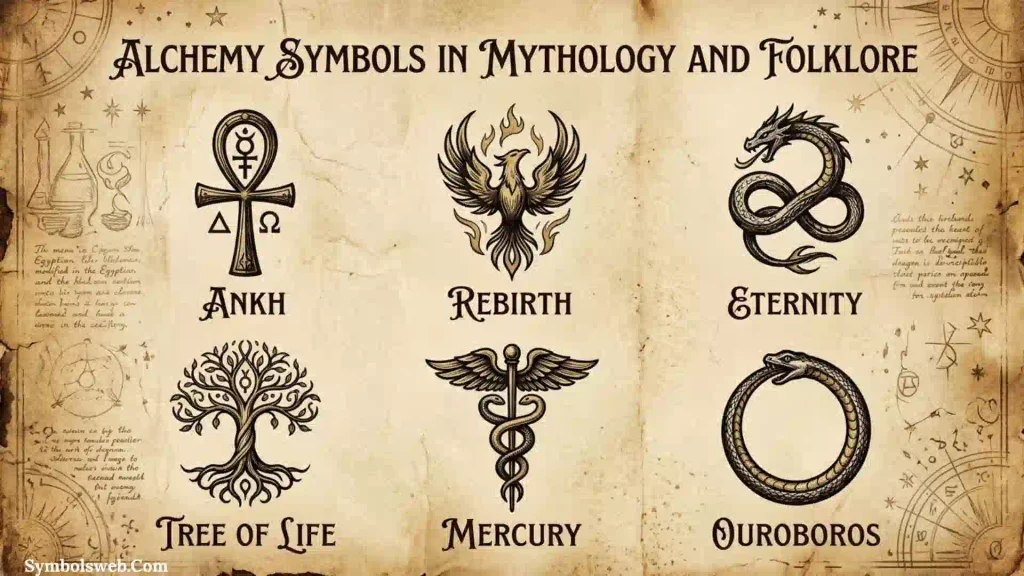
Alchemy appears throughout myths and legends worldwide.
One recurring theme is the magical substance capable of granting wisdom or immortality.
Examples include:
- The Philosopher’s Stone
- Elixirs of life
- Sacred fountains
- Divine nectar
These stories often portray heroes seeking hidden knowledge.
The symbolism remains remarkably consistent:
A difficult journey leads to transformation and enlightenment.
This narrative appears in countless cultures and continues to influence modern storytelling.
Alchemy Symbols in Art, Literature, Movies, and Pop Culture
Paintings
Renaissance artists frequently included alchemical symbols in their work.
These symbols represented:
- Hidden knowledge
- Divine mysteries
- Transformation
Literature
Many literary works contain alchemical themes.
Examples include:
- The Alchemist
- Medieval mystical writings
- Renaissance philosophical texts
The journey toward gold often symbolizes personal destiny.
Poetry
Poets use alchemical imagery to describe:
- Love
- Growth
- Emotional healing
- Spiritual awakening
Movies and Television
Popular examples include:
- Harry Potter and the Philosopher’s Stone
- Fullmetal Alchemist
These stories use alchemical symbolism to explore sacrifice, wisdom, and transformation.
Tattoos
Alchemy symbol tattoos often represent:
- Personal growth
- Resilience
- Rebirth
- Spiritual evolution
Fashion and Design
Modern designers incorporate alchemical symbols into:
- Jewelry
- Logos
- Clothing
- Interior decor
The symbols communicate mystery and individuality.
Spiritual and Dream Meaning of Alchemy Symbols
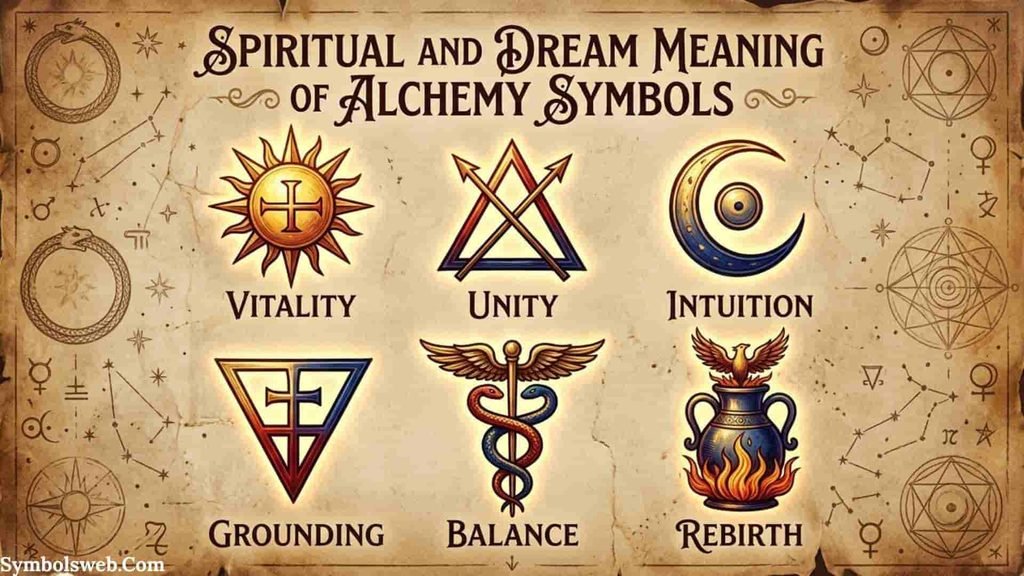
Dreams featuring alchemical symbols are often interpreted as signs of personal transformation.
Common Dream Interpretations
| Symbol | Possible Dream Meaning |
| Gold | Achievement and wisdom |
| Lead | Personal obstacles |
| Fire | Change and purification |
| Water | Emotional healing |
| Ouroboros | Life cycles and renewal |
Meditation and Spiritual Experiences
Many spiritual practitioners encounter alchemical imagery during:
- Meditation
- Visualization
- Energy work
- Mystical experiences
These symbols may represent inner progress and self-discovery.
Positive Messages
- Growth
- Wisdom
- Healing
- Renewal
Cautionary Messages
- Ego inflation
- Obsession
- Resistance to change
- Emotional imbalance
Positive and Negative Meanings of Alchemy Symbols
| Positive Meaning | Negative Meaning |
| Transformation | Obsession |
| Wisdom | Pride |
| Enlightenment | Delusion |
| Balance | Extremism |
| Self-discovery | Self-deception |
| Renewal | Destructive change |
| Unity | Loss of individuality |
Alchemy teaches that every force contains both light and shadow.
The challenge is achieving balance.
Why Humans Are Attracted to Alchemy Symbols
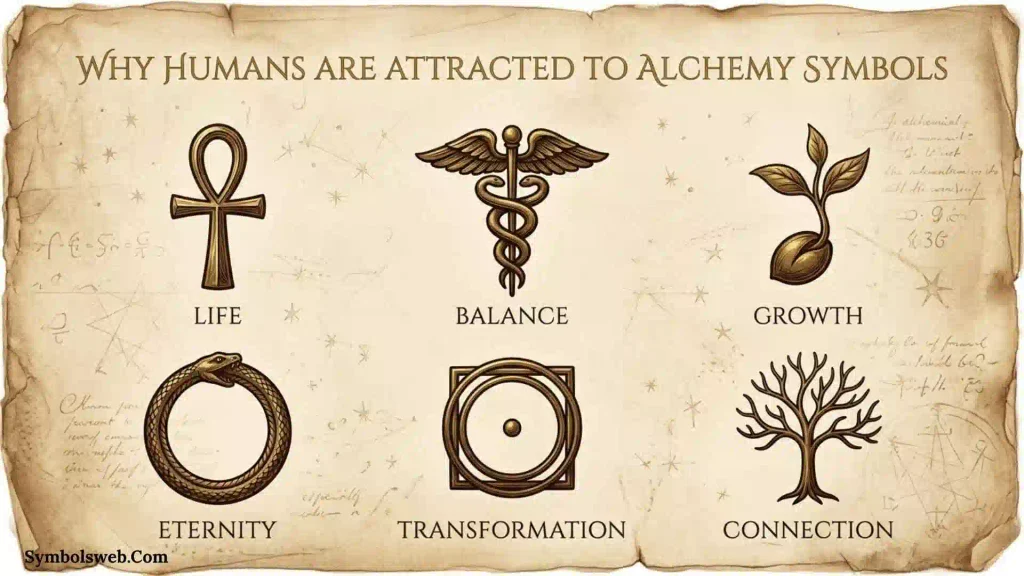
Humans naturally seek meaning.
Alchemy symbols appeal to us because they tell a universal story:
The possibility of becoming something greater.
Psychologically, these symbols activate deep archetypes within the human mind. We recognize themes of struggle, growth, death, and rebirth because they mirror our own experiences.
Cultural memory also plays a role. Across centuries, societies have passed down stories about hidden wisdom and transformation.
When people see an alchemical symbol today, they often feel connected to something ancient and mysterious.
The symbol becomes a mirror reflecting their personal journey.
Modern Uses of Alchemy Symbols
Today, alchemy symbols appear in many forms.
Tattoos
Represent:
- Transformation
- Strength
- New beginnings
Jewelry
Used as symbols of:
- Protection
- Wisdom
- Spiritual growth
Fashion
Designers use them to evoke mystery and individuality.
Branding
Companies sometimes use alchemical imagery to suggest innovation and transformation.
Social Media
Creators share alchemical symbols within spiritual, artistic, and self-development communities.
Home Decor
Many people display these symbols as reminders of balance and personal growth.
Interesting Facts About Alchemy Symbols
- Modern chemistry evolved partly from alchemical experimentation.
- Gold was associated with the Sun because both symbolized perfection.
- The Ouroboros is one of the oldest symbols known to humanity.
- Many alchemical manuscripts were intentionally written in code.
- Medieval alchemists often combined science, religion, and philosophy.
- Jung believed alchemy revealed hidden aspects of the human psyche.
- Planetary symbols were frequently used as metal symbols.
- The Philosopher’s Stone was often viewed as a metaphor rather than a physical object.
- Alchemical imagery influenced Renaissance art and architecture.
- Many modern spiritual practices still borrow alchemical concepts.
Frequently Asked Questions
What do alchemy symbols mean?
Alchemy symbols represent elements, metals, spiritual principles, and transformational processes. They often symbolize personal growth, purification, and enlightenment.
What is the most important alchemy symbol?
The Philosopher’s Stone is widely considered the most important alchemy symbol because it represents perfection, wisdom, and ultimate transformation.
Are alchemy symbols spiritual?
Yes. While they had practical uses in early chemistry, many alchemy symbols also carry spiritual meanings related to self-discovery, consciousness, and enlightenment.
What does the Ouroboros symbolize in alchemy?
The Ouroboros symbolizes eternity, renewal, unity, and the continuous cycle of life, death, and rebirth.
Why are alchemy symbols popular in tattoos?
People choose alchemy symbols because they represent transformation, resilience, growth, wisdom, and personal evolution.
Did alchemy influence modern science?
Yes. Alchemy contributed to the development of chemistry, laboratory methods, medicine, and scientific observation.
Conclusion
Alchemy symbols and meanings reveal far more than ancient attempts to create gold. They represent humanity’s enduring quest for wisdom, transformation, and understanding. Across cultures and centuries, these symbols have served as guides for spiritual growth, psychological development, and philosophical exploration.
Their power endures because they speak to a timeless truth: every person has the capacity to transform, evolve, and uncover hidden potential. In that sense, the greatest alchemical journey is not the transformation of metal into gold, but the transformation of the human spirit into its highest form.
Also Check This Post: 57+ Deep Meaning Woman Symbols of Strength and Courage: Powerful Female Symbols That Inspire Resilience

Jordan Hayes is a writer with a passion for exploring the history, meanings, and cultural significance behind symbols from around the world. He enjoys turning complex topics into clear, engaging content that anyone can understand. Jordan is also the fictional author of The Silent Language of Ancient Marks and Hidden Symbols Beyond the Surface, two original book concepts created for his author profile. When he’s not writing, he spends time researching myths, traditions, and forgotten stories that inspire his work. His goal is to help readers discover the deeper meanings behind the symbols they encounter every day.
 Ethan Holloway
 Eliana Foster
[…] Sign Language Symbols: Meanings, History, Cultural Significance, and Hidden Communication Power 63+ Alchemy Symbols and Meanings: The Hidden Language of Transformation, Wisdom, and Spiritual Pow… 55+ Food Symbols: Hidden Meanings Cultural Traditions and Powerful Symbolism 59+ Maori […]
[…] Sign Language Symbols: Meanings, History, Cultural Significance, and Hidden Communication Power 63+ Alchemy Symbols and Meanings: The Hidden Language of Transformation, Wisdom, and Spiritual Pow… 55+ Food Symbols: Hidden Meanings Cultural Traditions and Powerful Symbolism 59+ Maori […]