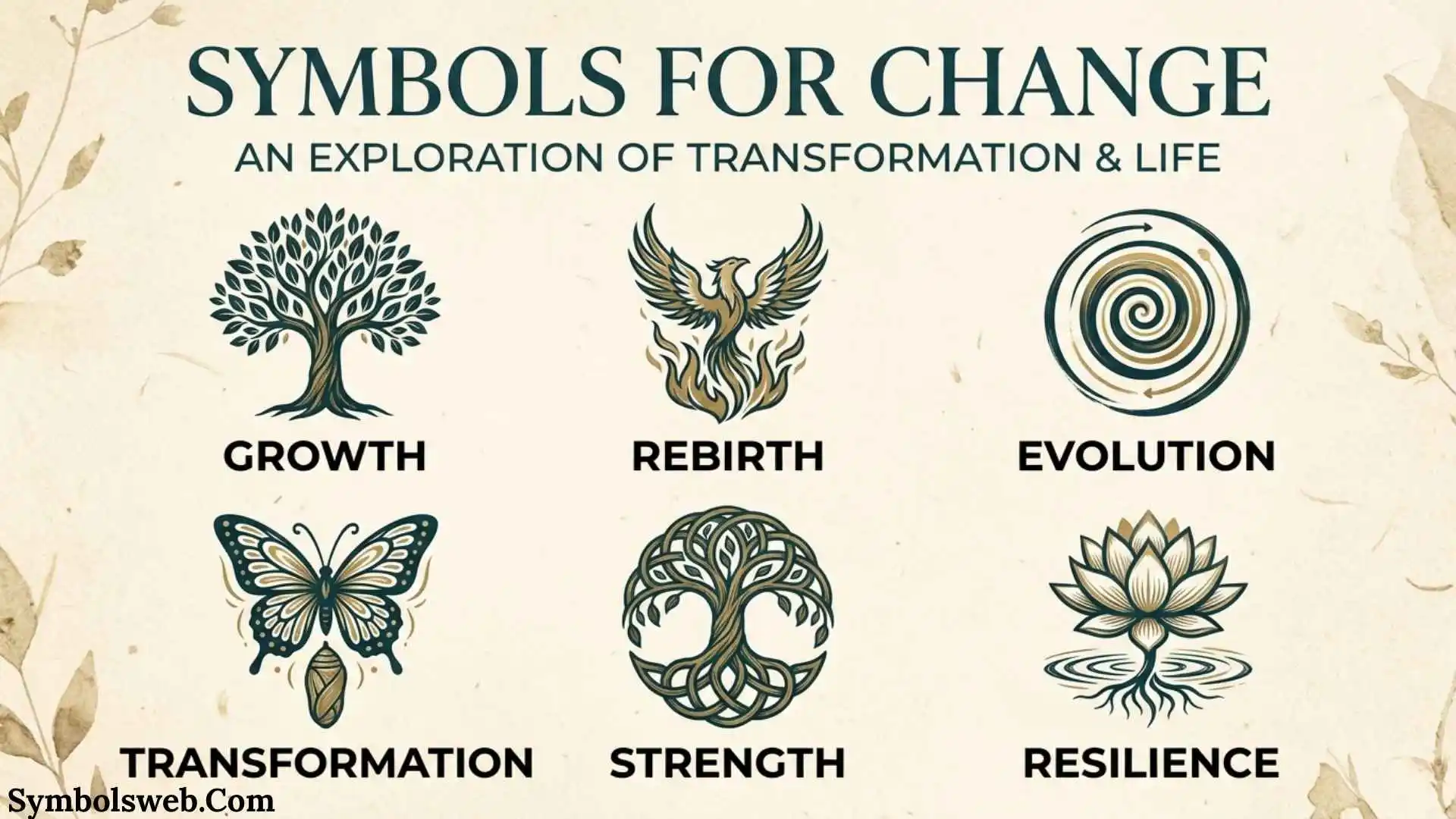
Symbols for Change have helped people understand one of life’s most powerful experiences: transformation. From the delicate butterfly to the legendary phoenix, these symbols turn difficult and invisible changes into images we can see and understand.
Across history, people have used animals, plants, celestial bodies, shapes, and mythical creatures to express growth, renewal, loss, healing, and new beginnings. These symbols appear in ancient religions, mythology, art, psychology, literature, and everyday life.
If you are looking for a symbol for a tattoo, a spiritual reminder, personal growth, or simply curious about their hidden meanings, the stories behind these symbols reveal something deeply human.
Symbols for Change: (Quick Answer)
Symbols for Change are images, objects, natural forms, or cultural signs that represent transformation, growth, renewal, transition, rebirth, or new beginnings. Common examples include the butterfly, phoenix, lotus, ouroboros, spiral, changing moon, snake, tree, seed, and sunrise.
Also Check This Post: 73+ Naruto Village Symbols: A Complete Guide to Their Meanings
Symbols for Change in Life
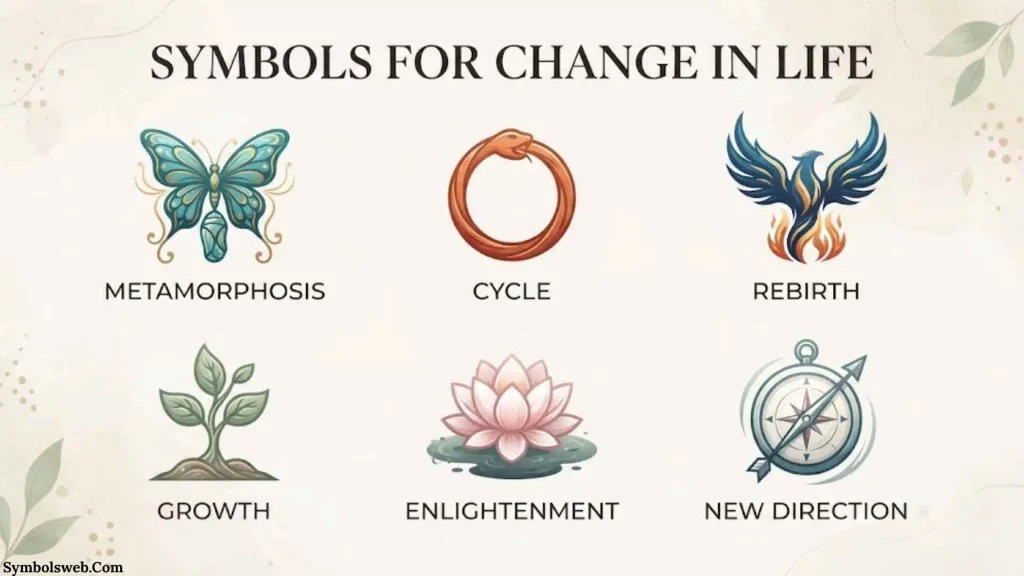
- A butterfly represents a new version of life after a period of personal change.
- A rising sun can symbolize a fresh beginning after a difficult chapter.
- A winding path represents the changes and unexpected turns of life.
- A growing tree can represent personal development through different stages.
- An open door symbolizes entering a new phase with new possibilities.
- A bridge can represent moving from one stage of life to another.
- A phoenix is often used as a symbol of renewal after hardship.
- A flowing river represents how life continues to move and change.
- A sunrise can symbolize hope, renewal, and the beginning of something new.
- A spiral can represent continuous growth, change, and personal evolution.
Ancient Symbols for Change
- The phoenix is an ancient symbol associated with renewal, rebirth, and transformation.
- The ouroboros represents cycles, endings, beginnings, and continuous renewal.
- The butterfly has long been connected with transformation because of its dramatic life cycle.
- The lotus can symbolize spiritual growth emerging from difficult conditions.
- The spiral appears in ancient cultures as a representation of cycles and movement.
- The serpent has been associated with renewal because of its ability to shed its skin.
- The sun has traditionally represented renewal, life, and the recurring cycle of time.
- The moon can symbolize changing phases, transitions, and the passage of time.
- The tree can represent growth, continuity, change, and the connection between life stages.
- Water has been used symbolically to represent movement, transformation, and the changing nature of life.
Symbols for Change and Growth
- A growing tree symbolizes steady development from strong roots toward new possibilities.
- A seed represents potential that develops through patience, care, and time.
- A sprouting plant can symbolize the beginning of personal growth.
- A butterfly represents growth through major stages of transformation.
- A staircase can symbolize progress through one level of development at a time.
- A mountain represents challenges that can lead to strength and personal growth.
- A sunrise symbolizes the opportunity to begin again and grow beyond the past.
- A river represents continuous movement and growth rather than remaining unchanged.
- A spiral can symbolize growth that continues through different experiences.
- An open book can represent learning, new experiences, and personal development.
Symbols for Change and Transformation
- The butterfly is one of the clearest symbols of transformation and personal change.
- The phoenix represents rising again after an ending or difficult experience.
- A snake shedding its skin can symbolize leaving an old identity behind.
- A caterpillar represents an earlier stage before a major transformation takes place.
- A chrysalis symbolizes the quiet period in which transformation develops.
- A doorway can represent crossing from an old phase into a new chapter.
- A broken shell can symbolize breaking away from limitations and becoming something new.
- Fire can represent the destruction of an old state and the possibility of renewal.
- A changing moon can symbolize the different stages of transformation.
- A metamorphosis symbol can represent a complete change in identity, perspective, or direction.
Symbols for Change and Strength
- A mountain symbolizes strength, endurance, and the courage to face change.
- A lion can represent inner strength while moving through difficult transitions.
- An oak tree symbolizes resilience, stability, and the strength to grow through changing seasons.
- A phoenix represents the strength to rebuild after loss or hardship.
- A storm can symbolize difficult changes that test and develop personal strength.
- A sword can represent courage, determination, and the ability to face challenges.
- A rock can symbolize stability while everything around you is changing.
- A rooted tree represents staying strong while continuing to grow and adapt.
- A wave can symbolize the ability to move with change rather than resist it.
- A mountain path represents the strength required to continue despite obstacles.
Visual Symbols for Change
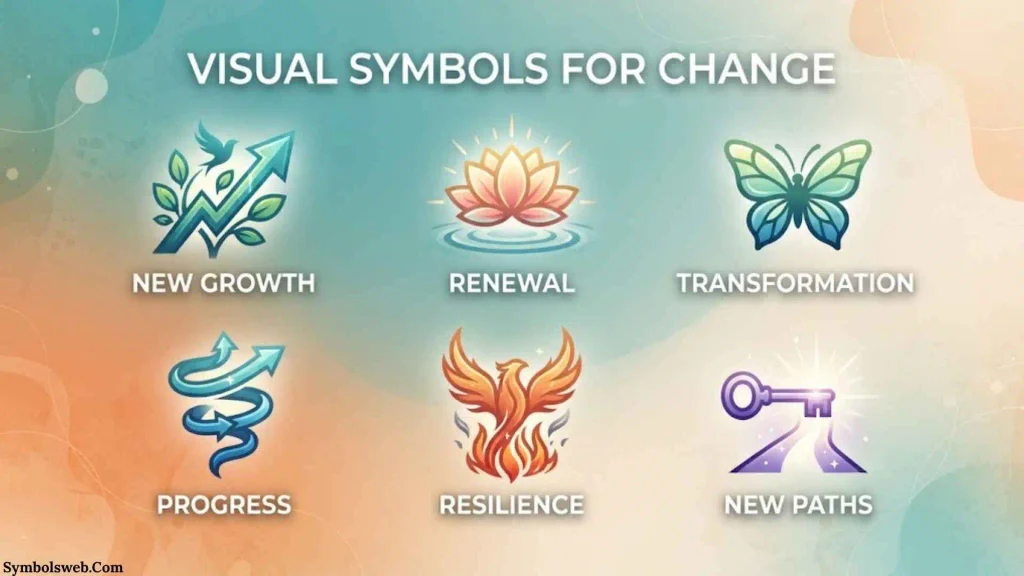
- A butterfly is a simple visual symbol that immediately suggests transformation and new beginnings.
- A before-and-after image can visually communicate personal change and development.
- A rising sun creates a strong visual impression of renewal and a fresh start.
- A winding road represents movement, uncertainty, and the changing direction of life.
- A bridge visually represents crossing from one stage or situation into another.
- A growing plant shows change through a sequence of visible stages.
- A spiral creates a visual sense of movement, evolution, and continuous development.
- A doorway represents leaving one environment behind and entering something new.
- A river visually communicates movement, transition, and the passage of time.
- A phoenix rising from flames creates a powerful visual representation of renewal and transformation.
Quick Facts About Symbols for Change
| Aspect | Information |
| Origin | Ancient nature symbolism, mythology, religion, art, and cultural traditions |
| Historical Significance | Used to explain life cycles, death, rebirth, spiritual growth, and transformation |
| Main Meaning | Change, transformation, growth, renewal, and transition |
| Spiritual Meaning | Awakening, rebirth, healing, inner growth, and release |
| Cultural Importance | Different cultures developed their own symbols and interpretations of change |
| Modern Usage | Tattoos, jewelry, fashion, branding, artwork, social media, spirituality, and home decor |
What Are Symbols for Change?
Definition of Symbols for Change
Symbols for Change are visual representations of transformation. They allow people to express an idea that can otherwise be difficult to describe.
Change can mean many things. It can be a new beginning, the end of an old chapter, emotional healing, spiritual awakening, personal growth, or a complete change in identity.
A butterfly, for example, can represent transformation because it changes dramatically during its life cycle. A bridge can represent transition because it connects one place to another. A sunrise can represent hope because darkness is followed by light.
The symbol gives the abstract idea of change a physical form.
Origin and Historical Background
The history of change symbolism is closely connected with nature.
Ancient people observed the changing seasons, rising and setting of the sun, phases of the moon, growth of plants, migration of animals, and cycles of birth and death. These natural patterns became powerful metaphors for human life.
Ancient Egypt provides important examples. The ankh was associated with life, while scarab imagery became connected with rebirth and regeneration. The wedjat, or Eye of Horus, was associated with restoration and healing.
In Greek mythology, transformation appears in many stories in which humans and gods change their forms. The butterfly also became connected with psyche, the Greek word associated with the soul.
Over time, these ancient ideas moved into literature, religious art, folklore, philosophy, and eventually modern popular culture.
How Symbols for Change Evolved Over Time
The meaning of a symbol is rarely frozen forever.
A symbol may begin with a specific religious or cultural meaning and later gain new interpretations. The phoenix is a good example. Its older associations with renewal and rebirth have developed into a modern symbol of resilience and surviving hardship.
Today, people often choose symbols according to their own experiences.
A butterfly might represent leaving an unhealthy relationship. A phoenix might represent rebuilding after failure. A lotus might represent finding peace after a difficult period.
The original cultural meaning still matters, but personal meaning has become an important part of modern symbolism.
Why Symbols for Change Became Important
Humans naturally look for meaning during uncertain times.
Change can make people feel that their identity, future, or sense of security is unstable. Symbols provide a simple way to understand that uncertainty.
Instead of saying, “I have completely changed after everything I have experienced,” someone may wear a phoenix pendant or get a butterfly tattoo.
The image tells part of the story.
Deep Symbolic Meaning of Symbols for Change
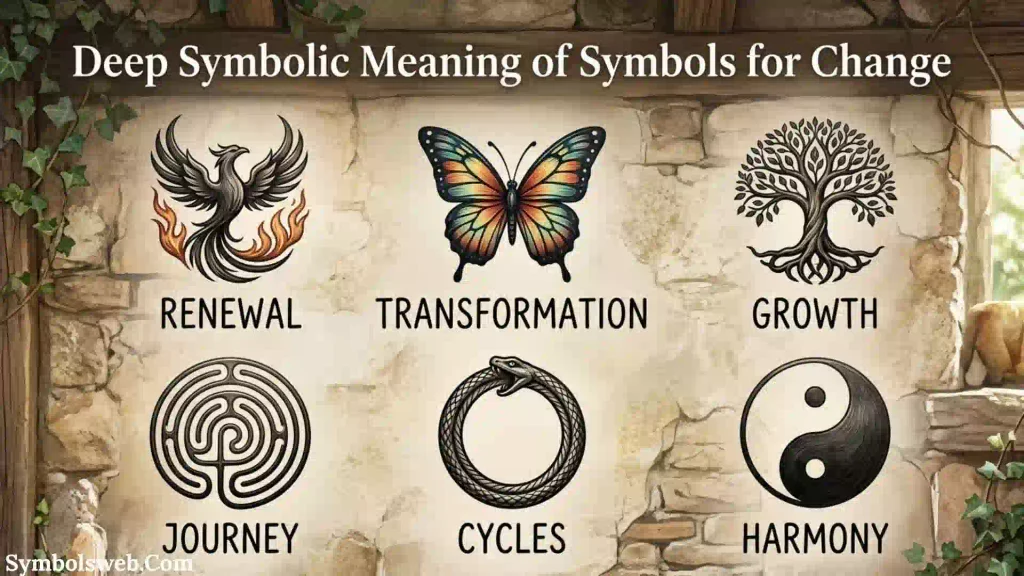
Symbols for change can be understood on spiritual, psychological, and cultural levels.
Spiritual Meaning of Symbols for Change
Spiritually, symbols of change often represent movement from one state of consciousness to another.
They may represent:
- Spiritual awakening
- Rebirth
- Inner transformation
- Healing
- Letting go
- Renewal
- Growth of consciousness
- A new life chapter
- Release from the past
The lotus is especially powerful in this context. Its growth from muddy water into an open flower has made it a strong image of spiritual development in Buddhist and Hindu traditions.
The deeper message is simple: difficult surroundings do not necessarily prevent meaningful growth.
Psychological Meaning of Symbols for Change
Symbols can help people express emotions and experiences that are difficult to explain directly.
Psychologist Carl Jung gave considerable attention to symbols, myths, archetypes, and transformation. His ideas about archetypes and the collective unconscious influenced later discussions about recurring symbolic patterns in human experience.
A transformation symbol can therefore become a psychological reminder.
Someone going through a major life transition may feel drawn to images of butterflies, doors, roads, or rising suns because these images reflect an internal experience.
The symbol does not magically cause change. Instead, it can help a person give meaning to the change they are already experiencing.
Cultural Meaning of Symbols for Change
Culture strongly influences symbolism.
The same image can have different meanings in different societies. A snake may represent renewal in one context and danger in another. A lotus may carry religious meaning in one culture and simply represent beauty in another.
This is why symbolic meanings should always be understood within their cultural and historical context.
There is no universal dictionary where every symbol has one permanent meaning.
Types and Variations of Symbols for Change
Butterfly
Visual Description: A winged insect that develops through several stages, including a caterpillar and chrysalis.
Meaning: Transformation, freedom, beauty, growth, and new identity.
Symbolism: The butterfly is one of the clearest natural symbols of transformation because its physical form changes dramatically.
Cultural Connection: In classical Greek and Roman traditions, the butterfly became associated with psyche, or soul.
Where It Appears: Tattoos, jewelry, dreams, poetry, paintings, fashion, and spiritual artwork.
Phoenix
Visual Description: A mythical bird associated with fire and rebirth.
Meaning: Rebirth, resilience, renewal, recovery, and rising after hardship.
Symbolism: The phoenix represents a powerful form of transformation in which an old existence ends and a new one begins.
Cultural Connection: Phoenix traditions developed in the ancient Mediterranean and later became influential in Western literature and symbolism.
Where It Appears: Mythology, literature, tattoos, fantasy art, movies, jewelry, and modern motivational imagery.
Lotus Flower
Visual Description: A flower that rises above water from roots beneath the surface.
Meaning: Spiritual growth, purity, awakening, resilience, and transformation.
Symbolism: The lotus represents growth through difficult circumstances.
Cultural Connection: It has deep symbolic importance in Hinduism and Buddhism and appears widely in South Asian and East Asian religious art.
Where It Appears: Temples, meditation imagery, tattoos, jewelry, paintings, and spiritual design.
Ouroboros
Visual Description: A serpent or dragon forming a circle by biting its own tail.
Meaning: Cycles, renewal, continuity, transformation, and return.
Symbolism: The ouroboros presents endings and beginnings as connected parts of a larger cycle.
Cultural Connection: Its history reaches into ancient Egyptian and later Greek, Gnostic, and alchemical traditions.
Where It Appears: Ancient artwork, manuscripts, alchemy, occult symbolism, tattoos, jewelry, and fantasy design.
Spiral
Visual Description: A curved line that circles around a central point.
Meaning: Growth, movement, evolution, cycles, and development.
Symbolism: A spiral can suggest that life moves in cycles while still progressing.
Where It Appears: Ancient art, architecture, jewelry, tattoos, sacred designs, and modern artwork.
Changing Moon
Visual Description: The moon represented through its different phases.
Meaning: Cycles, transition, renewal, time, emotions, and change.
Symbolism: The moon seems to disappear and return, making it a natural metaphor for endings and beginnings.
Where It Appears: Mythology, poetry, astrology, spiritual practices, jewelry, tattoos, and art.
Snake
Visual Description: A snake shedding its outer skin.
Meaning: Renewal, healing, transformation, and rebirth.
Symbolism: The snake can represent leaving an old layer of identity behind.
Cultural Connection: Snake symbolism varies greatly across cultures, appearing as a symbol of healing, danger, wisdom, fertility, rebirth, or transformation.
Where It Appears: Mythology, medicine-related imagery, religious art, tattoos, jewelry, and folklore.
Tree
Visual Description: A rooted plant growing upward with branches and leaves.
Meaning: Growth, stability, ancestry, continuity, and life cycles.
Symbolism: A tree combines stability with constant change. Its roots remain while branches grow and leaves appear, change, and fall.
Where It Appears: Mythology, religious traditions, family symbolism, literature, tattoos, and memorial art.
Seed
Visual Description: A small object containing the potential for a new plant.
Meaning: Potential, beginning, patience, growth, and hidden transformation.
Symbolism: A seed reminds us that important change can begin invisibly.
Where It Appears: Literature, spiritual teachings, artwork, education, jewelry, and personal-growth imagery.
Sunrise
Visual Description: The sun appearing above the horizon.
Meaning: Hope, renewal, opportunity, and new beginnings.
Symbolism: Sunrise represents the possibility of beginning again after darkness.
Where It Appears: Poetry, photography, paintings, tattoos, motivational art, and social media.
Doorway
Visual Description: An opening connecting two spaces.
Meaning: Transition, opportunity, choice, and entering a new stage.
Symbolism: A doorway often represents a decision. Something new exists beyond it, but someone must choose to cross.
Where It Appears: Dreams, literature, paintings, movies, architecture, and spiritual artwork.
Bridge
Visual Description: A structure connecting two separated places.
Meaning: Transition, connection, progress, reconciliation, and movement.
Symbolism: A bridge represents the journey between an old situation and a new one.
Where It Appears: Literature, films, paintings, architecture, tattoos, and personal symbolism.
Crossroads
Visual Description: Several paths meeting at one location.
Meaning: Choice, uncertainty, destiny, decision, and change.
Symbolism: The crossroads emphasizes the role of human choice in transformation.
Where It Appears: Mythology, folklore, literature, movies, tattoos, and spiritual traditions.
Wave
Visual Description: Moving water rising and falling.
Meaning: Movement, emotional change, impermanence, adaptability, and rhythm.
Symbolism: A wave can represent the idea of moving with change rather than trying to stop it.
Dragonfly
Visual Description: A winged insect that spends part of its life underwater before becoming an airborne adult.
Meaning: Transformation, adaptability, freedom, maturity, and perspective.
Symbolism: Its life cycle naturally lends itself to ideas of transformation.
Scarab
Visual Description: A beetle frequently represented in ancient Egyptian art.
Meaning: Rebirth, emergence, renewal, and becoming.
Cultural Connection: Ancient Egyptian scarab symbolism was connected with the beetle’s behavior and its association with the sun and regeneration.
Where It Appears: Egyptian amulets, jewelry, funerary objects, museum collections, and modern Egyptian-inspired designs.
Ankh
Visual Description: A cross-like Egyptian hieroglyph with a loop at the top.
Meaning: Life, vitality, and continued existence.
Symbolism: The ankh is primarily a symbol of life rather than a generic symbol of change, but life itself became closely connected with ideas of continuity and renewal.
Where It Appears: Ancient Egyptian art, temples, amulets, jewelry, tattoos, fashion, and popular culture.
Eye of Horus
Visual Description: A stylized eye associated with the Egyptian god Horus.
Meaning: Healing, restoration, protection, and wholeness.
Symbolism: The restored eye of Horus became a powerful image of recovery and renewal.
Where It Appears: Ancient Egyptian art, amulets, jewelry, tattoos, museums, and modern Egyptian-inspired design.
Fire
Visual Description: A flame that consumes and transforms material.
Meaning: Transformation, purification, destruction, energy, passion, and renewal.
Symbolism: Fire has both creative and destructive meanings. It can destroy an old form while making room for something new.
Rising Sun
Visual Description: The sun ascending above the horizon.
Meaning: Awakening, hope, renewal, victory, and a new beginning.
Symbolism: The rising sun represents light returning after darkness.
Where It Appears: Flags, paintings, literature, religious imagery, tattoos, logos, and modern design.
Symbols for Change Across Different Cultures
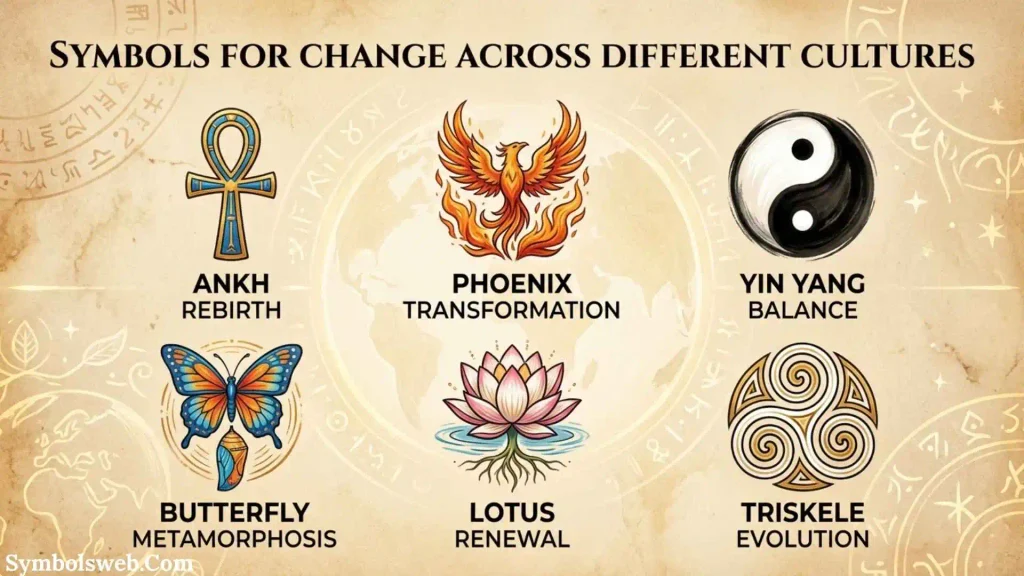
Symbols for Change in Ancient Egypt
Ancient Egypt developed a rich symbolic language around life, death, restoration, and rebirth.
The ankh represented life. The scarab was connected with regeneration and becoming. The Eye of Horus represented restoration and healing.
Egyptian religious thought placed strong importance on the continuation of existence after death, making renewal an important part of its symbolic world.
Symbols for Change in Ancient Greece
Greek mythology contains countless stories of transformation.
People and gods are transformed into plants, animals, stars, and other forms. These stories often explore punishment, love, escape, identity, and divine power.
The story of Psyche is particularly relevant to transformation. The butterfly also became associated with the soul in classical symbolism.
Symbols for Change in Roman Culture
Roman culture adopted and adapted many Greek myths and symbolic traditions.
Transformation remained important in Roman literature, especially in stories involving gods, humans, animals, plants, and changing identities.
Ovid’s Metamorphoses is one of the most famous Roman works built around transformation. The title itself means transformations and presents a huge collection of stories involving change of form.
Symbols for Change in Eastern Traditions
Eastern traditions contain powerful symbols of spiritual transformation.
The lotus represents spiritual growth and awakening in Hindu and Buddhist traditions.
The yin yang comes from Chinese philosophical traditions and represents complementary forces that interact dynamically.
These traditions also contain deep ideas about cycles, rebirth, consciousness, balance, and liberation.
Symbols for Change in Indigenous Traditions
Indigenous cultures around the world have their own distinct symbolic systems involving animals, nature, seasons, ancestors, dreams, land, and spiritual life.
There is no single universal Indigenous symbol for change.
Different Indigenous nations have different languages, histories, ceremonies, and beliefs. Therefore, a symbol should be interpreted according to the specific culture from which it comes rather than being given a generic “Indigenous” meaning.
Modern Interpretations of Symbols for Change
Modern society often turns traditional symbols into personal expressions.
A person may choose a butterfly to represent personal transformation, a phoenix to symbolize resilience, or a lotus to represent spiritual development.
Modern interpretations can be meaningful, but they should not automatically be presented as the original ancient meaning of a symbol.
Also Check This Post: 95+ The Outsiders Symbols: A Complete Guide to Their Meaning
Similar Symbols and Their Meanings
| Symbol | Main Meaning | Type of Change |
| Butterfly | Metamorphosis | Personal transformation |
| Phoenix | Rebirth | Recovery after hardship |
| Lotus | Awakening | Spiritual transformation |
| Ouroboros | Cycles | Renewal and continuity |
| Spiral | Evolution | Ongoing growth |
| Snake | Renewal | Shedding the old |
| Moon | Cycles | Natural and emotional change |
| Seed | Potential | Beginning and growth |
| Bridge | Transition | Moving between stages |
| Sunrise | Hope | New beginning |
Butterfly vs Phoenix
The butterfly represents transformation through metamorphosis.
The phoenix represents rebirth after destruction.
A butterfly says, “I have become different.”
A phoenix says, “I survived and rose again.”
Butterfly vs Lotus
The butterfly focuses on visible transformation.
The lotus focuses on growth despite difficult conditions.
Both can represent personal growth, but their symbolic stories are different.
Phoenix vs Ouroboros
The phoenix emphasizes dramatic rebirth.
The ouroboros emphasizes cycles and continuity.
The phoenix represents starting again after an ending. The ouroboros suggests that the ending may already be part of another beginning.
Spiral vs Ouroboros
Both can represent cycles.
The ouroboros forms a closed circle, emphasizing continuity and return.
The spiral moves outward or inward, making it a stronger image for development and progression.
Moon vs Sun
The moon represents phases and recurring cycles.
The sun often represents light, life, energy, and renewal.
Together, they can represent balance between change and continuity.
Snake vs Butterfly
Both can represent transformation, but they do so differently.
The snake sheds an old outer layer.
The butterfly undergoes metamorphosis and emerges in a dramatically different form.
Symbols for Change in Mythology and Folklore
The Phoenix and Rebirth
The phoenix became famous as an image of renewal because its legendary life cycle involves destruction followed by rebirth.
Its story has survived because it speaks to a powerful human hope: an ending does not always have to be the end of the story.
Psyche and the Butterfly
Psyche’s story involves trials, suffering, growth, and transformation.
The Greek word psyche could refer to the soul or spirit and was also connected with the butterfly in classical symbolism.
This connection helped make the butterfly one of the strongest Western images associated with the soul and transformation.
Egyptian Stories of Renewal
Ancient Egyptian symbolism repeatedly connected life with restoration and renewal.
The scarab became associated with regeneration, while the Eye of Horus represented restoration after injury.
These symbols show that transformation was not always imagined as becoming something completely different. Sometimes it meant restoring something that had been damaged.
Transformation in Folklore
Transformation appears throughout folklore.
A person may become an animal.
A hero may leave home and return changed.
A poor character may discover a new identity.
A creature may transform after a test.
These stories continue to appeal to modern audiences because personal growth follows a similar pattern.
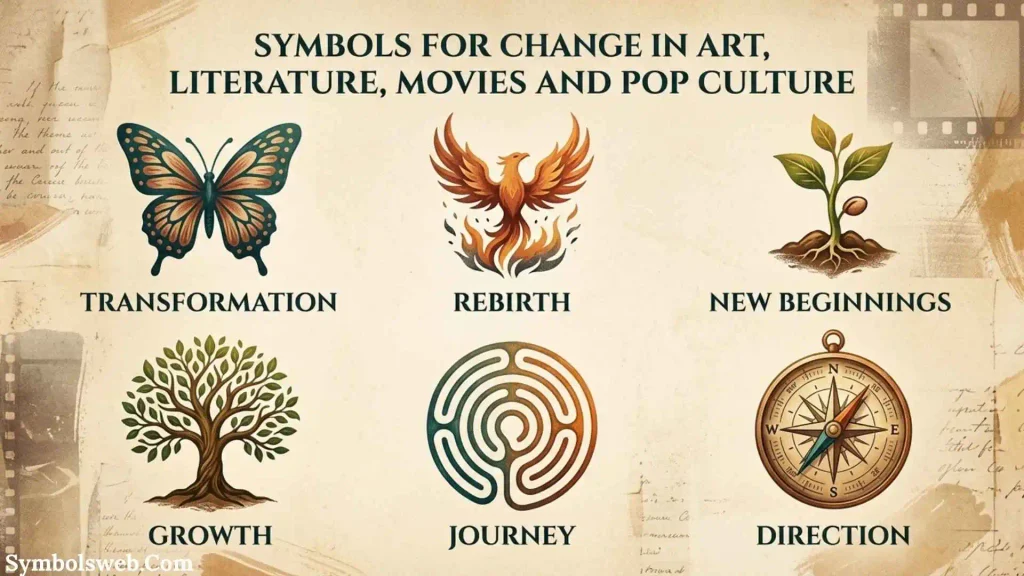
Symbols for Change in Art, Literature, Movies and Pop Culture
Symbols for Change in Paintings
Artists use flowers, butterflies, seasons, mirrors, doors, birds, trees, and changing landscapes to communicate transformation.
A dying flower may represent loss.
A blooming flower may represent renewal.
A changing landscape may represent the passage of time.
Symbols for Change in Literature
Writers often use symbolic objects to show character development.
A road may represent a journey.
A door may represent opportunity.
Winter may represent emotional isolation.
Spring may represent recovery.
A river may represent time and movement.
Symbols for Change in Poetry
Poetry often uses nature as a language for emotional transformation.
Falling leaves can represent letting go.
Sunrise can represent hope.
Rain can represent cleansing or sadness.
A butterfly can represent freedom.
The strength of these symbols comes from their ability to communicate emotion without lengthy explanation.
Symbols for Change in Movies
Movies often use transformation symbols to show a character entering a new stage of life.
Fire, mirrors, costumes, doors, roads, wings, and changing landscapes can visually communicate identity and personal growth.
Symbols for Change in Television
Television series frequently use recurring symbols to show how characters evolve across seasons.
A changing home, piece of jewelry, tattoo, photograph, or location can quietly show that a character is no longer the person they were at the beginning.
Symbols for Change in Tattoos
Tattoos are among the most personal modern uses of transformation symbolism.
Popular choices include:
- Butterfly for transformation
- Phoenix for resilience
- Lotus for spiritual growth
- Snake for renewal
- Ouroboros for cycles
- Moon for changing life phases
- Tree for growth
- Sunrise for a new beginning
- Crossroads for an important life decision
Symbols for Change in Fashion
Butterflies, flowers, celestial imagery, snakes, wings, and flames often appear in fashion because they combine visual beauty with emotional meaning.
The wearer may use the symbol simply for its appearance or as a personal statement.
Symbols for Change in Modern Design
Modern designers use circles, arrows, leaves, rising shapes, spirals, wings, and sunrise imagery to communicate ideas such as progress, innovation, renewal, sustainability, and growth.
Spiritual and Dream Meaning of Symbols for Change
Dream Meaning of a Butterfly
A butterfly in a dream may suggest transformation, freedom, emotional growth, or a new identity.
The feeling experienced during the dream is important. A peaceful butterfly may feel hopeful, while a frightening dream may reflect anxiety about change.
Dream Meaning of a Phoenix
A phoenix may symbolize rebuilding, resilience, recovery, or starting again.
It can be especially meaningful when someone is leaving behind a difficult period.
Dream Meaning of a Snake
A snake can have many meanings.
It may represent renewal because snakes shed their skin. It may also symbolize fear, danger, hidden emotions, wisdom, or something that needs attention.
There is no scientifically proven universal dream dictionary, so personal context matters.
Dream Meaning of a Lotus
A lotus may represent spiritual growth, peace, emotional healing, or the ability to grow through difficult circumstances.
Dream Meaning of a Moon
A changing moon may represent emotional cycles, personal transitions, time, uncertainty, or renewal.
Dream Meaning of a Door
A door may symbolize an opportunity, decision, transition, or unknown future.
An open door may feel welcoming, while a locked door may represent an obstacle or hesitation.
Spiritual Meaning of Transformation Symbols
From a spiritual perspective, transformation symbols can serve as reminders to release old patterns and remain open to growth.
They may be used during meditation, prayer, reflection, or personal rituals.
However, spiritual interpretations are matters of belief rather than scientifically established facts.
Positive Spiritual Messages
Transformation symbols may encourage ideas such as:
- Trust the process
- Let go of the past
- Accept growth
- Begin again
- Seek inner peace
- Learn from hardship
- Remain open to change
Cautionary Spiritual Messages
Some symbols can also remind people that change requires responsibility.
Transformation may involve uncertainty, loss, discomfort, or difficult choices.
A symbol should therefore not be treated as a promise that everything will automatically improve.
Positive and Negative Meanings of Symbols for Change
Positive Meanings
Symbols of change can represent:
- Growth
- Healing
- Renewal
- Freedom
- Hope
- Resilience
- Rebirth
- Adaptability
- Courage
- New beginnings
Negative Meanings
The same symbols can also represent:
- Loss
- Fear
- Uncertainty
- Instability
- Destruction
- Identity confusion
- Emotional resistance
- Endings
- Disruption
- Lack of control
Why One Symbol Can Have Both Positive and Negative Meanings
Change itself is neither completely good nor completely bad.
A new beginning requires an ending.
Freedom can involve leaving something familiar.
Growth can be uncomfortable.
Fire can destroy, but it can also symbolize purification.
The meaning depends on context, culture, personal experience, and the story surrounding the symbol.
Why Humans Are Attracted to Symbols for Change
Human Nature and Symbolism
People naturally search for meaning when life changes.
A symbol can make an uncertain experience easier to understand.
Emotional Connections
A person may connect deeply with a symbol because it reminds them of something they survived, lost, learned, or became.
Pattern Recognition
Humans naturally notice recurring patterns.
We see change in day and night, seasons, moon phases, plant growth, aging, relationships, and life stages.
Symbols turn these patterns into memorable images.
Collective Symbolism
Some symbols appear across many cultures because they are connected with experiences that humans commonly observe.
Birth, death, darkness, light, growth, decay, and renewal are universal parts of life.
Cultural Memory
Symbols can survive for thousands of years.
Their meanings may change, but the images continue to be reused by later generations.
Personal Meaning
Personal meaning may be the most powerful layer of all.
A butterfly does not mean exactly the same thing to everyone.
For one person, it may represent freedom.
For another, recovery.
For another, the memory of someone they loved.
The symbol provides the image. The person provides the story.
Modern Uses of Symbols for Change
Symbols for Change in Tattoos
Transformation tattoos often mark major life transitions, personal achievements, recovery, or emotional growth.
Symbols for Change in Jewelry
Pendants, rings, bracelets, and charms allow people to carry symbolic reminders with them every day.
Symbols for Change in Fashion
Symbolic clothing and accessories can communicate identity, beliefs, personality, or personal experiences.
Symbols for Change in Branding
Businesses use visual symbols of movement, growth, renewal, and progress to communicate innovation and change.
Arrows, leaves, circles, rising lines, and growing plants are common examples.
Symbols for Change on Social Media
People use transformation symbols in profile images, captions, posts, usernames, and motivational content.
Symbols for Change in Contemporary Spirituality
Modern spiritual communities frequently use lotus flowers, moons, butterflies, spirals, crystals, wings, and phoenix imagery when discussing personal growth and awakening.
Symbols for Change in Home Decor
Transformation symbols can appear in wall art, sculptures, mirrors, plants, decorative objects, and inspirational artwork.
Symbols for Change in Personal Expression
Ultimately, symbols allow people to communicate something about themselves without saying everything directly.
A single image can represent an entire chapter of someone’s life.
Interesting Facts About Symbols for Change
- The butterfly became associated with the soul in classical Greek and Roman symbolism.
- The ancient Egyptian ankh was a real hieroglyph associated with life, rather than being created as a modern decorative symbol.
- Scarab imagery became strongly connected with rebirth in ancient Egypt.
- The Eye of Horus was associated with restoration and healing, not simply protection.
- The ouroboros has a long and complex history and its meaning cannot be reduced to one simple definition.
- Ovid’s Roman epic Metamorphoses contains a huge collection of transformation stories, making change the central theme of the work.
- Nature is one of humanity’s oldest sources of transformation symbolism, especially through seasons, plants, animals, and celestial cycles.
- A symbol’s modern meaning may differ from its ancient meaning. Historical context is essential when interpreting symbols.
- The same symbol can have opposite meanings in different cultures. A snake, for example, can represent renewal, danger, healing, wisdom, or transformation depending on context.
- Personal experience can become part of a symbol’s meaning. A modern tattoo may carry a meaning that is completely unique to its owner.
Frequently Asked Questions About Symbols for Change
What Is the Most Powerful Symbol for Change?
There is no single universally accepted symbol for change. The butterfly is one of the clearest symbols of transformation, while the phoenix is especially powerful for rebirth and resilience. The lotus often represents spiritual growth, while the ouroboros represents cycles and renewal.
What Symbol Represents a New Beginning?
The sunrise, seed, spring, open door, butterfly, lotus, and phoenix can all represent new beginnings. The sunrise is especially simple and widely understood as a symbol of hope after darkness.
What Symbol Represents Personal Transformation?
The butterfly is one of the strongest symbols of personal transformation because its life cycle involves dramatic metamorphosis. A phoenix is another popular choice when transformation follows hardship.
What Flower Symbolizes Change?
The lotus is commonly associated with spiritual growth and transformation. Other flowers may represent renewal, life, death, or transition depending on the culture and context.
What Animal Symbolizes Transformation?
The butterfly, snake, dragonfly, and scarab are natural examples associated with transformation because of their life cycles. The phoenix is a mythical example of rebirth and renewal.
What Symbol Represents Change and Growth?
The tree, spiral, seed, butterfly, lotus, moon, and sunrise can all symbolize change and growth. The best choice depends on whether the intended message is personal development, spiritual growth, renewal, or a new beginning.
Conclusion
Symbols for Change give visible meaning to one of the deepest experiences of human life: transformation. From the butterfly and phoenix to the lotus, moon, tree, and rising sun, each symbol tells a different story about growth, renewal, loss, resilience, or rebirth.
Their meanings have developed across ancient civilizations, mythology, religion, psychology, art, and modern culture. Yet the most powerful meaning often comes from the personal story behind the symbol.
Also Check This Post: 63+ Yule Symbols: The Complete Guide to Their Meaning and Origins

Hi, I’m Ethan Holloway, and I’ve always believed that a few meaningful words can change the way we think, feel, and live. I enjoy collecting timeless quotes, studying their deeper meanings, and sharing inspiring messages that help people stay motivated through every stage of life.
Over the years, I’ve explored thousands of famous sayings from writers, leaders, philosophers, and everyday people. My goal is to make wisdom easy to understand and useful for everyone.
Books by Ethan Holloway
- The Power of Everyday Quotes
- Words That Inspire Greatness
 Jordan Hayes
 Eliana Foster
[…] Their Hidden Meanings 111+ Engineering Drawing Symbols: Types Meanings & Uses Explained 99+ Symbols for Change: The Ultimate Guide to Their Meanings 63+ Yule Symbols: The Complete Guide to Their Meaning and Origins 73+ Naruto Village Symbols: […]