Travel symbols have guided human journeys for thousands of years, carrying meanings far deeper than simple directions on a map. Whether carved into ancient stones, painted on ships, worn as amulets, or displayed in modern travel logos, these symbols represent adventure, discovery, freedom, transformation, and the human desire to explore the unknown.
From ancient pilgrims crossing deserts to modern travelers flying across continents, travel symbols connect us to a universal story. They reveal how different cultures understood movement, destiny, protection, and personal growth. Understanding these symbols opens a fascinating window into history, psychology, spirituality, and human imagination.
Travel Symbols: (Quick Answer)
Travel symbols are visual signs, icons, objects, or images that represent journeys, exploration, movement, guidance, adventure, and transformation. Throughout history, symbols such as the compass, ship, road, wings, star, and walking staff have been used to express physical travel, spiritual journeys, personal growth, and the search for new experiences.
Also Check This Post: 51+ Powerful Symbols of Innocence: And Their Hidden Meanings Across the World
Quick Facts About Travel Symbols
| Aspect | Information |
| Origin | Ancient civilizations including Egypt, Mesopotamia, Greece, and Indigenous cultures |
| Historical Significance | Guided travelers, pilgrims, merchants, and explorers |
| Main Meaning | Journey, exploration, movement, adventure, discovery |
| Spiritual Meaning | Personal transformation, soul journey, life path |
| Cultural Importance | Appears in mythology, religion, folklore, and traditions worldwide |
| Modern Usage | Tourism, tattoos, branding, social media, fashion, travel accessories |
What Are Travel Symbols?
Travel symbols are visual representations associated with movement from one place to another. While some serve practical purposes, many carry deeper symbolic meanings.
Throughout human history, traveling was often dangerous. Roads were uncertain, oceans were mysterious, and distant lands were largely unknown. As a result, people created symbols to provide guidance, protection, and hope.
Ancient merchants used stars for navigation. Pilgrims carried staffs representing faith and endurance. Sailors trusted compasses and celestial symbols to cross vast oceans.
Over time, these practical tools evolved into powerful cultural symbols representing:
- Adventure
- Freedom
- Discovery
- Courage
- Growth
- Destiny
- Transformation
Today, travel symbols appear everywhere, from airport signs and tourism logos to jewelry and tattoos.
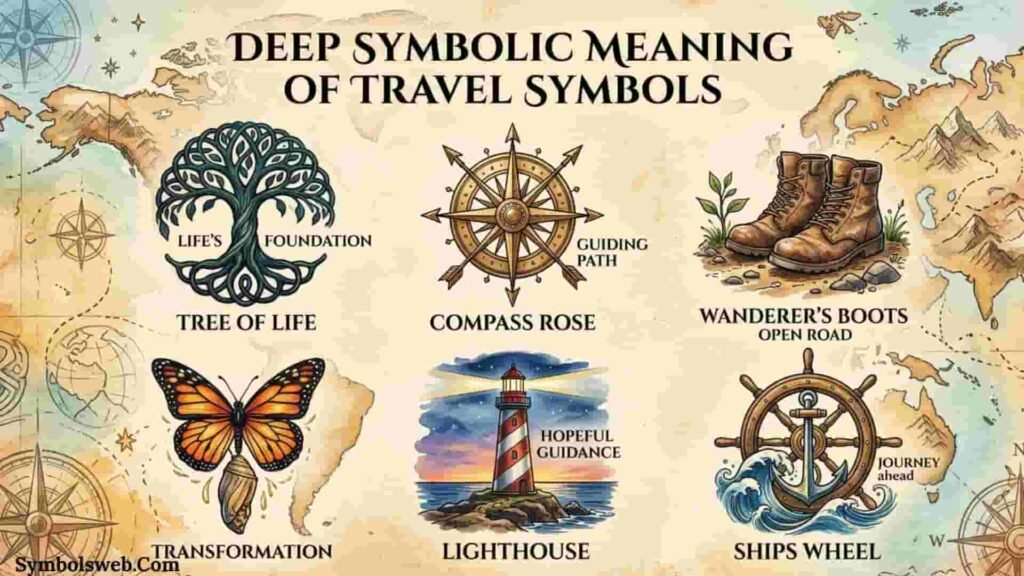
Deep Symbolic Meaning of Travel Symbols
Spiritual Level
On a spiritual level, travel often symbolizes the journey of the soul.
Many traditions view life itself as a pilgrimage. The destination matters, but the lessons learned along the way matter even more.
Common spiritual meanings include:
- Awakening
- Self-discovery
- Divine guidance
- Inner transformation
- Personal evolution
In many religious traditions, sacred journeys symbolize purification and enlightenment. Pilgrimages often represent leaving behind old beliefs and embracing new understanding.
Travel as Transformation
Crossing mountains, oceans, or deserts often mirrors inner challenges. The traveler returns changed, wiser, and spiritually stronger.
Psychological Level
Psychologist Carl Jung described journeys as one of humanity’s most powerful archetypes.
The traveler’s path reflects:
- Personal growth
- Facing fears
- Discovering identity
- Exploring the unconscious mind
Travel symbols resonate because they mirror our internal experiences.
A winding road may symbolize uncertainty.
A compass may represent guidance.
A bridge may symbolize transition from one life stage to another.
Humans naturally connect travel with emotional development and self-understanding.
Cultural Level
Every culture has developed travel symbols that reflect its values and worldview.
For example:
- Seafaring cultures celebrate ships and stars.
- Desert cultures value paths and caravans.
- Mountain societies emphasize trails and crossings.
Travel symbols help communities express ideas about exploration, courage, destiny, and connection with distant places.
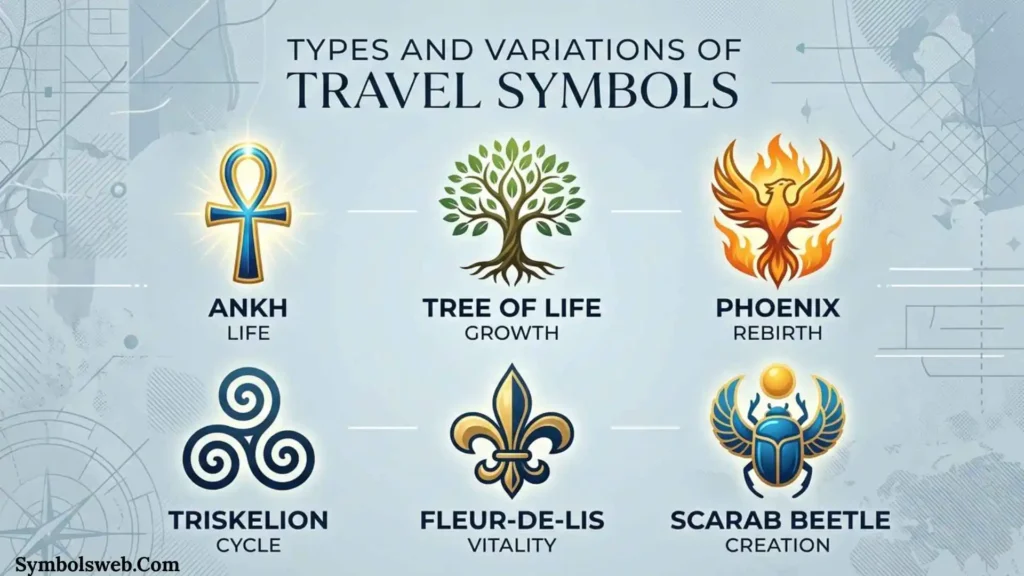
Types and Variations of Travel Symbols
Compass
Visual Description
A circular instrument marked with cardinal directions.
Meaning
Guidance and navigation.
Symbolism
Finding one’s path in life.
Cultural Connection
Used by explorers, sailors, and adventurers.
Where It Appears
- Tattoos
- Travel logos
- Jewelry
- Maps
Ship
Visual Description
A sailing vessel crossing water.
Meaning
Exploration and discovery.
Symbolism
Venturing into the unknown.
Cultural Connection
Associated with maritime civilizations.
Where It Appears
- Mythology
- Literature
- Art
- Travel branding
Road or Path
Visual Description
A winding trail or roadway.
Meaning
Life’s journey.
Symbolism
Choices, progress, and destiny.
Cultural Connection
Found in countless traditions worldwide.
Where It Appears
- Dreams
- Religious teachings
- Literature
- Folklore
Wings
Visual Description
Bird or angel wings.
Meaning
Freedom and movement.
Symbolism
Transcendence and exploration.
Cultural Connection
Ancient spiritual traditions.
Where It Appears
- Art
- Fashion
- Spiritual imagery
Star
Visual Description
Celestial body shining in the night sky.
Meaning
Direction and hope.
Symbolism
Guidance through uncertainty.
Cultural Connection
Ancient navigation traditions.
Where It Appears
- Maritime history
- Religious symbolism
- National emblems
Walking Staff
Visual Description
A long stick carried by travelers.
Meaning
Support and endurance.
Symbolism
Perseverance during life’s journey.
Cultural Connection
Pilgrims and wanderers.
Where It Appears
- Religious traditions
- Folklore
- Mythology
Travel Symbols Across Different Cultures
Ancient Egypt
Travel symbols were closely tied to the afterlife.
Boats held special significance because Egyptians believed souls traveled through the spiritual realm aboard sacred vessels.
The solar boat of the sun god represented cosmic journeys and rebirth.
Ancient Greece
Greek culture celebrated travel through epic adventures.
The voyages of heroes symbolized courage, wisdom, and transformation.
Ships became symbols of exploration and human ambition.
Travel represented both physical movement and personal growth.
Roman Culture
Romans built extensive road systems that connected vast territories.
Roads became symbols of power, unity, and civilization.
Travel represented expansion, communication, and cultural exchange.
Eastern Traditions
In Hinduism, Buddhism, and Taoist philosophy, journeys often symbolize spiritual awakening.
Pilgrimages remain important practices.
Paths and roads represent movement toward enlightenment and self-realization.
Indigenous Traditions
Many Indigenous cultures view travel as a sacred relationship with the land.
Travel symbols often include:
- Animal tracks
- Rivers
- Mountains
- Migration paths
These symbols reflect respect for nature and ancestral wisdom.
Modern Interpretations
Today, travel symbols represent:
- Freedom
- Adventure
- Global connection
- Personal growth
- Cultural discovery
Modern travelers often embrace these symbols through tattoos, artwork, and social media.
Similar Symbols and Their Meanings
| Symbol | Similarity to Travel Symbols | Key Difference |
| Compass | Guidance | Focuses specifically on direction |
| Anchor | Journey and navigation | Represents stability rather than movement |
| Bridge | Transition | Emphasizes crossing between states |
| Bird | Freedom and movement | Associated with natural migration |
| Map | Exploration | Practical representation of places |
| Wheel | Movement | Symbolizes cycles and progress |
Common Misconceptions
Many people assume travel symbols only represent vacations or tourism.
In reality, most ancient travel symbols carried profound spiritual and psychological meanings related to growth, destiny, and transformation.
Travel Symbols in Mythology and Folklore
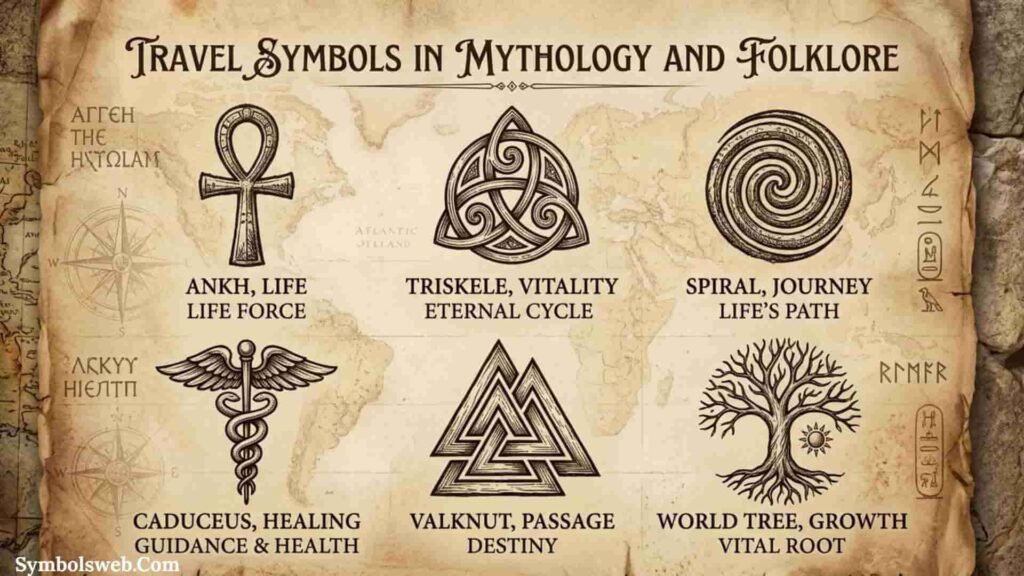
Myths around the world often center on legendary journeys.
Hero’s Journey
Many myths follow a traveler who leaves home, faces challenges, gains wisdom, and returns transformed.
Examples include:
- Odysseus in Greek mythology
- Aeneas in Roman tradition
- Ancient pilgrimage stories
- Indigenous migration legends
The traveler’s path became one of humanity’s most enduring symbolic patterns.
Magical Roads and Paths
Folklore frequently describes enchanted roads leading to hidden realms.
These stories symbolize:
- Personal growth
- Hidden knowledge
- Spiritual awakening
The road itself often becomes a teacher.
Sacred Voyages
Across cultures, journeys by sea often symbolize crossing between worlds.
Water represents mystery, change, and transformation.
Ships therefore become symbols of courage and destiny.
Travel Symbols in Art, Literature, Movies and Pop Culture
Paintings
Artists often use roads, ships, and horizons to symbolize possibility and exploration.
Landscape paintings frequently evoke emotional journeys.
Literature
Travel is one of literature’s oldest themes.
From ancient epics to modern novels, journeys symbolize:
- Discovery
- Change
- Identity
- Growth
Many famous stories are built around a symbolic journey.
Poetry
Poets often use roads, stars, rivers, and horizons to explore human emotions and life’s uncertainties.
Movies and Television
Travel symbols appear throughout modern storytelling.
Examples include:
- Roads representing adventure
- Trains symbolizing transition
- Ships symbolizing discovery
- Portals representing transformation
Audiences instantly recognize these meanings.
Tattoos
Popular travel-themed tattoos include:
- Compasses
- Maps
- Airplanes
- Mountains
- Coordinates
- Ships
People often choose them to represent freedom and personal journeys.
Fashion and Design
Travel symbols frequently appear on:
- Clothing
- Backpacks
- Jewelry
- Travel accessories
- Home décor
They communicate curiosity and an adventurous spirit.
Spiritual and Dream Meaning of Travel Symbols
Dreams involving travel symbols often reflect personal development.
Common Dream Interpretations
Compass in a Dream
Seeking direction or clarity.
Road in a Dream
Life choices and future opportunities.
Ship in a Dream
Emotional journeys and change.
Bridge in a Dream
Transition into a new stage of life.
Wings in a Dream
Freedom from limitations.
Positive Spiritual Messages
- Growth
- Hope
- New opportunities
- Discovery
- Awakening
Cautionary Messages
- Feeling lost
- Fear of change
- Uncertainty
- Lack of direction
The meaning depends on personal circumstances and emotional context.
Positive and Negative Meanings of Travel Symbols
| Positive Meaning | Negative Meaning |
| Adventure | Restlessness |
| Growth | Instability |
| Freedom | Escapism |
| Discovery | Uncertainty |
| Transformation | Fear of the unknown |
| Opportunity | Lack of roots |
| Curiosity | Constant dissatisfaction |
| Hope | Confusion |
Travel symbols often contain both light and shadow aspects. Their meaning depends on how the journey is experienced.
Why Humans Are Attracted to Travel Symbols
Humans are natural explorers.
Long before modern technology, survival often depended on movement, migration, and discovery.
Travel symbols tap into ancient instincts.
Psychologically, they activate powerful archetypes:
- The explorer
- The wanderer
- The seeker
- The pilgrim
- The hero
These archetypes exist across cultures because they reflect universal human experiences.
Travel symbols also trigger imagination.
A compass suggests possibility.
A road suggests adventure.
A distant horizon invites curiosity.
These images remind us that growth often begins when we step beyond what is familiar.
Modern Uses of Travel Symbols
Tattoos
Represent freedom, adventure, and life experiences.
Jewelry
Compasses, airplanes, and maps remain popular symbolic designs.
Fashion
Travel-inspired imagery reflects curiosity and exploration.
Branding
Travel companies frequently use:
- Globes
- Wings
- Paths
- Compasses
- Mountains
These symbols communicate trust and adventure.
Social Media
Travel creators use symbolic imagery to represent exploration and storytelling.
Contemporary Spirituality
Many people view travel as a path to self-discovery and personal transformation.
Home Decor
Travel-themed decorations celebrate memories, aspirations, and global connection.
Interesting Facts About Travel Symbols
- The compass became a major travel symbol after its widespread use in medieval navigation.
- Ancient sailors often relied on stars long before compasses existed.
- Pilgrimage routes inspired many modern travel traditions.
- Birds are among humanity’s oldest travel symbols because of migration.
- Maps were once considered sacred objects in some cultures.
- Roads frequently symbolize destiny in world mythology.
- Ships appear in both creation myths and afterlife beliefs.
- Many travel tattoos symbolize inner journeys rather than physical trips.
- Horizons are often used in psychology to represent future possibilities.
- The hero’s journey remains one of the most influential storytelling patterns in human culture.
Frequently Asked Questions
What do travel symbols represent?
Travel symbols typically represent adventure, exploration, freedom, discovery, transformation, guidance, and personal growth.
What is the most common travel symbol?
The compass is often considered the most recognized travel symbol because it represents navigation, direction, and finding one’s path.
Are travel symbols spiritual?
Yes. Many traditions view travel symbols as representations of spiritual journeys, self-discovery, and personal transformation.
Why are compasses popular in tattoos?
Compass tattoos symbolize guidance, purpose, protection, and staying true to one’s direction in life.
What do roads symbolize in dreams?
Roads often symbolize life choices, future opportunities, personal growth, and the direction of one’s life journey.
How do different cultures interpret travel symbols?
While interpretations vary, most cultures associate travel symbols with exploration, movement, wisdom, transformation, and connection to the unknown.
Conclusion
Travel symbols are far more than decorative images or navigation tools. They carry centuries of history, mythology, spirituality, and human experience. Whether represented by a compass, ship, road, star, or wing, these symbols remind us that every journey changes us in some way.
Across cultures and generations, travel symbols have expressed humanity’s deepest desires to explore, learn, grow, and discover meaning. They speak to the adventurer within us all. Perhaps that is why they remain timeless. Every road, every horizon, and every step forward tells a story of transformation waiting to unfold.
Also Check This Post: 53+ Logic Gates Symbols and Meanings: Everything You Need to Understand Digital Logic

Jordan Hayes is a writer with a passion for exploring the history, meanings, and cultural significance behind symbols from around the world. He enjoys turning complex topics into clear, engaging content that anyone can understand. Jordan is also the fictional author of The Silent Language of Ancient Marks and Hidden Symbols Beyond the Surface, two original book concepts created for his author profile. When he’s not writing, he spends time researching myths, traditions, and forgotten stories that inspire his work. His goal is to help readers discover the deeper meanings behind the symbols they encounter every day.
 Eliana Foster
 Ethan Holloway
[…] Meaning Woman Symbols of Strength and Courage: Powerful Female Symbols That Inspire Resilience 55+ Travel Symbols: Hidden Meanings, History, Spiritual Power, and Cultural Significance 53+ Logic Gates Symbols and Meanings: Everything You Need to Understand Digital Logic 51+ […]
[…] Meaning Woman Symbols of Strength and Courage: Powerful Female Symbols That Inspire Resilience 55+ Travel Symbols: Hidden Meanings, History, Spiritual Power, and Cultural Significance 53+ Logic Gates Symbols and Meanings: Everything You Need to Understand Digital […]