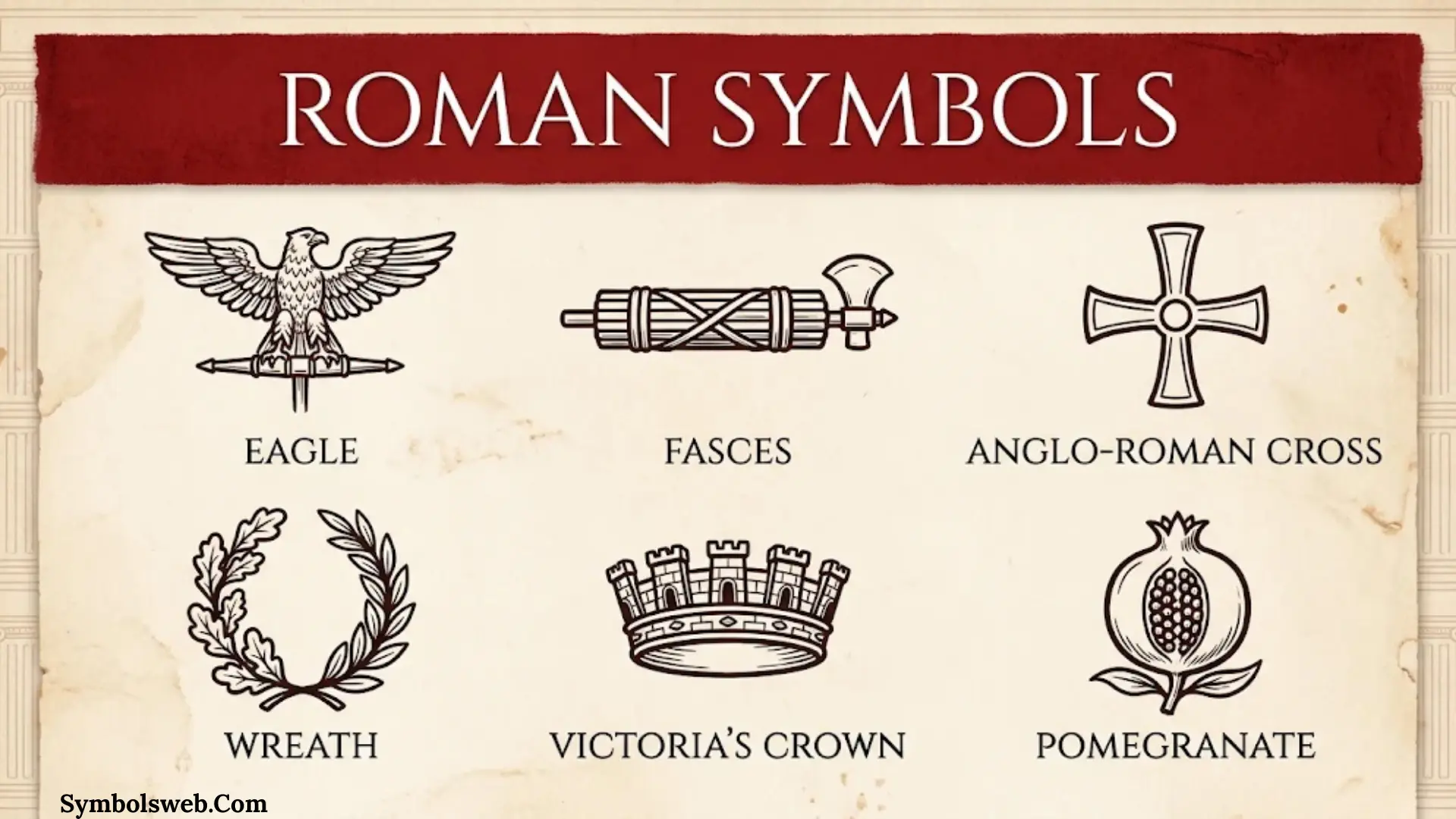
Roman symbols tell the story of one of history’s most influential civilizations. From the powerful letters SPQR to the famous Capitoline Wolf, these images and objects represented Rome’s government, military strength, religious beliefs, mythology, and cultural identity.
The ancient Romans used symbols everywhere. You could find them on coins, statues, temples, military standards, public buildings, jewelry, and household objects. Some represented powerful gods such as Jupiter and Mars. Others celebrated military victories, honored important citizens, or reminded people of Rome’s legendary beginnings.
Many Roman symbols still appear in modern Rome. You can see them on historic monuments, government buildings, churches, and public spaces. Understanding their meanings helps you recognize the stories and beliefs hidden in Roman art and architecture.
What Are Roman Symbols?
Roman symbols are images, objects, letters, and decorative designs that represented important ideas in ancient Roman society. They communicated messages about political authority, religion, military power, social status, and cultural traditions.
Unlike modern countries, ancient Rome did not rely on one national flag or a single official emblem throughout its history. Instead, Romans used several recognizable symbols to represent their city, government, armies, gods, and emperors.
For example, SPQR identified the Roman state, while the eagle represented the strength and identity of a Roman legion. The laurel wreath celebrated victory and achievement. The she-wolf recalled the legendary story of Rome’s founders, Romulus and Remus.
Roman symbols developed over many centuries. Some came from early Italian and Etruscan traditions. Others reflected Greek mythology, Egyptian art, or religious customs from across the Roman Empire.
Their meanings could also change over time. A symbol used during the Roman Republic might later become associated with imperial authority or Christian Rome.
Famous Roman Symbols and Their Meanings
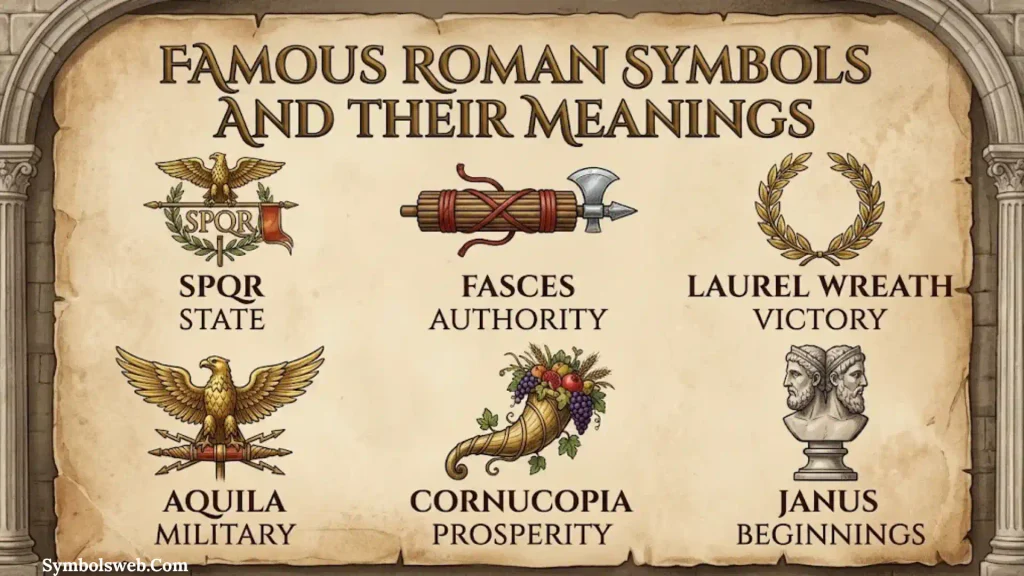
Several symbols became closely connected with Roman identity. They appeared on public monuments, coins, military equipment, and official buildings.
SPQR: The Senate and People of Rome
SPQR is one of the most recognizable Roman symbols. The letters stand for the Latin phrase Senatus Populusque Romanus, meaning The Senate and People of Rome.
The phrase represented the Roman state and its two central political institutions: the Senate and the Roman people. It expressed the idea that Rome’s authority belonged to the political community rather than to one individual ruler.
Romans placed SPQR on:
- Public buildings and monuments
- Military standards and equipment
- Official inscriptions
- Coins and public documents
- Roads and other public works
The letters continued to appear during the Roman Empire, even after emperors gained control over much of the government.
You can still see SPQR throughout modern Rome. The city uses the initials on municipal property, manhole covers, official buildings, and public monuments.
SPQR is more than an ancient abbreviation. It represents the Roman government, civic identity, and the long history of the city.
The Capitoline Wolf: The Founding of Rome
The Capitoline Wolf, also called Lupa Capitolina, is one of Rome’s most famous images. It shows a female wolf nursing two infants named Romulus and Remus.
According to Roman legend, the twins were sons of the god Mars and the Vestal Virgin Rhea Silvia. Their uncle ordered them to be abandoned near the Tiber River. A she-wolf found the babies and cared for them until a shepherd named Faustulus discovered them.
The twins eventually grew up and decided to establish a city. After a dispute, Romulus killed Remus and became the founder of Rome.
The wolf represents several ideas:
- Rome’s legendary foundation
- Protection and survival
- Motherhood and care
- Strength and endurance
- The connection between mythology and Roman identity
The bronze Capitoline Wolf is traditionally dated to the fifth century BCE, although its date and origin have been debated. The two infant figures were added during the Renaissance after the ancient sculpture entered the Capitoline collection.
Today, the Capitoline Wolf remains a powerful symbol of Rome. The Capitoline Museums explain its development into an emblem of the city.
The Roman Eagle (Aquila): Power and Military Strength
The Roman Eagle, known in Latin as Aquila, was the principal standard of a Roman legion. It represented the honor, identity, and spirit of the soldiers who served under it.
The eagle was associated with Jupiter, the chief god of the Roman pantheon. Its connection with the king of the gods made it a fitting symbol for Rome’s military power.
Each legion had its own eagle standard. A soldier known as the aquilifer carried it during military campaigns and ceremonies.
Losing the eagle was considered a terrible disgrace. Roman soldiers fought to protect their standard because its capture could damage the honor of an entire legion.
The eagle commonly represented:
- Military courage
- Loyalty and discipline
- Imperial authority
- Victory and strength
- Protection under Jupiter
The Roman eagle later influenced military and imperial imagery across Europe. However, its meaning depended on the historical period and political setting.
The Laurel Wreath: Victory and Honor
The laurel wreath was a crown made from the leaves of the laurel tree. Romans associated it with victory, achievement, and public honor.
Military commanders could receive laurel wreaths during triumphal celebrations. These ceremonies honored successful generals who returned to Rome after major military victories.
The laurel also had religious connections. It was associated with Apollo, a god whose worship and imagery influenced Roman culture.
Romans used laurel wreaths in:
- Triumphal ceremonies
- Statues of emperors and important leaders
- Coins and public monuments
- Religious celebrations
- Artistic representations of victory
The wreath became a lasting symbol of success. Even today, people use laurel imagery to represent achievement, academic excellence, and victory.
The Fasces: Authority and Justice
The fasces consisted of a bundle of wooden rods tied together, sometimes with an axe projecting from the center. Roman attendants called lictors carried fasces before certain magistrates.
The symbol represented the authority of Roman officials to command and punish. The rods suggested the power to administer corporal punishment, while the axe represented the authority to impose more severe penalties.
The fasces communicated:
- Public authority
- Law and order
- Government power
- Discipline
- The authority of magistrates
The number of fasces carried could indicate the rank of the official. Their appearance and use also changed according to the office and historical period.
The fasces later became a political symbol in modern Europe. Italian Fascism adopted it as an emblem, giving the ancient object a controversial modern association. Its ancient Roman meaning and its later political use should be understood separately.
Roman Military Standards
Roman armies used several types of standards to identify military units and communicate their identity.
The aquila was the most important standard of a legion. Other standards included the signum, which could display different symbols, and the vexillum, a cloth banner attached to a crossbar.
These objects helped soldiers identify their units during military operations. They also carried religious and ceremonial importance.
Military standards represented:
- Unit identity
- Loyalty to Rome
- Military discipline
- Honor and reputation
- The authority of commanders
A standard was not simply a battlefield decoration. It helped create unity among soldiers who served together under the same emblem.
Roman Coins and Imperial Portraits
Roman coins were important tools for communication. They carried portraits, inscriptions, gods, animals, and images of military achievements.
Emperors used coins to present their authority and share political messages across the empire. Since coins circulated widely, their designs helped people recognize rulers and important events.
Common Roman coin symbols included:
- Eagles representing Jupiter and military power
- Laurel wreaths representing victory
- Victory figures celebrating military success
- Gods protecting the Roman state
- Ships representing naval strength
- Cornucopias representing prosperity and abundance
Imperial portraits also helped establish the public image of a ruler. A coin could show an emperor wearing a laurel wreath or military clothing to connect him with victory and authority.
Roman Mythology Symbols and Their Meanings
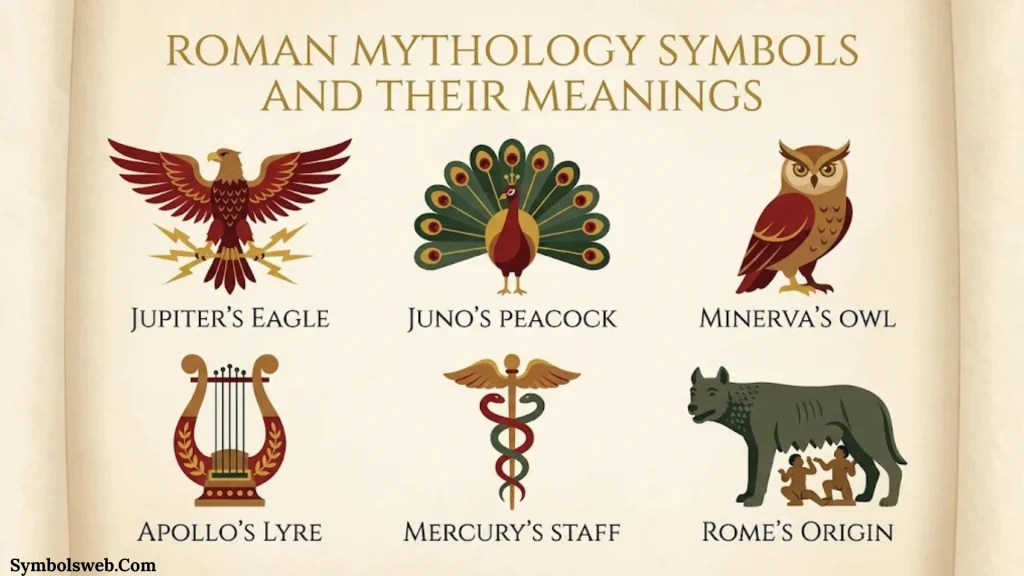
Roman mythology included a large collection of gods, goddesses, legendary creatures, and sacred objects. Their symbols helped people recognize divine figures in statues, paintings, temples, and religious ceremonies.
Roman mythology developed through local Italian traditions and contact with other cultures. Greek mythology strongly influenced Roman religious art, but Roman gods also had their own names, rituals, and political roles.
Jupiter: Thunderbolt and Eagle
Jupiter was the chief god of the Roman pantheon. He ruled the sky and thunder and served as a protector of the Roman state.
His Greek counterpart was Zeus. However, Jupiter held a distinct place in Roman public religion and political life.
His main symbols included:
- Thunderbolt: Divine power and authority
- Eagle: Strength and connection with the heavens
- Scepter: Sovereignty and leadership
- Oak tree: Sacred power and protection
Jupiter was worshipped at the great Temple of Jupiter Optimus Maximus on the Capitoline Hill. His importance connected religion with Roman government and military life.
Mars: Spear, Shield, and Wolf
Mars was the Roman god of war. He represented military strength, courage, and the protection of Rome.
Unlike the Greek god Ares, who was often portrayed as destructive and uncontrolled, Mars held a respected position in Roman religion. He was also associated with agriculture and the protection of the community.
His symbols included:
- Spear: Military power and combat
- Shield: Defense and protection
- Helmet: Courage and warfare
- Wolf: Connection with Rome’s founding legend
- Woodpecker: An animal associated with Mars in Roman tradition
Mars was especially important to Roman soldiers and military commanders. The month of March takes its name from him.
Mercury: Caduceus and Winged Sandals
Mercury was the Roman god of commerce, communication, travel, and messengers. He was closely connected with the Greek god Hermes.
His symbols included:
- Caduceus: A staff with two intertwined snakes
- Winged sandals: Speed and travel
- Winged helmet: Quick movement and communication
- Purse: Trade and wealth
The caduceus is often confused with the Rod of Asclepius. The caduceus has two snakes and is associated with Mercury. The Rod of Asclepius has one snake and is associated with healing.
This distinction matters when identifying symbols in ancient Roman art.
Minerva: Owl, Helmet, and Shield
Minerva was the Roman goddess of wisdom, strategic warfare, crafts, and skilled work. Her Greek counterpart was Athena.
Her symbols included:
- Owl: Wisdom and knowledge
- Helmet: Strategic military protection
- Shield: Defense and strength
- Spear: Courage and warfare
- Aegis: Divine protection
Minerva was one of the three deities worshipped in the Capitoline Triad alongside Jupiter and Juno.
Neptune: Trident and Horse
Neptune was the Roman god of the sea, freshwater, and horses. He was associated with Poseidon in Greek mythology.
His main symbols included:
- Trident: Power over the sea
- Horse: Connection with horses and horse breeding
- Dolphin: Marine life and the ocean
- Sea creatures: His connection with the underwater world
Artists often represented Neptune holding a trident while riding a sea chariot or standing among marine creatures.
Venus: Rose, Dove, and Seashell
Venus was the Roman goddess of love, beauty, fertility, and desire. She was closely associated with the Greek goddess Aphrodite.
Her symbols included:
- Rose: Love and beauty
- Dove: Affection and peace
- Seashell: Beauty and birth
- Myrtle: Love and sacred devotion
- Apple: Desire and beauty
Venus also had an important connection with Roman ancestry. The Julian family claimed descent from her through her son Aeneas, the legendary Trojan hero.
Ceres: Wheat and Cornucopia
Ceres was the Roman goddess of agriculture, grain, and fertility. Her Greek counterpart was Demeter.
Her symbols included:
- Wheat: Harvest and food
- Grain sheaves: Agricultural prosperity
- Torch: Her search for her daughter Proserpina
- Cornucopia: Abundance and fertility
- Poppies: Fertility and agricultural imagery
Ceres represented the importance of farming in Roman society. Grain production was essential to feeding the growing population of Rome.
Vesta: Sacred Flame and Hearth
Vesta was the Roman goddess of the hearth and domestic fire. She represented the home and the sacred fire of the Roman state.
Her symbols included:
- Sacred flame: Continuity and protection
- Hearth: Family and home
- Fire altar: Religious devotion
- Veil: Her traditional appearance in Roman art
The Vestal Virgins served Vesta and maintained the sacred fire in her temple. Keeping the flame burning was an important religious responsibility.
Janus: Two Faces and the Key
Janus was the Roman god of beginnings, transitions, doorways, and passages. Artists commonly represented him with two faces looking in opposite directions.
His symbols included:
- Two faces: Looking toward the past and future
- Key: Access and openings
- Staff: Guidance and travel
- Doorway: Transitions and new beginnings
January takes its name from Janus. The month stands at the entrance to a new year, making the connection especially meaningful.
Roman Religious Symbols and Sacred Objects
Religion influenced almost every part of Roman life. People honored the gods through offerings, prayers, sacrifices, festivals, and household rituals.
Roman religious symbols appeared in temples and public ceremonies as well as private homes.
Altars
Roman altars were important places for religious offerings and sacrifices. They could be made from stone, marble, or other materials.
Many altars carried inscriptions identifying the deity or person receiving the dedication. Decorative carvings sometimes showed garlands, animals, sacrificial tools, and religious scenes.
An altar represented communication between people and the divine.
Sacred Fire
Fire held a special place in Roman religion. It was associated with Vesta and the protection of the household and state.
The sacred flame maintained by the Vestal Virgins represented the continuity and security of Rome. Its preservation was considered a public religious responsibility.
The Lituus
The lituus was a curved staff used by Roman priests known as augurs.
Augurs studied signs from the gods, including the flight and behavior of birds. They used the lituus to mark out a sacred area of the sky during certain religious practices.
The object became a recognizable symbol of Roman religious authority.
The Patera
A patera was a shallow bowl used during religious offerings and ceremonies.
Romans poured wine or other liquids as offerings to the gods. Paterae also appeared in religious artwork and on coins.
The object represented ritual devotion and communication with the divine.
The Suovetaurilia
The suovetaurilia was a Roman purification ceremony involving the sacrifice of three animals: a pig, a sheep, and a bull.
The ritual was associated with purification and protection. It could be performed to cleanse land, military camps, or communities.
Relief sculptures sometimes show the three animals being led toward a religious ceremony.
Roman Political and Military Symbols
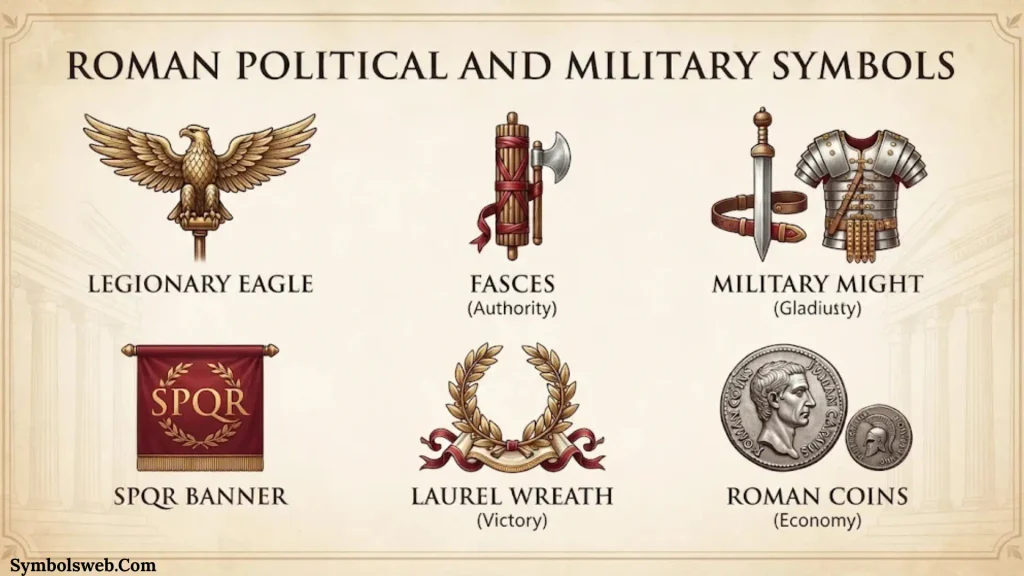
Roman political symbols communicated the authority of government officials and the power of the state. Military symbols reinforced loyalty, courage, and discipline.
Corona Civica: The Civic Crown
The Corona Civica, or Civic Crown, was an important Roman military honor made from oak leaves.
It was traditionally awarded to a soldier who saved the life of a fellow Roman citizen in battle. The recipient had to meet strict conditions associated with the rescue.
The crown represented:
- Courage
- Self-sacrifice
- Loyalty to fellow citizens
- Public service
- Military honor
Emperor Augustus received the Civic Crown, which became part of his official image.
Corona Muralis: The Mural Crown
The Corona Muralis was a crown decorated with the appearance of city walls and towers.
Roman military tradition associated it with the soldier who first climbed an enemy wall during an assault.
It represented bravery, military achievement, and the ability to overcome strong defenses.
The Toga Praetexta
The toga praetexta was a Roman garment with a purple border.
It was worn by certain magistrates and religious officials. Freeborn Roman boys also wore it before reaching adulthood.
The purple border helped distinguish the wearer and communicate social or official status.
Victoria: The Goddess of Victory
Victoria was the Roman goddess of victory. She was closely associated with the Greek goddess Nike.
Artists often represented her as a winged woman holding a wreath or palm branch.
Her symbols included:
- Wings: Speed and triumph
- Laurel wreath: Victory and honor
- Palm branch: Military success
- Chariot: Triumph and celebration
Victoria appeared on Roman coins, monuments, and military artwork. Her image helped celebrate successful campaigns and imperial achievements.
Roman Architecture and Monument Symbols
Roman architecture was more than a display of engineering skill. Buildings and monuments also communicated political messages, religious beliefs, and public values.
SPQR Inscriptions on Public Buildings
The inscription SPQR appeared on many public structures and monuments. It identified the Roman state as the authority behind public projects and official dedications.
The Arch of Titus, for example, includes a dedication by the Senate and People of Rome.
Such inscriptions connected architecture with political identity. They reminded people who built, funded, or honored a public monument.
Triumphal Arches
Roman triumphal arches celebrated military victories and important public achievements.
They often included inscriptions, relief sculptures, and images of emperors or victorious soldiers.
The Arch of Titus commemorates the Roman victory in Jerusalem in 70 CE. Its reliefs show Roman soldiers carrying spoils from the Temple in Jerusalem.
The Arch of Constantine celebrates Constantine’s victory over Maxentius in 312 CE. Its decoration combines artwork from different periods of Roman imperial history.
Triumphal arches represented military success, imperial authority, and the public memory of important events.
Trajan’s Column
Trajan’s Column is one of the best-known monuments in Rome. It was completed in the early second century CE to commemorate Emperor Trajan’s victories in the Dacian Wars.
A continuous spiral relief wraps around the column. It shows scenes of Roman military campaigns, including soldiers building forts, crossing rivers, and fighting battles.
The monument communicates Roman military organization, imperial power, and the importance of the emperor.
Roman Columns and Decorative Motifs
Roman buildings used several architectural styles and decorative elements. Some came from Greek architecture, while others developed through Roman engineering and artistic traditions.
Common features included:
- Acanthus leaves: Decorative plant patterns used on Corinthian capitals
- Egg-and-dart molding: Repeating egg-shaped and pointed designs
- Garlands: Decorative arrangements of leaves and flowers
- Eagles: Imperial and religious imagery
- Laurel branches: Victory and honor
- Military trophies: Captured weapons and armor
These designs helped communicate wealth, prestige, and cultural identity.
Egyptian Symbols in Rome: Obelisks and Their Meanings
Egyptian obelisks are among the most striking monuments in Rome. These tall, four-sided stone pillars usually end in a pointed pyramid-shaped top.
Ancient Egyptians associated obelisks with the sun god and solar power. Their shape represented a connection between the earth and the heavens.
Roman emperors brought several Egyptian obelisks to Rome. They displayed them in public spaces as monuments of imperial power and as reminders of Rome’s control over Egypt.
Rome eventually became home to more surviving obelisks than any other city.
Vatican Obelisk
The Vatican Obelisk stands in St. Peter’s Square. It originally came from Egypt and was transported to Rome during the reign of Emperor Caligula in 37 CE.
It once stood in the Circus of Nero, where public spectacles and chariot races took place.
In 1586, Pope Sixtus V ordered the obelisk moved to its current location. Architect Domenico Fontana led the difficult operation.
A cross now stands at its top. This Christian addition changed the monument’s religious context while preserving its ancient Egyptian form.
Lateran Obelisk
The Lateran Obelisk stands near the Archbasilica of St. John Lateran.
It originally came from Egypt and was commissioned under the pharaohs Thutmose III and Thutmose IV. Emperor Constantius II brought it to Rome in 357 CE.
It is one of the tallest ancient Egyptian obelisks still standing.
Its hieroglyphic inscriptions connect it with Egyptian royal power and religious traditions.
Flaminian Obelisk
The Flaminian Obelisk stands in Piazza del Popolo.
It was commissioned by the Egyptian pharaohs Seti I and Ramesses II. Emperor Augustus brought it to Rome in 10 BCE and placed it in the Circus Maximus.
The monument later fell and remained buried until it was recovered and relocated during the Renaissance.
Today, it is an important landmark in one of Rome’s best-known public squares.
Why Did Rome Use Egyptian Obelisks?
Roman emperors valued Egyptian obelisks for several reasons.
First, these monuments were impressive examples of ancient craftsmanship. Their size and inscriptions displayed the achievements of Egyptian civilization.
Second, transporting them to Rome demonstrated the empire’s power and control over distant territories.
Finally, obelisks helped decorate major public spaces and connect Roman rulers with the prestige of ancient Egypt.
You can learn more about these monuments through Tourism Rome’s guide to the city’s obelisks and the Vatican’s history of its obelisk.
Roman Family Symbols and Coats of Arms
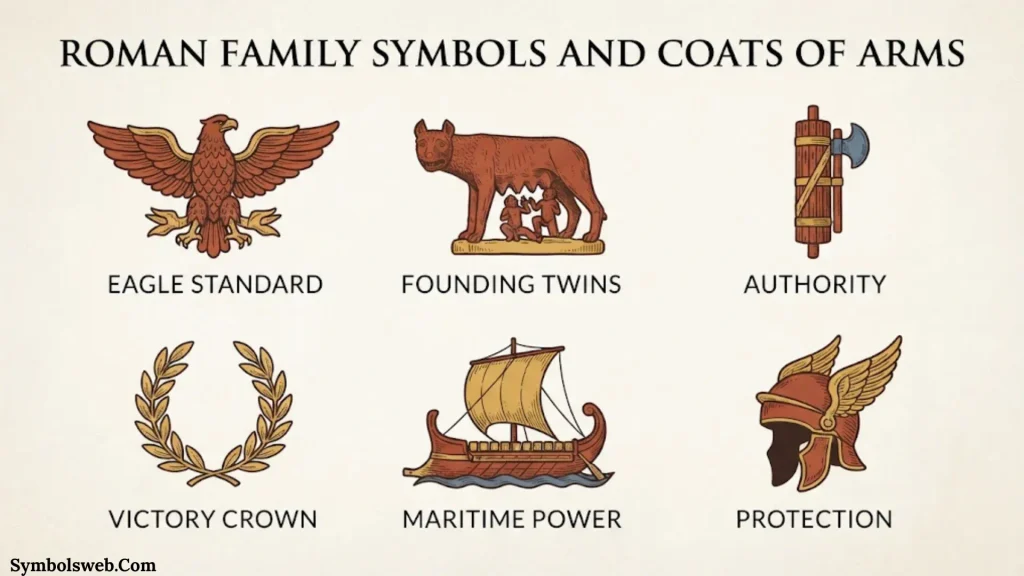
Ancient Roman families used names, portraits, inscriptions, and personal emblems to express identity and social position.
However, the familiar system of medieval European heraldry did not exist in the same form during ancient Rome. Shields, family badges, and later coats of arms should not be treated as one continuous ancient Roman tradition.
Roman Family Identity
Important Roman families often displayed their status through public monuments, funerary inscriptions, statues, and portraits.
Family names also carried political and social importance. A person’s ancestry could influence their reputation and opportunities in Roman public life.
Images of ancestors helped powerful families preserve their history and demonstrate their connections with earlier generations.
The Barberini Bees
The Barberini bees are a famous example of a later Roman family emblem.
The Barberini family rose to great influence in Rome during the Renaissance and Baroque periods. Their emblem featured three bees, which appeared on buildings, monuments, and works connected with the family.
The bees became especially visible during the papacy of Pope Urban VIII, whose family name was Maffeo Barberini.
They represent the later history of Rome rather than an ancient Roman family symbol.
Christian and Papal Symbols in Rome
Christianity gradually transformed Roman religious and cultural life. As Christianity became more influential, new symbols appeared in churches, monuments, religious objects, and official emblems.
Some Christian symbols developed during the late Roman Empire. Others became important during the medieval and Renaissance periods.
The Christian Cross
The cross is the central symbol of Christianity. It represents the crucifixion of Jesus Christ and, for Christians, his resurrection and victory over death.
The cross became increasingly visible in Roman public life after Christianity gained imperial support.
Today, crosses appear throughout Rome on churches, religious monuments, and historic buildings.
Chi Rho Symbol
The Chi Rho is an early Christian monogram formed by combining the Greek letters Chi (Χ) and Rho (Ρ), the first two letters of the Greek word Christos, meaning Christ.
The symbol became closely associated with Emperor Constantine and the development of Christianity within the Roman Empire.
It appeared in Christian art, inscriptions, and religious objects.
The Chi-Rho represents Christ and the Christian faith.
Alpha and Omega
Alpha and Omega are the first and last letters of the Greek alphabet.
In Christian tradition, they represent the beginning and the end. The phrase expresses God’s eternal nature and appears in the Book of Revelation.
Artists sometimes place these letters beside the Chi-Rho or the Christian cross.
Crossed Keys of Saint Peter
The crossed keys are among the most recognizable symbols of the papacy and Vatican City.
They represent the keys given by Jesus to Saint Peter in the Gospel of Matthew. Christian tradition connects these keys with spiritual authority and the responsibility of the Church.
The Vatican coat of arms displays two crossed keys beneath the papal tiara.
The gold key traditionally represents authority associated with the Kingdom of Heaven, while the silver key represents spiritual authority on earth.
The Vatican’s official explanation of its coat of arms explains the meaning of these elements.
The Papal Tiara
The papal tiara is a ceremonial crown historically associated with the pope.
It appeared above the crossed keys in papal and Vatican heraldry. Its design developed over time and became an important symbol of papal authority.
The tiara is no longer worn by modern popes during their inauguration ceremonies, but it remains part of traditional papal imagery.
Where to See Roman Symbols in Rome Today
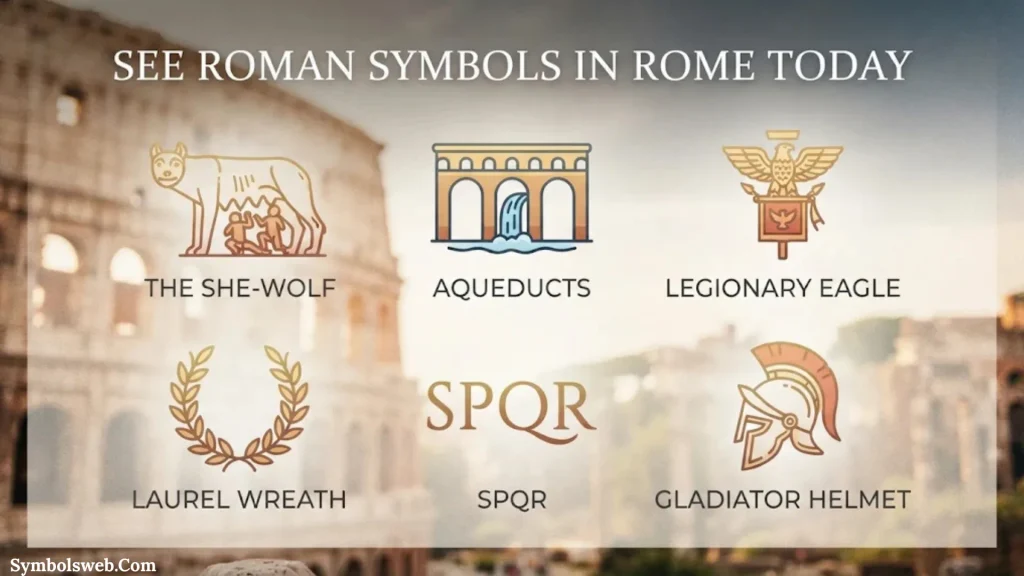
Rome is an excellent place to explore ancient symbols because many remain visible in their original historical settings.
You can find them in museums, archaeological sites, churches, public squares, and monuments.
Capitoline Museums
The Capitoline Museums house important Roman sculptures, inscriptions, and historical objects.
The Capitoline Wolf is one of their most famous works. The museum also contains statues of Roman gods, emperors, and other figures connected with the city’s history.
Roman Forum
The Roman Forum was the center of political, religious, and commercial life in ancient Rome.
Visitors can explore the remains of temples, basilicas, monuments, and public spaces.
Look for inscriptions, carved reliefs, and architectural details that reveal Roman political and religious traditions.
Arch of Titus
The Arch of Titus contains relief sculptures celebrating the Roman victory in Jerusalem.
Its carvings show soldiers carrying captured objects from the Temple. The monument also contains an inscription dedicated by the Senate and People of Rome.
Arch of Constantine
The Arch of Constantine stands near the Colosseum.
Its decorations include reliefs and sculptures that celebrate imperial authority and Constantine’s military victory.
It also provides an example of how Roman monuments reused artwork from earlier imperial periods.
Trajan’s Column
Trajan’s Column displays a detailed visual record of the Dacian Wars.
Its spiral carvings show military activities and scenes from Roman campaigns. The monument is especially useful for understanding Roman soldiers, equipment, and imperial propaganda.
Piazza del Popolo
Piazza del Popolo contains the Flaminian Obelisk.
The monument connects ancient Egyptian art, Roman imperial history, and later Christian Rome.
St. Peter’s Square
St. Peter’s Square contains the Vatican Obelisk at its center.
The obelisk is a remarkable example of how an ancient Egyptian monument became part of the Christian landscape of Rome.
Archbasilica of St. John Lateran
The Lateran Obelisk stands near the Archbasilica of St. John Lateran.
It offers another example of the movement of Egyptian monuments into Roman public spaces.
How to Identify Roman Symbols
Recognizing Roman symbols becomes easier when you understand their common features and historical settings.
Start by looking at the object or image. Then consider where it appears and what message it might communicate.
| Symbol | Main Meaning | Common Appearance |
| SPQR | Roman government and civic identity | Inscriptions and monuments |
| Capitoline Wolf | Legendary foundation of Rome | Statues and coins |
| Eagle (Aquila) | Legionary honor and military power | Military standards |
| Laurel wreath | Victory and achievement | Coins and triumphal art |
| Fasces | Magistrate authority | Official processions and reliefs |
| Thunderbolt | Jupiter’s divine power | Statues and religious art |
| Trident | Neptune’s power over the sea | Mythological sculptures |
| Caduceus | Mercury, trade, and communication | Coins and divine imagery |
| Owl | Minerva and wisdom | Statues and decorative art |
| Sacred flame | Vesta and the Roman hearth | Religious imagery |
| Two faces | Janus and transitions | Sculptures and coins |
| Chi-Rho | Christ and early Christianity | Christian monuments |
| Crossed keys | Saint Peter and papal authority | Vatican emblems |
Context is important. For example, an eagle on a Roman military standard has a specific connection with a legion. An eagle shown beside Jupiter may communicate divine authority instead.
The same image can carry different meanings depending on its location, inscription, and historical period.
Roman Symbols Compared With Greek, Egyptian, and Christian Symbols
Roman symbols often share features with symbols from other ancient cultures. However, their meanings depend on the traditions that shaped them.
Roman and Greek Symbols
Roman and Greek mythology share many gods and religious images.
Jupiter resembles Zeus, Mars resembles Ares, Venus resembles Aphrodite, and Neptune resembles Poseidon.
The Romans adopted and adapted many Greek artistic traditions. However, Roman religion also included local customs, public rituals, and political meanings that gave these symbols a distinct role.
For example, Mars was especially important to Rome’s military identity and legendary ancestry.
Roman and Egyptian Symbols
Egyptian symbols influenced Roman art after Rome expanded into the eastern Mediterranean and conquered Egypt.
Obelisks are a clear example. Egyptian rulers originally commissioned them as religious and royal monuments. Roman emperors later transported them to Rome to demonstrate imperial power.
Egyptian imagery also appeared in Roman art, decorative objects, and religious practices.
Roman and Christian Symbols
Early Christianity developed within the Roman world. As the religion spread, Christian symbols gradually became part of Roman public and imperial culture.
The Chi-Rho, cross, and Alpha and Omega became recognizable expressions of Christian belief.
Later, papal symbols such as the crossed keys and tiara became closely connected with Rome’s religious identity.
Why Roman Symbols Still Matter Today
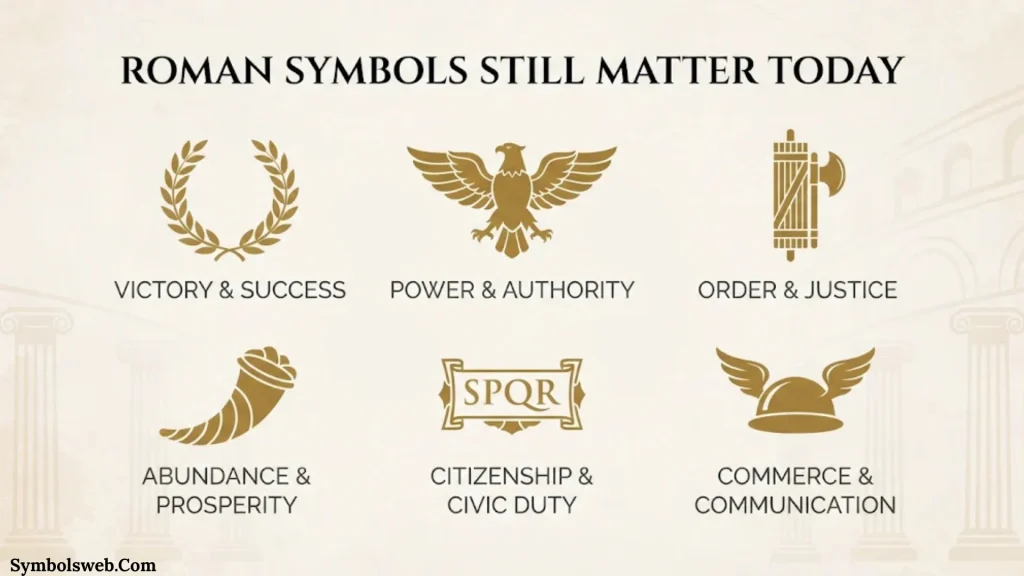
Roman symbols remain important because they connect modern society with the political, religious, and cultural history of ancient Rome.
Their influence extends beyond museums and archaeological sites.
They Represent Roman Identity
SPQR and the Capitoline Wolf remain recognizable symbols of Rome.
They connect the modern city with its ancient history and legendary foundation.
They Influenced Later Governments
Roman political and military symbols influenced later European institutions, official emblems, architecture, and ceremonial traditions.
The eagle, laurel wreath, and fasces all appeared in different forms across later periods.
They Preserve Mythology and Religion
Roman symbols help preserve stories about gods, heroes, and the founding of Rome.
The Capitoline Wolf, for example, keeps the legend of Romulus and Remus visible in modern culture.
They Continue to Influence Art and Architecture
Roman architectural designs influenced buildings across Europe and beyond.
Columns, arches, decorative motifs, and inscriptions remain common features in public architecture.
They Help Historians Understand the Past
Symbols provide valuable evidence about Roman society.
A coin portrait can reveal how an emperor wanted people to see him. A military standard can show the importance of loyalty and unit identity. A religious inscription can reveal which deity a person or community honored.
When historians study these objects together, they gain a clearer picture of Roman beliefs and everyday life.
Frequently Asked Questions About Roman Symbols
What Is the Most Famous Roman Symbol?
SPQR and the Capitoline Wolf are among the most famous Roman symbols. SPQR represents the Senate and People of Rome, while the wolf recalls the legendary story of Romulus and Remus.
What Does SPQR Mean in Roman Symbols?
SPQR stands for Senatus Populusque Romanus, which translates to The Senate and People of Rome. It represented the Roman state and appeared on public monuments, inscriptions, coins, and official objects.
What Did the Roman Eagle Symbolize?
The Roman eagle, or Aquila, represented the honor and identity of a Roman legion. It was also associated with Jupiter, the chief Roman god. Soldiers treated the eagle standard as a sacred and valuable object.
What Does the Roman Laurel Wreath Mean?
The Roman laurel wreath represented victory, honor, and achievement. Victorious commanders received laurel crowns during triumphal celebrations. The symbol later became widely associated with success.
What Did the Fasces Represent in Ancient Rome?
The fasces represented the authority of Roman magistrates. It consisted of wooden rods tied together, sometimes with an axe. The rods and axe communicated the official’s power to punish and enforce public authority.
What Animal Symbolized Rome?
The she-wolf is one of the most famous animals associated with Rome. According to Roman legend, she cared for the abandoned twins Romulus and Remus, who later became connected with the founding of the city.
What Was the Roman Symbol of Victory?
The laurel wreath and the goddess Victoria were important Roman symbols of victory. The laurel represented honor and achievement, while Victoria was often shown with wings, a wreath, or a palm branch.
What Is the Roman Symbol for Jupiter?
Jupiter was commonly represented by a thunderbolt, an eagle, and a scepter. These objects expressed his authority over the heavens and his position as the chief god of Rome.
Are Roman Symbols the Same as Greek Symbols?
No. Roman and Greek symbols often share similar gods and artistic features, but their cultural meanings can differ. Roman religion adapted Greek traditions while maintaining its own rituals, political associations, and local beliefs.
What Does the Crossed Keys Symbol Mean in Rome?
The crossed keys represent Saint Peter and the spiritual authority associated with the papacy. They appear in the Vatican coat of arms beneath the papal tiara.
Conclusion: The Lasting Legacy of Roman Symbols
Roman symbols reveal how ancient Romans understood their world. They used images and objects to represent government, military power, religion, mythology, social status, and public achievement. From SPQR and the Capitoline Wolf to the eagle and laurel wreath, each symbol carried a message that helped shape Roman identity. Their presence on coins, monuments, temples, and military standards made these ideas part of everyday life.
Today, Roman symbols remain visible across Rome and influence art, architecture, government, and popular culture. They also help historians understand the beliefs and ambitions of one of history’s most influential civilizations. When you recognize a Roman eagle, read an SPQR inscription, or see the she-wolf with Romulus and Remus, you’re looking at more than an ancient design. You’re seeing a small but meaningful part of Rome’s lasting story.

Jordan Hayes is a writer with a passion for exploring the history, meanings, and cultural significance behind symbols from around the world. He enjoys turning complex topics into clear, engaging content that anyone can understand. Jordan is also the fictional author of The Silent Language of Ancient Marks and Hidden Symbols Beyond the Surface, two original book concepts created for his author profile. When he’s not writing, he spends time researching myths, traditions, and forgotten stories that inspire his work. His goal is to help readers discover the deeper meanings behind the symbols they encounter every day.
 Eliana Foster
 Ethan Holloway