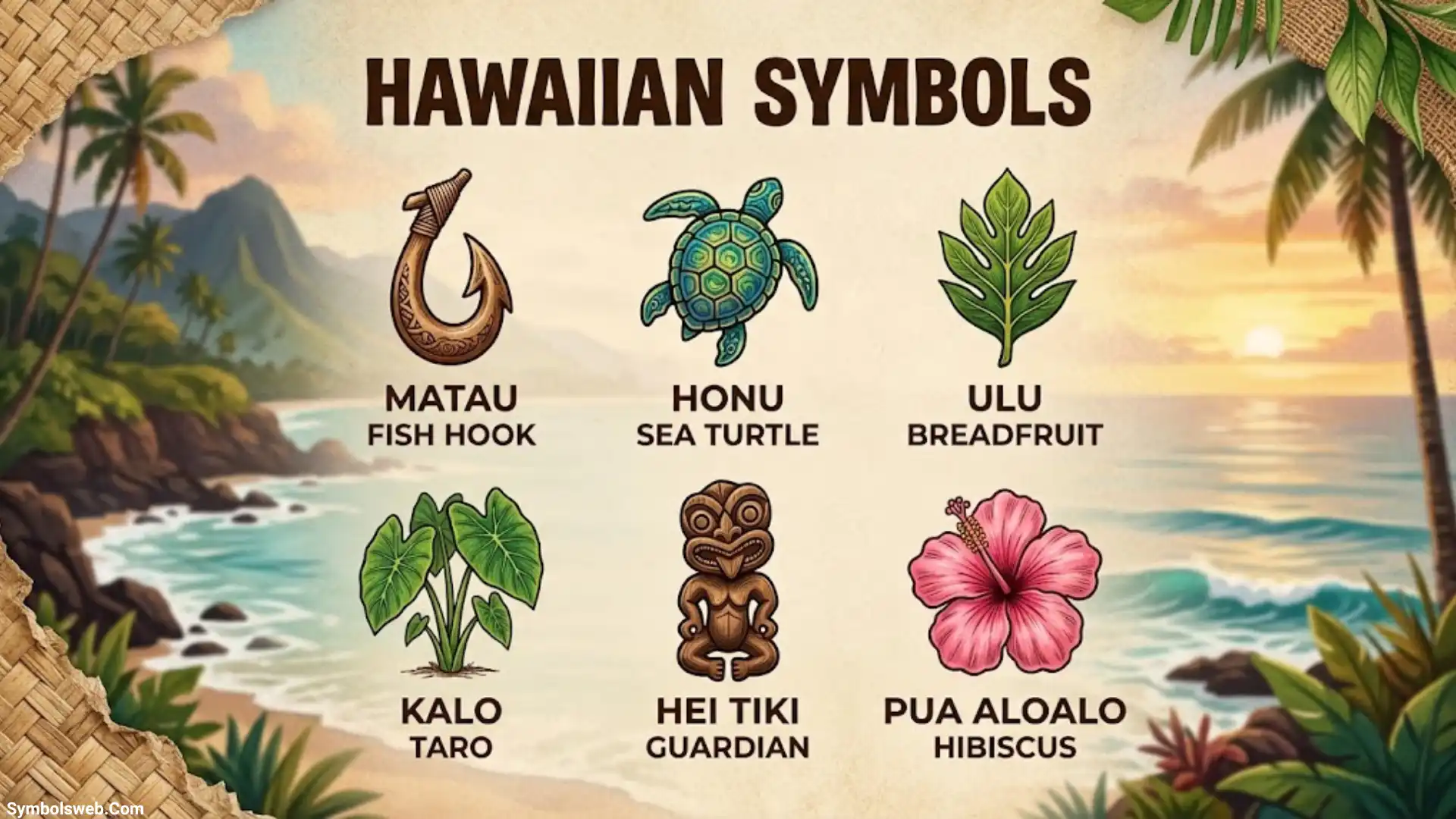
Hawaiian symbols give me a fascinating way to explore the connection between people, nature, family, and the ocean. When you look at Hawaiian symbols, you can find designs inspired by sea turtles, flowers, waves, plants, and traditional patterns. Each symbol can carry its own story, cultural background, or personal meaning.
When you explore Hawaiian symbols and their meanings, you may discover ideas connected with love, strength, protection, family, guidance, and connection. I believe a symbol becomes more meaningful when you understand the culture behind it instead of choosing a design simply because it looks beautiful. You can use this guide to learn about different Hawaiian symbols and what they may represent.
If you are searching for a meaningful tattoo, artwork, or personal symbol, you can find many ideas throughout this guide. I will take you through traditional, ancient, Native Hawaiian, and modern interpretations so you can better understand the symbolism before choosing a design that feels meaningful to you.
Hawaiian Symbols: (Quick Answer)
If you are exploring Hawaiian symbols, you can find meaningful designs connected with nature, love, family, strength, protection, and cultural identity. You may recognize popular examples such as the hone (sea turtle), flowers, waves, shark tooth patterns, and traditional geometric designs. When you choose a Hawaiian symbol for a tattoo or personal meaning, I recommend that you learn its cultural background so you can understand and appreciate the design more respectfully.
Quick Facts About Hawaiian Symbols
| Aspect | Information |
| Origin | Polynesian settlers of ancient Hawaiʻi |
| Historical Significance | Used in navigation, rituals, storytelling, and spiritual protection |
| Main Meaning | Harmony with nature, ancestry, protection, and life cycles |
| Spiritual Meaning | Connection to ancestors, gods, and natural spirits |
| Cultural Importance | Identity, heritage, and sacred storytelling in Hawaiian society |
| Modern Usage | Tattoos, jewelry, art, tourism branding, and cultural revival |
What Are Hawaiian Symbols?
Hawaiian symbols are traditional visual motifs developed by the Native Hawaiian people and their Polynesian ancestors. These symbols evolved long before written language became common in the islands now known as Hawaii.
Early Hawaiians used symbols to communicate complex ideas about nature, spirituality, navigation, and community life. Since written language was not originally used in ancient Hawaiian society, symbols became essential storytelling tools.
These symbols appeared in:
- Canoe carvings used for ocean navigation
- Tattoos known as kākau
- Petroglyphs carved into lava rock
- Ritual objects and temple designs
- Everyday tools and clothing patterns
Over time, Hawaiian symbols became deeply spiritual. They were not just art but sacred representations of life forces called mana, meaning spiritual energy or power.
Deep Symbolic Meaning of Hawaiian Symbols
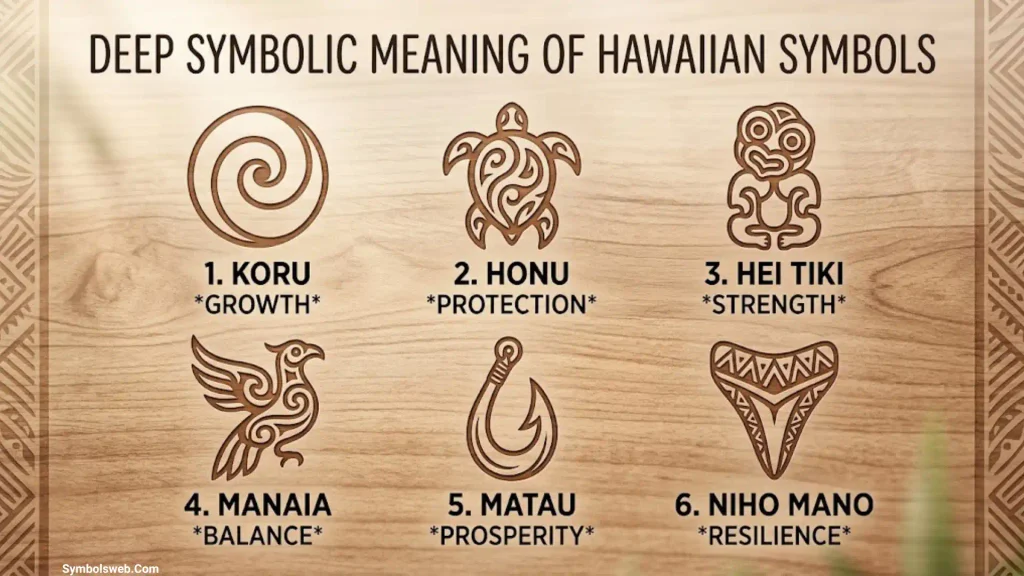
Spiritual Level
At the spiritual level, Hawaiian symbols represent the unseen forces of nature and ancestry. Hawaiians believe everything has mana, including animals, plants, oceans, and even stones.
Symbols like the shark (mano) or turtle (honu) are not just animals. They are spiritual guardians believed to guide and protect humans across life journeys.
Many symbols are also connected to ancestral spirits known as aumakua. These ancestral guardians are believed to appear in nature and offer protection through signs and dreams.
Psychological Level
From a psychological perspective, Hawaiian symbols reflect deep human emotions and universal archetypes. Carl Jung’s theory of collective unconscious fits well here.
For example:
- The ocean represents the unconscious mind and emotional depth
- The turtle symbolizes stability, patience, and long life
- Waves represent emotional cycles and life’s constant movement
These symbols help people process emotions through nature-based imagery. They create a sense of grounding, identity, and emotional balance.
Cultural Level
Culturally, Hawaiian symbols are a form of storytelling and identity preservation. They were used to pass knowledge from one generation to another.
In traditional Hawaiian society, symbols helped teach:
- Respect for nature
- Family lineage
- Survival skills
- Spiritual beliefs
Even today, these symbols remain powerful expressions of cultural pride and heritage.
Hawaiian Symbols and Meanings
When you explore Hawaiian symbols and meanings, you can discover how deeply nature, family, ocean life, and cultural traditions are connected. I find Hawaiian symbolism especially meaningful because many designs can remind you of values such as love, strength, protection, family, and connection.
You may see symbols inspired by sea turtles, flowers, waves, plants, and traditional geometric patterns. When you choose one for a tattoo, artwork, or personal reminder, you should look beyond its appearance and learn about the cultural meaning behind it.
Native Hawaiian Symbols
Native Hawaiian symbols can help you understand the close relationship between people, ʻāina (land), the ocean, nature, and ancestry. When you explore these symbols, you will find that many are inspired by the natural world surrounding the Hawaiian Islands.
You may come across the honu, kukui, flowers, ocean patterns, and other traditional motifs. I recommend looking at each symbol within its cultural context rather than assuming that every modern Hawaiian-style design has an ancient meaning.
Ancient Hawaiian Symbols and Meanings
When you explore ancient Hawaiian symbols and meanings, you can see how traditional Hawaiian culture was closely connected with nature, spirituality, ancestry, and everyday life. I think these symbols become more meaningful when you learn the stories and traditions connected with them.
You may find motifs inspired by animals, plants, the ocean, stars, and geometric forms. Their meanings were not always fixed, so you should consider the historical context instead of assuming that one symbol has only one universal definition.
Traditional Hawaiian Symbols and Meanings
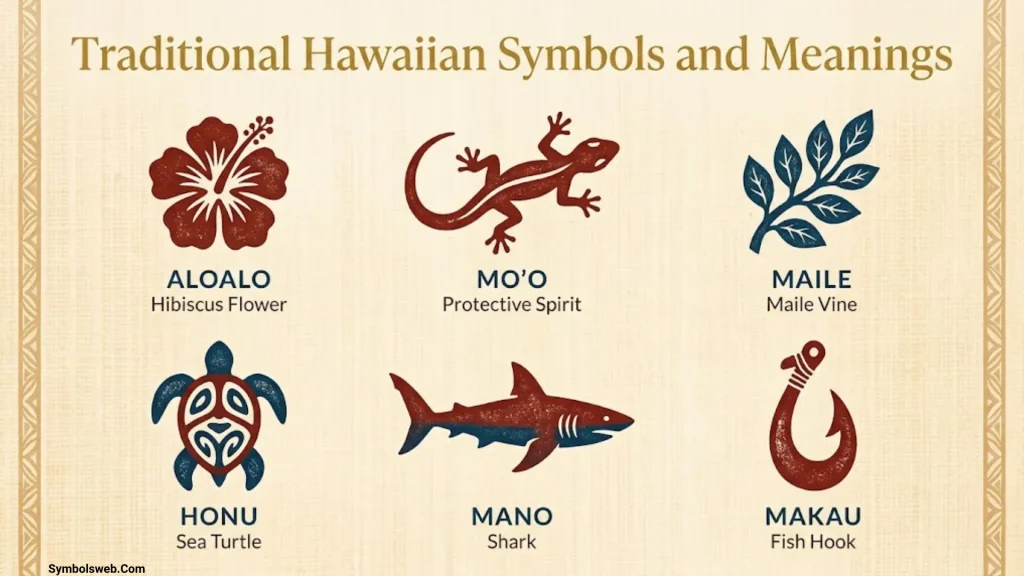
Traditional Hawaiian symbols allow you to explore ideas connected with nature, family, ancestry, community, and the ocean. When you look at traditional patterns, you may notice repeated geometric shapes and natural forms that reflect the environment and cultural traditions of Hawaiʻi.
If you want to use one of these symbols, I encourage you to learn its background first. A design can look beautiful, but understanding its cultural significance can make your choice much more thoughtful and respectful.
Hawaiian Symbols for Love
If you are looking for Hawaiian symbols for love, you can explore designs connected with affection, beauty, connection, and the natural world. Flowers such as plumeria and hibiscus are often associated with beauty and affection in contemporary Hawaiian imagery.
You may also choose the honu or ocean-inspired imagery to express an enduring connection. I would suggest choosing a symbol based on the meaning that speaks to you rather than selecting a design only because it looks attractive.
Hawaiian Symbols for Family
Hawaiian symbols for family can help you express ideas of connection, ancestry, unity, and belonging. When you think about family, you may want a symbol that reminds you of the people who support you and the generations that came before you.
I especially like the idea of using nature-inspired Hawaiian imagery to represent family because it can communicate a sense of roots and lasting connection. If you choose a family-inspired tattoo, you can also combine a meaningful motif with names, dates, or other personal details.
Hawaiian Symbols for Strength
When you want a Hawaiian symbol for strength, you can explore imagery inspired by powerful animals, the ocean, mountains, and traditional patterns. These designs can help you express courage, resilience, determination, and protection.
You may come across shark-tooth motifs, known as niho mano, in Hawaiian-inspired designs. If you choose this type of symbol, learning about its traditional cultural context can help you understand why it has become associated with strength and protection in modern interpretations.
Hawaiian Symbols Tattoos and Meanings
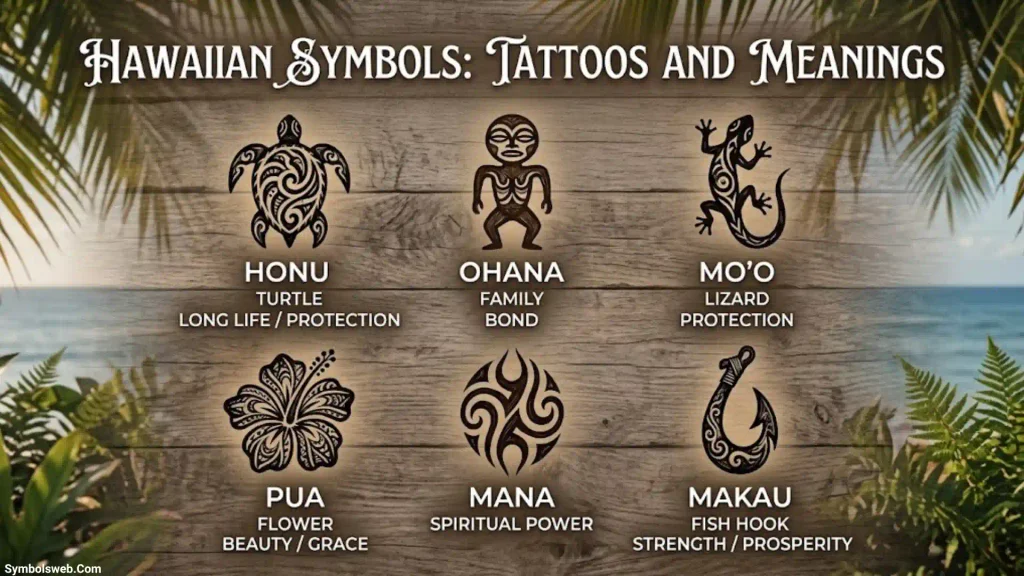
If you are considering Hawaiian symbols tattoos, you have many designs to explore, including honu, shark teeth, waves, flowers, and geometric patterns. You can use these motifs to represent ideas such as family, strength, protection, identity, love, and connection with nature.
I recommend that you research the design before getting it permanently tattooed. Traditional Hawaiian tattooing, known as kakau, has its own cultural history, so you should not assume that every modern Polynesian-style tattoo is traditionally Hawaiian.
Hawaiian Symbols Honu Meaning
When you see the honu, you are looking at one of the most recognizable symbols associated with Hawaiʻi. The honu is the Hawaiian green sea turtle, and its connection with the ocean makes it especially meaningful in Hawaiian cultural and natural contexts.
You may see the honu used in modern designs to represent longevity, protection, peace, guidance, and a lasting connection with the sea. I would avoid treating one interpretation as the only meaning because symbolism can change depending on the cultural and personal context.
If you choose a honu for a tattoo or personal design, you can make it more meaningful by learning about the animal, Hawaiian culture, and the importance of protecting sea turtles.
Hawaiian Tribal Symbols
When you search for Hawaiian tribal symbols, you will often find bold geometric patterns and designs inspired by Hawaiian and broader Polynesian tattoo traditions. You should remember that “tribal” is a modern term and does not necessarily describe a single traditional Hawaiian symbol system.
If you want to choose a Hawaiian inspired pattern, I recommend learning where the specific motif comes from and what it represents. Hawaiian culture is distinct from other Polynesian cultures, so you should not assume that every Polynesian-style pattern has a specifically Hawaiian origin.
Types and Variations of Hawaiian Symbols
1. Honu (Sea Turtle)
- Visual Description: A green sea turtle with smooth, rounded shell patterns
- Meaning: Longevity, peace, navigation
- Symbolism: Safe travel across life and oceans
- Cultural Connection: Guardian spirit in Hawaiian tradition
- Where It Appears: Tattoos, carvings, ocean art
2. Nalu (Ocean Waves)
- Visual Description: Flowing curved wave patterns
- Meaning: Life cycles and emotional flow
- Symbolism: Change, strength, continuity
- Cultural Connection: Deep respect for the ocean’s power
- Where It Appears: Surf art, tattoos, ancient carvings
3. Mano (Shark)
- Visual Description: Stylized shark teeth or full shark form
- Meaning: Protection and strength
- Symbolism: Leadership and survival
- Cultural Connection: Ancestor guardian spirit
- Where It Appears: Tribal tattoos, war symbols
4. Hibiscus Flower
- Visual Description: Bright tropical flower with large petals
- Meaning: Beauty and delicate nature of life
- Symbolism: Feminine energy and grace
- Cultural Connection: Island identity and hospitality
- Where It Appears: Clothing prints, leis, art
5. Tiki Figures
- Visual Description: Human-like carved faces with strong expressions
- Meaning: Ancestral protection
- Symbolism: Spiritual guardianship
- Cultural Connection: Early Polynesian religion
- Where It Appears: Wooden carvings, statues
Hawaiian Symbols Across Different Cultures
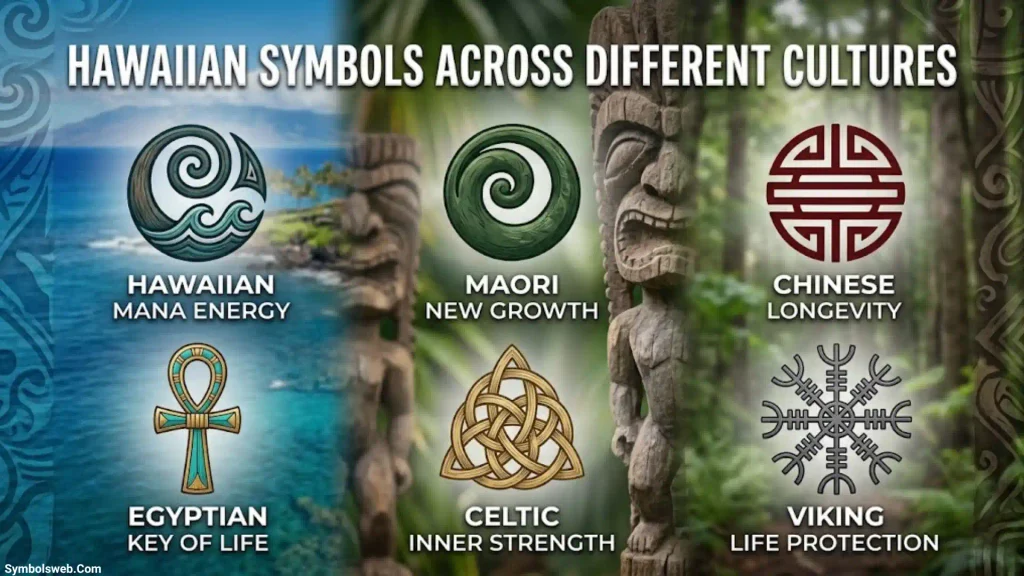
Ancient Polynesian Traditions
Hawaiian symbols originated from Polynesian voyagers. These early travelers used symbolic navigation patterns based on stars, ocean currents, and animal behavior.
Indigenous Hawaiian Culture
Symbols were deeply tied to kapu systems, sacred laws governing daily life and spirituality.
Eastern Philosophical Parallels
Similar to Eastern traditions, Hawaiian symbols reflect harmony between humans and nature, much like Taoist principles.
Ancient Greek Culture (Comparison)
Like Greek mythology, Hawaiian symbols often represent gods and natural forces, but they are more nature-centered rather than human-like deities.
Roman Cultural Interpretation
Romans used symbols for power and conquest, while Hawaiian symbols focus on balance and survival with nature.
Modern Global Culture
Today, Hawaiian symbols are widely used in fashion, tattoos, and tourism branding, often separated from their original sacred meaning.
Similar Symbols and Their Meanings
| Hawaiian Symbol | Similar Symbol | Similarity | Difference |
| Honu (Turtle) | Egyptian Turtle Symbol | Longevity | Hawaiian version tied to ocean navigation |
| Nalu (Wave) | Yin-Yang | Balance | Waves focus on nature cycles |
| Mano (Shark) | Celtic Warrior Symbols | Protection | Shark represents ocean guardianship |
| Tiki | African Ancestral Masks | Ancestry | Hawaiian tiki is nature-based |
Hawaiian Symbols in Mythology and Folklore
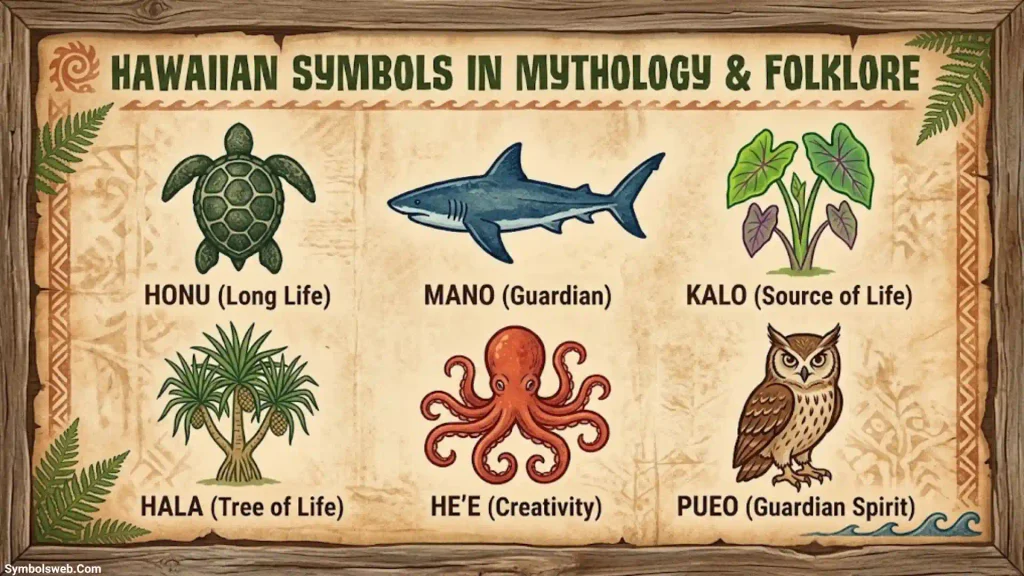
Hawaiian mythology is rich with stories of gods like Kane, Kanaloa, and Pele, the goddess of volcanoes. Symbols often represent their powers.
For example, lava flows symbolize Pele’s emotional strength and destruction that leads to rebirth. Ocean symbols reflect Kanaloa, the god of the sea.
These myths shaped how symbols are used today, especially in rituals and cultural storytelling.
Hawaiian Symbols in Art, Literature, and Pop Culture
Hawaiian symbols appear widely in modern media:
- Tattoos: Represent identity, protection, and heritage
- Movies: Films like Moana highlight Polynesian symbolism
- Fashion: Hawaiian prints use flowers and wave patterns
- Jewelry: Turtle and wave pendants are popular
- Tourism branding: Used to represent island identity
In modern use, these symbols often lose deeper meaning unless culturally explained.
Spiritual and Dream Meaning of Hawaiian Symbols
In dreams, Hawaiian symbols often carry strong emotional messages:
- Waves may indicate emotional change or uncertainty
- Turtles suggest protection and guidance
- Sharks may symbolize hidden fears or inner strength
- Flowers represent beauty, love, and new beginnings
Spiritually, seeing Hawaiian symbols in meditation is often interpreted as a call to reconnect with nature and inner balance.
Positive and Negative Meanings of Hawaiian Symbols
| Positive Meaning | Negative Meaning |
| Protection | Fear of change |
| Harmony | Emotional turbulence |
| Ancestral guidance | Feeling lost or disconnected |
| Strength | Overpowering forces |
Like many ancient symbols, meaning depends on context and personal experience.
Why Humans Are Attracted to Hawaiian Symbols
Humans are naturally drawn to Hawaiian symbols because they combine nature, emotion, and storytelling. The brain responds strongly to patterns found in nature, especially ocean waves and animal forms.
Psychologically, these symbols activate:
- Emotional memory
- Sense of belonging
- Connection to nature
- Archetypal recognition
They feel familiar even to people outside Hawaiian culture because they represent universal human experiences.
Modern Uses of Hawaiian Symbols
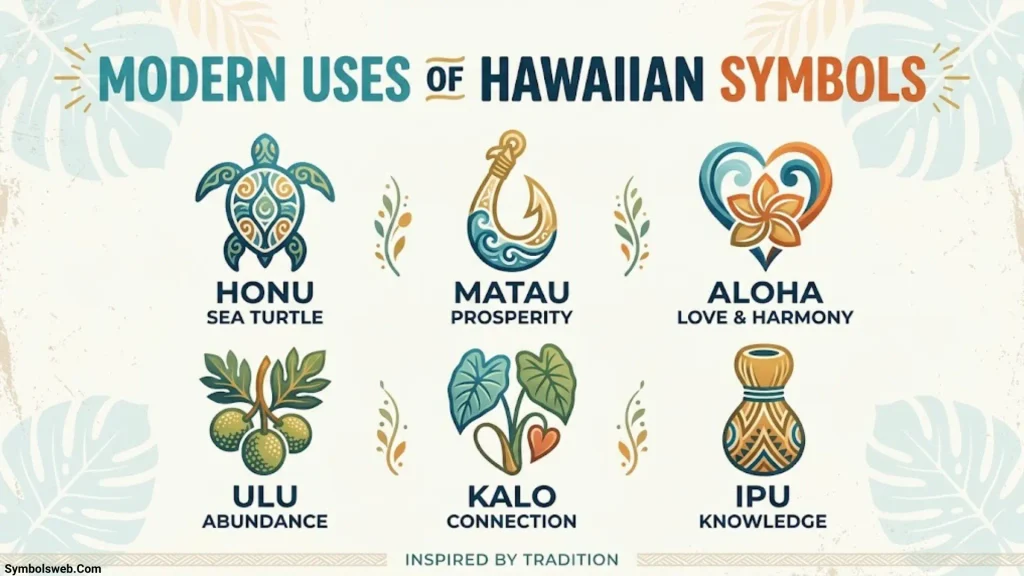
Today, Hawaiian symbols are widely used in:
- Tattoos representing identity and protection
- Jewelry like turtle necklaces and wave rings
- Fashion prints inspired by island aesthetics
- Branding for travel and tourism
- Home decor featuring tropical themes
- Spiritual practices focused on nature connection
While popular globally, respectful use requires understanding their cultural origins.
Interesting Facts About Hawaiian Symbols
- Many symbols originated from ancient Polynesian navigation techniques
- Tattoos (kākau) were historically sacred and highly spiritual
- Some symbols were only used by chiefs or spiritual leaders
- Petroglyphs in lava rock are among the oldest symbolic records in Hawaiʻi
- The turtle (honu) is still considered a guardian spirit in modern Hawaiian culture
- Hawaiian symbols were originally part of oral storytelling systems
- Volcano goddess Pele is still honored in cultural practices today
- Wave patterns often represented emotional intelligence long before psychology existed
Frequently Asked Questions
What do Hawaiian symbols represent?
Hawaiian symbols represent nature, ancestry, spirituality, protection, and life cycles rooted in Polynesian culture.
Are Hawaiian symbols religious?
Some symbols have spiritual origins tied to Hawaiian mythology and ancestral beliefs, but not all are religious.
Can anyone use Hawaiian symbols in tattoos?
Yes, but it is important to understand their cultural meaning and avoid using sacred symbols disrespectfully.
What is the most common Hawaiian symbol?
The sea turtle (honu) is one of the most recognized symbols, representing peace and long life.
Why are Hawaiian symbols important?
They preserve cultural identity, ancient knowledge, and the spiritual relationship between humans and nature.
Conclusion
Hawaiian symbols are more than artistic designs. They are living expressions of a culture deeply connected to nature, spirit, and ancestry. Each symbol carries layers of meaning shaped by centuries of tradition and storytelling.
When we understand these symbols, we begin to see the world through a more mindful and respectful lens. They remind us that everything in life is connected, just like the ocean that surrounds the islands of Hawaiʻi.

Jordan Hayes is a writer with a passion for exploring the history, meanings, and cultural significance behind symbols from around the world. He enjoys turning complex topics into clear, engaging content that anyone can understand. Jordan is also the fictional author of The Silent Language of Ancient Marks and Hidden Symbols Beyond the Surface, two original book concepts created for his author profile. When he’s not writing, he spends time researching myths, traditions, and forgotten stories that inspire his work. His goal is to help readers discover the deeper meanings behind the symbols they encounter every day.
 Eliana Foster
 Ethan Holloway