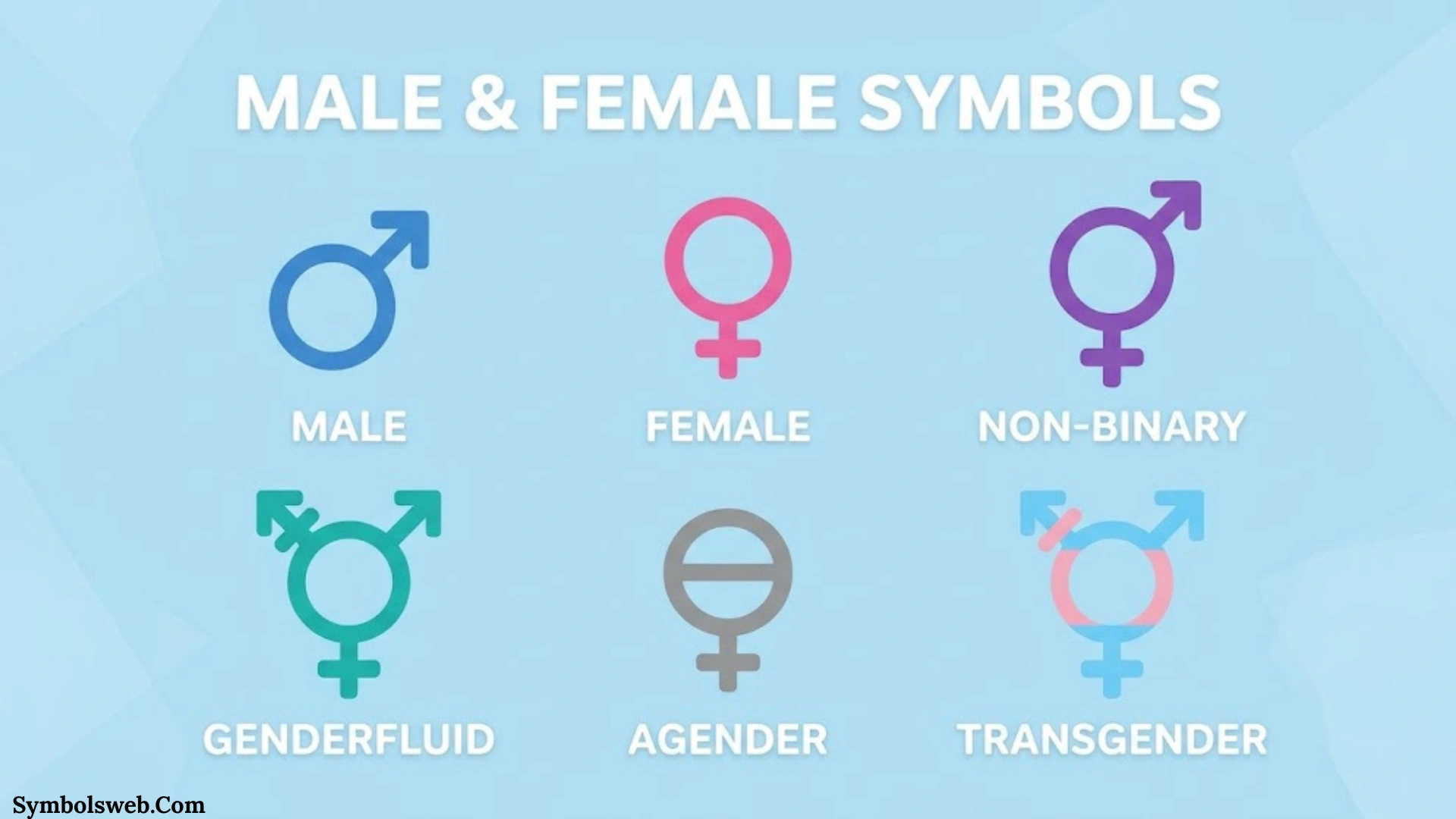
Male female symbols (♂ and ♀) are commonly used to represent human beings around the world. The male symbol (♂) represents males, while the female symbol (♀) represents females. These symbols are widely recognized and used in science, biology, education, and everyday communication.
These symbols have an interesting history that dates back to ancient astronomy and mythology. The male symbol is associated with Mars, while the female symbol is connected to Venus. Over time, both signs became popular ways to identify male and female genders in books, scientific studies, medical information, and public signs.
In this article, you’ll learn everything about male female symbols, including their meanings, differences, history, and common uses. You’ll also discover how to copy and paste these symbols and use them on different devices. If you need them for schoolwork, online content, or personal use, this guide will help you understand these symbols easily.
Male Female Symbols: (Quick Answer)
The male symbol (♂) represents males and is traditionally associated with Mars, the Roman god of war. The female symbol (♀) represents females and is associated with Venus, the Roman goddess of love and beauty. Both symbols originated from ancient planetary and astrological traditions before becoming widely used in biology, medicine, and modern communication.
Quick Facts About Male Female Symbols
| Aspect | Information |
| Origin | Ancient astronomical and astrological traditions |
| Historical Significance | Associated with the planets Mars and Venus |
| Main Meaning | Male (♂) and female (♀) |
| Spiritual Meaning | Traditionally associated with masculine and feminine energies |
| Cultural Importance | Used in mythology, science, art, and communication |
| Modern Usage | Biology, medicine, education, restrooms, and digital communication |
| Male Symbol | ♂ |
| Female Symbol | ♀ |
| Male Symbol Unicode | U+2642 |
| Female Symbol Unicode | U+2640 |
What Are Male Female Symbols?
Male female symbols are graphic signs used to represent male and female sex. They appear in biology, medicine, education, public signage, and everyday communication.
The two familiar symbols are:
- Male symbol (♂): A circle with an arrow extending diagonally toward the upper right.
- Female symbol (♀): A circle with a small cross extending downward.
Although these shapes look simple, their history reaches back to ancient astronomy, astrology, and alchemy.
Historical Origin of Male Female Symbols
The male and female symbols have roots in ancient planetary traditions. Early civilizations connected visible planets with gods and believed celestial movements influenced life on Earth.
The male symbol became associated with Mars, while the female symbol became associated with Venus.
In Roman mythology:
- Mars represented war, courage, strength, and military power.
- Venus represented love, beauty, fertility, and attraction.
These planetary associations also connected the symbols with particular metals. Mars was associated with iron, while Venus was associated with copper.
Their familiar shapes developed through historical systems of planetary notation and alchemical writing. The popular explanation that the arrow represents a spear and the cross represents a hand mirror is widely repeated, but their actual development is more complicated.
How Did Male Female Symbols Become Scientific Signs?
The Swedish botanist Carl Linnaeus helped popularize these symbols in scientific writing during the eighteenth century.
He used planetary signs to identify male and female flowers. This made scientific descriptions easier to organize and understand.
Later, researchers adopted the symbols in zoology, genetics, and human biology.
Eventually, they became common in textbooks, medical documents, family diagrams, and public signs.
Today, both symbols have official Unicode characters:
- Male sign: U+2642.
- Female sign: U+2640.
Deep Symbolic Meaning of Male Female Symbols

Male and female symbols carry meanings beyond biological classification. Different cultures have used masculine and feminine imagery to represent creation, relationships, balance, and human experiences.
Spiritual Meaning of Male Female Symbols
In spiritual traditions, masculine and feminine symbolism often represents two complementary aspects of existence.
These ideas sometimes describe different qualities within every person rather than characteristics belonging exclusively to men or women.
Masculine symbolism traditionally represents:
- Action and determination
- Protection and courage
- Direction and leadership
- Structure and discipline
- Energy and outward expression
Feminine symbolism traditionally represents:
- Creation and fertility
- Intuition and reflection
- Compassion and nurturing
- Receptivity and emotional awareness
- Growth and transformation
Different spiritual philosophies interpret these qualities in different ways.
For example, some modern spiritual traditions connect masculine and feminine energies with the balance between action and receptivity.
The deeper message is that both qualities can contribute to personal growth and a complete human experience.
Psychological Meaning of Male Female Symbols
From a psychological perspective, male and female symbols can represent identity, relationships, attraction, and social expectations.
They also connect with traditional ideas about masculine and feminine archetypes.
The psychologist Carl Jung developed the concepts of anima and animus. In his original framework, the anima represented an inner feminine figure in a man’s unconscious, while the animus represented an inner masculine figure in a woman’s unconscious.
Jung connected these ideas with psychological development and personal integration.
However, these theories have received criticism for relying on traditional gender assumptions. Modern psychology recognizes that personality traits such as courage, compassion, independence, and intuition are not limited to one sex or gender.
Cultural Meaning of Male Female Symbols
Different societies have developed their own ideas about masculinity and femininity.
In some cultures, masculine imagery represents authority, protection, and leadership. Feminine imagery may represent motherhood, fertility, wisdom, and family relationships.
However, these meanings are not universal.
Religion, art, clothing, mythology, and social traditions have influenced how different communities understand gender throughout history.
The male and female symbols provide a familiar visual language for these ideas, but they cannot represent the full complexity of human identity.
Types and Variations of Male Female Symbols

The traditional male and female signs belong to a wider family of symbols connected with sex, gender, identity, and relationships.
Male Symbol (♂)
♂
Visual Description: A circle with an arrow pointing diagonally upward and to the right.
Meaning: Traditionally represents the male sex and masculinity.
Symbolism: Associated with strength, action, courage, and protection.
Cultural Connection: Connected with Mars, the Roman god of war.
The male symbol is widely recognized in science and everyday communication.
Its connection with Mars gives it traditional associations with strength, courage, energy, and military power.
You can find it in biology textbooks, medical information, public restroom signs, astrology references, and educational materials.
Female Symbol (♀)
♀
Visual Description: A circle with a small cross extending downward.
Meaning: Traditionally represents the female sex and femininity.
Symbolism: Associated with beauty, love, fertility, and creativity.
Cultural Connection: Connected with Venus, the Roman goddess of love and beauty.
The female symbol represents the female sex in biological and scientific contexts.
Its traditional connection with Venus gives it associations with beauty, fertility, love, and attraction.
A popular explanation describes the circle as a hand mirror belonging to Venus. However, the historical development of the sign involves older planetary and alchemical traditions.
Combined Male and Female Symbol (⚥)
⚥
Visual Description: A combination of traditional male and female symbolic elements.
Meaning: Commonly represents bisexual or hermaphroditic reproductive structures in botanical and biological contexts.
Symbolism: Associated with combined reproductive characteristics.
Cultural Connection: Used in scientific classification.
The combined symbol is particularly important in botanical notation.
It can indicate a flower containing both male and female reproductive organs. Such flowers are commonly called bisexual flowers.
However, it should not automatically be interpreted as a symbol representing every intersex or nonbinary identity.
Transgender Symbol (⚧)
⚧
Visual Description: A combination of familiar male and female symbolic elements with an additional diagonal component.
Meaning: Commonly associated with transgender identity and gender diversity.
Symbolism: Represents gender expression and inclusion.
Cultural Connection: Used in LGBTQ+ communities.
The transgender symbol communicates that gender identity is not limited to traditional male and female categories.
It appears in community organizations, educational resources, awareness campaigns, and inclusive public signage.
Male and Female Symbols Together (♂♀)
♂♀
Visual Description: The male and female signs displayed together.
Meaning: Often represents male-female relationships, reproduction, sex differences, or gender comparison.
Symbolism: Connection, partnership, and biological reproduction.
Cultural Connection: Used in biology, education, and relationship-related designs.
When displayed together, these signs can communicate partnership, reproduction, or relationships between male and female sexes.
Their meaning depends on the context in which they appear.
Male and Female Symbols in Genetic Pedigree Charts
Traditional genetics uses geometric shapes to represent individuals in family history diagrams.
- Squares represent males.
- Circles represent females.
- Horizontal lines represent relationships.
- Vertical lines represent parent-child connections.
These diagrams help researchers follow inherited characteristics and genetic conditions across generations.
Male Female Symbols Across Different Cultures

Ideas about masculinity and femininity existed long before the familiar planetary signs became common.
Ancient civilizations developed their own visual languages to represent fertility, creation, protection, motherhood, authority, and nature.
Ancient Egyptian Culture
Ancient Egyptian culture used gender symbolism throughout religion, royal art, mythology, and funerary traditions.
Male and female qualities often appeared together in stories about creation and cosmic balance.
Important examples include:
- Geb: The male earth deity, associated with fertility and the land.
- Nut: The female sky goddess, connected with the heavens and the cycle of life.
- Isis: A goddess associated with motherhood, magic, protection, and healing.
- Osiris: A god associated with kingship, fertility, death, and resurrection.
The relationship between Geb and Nut illustrates how masculine and feminine divine figures could represent complementary parts of the universe.
Egyptian representations were not versions of the modern male and female signs. They belonged to a different religious and visual system.
Ancient Greek Culture
Ancient Greek mythology developed powerful representations of masculine and feminine identity.
Important figures include:
- Ares: God of war, associated with military conflict.
- Aphrodite: Goddess of love, beauty, desire, and attraction.
- Athena: Goddess of wisdom, strategic warfare, and crafts.
- Hermaphroditus: A mythological figure associated with combined male and female physical characteristics.
Hermaphroditus is particularly relevant to the history of gender symbolism.
In Ovid’s Metamorphoses, Hermaphroditus becomes physically joined with the nymph Salmacis. Their story influenced later artistic representations of combined sex characteristics.
Ancient Roman Culture
Roman culture provides the clearest mythological connection to the familiar male and female signs.
The male symbol (♂) is associated with Mars, while the female symbol (♀) is associated with Venus.
Mars represented:
- Military power
- Courage
- Protection
- Strength
- War and conquest
Venus represented:
- Love
- Beauty
- Fertility
- Desire
- Attraction
These associations helped shape the traditional meanings attached to the symbols.
Eastern Traditions
Eastern philosophical and religious traditions offer different ways to understand complementary forces.
One of the best-known examples is the Yin-Yang symbol (☯) from Chinese philosophy.
Yin and Yang represent interconnected and changing qualities found throughout nature.
Traditionally:
- Yin is associated with darkness, receptivity, coolness, and stillness.
- Yang is associated with brightness, activity, warmth, and movement.
These qualities are sometimes compared with feminine and masculine symbolism. However, Yin and Yang are not simply Chinese versions of female and male signs.
Another important example comes from Hindu traditions.
Ardhanarishvara represents a divine form combining Shiva and Parvati in one body. The image expresses unity, creation, and the interconnected nature of existence.
Indigenous Traditions
Indigenous cultures around the world have developed diverse understandings of gender, identity, family, and spiritual roles.
There is no single Indigenous interpretation of male and female symbolism.
For example, some Native American communities recognize culturally specific gender roles and identities that do not fit neatly into modern Western categories.
The term Two-Spirit is a contemporary umbrella term used by some Indigenous people to describe particular cultural, spiritual, and gender identities. It does not apply to every Indigenous nation or individual.
Other Indigenous traditions have their own teachings about balance, kinship, fertility, and relationships with nature.
Modern Interpretations
Today, male and female symbols appear in almost every area of public life.
Their traditional meanings remain familiar, but their uses have expanded.
Modern interpretations include:
- Biological sex classification
- Gender identity discussions
- Feminist movements
- LGBTQ+ representation
- Inclusive design
- Educational communication
- Digital identity and social media
The familiar symbols remain useful, but modern gender discussions recognize that human identity is more complex than two signs.
Similar Symbols and Their Meanings
Male and female signs belong to a wider family of symbols associated with identity, relationships, fertility, and balance.
| Symbol | Name | Main Meaning | Main Connection |
| ♂ | Male symbol | Male sex | Mars |
| ♀ | Female symbol | Female sex | Venus |
| ⚥ | Combined sex symbol | Combined reproductive structures | Biology and botany |
| ⚧ | Transgender symbol | Gender diversity | LGBTQ+ communities |
| ☯ | Yin-Yang | Complementary forces | Chinese philosophy |
| ∞ | Infinity | Endless connection | Mathematics and symbolism |
| ⚪ | Circle | Wholeness and unity | Various traditions |
Male vs. Female Symbols: What Is the Difference?
The most obvious difference is their shape.
The male sign features an upward-pointing arrow, while the female sign features a downward-pointing cross.
Their traditional associations also differ.
| Feature | Male Symbol ♂ | Female Symbol ♀ |
| Planet | Mars | Venus |
| Roman Deity | Mars | Venus |
| Metal | Iron | Copper |
| Traditional Association | Strength and action | Love and beauty |
| Scientific Meaning | Male | Female |
| Modern Context | Sex and gender information | Sex and gender information |
These are historical and cultural associations, not fixed descriptions of every man or woman.
Are Male and Female Symbols the Same as Masculine and Feminine Symbols?
No. The terms are related, but they are not interchangeable.
Male and female signs commonly identify sex categories in scientific or everyday settings.
Masculine and feminine symbolism refers to cultural ideas, personality associations, visual styles, and traditional representations.
For example, a flower may be described as feminine in an artistic context because of cultural associations with beauty or delicacy.
Similarly, strength and courage are often described as masculine qualities, but people of every sex and gender can demonstrate them.
Male Female Symbols in Mythology and Folklore

Mythology has played a major role in shaping the meanings associated with masculine and feminine imagery.
Stories about gods, goddesses, creation, fertility, and transformation helped ancient societies explain the natural world.
Although the male and female signs were not used in every ancient myth, their later planetary associations connected them with important mythological figures.
Mars: The Symbol of Masculine Power
De tolv största romerska gudarna – och alla de små | varldenshistoria.se
Mars was one of the most important gods in Roman religion.
He represented military power and played a major role in Rome’s national identity.
Unlike the Greek Ares, who was often portrayed as a destructive force of war, Mars also had strong connections with agriculture, protection, and the well-being of the Roman community.
His influence made the male sign a recognizable representation of traditional masculine imagery.
Venus: The Symbol of Love and Feminine Beauty
Italian PM Matteo Renzi criticised for covering up nude statues to please Iranian President Rouhani – ABC News
Venus represented love, beauty, fertility, and desire.
She was also connected with the Roman origin story through her son Aeneas, whose legendary descendants included the founders of Rome.
Her Greek counterpart was Aphrodite.
The connection between Venus and the female sign helped establish its familiar associations with attraction, beauty, and fertility.
Hermaphroditus: A Story of Combined Sex Characteristics
How Many Sexes Are There? | CNRS News
news.cnrs.fr
Hermaphroditus was the child of Hermes and Aphrodite in Greek mythology.
His story became important in later artistic traditions because of its depiction of combined male and female physical characteristics.
Roman artists frequently explored this myth through sculpture.
The figure remains an important historical reference when discussing how ancient societies represented sex characteristics and bodily variation.
Ardhanarishvara: The Unity of Shiva and Shakti
In Hindu traditions, Ardhanarishvara represents Shiva and Parvati in a combined divine form.
One side represents Shiva, while the other represents Parvati.
The image expresses the relationship between different divine principles and the creative nature of existence.
It also challenges the idea that masculine and feminine qualities must always appear separately.
Male Female Symbols in Art, Literature, Movies, and Pop Culture
Male and female symbols have become part of visual communication across the modern world.
Artists, writers, designers, and filmmakers use them to communicate identity, relationships, social expectations, and cultural change.
Male and Female Symbols in Paintings and Visual Art
Artists have used masculine and feminine imagery for centuries.
Male figures may appear as warriors, rulers, protectors, or heroes. Female figures may appear as goddesses, mothers, muses, or symbols of beauty.
However, artists have also challenged these traditional roles.
For example, depictions of Athena combine feminine identity with wisdom, courage, and military strategy.
Modern artists sometimes place ♂ and ♀ together to explore relationships, gender expectations, and identity.
Male and Female Symbols in Literature and Poetry
Literature frequently explores the symbolic relationship between masculine and feminine ideas.
Ancient myths, romantic poetry, religious stories, and modern novels often use gendered imagery to discuss:
- Love and attraction
- Creation and fertility
- Power and authority
- Identity and belonging
- Relationships and family
- Social expectations
Writers may also challenge traditional ideas about masculinity and femininity through characters who reject expected roles.
Male and Female Symbols in Movies and Television
Movies and television often use familiar signs to communicate gender quickly.
You might see them on restroom doors, hospital signs, laboratory equipment, or character-related graphics.
In science fiction, combined or modified gender symbols can also suggest new ideas about identity, artificial life, or future societies.
Male and Female Symbols in Tattoos
Male and Female Symbols Tattoo Design
Male and female signs are popular choices for minimalist tattoo designs.
People may choose them to express:
- Romantic relationships
- Family connections
- Personal identity
- Gender awareness
- Masculine and feminine balance
- A connection with ancient mythology
Some people combine the signs with hearts, infinity symbols, flowers, or geometric shapes.
A tattoo does not have one universal meaning. Its significance depends on the person wearing it.
Male and Female Symbols in Fashion and Modern Design
Fashion designers sometimes use gender signs as graphic elements on clothing, accessories, and jewelry.
Their simple shapes make them easy to recognize and reproduce.
In contemporary design, these symbols can communicate traditional gender categories or challenge the limits of those categories.
Some brands also use gender-inclusive graphics to make products and spaces feel more welcoming.
Spiritual and Dream Meaning of Male Female Symbols

Male and female symbols can carry personal spiritual meanings, especially when someone uses them to explore identity, relationships, balance, or personal growth.
Dream interpretations and spiritual experiences are subjective. Seeing these symbols does not predict a particular event or deliver a universal spiritual message.
Seeing Male and Female Symbols in Dreams
Dreams involving male and female signs may reflect thoughts about relationships, identity, family, or personal experiences.
Here are some common symbolic interpretations:
| Dream Symbol | Possible Interpretation |
| Seeing the male symbol | Thoughts about masculinity, action, or authority |
| Seeing the female symbol | Thoughts about femininity, creativity, or relationships |
| Seeing both symbols together | Interest in partnership, connection, or balance |
| Seeing a broken symbol | Feelings of uncertainty or conflict |
| Seeing combined symbols | Exploring identity or different aspects of yourself |
| Seeing repeated symbols | A personal concern or idea receiving attention |
The meaning depends on your emotions and the events surrounding the dream.
For example, dreaming about both signs while thinking about a relationship might reflect questions about communication, attraction, or compatibility.
It does not necessarily predict a future romantic event.
Male Female Symbols During Meditation
Some people use masculine and feminine imagery during meditation to reflect on different aspects of their personality.
They might focus on:
- Confidence and compassion
- Action and patience
- Logic and intuition
- Independence and connection
- Strength and emotional awareness
This practice can encourage self-reflection.
The goal is not to force yourself into traditional gender roles. Instead, it is to recognize that different qualities can work together.
Spiritual Encounters and Personal Interpretation
Some spiritual traditions interpret masculine and feminine imagery as complementary forces involved in creation and transformation.
For example, a person might associate the male symbol with taking action and the female symbol with receiving new ideas.
Another person might interpret both as signs of unity and personal acceptance.
Personal beliefs, cultural background, and individual experiences shape symbolic meaning.
Positive and Negative Meanings of Male Female Symbols
Male and female symbols can represent positive ideas such as identity, connection, and balance. However, they can also reflect outdated assumptions when people use them to impose rigid expectations.
| Positive Meaning | Negative Meaning |
| Identity and self-expression | Rigid gender classification |
| Love and attraction | Stereotypes about relationships |
| Complementary qualities | Belief that genders must always be opposites |
| Biological education | Oversimplification of human biology |
| Cultural heritage | Reinforcement of outdated social roles |
| Personal connection | Assumptions about someone’s identity |
| Diversity and inclusion | Exclusion of identities outside a binary framework |
Positive Meaning: Identity, Connection, and Balance
The symbols provide a simple visual language that people can recognize across different settings.
They help communicate biological information and can represent personal or cultural connections.
When used thoughtfully, they can also encourage conversations about identity, relationships, and the ways people understand themselves.
Negative Meaning: Stereotypes and Limited Definitions
Problems arise when people treat these symbols as complete descriptions of human identity.
For example, assuming that every man must be aggressive or every woman must be nurturing turns symbolic associations into restrictive stereotypes.
Human personalities are much more diverse.
Likewise, the two traditional signs cannot fully represent the range of sex characteristics, gender identities, and individual experiences.
Why Humans Are Attracted to Male Female Symbols

Why do two simple shapes continue to attract attention thousands of years after their planetary associations developed?
Part of the answer lies in how humans recognize patterns and create meaning.
Simple Shapes Are Easy to Remember
The male and female symbols are visually distinct.
One has an arrow, while the other has a cross. Their basic shapes make them easy to identify, draw, and reproduce.
This simplicity explains why they work well on public signs, educational materials, and digital screens.
Humans Naturally Search for Meaning
People often connect familiar objects with deeper ideas.
A heart can represent love. A dove can represent peace. A circle can represent unity.
In a similar way, male and female signs can represent identity, attraction, relationships, and cultural traditions.
Their meanings become stronger through repeated use.
Cultural Memory Keeps Symbols Alive
The connection between Mars and masculinity and Venus and femininity has survived through mythology, astronomy, astrology, and education.
Every generation encounters these associations through books, art, science, and everyday communication.
This repeated exposure helps preserve their meanings.
Relationships Give Symbols Emotional Meaning
For many people, the signs represent more than biological categories.
They can remind someone of a marriage, a family member, a romantic relationship, or a personal experience.
For example, a couple might choose matching jewelry featuring ♂ and ♀ as a personal reminder of their relationship.
The emotional meaning comes from their shared experience rather than the shapes themselves.
Symbols Help People Express Identity
Visual symbols make complicated ideas easier to communicate.
People may use traditional signs to discuss biological sex or choose different symbols to express gender identity and personal beliefs.
Their ability to communicate identity helps explain their continued presence in modern culture.
Modern Uses of Male Female Symbols
Male and female signs remain useful because they are recognizable, compact, and easy to display.
Their modern applications extend across science, fashion, education, technology, and personal expression.
Male Female Symbols in Biology
Biology is one of the most important areas where these symbols appear.
Researchers use them to identify male and female organisms, reproductive structures, and sex-related characteristics.
In botanical studies, they can indicate if flowers have male, female, or combined reproductive structures.
In genetics, traditional male and female symbols have also appeared in family pedigree diagrams.
Male Female Symbols in Medicine
Medical professionals may use sex-related symbols in historical records, educational diagrams, and certain clinical documents.
They can help identify biological information quickly.
However, modern medical care requires more detailed information than a single symbol can provide.
For example, reproductive anatomy, chromosomes, hormones, and other physical characteristics may all matter in different medical situations.
Male Female Symbols on Restroom Signs
Public restroom signs are among the most familiar examples.
The male and female signs help people identify facilities without reading long descriptions.
Some modern buildings also use gender-neutral restroom signs to make public facilities more inclusive.
Male Female Symbols in Jewelry
Jewelry designers sometimes use the symbols in pendants, rings, bracelets, and matching accessories.
Their small size makes them suitable for minimalist designs.
Some people choose them to represent relationships or family connections, while others appreciate their historical connection with Mars and Venus.
Male Female Symbols in Tattoos
People use the signs in tattoos to express identity, attraction, relationships, and personal beliefs.
Common designs include:
- Small male and female signs on the wrist.
- Matching tattoos for couples.
- Combined symbols with hearts.
- Planetary designs featuring Mars and Venus.
- Geometric designs representing balance.
A simple design can carry a deeply personal meaning.
Male Female Symbols in Fashion
Fashion designers sometimes incorporate these signs into clothing, bags, jewelry, and accessories.
They may use them to explore traditional gender roles or create designs that question conventional ideas about identity.
Their clean shapes also make them useful for modern graphic design.
Male Female Symbols on Social Media
Social media platforms have made gender-related symbols easier to share.
People use them in:
- Educational posts
- Gender awareness campaigns
- Biology discussions
- Relationship content
- Personal profiles
- Digital illustrations
The symbols can also appear alongside pride flags and other identity-related graphics.
Male Female Symbols in Home Decor
Some people incorporate these signs into wall art, decorative objects, and personalized gifts.
A combined design might represent partnership, family, or the connection between different aspects of life.
Their meaning depends on the style and intention behind the design.
Male Female Symbols in Contemporary Spirituality
Modern spiritual communities sometimes use masculine and feminine signs to represent complementary energies.
These interpretations may connect with meditation, personal development, and ideas about balance.
However, the traditional male and female signs are not universal religious symbols. Their spiritual meaning depends on the tradition or individual using them.
How to Type Male and Female Symbols on Different Devices
Both signs are available in Unicode and work on many modern devices and applications.
| Symbol | Name | Unicode | HTML Entity |
| ♂ | Male sign | U+2642 | ♂ |
| ♀ | Female sign | U+2640 | ♀ |
| ⚥ | Combined sex sign | U+26A5 | ⚥ |
| ⚧ | Transgender sign | U+26A7 | ⚧ |
How to Copy and Paste Male Female Symbols
You can copy these signs directly:
- Male: ♂
- Female: ♀
- Both together: ♂♀
- Combined sex sign: ⚥
- Transgender sign: ⚧
How to Use Male and Female Symbols in HTML
If you are adding these signs to a website, HTML entities make them easy to display.
<p>Male Symbol: ♂</p>
<p>Female Symbol: ♀</p>
You can also use their Unicode characters directly when your document supports UTF-8 encoding.
Interesting Facts About Male Female Symbols

- They represent planets: The male symbol is associated with Mars, while the female symbol is associated with Venus.
- They have ancient connections: Their history reaches back to astronomical and astrological traditions rather than beginning as modern gender signs.
- They represent metals: Traditional alchemical associations connect Mars with iron and Venus with copper.
- Linnaeus helped popularize them: The eighteenth-century botanist used these signs to describe male and female flowers.
- They appear in scientific classifications: The signs became common in botany, zoology, genetics, and other scientific fields.
- Their meanings extend beyond biology: Modern communities use gender-related symbols to communicate identity and social ideas.
- They have official Unicode identities: The male and female signs are encoded as U+2642 and U+2640.
- They are not universal descriptions of gender: Human sex characteristics and gender identities are more complex than two traditional symbols can represent.
Frequently Asked Questions About Male Female Symbols
What are the male and female symbols?
The male symbol is ♂ and the female symbol is ♀. The male sign is traditionally associated with Mars, while the female sign is associated with Venus. Today, they are widely used in biology, medicine, education, and everyday communication.
Why is the male symbol an arrow and the female symbol a cross?
The male sign features a circle with an upward-pointing arrow, while the female sign has a circle with a downward cross. Their historical development is connected with planetary and astrological notation. The popular explanations linking them to a spear and a hand mirror are traditional interpretations rather than a complete account of their origins.
What do male and female symbols represent spiritually?
Spiritually, male and female symbols are sometimes interpreted as representations of complementary energies. Masculine symbolism may suggest action, strength, and direction, while feminine symbolism may represent creativity, intuition, and nurturing. These meanings vary across spiritual traditions.
Are male and female symbols connected to Mars and Venus?
Yes. The male symbol (♂) is traditionally associated with Mars, the Roman god of war. The female symbol (♀) is associated with Venus, the Roman goddess of love and beauty. Their planetary connections explain many of their traditional symbolic meanings.
What does the combined male and female symbol mean?
The combined symbol ⚥ is commonly used in botanical and biological contexts to represent flowers or reproductive structures containing both male and female reproductive organs. Its meaning depends on context.
What is the difference between sex symbols and gender symbols?
Sex symbols traditionally identify biological sex categories, while gender symbols can communicate gender identity, expression, and social meaning. The male and female signs are commonly used for sex related classification, although modern communities also use them in broader gender discussions.
Conclusion
Male female symbols may look like two simple shapes, but their history connects ancient mythology, planetary traditions, science, and human identity. From Mars and Venus to modern biology and digital communication, these signs have carried different meanings across generations.
Their deeper symbolism reminds us that identity, relationships, and human experiences are far more complex than two symbols can express. Sometimes the smallest signs tell the biggest stories about humanity.

Hi, I’m Ethan Holloway, and I’ve always believed that a few meaningful words can change the way we think, feel, and live. I enjoy collecting timeless quotes, studying their deeper meanings, and sharing inspiring messages that help people stay motivated through every stage of life.
Over the years, I’ve explored thousands of famous sayings from writers, leaders, philosophers, and everyday people. My goal is to make wisdom easy to understand and useful for everyone.
Books by Ethan Holloway
- The Power of Everyday Quotes
- Words That Inspire Greatness
 Jordan Hayes